
QuickLinks -- Click here to rapidly navigate through this document
Filed pursuant to Rule 424(b)(2)
Commission File Numbers: 333-113669
333-113669-01
333-113669-02
Prospectus Supplement to Prospectus dated September 7, 2004
| World Financial Network Credit Card Master Note Trust Issuer |
|
WFN Credit Company, LLC Transferor |
World Financial Network National Bank Servicer |
Series 2004-C Asset Backed Notes
| |
Class A Notes |
Class M Notes |
Class B Notes |
|||
|---|---|---|---|---|---|---|
| Principal amount | $355,500,000 | $16,875,000 | $21,375,000 | |||
| Interest rate | One-month LIBOR plus 0.20% per year | One-month LIBOR plus 0.40% per year | One-month LIBOR plus 0.60% per year | |||
| Interest payment dates | monthly on the 15th, beginning November 15, 2004 | monthly on the 15th, beginning November 15, 2004 | monthly on the 15th, beginning November 15, 2004 | |||
| Expected principal payment date | September 15, 2011 | September 15, 2011 | September 15, 2011 | |||
| Final maturity date | July 15, 2015 | July 15, 2015 | July 15, 2015 | |||
| Price to public | $355,500,000 (or 100.00%) |
$16,875,000 (or 100.00%) |
$21,375,000 (or 100.00%) |
|||
| Underwriting discount | $1,244,250 (or 0.35%) |
$67,500 (or 0.40%) |
$96,188 (or 0.45%) |
|||
| Proceeds to issuer | $354,255,750 (or 99.65%) |
$16,807,500 (or 99.60%) |
$21,278,812 (or 99.55%) |
The issuer is also issuing Class C notes in the amount of $56,250,000. The Class C notes, which are not offered by this prospectus supplement and the accompanying prospectus, are subordinated to the Class A notes, the Class M notes and the Class B notes.
The notes will be paid from the issuer's assets consisting primarily of an interest in receivables in a portfolio of private label revolving credit card accounts owned by World Financial Network National Bank.
We expect to issue the offered notes in book-entry form on or about September 22, 2004.
| You should consider carefully the risk factors beginning on page S-10 in this prospectus supplement and page 3 in the accompanying prospectus. |
A note is not a deposit and neither the notes nor the underlying accounts or receivables are insured or guaranteed by the Federal Deposit Insurance Corporation or any other governmental agency. |
The notes are obligations of World Financial Network Credit Card Master Note Trust only and are not obligations of WFN Credit Company, LLC, World Financial Network National Bank or any other person. |
This prospectus supplement may be used to offer and sell the notes only if accompanied by the prospectus. |
Neither the Securities and Exchange Commission nor any state securities commission has approved these notes or determined that this prospectus supplement or the accompanying prospectus is accurate or complete. Any representation to the contrary is a criminal offense.
Underwriters of the Class A notes
| Credit Suisse First Boston | JPMorgan |
Barclays Capital
Deutsche Bank Securities
SunTrust Robinson Humphrey
Wachovia Securities
Underwriters of the Class M notes
| Credit Suisse First Boston | JPMorgan |
Barclays Capital
Underwriters of the Class B notes
| Credit Suisse First Boston | JPMorgan |
September 14, 2004
Important Notice about Information Presented in this
Prospectus Supplement and the Accompanying Prospectus
We (WFN Credit Company, LLC) provide information to you about the notes in two separate documents: (a) the accompanying prospectus, which provides general information, some of which may not apply to your series of notes, and (b) this prospectus supplement, which describes the specific terms of your series of notes.
Whenever the information in this prospectus supplement is more specific than the information in the accompanying prospectus, you should rely on the information in this prospectus supplement.
You should rely only on the information provided in this prospectus supplement and the accompanying prospectus, including the information incorporated by reference. We have not authorized anyone to provide you with different information. We are not offering the notes in any state where the offer is not permitted.
We include cross references in this prospectus supplement and the accompanying prospectus to captions in these materials where you can find further related discussions. The following Table of Contents and the Table of Contents in the accompanying prospectus provide the pages on which these captions are located.
| |
Page |
||
|---|---|---|---|
| Summary of Terms | S-1 | ||
| Offered Notes | S-2 | ||
| Structural Summary | S-3 | ||
| The Issuer | S-3 | ||
| Collateral for the Notes | S-3 | ||
| World Financial Network Credit Card Master Trust | S-3 | ||
| Other Claims on the Receivables | S-4 | ||
| Allocations of Collections and Losses | S-4 | ||
| Application of Finance Charge Collections | S-5 | ||
| Application of Principal Collections | S-6 | ||
| Credit Enhancement | S-6 | ||
| Interest Rate Swaps | S-7 | ||
| Early Amortization Events | S-7 | ||
| Events of Default | S-8 | ||
| Optional Redemption | S-9 | ||
| Tax Status | S-9 | ||
| ERISA Considerations | S-9 | ||
| Risk Factors | S-9 | ||
| Ratings | S-9 | ||
| WFN Credit Company, LLC | S-9 | ||
| Risk Factors | S-10 | ||
| Receivables Performance | S-11 | ||
| Delinquency and Loss Experience | S-11 | ||
| Revenue Experience | S-12 | ||
| The Trust Portfolio | S-13 | ||
| Maturity Considerations | S-16 | ||
| Controlled Accumulation Period | S-16 | ||
| Early Amortization Period | S-16 | ||
| Payment Rates | S-17 | ||
| Reduced Principal Allocations | S-18 | ||
| Description of Series Provisions | S-19 | ||
| General | S-19 | ||
| Collateral Amount | S-19 | ||
| Allocation Percentages | S-19 | ||
| Interest Payments | S-20 | ||
| Interest Rate Swaps | S-21 | ||
| Interest Rate Swap Counterparty for Series 2004-C Notes | S-23 | ||
| Principal Payments | S-23 | ||
| Controlled Accumulation Period | S-24 | ||
| Early Amortization Period | S-25 | ||
| Subordination | S-25 | ||
| Application of Finance Charge Collections | S-26 | ||
| Reallocation of Principal Collections | S-27 | ||
| Investor Charge-Offs | S-28 | ||
| Sharing Provisions | S-28 | ||
| Principal Accumulation Account | S-29 | ||
| Cash Collateral Account | S-30 | ||
| Reserve Account | S-30 | ||
| Spread Account | S-32 | ||
| Paired Series | S-33 | ||
| Early Amortization Events | S-33 | ||
| Events of Default | S-34 | ||
| Servicing Compensation and Payment of Expenses | S-35 | ||
| Underwriting | S-36 | ||
| Legal Matters | S-37 | ||
| Glossary of Terms for Prospectus Supplement | S-38 | ||
| Other Securities Issued and Outstanding | A-1 | ||
i
| Issuer: | World Financial Network Credit Card Master Note Trust | |
Transferor: |
WFN Credit Company, LLC |
|
Servicer: |
World Financial Network National Bank |
|
Indenture Trustee: |
BNY Midwest Trust Company |
|
Owner Trustee: |
Chase Manhattan Bank USA, National Association |
|
Expected Closing Date: |
September 22, 2004 |
|
Clearance and Settlement: |
DTC/Clearstream/Euroclear |
|
Minimum Denominations: |
$1,000 |
|
Servicing Fee Rate: |
2% per year |
|
Cash Collateral Account Balance on Closing Date: |
$15,750,000 (3.5% of the collateral amount) |
|
Primary Assets of the Issuer: |
An interest in receivables originated in private label revolving credit card accounts owned by World Financial Network National Bank |
|
Offered Notes |
Only the Class A, Class M and Class B notes are offered by this prospectus supplement and the accompanying prospectus. The Class C notes will be sold to investors in private transactions. |
|
| |
Series 2004-C |
|
|||||
|---|---|---|---|---|---|---|---|
Class |
Amount |
% of Series 2004-C Notes |
|||||
| Class A notes | $ | 355,500,000 | 79.00 | % | |||
| Class M notes | $ | 16,875,000 | 3.75 | % | |||
| Class B notes | $ | 21,375,000 | 4.75 | % | |||
| Class C notes | $ | 56,250,000 | 12.50 | % | |||
| Total | $ | 450,000,000 | 100.00 | % | |||
S-1
| |
Class A |
Class M |
Class B |
|||
|---|---|---|---|---|---|---|
Principal Amount: |
$355,500,000 |
$16,875,000 |
$21,375,000 |
|||
Anticipated Ratings:1 |
Aaa/AAA/AAA |
Aa2/AA/AA |
A2/A/A+ |
|||
| (Moody's/S&P/Fitch) | ||||||
Credit Enhancement: |
subordination of Class M, Class B and Class C notes and cash collateral account |
subordination of Class B and Class C notes and cash collateral account |
subordination of Class C notes and cash collateral account |
|||
Interest Rate: |
One-month LIBOR plus 0.20% per year |
One-month LIBOR plus 0.40% per year |
One-month LIBOR plus 0.60% per year |
|||
Interest Accrual Method: |
actual/360 |
actual/360 |
actual/360 |
|||
Interest Payment Dates: |
monthly (15th), beginning November 15, 2004 |
monthly (15th), beginning November 15, 2004 |
monthly (15th), beginning November 15, 2004 |
|||
Interest Rate Index Reset Date: |
2 London business days before each interest payment date |
2 London business days before each interest payment date |
2 London business days before each interest payment date |
|||
Commencement of Accumulation Period (subject to adjustment): |
September 1, 2010 |
September 1, 2010 |
September 1, 2010 |
|||
Expected Principal Payment Date: |
September 15, 2011 |
September 15, 2011 |
September 15, 2011 |
|||
Final Maturity Date: |
July 15, 2015 |
July 15, 2015 |
July 15, 2015 |
|||
ERISA eligibility: |
Yes, subject to important considerations described under "ERISA Considerations" in the accompanying prospectus. |
|||||
Debt for United States Federal Income Tax Purposes: |
Yes, subject to important considerations described under "Federal Income Tax Consequences" in the accompanying prospectus. |
|||||
- 1
- It is a condition to issuance for each class of notes that one of these ratings be obtained and that the collateral certificate be rated investment grade by at least one rating agency.
S-2
This summary is a simplified presentation of the major structural components of Series 2004-C. It does not contain all of the information that you need to consider in making your investment decision. You should carefully read this entire document and the accompanying prospectus before you purchase any notes.
The Issuer
The notes will be issued by World Financial Network Credit Card Master Note Trust, a Delaware statutory trust, under an indenture supplement to an indenture, each between the issuer and the indenture trustee.
The indenture trustee is BNY Midwest Trust Company.
Collateral for the Notes
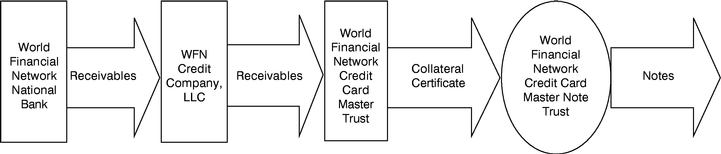
The notes are secured by a beneficial interest in a pool of receivables that arise under World Financial Network National Bank's private label revolving credit card accounts.
The bank has designated all eligible accounts from a number of merchant programs in its portfolio of private label credit card accounts and has transferred the receivables in those accounts either directly to World Financial Network Credit Card Master Trust or to us. We have, in turn, transferred the receivables sold to us by the bank to World Financial Network Credit Card Master Trust. We refer to the accounts that have been designated as trust accounts as the trust portfolio. World Financial Network Credit Card Master Trust has issued a collateral certificate representing an interest in the receivables and the other assets of World Financial Network Credit Card Master Trust to us. We have transferred that collateral certificate to the issuer and that collateral certificate serves as collateral for the notes.
The following information regarding the trust portfolio is as of June 30, 2004:
- •
- total
receivables: $2,889,223,672
- •
- principal
receivables: $2,808,454,712
- •
- finance
charge receivables: $80,768,960
- •
- total accounts designated to World Financial Network Credit Card Master Trust: 81,548,650.
Each class of notes also has the benefit of an interest rate swap covering the period from the date of issuance of the related notes through the final maturity date.
World Financial Network Credit Card Master Trust
World Financial Network Credit Card Master Trust is a common law trust formed by the bank in 1996 under a pooling and servicing agreement that has been amended and may in the future be amended from time to time. The August 2001 amendment, among other things, designated us as transferor in replacement of World Financial Network National Bank. The bank has transferred some of the private label credit card receivables directly to World Financial Network Credit Card Master Trust under the pooling and servicing agreement prior to its amendment, and we have transferred the receivables sold to us by the bank under a receivables purchase agreement to World Financial Network Credit Card Master Trust under that pooling and servicing agreement.
S-3
The trustee for World Financial Network Credit Card Master Trust is BNY Midwest Trust Company, successor to the corporate trust administration of Harris Trust and Savings Bank, successor to The Bank of New York.
At any time when no series of investor certificates issued by World Financial Network Credit Card Master Trust is outstanding, other than the collateral certificate held by the issuer, we may cause World Financial Network Credit Card Master Trust to terminate, at which time the receivables will be transferred to the issuer and held directly by the issuer as collateral for the notes.
We refer to the entity — either World Financial Network Credit Card Master Trust or the issuer — that holds the receivables at any given time as the trust.
Other Claims on the Receivables
Other Series of Notes
In addition to Series 2004-C, there are five other series of notes outstanding, four of which are expected to remain outstanding on the closing date. The issuer also expects to issue an additional series of notes, Series 2004-B, on the closing date. A summary of the outstanding series of notes is in Part A of "Annex I: Other Securities Issued and Outstanding" included at the end of this prospectus supplement. The issuer may issue other series of notes from time to time in the future. Neither you nor any other noteholder will have the right to consent to the issuance of future series of notes.
Outstanding Series of Investor Certificates
In addition to the collateral certificate, there is currently one series of investor certificates issued by World Financial Network Credit Card Master Trust, which is expected to be retired on the closing date. Each series of investor certificates represents a beneficial interest in the receivables and the other trust assets. A summary of the outstanding series of investor certificates is in Part B of "Annex I: Other Securities Issued and Outstanding" included at the end of this prospectus supplement. Neither you nor any other noteholder will have the right to consent to the issuance of future series of investor certificates.
The Transferor Interest
We own the interest, called the transferor interest, in the receivables and the other assets of the trust not supporting your series or any other series of notes or investor certificates. The transferor interest does not provide credit enhancement for your series or any other series.
Allocations of Collections and Losses
Your notes represent the right to payments from a portion of the collections on the receivables. The servicer will also allocate to your series a portion of defaulted receivables and would also allocate a portion of the dilution on the receivables to your series if the dilution is not offset by the amount of the transferor interest and the transferor fails to comply with its obligation to compensate the trust for the dilution. Dilution means any reduction to the principal balances of receivables made by the servicer because of merchandise returns or any other reason except losses or payments.
The portion of collections, defaulted receivables and uncovered dilution allocated to your series will be based mainly upon the ratio of the amount of collateral for your series to the sum of the total amount of principal receivables in the trust. The way this ratio is calculated will vary during each of three periods that may apply to your notes:
- •
- The
revolving period, which will begin on the closing date and will end when either of the other two periods begins.
- •
- The controlled accumulation period, which is scheduled to begin on September 1, 2010, but which may begin later, and end when the notes have been paid in full. However, if an early amortization event occurs before the controlled accumulation period begins, there will be no controlled accumulation period and an early amortization period will begin. If an early amortization event occurs during the controlled accumulation period, the controlled accumulation period will end,
S-4
- •
- The early amortization period, which will only occur if one or more adverse events, known as early amortization events, occurs.
and an early amortization period will begin.
For most purposes, the collateral amount used in determining these ratios will be reset no less frequently than at the end of each month. However, for allocations of principal collections during the controlled accumulation period or the early amortization period, the collateral amount at the end of the revolving period will be used, unless we request a decrease, and the rating agencies confirm that the decrease will not impair their ratings of your notes.
The collateral amount for your series is:
- •
- the
original principal amount of the Series 2004-C notes, minus
- •
- principal
payments on the Series 2004-C notes (other than principal payments made from funds on deposit in the spread account maintained for the benefit
of the Class C notes) and the balance held in the principal accumulation account for principal payments, minus
- •
- the
amount of any principal collections reallocated to cover interest, net swap payments and servicing payments for your series, minus
- •
- your series' share of defaults and uncovered dilution to the extent not reimbursed from finance charge collections, investment earnings allocated to your series and amounts on deposit in the cash collateral account.
A reduction to the collateral amount because of reallocated principal collections, defaults or uncovered dilution will be reversed to the extent that your series has available finance charge collections and investment earnings in future periods.
Application of Finance Charge Collections
The issuer will apply your series' share of collections of finance charge receivables, net swap receipts, recoveries and investment earnings each month in the following order of priority:
- •
- to
pay interest on the Class A notes and to make net swap payments under the interest rate swap for the Class A notes;
- •
- to
pay interest on the Class M notes and to make net swap payments under the interest rate swap for the Class M notes;
- •
- to
pay interest on the Class B notes and to make net swap payments under the interest rate swap for the Class B notes;
- •
- to
pay the servicing fee for your series (to the extent not retained by the servicer during the month);
- •
- to
pay interest on the Class C notes and to make net swap payments under the interest rate swap for the Class C notes;
- •
- to
cover your series' share of defaults and uncovered dilution;
- •
- to
cover reductions in your series' collateral amount resulting from defaults and uncovered dilution allocated to your series and from reallocated principal collections, in
each case that have not been reimbursed;
- •
- to
make a deposit, if needed, to the cash collateral account up to the required cash collateral amount;
- •
- to
fund, in limited circumstances, a reserve account to cover interest payment shortfalls for the Series 2004-C notes during the controlled accumulation
period;
- •
- to
make a deposit, if needed, to the spread account up to the required spread account amount;
- •
- to
make various payments or deposits relating to the interest rate swaps for each of the Class A, Class M, Class B and Class C notes;
- •
- to
make any other payments required to be made from your series' share of collections of finance charge receivables from time to time; and
- •
- to other series that share excess finance charge collections with Series 2004-C or to us or our assigns.
S-5
Application of Principal Collections
The issuer will apply your series' share of collections of principal receivables each month as follows:
Revolving Period
During the revolving period, no principal will be paid or accumulated in a trust account for you.
Controlled Accumulation Period
During the controlled accumulation period, your series' share of principal collections will be deposited in a trust account, up to a specified deposit amount on each distribution date. Unless an early amortization event occurs, amounts on deposit in that account will be paid on the expected principal payment date, first to the Class A noteholders until the Class A notes are paid in full, second to the Class M noteholders until the Class M notes are paid in full, third to the Class B noteholders until the Class B notes are paid in full and fourth to the Class C noteholders until the Class C notes are paid in full.
Early Amortization Period
An early amortization period for your series will start if an early amortization event occurs. The early amortization events for your series are described below in this summary and under "Description of Series Provisions — Early Amortization Events" in this prospectus supplement. During the early amortization period, your series' share of principal collections will be paid monthly, first to the Class A noteholders, second to the Class M noteholders, third to the Class B noteholders and fourth to the Class C noteholders, in each case until the specified class of notes is paid in full.
Reallocation of Principal Collections
During any of the above periods, principal collections allocated to your series may be reallocated, if necessary, to make required payments of interest on the Class A notes, the Class M notes and the Class B notes, net swap payments due from the issuer and monthly servicing fee payments not made from your series' share of finance charge collections, other amounts treated as finance charge collections and excess finance charge collections available from other series that share with your series. This reallocation is one of the ways that the more senior classes of notes obtain the benefit of subordination, as described under the caption " — Credit Enhancement" below. The amount of reallocated principal collections is limited by the amount of available subordination.
Extra Principal Collections
At all times, collections of principal receivables allocated to your series that are not needed for payments on your series will first, be made available to other series, second, deposited in the excess funding account, if needed, and third, paid to us or our assigns.
Credit Enhancement
Credit enhancement for your series includes subordination and a cash collateral account as described below. A spread account also provides credit enhancement primarily for the benefit of the Class C notes.
Credit enhancement for your series is for your series' benefit only, and you are not entitled to the benefits of credit enhancement available to other series.
Subordination
Credit enhancement for the Class A notes includes the subordination of the Class M notes, the Class B notes and the Class C notes. Credit enhancement for the Class M notes includes the subordination of the Class B notes and the Class C notes. Credit enhancement for the Class B notes includes the subordination of the Class C notes. Subordination serves as credit enhancement in the following way. The more subordinated, or junior, classes of notes will not receive payment of interest or principal until required payments have been made to the more senior classes. As a result, subordinated classes will absorb any shortfalls in collections or deterioration in the collateral for the notes prior to senior classes.
S-6
Cash Collateral Account
A cash collateral account will provide additional credit enhancement for your series. On the closing date, the balance on deposit in the cash collateral account will represent 3.5% of the collateral amount on the closing date. Deposits into the cash collateral account will be made each month, as needed, from finance charge collections allocated to your series, other amounts treated as finance charge collections and excess finance charge collections available from other series up to the required cash collateral account amount as described under "Description of Series Provisions — Cash Collateral Account."
The cash collateral account will be used to make payments on the notes if finance charge collections allocated to this series, other amounts treated as finance charge collections and excess finance charge collections available from other series are insufficient to make required payments.
Interest Rate Swaps
As additional enhancement for the Class A, Class M, Class B and Class C notes, the issuer will enter into an interest rate swap for the Class A notes, an interest rate swap for the Class M notes, an interest rate swap for the Class B notes and an interest rate swap for the Class C notes, each covering the period from the closing date through the final maturity date.
The notional amounts of each of the Class A, Class M, Class B and Class C interest rate swaps will, for each interest period, equal the outstanding principal balance of the corresponding class of notes, in each case as of the end of the first day of the related interest period. Under each swap, if one-month LIBOR exceeds a specified fixed rate, the issuer will receive payments from the swap counterparty equal to:
| rate differential |
x | Class A, M, B or C principal balance, as applicable |
x | days in interest period 360 |
where the rate differential equals one-month LIBOR minus the specified fixed rate. Alternatively, if one-month LIBOR is less than the applicable specified fixed rate, the issuer will be required to make a payment to the swap counterparty equal to the result of the equation shown above, where the rate differential equals the specified fixed rate minus one-month LIBOR. The specified fixed rate for each interest period for the Class A, Class M, Class B and Class C notes will be determined by reference to a schedule attached to the confirmation for each such interest rate swap.
The interest rate swaps, including the schedule of fixed rates for each swap, are more fully described in "Description of Series Provisions — Interest Rate Swaps."
For a discussion of certain risks arising from a default by a swap counterparty under the Class A, Class M, Class B or Class C interest rate swap or from the early termination of any of the interest rate swaps, see "Risk Factors — Default by a swap counterparty or termination of the Class A, Class M, Class B or Class C interest rate swap could reduce or delay payments and may cause commencement of an early amortization period or a reduction in the ratings of the notes" and "Description of Series Provisions — Interest Rate Swaps" and " — Early Amortization Events."
Early Amortization Events
The issuer will begin to repay the principal of the notes before the expected principal payment date if an early amortization event occurs. An early amortization event will occur if the finance charge collections on the receivables are too low or if defaults are too high. The minimum amount that must be available for payments to your series in any month, referred to as the base rate, is the sum of the interest payable on the Series 2004-C notes and any net swap payment due from the issuer for the related interest period, plus your series' share of the servicing fee for the related calendar month all divided by the sum of the collateral amount plus amounts on deposit in the principal accumulation account, each as of the last day of that period. If the average net yield for the trust portfolio, after deducting defaulted receivables net of recoveries and your series share of uncovered dilution and adding net swap receipts, for any three consecutive calendar months is less than the average base rate for the
S-7
same three consecutive calendar months, an early amortization event will occur.
The other early amortization events are:
- •
- Our
failure to make required payments or deposits or material failure to perform other obligations, subject to applicable grace periods;
- •
- Material
inaccuracies in our representations and warranties, subject to applicable grace periods;
- •
- The
Series 2004-C notes are not paid in full on the expected principal payment date;
- •
- Bankruptcy,
insolvency or similar events relating to us or the bank;
- •
- We
are unable to transfer additional receivables to the trust or the bank is unable to transfer additional receivables to us;
- •
- We
do not transfer receivables in additional accounts or participations to the trust when required;
- •
- Material
defaults of the servicer;
- •
- Failure
of a swap counterparty to make a payment under any of the interest rate swaps for the Class A, Class M, Class B or Class C notes where
such payment obligation arises as a result of LIBOR being greater than the specified fixed rate for such interest rate swap, and such failure is not cured within five business days after the payment
is due;
- •
- The
early termination of any of the interest rate swaps for the Class A, Class M, Class B or Class C notes, unless the issuer obtains a
replacement interest rate swap acceptable to the rating agencies within five business days of the termination;
- •
- World
Financial Network Credit Card Master Trust or the issuer becomes subject to regulation as an "investment company" under the Investment Company Act of 1940; or
- •
- An event of default occurs for the Series 2004-C notes, and their maturity date is accelerated.
Events of Default
The Series 2004-C notes are subject to events of default described under "The Indenture — Events of Default; Rights upon Event of Default" in the accompanying prospectus. These include, among other things, the failure to pay interest for 35 days after it is due or to pay principal when it is due on the final maturity date.
In the case of an event of default involving bankruptcy, insolvency or similar events relating to the issuer, the principal amount of the Series 2004-C notes automatically will become immediately due and payable. If any other event of default occurs and continues with respect to the Series 2004-C notes, the indenture trustee or holders of more than 50% of the then-outstanding principal balance of the Series 2004-C notes may declare the principal amount of the Series 2004-C notes to be immediately due and payable. These declarations may be rescinded by holders of more than 50% of the then-outstanding principal balance of the Series 2004-C notes if the related event of default has been cured, subject to the conditions described under "The Indenture — Events of Default; Rights upon Event of Default" in the accompanying prospectus.
After an event of default and the acceleration of the Series 2004-C notes, funds allocated to Series 2004-C and on deposit in the collection account, the excess funding account and the other trust accounts will be applied to pay principal of and interest on the Series 2004-C notes to the extent permitted by law. Principal collections and finance charge collections allocated to Series 2004-C will be applied to make monthly principal and interest payments on the Series 2004-C notes until the earlier of the date those notes are paid in full or the final maturity date of those notes. If the Series 2004-C notes are accelerated or the issuer fails to pay the principal of the Series 2004-C notes on the final maturity date, subject to the conditions described in the accompanying prospectus under "The Indenture — Events of
S-8
Default; Rights upon Event of Default," the indenture trustee may, if legally permitted, cause the trust to sell principal receivables in an amount equal to the collateral amount for Series 2004-C and the related finance charge receivables.
Optional Redemption
The servicer has the option to purchase your notes when the outstanding principal amount for your series has been reduced to 5% or less of the initial principal amount. See "Description of the Notes — Final Payment of Principal" in the accompanying prospectus.
Tax Status
Subject to important considerations described under "Federal Income Tax Consequences" in the accompanying prospectus, Mayer, Brown, Rowe & Maw LLP as tax counsel to the issuer, is of the opinion that under existing law the Class A, Class M and Class B notes will be characterized as debt for federal income tax purposes and that neither World Financial Network Credit Card Master Trust nor the issuer will be classified as an association or constitute a publicly traded partnership taxable as a corporation for U.S. federal income tax purposes. By your acceptance of a Series 2004-C note, you will agree to treat your Series 2004-C notes as debt for federal, state and local income and franchise tax purposes. See "Federal Income Tax Consequences" in the accompanying prospectus for additional information concerning the application of federal income tax laws.
ERISA Considerations
Subject to important considerations described under "ERISA Considerations" in the accompanying prospectus, the Class A, Class M and Class B notes are eligible for purchase by persons investing assets of employee benefit plans or individual retirement accounts. If you are contemplating purchasing the Series 2004-C notes on behalf of or with plan assets of any plan or account, we suggest that you consult with counsel regarding whether the purchase or holding of the Series 2004-C notes could give rise to a transaction prohibited or not otherwise permissible under the Employee Retirement Income Security Act of 1974, as amended or Section 4975 of the Internal Revenue Code. Each purchaser that purchases a Series 2004-C note on behalf of or with plan assets of a plan or account will be deemed to represent and warrant that its purchase and holding of such note will not constitute a non-exempt prohibited transaction under ERISA or the Code. See "ERISA Considerations" in the accompanying prospectus.
Risk Factors
There are material risks associated with an investment in the Series 2004-C notes, and you should consider the matters set forth under "Risk Factors" beginning on page S-10 below and on page 3 of the accompanying prospectus.
Ratings
It is a condition to the issuance of your notes that one of the ratings set forth under the caption "Offered Notes" above be obtained for each of the Class A, Class M and Class B notes.
Any rating assigned to the notes by a credit rating agency will reflect the rating agency's assessment solely of the likelihood that noteholders will receive the payments of interest and principal required to be made under the terms of the series and will be based primarily on the value of the receivables in the trust, the credit enhancement provided and the creditworthiness of the swap counterparty. The rating is not a recommendation to purchase, hold or sell any notes. The rating does not constitute a comment as to the marketability of any notes, any market price or suitability for a particular investor. Any rating can be changed or withdrawn by a rating agency at any time.
WFN Credit Company, LLC
Our address is 220 West Schrock Road, Westerville, Ohio 43801. Our phone number is (614) 729-5044.
S-9
This prospectus supplement uses defined terms. You can find a glossary of terms under the caption "Glossary of Terms for Prospectus Supplement" beginning on page S-38 in this prospectus supplement and under the caption "Glossary of Terms for Prospectus" beginning on page 75 in the accompanying prospectus.
In addition to the risk factors described in the accompanying prospectus, you should consider the following risk factors before deciding whether to purchase the Series 2004-C notes.
Default by a swap counterparty or termination of the Class A, Class M, Class B or Class C interest rate swap could reduce or delay payments and may cause commencement of an early amortization period or a reduction in the ratings of the notes.
The interest rate swaps expose you to risks arising from the failure of either a swap counterparty or the issuer to perform its obligations thereunder or from the early termination of an interest rate swap. If a swap counterparty does not make a required payment due under the interest rate swap, the issuer will have less funds available to make interest payments on the notes. Continuance of such failure for five business days will cause the early amortization period to commence. If either a swap counterparty or the issuer does not make a payment due under an interest rate swap, the other party may initiate an early termination of the interest rate swap. If the ratings of a swap counterparty are reduced below certain levels established by either Standard & Poor's or Moody's, that swap counterparty will be required to assign its rights and obligations under the applicable interest rate swap to a replacement swap counterparty, post collateral or make other arrangements satisfactory to the rating agencies within certain grace periods. The interest rate swaps may be terminated if that swap counterparty fails to do so. If an interest rate swap is terminated or a swap counterparty fails to perform its obligations (whether following a ratings downgrade or otherwise) under the interest rate swap, we cannot assure you that the issuer would be able to enter into a replacement interest rate swap or make other arrangements to hedge the issuer's interest payment obligations. The early termination of an interest rate swap will cause an early amortization event and commencement of the early amortization period if the trust does not enter into a replacement interest rate swap or enter into an alternative arrangement satisfactory to the rating agencies.
If the early amortization period commences as a result of any of the foregoing, you could be paid sooner than expected and may not be able to reinvest the amount paid to you at the same rate you would have been able to earn on your notes. If the affected interest rate swap is not terminated following the swap counterparty's failure to perform, the issuer may have less funds available to pay interest on the notes. In addition, the ratings of the notes may be reduced, which could affect your ability to sell your notes. See "Description of Series Provisions — Interest Rate Swaps" and "— Early Amortization Events."
It may not be possible to find an investor to purchase your notes.
The underwriters may assist in resales of the offered notes but they are not required to do so. A secondary market for any notes may not develop. If a secondary market does develop, it might not continue or it might not be sufficiently liquid to allow you to resell any of your notes.
S-10
The tables below contain performance information for the receivables in the trust portfolio of private label credit cards for each of the periods shown. The composition of the trust portfolio is expected to change over time. The future performance of the receivables in the trust portfolio may be different from the historical performance set forth below.
On April 7, 2004, we designated 4,662,058 accounts to the trust. The information for the six month period ended June 30, 2004 in the Loss Experience and Revenue Experience tables below is presented both on an actual basis and on a pro forma basis, as if the accounts designated on April 7, 2004 had been designated to the trust on January 1, 2004, except that a small number of those accounts designated to the trust on April 7, 2004 were not acquired by the bank until March 5, 2004 and are therefore included on a pro forma basis as if those accounts were designated to the trust on March 5, 2004.
All data set forth in the tables below is reported on a collected basis, except that data for some acquired portfolios is reported on a billed basis for the period before the bank acquired them. Average receivables outstanding is the average of the receivables balances at the beginning of each month in the period indicated. Fees include late fees and return check fees that are, under the terms of the pooling agreement, allocated to the trust.
Delinquency and Loss Experience
The following tables set forth the aggregate delinquency and loss experience for cardholder payments on the credit card accounts in the trust portfolio for each of the dates or periods shown.
We cannot assure you that the future delinquency and loss experience for the receivables will be similar to the historical experience set forth below.
Delinquency Experience
Trust Portfolio
(Dollars in Thousands)
| |
June 30, 2004 |
||||||
|---|---|---|---|---|---|---|---|
| |
Receivables |
Percentage of Total Receivables |
|||||
| Receivables Outstanding | $ | 2,808,455 | 100.00 | % | |||
| Receivables Delinquent: | |||||||
| 31-60 Days | 49,104 | 1.75 | % | ||||
| 61-90 Days | 31,376 | 1.12 | % | ||||
| 91 or More Days | 57,580 | 2.05 | % | ||||
| Total | $ | 138,060 | 4.92 | % | |||
| |
December 31, |
||||||||||||||||||||||||||
|---|---|---|---|---|---|---|---|---|---|---|---|---|---|---|---|---|---|---|---|---|---|---|---|---|---|---|---|
| |
2003 |
2002 |
2001 |
2000 |
1999 |
||||||||||||||||||||||
| |
Receivables |
Percentage of Total Receivables |
Receivables |
Percentage of Total Receivables |
Receivables |
Percentage of Total Receivables |
Receivables |
Percentage of Total Receivables |
Receivables |
Percentage of Total Receivables |
|||||||||||||||||
| Receivables Outstanding | $ | 2,543,851 | 100.00 | % | $ | 2,492,387 | 100.00 | % | $ | 2,275,302 | 100.00 | % | $ | 2,273,320 | 100.00 | % | $ | 2,135,009 | 100.00 | % | |||||||
| Receivables Delinquent: | |||||||||||||||||||||||||||
| 31-60 Days | 46,930 | 1.84 | % | 48,864 | 1.96 | % | 56,097 | 2.47 | % | 59,729 | 2.63 | % | 53,650 | 2.51 | % | ||||||||||||
| 61-90 Days | 28,741 | 1.13 | % | 30,291 | 1.22 | % | 32,355 | 1.42 | % | 34,622 | 1.52 | % | 31,569 | 1.48 | % | ||||||||||||
| 91 or More Days | 56,013 | 2.20 | % | 58,662 | 2.35 | % | 60,564 | 2.66 | % | 61,274 | 2.70 | % | 52,247 | 2.45 | % | ||||||||||||
| Total | $ | 131,684 | 5.18 | % | $ | 137,817 | 5.53 | % | $ | 149,016 | 6.55 | % | $ | 155,625 | 6.85 | % | $ | 137,466 | 6.44 | % | |||||||
S-11
Loss Experience
Trust Portfolio
(Dollars in Thousands)
| |
Pro Forma Six Calendar Months Ended June 30, 2004 |
|
|
|
|
|
|
||||||||||||||
|---|---|---|---|---|---|---|---|---|---|---|---|---|---|---|---|---|---|---|---|---|---|
| |
Six Calendar Months Ended June 30, 2004 |
|
|
|
|
|
|||||||||||||||
| |
Fiscal Year |
||||||||||||||||||||
| |
2003 |
2002 |
2001 |
2000 |
1999 |
||||||||||||||||
| Average Receivables Outstanding | $ | 2,831,977 | $ | 2,521,605 | $ | 2,291,066 | $ | 2,161,860 | $ | 2,076,061 | $ | 2,022,198 | $ | 1,850,995 | |||||||
| Gross Charge-Offs | 132,486 | 120,967 | 221,781 | 217,128 | 211,470 | 175,906 | 148,873 | ||||||||||||||
| Recoveries | 31,118 | 29,860 | 51,600 | 51,721 | 33,560 | 29,026 | 27,534 | ||||||||||||||
| Net Charge-Offs | 101,368 | 91,107 | 170,181 | 165,407 | 177,910 | 146,880 | 121,339 | ||||||||||||||
| Net Charge-Offs as a percentage of Average Receivables Outstanding (annualized) | 7.16% | 7.23% | 7.43% | 7.65% | 8.57% | 7.26% | 6.56% | ||||||||||||||
Revenue Experience
The gross revenues from finance charges and fees related to accounts in the trust portfolio for each of the periods shown are set forth in the following table. The figures reflected in the following table represent balances before deductions for charge-offs, returned merchandise, and customer disputes or other expenses and reductions due to fraud.
Revenue Experience
Trust Portfolio
(Dollars in Thousands)
| |
Pro Forma Six Calendar Months Ended June 30, 2004 |
|
|
|
|
|
|
||||||||||||||
|---|---|---|---|---|---|---|---|---|---|---|---|---|---|---|---|---|---|---|---|---|---|
| |
Six Calendar Months Ended June 30, 2004 |
|
|
|
|
|
|||||||||||||||
| |
Fiscal Year |
||||||||||||||||||||
| |
2003 |
2002 |
2001 |
2000 |
1999 |
||||||||||||||||
| Average Receivables Outstanding | $ | 2,831,977 | $ | 2,521,605 | $ | 2,291,066 | $ | 2,161,860 | $ | 2,076,061 | $ | 2,022,198 | $ | 1,850,995 | |||||||
| Total Finance Charges and Fees | 356,303 | 328,225 | 578,769 | 514,783 | 472,135 | 457,560 | 401,977 | ||||||||||||||
| Total Finance Charges and Fees as a percentage of Average Receivables Outstanding (annualized) | 25.16% | 26.03% | 25.26% | 23.81% | 22.74% | 22.63% | 21.72% | ||||||||||||||
S-12
The receivables to be conveyed to the trust have been or will be generated from transactions made by holders of credit card accounts included in the trust portfolio. Please note that percentages presented in the following tables may not add to 100.00% due to rounding. A description of the bank's credit card business is contained in the accompanying prospectus under the heading "The Bank's Private Label Credit Card Activities — World Financial Network National Bank Credit Cards."
As of the close of business on June 30, 2004:
- •
- The
receivables in the trust portfolio included approximately $2,808,454,712 of principal receivables and $80,768,960 of finance charge receivables.
- •
- The
accounts designated for the trust portfolio had an average principal receivables balance per active account of $287 and an average credit limit of $849.
- •
- The
percentage of the aggregate total receivables balance to the aggregate total credit limit was 4.9%.
- •
- The
average age of the accounts by outstanding receivables balance was approximately 40 months.
- •
- Cardholders whose accounts are designated for the trust portfolio had billing addresses in all 50 states and the District of Columbia except for 0.65% of the aggregate total receivables balance for which cardholders had billing addresses located outside of the United States or the District of Columbia.
The following table sets forth the number of fixed and floating rate credit cards contained in the trust portfolio as of June 30, 2004:
Distribution of Trust Portfolio
by Fixed/Floating APR
(Dollars in Millions; Accounts in Thousands)
| |
Number of Accounts |
Percentage of Number of Accounts |
Principal Receivables Outstanding |
Percentage of Principal Receivables Outstanding |
||||||
|---|---|---|---|---|---|---|---|---|---|---|
| Total Fixed | 76,874.7 | 94.3 | % | $ | 2,623.8 | 93.4 | % | |||
| Total Variable | 4,674.0 | 5.7 | % | $ | 184.7 | 6.6 | % | |||
The following tables summarize the trust portfolio by various criteria as of the end of business on June 30, 2004. Because the future composition of the trust portfolio will change over time, these tables are not indicative of the composition of the trust portfolio at any subsequent time.
S-13
Composition by Retailer Type
Trust Portfolio
| Retailer Type |
Percentage of Principal Receivables Outstanding |
||
|---|---|---|---|
| Softgoods | 77.3 | % | |
| Furniture | 13.4 | % | |
| Jewelry | 2.8 | % | |
| Other | 6.5 | % |
The credit card programs, or group of credit card programs for affiliated companies of Limited Brands, including each of its affiliates as of June 30, 2004, accounted for more than 29% of the receivables in the trust portfolio. The credit card programs, or group of credit card programs for affiliated companies of Brylane, including each of its affiliates as of June 30, 2004, accounted for more than 14% of the receivables in the trust portfolio. As of that date there were 36 other credit card programs included in the trust portfolio.
Composition by Account Balance
Trust Portfolio
| Account Balance Range |
Number of Accounts |
Percentage of Number of Accounts |
Principal Receivables Outstanding |
Percentage of Principal Receivables Outstanding |
|||||||
|---|---|---|---|---|---|---|---|---|---|---|---|
| Credit Balance | 233,454 | 0.29 | % | $ | (9,769,431 | ) | -0.35 | % | |||
| No Balance | 71,494,898 | 87.67 | — | 0.00 | |||||||
| $0.01-$50.00 | 1,792,158 | 2.20 | 50,369,424 | 1.79 | |||||||
| $50.01-$100.00 | 1,774,318 | 2.18 | 131,325,115 | 4.68 | |||||||
| $100.01-$150.00 | 1,243,545 | 1.52 | 154,188,025 | 5.49 | |||||||
| $150.01-$250.00 | 1,591,655 | 1.95 | 312,285,047 | 11.12 | |||||||
| $250.01-$350.00 | 973,123 | 1.19 | 288,537,175 | 10.27 | |||||||
| $350.01-$500.00 | 888,565 | 1.09 | 372,239,382 | 13.26 | |||||||
| $500.01-$1,000.00 | 1,113,601 | 1.36 | 771,039,307 | 27.46 | |||||||
| $1,000.01-$1,500.00 | 266,335 | 0.33 | 319,413,256 | 11.37 | |||||||
| $1,500.01 or more | 176,998 | 0.22 | 418,827,412 | 14.91 | |||||||
| Total | 81,548,650 | 100.00 | % | $ | 2,808,454,712 | 100.00 | % | ||||
S-14
Composition by Credit Limit
Trust Portfolio
| Credit Limit Balance |
Number of Accounts |
Percentage of Number of Accounts |
Principal Receivables Outstanding |
Percentage of Principal Receivables Outstanding |
|||||||
|---|---|---|---|---|---|---|---|---|---|---|---|
| $0 | 6,863,222 | 8.42 | % | $ | 265,384,774 | 9.45 | % | ||||
| $0.01-$100.00 | 2,451,741 | 3.01 | 12,563,442 | 0.45 | |||||||
| $100.01-$250.00 | 5,775,346 | 7.08 | 88,748,708 | 3.16 | |||||||
| $250.01-$350.00 | 4,976,967 | 6.10 | 88,109,643 | 3.14 | |||||||
| $350.01-$500.00 | 14,417,446 | 17.68 | 184,647,899 | 6.57 | |||||||
| $500.01-$750.00 | 13,006,223 | 15.95 | 310,556,312 | 11.06 | |||||||
| $750.01-$1,000.00 | 22,117,222 | 27.12 | 426,197,451 | 15.18 | |||||||
| $1,000.01-$1,250.00 | 3,833,037 | 4.70 | 328,918,344 | 11.71 | |||||||
| $1,250.01-$1,500.00 | 2,721,235 | 3.34 | 258,810,528 | 9.21 | |||||||
| $1,500.01-$2,000.00 | 2,439,626 | 2.99 | 308,870,756 | 11.00 | |||||||
| $2,000.01-$2,500.00 | 1,132,398 | 1.39 | 164,705,100 | 5.86 | |||||||
| $2,500.01 or more | 1,814,187 | 2.22 | 370,941,755 | 13.21 | |||||||
| Total | 81,548,650 | 100.00 | % | $ | 2,808,454,712 | 100.00 | % | ||||
Composition by Account Age
| Age |
Total Number of Accounts |
Percent of Total Number of Accounts |
Principal Receivables Outstanding |
Percent of Total Receivables Outstanding |
|||||||
|---|---|---|---|---|---|---|---|---|---|---|---|
| Not More than 12 Months | 7,234,900 | 8.87 | % | $ | 638,985,065 | 22.75 | % | ||||
| Over 12 Months to 24 Months | 7,760,891 | 9.52 | 406,294,910 | 14.47 | |||||||
| Over 24 Months to 36 Months | 6,906,316 | 8.47 | 335,673,495 | 11.95 | |||||||
| Over 36 Months to 48 Months | 5,938,151 | 7.28 | 263,934,307 | 9.40 | |||||||
| Over 48 Months to 60 Months | 5,734,761 | 7.03 | 225,091,010 | 8.01 | |||||||
| Over 60 Months | 47,973,631 | 58.83 | 938,475,925 | 33.42 | |||||||
| Total | 81,548,650 | 100.00 | % | $ | 2,808,454,712 | 100.00 | % | ||||
S-15
Cardholders whose accounts are designated for the trust portfolio had billing addresses in all 50 states and the District of Columbia except for 0.65% of the aggregate total receivable balance for which cardholders had billing addresses located outside of the United States or the District of Columbia. Except for the seven states listed below, no state accounted for more than 5% of the number of accounts or 5% of the total receivables balances as of June 30, 2004.
Geographic Distribution of Principal Receivables
Trust Portfolio
| State |
Percentage of Number of Accounts |
Percentage of Principal Receivables Outstanding |
|||
|---|---|---|---|---|---|
| Texas | 7.16 | % | 11.29 | % | |
| New York | 8.74 | % | 8.30 | % | |
| California | 9.47 | % | 7.52 | % | |
| Illinois | 5.06 | % | 7.01 | % | |
| Florida | 5.60 | % | 5.98 | % | |
| Ohio | 5.07 | % | 5.40 | % | |
| Pennsylvania | 5.20 | % | 5.16 | % |
Series 2004-C will always be in one of three periods — the revolving period, the controlled accumulation period or the early amortization period. Unless an early amortization event occurs, each class of notes will not receive payments of principal until the expected principal payment date for the Series 2004-C notes. The expected principal payment date for the Series 2004-C notes will be the September 2011 distribution date. We expect the issuer to have sufficient funds to pay the full principal amount of each class of Series 2004-C notes on the expected principal payment date. However, if an early amortization event occurs, principal payments for any class may begin prior to the expected principal payment date.
Controlled Accumulation Period
During the controlled accumulation period, principal allocated to the Series 2004-C noteholders will accumulate in the principal accumulation account in an amount calculated to pay the Series 2004-C notes in full on the expected principal payment date. We expect, but cannot assure you, that the amounts available in the principal accumulation account on the expected principal payment date will be sufficient to pay in full the outstanding principal amount of the notes. If there are not sufficient funds on deposit in the principal accumulation account to pay the notes in full on their expected principal payment date, an early amortization event will occur and the early amortization period will begin.
Early Amortization Period
If an early amortization event occurs during either the revolving period or the controlled accumulation period, the early amortization period will begin. If an early amortization event occurs during the controlled accumulation period, on the next distribution date any amount on deposit in the principal accumulation account will be paid:
- •
- first
to Class A noteholders, up to the outstanding principal balance of the Class A notes;
- •
- second to Class M noteholders, up to the outstanding principal balance of the Class M notes; and
S-16
- •
- third to Class B noteholders, up to the outstanding principal balance of the Class B notes.
In addition, if the outstanding principal balance of the notes has not been paid in full, the issuer will continue to pay principal in the priority noted above to the noteholders on each distribution date during the early amortization period until the Series 2004-C final maturity date, which is the July 2015 distribution date. No principal will be paid on the Class M notes until the Class A notes have been paid in full and no principal will be paid on the Class B notes until the Class A and Class M notes have been paid in full. Except as described under "Description of Series Provisions — Spread Account," no principal will be paid on the Class C notes until the Class A, Class M and Class B notes have been paid in full.
Payment Rates
The payment rate on the receivables is the most important factor that will determine the size of principal payments during the early amortization period and whether the issuer has funds available to repay the Class A, Class M or Class B notes on the expected principal payment date. The following table sets forth the highest and lowest cardholder monthly payment rates on the credit card accounts during any month in the periods shown and the average cardholder monthly payment rates for all months in the periods shown, in each case calculated as a percentage of average total receivables for each month during the periods shown. Payment rates shown in the table are based on amounts that would be deemed payments of principal receivables and finance charge receivables with respect to the accounts.
Although we have provided historical data concerning the payment rates on the receivables, because of the factors described in the accompanying prospectus under "Risk Factors," we cannot provide you with any assurance that the levels and timing of payments on receivables in the trust portfolio from time to time will be similar to the historical experience described in the following table or that deposits into the principal accumulation account or the distribution account, as applicable, will be in accordance with the applicable controlled accumulation amount. The servicer may shorten the controlled accumulation period and, in that event, we cannot provide any assurance that there will be sufficient time to accumulate all amounts necessary to pay the outstanding principal amounts of the Class A, Class M or Class B notes on the expected principal payment date.
On April 7, 2004, we designated 4,662,058 accounts to the trust. The information for the six month period ended June 30, 2004 in the following table is presented both on an actual basis and on a pro forma basis, as if the accounts designated on April 7, 2004 had been designated to the trust on January 1, 2004, except that a small number of those accounts designated to the trust on April 7, 2004 were not acquired by the bank until March 5, 2004 and are therefore included on a pro forma basis as if those accounts were designated to the trust on March 5, 2004.
Cardholder Monthly Payment Rates
Trust Portfolio
| |
Pro Forma Six Calendar Months Ended June 30, 2004 |
|
Fiscal Year |
||||||||||||
|---|---|---|---|---|---|---|---|---|---|---|---|---|---|---|---|
| |
Six Calendar Months Ended June 30, 2004 |
||||||||||||||
| |
2003 |
2002 |
2001 |
2000 |
1999 |
||||||||||
| Lowest Month | 17.03 | % | 17.98 | % | 17.45 | % | 16.55 | % | 15.14 | % | 14.72 | % | 14.89 | % | |
| Highest Month | 19.67 | % | 20.54 | % | 21.12 | % | 19.86 | % | 17.58 | % | 17.33 | % | 18.07 | % | |
| Monthly Average | 18.59 | % | 19.33 | % | 18.58 | % | 18.02 | % | 16.68 | % | 16.26 | % | 16.45 | % | |
S-17
We cannot assure you that the cardholder monthly payment rates in the future will be similar to the historical experience set forth above. In addition, the amount of collections of receivables may vary from month to month due to seasonal variations, general economic conditions and payment habits of individual cardholders.
Reduced Principal Allocations
The issuer may issue another series of notes as a paired series for Series 2004-C. If issued, a paired series may have terms that are different than the terms of Series 2004-C and other series. For example, the early amortization events for the paired series may vary from the early amortization events for Series 2004-C and may include early amortization events that are unrelated to the status of the issuer or the servicer, such as early amortization events related to the continued availability and rating of the providers of credit enhancement for the paired series. If an early amortization event occurs with respect to the paired series prior to the payment in full of the Series 2004-C notes, the allocation percentage used to determine your series' share of principal collections may be reduced, which may delay the final payment of principal for your series. See "Description of Series Provisions — Paired Series" in this prospectus supplement.
Even if there is no paired series, at any time prior to the occurrence of an early amortization event for your series we may request a reduction to the allocation percentage used to determine your series' share of principal collections.
In either case, however, the reduction will only be permitted upon satisfying the following conditions:
- •
- written
notice delivered to the indenture trustee and the servicer;
- •
- each
rating agency confirms that the reduction will not impair its rating of the Series 2004-C notes; and
- •
- we certify that in our reasonable belief, the reduction will not cause an early amortization event with respect to Series 2004-C.
S-18
Description of Series Provisions
We have summarized the material terms of the Series 2004-C notes below and under "Description of the Notes" in the accompanying prospectus.
General
The Class A notes, the Class M notes, the Class B notes and the Class C notes comprise the Series 2004-C notes and will be issued under the indenture, as supplemented by the Series 2004-C indenture supplement, in each case between the issuer and the indenture trustee.
The Series 2004-C notes will be issued in denominations of $1,000 and integral multiples of $1,000 and will be available only in book-entry form, registered in the name of Cede & Co., as nominee of DTC. See "Description of the Notes — General," " — Book-Entry Registration" and " — Definitive Notes" in the accompanying prospectus. Payments of interest and principal will be made on each distribution date on which those amounts are due to the noteholders in whose names the Series 2004-C notes are registered on the related record date, which will be the last day of the calendar month preceding that distribution date.
Collateral Amount
The Series 2004-C notes are secured by collateral consisting of an interest in the receivables. At any time, the amount of the collateral for the Series 2004-C notes, which we call the collateral amount, is calculated as follows:
- •
- the
original principal amount of the notes, less
- •
- all
previous principal payments made on your series (other than principal payments made from funds on deposit in a trust account maintained for the benefit of the
Class C notes) and the balance held in the principal accumulation account for such payments, less
- •
- all unreimbursed reductions to the collateral amount as a result of defaulted receivables or uncovered dilution allocated to your series or reallocations of principal collections to cover interest, net swap payments or the servicing fee for your series.
The collateral amount cannot be less than zero.
Allocation Percentages
The servicer will allocate among your series, other series of notes issued and outstanding, outstanding series of investor certificates issued by World Financial Network Credit Card Master Trust and our unpledged interest in the trust the following items: collections of finance charge receivables and principal receivables; defaulted receivables; and any dilution amounts that are not offset by the amount of our interest in the trust or reimbursed by us. On any day, the allocation percentage for your series will be the percentage equivalent — which may not exceed 100% — of a fraction:
- •
- the numerator of which is: for purposes of allocating finance charge collections and defaulted receivables at all times and principal collections during the revolving period, equal to the collateral amount as measured at the end of the prior calendar month (or, in the case of the month during which the closing date occurs, on the closing date) after taking into account any deposits to be made to the principal accumulation account and any reductions to be made to the collateral amount on account of principal payments on the distribution date for the current calendar month; and for purposes of allocating principal collections during the controlled accumulation period and the early amortization period, equal to the collateral amount as of the end of the revolving period unless the numerator is reduced as described below; and
S-19
- •
- the
denominator of which is the greater of:
- (a)
- the
total amount of principal receivables in the trust measured as of a specified date; and
- (b)
- the sum of the numerators used to calculate the applicable allocation percentages for all series of notes or investor certificates outstanding as of the date of determination.
The denominator referred to above will initially be set as of the closing date. The denominator will be reset for purposes of allocating principal collections, finance charge collections and defaulted receivables at all times as follows:
- •
- at
the end of each calendar month;
- •
- on
each date on which supplemental accounts are added to the trust;
- •
- on
each date on which accounts are removed from the trust in an aggregate amount approximately equal to the collateral amount of any series that has been paid in full;
- •
- on
each date on which there is an increase in the outstanding balance of any variable interest issued by the trust; and
- •
- on each date on which a new series of notes, or a class of notes relating to a multiple issuance series, is issued.
As discussed in "Maturity Considerations — Reduced Principal Allocations" in this prospectus supplement, we may, by written notice delivered to the indenture trustee and the servicer, designate a reduced numerator for allocating principal collections to your series.
Interest Payments
Each interest period will begin on and include a distribution date and end on but exclude the next distribution date. However, the first interest period will begin on and include the closing date.
Each class of notes will accrue interest during each interest period at a rate of LIBOR for that interest period plus an additional percentage per year specified below:
| Class A | 0.20% | |
| Class M | 0.40% | |
| Class B | 0.60% | |
| Class C | not to exceed 1.25% |
For purposes of determining the interest rates applicable to each interest period, LIBOR will be determined two London business days before that interest period begins.
For each date of determination, LIBOR will equal the rate for deposits in United States dollars for a one-month period (or, solely for purposes of determining LIBOR for the first interest period as described in the following paragraph, a two-month period) which appears on the display page currently designated as "Telerate Page 3750" on the Moneyline Telerate Service, or any other page as may replace that page on that service for the purpose of displaying comparable rates or prices as of 11:00 a.m., London time, on that date. If that rate does not appear on that display page, the rate for that date will be determined based on the rates at which deposits in United States dollars are offered by four major banks, selected by the servicer at approximately 11:00 a.m., London time, on that day to prime banks in the London interbank market for a one-month period (or, solely for purposes of determining LIBOR for the first interest period as described in the following paragraph, a two-month period). The indenture trustee or the interest rate swap counterparty will request the principal London office of each of those banks to provide a quotation of its rate. If at least two quotations are provided, the rate for that date will be the arithmetic mean of the quotations. If fewer than two quotations are provided, the rate for that date will be the arithmetic mean of the rates quoted by four major banks in
S-20
New York City, selected by the servicer, at approximately 11:00 a.m., New York City time, on that day for loans in United States dollars to leading European banks for a one-month period.
LIBOR for the first interest period will be determined by straight-line interpolation, based on the actual number of days in the period from the closing date through and including November 14, 2004, between two rates determined in accordance with the preceding paragraph, one of which will be determined for a maturity of one month and one of which will be determined for a maturity of two months.
The interest rates applicable to the then current and immediately preceding interest period may be obtained by telephoning the indenture trustee at its corporate trust office at (312) 827-8500.
Interest on the Class A, Class M and Class B notes will be calculated on the basis of the actual number of days in the related interest period and a year of 360 days.
If the issuer does not pay interest as calculated above to any class when due on a distribution date, the amount not paid will be due on the next distribution date, together with interest on the overdue amount of regular monthly interest at 2% plus the interest rate payable on the notes for the applicable class.
Interest Rate Swaps
To hedge the issuer's interest payment obligations, the issuer will enter into an interest rate swap for each of the Class A, Class M, Class B and Class C notes, each covering the period from the closing date through the final maturity date.
The notional amounts of each of the Class A, Class M, Class B and Class C interest rate swaps for each interest period will be equal to the outstanding principal balance of the corresponding class of notes, in each case as of the end of the first day of the related interest period. Under each swap, if one-month LIBOR exceeds a specified fixed rate, the issuer will receive payments from the swap counterparty equal to:
| rate differential |
x | Class A, M, B or C principal balance, as applicable |
x | days in interest period 360 |
where the rate differential equals one-month LIBOR minus the specified fixed rate. Alternatively, if one-month LIBOR is less than the applicable specified fixed rate, the issuer will be required to make a payment to the swap counterparty equal to the result of the equation shown above, where the rate differential equals the specified fixed rate minus one-month LIBOR.
The specified fixed rate for each interest period for each of the interest rate swaps will be determined by reference to a fixed rate schedule attached to the confirmation for each such interest
S-21
rate swap. The specified fixed rates for the Class A, Class M, Class B and Class C interest rate swaps will be as follows:
| For each interest period in the period |
|
|||
|---|---|---|---|---|
| from and including |
to but excluding |
specified fixed rate |
||
| September 22, 2004 | March 15, 2005 | 6.600% | ||
| March 15, 2005 | March 15, 2006 | 5.859% | ||
| March 15, 2006 | March 15, 2007 | 5.118% | ||
| March 15, 2007 | March 15, 2008 | 4.377% | ||
| March 15, 2008 | March 15, 2009 | 3.636% | ||
| March 15, 2009 | March 15, 2010 | 2.895% | ||
| March 15, 2010 | March 15, 2011 | 2.154% | ||
| March 15, 2011 | September 15, 2011 | 1.413% | ||
| September 15, 2011 | — | 3.996% | ||
Any net amounts received by the issuer under the interest rate swaps will be treated as collections of finance charge receivables. Any net amounts payable by the issuer under the Class A interest rate swap will be paid from finance charge collections at the same priority as interest payable to the Class A noteholders, on a pari passu basis based on the respective amounts of interest and net swap payments, as applicable, owing to the Class A noteholders and the swap counterparty with respect to the Class A interest rate swap. Any net amounts payable by the issuer under the Class M interest rate swap will be paid from finance charge collections at the same priority as interest payable to the Class M noteholders, on a pari passu basis based on the respective amounts of interest and net swap payments, as applicable, owing to the Class M noteholders and the swap counterparty with respect to the Class M interest rate swap. Any net amounts payable by the issuer under the Class B interest rate swap will be paid from finance charge collections at the same priority as interest payable to the Class B noteholders, on a pari passu basis based on the respective amounts of interest and net swap payments, as applicable, owing to the Class B noteholders and the swap counterparty with respect to the Class B interest rate swap. Any net amounts payable by the issuer under the Class C interest rate swap will be paid from finance charge collections at the same priority as interest payable to the Class C noteholders, on a pari passu basis based on the respective amounts of interest and net swap payments, as applicable, owing to the Class C noteholders and the swap counterparty with respect to the Class C interest rate swap. Unlike Class C interest payments, the net swap payments owing to the swap counterparties with respect to the Class C interest rate swap may also be paid from reallocated principal collections, if necessary.
Each of the interest rate swaps may terminate, whether or not the notes have been paid in full prior to such termination, upon:
- •
- the
insolvency, conservatorship or receivership of the swap counterparty;
- •
- the
failure on the part of the issuer or a swap counterparty to make any payment under the related interest rate swap within the applicable grace period, if any;
- •
- illegality
on the part of the issuer or a swap counterparty to be a party to, or perform an obligation under, the related interest rate swap agreement; and
- •
- certain other events specified in the interest rate swap agreements.
The issuer can only enter into and maintain interest rate swaps with counterparties that have debt ratings consistent with the standards of the rating agencies for the notes. If the ratings of a swap counterparty are reduced below certain levels established by either Standard & Poor's or Moody's, that swap counterparty will be required to assign its rights and obligations under the applicable interest rate swap to a replacement swap counterparty, post collateral or make other arrangements satisfactory to the rating agencies within certain grace periods. The failure to replace a terminated interest rate swap
S-22
within five business days, or the failure of a swap counterparty to make a required payment for five business days after a payment is due, will cause an early amortization event and commencement of the early amortization period. See "Risk Factors — Default by a swap counterparty or termination of the Class A, Class M, Class B or Class C interest rate swap could reduce or delay payments and may cause commencement of an early amortization period or a reduction in the ratings of the notes" for a discussion of potential adverse consequences if a swap counterparty defaults on its obligations or is downgraded, or another termination event occurs under an interest rate swap.
Interest Rate Swap Counterparty for Series 2004-C Notes
Barclays Bank PLC is the initial interest rate swap counterparty for the Class A, Class M, Class B and Class C interest rate swap agreements.
Barclays Bank PLC is a public limited company registered in England and Wales under number 1026167. The liability of the members of Barclays Bank PLC is limited. It has its registered and head office at 54 Lombard Street, London EC3P 3AH. Barclays Bank PLC was incorporated on August 7, 1925 under the Colonial Bank Act 1925 and on October 4, 1971 was registered as a company limited by shares under the Companies Act 1948 to 1967. Pursuant to The Barclays Bank Act 1984, on January 1, 1985, Barclays Bank was re-registered as a public limited company and its name was changed from "Barclays Bank International Limited" to "Barclays Bank PLC".
Barclays Bank PLC and its subsidiary undertakings (taken together, the "Group") is an international financial services group engaged primarily in banking, investment banking and asset management. In terms of assets employed, it is one of the largest financial services groups in the United Kingdom. The Group also operates in many other countries around the world and is leading provider of co-ordinated global services to multinational corporations and financial institutions in the world's main financial centers. The whole of the issued ordinary share capital of Barclays Bank PLC is owned by Barclays PLC, which is the ultimate holding company of the Group.
The short term unsecured obligations of Barclays Bank PLC are rated A-1+ by Standard & Poor's, P-1 by Moody's and F1+ by Fitch Ratings Limited and the long term obligations of Barclays Bank PLC are rated Aa1 by Moody's, AA by Standard & Poor's and AA+ by Fitch Ratings Limited.
As of December 31, 2003, the Group had total assets of £443,373 million (December 31, 2002: £403,066 million), total net loans and advances of £288,743 million (December 31, 2002: £260,572 million), total deposits of £278,960 million (December 31, 2002: £258,932 million) and equity shareholders funds of £16,485 million (December 31, 2002: £15,205 million). The profit before taxation of the Group in respect of the year ended December 31, 2003 was £3,845 million (December 31, 2002: £3,203 million) after charging net provisions for bad and doubtful debts of £1,347 million (December 31, 2002: £1,484 million).
The information contained in this section relates to and has been obtained from Barclays Bank PLC for the Class A, Class M, Class B and Class C interest rate swap agreements. The information concerning Barclays Bank PLC contained herein is furnished solely to provide limited introductory information regarding Barclays Bank PLC and does not purport to be comprehensive.
The delivery of this prospectus shall not create any implication that there has been no change in the affairs of Barclays Bank PLC since the date hereof, or that the information contained or referred to in this section is correct as of any time subsequent to its date. We have not made an independent investigation of the information relating to Barclays Bank PLC in this section and do not make any representation as to the accuracy or completeness of such information.
Principal Payments
During the revolving period, no principal payments will be made on your notes. During the controlled accumulation period and the early amortization period, deposits to the principal
S-23
accumulation account and principal payments on the Series 2004-C notes will be made on each distribution date from the following sources:
- (a)
- principal
collections allocated to your series based on your allocation percentage and retained in the collection account during the prior calendar month, less any amounts required to
be reallocated to cover interest payments on the Class A, Class M or Class B notes, net swap payments due from the issuer or servicing fee payments; plus
- (b)
- any
finance charge collections or other amounts required to be treated as principal collections in order to cover the share of defaulted receivables and uncovered dilution amounts
allocated to your series or to reinstate prior reductions to the collateral amount; plus
- (c)
- any principal collections from other series that are shared with your series.
Controlled Accumulation Period
The controlled accumulation period is scheduled to commence on September 1, 2010. However, the servicer may elect to extend the revolving period and postpone the controlled accumulation period, subject to the conditions described under "Description of the Notes — Suspension and Postponement of Controlled Accumulation Period" in the accompanying prospectus. The servicer may elect to postpone the controlled accumulation period only if the number of months needed to fully fund the principal accumulation account to pay the notes on the expected principal payment date is less than 12 months. In no event will the servicer postpone the beginning of the controlled accumulation period to later than August 1, 2011.
The servicer may also elect to suspend the controlled accumulation period, subject to the conditions described under "Description of the Notes — Suspension and Postponement of Controlled Accumulation Period" in the accompanying prospectus.
On each distribution date relating to the controlled accumulation period prior to the expected principal payment date for the notes, the indenture trustee will deposit in the principal accumulation account an amount equal to the least of:
- (1)
- funds
available for this purpose for your series with respect to that distribution date;
- (2)
- $37,500,000
or, if the commencement of the controlled accumulation is postponed, any higher deposit amount as the servicer may determine is necessary to fully fund the principal
accumulation account, plus any amounts required to be deposited to the principal accumulation account on prior distribution dates that have not yet been
deposited;
- (3)
- an
amount equal to the outstanding principal amount of the Series 2004-C notes, minus the amount on deposit in the
principal accumulation account prior to any deposits on that date; and
- (4)
- the collateral amount.
If the early amortization period has not commenced, on the expected principal payment date, amounts in the principal accumulation account will be paid to the Class A noteholders until the Class A notes are paid in full, to the Class M noteholders until the Class M notes are paid in full and any remaining amounts will then be paid to the Class B noteholders until the Class B notes are paid in full.
During the controlled accumulation period, the portion of funds available but not required to be deposited in the principal accumulation account on a distribution date will be made available to investors in other series as shared principal collections.
S-24
Early Amortization Period
On each distribution date relating to the early amortization period, the Class A noteholders will be entitled to receive funds available for principal payments for Series 2004-C for the related calendar month in an amount up to the outstanding principal balance of the Class A notes.
After payment in full of the outstanding principal balance of the Class A notes, the Class M noteholders will be entitled to receive, on each distribution date relating to the early amortization period, the remaining available funds for Series 2004-C for the related calendar month, in an amount up to the outstanding principal balance of the Class M notes.
After payment in full of the outstanding principal balance of the Class A notes and the Class M notes, the Class B noteholders will be entitled to receive, on each distribution date relating to the early amortization period, the remaining available funds for Series 2004-C for the related calendar month in an amount up to the outstanding principal balance of the Class B notes.
See "— Early Amortization Events" below for a discussion of events that might lead to the commencement of the early amortization period.
Subordination
The Class M notes are subordinated to the Class A notes. The Class B notes are subordinated to the Class A notes and the Class M notes. The Class C notes are subordinated to the Class A notes, the Class M notes and the Class B notes. Interest payments will be made on the Class A notes prior to being made on the Class M notes, the Class B notes and the Class C notes. Interest payments will be made on the Class M notes prior to being made on the Class B notes and the Class C notes. Interest payments will be made on the Class B notes prior to being made on the Class C notes.
Principal payments on the Class M notes will not begin until the Class A notes have been paid in full. Principal payments on the Class B notes will not begin until the Class A notes and the Class M notes have been paid in full. Except as described under "Description of Series Provisions — Spread Account," principal payments on the Class C notes will not begin until the Class A notes, the Class M notes and the Class B notes have been paid in full.
The collateral amount for your series will be reduced as the collateral is applied for the benefit of your series, for instance as principal payments are made on your series (other than principal payments made from funds on deposit in the spread account maintained for the benefit of the Class C notes). In addition, the collateral amount can be applied for the benefit of your series in two other ways:
- •
- by
reallocating principal collections to make Class A, Class M and Class B interest payments and to pay net swap payments due from the issuer and the
servicing fee for your series, when finance charge collections are not sufficient to make these payments; and
- •
- to absorb your series' share of defaulted receivables and any uncovered dilution amounts, when finance charge collections are not sufficient to cover these amounts.
If the total amount of these latter two types of reductions exceeds the principal amount of the Class C notes, then the Class B notes may not be repaid in full. If the total exceeds the sum of principal amounts of Class B and Class C notes, then the Class M notes may not be repaid in full. If the total exceeds the sum of principal amounts of the Class C, Class B and Class M notes, then the Class A notes may not be repaid in full.
If receivables are sold after an event of default, the net proceeds of that sale would be paid first to the Class A notes, second to the Class M notes, third to the Class B notes and finally to the Class C notes, in each case until the outstanding principal amount of the specified class and all accrued and unpaid interest payable to that class have been paid in full.
S-25
Application of Finance Charge Collections
We refer to your series' share of finance charge collections, including net investment proceeds transferred from the principal accumulation account, net swap receipts, amounts withdrawn from the reserve account and any available excess finance charge collections from other series, collectively, as finance charge collections. On each distribution date, the servicer will direct the indenture trustee to apply your series' share of finance charge collections for the prior month in the following order:
- (1)
- to
pay, on a pari passu basis based on the amounts owing under this clause (1) to the Class A noteholders and the swap counterparty with respect to the
Class A notes, interest on the Class A notes, including any overdue interest and additional interest on the overdue interest, and any net swap payments due from the issuer under the
Class A interest rate swap;
- (2)
- to
pay, on a pari passu basis based on the amounts owing under this clause (2) to the Class M noteholders and the swap counterparty with respect to the
Class M notes, interest on the Class M notes, including any overdue interest and additional interest on the overdue interest, and any net swap payments due from the issuer under the
Class M interest rate swap;
- (3)
- to
pay, on a pari passu basis based on the amounts owing under this clause (3) to the Class B noteholders and the swap counterparty with respect to the
Class B notes, interest on the Class B notes, including any overdue interest and additional interest on the overdue interest, and any net swap payments due from the issuer under the
Class B interest rate swap;
- (4)
- to
pay the servicing fee for your series for the prior calendar month and any overdue servicing fee (to the extent not retained by the servicer during the month);
- (5)
- to
pay, on a pari passu basis based on the amounts owing under this clause (5) to the Class C noteholders and the swap counterparty with respect to the
Class C notes, interest on the Class C notes, including any overdue interest and additional interest on the overdue interest and any net swap payments due from the issuer under the
Class C interest rate swap;
- (6)
- an
amount equal to your series' share of the defaulted receivables and uncovered dilution, if any, for the related calendar month, will be treated as principal
collections for the prior calendar month;
- (7)
- an
amount equal to any previously unreimbursed reductions to the collateral amount on account of defaulted receivables, uncovered dilution or reallocations of principal
collections will be treated as principal collections for the prior calendar month;
- (8)
- an
amount equal to the excess, if any, of the required cash collateral amount over the amount then on deposit in the cash collateral account will be deposited into the
cash collateral account;
- (9)
- on
and after the reserve account funding date, an amount equal to the excess, if any, of the required reserve account amount over the amount then on deposit in the
reserve account will be deposited into the reserve account;
- (10)
- an
amount equal to the excess, if any, of the required spread account amount over the amount then on deposit in the spread account will be deposited into the spread
account;
- (11)
- to
make, on a pari passu basis based on the amounts owing to each swap counterparty with respect to the Series 2004-C notes, various payments and
deposits relating to the interest rate swaps for the Class A, Class M, Class B and Class C notes;
- (12)
- to
make any other payments required to be made from your series' share of collections of finance charge receivables from time to time; and
- (13)
- all remaining amounts will constitute excess finance charge collections and will be available to cover any shortfalls in finance charge collections for other outstanding series in group one and the remaining amount will be paid to us or our assigns.
S-26
Reallocation of Principal Collections
If your series' share of finance charge collections plus any draw made on the cash collateral account are not sufficient to pay the aggregate amount of interest on the Class A, Class M and Class B notes, net swap payments due from the issuer and the servicing fee for your series, then principal collections will be reallocated to cover these amounts. Any reallocation of principal collections is a use of the collateral for your notes. Consequently, these uses will reduce the remaining collateral amount by a corresponding amount. The amount of principal collections that will be reallocated on any distribution date will not exceed:
- •
- the
lower of:
- •
- the
excess of the amounts needed to pay current, overdue and additional interest on the Class A notes and any net payments due from the issuer under the interest rate
swap for the Class A notes over the amount of finance charge collections allocated to your series and amounts withdrawn from the cash collateral
account that are available to cover these amounts;
- •
- and
the greater of (1)(a) 21.00% of the initial collateral amount minus (b) the sum of (i) the amount of
unreimbursed investor charge-offs after giving effect to investor charge-offs for the related calendar month and (ii) the amount of unreimbursed reallocated principal
collections as of the previous distribution date and (2) zero; plus
- •
- the
lower of:
- •
- the
excess of the sum of the amounts needed to pay current, overdue and additional interest on the Class M notes and any net payments due from the issuer under the
interest rate swap for the Class M notes over the amount of finance charge collections allocated to your series and amounts withdrawn from the
cash collateral account that are available to cover these amounts;
- •
- and
the greater of (1)(a) 17.25% of the initial collateral amount minus (b) the sum of (i) the amount of
unreimbursed investor charge-offs after giving effect to investor charge-offs for the related calendar month and (ii) the amount of unreimbursed reallocated principal
collections as of the previous distribution date and after giving effect to the reallocation of principal collections to make required interest payments for the Class A notes and any net
payments due under the interest rate swap for the Class A notes on the then-current distribution date and (2) zero; plus
- •
- the
lower of:
- •
- the
excess of the sum of the amounts needed to pay current, overdue and additional interest on the Class B notes, and any net payments due from the issuer under the
interest rate swaps for the Class B or Class C notes and the current and past due servicing fee for your series over the amount of finance
charge collections allocated to your series and amounts withdrawn from the cash collateral account and from the spread account that are available to cover these amounts;
- •
- and the greater of (1)(a) 12.50% of the initial collateral amount minus (b) the sum of (i) the amount of unreimbursed investor charge-offs after giving effect to investor charge-offs for the related calendar month and (ii) the amount of unreimbursed reallocated principal collections as of the previous distribution date and after giving effect to the reallocation of principal collections to make required interest payments for the Class A and Class M notes and any net payments due under the interest rate swaps for the Class A and Class M notes on the then-current distribution date and (2) zero.
S-27
Investor Charge-Offs
For each charged-off account, the servicer will allocate a portion of the defaulted receivables in that account to your series in an amount equal to your series' allocation percentage on the date the account is charged-off, multiplied by the amount of principal receivables in the charged-off account on that date. The allocation percentage is described under "— Allocation Percentages" above. The defaulted receivables allocated to your series for any calendar month will equal the sum of all such amounts allocated to your series during that calendar month.
Dilution will also be allocated to your series in the circumstances described in "Description of the Notes — Defaulted Receivables; Dilution; Investor Charge-Offs" in the accompanying prospectus. If dilution is allocated among series for any calendar month, your series' share of dilution will equal:
- (1)
- dilution
to be allocated to all series for that calendar month, times
- (2)
- a
fraction,
- •
- the
numerator of which is your series' allocation percentage for purposes of allocating finance charge collections for that calendar month, as described under "— Allocation Percentages" above, and
- •
- the denominator of which is the sum of the allocation percentages used by all outstanding series for purposes of allocating finance charge collections;
provided that, if the allocation percentage for finance charge collections has been reset during that calendar month, the fraction described in clause (2) above will be calculated on a weighted average basis for that calendar month.
On each distribution date, if the sum of the defaulted receivables and any remaining uncovered dilution allocated to your series is greater than finance charge collections used to cover those amounts, then the collateral amount will be reduced by the amount of the excess. Any reductions in the collateral amount on account of defaulted receivables and uncovered dilution will be reinstated to the extent that finance charge collections are available for that purpose on any subsequent distribution date.
Sharing Provisions
Your series is in group one for purposes of sharing excess finance charge collections. Your series will share excess finance charge collections with other series of notes in group one and other series of investor certificates in group one for World Financial Network Credit Card Master Trust. See "Description of the Notes — Shared Excess Finance Charge Collections" in the accompanying prospectus.
Your series is a principal sharing series; however, your series will not be entitled to share excess principal collections from other series if your series is in an early amortization period. See "Description of the Notes — Shared Principal Collections — Excess Funding Account" in the accompanying prospectus.
S-28
Principal Accumulation Account
The indenture trustee will establish and maintain a segregated trust account held for the benefit of the noteholders to serve as the principal accumulation account. During the controlled accumulation period, the indenture trustee at the direction of the servicer will make deposits to the principal accumulation account as described under "— Principal Payments" in this prospectus supplement.
Funds on deposit in the principal accumulation account will be invested to the following distribution date by the indenture trustee at the direction of the servicer in highly rated liquid investments that meet the criteria described in the indenture supplement. Investment earnings, net of investment losses and expenses, on funds on deposit in the principal accumulation account will be deposited in the collection account and treated as finance charge collections available to your series for the related interest period. If, for any distribution date on or prior to the expected principal payment date for the notes, these net investment earnings are less than the sum of:
- (a)
- the
product of (1) a fraction the numerator of which is equal to the balance of the principal accumulation account, up to the outstanding principal balance of the
Class A notes, and the denominator of which is equal to the outstanding principal balance of the Class A notes, in each case on the record date immediately preceding that distribution
date and (2) the Class A monthly interest payment, plus any net swap payments payable by the issuer under the interest rate swap for the
Class A notes, minus net swap receipts payable by the swap counterparty under the interest rate swap for the Class A notes, plus
- (b)
- the
product of (1) a fraction the numerator of which is equal to the balance of the principal accumulation account in excess of the outstanding principal balance of the
Class A notes, up to the outstanding principal balance of the Class M notes, in each case on the record date immediately preceding that distribution date, and the denominator of which is
equal to the outstanding principal balance of the Class M notes, on the record date immediately preceding that distribution date and (2) the Class M monthly interest payment, plus any net
swap payments payable by the issuer under the Class M interest rate swap, minus net
swap receipts payable by the swap counterparty under the Class M interest rate swap, plus
- (c)
- the
product of (1) a fraction the numerator of which is equal to the balance of the principal accumulation account in excess of the sum of the outstanding principal balances of
the Class A notes and the Class M notes, up to the outstanding principal balance of the Class B notes, in each case on the record date immediately preceding that distribution
date, and the denominator of which is equal to the outstanding principal balance of the Class B notes, on the record date immediately preceding that distribution date and (2) the
Class B monthly interest payment, plus any net swap payments payable by the issuer under the Class B interest rate swap, minus net swap receipts
payable by the swap counterparty under the Class B interest rate swap, plus
- (d)
- the product of (1) a fraction the numerator of which is equal to the balance of the principal accumulation account in excess of the sum of the outstanding principal balances of the Class A notes, the Class M notes and the Class B notes, in each case on the record date immediately preceding that distribution date, and the denominator of which is equal to the outstanding principal balance of the Class C notes, on the record date immediately preceding that distribution date and (2) the Class C monthly interest payment, plus any net swap payments payable by the issuer under the Class C interest rate swap, minus net swap receipts payable by the swap counterparty under the Class C interest rate swap,
then the indenture trustee will withdraw the shortfall, to the extent required and available, from the reserve account and deposit it in the collection account for use as finance charge collections that are available to your series.
S-29
Cash Collateral Account
The indenture trustee will establish and maintain a segregated trust account held for the benefit of the noteholders to serve as the cash collateral account. The interest of the Class M noteholders in the cash collateral account will be subordinated to the interests of the Class A noteholders, and the interest of the Class B noteholders in the cash collateral account will be subordinated to the interests of the Class A and Class M noteholders, in each case as described in this prospectus supplement. The interest of the Class C noteholders in the cash collateral account will be subordinated to the interests of the Class A, Class M and Class B noteholders as described in this prospectus supplement.
On each distribution date prior to the termination of the cash collateral account, the indenture trustee will apply finance charge collections allocated to your series at the priority identified above under "— Application of Finance Charge Collections" to increase the amount on deposit in the cash collateral account to the extent the amount on deposit in the cash collateral account is less than the required cash collateral account amount. All amounts on deposit in the cash collateral account will be invested by the indenture trustee, at the direction of the servicer, in highly rated liquid investments that meet the criteria described in the indenture supplement. The interest and other investment income, net of losses and investment expenses, earned on these investments will be treated as collections of finance charge receivables. For purposes of determining the availability of funds or the balance of the cash collateral account, all investment earnings will be deemed not to be available or on deposit.
On the day before each distribution date — which we call a transfer date — the servicer will calculate the required draw amount and the required cash collateral amount for the related distribution date.
Required Draw Amount
The required draw amount will equal the shortfall, if any, in the amount of finance charge collections available to cover the interest payable on the notes, net swap payments, servicing fees that are then due and your series share of defaulted receivables and any uncovered dilution. See "— Application of Finance Charge Collections."
If the required draw amount is greater than zero, the indenture trustee will withdraw the required draw amount (to the extent available) from the cash collateral account and use the funds to cover the shortfall.
Required Cash Collateral Amount
The required cash collateral amount will equal $15,750,000 (3.5% of the initial collateral amount), subject to reduction only as follows. The required cash collateral amount will never exceed the aggregate outstanding principal balance of the notes less any amounts on deposit in the principal accumulation account, each as of the last day of the calendar month preceding that transfer date after taking into account deposits into the principal accumulation account on that transfer date and the payments to be made on the related distribution date. Also, we may designate a lesser required cash collateral amount if each rating agency confirms that the designation will not impair its rating of your notes.
If on any transfer date, the amount on deposit in the cash collateral account exceeds the required cash collateral amount, the indenture trustee will withdraw the excess amount from the cash collateral account, and the amount withdrawn will no longer be available as enhancement for your notes.
Reserve Account
The indenture trustee will establish and maintain a segregated trust account held for the benefit of the noteholders to serve as the reserve account. The reserve account is established to assist with the
S-30
distribution of interest on the notes during the controlled accumulation period and on the first distribution date with respect to the early amortization period. On each distribution date from and after the reserve account funding date, but prior to the termination of the reserve account, the indenture trustee will apply finance charge collections allocated to your series at the priority identified above under "— Application of Finance Charge Collections" to increase the amount on deposit in the reserve account to the extent the amount on deposit in the reserve account is less than the required reserve account amount.
Unless each rating agency confirms that the postponement of the reserve account funding date will not impair its rating of the Series 2004-C notes, the reserve account funding date will be a date selected by the servicer that is not later than the distribution date with respect to the calendar month which commences three months prior to the commencement of the controlled accumulation period.
The required reserve account amount for any distribution date on or after the reserve account funding date will be equal to (a) 0.50% of the outstanding principal balance of the Series 2004-C notes or (b) any other amount designated by us. We may only designate a lesser amount if each rating agency confirms that the designation will not impair its rating of any outstanding series or class and we will certify to the indenture trustee that, based on the facts known to the certifying officer at the time, in our reasonable belief, the designation will not cause an early amortization event to occur for Series 2004-C.
On each distribution date, after giving effect to any deposit to be made to, and any withdrawal to be made from, the reserve account on that distribution date, the indenture trustee will withdraw from the reserve account an amount equal to the excess, if any, of the amount on deposit in the reserve account over the required reserve account amount, and the amount withdrawn will no longer be available as enhancement for your notes. Any amounts withdrawn from the reserve account and distributed to us or our assigns will not be available for distribution to the noteholders.
All amounts on deposit in the reserve account on any distribution date — after giving effect to any deposits to, or withdrawals from, the reserve account to be made on that distribution date — will be invested to the following distribution date by the indenture trustee, at the direction of the servicer, in highly rated liquid investments that meet the criteria described in the indenture supplement. The interest and other investment income, net of losses and investment expenses, earned on these investments will be either retained in the reserve account to the extent the amount on deposit is less than the required reserve account amount or deposited in the collection account and treated as finance charge collections available to your series.
On or before each distribution date with respect to the controlled accumulation period and on or before the first distribution date with respect to the early amortization period, the indenture trustee will withdraw from the reserve account and deposit in the collection account an amount equal to the lesser of:
(1) the amount then on deposit in the reserve account with respect to that distribution date; and
(2) the amount of the shortfall described under "— Principal Accumulation Account" above.
Amounts withdrawn from the reserve account on any distribution date will be included as finance charge collections available to your series for that distribution date.
The reserve account will be terminated upon the earliest to occur of:
(1) the first distribution date for the early amortization period;
(2) the expected principal payment date for the Series 2004-C notes; and
(3) the termination of the trust.
S-31
Upon the termination of the reserve account, all amounts on deposit in the reserve account, after giving effect to any withdrawal from the reserve account on that date, will be distributed to us or our assigns. Any amounts withdrawn from the reserve account and distributed to us or our assigns will not be available for distribution to the noteholders.
Spread Account
The indenture trustee will establish and maintain a segregated trust account held for the benefit of the Class C noteholders to serve as the spread account. The spread account will be established to assist with the distribution of interest on the Class C notes and net swap payments due from the issuer under the interest rate swap for the Class C notes. On each distribution date prior to the termination of the spread account, the indenture trustee will apply finance charge collections allocated to your series at the priority identified above under "— Application of Finance Charge Collections" to increase the amount on deposit in the spread account to the extent that the amount on deposit in the spread account is less than the required spread account amount. The required spread account amount may be changed at any time without the consent of the Class A, Class M or Class B noteholders.
On each distribution date, after giving effect to any deposit to be made to, and any withdrawals to be made from, the spread account on that distribution date, the indenture trustee will withdraw from the spread account an amount equal to the excess, if any, of the amount on deposit in the spread account over the required spread account amount, and the amount withdrawn will no longer be available as enhancement for the Class C notes. Any amounts withdrawn from the spread account and distributed to us or our assigns will not be available for distribution to the noteholders.
All amounts on deposit in the spread account on any distribution date — after giving effect to any deposits to, or withdrawals from, the spread account on that distribution date — will be invested to the following distribution date by the indenture trustee, at the direction of the servicer, in highly rated liquid investments that meet the criteria described in the indenture supplement. The interest and other investment income, net of losses and investment expenses, earned on those investments will be either retained in the spread account to the extent the amount on deposit is less than the required spread account amount or deposited in the collection account and treated as finance charge collections available to your series.
On or before each distribution date, the indenture trustee will withdraw from the spread account and deposit in the distribution account for payment to the Class C noteholders an amount equal to the lesser of:
- (1)
- the
amount then on deposit in the spread account with respect to that distribution date; and
- (2)
- the shortfall, if any, in the amount of finance charge collections and amounts withdrawn from the cash collateral account that are available to cover the interest payable on the Class C notes and the net swap payments due from the issuer under the interest rate swap for the Class C notes.
Unless an early amortization event occurs, the indenture trustee will withdraw from the spread account and deposit in the collection account for distribution to the Class C noteholders on the expected principal payment date for the Series 2004-C notes an amount equal to the lesser of:
- (1)
- the
amount on deposit in the spread account after application of any amounts as set forth in the immediately preceding paragraph; and
- (2)
- the outstanding principal balance of the Class C notes after the application of any amounts on that distribution date.
S-32
Except as provided in the following paragraph, if an early amortization event occurs, the amount, if any, remaining on deposit in the spread account, after making the payments described in the second preceding paragraph, will be applied to pay principal on the Class C notes on the earlier of the final maturity date and the first distribution date on which the outstanding principal amount of the Class A, Class M and Class B notes has been paid in full.
In addition, on any day after the occurrence of an event of default with respect to Series 2004-C and the acceleration of the maturity date, the indenture trustee will withdraw from the spread account the outstanding amount on deposit in the spread account and deposit that amount in the distribution account for distribution to the Class C, Class A, Class M and Class B noteholders, in that order of priority, to fund any shortfalls in amounts owed to those noteholders.
Paired Series
Your series may be paired with one or more other series issued at a later time once the controlled accumulation period for your series begins. We call each of these later issued series a paired series. See "Description of the Notes — Paired Series" in the accompanying prospectus. The issuance of the paired series will be subject to the conditions described under "Description of the Notes — New Issuances of Notes" in the accompanying prospectus.
We cannot guarantee that the terms of any paired series will not have an impact on the calculation of the allocation percentage used to allocate principal collections to your series or the timing or amount of payments received by you as a Series 2004-C noteholder. In particular, the numerator for the allocation percentage used to allocate principal collections to your series may be reduced upon the occurrence of an early amortization event for a paired series. The extent to which the timing or amount of payments received by you may be affected will depend on many factors, only one of which is a change in the calculation of the allocation percentage.
Early Amortization Events
An early amortization event will occur for the Series 2004-C notes upon the occurrence of any of the following events:
(a) failure of the transferor (1) to make any payment or deposit on the date required to be made under the pooling and servicing agreement, the collateral series supplement, the transfer and servicing agreement, the indenture or the Series 2004-C indenture supplement within the applicable grace period which shall not exceed five business days or (2) to observe or perform in any material respect its other covenants or agreements set forth in the pooling and servicing agreement, the transfer and servicing agreement, the indenture or the Series 2004-C indenture supplement, which failure has a material adverse effect on the Series 2004-C noteholders and which continues unremedied for a period of 60 days after written notice of the failure, requiring the same to be remedied;
(b) any representation or warranty made by the transferor in the transfer and servicing agreement or the pooling and servicing agreement or any information required to be given by it to identify the accounts proves to have been incorrect in any material respect when made or delivered and which continues to be incorrect in any material respect for a period of 60 days after written notice of the failure, requiring the same to be remedied, and as a result of which the interests of the noteholders are materially and adversely affected and continue to be materially and adversely affected for the designated period; except that an early amortization event described in this subparagraph (b) will not occur if we have accepted reassignment of the related receivable or all related receivables, if applicable, within the designated period;
(c) transferor's failure to convey receivables in additional accounts or participations to the trust within five business days after the date on which it is required to do so;
S-33
(d) any servicer default;
(e) the average of the Portfolio Yields for any 3 consecutive monthly periods is less than the average of the Base Rates for the same monthly periods;
(f) sufficient funds are not available to pay in full the outstanding principal balance of any class of notes on the expected principal payment date;
(g) specified bankruptcy, insolvency, liquidation, conservatorship, receivership or similar events relating to us or the bank;
(h) we are unable for any reason to transfer receivables to the trust or the bank is unable to transfer receivables to us;
(i) World Financial Network Credit Card Master Trust or the issuer becomes subject to regulation as an "investment company" within the meaning of the Investment Company Act of 1940, as amended;
(j) an event of default for Series 2004-C and an acceleration of the maturity of the Series 2004-C notes occurs under the indenture;
(k) failure of any interest rate swap counterparty to make a payment under any of the interest rate swaps for the Class A, Class M, Class B or Class C notes where such payment obligation arises as a result of LIBOR being greater than the specified fixed rate for such interest rate swap, and such failure is not cured within five business days after the payment is due; or
(l) the early termination of the interest rate swaps for any of the Class A, Class M, Class B or Class C notes unless the issuer obtains a replacement interest rate swap acceptable to the rating agencies within five business days.
In the case of any event described in clause (a), (b) or (d) above, an early amortization event will be deemed to have occurred with respect to the notes only if, after any applicable grace period, either the indenture trustee or the Series 2004-C noteholders evidencing interests aggregating more than 50% of the aggregate unpaid principal amount of the Series 2004-C notes, by written notice to us, the servicer and, if notice is given by the Series 2004-C noteholders, the indenture trustee, declare that an early amortization event has occurred with respect to the Series 2004-C notes as of the date of the notice.
In the case of any event described in clause (g), (h) or (i), an early amortization event with respect to all series then outstanding, and in the case of any event described in clause (c), (e), (f), (j), (k) or (l), an early amortization event with respect to only the Series 2004-C notes, will occur without any notice or other action on the part of the indenture trustee or the Series 2004-C noteholders immediately upon the occurrence of the event.
On the date on which an early amortization event is deemed to have occurred, the early amortization period will begin.
See "Description of the Notes — Early Amortization Events" in the accompanying prospectus for an additional discussion of the consequences of insolvency, conservatorship or receivership events related to us and the bank.
Events of Default
The events of default for Series 2004-C, as well as the rights and remedies available to the indenture trustee and the Series 2004-C noteholders when an event of default occurs, are described under "The Indenture — Events of Default; Rights Upon Event of Default" in the accompanying prospectus.
S-34
In the case of an event of default involving bankruptcy, insolvency or similar events relating to the issuer, the principal amount of the Series 2004-C notes automatically will be deemed to be immediately due and payable. If any other event of default for Series 2004-C occurs, the indenture trustee or the holders of a majority of the then-outstanding principal balance of the Series 2004-C notes may declare the Series 2004-C notes to be immediately due and payable. If the Series 2004-C notes are accelerated, you may receive principal prior to the expected principal payment date.
Proceeds of the sale of receivables after an event of default will be distributed in the following order:
- (1)
- to
the indenture trustee, an amount equal to all amounts owed by the issuer to the indenture trustee pursuant to the indenture;
- (2)
- to
the Class A noteholders, an amount equal to the sum of the outstanding principal balance of the Class A notes and interest on the Class A notes, including any
overdue interest and additional interest on the overdue interest;
- (3)
- to
the Class M noteholders, an amount equal to the sum of the outstanding principal balance of the Class M notes and interest on the Class M notes, including any
overdue interest and additional interest on the overdue interest;
- (4)
- to
the Class B noteholders, an amount equal to the sum of the outstanding principal balance of the Class B notes and interest on the Class B notes, including any
overdue interest and additional interest on the overdue interest;
- (5)
- to
the Class C noteholders, an amount equal to the sum of the outstanding principal balance of the Class C notes and interest on the Class C notes, including any
overdue interest and additional interest on the overdue interest;
- (6)
- to
the swap counterparty, on a pari passu basis, any amounts owed with respect to the interest rate swaps for the Class A, Class M, Class B and Class C
notes; and
- (7)
- to the issuer, any remaining amounts.
Servicing Compensation and Payment of Expenses
The servicing fee rate for your series is 2% per year. Your series' share of the servicing fee for each month will be equal to one-twelfth of the product of (a) the servicing fee rate and (b) the collateral amount as of the last day of that month. However, the monthly servicing fee allocable to your series for the first distribution date after the closing date will equal $1,000,000.
S-35
Subject to the terms and conditions set forth in an underwriting agreement between us and the underwriters named below, we have agreed to sell to the underwriters, and each of the underwriters has severally agreed to purchase, the principal amount of the Class A, Class M and Class B notes set forth opposite its name:
| Class A Underwriters |
Principal Amount of Class A Notes |
|||
|---|---|---|---|---|
| Credit Suisse First Boston LLC | $ | 59,250,000 | ||
| J.P. Morgan Securities Inc. | 59,250,000 | |||
| Barclays Capital Inc. | 59,250,000 | |||
| Deutsche Bank Securities Inc. | 59,250,000 | |||
| SunTrust Capital Markets, Inc. | 59,250,000 | |||
| Wachovia Capital Markets, LLC | 59,250,000 | |||
| Total | $ | 355,500,000 | ||
| Class M Underwriters |
Principal Amount of Class M Notes |
|||
|---|---|---|---|---|
| Credit Suisse First Boston LLC | $ | 5,625,000 | ||
| J.P. Morgan Securities Inc. | 5,625,000 | |||
| Barclays Capital Inc. | 5,625,000 | |||
| Total | $ | 16,875,000 | ||
| Class B Underwriters |
Principal Amount of Class B Notes |
|||
|---|---|---|---|---|
| Credit Suisse First Boston LLC | $ | 10,687,500 | ||
| J.P. Morgan Securities Inc. | 10,687,500 | |||
| Total | $ | 21,375,000 | ||
In the underwriting agreement, the underwriters of each class of notes have agreed, subject to the terms and conditions set forth in that agreement, to purchase all of the notes in that class offered by this prospectus supplement if any of the notes in that class are purchased.
The underwriters of each class of notes have advised us that they propose initially to offer the notes in that class to the public at the prices set forth in this prospectus supplement, and to dealers chosen by the underwriters at the prices set forth in this prospectus supplement less a concession not in excess of the percentages set forth in the following table. The underwriters of each class of notes and those dealers may reallow a concession not in excess of the percentages set forth in the following table. After the initial public offering of the notes, the public offering prices and the concessions referred to in this paragraph may be changed. Additional offering expenses are estimated to be $450,000.
| |
Class A Notes |
Class M Notes |
Class B Notes |
||||
|---|---|---|---|---|---|---|---|
| Concessions | 0.210 | % | 0.240 | % | 0.270 | % | |
| Reallowances | 0.105 | % | 0.120 | % | 0.135 | % |
The underwriters will be compensated as set forth in the following table:
| |
Underwriters' Discounts and Commissions |
Amount per $1,000 of Principal |
Total Amount |
||||||
|---|---|---|---|---|---|---|---|---|---|
| Class A Notes | 0.35 | % | $ | 3.50 | $ | 1,244,250 | |||
| Class M Notes | 0.40 | % | $ | 4.00 | $ | 67,500 | |||
| Class B Notes | 0.45 | % | $ | 4.50 | $ | 96,188 | |||
| Total Class A, Class M and Class B Notes | $ | 1,407,938 | |||||||
S-36
Each underwriter has represented and agreed that:
(a) it has complied and will comply with all applicable provisions of the Financial Services and Markets Act 2000 ("FSMA") and the Public Offers of Securities Regulations 1995 (the "Regulations") with respect to anything done by it in relation to the notes in, from or otherwise involving the United Kingdom;
(b) it has only communicated or caused to be communicated and it will only communicate or cause to be communicated any invitation or inducement to engage in investment activity (within the meaning of section 21 of FSMA) received by it in connection with the issue or sale of any notes in circumstances in which section 21(1) of the FSMA does not apply to the transferor or the issuer; and
(c) it has not offered or sold and, prior to the date which is six months after the date of issue of the notes will not offer or sell any note to persons in the United Kingdom except to persons whose ordinary activities involve them in acquiring, holding, managing, or disposing of investments (as principal or agent) for the purposes of their businesses or otherwise in circumstances which do not constitute an offer to the public in the United Kingdom for purposes of the Regulations.
The bank and the transferor will indemnify the underwriters against the liabilities specified in the underwriting agreement, including liabilities under the Securities Act, or will contribute to payments the underwriters may be required to make in connection with those liabilities.
The underwriters may engage in overallotment transactions, stabilizing transactions, syndicate covering transactions and penalty bids with respect to the notes in accordance with Regulation M under the Exchange Act. Over-allotment transactions involve syndicate sales in excess of the offering size, which creates a syndicate short position. The underwriters do not have an "overallotment" option to purchase additional notes in the offering, so syndicate sales in excess of the offering size will result in a naked short position. The underwriters must close out any naked short position through syndicate covering transactions in which the underwriters purchase notes in the open market. A naked short position is more likely to be created if the underwriters are concerned that there may be downward pressure on the price of the notes in the open market after pricing that would adversely affect investors who purchase in the offering. Stabilizing transactions permit bids to purchase the notes so long as the stabilizing bids do not exceed a specified maximum. Penalty bids permit the underwriters to reclaim a selling concession from a syndicate member when the notes originally sold by that syndicate member are purchased in a syndicate covering transaction. Over-allotment transactions, stabilizing transactions, syndicate covering transactions and penalty bids may have the effect of raising or maintaining the market price of the notes or preventing or retarding a decline in the market price of the notes. As a result, the price of the notes may be higher than the price that might otherwise exist in the open market. Neither we nor the underwriters represent that the underwriters will engage in any of these transactions or that those transactions, once commenced, will not be discontinued without notice at any time.
In the ordinary course of their respective businesses, the underwriters and their respective affiliates have engaged and may in the future engage in investment banking or commercial banking transactions with us and our affiliates. We will use all or a portion of the net proceeds of the sale of the Series 2004-C notes to retire the Series 2004-VFC certificates. The Series 2004-VFC certificates are held by certain conduit investors, including a conduit investor for which one or another of JPMorgan Chase Bank, an affiliate of J.P. Morgan Securities Inc. and SunTrust Capital Markets, Inc. or other affiliates of SunTrust Capital Markets, Inc. provide liquidity lines and/or act as administrator. J.P. Morgan Securities Inc. is an underwriter of the Class A notes, the Class M notes and the Class B notes. SunTrust Capital Markets, Inc. is an underwriter of the Class A notes.
Certain legal matters relating to the issuance of the offered notes will be passed upon for us by Mayer, Brown, Rowe & Maw LLP as special counsel for us. Certain legal matters relating to the federal tax consequences of the issuance of the offered notes will be passed upon for us by Mayer, Brown, Rowe & Maw LLP. Certain legal matters relating to the issuance of the offered notes will be passed upon for the underwriters by Orrick, Herrington & Sutcliffe LLP.
S-37
Glossary of Terms for Prospectus Supplement
"Additional Minimum Transferor Amount" means,
- (1)
- as of any date of determination falling in November, December and January of each calendar year, an amount calculated as follows:
| (a) 2% | times | (b)(i) | Aggregate Principal Receivables | ||||
plus |
|||||||
(ii) |
if on such date of determination, World Financial Network Credit Card Master Trust has not been terminated, amounts on deposit in the excess funding account |
||||||
- (2)
- for any other date of determination; zero.
"Base Rate" means, with respect to any monthly period, the annualized percentage equivalent of a fraction:
- •
- the
numerator of which is the sum of (a) the interest due on the Series 2004-C notes, (b) the monthly
servicing fee for your series and (c) any net swap payments due from the issuer on the following distribution date; and
- •
- the denominator of which is the collateral amount, plus amounts on deposit in the principal accumulation account, each as of the last day of that monthly period.
For purposes of this definition, each monthly period will be a calendar month except that the monthly period preceding the first distribution date will be the period from the closing date through and including the last day of October 2004.
"Excess Fraud Receivables" has the definition specified in the accompanying prospectus. The Series 2004-C indenture supplement does not require the definition of Excess Fraud Receivables to remain in effect after the Series 2001-A notes and Series 2002-A notes have been retired.
"Minimum Transferor Amount" will be calculated as follows:
| (a)(i) | Aggregate Principal Receivables | ||||||||
plus |
|||||||||
(ii) |
if on such date of determination, World Financial Network Credit Card Master Trust has not been terminated, amounts on deposit in the excess funding account |
times |
(b) |
4%, or if less, the highest of the Required Retained Transferor Percentages specified in the prospectus supplement for each series |
|||||
plus |
|||||||||
(c) |
any Additional Minimum Transferor Amount |
||||||||
S-38
"Portfolio Yield" means, with respect to any monthly period, the annualized percentage equivalent of a fraction:
- •
- the
numerator of which is the amount of finance charge collections allocated to your series, (including net investment
earnings, amounts withdrawn from the reserve account and net swap receipts treated as finance charge collections, but excluding excess finance charge collections allocated to your series), minus the
amount of defaulted receivables and uncovered dilution allocated to your series for that monthly period; and
- •
- the denominator of which is the collateral amount plus amounts on deposit in the principal accumulation account, each as of the last day of that monthly period.
For purposes of this definition, each monthly period will be a calendar month except that the monthly period preceding the first distribution date will be the period from the closing date through and including the last day of October 2004.
"Required Retained Transferor Percentage" means, for purposes of Series 2004-C, 4%.
"Specified Transferor Amount" means, for purposes of Series 2004-C, at any time, the Minimum Transferor Amount, at that time.
S-39
Annex I
Other Securities Issued and Outstanding
The principal characteristics of the other outstanding series of notes previously issued by the issuer and the outstanding series of investor certificates issued by World Financial Network Credit Card Master Trust are set forth in Part A and Part B, respectively, of the table below. All of the outstanding series of notes and investor certificates are in group one.
Part A
Series 2001-A
| Series 2001-A initial collateral amount | $900,000,000 | |
| Class A initial principal amount | $702,000,000 | |
| Class B initial principal amount | $76,500,000 | |
| Class C initial principal amount | $121,500,000 | |
| Initial cash collateral account balance | $22,500,000 | |
| Class A interest rate | LIBOR+0.24% | |
| Class B interest rate | LIBOR+0.67% | |
| Class C interest rate | not to exceed LIBOR+1.70% | |
| Class A/B expected principal payment date | August 2004 distribution date* | |
| Class C expected principal payment date | September 2004 distribution date* | |
| Annual servicing fee percentage | 2.0% per annum | |
| Enhancement for the Class A notes | subordination of Class B and Class C notes, cash collateral account |
|
| Enhancement for the Class B notes | subordination of Class C notes, cash collateral account | |
| Enhancement for the Class C notes | cash collateral account, spread account | |
| Series 2001-A termination date | June 2008 distribution date | |
| Group | One | |
| Series issuance date | August 21, 2001 | |
| Required retained transferor percentage for 2001-A | 4% |
- *
- The Class A and Class B notes of Series 2001-A were paid in full on the August 2004 distribution date. The Class C notes of Series 2001-A are expected to be paid in full on the September 2004 distribution date.
Series 2002-A
| Series 2002-A initial collateral amount | $600,000,000 | |
| Class A initial principal amount | $468,000,000 | |
| Class B initial principal amount | $51,000,000 | |
| Class C initial principal amount | $81,000,000 | |
| Initial cash collateral account balance | $15,000,000 | |
| Class A interest rate | LIBOR+ 0.43% | |
| Class B interest rate | LIBOR+ 1.25% | |
| Class C interest rate | LIBOR+ 2.95% | |
| Class A/B expected principal payment date | October 2007 distribution date | |
| Class C expected principal payment date | November 2007 distribution date | |
| Annual servicing fee percentage | 2.0% per annum | |
| Enhancement for the Class A notes | subordination of Class B and Class C notes, cash collateral account |
|
| Enhancement for the Class B notes | subordination of Class C notes, cash collateral account | |
| Enhancement for the Class C notes | cash collateral account, spread account | |
| Series 2002-A termination date | August 2011 distribution date | |
| Group | One | |
| Series issuance date | November 7, 2002 | |
| Required retained transfer percentage for 2002-A | 4% |
A-1
Series 2002-VFN
The issuer has also issued Series 2002-VFN which is a series of variable funding notes, meaning that the aggregate outstanding principal amount of Series 2002-VFN notes may be increased or decreased from time to time subject to a maximum amount. The maximum amount for Series 2002-VFN is currently $589,600,000. The maximum amount for Series 2002-VFN may be increased or decreased from time to time, subject to certain conditions, including the mutual agreement of the transferor and the holders of Series 2002-VFN notes. Series 2002-VFN is in an extendable revolving period (unless an early amortization event occurs prior to that date). That revolving period may be extended by mutual agreement of the transferor, the servicer and the holders of Series 2002-VFN notes.
Series 2003-A1
| Series 2003-A initial collateral amount | $600,000,0002 | |
| Class A-1 initial principal amount | $100,000,000 | |
| Class A-2 initial principal amount | $368,000,000 | |
| Class B initial principal amount | $51,000,000 | |
| Class C-1 initial principal amount | $40,000,000 | |
| Class C-2 initial principal amount | $41,000,000 | |
| Initial cash collateral account balance | $15,000,0002 | |
| Class A-1 interest rate | not to exceed LIBOR+ 0.42% | |
| Class A-2 interest rate | LIBOR+ 0.37% | |
| Class B interest rate | LIBOR+ 1.10% | |
| Class C-1 interest rate | not to exceed LIBOR+ 2.95% | |
| Class C-2 interest rate | LIBOR+ 2.45% | |
| Class A/B expected principal payment date | May 2008 distribution date | |
| Class C expected principal payment date | June 2008 distribution date | |
| Annual servicing fee percentage | 2.0% per annum | |
| Enhancement for the Class A notes | subordination of Class B notes, C notes, cash collateral account | |
| Enhancement for the Class B notes | subordination of Class C notes, and cash collateral account | |
| Enhancement for the Class C notes | cash collateral account and spread account | |
| Series 2003-A termination date | March 2012 distribution date | |
| Group | One | |
| Series issuance date | June 19, 2003, August 14, 20031 | |
| Required retained transfer percentage for 2003-A | 4% |
- 1
- The
Class A-1 Notes and Class C-1 Notes were issued on June 19, 2003. The Class A-2 Notes, the
Class B Notes and the Class C-2 Notes were issued on August 14, 2003.
- 2
- Dollar amounts are as of the date of issuance of the Class A-2 Notes, the Class B Notes and the Class C-2 Notes.
A-2
Series 2004-A
| Series 2004-A initial collateral amount | $500,000,000 | |
| Class A initial principal amount | $390,000,000 | |
| Class B initial principal amount | $42,500,000 | |
| Class C initial principal amount | $67,500,000 | |
| Initial cash collateral account balance | $12,500,000 | |
| Class A interest rate | LIBOR+ 0.18% | |
| Class B interest rate | LIBOR+ 0.50% | |
| Class C interest rate | LIBOR+ 1.00% | |
| Class A/B expected principal payment date | May 2009 distribution date | |
| Class C expected principal payment date | June 2009 distribution date | |
| Annual servicing fee percentage | 2.0% per annum | |
| Enhancement for the Class A notes | subordination of Class B notes, Class C notes, cash collateral account |
|
| Enhancement for the Class B notes | subordination of Class C notes, and cash collateral account | |
| Enhancement for the Class C notes | cash collateral account and spread account | |
| Series 2004-A termination date | March 2013 distribution date | |
| Group | One | |
| Series issuance date | May 19, 2004 | |
| Required retained transfer percentage for 2004-A | 4% |
Series 2004-B
| Series 2004-B initial collateral amount | $450,000,000 | |
| Class A initial principal amount | $355,500,000 | |
| Class M initial principal amount | $16,875,000 | |
| Class B initial principal amount | $21,375,000 | |
| Class C initial principal amount | $56,250,000 | |
| Initial cash collateral account balance | $15,750,000 | |
| Class A interest rate | LIBOR+ 0.10% | |
| Class M interest rate | LIBOR+ 0.25% | |
| Class B interest rate | LIBOR+ 0.32% | |
| Class C interest rate | LIBOR+ 0.65% | |
| Expected principal payment date | September 2006 distribution date | |
| Annual servicing fee percentage | 2.0% per annum | |
| Enhancement for the Class A notes | subordination of Class M, Class B and Class C notes, cash collateral account |
|
| Enhancement for the Class M notes | subordination of Class B and Class C notes, cash collateral account |
|
| Enhancement for the Class B notes | subordination of Class C notes, cash collateral account | |
| Enhancement for the Class C notes | cash collateral account, spread account | |
| Series 2004-B termination date | July 2010 distribution date | |
| Group | One | |
| Series issuance date | September 22, 2004 | |
| Required retained transferor percentage for 2004-B | 4% |
A-3
Part B
Series 2004-VFC
The trust has issued Series 2004-VFC which is a series of variable funding certificates, meaning that the aggregate outstanding principal amount of Series 2004-VFC certificates may be increased or decreased from time to time subject to a maximum amount. The maximum amount for Series 2004-VFC is currently $900,000,000. The maximum amount for Series 2004-VFC may be increased or decreased from time to time, subject to certain conditions, including the mutual agreement of the transferor and the holders of Series 2004-VFC certificates. Series 2004-VFC is in a revolving period until April 29, 2005 (unless a voluntary retirement or an early amortization event occurs prior to that date). That revolving period may be extended by mutual agreement of the transferor and the holders of Series 2004-VFC certificates. The Series 2004-VFC certificates are expected to be retired with the proceeds of the Series 2004-B notes and the Series 2004-C notes.
A-4
| World Financial Network Credit Card Master Note Trust | ||
| Issuer | ||
WFN Credit Company, LLC |
World Financial Network National Bank |
|
| Transferor | Servicer | |
Asset Backed Notes
The Issuer—
- •
- may
periodically issue asset backed notes in one or more series with one or more classes; and
- •
- will
have a direct or indirect interest in—
- •
- receivables
in a portfolio of private label revolving credit card accounts owned by World Financial Network National Bank;
- •
- payments
due on those receivables; and
- •
- other property described in this prospectus and in the accompanying prospectus supplement.
The Notes—
- •
- will
be paid only from the trust assets;
- •
- offered
with this prospectus will be rated in one of the four highest rating categories by at least one nationally recognized rating organization;
- •
- may
have one or more forms of credit enhancement; and
- •
- will be issued as part of a designated series which may include one or more classes of notes.
You should consider carefully the risk factors beginning on page 3 in this prospectus.
A note is not a deposit and neither the notes nor the underlying accounts or receivables are insured or guaranteed by the Federal Deposit Insurance Corporation or any other governmental agency.
The notes are obligations of World Financial Network Credit Card Master Note Trust only and are not obligations of WFN Credit Company, LLC, World Financial Network National Bank or any other person.
This prospectus may be used to offer and sell notes of a series only if accompanied by the prospectus supplement for that series.
Neither the Securities and Exchange Commission nor any state securities commission has approved or disapproved of these notes or determined that this prospectus is accurate or complete. Any representation to the contrary is a criminal offense.
September 7, 2004
Important Notice About Information Presented In This
Prospectus And The Accompanying Prospectus Supplement
We (WFN Credit Company, LLC) provide information to you about the notes in two separate documents: (a) this prospectus, which provides general information, some of which may not apply to your series of notes, and (b) the accompanying prospectus supplement, which describes the specific terms of your series of notes, including:
- •
- the
terms, including interest rates, for each class;
- •
- the
timing of interest and principal payments;
- •
- information
about the receivables;
- •
- information
about credit enhancement, if any, for each class;
- •
- the
ratings for each class being offered; and
- •
- the method for selling the notes.
If the terms of your series of notes vary between this prospectus and the accompanying prospectus supplement, you should rely on the information in the prospectus supplement.
You should rely only on the information provided in this prospectus and the accompanying prospectus supplement, including the information incorporated by reference. We have not authorized anyone to provide you with different information. We are not offering the notes in any state where the offer is not permitted.
We include cross references in this prospectus and the accompanying prospectus supplement to captions in these materials where you can find further related discussions. The following Table of Contents and the Table of Contents in the accompanying prospectus supplement provide the pages on which these captions are located.
| |
Page |
|
|---|---|---|
| Summary: Overview of Transactions | 1 | |
| Risk Factors | 3 | |
| It may not be possible to find an investor to purchase your notes | 3 | |
| Some liens would be given priority over your notes which could cause delayed or reduced payments | 3 | |
| If a conservator or receiver were appointed for World Financial Network National Bank delays or reductions in payment of your notes could occur | 3 | |
| The bank may change the terms and conditions of the accounts in a way that reduces collections | 5 | |
| Allocations of charged-off receivables or uncovered dilution could reduce payments to you | 5 | |
| Current and proposed regulation and legislation relating to consumer protection laws may impede collection efforts or reduce collections | 6 | |
| Limited remedies for breaches of representations could reduce or delay payments | 6 | |
| Payment and origination patterns of receivables and operations of retailers could reduce collections | 7 | |
| Termination of certain private label credit card programs could lead to a reduction of receivables in the trust | 7 | |
| The bank depends on its ability to sell and securitize its credit card receivables to fund new receivables |
8 | |
| Subordinated classes bear losses before senior classes | 8 | |
| Issuance of additional notes may affect the timing and amount of payments to you | 8 | |
| Recharacterization of principal receivables would reduce principal receivables and may require the addition of new receivables | 9 | |
| The note interest rate and the receivables interest rate may re-set at different times, resulting in reduced or early payments to you | 9 | |
| We may assign our obligations as transferor and the bank may assign its obligations as servicer | 9 | |
| Failure to safeguard the bank's databases and consumer privacy could affect the bank's reputation among its clients and their customers and may expose the bank to legal claims from consumers | 9 | |
| Important Parties | 11 | |
| The Issuer | 11 | |
| WFN Credit Company, LLC | 11 | |
| World Financial Network Credit Card Master Trust | 11 | |
| World Financial Network National Bank | 11 | |
| Alliance Data Systems | 13 | |
| The Bank's Private Label Credit Card Activities | 13 | |
| World Financial Network National Bank Credit Cards | 13 | |
| Program Agreements | 14 | |
| Marketing Programs and Account Origination | 14 | |
| Portfolio Acquisitions and New Start-ups | 15 | |
| Underwriting Process | 16 | |
| Servicing of Accounts | 16 | |
| Delinquency and Collections Procedures | 17 | |
| The Trust Portfolio | 17 | |
| Use of Proceeds | 19 | |
| Description of the Notes | 19 | |
| General | 19 | |
| Book-Entry Registration | 21 | |
| Definitive Notes | 23 | |
| Interest Payments | 24 | |
| Principal Payments | 24 | |
| Suspension and Postponement of Controlled Accumulation Period | 25 | |
| Transfer and Assignment of Receivables | 27 | |
| Multiple Issuance Series | 27 | |
| New Issuances of Notes | 28 | |
| Representations and Warranties | 29 | |
-i-
| |
Page |
|
|---|---|---|
| Addition of Trust Assets | 30 | |
| Removal of Accounts | 31 | |
| Collection and Other Servicing Procedures | 32 | |
| Discount Option | 32 | |
| Trust Accounts | 33 | |
| Funding Period | 33 | |
| Application of Collections | 34 | |
| Shared Excess Finance Charge Collections | 34 | |
| Shared Principal Collections | 35 | |
| Excess Funding Account | 35 | |
| Defaulted Receivables; Dilution; Investor Charge-Offs | 35 | |
| Defeasance | 36 | |
| Final Payment of Principal | 36 | |
| Paired Series | 37 | |
| Early Amortization Events | 37 | |
| Servicing Compensation and Payment of Expenses | 38 | |
| Matters Regarding the Transferor and the Servicer | 39 | |
| Servicer's Representations and Warranties | 41 | |
| Servicer Default | 41 | |
| Reports to Noteholders | 43 | |
| Evidence as to Compliance | 44 | |
| Amendments | 45 | |
| The Indenture | 46 | |
| Events of Default; Rights upon Event of Default | 46 | |
| Covenants | 49 | |
| Modification of the Indenture | 50 | |
| Annual Compliance Statement | 52 | |
| Indenture Trustee's Annual Report | 52 | |
| List of Noteholders | 52 | |
| Satisfaction and Discharge of Indenture | 52 | |
| The Indenture Trustee | 53 | |
| Matters Regarding the Administrator | 54 | |
| Pooling and Servicing Agreement | 54 | |
| New Issuances of Investor Certificates | 54 | |
| Trustee for World Financial Network Credit Card Master Trust | 55 | |
| Amendments | 56 | |
| Credit Enhancement | 57 | |
| General | 57 | |
| Subordination | 58 | |
| Letter of Credit | 59 | |
| Cash Collateral Guaranty, Cash Collateral Account or Excess Collateral | 59 | |
| Surety Bond or Insurance Policy | 59 | |
| Spread Account | 60 | |
| Reserve Account | 60 | |
| Description of the Receivables Purchase Agreement | 60 | |
| Sale of Receivables | 60 | |
| Representations and Warranties | 60 | |
| Covenants | 61 | |
| Amendments | 62 | |
| Termination | 62 | |
| Note Ratings | 62 | |
| Material Legal Aspects of the Receivables | 63 | |
| Transfer of Receivables | 63 | |
| Conservatorship and Receivership | 64 | |
| Certain Regulatory Matters | 65 | |
| Consumer Protection Laws | 66 | |
| Federal Income Tax Consequences | 66 | |
| General | 66 | |
| Tax Classification of the Issuer and the Notes | 67 | |
| Consequences to Holders of the Offered Notes | 69 | |
| State and Local Tax Consequences | 71 | |
| ERISA Considerations | 71 | |
| Plan of Distribution | 73 | |
| Reports to Noteholders | 73 | |
| Where You Can Find More Information | 73 | |
| Glossary of Terms for Prospectus | 75 | |
| Global Clearance, Settlement and Tax Documentation Procedures | A-1 | |
| Initial Settlement | A-1 | |
| Secondary Market Trading | A-1 | |
| Certain U.S. Federal Income Tax Documentation Requirements | A-3 | |
-ii-
Summary: Overview of Transactions
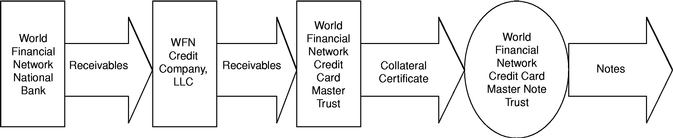
Each series of notes will be issued by World Financial Network Credit Card Master Note Trust and will include one or more classes of notes, representing debt of the issuer. Each series and class may differ as to timing and priority of distributions, allocations of losses, interest rates, amount of distributions in respect of principal or interest and credit enhancement. We, WFN Credit Company, LLC, will disclose the details of these timing, priority and other matters in a prospectus supplement.
Initially, the primary asset of the issuer will be a collateral certificate issued by World Financial Network Credit Card Master Trust to us and transferred to the issuer under a transfer and servicing agreement. It represents a beneficial interest in the assets of World Financial Network Credit Card Master Trust. World Financial Network Credit Card Master Trust owns primarily credit card receivables arising in private label revolving credit card accounts.
World Financial Network National Bank is the originator of the credit card receivables. The receivables comprising the trust have been transferred either directly by the bank to the trust or by the bank to us, and in turn, by us to the trust. Under the pooling and servicing agreement entered into by the bank in 1996, the bank, in its capacity as transferor, designated all eligible accounts from a number of merchant programs in its portfolio of private label credit card accounts and transferred the receivables in those accounts to the trust. The bank continued to transfer additional receivables generated in those accounts and additional accounts to the trust until August 2001, when the pooling and servicing agreement was amended. The amendment, among other things, designated us as the transferor replacing the bank. At the same time, we entered into a receivables purchase agreement with the bank under which the bank designated eligible accounts to us and transferred the receivables created after the date of the agreement to us. Under the receivables purchase agreement, the bank will, from time to time, designate additional accounts to us and transfer additional receivables to us. Under the amended pooling and servicing agreement, in our capacity as transferor, we transfer all receivables sold to us by the bank under the receivables purchase agreement to the trust. The bank will continue to own the accounts that are designated to the trust.
At any time where no series of investor certificates issued by World Financial Network Credit Card Master Trust are outstanding, we may cause World Financial Network Credit Card Master Trust to terminate, at which time the receivables remaining in World Financial Network Credit Card Master Trust will be transferred to the issuer and held directly by the issuer. We refer to the entity—either World Financial Network Credit Card Master Trust or the issuer—that holds the receivables at any given time as the trust.
1
The notes will represent the right to payments from a portion of collections on the credit card receivables and certain fees held by the trust. All new receivables generated in the accounts will be automatically transferred to the trust. The total amount of receivables held by the trust will fluctuate daily as new receivables are generated and payments are received on existing receivables.
The bank services the receivables that are transferred to the trust and acts as the issuer's administrator.
BNY Midwest Trust Company is the trustee for World Financial Network Credit Card Master Trust and the indenture trustee for the issuer. The issuer will grant a security interest in its assets—including the collateral certificate or, if World Financial Network Credit Card Master Trust has terminated, the receivables—to the indenture trustee for the benefit of the noteholders.
2
The following is a summary of the principal risk factors that apply to an investment in the notes. You should consider the following risk factors and any risk factors in the accompanying prospectus supplement before deciding whether to purchase the notes.
It may not be possible to find an investor to purchase your notes.
The underwriters may assist in resales of the notes but they are not required to do so. A secondary market for any notes may not develop. If a secondary market does develop, it might not continue or it might not be sufficiently liquid to allow you to resell any of your notes.
Some liens would be given priority over your notes which could cause delayed or reduced payments.
We and the bank account for the transfer of the receivables as a sale. Even so, a court could conclude that we or the bank own the receivables and that the trust holds only a security interest. Even if a court would reach that conclusion, however, steps will be taken to give the trust a first-priority perfected security interest in the receivables.
If a court were to conclude that the trust has only a security interest, a tax or governmental lien or other lien imposed under applicable state or federal law without consent on our property or the bank's property arising before receivables come into existence may be senior to the trust's interest in the receivables. Additionally, if a receiver or conservator were appointed for the bank, the fees and expenses of the receiver or conservator might be paid from the receivables before the trust receives any payments on the receivables. In addition, the trust may not have a first-priority perfected security interest in collections that have been commingled with other funds. If any of these events were to occur, payments to you could be delayed or reduced. See "Material Legal Aspects of the Receivables—Transfer of Receivables" and "Description of the Notes—Representations and Warranties" in this prospectus.
If a conservator or receiver were appointed for World Financial Network National Bank delays or reductions in payment of your notes could occur.
If the bank were to become insolvent, the FDIC could act as conservator or receiver for the bank. In that role, the FDIC would have broad powers to repudiate contracts to which the bank was party if the FDIC determined that the contracts were burdensome and that repudiation would promote the orderly administration of the bank's affairs. Also, if the FDIC were acting as the bank's conservator or receiver, the FDIC might have the power to extend its repudiation and avoidance powers to us because we are a wholly-owned subsidiary of the bank.
The FDIC has adopted a rule stating that, if certain conditions are met, the FDIC shall not use its repudiation power to reclaim, recover or recharacterize as property of an FDIC-insured bank any financial assets transferred by that bank in connection with a securitization transaction. Although the FDIC has the power to repeal or amend its own rules, the securitization rule states that any repeal or amendment of that rule will not apply to any transfers of financial assets made before the repeal or modification.
We have structured the issuance of the notes with the intention that the transfers of the receivables by the bank would have the benefit of this rule. If the FDIC were to assert that the rule does not apply to these transfers of receivables or that these transactions do not comply with certain banking laws, however, payments of principal and interest on your notes could be delayed and, if the FDIC were
3
- •
- require
the indenture trustee or any of the other transaction parties to go through the administrative claims procedure established by the FDIC in order to obtain payments
on the notes;
- •
- obtain
a stay of any actions by any of those parties to enforce the transaction documents against the bank; or
- •
- repudiate the transaction documents and limit the affected parties' claims to their "actual direct compensatory damages" (as defined in the statute that governs the FDIC's authority and actions as a receiver or conservator).
successful, possibly reduced. Furthermore, if the FDIC were successful, the FDIC could—
- •
- our
assets (including the receivables) constitute assets of the bank available for liquidation and distribution by a conservator or receiver for the bank;
- •
- we
and our assets (including the receivables) should be substantively consolidated with the bank and its assets; or
- •
- the FDIC's control over the receivables is necessary for the bank to reorganize or to protect the public interest.
If the FDIC were to successfully take any of these actions, the amount payable to you could be lower than the outstanding principal and accrued interest on the notes, thus resulting in losses to you.
We are a wholly-owned bankruptcy remote subsidiary of the bank and our limited liability company agreement limits the nature of our business. If, however, we became a debtor in a bankruptcy case, and our transfer of the receivables to the trust were construed as a grant of a security interest to secure a borrowing, your payments of outstanding principal and interest could be delayed and possibly reduced.
Because we are a wholly-owned subsidiary of the bank, certain banking laws and regulations may apply to us, and if we were found to have violated any of these laws or regulations, payments to you could be delayed or reduced. In addition, if the bank entered conservatorship or receivership, the FDIC could seek to exercise control over the receivables or our other assets on an interim or a permanent basis. Although steps have been taken to minimize this risk, the FDIC could argue that—
If these or similar arguments were made, whether successfully or not, payments to you could be delayed or reduced. Furthermore, regardless of any decision made by the FDIC or ruling made by a court, the fact that the bank has entered conservatorship or receivership could have an adverse effect on the liquidity and value of the notes.
If a conservator or receiver were appointed for the bank, an early payment of principal on all outstanding series could result. Under the terms of the agreement that governs the transfer of the receivables from us to the trust, new principal receivables would not be transferred to the trust. However, the conservator or the receiver may have the power, regardless of the terms of that agreement, to prevent the early payment of principal or to require new principal receivables to continue being transferred. In addition, the conservator or receiver may have the power to prevent either the indenture trustee or the noteholders from appointing a new servicer, to direct the servicer to stop servicing the receivables or to increase the amount or the priority of the servicing fee due to the bank or otherwise alter the terms under which the bank services the receivables. See "Material Legal Aspects of the Receivables—Conservatorship, Receivership and Bankruptcy" in this prospectus.
4
In addition, at any time, if the appropriate banking regulatory authorities, including the Office of the Comptroller of the Currency, were to conclude that an obligation of the bank under the agreement governing the transfer of receivables to us or the servicing agreement were an unsafe or unsound practice or violated any law, rule or regulation applicable to the bank, the FDIC could order the bank to rescind or amend the terms of such obligation. See "Material Legal Aspects of the Receivables—Certain Regulatory Matters" in this prospectus.
The bank may change the terms and conditions of the accounts in a way that reduces collections.
As owner of the accounts, the bank retains the right to change various account terms, including finance charges, other fees and the required monthly minimum payment. These changes may be voluntary on the part of the bank or may be required by law or market conditions. Changes in interest and fees could decrease the effective yield on the accounts and this could result in an early payment of principal of your notes. Changes could also cause a reduction in the credit ratings on your notes.
Allocations of charged-off receivables or uncovered dilution could reduce payments to you.
The primary risk associated with extending credit to the bank's customers under its private label credit card programs is the risk of default or bankruptcy of the customer, resulting in the customer's account balance being charged-off as uncollectible. We rely principally on the customer's creditworthiness for repayment of the account and therefore have no other recourse for collection. The bank may not be able to successfully identify and evaluate the creditworthiness of cardholders to minimize delinquencies and losses. An increase in defaults or net charge-offs beyond historical levels will reduce the net spread available from the World Financial Network Credit Card Master Trust and could result in a reduction in finance charge income. General economic factors, such as the rate of inflation, unemployment levels and interest rates, may result in greater delinquencies that lead to greater credit losses among customers.
In addition to being affected by general economic conditions and the success of the servicer's collection and recovery efforts, the trust's delinquency and net credit card receivable charge-off rates are affected by the credit risk of credit card receivables and the average age of the various credit card account portfolios. The average age of credit card receivables affects the stability of delinquency and loss rates of the portfolio because delinquency and loss rates typically increase as the average age of accounts in a credit card portfolio increases. As of June 30, 2004, 18.39% of the total number of accounts in the trust portfolio with outstanding balances and 37.22% of the amount of the principal receivables outstanding in the trust portfolio would have been less than 24 months old. The servicer will write off the receivables arising in accounts designated to the trust if the receivables become uncollectible. Your series will be allocated a portion of these charged-off receivables. See "Description of Series Provisions—Allocation Percentages" and "—Investor Charge-Offs" in the accompanying prospectus supplement.
Unlike charged-off receivables, reductions in the receivables due to returns of merchandise, unauthorized charges to the extent such receivables are Excess Fraud Receivables or disputes between a cardholder and a merchant, called dilution, are typically absorbed by reductions in our interest in the trust, the transferor interest, or reimbursed by us through cash deposits to the excess funding account and are not intended to be allocated to investors. However, to the extent our interest is insufficient to cover dilution for any calendar month and we then default in our
5
obligation to compensate the trust for these reductions, your series will be allocated a portion of the uncovered dilution. If the amount of charged-off receivables and any uncovered dilution allocated to your series of notes exceeds the amount of funds available to reimburse those amounts, you may not receive the full amount of principal and interest due to you. See "Description of Series Provisions—Investor Charge-Offs" in the accompanying prospectus supplement and "Description of the Notes—Defaulted Receivables; Dilution; Investor Charge-Offs" in this prospectus.
Current and proposed regulation and legislation relating to consumer protection laws may impede collection efforts or reduce collections.
Various federal and state consumer protection laws regulate the creation and enforcement of consumer loans, including credit card accounts and receivables. Such laws and regulations, among other things, limit the fees and other charges that the bank can impose on customers, limit or prescribe certain other terms of the bank's products and services, require specified disclosures to consumers, or require that we maintain certain licenses, qualifications and minimum capital levels. In some cases, the precise application of these statutes and regulations is not clear. In addition, numerous legislative and regulatory proposals are advanced each year which, if adopted, could have a material adverse effect on the amount of collections available to the trust or further restrict the manner in which the servicer may conduct its activities. The failure to comply with, or adverse changes in, these laws or regulations or adverse changes in their interpretation, could make it more difficult for the servicer of the receivables to collect payments on the receivables or reduce the finance charges and other fees that can be charged, resulting in reduced collections.
Receivables that do not comply with consumer protection laws may not be valid or enforceable under their terms against the obligors on those receivables. If a cardholder sought protection under federal or state bankruptcy or debtor relief laws, a court could reduce or discharge completely the cardholder's obligations to repay amounts due on its account and, as a result, the related receivables would be written off as uncollectible. See "Material Legal Aspects of the Receivables—Consumer Protection Laws" in this prospectus.
Limited remedies for breaches of representations could reduce or delay payments.
When we transfer the receivables to the trust, we make representations and warranties relating to the validity and enforceability of the receivables arising under the accounts designated to the trust, and as to the perfection and priority of the indenture trustee's interest in the receivables. However, none of the trustee for World Financial Network Credit Card Master Trust, the owner trustee or the indenture trustee will make any examination of the receivables or the related assets to determine the presence of defects or compliance with the representations and warranties or for any other purpose.
A representation or warranty relating to the receivables may be violated if the related obligors have defenses to payment or offset rights, or our creditors or creditors of the bank claim rights to the trust assets. If a representation or warranty is violated, we may have an opportunity to cure the violation. If we are unable to cure the violation within the specified time period or if there is no right to cure the violation, we must accept reassignment of the receivables affected by the violation. These reassignments are the only remedy for breaches of representations and warranties, even if your damages exceed your share of the reassignment price. See "Description of the Notes—Representations and Warranties" in this prospectus.
6
Payment and origination patterns of receivables and operations of retailers could reduce collections.
The bank's ability to generate new receivables is dependent upon its ability to compete in the current industry environment and upon the retailers from which purchases may be financed on its private label credit cards. Accordingly, the trust is completely dependent upon sales at or through the retailers for the generation of receivables. The retailing industry is intensely competitive. Generally, the retailers compete not only with other retailers, department stores and catalogue sale businesses in the geographic areas in which they operate but also with numerous other types of retail outlets. We cannot assure you that the retailers will continue to generate receivables at the same rate as in prior years. Also, the retailers generally accept most major credit cards, and we cannot guaranty that credit card sales under the bank's proprietary card programs will not decline as a percentage of total credit card sales by the retailers.
The receivables transferred to the trust may be paid at any time. Prepayments represent principal reductions in excess of the contractually scheduled reductions. The rate of cardholder prepayments or defaults on credit card balances may be affected by a variety of competitive, economic and social factors.
Economic factors that may affect payment patterns and credit card usage include the rate of inflation, unemployment levels, relative interest rates and the availability of alternative financing, most of which are not within the bank's control. A decrease in interest rates could cause cardholder prepayments to increase.
Social factors that may affect payment patterns and credit card usage include consumer confidence levels and the public's attitude about the use of credit cards and incurring debt and the consequences of personal bankruptcy. Moreover, adverse changes in economic conditions in states where cardholders are located, terrorist acts against the United States or other nations, or the commencement of hostilities between the United States and a foreign nation or nations could have a direct impact on the timing and amounts of payments on your notes.
We cannot assure the creation of additional receivables in the accounts designated to the trust or that any particular pattern of cardholder payments will occur. A significant decline in the amount of new receivables generated could result in the occurrence of an early amortization event for one or more series and the commencement of the early amortization period for each of those series. If an early amortization event occurs, you could receive payment of principal sooner than expected. In addition, changes in finance charges can alter the monthly payment rates of cardholders. A significant decrease in monthly payment rates could slow the return or accumulation of principal during an amortization period or accumulation period. See "Maturity Considerations" in the accompanying prospectus supplement.
Termination of certain private label credit card programs could lead to a reduction of receivables in the trust.
The bank operates its private label credit card programs with various retailers under agreements with fixed minimum terms, some of which may expire while your notes are outstanding. Some of these program agreements provide that, upon expiration, the retailer has either the option or the obligation to purchase the receivables generated with respect to its program, including receivables in the trust. If these terminations and purchases were to occur with respect to retailers whose programs generate a significant portion of the trust's receivables, and the bank was unable to provide receivables arising under newly designated additional accounts to replace those purchased by a retailer, an early amortization period could begin.
7
- •
- conditions
in the securities markets in general and the asset-backed securitization market in particular;
- •
- conformity
in the quality of private label credit card receivables to rating agency requirements and changes in those requirements; and
- •
- ability to fund required overcollateralizations or credit enhancements, which are routinely utilized in order to acheive better credit ratings to lower borrowing cost.
In addition, the program agreements generally permit the retailer to discontinue the program prior to the termination date if the bank materially breaches its obligations under the program agreement. If the bank was unable to adequately perform its obligations, or a retailer were otherwise to assert that the bank was not adequately performing, then one or more of the programs could be terminated, leading to reduction in the generation of receivables.
The bank depends on its ability to sell and securitize its credit card receivables to fund new receivables.
The bank's ability to originate and service receivables is dependent upon its continued access to funding sources. Since January 1996, the bank has used a program involving the sale and securitization of its private label credit card receivables as its primary funding vehicle for private label credit card receivables. If the bank was unable to regularly securitize its receivables, its ability to generate new receivables and to service receivables would be materially impaired. A number of factors affect securitization transactions, some of which are beyond the bank's control, including:
These factors could adversely affect the bank's ability to effect securitization transactions or the benefits to the bank of securitization transactions.
In addition, the bank has overcollateralized and maintained an interest in its securitizations in order to achieve better credit ratings. Failure to obtain acceptable credit ratings or more stringent credit enhancement requirements could decrease the efficiency of or have an adverse effect on the timing of, or the bank's ability to effect, future securitizations.
The bank intends to continue public securitizations of its private label credit card receivables. The inability to securitize private label credit card receivables due to changes in the market, the unavailability of credit enhancements, or any other circumstance or event would have a material adverse effect on the bank's business, financial condition and operating results.
Subordinated classes bear losses before senior classes.
One or more classes of notes in a series may be subordinated to one or more senior classes of notes in the same series. Principal allocations to the subordinated class or classes may not begin until each of the more senior classes has been paid in full. Additionally, if collections of finance charge receivables allocated to a series are insufficient to cover amounts due for that series' senior notes or to reimburse for that series' share of charged-off receivables, the collateral amount for the series might be reduced. This would reduce the amount of finance charge collections available to the series in future periods and could cause a possible delay or reduction in principal and interest payments on the subordinated notes.
Issuance of additional notes may affect the timing and amount of payments to you.
The issuer expects to issue notes from time to time. New notes, which may have different terms from outstanding notes, may be issued without any requirement for
8
notice to, or consent from, existing noteholders. For a description of the conditions that must be met before the issuer can issues new notes, see "Description of the Notes—New Issuances of Notes" in this prospectus.
The issuance of new notes could adversely affect the timing and amount of payments on outstanding notes. For example, if additional notes in the same group as your series, for purposes of sharing excess finance charge collections are issued after your notes and those notes have a higher interest rate than your notes, this could result in a reduction in the amount of excess funds from other series available to pay interest on your notes. Also, when new notes are issued, the voting rights of your notes will be diluted.
Recharacterization of principal receivables would reduce principal receivables and may require the addition of new receivables.
As described under "Description of the Notes—Discount Option," we may designate a percentage of the receivables that would otherwise be treated as principal receivables to be treated as finance charge receivables. This designation should decrease the likelihood of an early amortization event occurring as a result of a reduction of the average net portfolio yield for a given period. However, this designation will also reduce the aggregate amount of principal receivables, which may increase the likelihood that we will be required to add receivables to the trust. If we were unable to add receivables and could not make a sufficient cash deposit into the excess funding account, one or more series of notes, including your series, could go into early amortization.
The note interest rate and the receivables interest rate may re-set at different times, resulting in reduced or early payments to you.
Some accounts may have finance charges assessed at a variable rate. A series of notes may bear interest either at a fixed rate or at a floating rate based on a different index. If the interest rate charged on the accounts declines, collections of finance charge receivables may be reduced without a corresponding reduction in the amounts of interest payable on your notes and other amounts required to be paid out of collections of finance charge receivables. If the interest rate on the accounts declines or the interest rate on a series increases, this could decrease the spread, or difference, between collections of finance charge receivables and those collections allocated to make interest payments on your notes. This would increase the risk of early repayment of your notes, as well as the risk that there may not be sufficient collections to make all required payments on your notes.
We may assign our obligations as transferor and the bank may assign its obligations as servicer.
In our capacity as transferor and the bank's capacity as servicer, either of us may transfer our rights and obligations under the pooling and servicing agreement and transfer and servicing agreement to one or more entities without noteholders' consent so long as specific conditions are satisfied. The entity assuming the rights and obligations may or may not be affiliated with us or the bank. After the assignment, either we or the bank, as the case may be, would have no further liability or obligation under the pooling and servicing agreement or transfer and servicing agreement, other than those liabilities that arose prior to the transfer.
Failure to safeguard the bank's databases and consumer privacy could affect the bank's reputation among its clients and their customers and may expose the bank to legal claims from consumers.
An important feature of the bank's credit services is the ability to develop and maintain individual consumer profiles. As part of the bank's private label program, it
9
maintains marketing databases containing information on consumers' account transactions. Although the bank has extensive security procedures, the databases may be subject to unauthorized access. If the bank experiences a security breach, the integrity of the databases could be affected. Security and privacy concerns may cause consumers to resist providing the personal data necessary to support the bank's profiling capability. The use of private label programs could decline if any well-publicized compromise of security occurred. Any public perception that the bank released consumer information without authorization could subject the bank to legal claims from consumers and adversely affect client relationships.
This prospectus uses defined terms. You can find a glossary of these terms under the caption "Glossary of Terms for Prospectus" beginning on page 75 in this prospectus.
10
The Issuer
The issuer of your notes will be World Financial Network Credit Card Master Note Trust. The issuer is a statutory trust created under the laws of the State of Delaware. It is operated under a trust agreement, dated as of August 1, 2001, between us and JPMorgan Chase Bank, as owner trustee.
The activities of the issuer are limited to:
- •
- acquiring,
owning and managing the trust assets and the proceeds of those assets;
- •
- issuing
and making payments on the notes; and
- •
- engaging in related activities.
The issuer's principal offices are in Newark, Delaware, in care of Chase Manhattan Bank USA, National Association, c/o JPMorgan Chase Bank, as owner trustee, at the following address: 500 Stanton Christiana Road, OPS4, 3rd Floor, Newark, Delaware 19713, Attention: Institutional Trust Services.
We will pay the fees of the owner trustee and will reimburse it for various liabilities and expenses.
WFN Credit Company, LLC
We—WFN Credit Company, LLC—are a limited liability company formed under the laws of the State of Delaware on May 1, 2001, and are a wholly-owned, direct subsidiary of World Financial Network National Bank. We were organized for the limited purpose of purchasing, holding, owning and transferring receivables and related activities.
World Financial Network Credit Card Master Trust
The notes are secured by a beneficial interest in a pool of receivables that arise under private label credit card accounts owned by the bank and designated by the bank as trust accounts. The receivables are currently held by World Financial Network Credit Card Master Trust, a New York common law trust formed by the bank in January 1996 to securitize a portion of the bank's private label credit card receivables. World Financial Network Credit Card Master Trust is operated under a pooling and servicing agreement, amended in August 2001, among us, as transferor, the bank, as servicer, and BNY Midwest Trust Company, successor to the corporate trust administration of Harris Trust and Savings Bank, successor to The Bank of New York, as trustee.
World Financial Network Credit Card Master Trust issued a collateral certificate to us that represents a beneficial interest in the receivables. We have transferred this collateral certificate to the issuer under a transfer and servicing agreement between us, as transferor, the bank, as servicer, and the issuer. Any other outstanding series of investor certificates issued by World Financial Network Credit Card Master Trust and the notes are referred to in this prospectus, collectively, as the securities, and the holders of those securities are referred to as the securityholders. At any time when no series of investor certificates issued by World Financial Network Credit Card Master Trust are outstanding, other than the collateral certificate, we may cause World Financial Network Credit Card Master Trust to terminate, at which time the receivables will be transferred to the issuer under the transfer and servicing agreement and held directly by the issuer.
World Financial Network National Bank
World Financial Network National Bank is a national banking association and a limited purpose credit card bank established under the Competitive Equality Banking Act of 1987. The bank is regulated, supervised, and examined by the Office of the Comptroller of the Currency, its primary
11
regulator, and is also subject to regulation by the board of Governors of the Federal Reserve System and the Federal Deposit Insurance Corporation, as back-up regulators.
The bank was formed in 1989 to provide private label credit card services to the various retail establishments owned by Limited Brands and its subsidiaries and their customers. Until October 1995, the bank was a wholly owned subsidiary of Limited Commerce Corp., a wholly owned subsidiary of Limited Brands. Limited Commerce Corp. no longer owns any common stock of the bank or the bank's parent corporation, Alliance Data Systems Corporation.
Under credit card processing agreements, the bank is required to continue to provide private label credit card services to certain retailers affiliated with Limited Brands until at least August 2009.
The bank continues to leverage its experience with private label product development, marketing support and risk management to support the sales of Limited Brands and other third-party retailers. The bank's goal is to provide world class credit and information services which build lifetime relationships with customers and generate incremental sales and profit for retailer clients. The bank seeks to differentiate itself from other providers of store credit such as general purpose credit cards by delivering superior quality and service at all times.
The bank plans to continue to selectively acquire or start-up private label credit card portfolios for other retailers. These private label credit card portfolios require approval of the rating agencies prior to their addition to the trust portfolio.
The bank is a fully integrated provider of private label credit card services. All activities pertaining to credit card operations are performed in-house or by its sister company, ADS Alliance Data Systems, Inc.
As part of an acquisition by the bank in 2003, which acquisition required approval by the Office of the Comptroller of the Currency, the Office of the Comptroller of the Currency required the bank to enter into an operating agreement with it. The Office of the Comptroller of the Currency informed the bank that this requirement was consistent with its general policies toward special purpose credit card banks at the time and was not motivated by the bank's condition. The operating agreement and subsequent understandings between the bank and the Office of the Comptroller of the Currency require the bank to continue to operate in a manner consistent with its current practices, regulatory guidelines and applicable law, including those related to affiliate transactions, maintenance of capital and corporate governance and to enhance some of its policies, procedures and business practices relating to information technology and associated risks.
Also, in the bank's capacity as administrator under the administration agreement, between it and the issuer, the bank will provide the notices and perform on behalf of the issuer other administrative obligations required by the transfer and servicing agreement, the indenture and the indenture supplement for each series, and will be compensated for acting as the administrator.
12
Alliance Data Systems
The bank's parent company, Alliance Data Systems Corporation offers transaction services, credit services and marketing services as described below:
| Segment |
Products and Services |
Target Markets |
||
|---|---|---|---|---|
| Transaction Services | • Issuer Services – Card Processing – Billing and Payment Processing – Customer Care • Utility Services – Customer Information System Hosting – Customer Care – Billing and Payment Processing • Merchant Services – Point-of-Sale Services – Merchant Bankcard Services |
• Specialty Retail • Utility Providers • Petroleum Retail |
||
Credit Services |
• Private Label Receivables Financing – Underwriting and Risk Management – Merchant Processing – Receivables Funding |
• Specialty Retail • Petroleum Retail |
||
Marketing Services |
• Loyalty Programs – AIR MILES® Reward Program – One-to-One Loyalty • Database Marketing Services |
• Financial Services • Supermarkets • Petroleum Retail • Specialty Retail |
The bank's customer service, billing and collections functions related to the portfolios it owns and securitizes are outsourced to ADS Alliance Data Systems, Inc.
The Bank's Private Label Credit Card Activities
World Financial Network National Bank Credit Cards
The trust's portfolio of credit card accounts currently consists of revolving credit card accounts included in private label credit card programs, which allow cardholders to finance purchases from stores and catalogue programs operated by one or more affiliated retailers. Not all of the bank's private label credit card programs are included in the trust portfolio.
We refer to the stores and catalogue programs associated with private label credit card programs currently included in the trust as the current retailers. The bank's credit cards are issued under the insignia of the current retailers based on the store or catalogue business through which the account was opened. The credit card programs are administered under a credit card processing agreement with the corporation that operates each of the current retailers. The private label credit card may be used to purchase merchandise from one or more affiliated retailers, to purchase third-party products/services marketed through statement inserts or "bang-tail" remittance envelopes, or, in certain instances, to obtain cash advances upon written request not to exceed $100 in any 90 day period. The bank also offers premium cards, such as gold and platinum cards, for some current retailers. While these cards may offer certain ancillary benefits to customers, they generally carry identical pricing parameters.
13
Program Agreements
Retailers that are approved and accepted into a private label program enter into a credit card program agreement with the bank. These agreements vary on a retailer-by-retailer basis, and may be amended from time to time. Under these agreements, the bank issues credit cards to approved customers and owns the underlying account and all receivables generated thereunder from the time of origination, unless otherwise sold following origination.
The program agreements generally provide that the bank will fund new purchases on an account only if the bank has authorized such new purchases. Some program agreements also provide that upon termination, the retailer has either the option or the obligation to purchase the receivables generated with respect to its program, including receivables in the trust. If these terminations and purchases were to occur with respect to retailers whose programs generate a significant portion of the trust's receivables, and the bank was unable to provide receivables arising under newly designated additional accounts to replace those purchased by a retailer, an early amortization period could begin. See "Risk Factors—Termination of certain private label credit card programs could lead to a reduction of receivables in the trust" in this prospectus.
The program agreements typically provide that the bank may chargeback a receivable if customer disputes occur concerning the merchandise or the validity of the charge or if there is a violation of certain terms of the program agreement. The program agreements may also provide for chargeback of receivables if there is fraud and the retailer failed to follow the program agreement or operating procedures. In most other cases there is no recourse to the retailer because of the failure of the customer to pay.
The program agreements generally have terms ranging from five to ten years and many of the program agreements have renewal clauses which allow the program agreement to be renewed for successive one or more year terms until terminated by the bank or the retailer. In addition, the program agreements generally permit termination in the event of a breach of the agreement or in the event the retailer becomes insolvent, files bankruptcy, undergoes a change in ownership or has a material adverse change in financial condition.
Marketing Programs and Account Origination
The bank has separately developed programs to promote credit with each of the retailers and has developed varying credit guidelines for the different retailers. The bank originates credit card accounts through several different programs: (1) in-store solicitation using "quick credit" and "instant credit," (2) preapproved catalogue mailings and solicitation of customers placing catalogue orders and (3) the acquisition of credit card portfolios from other financial institutions or retailers.
The bank primarily uses in-store solicitation using "quick credit" and "instant credit" to acquire new accounts. Applicants provide a limited amount of information, such as name, mailing address, date of birth and social security number, which allows the credit underwriting department to access its credit bureau reports. The credit underwriting department then scores an applicant's credit bureau report using proprietary credit score cards. Applicants must also present a photo I.D. to the store associate and a major credit card is required to apply for "quick credit".
With "instant credit," an account can be opened in under three minutes from the time the bank receives a call from the store. The salesperson at a retail store records the applicant's information on an application form and calls the bank. One of the bank's associates inputs the necessary information and electronically transmits the applicant's data to credit bureaus. The applicant's credit bureau report is electronically transmitted to the bank and the information is automatically fed into the risk scoring models to arrive at a risk score. The associate relays the risk model's credit decision to the salesperson at the retail store, as well as the account number and credit limit, if applicable.
14
With "quick credit," an account can be opened in less than a minute. Applicant information is taken at the retail store through use of the store cash register and the customer's major credit card. The applicant's name is obtained by swiping the credit card. The customer's social security number and home zip code are then entered via the register. This data is transmitted electronically to credit bureaus where a sophisticated match routine is used to order a credit bureau report. The bureau report, including the date of birth, is received by the bank electronically and is automatically run through the risk scoring models to arrive at a risk score. The system then provides the credit decision to the register, as well as the account and credit limit, if applicable.
The bank uses two methods of soliciting new catalogue accounts: (1) pre-approved catalogue mailings and (2) soliciting customers when they call in an order using either instant credit or on-line pre-screen. The on-line pre-screen process requires the customer's name, address, date of birth and social security number to be sent to a credit bureau where it is matched to the customer's credit report. The credit bureau then analyzes the customer's credit report against the bank's normal pre-screen criteria. If a customer passes the criteria, the bank pre-approves the customer with a pre-determined credit limit. The bank offers credit cards to pre-approved customers at the completion of the order placing process.
A number of the current retailers use or have used pre-approved account solicitations in varying degrees. Of the accounts originated by the bank in 2003, approximately 4.0% were pre-approved. The bank may purchase names for the pre-approved account solicitations from a number of sources or may obtain the names directly from the catalogue or in-store customer files. The bank then compares these lists against the database of existing cardholders to eliminate duplicates. The bank risk scores the remaining names using credit bureau reports and mails a pre-approved account solicitation to each individual who meets an established minimum risk score.
The bank enters application information on all new accounts into a new account processing system that codes each application to allow future tracking of activation rates, sales, delinquencies and charge-offs. Some retailers offer new cardholders discounts on purchases in return for obtaining a credit card. At the time a new account is opened, the bank groups the credit card account into one of nineteen billing cycles based upon geography. Each billing cycle has a separate monthly billing date.
For "instant" and "quick" credit accounts, a salesperson issues a temporary card and terms of the account to the customer at the retail store so that the credit card can be used immediately for purchases. The bank mails the credit card and the terms of the account to the new cardholders.
In addition, the accounts may receive discount inserts and sale announcements in the monthly statements. Customers phoning with account inquiries may be given a marketing message regarding products which are currently popular in stores. The bank can support marketing efforts related to premium cards, loyal shopper rebates, gift certificate orders by phone and fulfillment, surveys, outbound telemarketing, deferred billing and sweepstakes, etc. The bank regularly uses reactivation mailings and credit card reissues to reactivate dormant accounts.
Portfolio Acquisitions and New Start-ups
Since 1996, the bank has also acquired or launched private label credit card programs for a number of retailers. Conversely, over that same period of time, the bank has not renewed its credit card processing agreements relating to the private label credit card programs of several retailers. The bank plans to continue to selectively acquire or start-up private label credit card portfolios for other retailers. These private label credit card portfolios require approval of the rating agencies prior to their addition to the trust portfolio.
15
Underwriting Process
In order to efficiently and accurately process the millions of annual applications the bank receives, it uses a high degree of automation in scoring technology and verification procedures. In the initial credit evaluation process, the bank uses one of five proprietary scorecards that have been refined to reflect performance of the various retail programs. Credit scoring is based on several factors including delinquency history, number of recent credit inquiries and the amount of credit used and available. The bank continuously validates, monitors and maintains these scorecards and uses the resulting data to ensure optimal risk performance.
The bank scores each application on the basis of information purchased from one of the major credit bureaus. Most programs also use a credit bureau score in addition to the proprietary score in the credit granting decision. Cut-off scores are reviewed twice a year to ensure the accounts approved are performing as expected and profitability is being maintained at predetermined levels.
In order to monitor and control the quality of the credit card portfolio, the bank uses behavioral scoring models and credit bureau scores to score each active account on its monthly billing date. The behavioral scoring models dynamically evaluate credit limit assignments to determine whether or not credit limits should be increased, decreased or maintained based on the creditworthiness of the individual cardholder. The bank's proprietary scoring models include such factors as: how long the account has been on file, credit utilization, shopping patterns and trends, payment history and account delinquency.
Point-of-sale terminals in stores operated by the current retailers have an on-line connection with the bank's credit authorization system and allow real-time updating of accounts. Every sales transaction is passed through the bank's automated authorization system. If the proposed charge would place the account over its credit limit, the sale is declined, unless the store associate calls us and obtains an override or an increase in the cardholder's credit limit.
Servicing of Accounts
The bank's credit card operations are organized to support the specific retailers being serviced around the core functional components. The organization is managed to provide for the consistent application of credit policies and service standards for each portfolio serviced. Accounts are serviced by ADS Alliance Data Systems, Inc. in one of six call centers located throughout the United States. Each call center processes new account applications, responds to customer inquiries and collects on delinquent or past due accounts. The service provided within a call center can be customized to support the particular requirements of each retailer. The credit processing functions consisting of statement rendering and mailing, payment processing, and card embossing are centralized in two processing centers. Each customer account is processed from one of these centers. Credit card production is performed in a secured environment, including a separately alarmed secured area and audit procedures that are designed to maintain an absolute count of all cards produced, stored, destroyed and mailed.
ADS Alliance Data Systems, Inc. on the bank's behalf, mails monthly billing statements to cardholders. Statement mailing is highly automated, using pre-sorting and bar coding. The billing statements present the total amount due showing the split between principal, current fees, current finance charges and the minimum payment due. Subject to applicable law, late and returned check fees are also added to a cardholder's outstanding balance. No over credit limit or transaction fees are charged to any cardholders. The processing of cardholder remittances is also performed by ADS Alliance Data Systems, Inc., on the bank's behalf, using automated payment processing equipment and systems.
Finance charges are calculated by multiplying the average daily balance outstanding on an account during the monthly billing period times the applicable periodic finance charge rate. Finance charges are
16
assessed from the date of purchase. A grace period of approximately 25 days from the billing date is available to make payment and avoid finance charges. Payments are applied at the bank's discretion, but are generally applied in the following order: (1) to fees assessed on the account, (2) to finance charges and (3) to the unpaid principal balance of purchases allocated first to the longest outstanding receivable. In most instances the annual fixed finance charge rate is currently 22.8%, although a small percentage of the accounts offer a lower prime-based rate. The bank may change finance charge rates from time to time at its discretion.
Currently, the minimum monthly payment amount is equal to a percentage of the account balance, as well as any past due amounts. Minimum monthly payments are in most instances subject to a $10 minimum payment. The bank may change the minimum monthly payment from time to time at its discretion.
Delinquency and Collections Procedures
Efforts to collect delinquent receivables are made by ADS Alliance Data Systems, Inc's collection department on the bank's behalf and, if necessary, by collection agencies and outside attorneys. New collectors undergo training which includes courses in professional debt collection, the Fair Debt Collection Practices Act and negotiating skills. These courses are also available on a "refresher" basis for experienced collectors.
The bank classifies an account as delinquent when the minimum payment due on the account is not received by the payment due date specified in the cardholder's billing statement. It is the bank's policy to continue to accrue interest and fee income on all credit card accounts, except in limited circumstances until the account and all related loans, interest and other fees are charged-off or paid. When an account becomes delinquent, the bank prints a message requesting payment on the cardholder's billing statement. After an account becomes 30 days past due, a proprietary collection scoring algorithm automatically scores the risk of the account rolling to a more delinquent status. The collection system then recommends a collection strategy for the past-due account based on the collection score and account balance, and dictates the contact schedule and collections priority for the account. The key measures used are (1) age of account, (2) number of previous delinquencies, (3) account balance, and (4) previous payment history. If the bank is unable to make a collection after exhausting all in-house efforts, it engages collection agencies and outside attorneys to continue those efforts.
Specific collection actions include automatic letter dunning, telephone calls using automated dialing equipment, no action and sending the account to the mid-range collections group. The mid-range collection staff handles the intermediate to serious collection efforts. Unlike the auto-dial collections staff, the mid-range collectors are responsible for their own individual accounts and are reviewed accordingly. The mid-range collections group can take past due accounts as early as 30 days past due.
The bank charges off accounts which become 180 days contractually past due. Accounts may be re-aged during delinquency in accordance with regulatory guidelines.
We refer to the accounts that have been designated as trust accounts as the trust portfolio. References to the trustee in this prospectus will refer to (a) BNY Midwest Trust Company, as trustee of World Financial Network Credit Card Master Trust under the pooling and servicing agreement for so long as World Financial Network Credit Card Master Trust holds the receivables, or (b) BNY Midwest Trust Company, as indenture trustee, if the issuer holds the receivables.
In addition to the receivables in the trust portfolio, the notes will be secured by:
- •
- all proceeds of these receivables and related recoveries;
17
- •
- all
monies on deposit in specified trust accounts or investments made with these monies, including any earned investment proceeds if the prospectus supplement for your
series of notes so indicates;
- •
- other
assets that may be added to the trust consisting of participations or trust certificates representing undivided legal or beneficial interests in a pool of assets
primarily consisting of private label credit card receivables originated by World Financial Network National Bank or other approved credit card originators and the funds collected thereon;
- •
- our
rights under the receivables purchase agreement;
- •
- our
rights to receive payments from retailers under their credit card processing agreements for in-store payments received by retailers from obligors; and
- •
- proceeds of any credit enhancement or derivative contracts, consisting of interest rate swaps, currency swaps, credit swaps, interest rate caps, interest rate floors or bankruptcy options, which are instruments under which a counterparty assumes the risk of an increase in bankruptcies in exchange for payment, as described in the prospectus supplement for your series of notes.
Receivables in the trust consist of:
- •
- principal
receivables, which are amounts charged by trust account cardholders for goods and services and cash advances; and
- •
- finance charge receivables, which are periodic finance charges, other amounts charged to trust accounts, including late fees and return check fees.
The receivables arise in the bank's private label credit card programs for various retailers. We refer to the accounts relating to those programs collectively as the "approved portfolios." In addition, we may designate additional portfolios of accounts as "approved portfolios" to be included in the trust portfolio if certain conditions are met. We currently designate all newly created Eligible Accounts arising in the approved portfolios as automatic additional accounts, and the receivables in these accounts will be transferred to the trust. If we acquire or begin to directly originate additional types of private label credit cards, bank cards, these accounts may be designated as supplemental accounts and added to the trust so long as each rating agency that rates any outstanding notes has confirmed that the designation will not impair the rating of those notes. We refer to both the supplemental accounts and the automatic additional accounts in this prospectus as "additional accounts".
Our right to automatically add additional Eligible Accounts to the trust as they arise is subject to the quantitative limitations described in "Description of the Notes—Addition of Trust Assets" in this prospectus. We may also elect to stop the automatic addition of receivables arising in automatic additional accounts, but only as to accounts created on or after the date of suspension or termination. If we do so, we have the right, and in some cases the obligation, to designate from time to time additional Eligible Accounts to the trust portfolio and to convey to the trust all receivables in those additional accounts, whether those receivables are then existing or thereafter created.
The accounts must be Eligible Accounts as of the date we designate them as supplemental accounts or automatic additional accounts. Once these accounts are designated, only the receivables arising under these accounts, and not the accounts themselves, are sold. In addition, as of the date on which any new receivables are created, we will represent and warrant to the trust that the receivables conveyed to the trust on that day are Eligible Receivables. However, we cannot guarantee that all the accounts will continue to meet the applicable eligibility requirements throughout the life of the trust.
Under some circumstances, we may also designate that some accounts will no longer be trust accounts, and the receivables originated under these accounts will be removed from the trust. Throughout the term of the trust, the trust portfolio will consist of receivables originated in the initial
18
accounts plus receivables originated in any additional accounts and minus receivables originated in any removed accounts and plus any participation interests.
We cannot assure you that additional accounts will be of the same credit quality as the initial accounts. Moreover, additional accounts may contain receivables which consist of fees, charges and amounts which are different from the fees, charges and amounts described in this prospectus. Additional accounts may also have different credit guidelines, balances and ages. Consequently, we cannot assure you that the accounts will continue to have the characteristics described in this prospectus as additional accounts are added. In addition, if we designate additional accounts with lower periodic finance charges, that may have the effect of reducing the portfolio yield.
The prospectus supplement relating to each series of notes will provide the following information about the trust portfolio as of the date specified:
- •
- the
amount of principal receivables;
- •
- the
amount of finance charge receivables;
- •
- the
range and average of principal balances of the accounts;
- •
- the
range and average of credit limits of the accounts;
- •
- the
range and average of ages of the accounts;
- •
- the
geographic distribution of the accounts; and
- •
- delinquency statistics relating to the accounts.
We will receive the net proceeds from the sale of each series of notes offered by this prospectus and will use those proceeds (a) to retire existing series of investor certificates, and (b) for general corporate purposes.
The issuer will issue one or more series of notes under a master indenture and an indenture supplement entered into by the issuer and the indenture trustee. The following summaries describe all material provisions common to each series of notes. The accompanying prospectus supplement gives you all of the additional material terms specific to the notes of your series. The summaries are qualified by all of the provisions of the transfer and servicing agreement, the indenture and the related indenture supplement and the pooling and servicing agreement. We have filed a copy of the pooling and servicing agreement for World Financial Network Credit Card Master Trust and a form of each of the transfer and servicing agreement, the indenture and an indenture supplement with the SEC as exhibits to the registration statement relating to the notes.
General
The notes will be secured by and paid from the assets of the issuer. The amount of collateral allocated for any series of notes, called its collateral amount, will be specified in the related prospectus supplement. Each series of notes will be allocated collections of principal receivables and finance charge receivables based on its allocation percentage, which will be based on the collateral amount for that series and will be calculated as described in the related prospectus supplement.
Each series of notes may consist of one or more classes, one or more of which may be senior notes and one or more of which may be subordinated notes. Each class of a series will evidence the
19
right to receive a specified portion of each distribution of principal or interest or both. Each class of a series may differ from other classes in some aspects, including:
- •
- amounts
allocated to principal payments;
- •
- maturity
date;
- •
- interest
rate; and
- •
- availability and amount of enhancement.
We or our assigns will have the right to receive all cash flows from the assets of the trust not required to make payments on the securities or to make payments to credit enhancement providers for any series of securities. Our interest is called the transferor interest and is an amount equal to the Transferor Amount.
During the revolving period, the amount of collateral for a series will remain constant unless reduced on account of:
- •
- defaulted
receivables or dilution; or
- •
- reallocation of principal collections to cover shortfalls in the payment of interest or other specified amounts to be paid from finance charge collections.
See "—Defaulted Receivables; Dilution; Investor Charge-Offs" in this prospectus. The amount of principal receivables in the trust, however, will vary each day as new principal receivables are created and others are paid. The Transferor Amount will fluctuate each day to reflect the changes in the amount of the principal receivables in the trust. When a series is amortizing, the collateral amount of that series will decline as customer payments of principal receivables are collected and distributed, or accumulated for distribution, to the noteholders. As a result, the Transferor Amount will generally increase to reflect reductions in the collateral amount for that series and will also change to reflect the variations in the amount of principal receivables in the trust. The Transferor Amount may also be reduced as the result of new issuances by the issuer, see "—New Issuances of Notes" in this prospectus, or new issuances of investor certificates by World Financial Network Credit Card Master Trust, see "Pooling and Servicing Agreement—New Issuances of Investor Certificates" in this prospectus.
Generally, notes offered under this prospectus and the accompanying prospectus supplement:
- •
- will
be represented by notes registered in the name of a DTC nominee;
- •
- will
be available for purchase in minimum denominations of $1,000 and multiples of $1,000 in excess of that amount; and
- •
- will be available for purchase in book-entry form only.
The accompanying prospectus supplement will specify if your notes have different characteristics from those listed above.
DTC has informed us that its nominee will be Cede & Co. Accordingly, Cede & Co. is expected to be the holder of record of each series of notes. As an owner of beneficial interests in the notes, you will generally not be entitled to a definitive note representing your interest in the issued notes because you will own notes through a book-entry record maintained by DTC. References in this prospectus and the accompanying prospectus supplement to distributions, reports, notices and statements to noteholders refer to DTC or Cede & Co., as registered holder of the notes, for distribution to you in accordance with DTC procedures. All references in this prospectus and the accompanying prospectus supplement to actions by noteholders shall refer to actions taken by DTC upon instructions from DTC participants.
The accompanying prospectus supplement may state that an application will be submitted to list your series or class of notes on the Luxembourg Stock Exchange or another exchange.
20
Book-Entry Registration
This section describes the form your notes will take, how your notes may be transferred and how payments will be made to you.
The information in this section concerning DTC and DTC's book-entry system has been provided by DTC. We have not independently verified the accuracy of this information.
You may hold your notes through DTC in the U.S., Clearstream or Euroclear in Europe or in any other manner described in the accompanying prospectus supplement. You may hold your notes directly with one of these systems if you are a participant in the system, or indirectly through organizations which are participants.
Cede & Co., as nominee for DTC, will hold the global notes. Clearstream and Euroclear will hold omnibus positions on behalf of the Clearstream customers and the Euroclear participants, respectively, through customers' securities accounts in Clearstream's and Euroclear's names on the books of their respective depositaries, which in turn will hold those positions in customers' securities accounts in the depositaries' names on the books of DTC.
DTC is a limited-purpose trust company organized under the laws of the State of New York, a member of the Federal Reserve System, a "clearing corporation" within the meaning of the New York Uniform Commercial Code, and a "clearing agency" registered under the provisions of Section 17A of the Securities Exchange Act of 1934. DTC was created to hold securities for its participants and facilitate the clearance and settlement of securities transactions between participants through electronic book-entry changes in accounts of participants, thereby eliminating the need for physical movement of certificates. Participants include securities brokers and dealers, banks, trust companies and clearing corporations and may include other organizations. Participants also may include the underwriters of any series. Indirect access to the DTC system also is available to others, including banks, brokers, dealers and trust companies, as indirect participants, that clear through or maintain a custodial relationship with a participant, either directly or indirectly.
Transfers between DTC participants will occur in accordance with DTC rules. Transfers between Clearstream customers and Euroclear participants will occur in the ordinary way in accordance with their applicable rules and operating procedures.
Cross-market transfers between persons holding directly or indirectly through DTC, on the one hand, and directly or indirectly through Clearstream customers or Euroclear participants, on the other, will be effected through DTC in accordance with DTC rules on behalf of the relevant European international clearing system by its depositary; however, those cross-market transactions will require delivery of instructions to the relevant European international clearing system by the counterparty in that system in accordance with its rules and procedures and within its established deadlines, which will be based on European time. The relevant European international clearing system will, if the transaction meets its settlement requirements, deliver instructions to its depositary to take action to effect final settlement on its behalf by delivering or receiving securities in DTC, and making or receiving payment in accordance with normal procedures for same-day funds settlement applicable to DTC. Clearstream customers and Euroclear participants may not deliver instructions directly to Clearstream's and Euroclear's depositaries.
Because of time-zone differences, credits of securities in Clearstream or Euroclear as a result of a transaction with a participant will be made during the subsequent securities settlement processing, dated the business day following the DTC settlement date, and those credits or any transactions in those securities settled during that processing will be reported to the relevant Clearstream customer or Euroclear participant on that business day. Cash received in Clearstream or Euroclear as a result of sales of securities by or through a Clearstream customer or a Euroclear participant to a DTC participant will be received with value on the DTC settlement date but will be available in the relevant Clearstream or Euroclear cash account only as of the business day following settlement in DTC.
21
Note owners that are not participants or indirect participants but desire to purchase, sell or otherwise transfer ownership of, or other interest in, notes may do so only through participants and indirect participants. In addition, note owners will receive all distributions of principal of and interest on the notes from the indenture trustee through the participants who in turn will receive them from DTC. Under a book-entry format, note owners may experience some delay in their receipt of payments, since payments will be forwarded by the indenture trustee to Cede & Co., as nominee for DTC. DTC will forward those payments to its participants, which thereafter will forward them to indirect participants or note owners. It is anticipated that the only "noteholder" will be Cede & Co., as nominee of DTC. Note owners will not be recognized by the indenture trustee as noteholders, as that term is used in the indenture, and note owners will only be permitted to exercise the rights of noteholders indirectly through the participants who in turn will exercise the rights of noteholders through DTC.
Under the rules, regulations and procedures creating and affecting DTC and its operations, DTC is required to make book-entry transfers among participants on whose behalf it acts with respect to the notes and is required to receive and transmit distributions of principal and interest on the notes. Participants and indirect participants with which note owners have accounts with respect to the notes similarly are required to make book-entry transfers and receive and transmit those payments on behalf of their respective note owners. Accordingly, although note owners will not possess notes, note owners will receive payments and will be able to transfer their interests.
Because DTC can only act on behalf of participants, who in turn act on behalf of indirect participants and certain banks, the ability of a note owner to pledge notes to persons or entities that do not participate in the DTC system, or otherwise take actions in respect of those notes, may be limited due to the lack of a physical certificate for those notes.
DTC has advised us that it will take any action permitted to be taken by a noteholder under the indenture only at the direction of one or more participants to whose account with DTC the notes are credited. Additionally, DTC has advised us that it will take those actions with respect to specified percentages of the collateral amount only at the direction of and on behalf of participants whose holdings include interests that satisfy those specified percentages. DTC may take conflicting actions with respect to other interests to the extent that those actions are taken on behalf of participants whose holdings include those interests.
Clearstream is incorporated under the laws of Luxembourg. Clearstream holds securities for its customers and facilitates the clearance and settlement of securities transactions between Clearstream customers through electronic book-entry changes in accounts of Clearstream customers, thereby eliminating the need for physical movement of notes. Transactions may be settled in Clearstream in any of 36 currencies, including United States dollars. Clearstream provides to its Clearstream customers, among other things, services for safekeeping, administration, clearance and settlement of internationally traded securities and securities lending and borrowing. Clearstream also deals with domestic securities markets in over 30 countries through established depository and custodial relationships. Clearstream is registered as a bank in Luxembourg, and therefore is subject to regulation by the Commission de Surveillance du Secteur Financier, which supervises Luxembourg banks. Clearstream's customers are world-wide financial institutions, including underwriters, securities brokers and dealers, banks, trust companies and clearing corporations, among others, and may include the underwriters of any series of notes. Clearstream's U.S. customers are limited to securities brokers and dealers and banks. Currently, Clearstream has approximately 2,000 customers located in over 80 countries, including all major European countries, Canada and the United States. Indirect access to Clearstream is also available to other institutions that clear through or maintain a custodial relationship with an account holder of Clearstream. Clearstream has established an electronic bridge with Euroclear Bank S.A./N.V. as the operator of the Euroclear System in Brussels to facilitate settlement of trades between Clearstream and Euroclear.
22
Euroclear was created in 1968 to hold securities for participants of the Euroclear System and to clear and settle transactions between Euroclear participants through simultaneous electronic book-entry delivery against payment, thereby eliminating the need for physical movement of notes and any risk from lack of simultaneous transfers of securities and cash. Transactions may now be settled in any of 34 currencies, including United States dollars. The Euroclear System includes various other services, including securities lending and borrowing and interfaces with domestic markets in several countries generally similar to the arrangements for cross-market transfers with DTC described above. The Euroclear System is operated by Euroclear Bank S.A./N.V. as the Euroclear operator. All operations are conducted by the Euroclear operator, and all Euroclear securities clearance accounts and Euroclear cash accounts are accounts with the Euroclear operator. Euroclear participants include central banks and other banks, securities brokers and dealers and other professional financial intermediaries and may include the underwriters of any series of notes. Indirect access to the Euroclear System is also available to other firms that clear through or maintain a custodial relationship with a Euroclear participant, either directly or indirectly.
Securities clearance accounts and cash accounts with the Euroclear operator are governed by the Terms and Conditions Governing Use of Euroclear and the related Operating Procedures of the Euroclear System. These terms and conditions govern transfers of securities and cash within the Euroclear System, withdrawal of securities and cash from the Euroclear System, and receipts of payments with respect to securities in the Euroclear System. All securities in the Euroclear System are held on a fungible basis without attribution of specific certificates to specific securities clearance accounts. The Euroclear operator acts under these rules and laws only on behalf of Euroclear participants and has no record of or relationship with persons holding through Euroclear participants.
Distributions with respect to notes held through Clearstream or Euroclear will be credited to the cash accounts of Clearstream customers or Euroclear participants in accordance with the relevant system's rules and procedures, to the extent received by its depositary. Those distributions will be subject to tax reporting in accordance with relevant United States tax laws and regulations. See "Federal Income Tax Consequences" in this prospectus. Clearstream or the Euroclear operator, as the case may be, will take any other action permitted to be taken by a noteholder under the indenture on behalf of a Clearstream customer or Euroclear participant only in accordance with its relevant rules and procedures and subject to its depositary's ability to effect those actions on its behalf through DTC.
Although DTC, Clearstream and Euroclear have agreed to the foregoing procedures in order to facilitate transfers of notes among participants of DTC, Clearstream and Euroclear, they are under no obligation to perform or continue to perform those procedures and those procedures may be discontinued at any time.
Definitive Notes
Notes that are initially cleared through DTC will be issued in definitive, fully registered, certificated form to note owners or their nominees, rather than to DTC or its nominee, only if:
- •
- we
advise the indenture trustee in writing that DTC is no longer willing or able to discharge properly its responsibilities as depository with respect to that series or
class of notes, and the indenture trustee or the issuer is unable to locate a qualified successor;
- •
- we,
at our option, advise the indenture trustee in writing that we elect to terminate the book-entry system through DTC with respect to that series or class of
notes; or
- •
- after the occurrence of a servicer default, note owners representing more than 50%—or another percentage specified in the accompanying prospectus supplement—of the outstanding principal amount of the notes of that series or class advise the indenture trustee and DTC through participants in writing that the continuation of a book-entry system through DTC or a successor to DTC is no longer in the best interest of those note owners.
23
If any of these events occur, DTC must notify all participants of the availability through DTC of definitive notes. Upon surrender by DTC of the definitive instrument representing the notes and instructions for re-registration, the issuer will execute and the indenture trustee will authenticate the notes as definitive notes, and thereafter the indenture trustee will recognize the registered holders of those definitive notes as noteholders under the indenture.
Distribution of principal and interest on the notes will be made by the indenture trustee directly to holders of definitive notes in accordance with the procedures set forth in this prospectus and in the indenture. Interest payments and any principal payments on each distribution date will be made to holders in whose names the definitive notes were registered at the close of business on the related record date. Distributions will be made by check mailed to the address of the noteholders as it appears on the register maintained by the indenture trustee. However, the final payment on any note—whether definitive notes or the notes registered in the name of Cede & Co. representing the notes—will be made only upon presentation and surrender of that note at the office or agency specified in the notice of final distribution to noteholders. The indenture trustee will provide this notice to registered noteholders not later than the fifth day of the month of the final distributions.
Definitive notes will be transferable and exchangeable at the offices of the transfer agent and registrar, which will initially be the indenture trustee. No service charge will be imposed for any registration of transfer or exchange, but the issuer and transfer agent and registrar may require payment of a sum sufficient to cover any tax or other governmental charge imposed in connection with the transfer or exchange. The transfer agent and registrar will not be required to register the transfer or exchange of definitive notes for a period of twenty days preceding the due date for any payment on those definitive notes.
Interest Payments
Your class of notes will pay interest on the dates and at the interest rate specified in the accompanying prospectus supplement. The interest rate on any note may be a fixed, floating or any other type of rate as specified in the accompanying prospectus supplement. If your notes bear interest at a floating or variable rate, the accompanying prospectus supplement will describe how that rate is calculated.
Interest payments or deposits on any distribution date will be funded from:
- •
- collections
of finance charge receivables allocated to the series during the preceding monthly period or periods;
- •
- investment
earnings, if any, on any funds held in trust accounts, to the extent described in the accompanying prospectus supplement;
- •
- any
credit enhancement or derivative instrument, to the extent described in the accompanying prospectus supplement; and
- •
- collections of principal receivables treated as collections of finance charge receivables as described under "—Discount Option," to the extent described in the accompanying prospectus supplement.
If interest payments will be made less frequently than monthly, an interest funding account may be established to accumulate the required interest amount. If a series has more than one class of notes, that series may have more than one interest funding account. For any series, all accrued and unpaid interest will be due and payable on the final maturity date of such series.
Principal Payments
Each series will begin with a revolving period during which no principal payments will be made to the noteholders of that series. However, if specified in the accompanying prospectus supplement, principal may be payable during the revolving period in connection with a partial amortization. A
24
partial amortization would occur if the transferor were required to add receivables and was unable to designate sufficient Eligible Accounts and the transferor elected to avoid an early amortization event by commencing a partial amortization.
The revolving period for each series will be scheduled to end on or no later than a specified date, at which time a new period will begin during which principal collections available to that series will be set aside on a daily basis to repay the series. That new period is called an amortization period if partial principal payments are made each month and an accumulation period if the available principal is accumulated for a series over one or more months to pay off a class in full. If the amount paid or accumulated each month is limited to some specified figure, then the period is called a controlled amortization period or controlled accumulation period.
However, each series will also be subject to early amortization events, which could cause the revolving period to end earlier than scheduled or could terminate an existing amortization period or accumulation period. Upon an early amortization event, an early amortization period will begin, during which available principal will be distributed monthly and will not be subject to any controlled amount or accumulation provision. Finally, a series with an accumulation period may specify some adverse events as accumulation events, rather than early amortization events, resulting in an early start to an accumulation period or removing any limitation based on a controlled accumulation amount.
Principal payments for any series or class will be funded from collections of principal receivables allocated to that series or class and from other sources specified in the accompanying prospectus supplement. In the case of a series with more than one class of notes, the noteholders of one or more classes may receive payments of principal at different times. The accompanying prospectus supplement will describe the manner, timing and priority of payments of principal to noteholders of each class.
Funds on deposit in any principal accumulation account for a series may be subject to a guaranteed rate agreement or guaranteed investment contract or other arrangement intended to assure a minimum rate of return on the investment of those funds if specified in the related prospectus supplement. In order to enhance the likelihood of the payment in full of the principal amount of a series or a related class of notes at the end of an accumulation period, that series or class of notes may be subject to a principal guaranty or other similar arrangement if specified in the related prospectus supplement.
Suspension and Postponement of Controlled Accumulation Period
The prospectus supplement for any series having a controlled accumulation period will specify the date on which that period is scheduled to commence and the scheduled length of that period. However, if specified in the prospectus supplement for any series, upon notice to the indenture trustee, the servicer may extend the revolving period and postpone the controlled accumulation period. In addition, the issuer may obtain a qualified maturity agreement, in which case the controlled accumulation period will be suspended, subject to the conditions described in the third following paragraph and any other conditions described in the related prospectus supplement.
On each determination date until the controlled accumulation period begins for any series, the servicer will review the amount of expected principal collections and determine the number of months expected to be required to fully fund the principal accumulation account by the related expected principal payment date for each class of notes in that series. If the number of months needed to fully fund the principal accumulation account by the related expected principal payment date for each class is less than the number of months in the scheduled controlled accumulation period, the servicer may then elect to postpone the controlled accumulation period. In making its decision, the servicer is required to assume that (1) the principal payment rate will be no greater than the lowest monthly principal payment rate for the prior 12 months, (2) the total amount of principal receivables in the trust and the amounts on deposit in the excess funding account will remain constant, (3) no early amortization event for any series will occur and (4) no additional series will be issued after the related
25
determination date. In no case will the controlled accumulation period for any series be reduced to less than one month.
The method for determining the number of months required to fully fund the principal accumulation account may be changed if each rating agency confirms that the change will not impair its rating of any outstanding series or class.
If specified in the prospectus supplement for any series having a controlled accumulation period, the controlled accumulation period will be suspended if:
- •
- the
issuer obtains a qualified maturity agreement in which an Eligible Institution agrees to deposit in the related principal accumulation account on the expected principal
payment date for each class of notes of that series an amount equal to the outstanding principal amount of those notes as of their respective expected principal payment dates; and
- •
- the servicer delivers an opinion of counsel to the indenture trustee to the effect that the qualified maturity agreement is enforceable against the provider of that agreement.
The issuer will pledge to the indenture trustee, for the benefit of the noteholders of the related series, all right, title and interest in any qualified maturity agreement.
If the issuer obtains a qualified maturity agreement, the issuer will cause the provider of that agreement to deposit in the principal accumulation account for the related series or class on or before its expected principal payment date an amount equal to the outstanding principal amount of that series or class. However, on the expected principal payment date for any series or class, we may, if provided in the related qualified maturity agreement, instead elect to fund all or a portion of the required deposit from either the proceeds of a new series or collections of principal receivables and other amounts allocated to that series or class for that purpose.
A qualified maturity agreement for any series or class will terminate at the close of business on the related expected principal payment date. However,
- (1)
- the
issuer will terminate a qualified maturity agreement earlier than the expected principal payment date if one of the following occurs:
- (a)
- the
issuer obtains a substitute qualified maturity agreement,
- (b)
- the
available reserve account amount equals the required reserve account amount and the institution providing the qualified maturity agreement ceases to be an Eligible Institution and
the issuer is unable to obtain a substitute qualified maturity agreement, or
- (c)
- an
early amortization event occurs for the related series; and
- (2)
- the
issuer may terminate a qualified maturity agreement prior to the later of:
- (a)
- the
date on which the controlled accumulation period was scheduled to begin, before giving effect to the suspension of the controlled accumulation period, and
- (b)
- the date to which the commencement of the controlled accumulation period may be postponed, as determined on the determination date preceding the termination of the qualified maturity agreement.
If the institution providing a qualified maturity agreement ceases to be an Eligible Institution, the issuer will use its best efforts to obtain a substitute qualified maturity agreement, unless the issuer elects to terminate the qualified maturity agreement and is not required to obtain a substitute qualified maturity agreement for any of the reasons described in the preceding paragraph.
If a qualified maturity agreement is terminated prior to the earlier of the expected principal payment date for the related series or class and the commencement of the early amortization period
26
for that series and the issuer does not obtain a substitute qualified maturity agreement, the controlled accumulation period will begin on the latest of:
- •
- the
date on which the controlled accumulation period was scheduled to begin, before giving effect to the suspension of the controlled accumulation period;
- •
- at
the servicer's election, the date to which the controlled accumulation period may be postponed, as determined on the determination date preceding the termination of the
qualified maturity agreement; and
- •
- the first day of the calendar month following the termination of the qualified maturity agreement.
Transfer and Assignment of Receivables
The receivables comprising the trust have been transferred either directly by the bank to the trust or by the bank to us, and in turn, by us to the trust. Under the pooling and servicing agreement entered into by the bank in 1996, the bank, in its capacity as transferor, transferred the receivables in designated accounts to the trust. As of August 1, 2001, the pooling and servicing agreement was amended, to designate us as the transferor in replacement of the bank. At the same time, we entered into a receivables purchase agreement with the bank whereby the bank designated all eligible accounts to us and transferred the receivables created after the date of the agreement to us. The bank will also transfer and assign future receivables created in these accounts and additional accounts to us. Under the amended pooling and servicing agreement, in our capacity as transferor, we transfer all receivables sold to us by the bank under the receivables purchase agreement to the trust. We and the bank have indicated and, in connection with each future transfer of receivables to the trust, will indicate in our computer files or books and records that the receivables have been conveyed to the trust. In addition, we and the bank have provided or caused to be provided to the trustee and the trust computer files or microfiche lists, containing a true and complete list showing each account, identified by account number and by total outstanding balance on the date of transfer. Neither we nor the bank will deliver to the trustee or the trust any other records or agreements relating to the accounts or the receivables, except in connection with additions or removals of accounts. Except as stated in this paragraph, the records and agreements that the bank maintains relating to the accounts and the receivables are not and will not be segregated from other documents and agreements relating to other credit card accounts and receivables and are not and will not be stamped or marked to reflect the transfers described in this paragraph, but the bank's computer records are and will be required to be marked to evidence these transfers. We and the bank have filed in all appropriate jurisdictions Uniform Commercial Code financing statements with respect to the receivables meeting the requirements of applicable law. See "Risk Factors—Some liens would be given priority over your notes which could cause delayed or reduced payments" and "Material Legal Aspects of the Receivables" in this prospectus.
Multiple Issuance Series
If specified in the accompanying prospectus supplement, a series of notes may be a multiple issuance series. In a multiple issuance series, notes of any class can be issued on any date so long as the issuer has received confirmation from the rating agencies then rating any outstanding notes of the multiple issuance series that the issuance will not impair its rating and the other conditions of issuance set forth in the indenture are met. All of the subordinated notes of a multiple issuance series provide subordination protection to all of the senior notes of the same series, regardless of whether the subordinated notes are issued before, at the same time as, or after the senior notes of that series. As part of a multiple issuance series, we expect the issuer to issue different classes of notes or additional notes of an already issued class, at different times. Neither you nor any other noteholder will have the right to consent to the issuance of future notes of your multiple issuance series.
27
New Issuances of Notes
We may cause the owner trustee, on behalf of the issuer, to issue one or more new series of notes or for any multiple issuance series, notes of any class for that series. We will define all principal terms of each new series in an indenture supplement. Each series issued may have terms and enhancements that are different than those for any other series. No prior noteholders' consent will be required for the issuance of an additional series of notes, and we do not expect to request such consents. We may offer any series or class relating to a multiple issuance series under a prospectus or other disclosure document in transactions either registered under the Securities Act or exempt from registration under the Securities Act directly, through one or more other underwriters or placement agents, in fixed-price offerings or in negotiated transactions or otherwise.
Unless World Financial Network Credit Card Master Trust has been terminated, the interests of all series of notes in the receivables and the other trust assets will be evidenced by a single global certificate held by the issuer. A new collateral certificate will be deemed to be issued and evidenced by the global certificate upon the issuance of each series and class of notes.
No new series or for any multiple issuance series, notes of any class for that series, may be issued unless we satisfy various conditions, including that:
- (1)
- each
rating agency confirms that the new issuance will not impair its rating of any outstanding series or class;
- (2)
- we
certify that we reasonably believe, based on the facts known to the certifying officer, that the new issuance will not cause an early amortization event, an event of default or
materially and adversely affect the amount or timing of distributions to be made to the noteholders of any series or class;
- (3)
- after
giving effect to the new issuance, the Transferor Amount is not less than the Minimum Transferor Amount and the Aggregate Principal Balance is not less than the Required
Principal Balance;
- (4)
- we
deliver an opinion of counsel to the effect that, for federal income tax purposes:
- (a)
- except
as otherwise stated in the related indenture supplement, the notes of the new series will be characterized as debt;
- (b)
- the
issuance will not adversely affect the tax characterization as debt of the notes of any outstanding series or class that were characterized as debt at the time of their issuance;
- (c)
- the
new issuance will not cause the issuer to be deemed to be an association or publicly traded partnership taxable as a corporation; and
- (d)
- the
new issuance will not cause or constitute an event in which gain or loss would be recognized by any noteholder; and
- (5)
- unless World Financial Network Credit Card Master Trust has been terminated, all of the conditions required for it to issue a new series of investor certificates are satisfied, as described under "Pooling and Servicing Agreement—New Issuances of Investor Certificates" in this prospectus.
For any multiple issuance series, there are no restrictions on the timing or amount of any additional issuance of notes, so long as the conditions described above are met. As of the date of any additional issuance of an outstanding class of notes, the outstanding principal amount for that class will be increased to reflect the principal amount of the additional notes. When issued, the additional notes of an outstanding class will be identical in all respects to the other outstanding notes of that class and will be equally and ratably entitled to the benefits of the indenture and the related indenture supplement as the other outstanding notes of that class without preference, priority or distinction.
28
Representations and Warranties
As of the closing date for each series of securities and the date each account is designated for inclusion to the trust, we represent to the trust that:
- •
- each
account is an Eligible Account as of the date it is designated to the trust and each receivable is an Eligible Receivable on the date it is transferred to the trust;
- •
- the
account schedule and information contained therein is true and correct in all material respects;
- •
- each
receivable has been conveyed to the trust free and clear of any liens, other than liens permitted by the pooling and servicing agreement and the transfer and servicing
agreement, and in compliance in all material respects with all applicable laws;
- •
- we
own all right, title and interest in each such receivable and have the right to transfer it to the trust; and
- •
- all required governmental approvals in connection with the transfer of each such receivable to the trust have been obtained and remain in full force and effect.
If any of these representations is not true in any material respect for any receivables as of the date specified in the representation and as a result of the untrue statement or breach any receivables in the related account become defaulted receivables or the trust's rights in the receivables or the proceeds of the receivables are impaired or are not available to the trust free and clear of any lien, we are required to accept reassignment of the affected receivable. We will be permitted 60 days to cure the breach or a longer period not to exceed 150 days agreed to by the trustee.
We will accept retransfer of a receivable by directing the servicer to deduct the principal amount of the ineligible receivable from the Transferor Amount. If this would reduce the Transferor Amount below the Specified Transferor Amount, we will make a cash deposit in the collection account in the amount by which the Transferor Amount would have been reduced below the Specified Transferor Amount after giving effect to the deduction. Any deduction or deposit is considered a repayment in full of the ineligible receivable.
On the closing date for each series, in our capacity as transferor, we will also make representations and warranties to the trust as to:
- •
- our
valid existence and good standing as a limited liability company and our ability to perform our obligations under each transaction document;
- •
- our
qualification to do business and good standing as a foreign corporation and our possession of necessary licenses and approvals to conduct our business;
- •
- the
due authorization, execution, delivery and performance of each transaction document to which we are a party;
- •
- the
enforceability of each transaction document against us as legal, valid and binding obligations;
- •
- the
effectiveness of the agreement governing our transfer of the receivables to the trust as a valid transfer and assignment of, or a grant of a first priority perfected
security interest in the receivables, other than liens permitted by the transfer agreement; and
- •
- the absence of any transferor claims or interests in the collection account, excess funding account, series account or credit enhancement for a series.
If any of these representations and warranties is false in any material respect and the breach of the representation or warranty has a material adverse effect on the receivables or the availability of the proceeds of the receivables to the trust, then either the trustee or securityholders holding more than 50% of the principal amount of any series of securities may direct us to accept retransfer of the entire
29
trust portfolio. We will be permitted 60 days after the direction is given, or a longer period, not to exceed 150 days, as may be specified in the direction, to cure the breach.
The reassignment price would equal the aggregate outstanding principal amounts for all series of securities, in each case as of the distribution date on which the reassignment is scheduled to be made, plus accrued and unpaid interest on the securities through the distribution date, plus any other amounts specified in any prospectus supplement.
Reassignment of any affected receivables or the entire trust portfolio to us, as the case may be, is the sole remedy respecting any breach of the representations and warranties described in this section.
On the closing date for each series, in our capacity as transferor, we will also make the following representations and warranties to the trust:
- •
- the
transfer and assignment of the collateral certificate under the transfer and servicing agreement constitutes:
- (1)
- either
a sale of the collateral certificate;
- (2)
- a
grant of a perfected security interest therein from us to the issuer; or
- (3)
- a
grant of a perfected security interest in the collateral certificate from us to the indenture trustee.
- •
- we
have good and marketable title to the collateral certificate free and clear of all liens, other than liens permitted by the transfer and servicing agreement;
- •
- upon
our transfer of the collateral certificate to the issuer, the issuer will have good and marketable title to the collateral certificate free and clear of all liens,
other than liens permitted by the transfer and servicing agreement; and
- •
- all actions necessary under the applicable Uniform Commercial Code have been taken to give either the issuer or the indenture trustee a first priority perfected security interest in the collateral certificate.
Addition of Trust Assets
We may, at our option, designate additional accounts to the trust, the receivables in which will be sold and assigned to the trust. As described above under "The Trust Portfolio," we currently designate all new Eligible Accounts to the trust automatically upon their establishment, and we expect to continue to do so. However, we may elect to terminate or suspend the automatic addition of accounts at any time by delivering prior written notice to the trustee, the trust, the rating agencies and the servicer. We are permitted to continue to automatically designate all new Eligible Accounts as they arise unless an automatic addition limitation event or additional limitation event has occurred. These events will occur if we reach specified triggers relating to default ratios and payment rates on the receivables.
Upon the occurrence of an automatic addition limitation event, the following limits will apply:
- (1)
- the
new accounts designated during the period from the first day of the transferor's fiscal year in which the addition is to occur through the date the new accounts will be added may
not exceed 20% of the number of accounts as of the first day of that period; or
- (2)
- for any fiscal calendar quarter, the new accounts designated during that fiscal calendar quarter may not exceed 15% of the number of accounts as of the first day of that fiscal calendar quarter.
Upon the occurrence of an additional limitation event, the following limits will apply:
- (1)
- the aggregate balance of receivables in the new accounts designated during any twelve month or shorter period beginning on the occurrence of such trigger event may not exceed 20% of
30
- (2)
- for any three month or shorter period beginning on the date on which such trigger event occurs, the aggregate balance of receivables in the new accounts designated during that calendar quarter may not exceed 15% of the aggregate balance of the receivables in the trust portfolio as of the first day after such trigger event occurs.
the aggregate balance of the receivables in the trust portfolio as of the first day after such trigger event occurs; or
The limitations imposed upon the occurrence of an automatic addition limitation event or additional limitation event will no longer apply if each rating agency that rates any outstanding notes confirms that the resumption of treating new accounts as automatic additional accounts will not impair its rating.
In addition, we will be required to make an addition of supplemental accounts and/or participation interests in order to maintain:
- •
- the
Transferor Amount averaged over any period of thirty consecutive days at the Minimum Transferor Amount for that period; and
- •
- for each business day, the Aggregate Principal Balance at the Required Principal Balance.
When we transfer receivables in additional accounts or participation interests to the trust, other than in connection with automatic additions of accounts, we must satisfy several conditions, including:
- •
- we
must give each rating agency and the servicer prior notice of each addition;
- •
- we
must certify that:
- •
- each
additional account is an Eligible Account and each receivable in such additional account is an Eligible Receivable;
- •
- no
selection procedures materially adverse to the securityholders were used in selecting the additional accounts from the available Eligible Accounts;
- •
- as
of the addition date, we are not insolvent and would not become insolvent by the addition of the accounts; and
- •
- the
transfer of the additional receivables constitutes a valid transfer to the trust of all our right, title and interest in the receivables in the additional accounts or
the grant to the trust of a first priority perfected security interest in those receivables; and
- •
- we must deliver an opinion of counsel with respect to the perfection of the transfer and related matters.
In addition to the periodic reports otherwise required to be filed by the servicer with the SEC in accordance with the Securities Exchange Act of 1934, we will file a Report on Form 8-K with respect to any addition to the trust of receivables in additional accounts that would have a material effect on the composition of the trust assets.
Defaulted accounts that have been charged-off as uncollectible in accordance with the servicer's credit card guidelines and the servicer's customary and usual policies and procedures for servicing revolving credit card receivables will not be included in any account addition. See "—Defaulted Receivables; Dilution; Investor Charge-Offs" in this prospectus.
Removal of Accounts
We also have the right to remove accounts from the list of designated accounts and to require the reassignment to us of all receivables in the removed accounts, whether the receivables already exist or
31
arise after the designation. Except as described in the following paragraph, our right to remove accounts is subject to the satisfaction of several conditions, including that:
- (1)
- if
the accounts to be removed have outstanding receivables, each rating agency confirms that the removal will not impair its rating of any outstanding series or class of securities;
- (2)
- we
certify that:
- (a)
- individual
accounts or administratively convenient groups of accounts, such as billing cycles, were chosen for removal randomly or on another basis intended to achieve sale treatment
of the accounts for accounting purposes;
- (b)
- no
selection procedures materially adverse to the securityholders were used in selecting the removed accounts; and
- (c)
- in
our reasonable belief, the removal will not cause an early amortization event, or an event that with notice or lapse of time or both, would constitute an early amortization event;
and
- (3)
- the removal will not cause (i) the Transferor Amount to be less than the Minimum Transferor Amount, (ii) the Aggregate Principal Balance to be less than the Required Principal Balance or (iii) a decrease in the sum of the collateral and invested amounts for all outstanding series, in any case, after giving effect to the removal.
In addition, without satisfying the above conditions, we may from time to time, remove accounts designated for repurchase by a retailer under the terms of their credit card processing agreement. The repurchase price for these receivables will be calculated as if the receivables were ineligible receivables. Amounts received by the trust for these removed receivables will be treated as collections of principal receivables.
Collection and Other Servicing Procedures
As servicer, the bank will be responsible for servicing and administering the receivables in the trust portfolio in accordance with the servicer's policies and procedures for servicing credit card receivables comparable to the receivables in the trust portfolio. The servicer will be required to maintain fidelity bond coverage insuring against losses through wrongdoing of its officers and employees who are involved in the servicing of credit card receivables.
Discount Option
We have the option to reclassify a percentage of collections of principal receivables in the trust portfolio as collections of finance charge receivables. If we do so, the reclassified percentage of collections of principal receivables for the trust portfolio for each monthly period will be considered collections of finance charge receivables and will be allocated with all other collections of finance charge receivables in the trust portfolio.
We may exercise this option in order to compensate for a decline in the portfolio yield, but only if there would be sufficient principal receivables to allow for that discounting. Exercise of this option would result in a larger amount of collections of finance charge receivables and a smaller amount of collections of principal receivables. By doing so, we would reduce the likelihood that an early amortization event would occur as a result of a decreased portfolio yield and, at the same time, would increase the likelihood that we will have to add principal receivables to the trust. We may not exercise our option to reclassify collections of principal receivables as collections of finance charge receivables if we reasonably believe that doing so would cause an early amortization event, or any event that with notice or lapse of time or both, would constitute an early amortization event for any series of securities.
In addition, we may not set the percentage of receivables for reclassification above 3% unless each rating agency confirms that doing so will not impair its rating of any outstanding series or class of securities.
32
As servicer, the bank established and maintains a collection account and an excess funding account, each in the name of the trustee, for the benefit of the securityholders. Both the collection account and the excess funding account must be Qualified Accounts.
The funds on deposit in these accounts may only be invested, at the direction of the servicer, in highly rated liquid investments that meet the criteria described in the indenture or the related indenture supplement for that series.
The indenture trustee, acting as the initial paying agent—or any entity then acting as paying agent—will have the revocable power to withdraw funds from the collection account and the excess funding account for the purpose of making payments to the noteholders of any series under the related indenture supplement.
Funding Period
On the closing date for any series of notes, the total amount of principal receivables in the trust available to that series may be less than the total principal amount of the notes of that series. If this occurs, the initial collateral amount for that series of notes will be less than the principal amount of that series of notes. In this case, the related prospectus supplement will set forth the terms of the funding period, which is the period from that series' closing date to the earliest of:
- •
- the
date that series' collateral amount equals the principal amount of that series of notes;
- •
- the
date specified in the related prospectus supplement, which will be no later than one year after that series' closing date; and
- •
- the commencement of an early amortization period.
During the funding period, the portion of the collateral amount not invested in receivables will be maintained in a prefunding account, which is a trust account established with the indenture trustee for the benefit of the noteholders of that series. On the closing date for that series of notes, this amount may be up to 100% of the principal balance of that series of notes. The collateral amount for that series will increase as new receivables are transferred to the trust or as the collateral amounts of other outstanding series of securities are reduced. The collateral amount may decrease due to investor charge-offs allocated to the series.
During the funding period, funds on deposit in the prefunding account will be paid to us as the collateral amount increases. If the collateral amount for that series is not increased so that the initial collateral amount equals the initial principal balance of the notes of that series by the end of the funding period, any amount remaining in the prefunding account will be repaid to noteholders.
The prospectus supplement for a series with a funding period will set forth:
- •
- the
series' initial collateral amount;
- •
- the
initial principal balance of the series of notes;
- •
- the
date on which the series' collateral amount is expected to equal the series' initial principal balance;
- •
- the
date by which the funding period will end; and
- •
- what other events, if any, will occur if the end of the funding period is reached before the full collateral amount is funded.
We will file a Current Report on Form 8-K with the SEC following the termination of any funding period containing updated trust portfolio information.
33
Application of Collections
The servicer must deposit into the collection account, no later than two business days after processing, all payments made on receivables in the trust portfolio. However, the servicer will be able to make these deposits on a monthly or other periodic basis if:
- (1)
- the
bank remains the servicer; and
- (2)
- either:
- (a)
- the
servicer provides to the trustee a letter of credit or other arrangement covering risk of collection of the servicer acceptable to the rating agencies;
- (b)
- the
servicer has and maintains a short-term debt rating of at least A-1 by Standard & Poor's, F1 by Fitch and P-1 by Moody's and has deposit
insurance as required by law and by the FDIC; or
- (c)
- with respect to collections allocated to any series, any other conditions specified in the related indenture supplement are satisfied.
The servicer currently has not provided a letter of credit and does not currently maintain the rating described above.
The servicer is only required to make daily or periodic deposits to the collection account during any monthly period to the extent that the funds are needed for deposit into other trust accounts or distribution to securityholders or other parties on or prior to the related distribution date. If the collection account balance ever exceeds the amount needed for those deposits or distributions, the servicer may withdraw the excess and pay that amount to us or our assigns. Subject to the immediate preceding sentence, the servicer may retain its servicing fee for any series and will not be required to deposit it in the collection account.
The servicer will then allocate all collections of finance charge receivables and principal receivables among each series of securities and the Transferor Amount based on the respective allocation percentages for each series and the transferor allocation percentage. The transferor allocation percentage at any time will equal 100% minus the total of the applicable allocation percentages for all outstanding series. The transferor allocation percentage of finance charge collections and principal collections will first be deposited in the excess funding account to the extent required to maintain a Transferor Amount that is not less than the Specified Transferor Amount. Any remaining finance charge collections and principal collections will be paid to us or our assigns. The collections allocated to each series will be retained in the collection account or applied as described in the related prospectus supplement.
Under the terms of each credit card processing agreement, many of the retailers accept payments on the accounts at their stores. These amounts are netted against payments owed by the servicer to the retailers on a periodic basis.
Shared Excess Finance Charge Collections
If a series is identified in the prospectus supplement for that series as included in a group, collections of finance charge receivables allocated to that series in excess of the amount needed to make deposits or payments for the benefit of that series may be shared with other series of securities that have been designated for inclusion in the same group. The servicer will allocate the aggregate of the excess finance charge collections for all series in the same group to cover any payments required to be made out of finance charge collections for any series in that group that have not been covered out of the finance charge collections allocable to those series. If the finance charge shortfalls exceed the excess finance charge collections for any group for any calendar month, excess finance charge
34
collections will be allocated pro rata among the applicable series based on the relative amounts of finance charge shortfalls.
Shared Principal Collections
Each series of notes will share excess principal collections with each other series of securities unless the related prospectus supplement excludes that series from this sharing arrangement. If a principal sharing series—including any series of investor certificates designated as a principal sharing series—is allocated principal in excess of the amount needed for deposits or distributions of principal collections, that excess will be shared with other principal sharing series. The servicer will allocate the aggregate of the shared principal collections for all principal sharing series to cover any scheduled or permitted principal distributions to securityholders and deposits to principal accumulation accounts, if any, for any series that have not been covered out of the collections of principal receivables allocable to those series. Shared principal collections will not be used to cover investor charge-offs for any series of securities.
If the principal shortfalls exceed the amount of shared principal collections for any calendar month, shared principal collections for all series will be allocated pro rata among the applicable series based on the relative amounts of principal shortfalls. If shared principal collections exceed principal shortfalls, the balance will be paid to us or our assigns or deposited in the excess funding account under the circumstances described under "—Excess Funding Account" below.
Excess Funding Account
On each business day on which the Transferor Amount is less than the Specified Transferor Amount, the servicer will deposit collections of principal receivables allocable to the Transferor Amount, as described in "—Application of Collections" above, and excess shared principal collections otherwise distributable to us or our assigns, into the excess funding account until the Transferor Amount equals the Specified Transferor Amount. Thereafter, funds on deposit in the excess funding account will be treated as shared principal collections to the extent that the Transferor Amount—calculated without including the excess funding account balance—is less than zero.
Investment earnings on amounts on deposit in the excess funding account will be treated as finance charge collections and allocated to each series of securities based on the respective allocation percentages for each series.
Defaulted Receivables; Dilution; Investor Charge-Offs
Receivables in any account will be charged-off as uncollectible in accordance with our credit card guidelines and our customary and usual policies and procedures for servicing revolving credit card receivables and other revolving credit account receivables comparable to the receivables. Our current policy is to charge off the receivables in an account when that account becomes 180 days delinquent. In addition, receivables other than Excess Fraud Receivables will be charged-off in accordance with such credit card guidelines and customary and usual policies and procedures to the extent such receivables have been created through a fraudulent or counterfeit charge. On the date on which a receivable is charged-off, the receivable will no longer be shown as an amount payable on the servicer's records and will cease to be a receivable.
Each series will be allocated a portion of defaulted receivables in each charged-off account in an amount equal to its allocation percentage on the date the account is charged-off, as specified in the related prospectus supplement, of the aggregate amount of principal receivables in that account.
Unlike defaulted receivables, dilution, which includes reductions in principal receivables as a result of returns, unauthorized charges to the extent such receivables are Excess Fraud Receivables and
35
disputes between a cardholder and a merchant, is not intended to be allocated to investors. Instead, these reductions are applied to reduce the Transferor Amount, and to the extent they would reduce the Transferor Amount below the Specified Transferor Amount, we are required to deposit the amount of the reduction into the trust's excess funding account. However, if we default in our obligation to make a payment to cover dilution, then a portion of any resulting shortfall in receivables will be allocated to your series as specified in the accompanying prospectus supplement.
On each distribution date, if the sum of the defaulted receivables and any dilution allocated to any series is greater than the finance charge collections and other funds available to cover those amounts as described in the related prospectus supplement, then the collateral amount for that series will be reduced by the amount of the excess. Any reductions in the collateral amount for any series on account of defaulted receivables and dilution will be reinstated to the extent that finance charge collections and other amounts on deposit in the collection account are available for that purpose on any subsequent distribution date as described in the related prospectus.
Defeasance
If so specified in the prospectus supplement relating to a series, the issuer may, at our direction, terminate its substantive obligations in respect of that series or the trust by depositing with the indenture trustee, from amounts representing, or acquired with, collections of receivables, money or eligible investments sufficient to make all remaining scheduled interest and principal payments on that series on the dates scheduled for those payments and to pay all amounts owing to any credit enhancement provider with respect to that series or all outstanding series, as the case may be, if that action would not result in an early amortization event for any series. Prior to its first exercise of its right to substitute money or eligible investments for receivables, the issuer will deliver to the indenture trustee an opinion of counsel to the effect that:
- •
- for
federal income tax purposes, the deposit and termination of obligations will not cause the trust, or any portion of the trust, to be deemed to be an association or
publicly traded partnership taxable as a corporation; and
- •
- the deposit and termination of obligations will not result in the trust being required to register as an "investment company" within the meaning of the Investment Company Act of 1940, as amended.
Final Payment of Principal
If so specified in the prospectus supplement relating to a series, the servicer will have the option to purchase the notes at any time after the remaining outstanding principal amount of that series is 5% or less of the initial principal amount of that series. The purchase price will equal:
- •
- the
outstanding principal amount of the notes of that series, plus
- •
- any accrued and unpaid interest through the day preceding the distribution date on which the repurchase occurs or, if the repurchase occurs on any other date, through the day preceding the distribution date immediately following the repurchase date.
For any series of notes, the related prospectus supplement may specify additional conditions to the servicer's purchase option.
Each prospectus supplement will specify the final maturity date for the related series of notes, which will generally be a date falling substantially later than the expected principal payment date. For any series, principal will be due and payable on the final maturity date. Additionally, the failure to pay principal in full not later than the final maturity date will be an event of default, and the indenture
36
trustee or holders of a specified percentage of the notes of that series will have the rights described under "The Indenture—Events of Default; Rights upon Event of Default" in this prospectus.
Paired Series
The prospectus supplement for a series of notes will specify whether that series may be paired with a previously or later issued series so that a decrease in the collateral amount of the previously issued series results in a corresponding increase in the collateral amount of the later issued series. In general, a series may be issued as a paired series so the trust can fund the amount by which the previously issued series either has amortized or has accumulated funds for a principal payment.
The later issued series will either be prefunded with an initial deposit to a prefunding account in an amount up to the initial principal balance of the previously issued series or will have a variable principal amount.
During the controlled amortization period or controlled accumulation period for any series that is paired with a later issued series, as principal payments are made on that previously issued series or deposits are made for purposes of principal payments:
- (a)
- in
the case of a prefunded paired series, an equal amount of funds on deposit in any prefunding account for that prefunded paired series will be released, which funds will be
distributed to us;
- (b)
- in
the case of a paired series having a variable principal amount, an interest in that variable paired series in an equal or lesser amount may be sold by the issuer, and the proceeds
from the issuance will be distributed to us; and
- (c)
- in either case, the collateral amount of the later issued series will increase by up to a corresponding amount.
If an early amortization event occurs for the previously issued series or its paired series when the previously issued series is amortizing, the allocation percentage for the allocation of collections of principal receivables for the previously issued series may be reset to a lower percentage as described in the prospectus supplement for that series and the period over which it will amortize may be lengthened as a result. The extent to which the period over which it amortizes is lengthened will depend on many factors, only one of which is the reduction of its allocation percentage. For a discussion of these factors, see "Maturity Considerations" in the accompanying prospectus supplement.
Early Amortization Events
The revolving period for your series of notes will continue through the date specified in the accompanying prospectus supplement unless an early amortization event occurs prior to that date. An early amortization event occurs with respect to all series issued by the issuer upon the occurrence of any of the following events:
- (a)
- bankruptcy,
insolvency, liquidation, conservatorship, receivership or similar events relating to us or the bank;
- (b)
- we
are unable for any reason to transfer receivables to the trust; and
- (c)
- World Financial Network Credit Card Master Trust or the issuer becomes subject to regulation as an "investment company" within the meaning of the Investment Company Act of 1940, as amended.
In addition, an early amortization event may occur with respect to any series upon the occurrence of any other event specified in the accompanying prospectus supplement. On the date on which an early amortization event is deemed to have occurred, the early amortization period or, if so specified in
37
the accompanying prospectus supplement, the controlled accumulation period will commence. If, because of the occurrence of an early amortization event, the early amortization period begins earlier than the scheduled commencement of an amortization period or prior to an expected principal payment date, noteholders will begin receiving distributions of principal earlier than they otherwise would have, which may shorten the average life of the notes.
In addition to the consequences of an early amortization event discussed above, unless otherwise specified in the accompanying prospectus supplement, if insolvency or similar proceedings under the Bankruptcy Code or similar laws occur with respect to us or the holder of the transferor interest, on the day of that event we will immediately cease to transfer principal receivables to the trust and promptly give notice to the trustee for World Financial Network Credit Card Master Trust, the indenture trustee and the owner trustee of this event. Any principal receivables or participation interests transferred to the trust prior to the event, as well as collections on those principal receivables, participation interests and finance charge receivables accrued at any time with respect to those principal receivables, will continue to be part of the trust assets. Unless World Financial Network Credit Card Master Trust has terminated and the issuer holds the receivables directly, upon the occurrence of an event of this type, the trustee for World Financial Network Credit Card Master Trust will sell the receivables held by World Financial Network Credit Card Master Trust in a commercially reasonable manner and on commercially reasonable terms. The proceeds of that sale or liquidation will be applied to payments on the outstanding series of securities as specified above in "—Application of Collections" and in the accompanying prospectus supplement.
If the only early amortization event to occur is our insolvency, the court may have the power to require the continued transfer of principal receivables to the trust. See "Risk Factors—If a conservator or receiver were appointed for World Financial Network National Bank delays or reductions in payment of your notes could occur" in this prospectus.
Servicing Compensation and Payment of Expenses
The servicer receives a fee for its servicing activities and reimbursement of expenses incurred in administering the issuer. The servicing fee payable to the servicer for any distribution date will be equal to one-twelfth of the product of (a) the weighted average of the servicing fee rates for each outstanding series and (b) the amount of principal receivables in the trust on the last day of the prior monthly period. The prospectus supplement for each series will describe the portion of this servicing fee allocable to that series.
The servicer will pay from its servicing compensation expenses of servicing the receivables, including payment of the fees and disbursements of the indenture trustee, the trustee for World Financial Network Credit Card Master Trust, the owner trustee and independent certified public accountants and other fees which are not expressly stated in the transfer and servicing agreement, the indenture, any indenture supplement or the pooling and servicing agreement for World Financial Network Credit Card Master Trust to be payable by the issuer or the securityholders, other than federal, state and local income and franchise taxes, if any, of the issuer or World Financial Network Credit Card Master Trust.
Each series' servicing fee is payable each period from collections of finance charge receivables allocated to the series. Neither the issuer nor the noteholders are responsible for any servicing fee allocable to the Transferor Amount.
38
Matters Regarding the Transferor and the Servicer
The servicer may not resign from its obligations and duties, except:
- •
- upon
a determination that performance of its duties is no longer permissible under applicable law, as evidenced by an opinion of counsel to that effect delivered to the
trustee and there is no reasonable action that the servicer could take to make the performance of its duties permissible under applicable law; or
- •
- as may be required in connection with the merger or consolidation of the servicer or the conveyance or transfer of substantially all of its assets.
If within 120 days of the determination that the servicer is no longer permitted to act as servicer, the indenture trustee is unable to appoint a successor, then the indenture trustee will act as servicer. If the indenture trustee is unable to act as servicer, it will petition an appropriate court to appoint an eligible successor.
The servicer's resignation will not become effective until the indenture trustee or another successor has assumed the servicer's obligations and duties. The indenture trustee will notify each rating agency upon the appointment of a successor servicer. The servicer may delegate any of its servicing duties to any entity that agrees to conduct those duties in accordance with our charge account guidelines. However, the servicer's delegation of its duties will not relieve it of its liability and responsibility with respect to the delegated duties.
The servicer will indemnify the indenture trustee and its officers, directors, employees and agents for any losses, including legal fees, incurred by the indenture trustee in connection with its performance of its duties under the indenture, the transfer and servicing agreement and related documents except for any losses or expenses incurred as a result of the indenture trustee's willful misconduct or negligence.
The servicer will indemnify World Financial Network Credit Card Master Trust, the issuer, the owner trustee and the trustee for World Financial Network Credit Card Master Trust for any losses suffered as a result of actions or omissions arising out of the activities of World Financial Network Credit Card Master Trust, the issuer, the owner trustee or the trustee for World Financial Network Credit Card Master Trust under the pooling and servicing agreement, the transfer and servicing agreement, the indenture and related documents, including its actions or omissions as servicer, except in each case, for losses resulting from the fraud, negligence, or willful misconduct by the trustee for World Financial Network Credit Card Master Trust or the fraud, gross negligence or willful misconduct by the owner trustee. The indemnity also does not include:
- •
- any
liabilities, costs or expenses of World Financial Network Credit Card Master Trust, the trustee for World Financial Network Credit Card Master Trust, the issuer or the
securityholders arising from any action taken by the trustee for World Financial Network Credit Card Master Trust or the indenture trustee at the direction of the securityholders;
- •
- any
losses, claims or damages that are incurred by World Financial Network Credit Card Master Trust, the issuer or any securityholder in the capacity of an investor,
including losses incurred as a result of the performance of the receivables; and
- •
- any federal, state or local income or franchise taxes or any other tax imposed on or measured by income or any penalties under any related tax laws required to be paid by World Financial Network Credit Card Master Trust, the issuer or any securityholder.
No indemnity payments by the servicer will be paid from the assets of the issuer or World Financial Network Credit Card Master Trust.
39
Except as provided in the preceding two paragraphs, neither the servicer nor any of its directors, officers, employees, or agents will be liable to World Financial Network Credit Card Master Trust, the issuer, the owner trustee, the indenture trustee, the trustee for World Financial Network Credit Card Master Trust, the securityholders or any other person for any action, or for refraining from taking any action under the pooling and servicing agreement or the transfer and servicing agreement. However, none of them will be protected against any liability resulting from willful misfeasance, bad faith or gross negligence in the performance of its duties or by reason of its reckless disregard of obligations and duties under the pooling and servicing agreement or the transfer and servicing agreement. In addition, we are not under any obligation to appear in, prosecute or defend any legal action which is not incidental to its servicing responsibilities under the pooling and servicing agreement and the transfer and servicing agreement and which in its reasonable opinion may expose it to any expense or liability. The servicer will be liable for any actual damages resulting directly from our material failure to perform any of our obligations under the pooling and servicing agreement or the transfer and servicing agreement, but only if another remedy is not provided for in those agreements.
The trust agreement provides that we may sell, assign, pledge or otherwise transfer our interest in all or a portion of the transferor interest. Before we may transfer our interest in the transferor interest, the following must occur:
- (1)
- each
rating agency confirms that the transfer will not impair its rating of any outstanding series or class of notes;
- (2)
- we
deliver an opinion of counsel to the effect that, for federal income tax purposes:
- (a)
- the
transfer will not adversely affect the tax characterization as debt of notes of any outstanding series or class that were characterized as debt at the time of their issuance;
- (b)
- the
transfer will not cause the issuer to be deemed to be an association or publicly traded partnership taxable as a corporation; and
- (c)
- the
transfer will not cause or constitute an event in which gain or loss would be recognized by any noteholder; and
- (3)
- we deliver an opinion to the effect that the transfer does not require registration of the interest under the Securities Act or state securities laws except for any registration that has been duly completed and become effective.
We or the servicer may consolidate with, merge into, or sell our or its respective businesses to, another entity, in accordance with the pooling and servicing agreement and the transfer and servicing agreement on the following conditions:
- (1)
- the
entity, if other than us or the servicer, as applicable, formed by the consolidation or merger or that acquires our property or assets or the servicer's property or assets, as the
case may be:
- (a)
- with
respect to us, is organized under the laws of the United States or any one of its states and (x) a business entity that may not become a debtor in a proceeding under the
bankruptcy code or (y) is a special-purpose corporation, the powers and activities of which are limited to the performance of our obligations under the pooling and servicing agreement,
transfer and servicing agreement and related documents;
- (b)
- with respect to the Servicer, is a corporation or a state or federal banking association; and
40
- (c)
- expressly
assumes, by a supplemental agreement, to perform every covenant and obligation of us or the servicer, as applicable;
- (2)
- delivery
to the trustee for World Financial Network Credit Card Master Trust and the indenture trustee of an officer's certificate stating that the merger, consolidation or transfer
and the related supplemental agreement comply with the pooling and servicing agreement and the transfer and servicing agreement and that all conditions precedent relating to the applicable transaction
have been complied with and, an opinion of counsel to the effect that, the related supplemental agreement is legal, valid and binding with respect to us or the servicer, as applicable; and
- (3)
- delivery of notice of the applicable transaction to each rating agency.
Servicer's Representations and Warranties
The servicer will make customary representations and warranties to the trust. If certain of these representations and warranties are breached and the trust's rights in, to or under the related receivables or accounts are materially impaired or the proceeds of the receivables are not available to the trust free and clear of any lien, then after specified time periods, the affected receivables and/or accounts will be assigned to the servicer. The servicer will effect the assignment by depositing funds into the collection account in an amount equal to the amount of those receivables. The representations and warranties of the servicer, the breach of which would cause an assignment of receivables and/or accounts to the servicer include the following:
- •
- the
servicer must maintain all necessary qualifications to do business and materially comply with applicable laws in connection with servicing the receivables and related
accounts which the failure to comply with would cause a material adverse effect on the interests of noteholders;
- •
- the
servicer may not permit any recission or cancellation of a receivable except as ordered by a court or other governmental authority or in the ordinary course of its
business in accordance with its Credit Card Guidelines;
- •
- the
servicer may not take any action, nor omit to take any action, the omission of which would materially impair the rights of noteholders in any receivable or account, nor
may it, except in the ordinary course of its business and in accordance with the Credit Card Guidelines, reschedule, revise or defer collections due on the receivables; and
- •
- except in connection with its enforcement or collection of an account, the servicer will take no action to cause any receivable to be evidenced by any instrument, other than an instrument that, taken together with one or more other writings, constitutes chattel paper and, if any receivable is so evidence it shall be reassigned or assigned to the servicer as provided in the transfer and servicing agreement or the pooling and servicing agreement, as applicable.
Servicer Default
Each of the following events constitutes a servicer default:
- (1)
- failure by the servicer to make any payment, transfer or deposit or to give instructions or notice to the trustee to do so, on the required date under the pooling and servicing agreement, any series supplement to the pooling and servicing agreement with respect to a series of investor certificates, the transfer and servicing agreement, the indenture or any indenture supplement, in each case on or before the date occurring 5 business days after the date that payment, transfer, deposit or that instruction or notice is required to be made or given by the servicer under the applicable document; provided, that, if the delay or default could not have been prevented by the exercise of reasonable due diligence by the servicer and
41
- (2)
- failure
on the part of the servicer to observe or perform in any material respect any of its other covenants or agreements if the failure has a material adverse effect on the
securityholders which continues unremedied for a period of 60 days after notice to the servicer by the trustee or to the servicer and the trustee by securityholders holding not less than 25% of
the aggregate outstanding principal amount of all series (or, with respect to any failure that does not relate to all series, 25% of the aggregate outstanding principal amount of all series to which
the failure relates); provided, that, if the delay or default could not have been prevented by the exercise of reasonable due diligence by the servicer and the delay or failure was caused by an act of
God or other similar occurrence, then the servicer shall have an additional 60 business days to cure the default;
- (3)
- the
servicer delegates its duties, except as specifically permitted under the pooling and servicing agreement and the transfer and servicing agreement, and the delegation remains
unremedied for 15 days after written notice to the servicer by the trustee or to the servicer and the trustee by securityholders holding not less than 25% of the aggregate outstanding principal
amount of all series;
- (4)
- any
representation, warranty or certification made by the servicer in the pooling and servicing agreement or the transfer and servicing agreement, or in any certificate delivered in
accordance with either agreement, proves to have been incorrect when made if it:
- (a)
- has
a material adverse effect on the rights of the securityholders of any series or class; and
- (b)
- continues
to be incorrect in any material respect for a period of 60 days after notice to the servicer by the trustee or to the servicer and the trustee by securityholders
holding not less than 25% of the aggregate outstanding principal amount of all series (or, with respect to any representation, warranty or certification that does not relate to all series, 25% of the
aggregate outstanding principal amount of all series to which the representation, warranty or certification relates), provided, that, if the delay or default could not have been prevented by the
exercise of reasonable due diligence by the servicer and the delay or failure was caused by an act of God or other similar occurrence, then the servicer shall have an additional 60 days to cure
the default; and
- (5)
- specific
insolvency, liquidation, conservatorship, receivership or similar events relating to the servicer; or
- (6)
- any other event specified in the accompanying prospectus supplement.
the delay or failure was caused by an act of God or other similar occurrence, then the servicer shall have an additional 5 business days to cure the default;
If a servicer default occurs, for so long as it has not been remedied, the trustee or securityholders representing more than 50% of the aggregate principal amount of all outstanding series of securities may give notice to the servicer, and if notice is given by the securityholders, the trustee, terminating all of the rights and obligations of the servicer under the transfer and servicing agreement. After the occurrence of a servicer default, the trustee must offer the transferor the right, at its option, to purchase the receivables for all outstanding series if the following events occur:
- •
- the
trustee is unable to obtain any bids from eligible successor servicers within 60 days of receipt of a servicer termination notice; and
- •
- the servicer delivers a certificate of an authorized officer to the effect that the servicer cannot in good faith cure the servicer default that gave rise to the servicer termination notice.
42
The transferor's purchase price in this case will be paid on the distribution date occurring in the month following receipt of the servicer termination notice and will equal the sum of the amounts specified in the prospectus supplement for each series.
Because the bank, as servicer, has significant responsibilities with respect to the servicing of the receivables, the trustee may have difficulty finding a suitable successor servicer. Potential successor servicers may not have the capacity to adequately perform the duties required of a successor servicer or may not be willing to perform such duties for the amount of the servicing fee currently payable under the pooling and servicing agreement and the transfer and servicing agreement. If no successor has been appointed and has accepted the appointment by the time the servicer ceases to act as servicer, the trustee will automatically become the successor. BNY Midwest Trust Company, the trustee, does not have credit card operations. If BNY Midwest Trust Company is automatically appointed as successor servicer it may not have the capacity to perform the duties required of a successor servicer and current servicing compensation under the pooling and servicing agreement and transfer and servicing agreement may not be sufficient to cover its actual costs and expenses of servicing the accounts. If the trustee is legally unable to act as servicer, the trustee will petition a court of competent jurisdiction to appoint an eligible servicer.
Any default by the servicer or us in the performance of its or our obligations under the transfer and servicing agreement may be waived by securityholders holding 662/3% or more of the then-outstanding principal balance of the securities of each series as to which that default relates, or with respect to any series with two or more classes, each class as to which the default relates, unless that default relates to a failure to make any required deposits or payments to be made to noteholders. No waiver by the securityholders of any default under the pooling and servicing agreement will affect the rights of any credit enhancement provider for any series.
Our rights and obligations under the pooling and servicing agreement and the transfer and servicing agreement will be unaffected by any change in servicer.
If a conservator or receiver is appointed for the servicer, the conservator or receiver may have the power to prevent either the trustee or the securityholders from appointing a successor servicer.
Reports to Noteholders
Noteholders of each series issued by the issuer will receive reports with information on the series and the trust. The paying agent will forward to each noteholder of record a report, prepared by the servicer, for its series on the distribution dates for that series. The report will contain the information specified in the related prospectus supplement. If a series has multiple classes, information will be provided for each class, as specified in the related prospectus supplement.
Periodic information to noteholders generally will include:
- •
- the
total amount distributed;
- •
- the
amount of principal and interest for distribution;
- •
- collections
of principal receivables and finance charge receivables allocated to the series;
- •
- the
aggregate amount of principal receivables, the collateral amount and the collateral amount as a percentage of the aggregate amount of the principal receivables in the
trust portfolio;
- •
- the
aggregate outstanding balance of accounts broken out by delinquency status;
- •
- the aggregate defaults and dilution allocated to the series;
43
- •
- the
amount of reductions, if any, to the collateral amount due to defaulted receivables and dilution allocated to the series and any reimbursements of previous reductions to
the collateral amount;
- •
- the
monthly servicing fee for that series;
- •
- the
amount available under the credit enhancement, if any, for the series or each class of the series;
- •
- the
"pool factor," which is the ratio of the current collateral amount to the initial collateral amount;
- •
- the
base rate and portfolio yield, each as defined in the related prospectus supplement for the series;
- •
- if
the series or a class of the series bears interest at a floating or variable rate, information relating to that rate;
- •
- for
any distribution date during a funding period, the remaining balance in the prefunding account; and
- •
- for the first distribution date that is on or immediately following the end of a funding period, the amount of any remaining balance in the prefunding account that has not been used to fund the purchase of receivables and is being paid as principal on the notes.
By January 31 of each calendar year, the paying agent will also provide to each person who at any time during the preceding calendar year was a noteholder of record a statement, prepared by the servicer, containing the type of information presented in the periodic reports, aggregated for that calendar year or the portion of that calendar year that the person was a noteholder, together with other information that is customarily provided to holders of debt, to assist noteholders in preparing their United States tax returns.
Evidence as to Compliance
The transfer and servicing agreement provides that on or before the 90th day following the end of servicer's fiscal year, beginning with 2002, the servicer will have a firm of independent certified public accountants furnish reports showing that, for the prior calendar year:
- •
- the
accounting firm has applied the procedures required by those agreements to the documents and records relating to the servicing of the accounts, compared the information
contained in the servicer's certificates delivered during the prior calendar year with those documents and records, and that based upon those procedures, the servicing was conducted in compliance with
the transfer and servicing agreement during the period covered by the report, and
- •
- the accounting firm has compared specified amounts set forth in the periodic reports prepared by the servicer for the prior calendar year with the servicer's computer reports and that the amounts are in agreement,
in either case, except for any discrepancies or exceptions they consider immaterial or that are otherwise disclosed. The servicer has historically complied with the requirements described in the first bullet point above by having the financial statements of the issuer audited. In the future, the servicer may instead obtain a report on servicing in a form approved by the Securities and Exchange Commission or otherwise commonly provided by other similar issuers.
The transfer and servicing agreement also provides that by the 90th day following the end of the servicer's fiscal year, beginning with 2002, the servicer will deliver to the indenture trustee, each credit enhancement provider and each rating agency a certificate of an authorized officer to the effect that
44
the servicer has fully performed its obligations under the transfer and servicing agreement during the preceding year, or, if there has been a default in the performance of any of its obligations, specifying the nature and status of the default.
Amendments
The transfer and servicing agreement may be amended by us, the servicer and the issuer, without the consent of the indenture trustee or the noteholders of any series to cure any ambiguity, to correct or supplement any provisions of the agreement that are inconsistent with any other provisions of the agreement or to add any other provisions concerning matters or questions raised under the agreement that are not inconsistent with the provisions of the agreement, so long as the amendment does not adversely affect in any material respect the interests of any noteholder. In addition, the transfer and servicing agreement may be amended by us, the servicer and the issuer, without the consent of the indenture trustee or the noteholders of any series, on the following conditions:
- (1)
- we
deliver to the owner trustee and the indenture trustee a certificate of an authorized officer stating that, in our reasonable belief, the amendment will not:
- (a)
- result
in the occurrence of an early amortization event or an event of default; or
- (b)
- materially
and adversely affect the amount or timing of distributions to be made to noteholders of any series or class; and
- (2)
- each rating agency confirms that the amendment will not impair its rating of any outstanding series or class of notes.
The transfer and servicing agreement may also be amended by us, the servicer and the issuer at our direction, without the consent of the indenture trustee, the noteholders of any series or the credit enhancement providers for any series to add, modify or eliminate any provisions necessary or advisable in order to enable the issuer or any portion of the issuer to (i) qualify as, and to permit an election to be made for the issuer to be treated as, a "financial asset securitization investment trust" under the Internal Revenue Code and (ii) avoid the imposition of state or local income or franchise taxes on the issuer's property or its income. However, we may not amend the transfer and servicing agreement as described in this paragraph unless each rating agency confirms that the amendment will not impair its rating of any outstanding series or class of notes. In addition, the amendment must not affect the rights, duties or obligations of the indenture trustee or the owner trustee under the transfer and servicing agreement.
The amendments that we may make without the consent of the noteholders of any series or the credit enhancement providers for any series may include the addition or sale of receivables in the trust portfolio and the addition of one or more persons, other than us, as transferors of receivables to the issuer.
The transfer and servicing agreement may also be amended by us, the servicer and the issuer with the consent of noteholders representing more than 662/3% of the then-outstanding principal balance of the notes of each series affected by the amendment for which we have not delivered a certificate of an authorized officer stating that, in our reasonable belief, the amendment will not:
- (a)
- result
in the occurrence of an early amortization event or an event of default; or
- (b)
- materially and adversely affect the amount or timing of distributions to be made to the noteholders of any series or class.
45
However, no amendment may occur if it:
- (1)
- reduces
the amount of, or delays the timing of:
- (a)
- any
distributions to be made to noteholders of any series or deposits of amounts to be distributed; or
- (b)
- the amount available under any credit enhancement,
- (2)
- changes
the manner of calculating the interest of any noteholder without the consent of each affected noteholder;
- (3)
- reduces
the percentage of the outstanding principal balance of the notes required to consent to any amendment, without the consent of each affected noteholder; or
- (4)
- adversely affects the rating of any series or class by each rating agency, without the consent of noteholders representing more than 662/3% of the then-outstanding principal balance of the notes of each affected series or class.
in each case, without the consent of each affected noteholder;
For purposes of clause (1) above, changes in early amortization events or events of default that decrease the likelihood of the occurrence of those events will not be considered delays in the timing of distributions.
In no event may any amendment to the transfer and servicing agreement adversely affect in any material respect the interests of any credit enhancement provider without the consent of that credit enhancement provider.
We have summarized the material terms of the indenture below. The summary is not complete and is qualified in its entirety by reference to the indenture.
Events of Default; Rights upon Event of Default
An event of default will occur under the indenture for any series of notes upon the occurrence of any of the following events:
- (1)
- the
issuer fails to pay principal when it becomes due and payable on the final maturity date for that series of notes;
- (2)
- the
issuer fails to pay interest when it becomes due and payable and the default continues for a period of 35 days;
- (3)
- bankruptcy,
insolvency, conservatorship, receivership, liquidation or similar events relating to the issuer;
- (4)
- the
issuer fails to observe or perform covenants or agreements made in the indenture in respect of the notes of that series, and:
- (a)
- the
failure continues, or is not cured, for 60 days after notice to the issuer by the indenture trustee or to the issuer and the indenture trustee by noteholders representing
25% or more of the then-outstanding principal amount of that series of notes; and
- (b)
- as
a result, the interests of the noteholders are materially and adversely affected, and continue to be materially and adversely affected during the 60-day period; or
- (5)
- any additional event specified in the indenture supplement related to that series.
46
An event of default will not occur if the issuer fails to pay the full principal amount of a note on its expected principal payment date.
An event of default with respect to one series of notes will not necessarily be an event of default with respect to any other series of notes.
If an event of default referred to in clause (1), (2) or (4) above occurs and is continuing with respect to any series of notes, the indenture trustee or noteholders holding a majority of the then-outstanding principal balance of the notes of the affected series may declare the principal of the notes of that series to be immediately due and payable. If an event of default referred to in clause (3) above occurs and is continuing, the unpaid principal and interest due on the notes automatically will be deemed to be declared due and payable. Before a judgment or decree for payment of the money due has been obtained by the indenture trustee, noteholders holding a majority of the then-outstanding principal balance of the notes of that series may rescind the declaration of acceleration of maturity if:
- (a)
- the
issuer has paid or deposited with the indenture trustee all principal and interest due on the notes and all other amounts that would then be due if the event of default giving
rise to the acceleration had not occurred, including all amounts then payable to the indenture trustee; and
- (b)
- all events of default have been cured or waived.
If an event of default occurs, the indenture trustee will be under no obligation to exercise any of the rights or powers under the indenture if requested or directed by any of the holders of the notes of the affected series if:
- (1)
- the
indenture trustee is advised by counsel that the action it is directed to take is in conflict with applicable law or the indenture;
- (2)
- the
indenture trustee determines in good faith that the requested actions would be illegal or involve the indenture trustee in personal liability or be unjustly prejudicial to
noteholders not making the request or direction; or
- (3)
- the indenture trustee reasonably believes it will not be adequately indemnified against the costs, expenses and liabilities which might be incurred by it in complying with that request.
Subject to those provisions for indemnification and those limitations contained in the indenture, noteholders holding more than 50% of the then-outstanding principal balance of the notes of the affected series will have the right to direct the time, method and place of conducting any proceeding for any remedy available to the indenture trustee if an event of default has occurred and is continuing. Prior to the acceleration of the maturity of the notes of the affected series, the noteholders holding more than 50% of the then-outstanding principal balance of each class of the notes of the affected series may also waive any default with respect to the notes, except a default in the payment of principal or interest or a default relating to a covenant or provision of the indenture that cannot be modified without the waiver or consent of each affected noteholder.
After acceleration of a series of notes, principal collections and finance charge collections allocated to those notes will be applied to make monthly principal and interest payments on the notes until the earlier of the date the notes are paid in full or the final maturity date of the notes. Funds in the collection account, the excess funding account and the other trust accounts for an accelerated series of notes will be applied immediately to pay principal of and interest on those notes.
Upon acceleration of the maturity of a series of notes following an event of default, the indenture trustee will have a lien on the collateral for those notes for its unpaid fees and expenses that ranks senior to the lien of those notes on the collateral.
47
In general, the indenture trustee will enforce the rights and remedies of the holders of accelerated notes. However, noteholders will have the right to institute any proceeding with respect to the indenture if the following conditions are met:
- •
- the
noteholder or noteholders have previously given the indenture trustee written notice of a continuing event of default;
- •
- the
noteholders of at least 25% of the then-outstanding principal balance of each affected series make a written request of the indenture trustee to institute a
proceeding as indenture trustee;
- •
- the
noteholders offer indemnification to the indenture trustee against the costs, expenses and liabilities of instituting a proceeding that is satisfactory to the indenture
trustee;
- •
- the
indenture trustee has not instituted a proceeding within 60 days after receipt of the request and offer of indemnification; and
- •
- during the 60-day period following receipt of the request and offer of indemnification, the indenture trustee has not received from noteholders holding more than 50% of the then-outstanding principal balance of the notes of that series a direction inconsistent with the request.
If the indenture trustee receives conflicting or inconsistent requests and indemnity from two or more groups of any affected series, each representing no more than 50% of the then-outstanding principal balance of that series, the indenture trustee in its sole discretion may determine what action, if any, will be taken.
Each holder of a note will have an absolute and unconditional right to receive payment of the principal of and interest in respect of that note as principal and interest become due and payable, and to institute suit for the enforcement of any payment of principal and interest then due and payable and those rights may not be impaired without the consent of that noteholder.
If any series of notes has been accelerated following an event of default, and the indenture trustee has not received any valid directions from those noteholders, the indenture trustee may, but is not required to, elect to continue to hold the portion of the trust assets that secures those notes and apply distributions on the trust assets to make payments on those notes to the extent funds are available.
Subject to the provisions of the indenture relating to the duties of the indenture trustee, if any series of notes has been accelerated following an event of default, the indenture trustee may:
- •
- institute
proceedings in its own name and as trustee for the collection of all amounts then payable on the notes of the affected series; or
- •
- take any other appropriate action to protect and enforce the rights and remedies of the indenture trustee and the noteholders of the affected series.
Subject to the conditions described in the following sentence, the indenture trustee also may cause the trust to sell principal receivables in an amount equal to the collateral amount for the series of accelerated notes and the related finance charge receivables. Before exercising this remedy, the indenture trustee must receive an opinion of counsel to the effect that exercise of this remedy complies with applicable federal and state securities laws and one of the following conditions must be satisfied:
- •
- receipt
by the indenture trustee of the consent of all noteholders of the affected series;
- •
- determination by the indenture trustee that any proceeds from exercising the remedy will be sufficient to discharge in full all principal and interest due on the accelerated notes, and the indenture trustee obtains the consent of noteholders holding more than 50% of the then-outstanding principal balance of the affected series; or
48
- •
- determination by the indenture trustee that the assets may not continue to provide sufficient funds for the payment of principal of and interest on those notes as they would have become due if the notes had not been accelerated, and the indenture trustee obtains the consent of noteholders holding at least 662/3% of the then-outstanding principal balance of each class of the notes of the affected series.
The remedies described above are the exclusive remedies provided to noteholders and each noteholder by accepting its interest in the notes of any series or the indenture trustee expressly waives any other remedy that might have been available under the Uniform Commercial Code.
The indenture trustee and the noteholders will covenant that they will not at any time institute against the issuer or World Financial Network Credit Card Master Trust any reorganization or other proceeding under any federal or state law.
None of us, the administrator, the owner trustee, the indenture trustee, the servicer, or World Financial Network Credit Card Master Trust, nor any holder of an ownership interest in the issuer, nor any of their respective owners, beneficiaries, agents, officers, directors, employees, successors or assigns shall, in the absence of an express agreement to the contrary, be personally liable for the payment of the principal of or interest on the notes or for the agreements of the issuer contained in the indenture. The notes will represent obligations solely of the issuer, and the notes will not be insured or guaranteed by us, the servicer, the administrator, the owner trustee, the indenture trustee, or any other person or entity.
Covenants
The indenture provides that the issuer may not consolidate with, merge into or sell its business to, another entity, unless:
- (1)
- the
entity, if other than the issuer, formed by or surviving the consolidation or merger or that acquires the issuer's business:
- (a)
- is
organized under the laws of the United States or any one of its states;
- (b)
- is
not subject to regulation as an "investment company" under the Investment Company Act of 1940;
- (c)
- expressly
assumes, by supplemental indenture, the issuer's obligation to make due and punctual payments upon the notes and the performance of every covenant of the issuer under the
indenture;
- (d)
- in
the case of a sale of the issuer's business, expressly agrees, by supplemental indenture that (i) all right, title and interest so conveyed or transferred by the issuer will
be subject and subordinate to the rights of the noteholders and (ii) it will make all filings with the Securities and Exchange Commission required by the Securities Exchange Act of 1934 in
connection with the notes; and
- (e)
- in
the case of a sale of the issuer's business, expressly agrees to indemnify the issuer from any loss, liability or expense arising under the indenture and the notes;
- (2)
- no
early amortization event or event of default will exist immediately after the merger, consolidation or sale;
- (3)
- each rating agency confirms that the transaction will not impair its rating of any outstanding series or class of notes;
49
- (4)
- the
issuer will have received an opinion of counsel to the effect that for federal income tax purposes:
- (a)
- the
transaction will not adversely affect the tax characterization as debt of notes of any outstanding series or class that were characterized as debt at the time of their issuance;
- (b)
- the
transaction will not cause the issuer to be deemed to be an association or publicly traded partnership taxable as a corporation; and
- (c)
- the
transaction will not cause or constitute an event in which gain or loss would be recognized by any noteholder;
- (5)
- any
action necessary to maintain the lien and security interest created by the indenture will have been taken; and
- (6)
- the issuer has delivered to the indenture trustee an opinion of counsel and officer's certificate each stating that the consolidation, merger or sale satisfies all requirements under the indenture and that the supplemental indenture is duly authorized, executed and delivered and is valid, binding and enforceable.
As long as the notes are outstanding, the issuer will not, among other things:
- •
- except
as expressly permitted by the indenture, the transfer and servicing agreement or related documents, sell, transfer, exchange or otherwise dispose of any of the assets
of the issuer that secure the notes unless directed to do so by the indenture trustee;
- •
- claim
any credit on or make any deduction from payments in respect of the principal of and interest on the notes—other than amounts withheld under the Internal
Revenue Code or applicable state law—or assert any claim against any present or former
noteholders because of the payment of taxes levied or assessed upon the assets of the issuer that secure the notes;
- •
- voluntarily
dissolve or liquidate in whole or in part; or
- •
- permit (A) the validity or effectiveness of the indenture or the lien under the indenture to be impaired, or permit any person to be released from any covenants or obligations with respect to the notes under the indenture except as may be expressly permitted by the indenture, (B) any lien or other claim of a third party to be created with respect to the assets of the issuer, or (C) the lien of the indenture not to constitute a valid first priority perfected security interest in the assets of the issuer that secure the notes.
The issuer may not engage in any activity other than as specified under "The Issuer" in this prospectus. The issuer will not incur, assume or guarantee any indebtedness other than indebtedness under the notes and the indenture.
Modification of the Indenture
The issuer and the indenture trustee may, without the consent of any noteholders but with prior written notice to each rating agency, enter into one or more supplemental indentures for any of the following purposes:
- •
- to
correct or enhance the description of any property subject to the lien of the indenture, or to take any action that will enhance the indenture trustee's lien under the
indenture, or to add to the property pledged to secure the notes;
- •
- to
reflect the agreement of another person to assume the role of the issuer;
- •
- to add to the covenants of the issuer, for the benefit of the noteholders, or to surrender any right or power of the issuer;
50
- •
- to
transfer or pledge any property to the indenture trustee;
- •
- to
cure any ambiguity, to correct or supplement any provision in the indenture or in any supplemental indenture that may be inconsistent with any other provision in the
indenture or in any supplemental indenture or to make any other provisions concerning matters arising under the indenture as long as that action would not adversely affect the interests of the
noteholders and would not be inconsistent with the other transaction documents;
- •
- to
appoint a successor to the indenture trustee with respect to the notes and to add to or change any of the provisions of the indenture to allow more than one indenture
trustee to act under the indenture;
- •
- to
modify, eliminate or add to the provisions of the indenture as necessary to qualify the indenture under the Trust Indenture Act of 1939, or any similar federal statute
later enacted; or
- •
- to permit the issuance of one or more new series of notes under the indenture.
The issuer and the indenture trustee may also, without the consent of any noteholders, enter into one or more supplemental indentures to amend the indenture, upon:
- (1)
- receipt
of written confirmation from each rating agency that the action will not impair its rating of any outstanding series or class of notes;
- (2)
- our
certification to the effect that, in the reasonable belief of the certifying officer, the action will not (i) cause an early amortization event or an event of default or
(ii) materially and adversely affect the amount or timing of payments to be made to the noteholders of any series or class; and
- (3)
- the
issuer will have received an opinion of counsel to the effect that for federal income tax purposes:
- (a)
- the
transaction will not adversely affect the tax characterization as debt of notes of any outstanding series or class that were characterized as debt at the time of their issuance;
- (b)
- the
transaction will not cause the issuer to be deemed to be an association or publicly traded partnership taxable as a corporation; and
- (c)
- the transaction will not cause or constitute an event in which gain or loss would be recognized by any noteholder.
The issuer and the indenture trustee may also, without the consent of the noteholders of any series or the credit enhancement providers for any series, enter into one or more supplemental indentures to add, modify or eliminate any provisions necessary or advisable in order to enable the issuer or any portion of the issuer (i) to qualify as, and to permit an election to be made for the issuer to be treated as, a "financial asset securitization investment trust" under the Internal Revenue Code and (ii) to avoid the imposition of state or local income or franchise taxes on the issuer's property or its income. Prior to any amendment described in this paragraph, each rating agency must confirm that the amendment will not impair its rating of any outstanding series or class of notes. In addition, no amendment described in this paragraph may affect the rights, duties or obligations of the indenture trustee or the owner trustee under the indenture.
The issuer and the indenture trustee will not, without prior notice to each rating agency and the consent of each noteholder affected, enter into any supplemental indenture to:
- •
- change the date of payment of any installment of principal of or interest on any note or reduce the principal amount of a note, the note interest rate or the redemption price of the note or change any place of payment where, or the currency in which, any note is payable;
51
- •
- impair
the right to institute suit for the enforcement of specified payment provisions of the indenture;
- •
- reduce
the percentage of the aggregate principal amount of the notes of any series, whose consent is required (a) for execution of any supplemental indenture or
(b) for any waiver of compliance with specified provisions of the indenture or of some defaults under the indenture and their consequences provided in the indenture;
- •
- reduce
the percentage of the aggregate outstanding amount of the notes required to direct the indenture trustee to sell or liquidate the trust assets if the proceeds of the
sale would be insufficient to pay the principal amount and interest due on those notes;
- •
- decrease
the percentage of the aggregate principal amount of the notes required to amend the sections of the indenture that specify the percentage of the principal amount of
the notes of a series necessary to amend the indenture or other related agreements;
- •
- modify
provisions of the indenture prohibiting the voting of notes held by the issuer, any other party obligated on the notes, us, or any of their affiliates; or
- •
- permit the creation of any lien superior or equal to the lien of the indenture with respect to any of the collateral for any notes or, except as otherwise permitted or contemplated in the indenture, terminate the lien of the indenture on the collateral or deprive any noteholder of the security provided by the lien of the indenture.
The issuer and the indenture trustee may otherwise, with receipt of written confirmation from each rating agency that the action will not impair its rating of any outstanding series or class and with the consent of noteholders holding more than 662/3% of the then-outstanding principal balance of the notes of each series adversely affected, enter into one or more supplemental indentures to add provisions to or change in any manner or eliminate any provision of the indenture or to change the rights of the noteholders under the indenture.
Annual Compliance Statement
The issuer will be required to present to the indenture trustee each year a written statement as to the performance of its obligations under the indenture.
Indenture Trustee's Annual Report
The indenture trustee will be required to mail to the noteholders each year a brief report relating to its eligibility and qualification to continue as indenture trustee under the indenture, the property and funds physically held by the indenture trustee and any action it took that materially affects the notes and that has not been previously reported.
List of Noteholders
Holders of not less than 10% of the outstanding principal balance of any series of notes may obtain access to the list of noteholders the indenture trustee maintains for the purpose of communicating with other noteholders. The indenture trustee may elect not to allow the requesting noteholders access to the list of noteholders if it agrees to mail the requested communication or proxy, on behalf and at the expense of the requesting noteholders, to all noteholders of record.
Satisfaction and Discharge of Indenture
The indenture will be discharged with respect to the notes upon the delivery to the indenture trustee for cancellation of all the notes or, with specific limitations, upon deposit with the indenture trustee of funds sufficient for the payment in full of all the notes.
52
The Indenture Trustee
Under the terms of the indenture, the servicer has agreed to pay to the indenture trustee reasonable compensation for performance of its duties under the indenture. The indenture trustee has agreed to perform only those duties specifically set forth in the indenture. Many of the duties of the indenture trustee are described throughout this prospectus and the related prospectus supplement. Under the terms of the indenture, the indenture trustee's limited responsibilities include the following:
- •
- to
deliver to noteholders of record certain notices, reports and other documents received by the indenture trustee, as required under the indenture;
- •
- to
authenticate, deliver, cancel and otherwise administer the notes;
- •
- to
maintain custody of the collateral certificate;
- •
- to
establish and maintain necessary issuer accounts and to maintain accurate records of activity in those accounts;
- •
- to
serve as the initial transfer agent, paying agent and registrar;
- •
- to
invest funds in the issuer accounts at the direction of the servicer;
- •
- to
represent the noteholders in interactions with clearing agencies and other similar organizations;
- •
- to
distribute and transfer funds at the direction of the servicer, as applicable, in accordance with the terms of the indenture;
- •
- to
periodically report on and notify noteholders of certain matters relating to actions taken by the indenture trustee, property and funds that are possessed by the
indenture trustee, and other similar matters; and
- •
- to perform certain other administrative functions identified in the indenture.
The indenture trustee is not liable for any errors of judgment as long as the errors are made in good faith and the indenture trustee was not negligent. The indenture trustee is not responsible for any investment losses to the extent that they result from permitted investments.
If an event of default or early amortization event occurs and the indenture trustee has actual knowledge, or received notice, of the occurrence of an event of default or early amortization event, as applicable, the indenture trustee will exercise its rights and powers under the indenture using the same degree of care and skill as a prudent person would exercise in the conduct of his own affairs. If an event of default occurs and is continuing, the indenture trustee may, in its discretion, proceed to protect and enforce its rights and the rights of the noteholders of the affected series by any appropriate proceedings as the indenture trustee may deem necessary to protect and enforce any of those rights. See "The Indenture—Events of Default; Rights Upon Event of Default."
The indenture trustee may resign at any time. Noteholders holding more than 662/3% of the aggregate outstanding principal balance of all series may remove the indenture trustee and may appoint a successor indenture trustee. In addition, the administrator will remove the indenture trustee if it ceases to be eligible to continue as an indenture trustee under the indenture or if the indenture trustee becomes insolvent or otherwise becomes legally unable to act as indenture trustee. If the indenture trustee resigns or is removed, the administrator will then be obligated to appoint a successor indenture trustee. If a successor indenture trustee does not assume the duties of indenture trustee within 60 days after the retiring indenture trustee resigns or is removed, the retiring indenture trustee, the issuer or noteholders representing more than 50% of the aggregate outstanding principal balance of all series may petition a court of competent jurisdiction to appoint a successor indenture trustee. In addition, if the indenture trustee ceases to be eligible to continue as indenture trustee, any noteholder may petition
53
a court of competent jurisdiction for the removal of the indenture trustee and the appointment of a successor indenture trustee.
If an event of default occurs under the indenture, under the Trust Indenture Act of 1939, the indenture trustee may be deemed to have a conflict of interest and be required to resign as indenture trustee for one or more classes of each series of notes. In that case, a successor indenture trustee will be appointed for one or more of those classes of notes and may provide for rights of senior noteholders to consent to or direct actions by the indenture trustee which are different from those of subordinated noteholders. Any resignation or removal of the indenture trustee and appointment of a successor indenture trustee for any class or series of notes will not become effective until the successor indenture trustee accepts its appointment.
The indenture trustee is not responsible for the accuracy, validity or adequacy of any of the information contained in this prospectus.
Matters Regarding the Administrator
The administrator will, to the extent provided in the administration agreement, provide the notices and perform on behalf of the issuer other administrative obligations required by the indenture.
Pooling and Servicing Agreement
We have summarized the terms of the pooling and servicing agreement that are material to noteholders in this prospectus. The summary is not complete and is qualified in its entirety by reference to the pooling and servicing agreement.
New Issuances of Investor Certificates
The pooling and servicing agreement provides that, in any one or more series supplements to the pooling and servicing agreement, we may direct the trustee for World Financial Network Credit Card Master Trust to issue one or more new series of investor certificates and may define all principal terms of those series. Until the World Financial Credit Card Master Trust has been terminated, each issuance of notes will also be treated as an issuance of a new series of investor certificates. A series supplement may only modify or amend the terms of the pooling and servicing agreement as applied to the new series. There is no limit to the number of new issuances we may cause under the pooling and servicing agreement.
No new series of investor certificates may be issued unless we satisfy various conditions, including that:
- (1)
- each
rating agency confirms that the issuance of the new series will not impair its rating of any outstanding series or class of investor certificates;
- (2)
- we
certify that, after giving effect to the issuance of the new series:
- (i)
- we
reasonably believe that the new issuance will not, based on the facts known to the certifying officer, cause an early amortization event with respect to any series;
- (ii)
- the
Transferor Amount would not be less than the Minimum Transferor Amount; and
- (iii)
- the
Aggregate Principal Balance would not be less than the Required Principal Balance.
- (3)
- we
deliver an opinion to the effect that:
- (i)
- the issuance will not adversely affect the tax characterization as debt of any outstanding series or class of investor certificates that was characterized as debt at the time of its issuance;
54
- (ii)
- the
issuance will not cause World Financial Network Credit Card Master Trust to be deemed to be an association or publicly traded partnership taxable as a corporation;
and
- (iii)
- the transaction will not cause or constitute an event in which gain or loss would be recognized by an investor certificateholder.
Trustee for World Financial Network Credit Card Master Trust
BNY Midwest Trust Company is the trustee for World Financial Network Credit Card Master Trust under the pooling and servicing agreement. The bank, the servicer and their respective affiliates may from time to time enter into normal banking and trustee relationships with the trustee for World Financial Network Credit Card Master Trust and its affiliates. The trustee for World Financial Network Credit Card Master Trust acting as a fiduciary, the bank, the servicer and any of their respective affiliates may hold certificates in their own names. For purposes of meeting the legal requirements of certain local jurisdictions, the trustee for World Financial Network Credit Card Master Trust will have the power to appoint a co-trustee for World Financial Network Credit Card Master Trust or separate trustee for World Financial Network Credit Card Master Trust of all or any part of World Financial Network Credit Card Master Trust. In the event of such appointment, all rights, powers, duties and obligations conferred or imposed upon the trustee for World Financial Network Credit Card Master Trust by the pooling and servicing agreement will be conferred or imposed upon the trustee for World Financial Network Credit Card Master Trust and such separate trustee or co-trustee jointly, or, in any jurisdiction in which the trustee for World Financial Network Credit Card Master Trust shall be incompetent or unqualified to perform certain acts, singly upon such separate trustee or co-trustee who shall exercise and perform such rights, powers, duties and obligations solely at the direction of the trustee for World Financial Network Credit Card Master Trust.
Under the terms of the pooling and servicing agreement, the servicer agrees to pay to the trustee for World Financial Network Credit Card Master Trust reasonable compensation for performance of its duties under the pooling and servicing agreement. The trustee for World Financial Network Credit Card Master Trust has agreed to perform only those duties specifically set forth in the pooling and servicing agreement. Many of the duties of the trustee for World Financial Network Credit Card Master Trust are described throughout this prospectus and the related prospectus supplement. Under the terms of the pooling and servicing agreement, the trustee for World Financial Network Credit Card Master Trust's limited responsibilities include the following:
- •
- to
deliver to certificateholders of record certain notices, reports and other documents received by the trustee for World Financial Network Credit Card Master Trust, as
required under the pooling and servicing agreement;
- •
- to
authenticate, deliver, cancel and otherwise administer the investor certificates;
- •
- to
remove and reassign ineligible receivables and receivables in removed accounts from World Financial Network Credit Card Master Trust;
- •
- to
maintain necessary accounts for World Financial Network Credit Card Master Trust and to maintain accurate records of activity in those accounts;
- •
- to
serve as the initial transfer agent, paying agent and registrar, and, if it resigns these duties, to appoint a successor transfer agent, paying agent and registrar;
- •
- to
invest funds in the World Financial Network Credit Card Master Trust accounts at the direction of the servicer;
- •
- to distribute and transfer funds at the direction of the servicer, as applicable, in accordance with the terms of the pooling and servicing agreement;
55
- •
- to
cause a sale of receivables allocated to any series of investor certificates that has an invested amount greater than zero on its series termination date; and
- •
- to perform certain other administrative functions identified in the pooling and servicing agreement.
If a servicer default occurs, in addition to the responsibilities described above, the trustee for World Financial Network Credit Card Master Trust may be required to appoint a successor servicer or to take over servicing responsibilities under the pooling and servicing agreement. See "Servicer Default." If a servicer default occurs, the trustee will be required to exercise the rights and powers granted to the trustee under the pooling and servicing agreement using the same degree of care and skill in its exercise as a prudent person would exercise or use under the circumstances in the conduct of its own affairs. In addition, if a servicer default occurs, the trustee for World Financial Network Credit Card Master Trust, in its discretion, may proceed to protect its rights or the rights of the investor certificateholders under the pooling and servicing agreement by a suit, action or other judicial proceeding.
The trustee for World Financial Network Credit Card Master Trust is not liable for any errors of judgment as long as the errors are made in good faith and the trustee for World Financial Network Credit Card Master Trust was not negligent. The trustee for World Financial Network Credit Card Master Trust may resign at any time, and it may be forced to resign if the trustee for World Financial Network Credit Card Master Trust fails to meet the eligibility requirements specified in the pooling and servicing agreement.
The holders of a majority of investor certificates have the right to direct the time, method or place of conducting any proceeding for any remedy available to the trustee under the pooling and servicing agreement. The trustee shall have the right to decline to follow any direction from the holders of a majority of investor certificates if the trustee has been advised by counsel determines that the action so directed may not lawfully be taken, or if trustee in good faith determines that the proceedings so directed would be illegal or involve it in personal liability.
The trustee for World Financial Network Credit Card Master Trust may resign at any time, in which event we will be obligated to appoint a successor trustee for World Financial Network Credit Card Master Trust. The servicer may also remove the trustee for World Financial Network Credit Card Master Trust if the trustee for World Financial Network Credit Card Master Trust ceases to be eligible to continue as such under the pooling and servicing agreement or if the trustee for World Financial Network Credit Card Master Trust becomes insolvent. In those circumstances, the servicer will be obligated to appoint a successor trustee for World Financial Network Credit Card Master Trust. Any resignation or removal of the trustee for World Financial Network Credit Card Master Trust and appointment of a successor trustee for World Financial Network Credit Card Master Trust does not become effective until acceptance of the appointment by the successor trustee for World Financial Network Credit Card Master Trust.
Amendments
The pooling and servicing agreement and any series supplement to the pooling and servicing agreement may be amended by us, the servicer and the trustee for World Financial Network Credit Card Master Trust, without the consent of certificateholders of any series, to cure any ambiguity, to correct or supplement any provisions which may be inconsistent with any other provisions of the pooling and servicing agreement, to issue a supplemental certificate in exchange for any transferor certificate, the assumption by another entity of the transferor's obligations under the pooling and servicing agreement or to add any other provisions which would not be inconsistent with the pooling
56
and servicing agreement if the amendment would not adversely effect the interests of the certificateholders in any material respect and the following conditions are satisfied:
- •
- we
deliver to the trustee a certificate of an authorized officer stating that, in our reasonable belief, the amendment will not adversely affect in any material respect the
interests of any certificateholder;
- •
- each
rating agency confirms that the amendment will not impair its rating of any outstanding series or class of certificates; and
- •
- we deliver an opinion relating to the tax consequences of the amendment.
The amendments that we may make without the consent of the certificateholders of any series or the credit enhancement providers for any series may include the addition or sale of receivables or participation interests in the trust portfolio.
The pooling and servicing agreement may also be amended by us, the servicer and the trustee for World Financial Network Credit Card Master Trust, with the consent of certificateholders representing not less than 662/3% of the aggregate invested amount of all series adversely affected by the amendment, and, unless each rating agency confirms that the amendment will not impair its rating of any outstanding series or class of investor certificates, of each class of each adversely affected series. Even with the consent of the investor certificateholders and the written confirmation from the rating agencies described in the preceding sentence, no amendment may occur if it:
- (1)
- reduces
the amount of, or delays the timing of, any distributions to be made to certificateholders of any series or the amount available under any credit enhancement without the
consent of each affected certificateholder;
- (2)
- changes
the manner of calculating the invested amounts and allocation percentages for any series or changes the manner of allocating defaulted receivables to any series without the
consent of each affected certificateholder; or
- (3)
- reduces the percentage of undivided interests the holders of which are required to consent to any amendment, without the consent of each affected certificateholder.
General
For any series, credit enhancement may be provided with respect to one or more of the related classes. Credit enhancement may be in the form of setting the collateral amount for that series at an amount greater than the initial principal amount of the notes in that series, the subordination of one or more classes of the notes of that series, a letter of credit, the establishment of a cash collateral guaranty or account, a surety bond, an insurance policy, a spread account, a reserve account, the use of cross support features or another method of credit enhancement described in the accompanying prospectus supplement, or any combination of these. If so specified in the accompanying prospectus supplement, any form of credit enhancement may be structured so as to be drawn upon by more than one class to the extent described in that accompanying prospectus supplement. Any credit enhancement that constitutes a guarantee of the applicable notes will be separately registered under the Securities Act unless exempt from registration under the Securities Act.
In the prospectus supplement for each series, we will describe the amount and the material terms of the related credit enhancement. Often, the credit enhancement will not provide protection against all risks of loss and will not guarantee repayment of the entire principal balance of the notes and interest thereon. If losses occur which exceed the amount covered by the credit enhancement or which are not covered by the credit enhancement, noteholders will bear their allocable share of deficiencies.
57
If credit enhancement is provided with respect to a series, the accompanying prospectus supplement will include a description of:
- •
- the
amount payable under that credit enhancement;
- •
- any
conditions to payment not described here;
- •
- the
conditions, if any, under which the amount payable under that credit enhancement may be reduced and under which that credit enhancement may be terminated or replaced;
and
- •
- any material provision of any agreement relating to that credit enhancement.
The accompanying prospectus supplement may also set forth additional information with respect to any credit enhancement provider, including:
- •
- a
brief description of its principal business activities;
- •
- its
principal place of business, place of incorporation and the jurisdiction under which it is chartered or licensed to do business;
- •
- if
applicable, the identity of regulatory agencies which exercise primary jurisdiction over the conduct of its business; and
- •
- its total assets, and its stockholders' or policy holders' surplus, if applicable, and other appropriate financial information as of the date specified in the prospectus supplement.
If so specified in the accompanying prospectus supplement, credit enhancement with respect to a series may be available to pay principal of the notes of that series following the occurrence of one or more early amortization events with respect to that series. In this event, the credit enhancement provider will have an interest in the cash flows in respect of the receivables to the extent described in that prospectus supplement.
Subordination
If so specified in the accompanying prospectus supplement, one or more classes of any series will be subordinated as described in the accompanying prospectus supplement to the extent necessary to fund payments with respect to the senior notes. The rights of the holders of these subordinated notes to receive distributions of principal and/or interest on any distribution date for that series will be subordinate in right and priority to the rights of the holders of senior notes, but only to the extent set forth in the accompanying prospectus supplement. If so specified in the accompanying prospectus supplement, subordination may apply only in the event that a specified type of loss is not covered by another credit enhancement.
The accompanying prospectus supplement will also set forth information concerning:
- •
- the
amount of subordination of a class or classes of subordinated notes in a series;
- •
- the
circumstances in which that subordination will be applicable;
- •
- the
manner, if any, in which the amount of subordination will decrease over time; and
- •
- the conditions under which amounts available from payments that would otherwise be made to holders of those subordinated notes will be distributed to holders of senior notes.
If collections of receivables otherwise distributable to holders of a subordinated class of a series will be used as support for a class of another series, the accompanying prospectus supplement will specify the manner and conditions for applying that cross-support feature.
58
Letter of Credit
If so specified in the accompanying prospectus supplement, support for a series or one or more of the related classes will be provided by one or more letters of credit. A letter of credit may provide limited protection against some losses in addition to or in lieu of other credit enhancement. The issuer of the letter of credit, will be obligated to honor demands with respect to that letter of credit, to the extent of the amount available thereunder, to provide funds under the circumstances and subject to any conditions as are specified in the accompanying prospectus supplement.
The maximum liability of the issuer of a letter of credit under its letter of credit will generally be an amount equal to a percentage specified in the accompanying prospectus supplement of the initial collateral amount of a series or a class of that series. The maximum amount available at any time to be paid under a letter of credit will be set forth in the accompanying prospectus supplement.
Cash Collateral Guaranty, Cash Collateral Account or Excess Collateral
If so specified in the accompanying prospectus supplement, support for a series or one or more of the related classes will be provided by the following:
- •
- a
cash collateral guaranty, secured by the deposit of cash or permitted investments in a cash collateral account, reserved for the beneficiaries of the cash collateral
guaranty;
- •
- a
cash collateral account; or
- •
- a collateral amount in excess of the initial principal amount of the notes for that series.
The amounts on deposit in the cash collateral account or available under the cash collateral guaranty may be increased under the circumstances described in the accompanying prospectus supplement which may include:
- •
- to
the extent we elect to apply collections of principal receivables allocable to the excess collateral to decrease the excess collateral;
- •
- to
the extent collections of principal receivables allocable to the excess collateral must be deposited into the cash collateral account; and
- •
- to the extent excess collections of finance charge receivables must be deposited into the cash collateral account.
The amount available from the cash collateral guaranty, the cash collateral account and any excess collateral be limited to an amount specified in the accompanying prospectus supplement. The accompanying prospectus supplement will set forth the circumstances under which payments are made to beneficiaries of the cash collateral guaranty from the cash collateral account or from the cash collateral account directly.
Surety Bond or Insurance Policy
If so specified in the accompanying prospectus supplement, insurance with respect to a series or one or more of the related classes will be provided by one or more insurance companies. This insurance will guarantee, with respect to one or more classes of the related series, distributions of interest or principal in the manner and amount specified in the accompanying prospectus supplement.
If so specified in the accompanying prospectus supplement, a surety bond will be purchased for the benefit of the holders of any series or class of that series to assure distributions of interest or principal with respect to that series or class of notes in the manner and amount specified in the accompanying prospectus supplement.
59
If an insurance policy or a surety bond is provided for any series or class, the provider of the insurance policy or surety bond will be permitted to exercise the voting rights of the noteholders of the applicable series or class to the extent described in the prospectus supplement for that series. For example, if specified in the related prospectus supplement, the provider of the insurance policy or surety bond, rather than the noteholders of that series, may have the sole right to:
- •
- consent
to amendments to the indenture, the pooling and servicing agreement, the transfer and servicing agreement or any other document applicable to that series;
- •
- if
an event of default occurs, accelerate the notes of that series or direct the trustee to exercise any remedy available to the noteholders; or
- •
- waive any event of default for that series.
Spread Account
If so specified in the accompanying prospectus supplement, support for a series or one or more of the related classes will be provided by the periodic deposit of all or a portion of available excess cash flow from the trust assets into a spread account intended to assist with subsequent distribution of interest and principal on the notes of that class or series in the manner specified in the accompanying prospectus supplement.
Reserve Account
If so specified in the accompanying prospectus supplement, support for a series or one or more of the related classes or any related enhancement will be provided by a reserve account. The reserve account may be funded, to the extent provided in the accompanying prospectus supplement, by an initial cash deposit, the retention of a portion of periodic distributions of principal or interest or both otherwise payable to one or more classes of notes, including the subordinated notes, or the provision of a letter of credit, guarantee, insurance policy or other form of credit or any combination of these arrangements. The reserve account will be established to assist with the subsequent distribution of principal or interest on the notes of that series or the related class or any other amount owing on any related enhancement in the manner provided in the accompanying prospectus supplement.
Description of the Receivables Purchase Agreement
The following is a summary of the material terms of the receivables purchase agreement entered into by the bank and us. The summary is qualified in its entirety by reference to the receivables purchase agreement. The receivables purchase agreement is filed as an exhibit to the registration statement of which this prospectus is a part.
Sale of Receivables
The bank previously transferred some of the receivables in the accounts currently designated to the trust directly to the trust under the pooling and servicing agreement. Under the receivables purchase agreement, the bank sold the remaining receivables in the accounts designated to the trust and, in the future, may sell to us receivables in additional accounts as of the related addition dates.
Representations and Warranties
In the receivables purchase agreement, the bank represents and warrants to us as of the closing date for each series of securities and the date each account is designated for inclusion to the trust that:
- •
- each account is an Eligible Account as of the date it is designated to the trust and each receivable is an Eligible Receivable on the date it is transferred to us;
60
- •
- the
account schedule and information contained therein is true and correct in all material respects;
- •
- each
receivable has been conveyed to us free and clear of any liens, other than liens permitted by the receivables purchase agreement, and in compliance in all material
respects with all applicable laws;
- •
- it
owns all right, title and interest in each such receivable and has the right to transfer it to us; and
- •
- all required governmental approvals in connection with the transfer of each such receivable to us have been obtained.
In the event of a breach of any of these representations and warranties which results in the requirement that we accept retransfer of an ineligible receivable under the pooling and servicing agreement or the transfer and servicing agreement, we can require the bank to repurchase that ineligible receivable on the date of the retransfer. The purchase price for the ineligible receivables will be the outstanding principal amount of those receivables.
In the receivables purchase agreement, the bank will also make representations and warranties to us as to:
- •
- the
bank's valid existence and good standing as a national banking organization and its ability to perform its obligations under each transaction document;
- •
- the
bank's qualification to do business and good standing as a foreign corporation and its possession of necessary licenses and approvals to conduct its business;
- •
- the
due authorization, execution, delivery and performance of the receivables purchase agreement;
- •
- the
enforceability of the receivables purchase agreement against the bank as a legal, valid and binding obligation; and
- •
- the effectiveness of the receivables purchase agreement governing the bank's transfer of the receivables to us as a valid transfer and assignment of its ownership interest in the receivables, other than liens permitted by the receivables purchase agreement.
If the breach of any of the representations or warranties described in this paragraph results in our obligation under the pooling and servicing agreement or the transfer and servicing agreement to accept retransfer of the receivables, we can require the bank to repurchase the receivables retransferred to us, for an amount of cash equal to the outstanding principal balance of the retransferred receivables.
Covenants
In the receivables purchase agreement, the bank covenants that it will comply with and perform its obligations under the credit card agreements relating to the accounts and its policies and procedures relating to the accounts unless the failure to do so would not have a material adverse effect on the rights of the trustee and the rights of the securityholders. The bank may change the terms and provisions of the credit card agreements or policies and procedures in any respect, including the calculation of the amount, or the timing of, charge-offs, so long as any changes made are also made to comparable accounts in the bank's private label credit card portfolio.
The bank also covenants that it will not reduce the finance charges and other fees on the accounts, if as a result of the reduction, its reasonable expectation of the portfolio yield as of the time of the reduction would be less than the highest of the base rates of all outstanding series, except as required by law or as is consistent with the pooling and servicing agreement and the transfer and servicing
61
agreement and as the bank deems advisable for its private label program based on a good faith assessment of various factors impacting the use of its private label credit cards.
Amendments
The receivables purchase agreement may be amended without the consent of the noteholders. However, no amendment may adversely affect in any material respect the interests of the securityholders. If World Financial Network Credit Card Master Trust is terminated, the parties to the receivables purchase agreement will not be permitted to amend the purchase price for receivables or change any obligation of us or the bank under the receivables purchase agreement unless each rating agency confirms that the amendment will not impair its rating of any outstanding series or class.
Termination
The receivables purchase agreement will terminate immediately after the trust terminates. In addition, if a receiver or conservator is appointed for the bank or we become a debtor in a bankruptcy case or other specified liquidation, bankruptcy, insolvency or similar events occur or the bank becomes unable for any reason to transfer receivables to us in accordance with the receivables purchase agreement, we will immediately cease to purchase receivables under the receivables purchase agreement.
Any rating of the notes by a rating agency will indicate:
- •
- its
view on the likelihood that noteholders will receive required interest and principal payments; and
- •
- its evaluation of the receivables and the availability of any credit enhancement for the notes.
Among the things a rating will not indicate are:
- •
- the
likelihood that principal payments will be paid on a scheduled date;
- •
- the
likelihood that an early amortization event will occur;
- •
- the
likelihood that a U.S. withholding tax will be imposed on non-U.S. noteholders;
- •
- the
marketability of the notes;
- •
- the
market price of the notes; or
- •
- whether the notes are an appropriate investment for any purchaser.
A rating will not be a recommendation to buy, sell or hold the notes. A rating may be lowered or withdrawn at any time by a rating agency.
We will request a rating of the notes offered by this prospectus and the accompanying prospectus supplement from at least one rating agency. Rating agencies other than those requested could assign a rating to the notes and, if so, that rating could be lower than any rating assigned by a rating agency chosen by us. Except as otherwise expressly stated, any reference in this prospectus or the accompanying prospectus supplement to a rating agency refers to a rating agency selected by us to rate the securities issued by the issuer or World Financial Network Credit Card Master Trust.
62
Material Legal Aspects of the Receivables
Transfer of Receivables
In the receivables purchase agreement, the bank will represent and warrant that its transfer of receivables constitutes a valid sale and assignment of all of its right, title and interest in and to the receivables. In the pooling and servicing agreement and the transfer and servicing agreement, we will represent and warrant that the transfer of receivables constitutes either (1) a valid sale and assignment of all of our or the bank's, as the case may be, right, title and interest in and to the receivables, except for the transferor interest, or (2) creates in favor of the trust a (x) valid first-priority perfected security interest in our or the bank's, as the case may be, rights in the receivables in existence at the time that the trust is formed or at the time that receivables in additional accounts are transferred, as the case may be, and (y) a valid first-priority perfected security interest in our rights in the receivables arising in accounts already designated for the trust portfolio on and after their creation, in each case until termination of the trust. For a discussion of the issuer's rights arising from these representations and warranties not being satisfied, see "Description of the Notes—Representations and Warranties" in this prospectus.
We will represent in the pooling and servicing agreement and the transfer and servicing agreement and the bank will represent in the receivables purchase agreement that the receivables are "accounts" for purposes of the UCC. Both the sale of accounts and the transfer of accounts as security for an obligation are subject to the provisions of Article 9 of the UCC. Therefore, we and the bank will file appropriate UCC financing statements to perfect the respective transferee's security interest in the receivables.
There are limited circumstances in which prior or subsequent transferees of receivables could have an interest in those receivables with priority over the trust's interest. Under the receivables purchase agreement, however, the bank will represent and warrant, as to itself and the receivables transferred by it, that it has transferred the receivables to us free and clear of the lien of any third party other than the trust and the indenture trustee. In addition, the bank will covenant that it will not sell, pledge, assign, transfer or grant any lien on any receivable or any interest in any receivable other than to us, the trust, or the indenture trustee. Similarly, under the pooling and servicing agreement and the transfer and servicing agreement, we will represent and warrant that the receivables have been transferred to the trust free and clear of the lien of any third party other than the indenture trustee and specified tax liens. In addition, we will covenant that we will not sell, pledge, assign, transfer, or grant any lien on any receivable or any interest in any receivable other than to the trust. Nevertheless, a tax, governmental or other nonconsensual lien on our property or the bank's property arising prior to the time a receivable comes into existence may have priority over the trust's interest in that receivable. Furthermore, if the FDIC were appointed as the bank's receiver or conservator, administrative expenses of the receiver or conservator may have priority over the trust's interest in the receivables.
So long as the conditions discussed in "Description of the Notes—Application of Collections" in this prospectus continue to be satisfied, the servicer, on behalf of the issuer, will be permitted to make deposits of collections on a monthly basis. Cash collections held by the servicer, on behalf of the issuer, therefore will be commingled and used for the benefit of the servicer prior to each payment date, and the trust may not have a first-priority perfected security interest in those collections. In addition, if a receiver or conservator were appointed for the bank, the indenture trustee may not be able to obtain, or may experience delays in obtaining, control of collections that are in possession of the bank at the time of such appointment. If any such event occurs, the amount payable to you could be lower than the outstanding principal and accrued interest on the notes, thus resulting in losses to you.
63
Conservatorship and Receivership
The bank is chartered as a national banking association and is regulated and supervised principally by the Office of the Comptroller of the Currency, which is required to appoint the FDIC as conservator or receiver for the bank if specified events occur relating to the bank's financial condition or the propriety of its actions. In addition, the FDIC could appoint itself as conservator or receiver for the bank.
In its role as conservator or receiver, the FDIC would have broad powers to repudiate contracts to which the bank was a party if the FDIC determined that the contracts were burdensome and that repudiation would promote the orderly administration of the bank's affairs.
Further, if the FDIC were acting as the bank's conservator or receiver, the FDIC may have the power to extend its repudiation and avoidance powers to us because we are a wholly-owned subsidiary of the bank.
The FDIC has adopted a rule stating that, if certain conditions are met, the FDIC shall not use its repudiation power to reclaim, recover or recharacterize as property of an FDIC-insured bank any financial assets transferred by that bank in connection with a securitization transaction. Although the FDIC has the power to repeal or amend its own rules, the securitization rule states that any repeal or amendment of that rule will not apply to any transfers of financial assets made in connection with a securitization that was in effect before the repeal or modification.
We have structured the issuance of the notes with the intention that the transfers of receivables by the bank would have the benefit of this rule. Nevertheless, if the FDIC were to assert that the transfers do not have the benefit of the rule or violate the banking laws, or were to require the indenture trustee or any of the other transaction parties to go through the administrative claims procedure established by the FDIC in order to obtain payments on the notes, or were to request a stay of any actions by any of those parties to enforce the applicable agreement, delays in payments on outstanding series of notes could occur. Furthermore, if the FDIC's assertions were successful, possible reductions in the amount of those payments could occur.
If bankruptcy, insolvency or similar proceedings occur with respect to the bank, we will promptly notify the indenture trustee and an early amortization event will occur with respect to each series. Under the pooling and servicing agreement and the transfer and servicing agreement, newly created receivables will not be transferred to the trust on and after any of these bankruptcy or insolvency related events. In addition, regardless of the terms of the transaction documents, the FDIC as conservator or receiver of the bank may have the power to prevent the commencement of an early amortization period, to prevent or limit the early liquidation of the receivables and termination of the trust, or to require the continued transfer of new principal receivables. Regardless of the instructions of those authorized to direct the indenture trustee and the trust, moreover, the FDIC as conservator or receiver of the bank may have the power to require the early liquidation of the receivables, to require the early termination of the trust and the retirement of the notes, or to prohibit or limit the continued transfer of new principal receivables.
In the event of conservatorship or receivership of the servicer, the conservator or receiver may have the power to prevent either the indenture trustee or the noteholders from appointing a successor servicer, to direct the servicer to stop servicing the receivables or to increase the amount or priority of the servicing fee due to the bank or otherwise alter the terms under which the bank services the receivables. See "Description of the Notes—Servicer Default" in this prospectus.
In the event of conservatorship or receivership of the administrator, the conservator or receiver may have the power to prevent the issuer from appointing a successor administrator or to direct the administrator to stop providing administrative services to the issuer.
64
Our organizational documents and structure have been designed so that the substantive consolidation of our assets and liabilities with those of the bank is unlikely. We are a separate, limited purpose limited liability company, and our operating agreement contains limitations on the nature of our business. In addition, the indenture trustee will covenant in the indenture and the trustee for World Financial Network Credit Card Master Trust has covenanted in the pooling and servicing agreement that it will not at any time institute against us any bankruptcy, insolvency or similar proceedings under the Bankruptcy Code or similar laws. Nevertheless, if we were to become a debtor in a bankruptcy case and if a bankruptcy trustee or one of our creditors or we as debtor-in-possession were to take the position that the transfer of the receivables by us to the trust should be characterized as a pledge of those receivables then delays in payment on the notes and possible reductions in the amount of those payments could result.
Because we are a wholly-owned subsidiary of the bank, certain banking laws and regulations may apply to us, and if we were found to have violated any of these laws or regulations, payments to you could be delayed or reduced. In addition, if the bank entered conservatorship or receivership, the FDIC could seek to exercise control over the receivables or our other assets on an interim or a permanent basis. Although steps have been taken to minimize this risk, the FDIC could argue that—
- •
- our
assets (including the receivables) constitute assets of the bank available for liquidation and distribution by a conservator or receiver for the bank;
- •
- we
and our assets (including the receivables) should be substantively consolidated with the bank and its assets; or
- •
- the FDIC's control over the receivables is necessary for the bank to reorganize or to protect the public interest.
If these or similar arguments were made, whether successfully or not, payments to you could be delayed or reduced. Furthermore, regardless of any decision made by the FDIC or ruling made by a court, the fact that the bank has entered conservatorship or receivership could have an adverse effect on the liquidity and value of the notes.
Application of federal and state insolvency and debtor relief laws would affect the interests of the noteholders if those laws result in any receivables being charged-off as uncollectible. See "Description of the Notes—Defaulted Receivables; Dilution; Investor Charge-Offs" in this prospectus.
Certain Regulatory Matters
If federal bank regulatory authorities supervising any bank were to find that any obligation of that bank or an affiliate under a securitization or other agreement, or any activity of that bank or affiliate, constituted an unsafe or unsound practice or violated any law, rule or regulation applicable to the related bank, including those related to affiliate transactions, these federal bank regulatory authorities have the power under the Federal Deposit Insurance Act to order that bank or affiliate, among other things, to rescind that contractual obligation or terminate that activity. The bank may not be liable to you for contractual damages for complying with such an order and you may have no recourse against the applicable regulatory authority.
Recently, the Office of the Comptroller of the Currency issued a consent order against a national bank asserting that, contrary to safe and sound banking practices, the bank was receiving inadequate servicing compensation under its securitization agreements, and ordered it, among other things, to resign as servicer within approximately 75 days and immediately to withhold funds from collections in an amount sufficient to compensate it for its actual costs and expenses of servicing, notwithstanding the priority of payments in the securitization agreements.
65
While the bank does not believe that any appropriate banking regulatory authority, including the Office of the Comptroller of the Currency, would consider provisions relating to the bank acting as servicer or the payment or amount of the servicing fee payable to the bank, or any other obligation of the bank under its securitization agreements, to be unsafe or unsound or violative of any law, rule or regulation applicable to it, we cannot assure you that any such regulatory authority in the future would not conclude otherwise. If such a regulatory authority did reach that conclusion, and ordered the bank to rescind or amend its securitization agreements, payments on your securities may be delayed or reduced.
Consumer Protection Laws
The relationship of the consumer and the provider of consumer credit is extensively regulated by federal and state consumer protection laws. With respect to credit accounts issued by us, the most significant federal laws include the Federal Truth-in-Lending, Equal Credit Opportunity, and Fair Credit Reporting Acts. These statutes impose various disclosure requirements either before or when an account is opened, or both, and at the end of monthly billing cycles, and, in addition, limit account holder liability for unauthorized use, prohibit various discriminatory practices in extending credit and regulate practices followed in collections. In addition, account holders are entitled under these laws to have payments and credits applied to the revolving credit account promptly and to request prompt resolution of billing errors. Congress and the states may enact new laws and amendments to existing laws to regulate further the consumer revolving credit industry. The trust may be liable for violations of consumer protection laws that apply to the receivables, either as assignee from us with respect to obligations arising before transfer of the receivables to the trust or as the party directly responsible for obligations arising after the transfer. In addition, an account holder may be entitled to assert those violations by way of set-off against the obligation to pay the amount of receivables owing. All receivables that were not created in compliance in all material respects with the requirements of consumer protection laws, if the noncompliance has a material adverse effect on the noteholders' interest therein, will be reassigned to us. The servicer has also agreed in the pooling and servicing agreement and the transfer and servicing agreement to indemnify the trust, among other things, for any liability arising from those types of violations. For a discussion of the trust's rights if the receivables were not created in compliance in all material respects with applicable laws, see "Description of the Notes—Representations and Warranties" in this prospectus.
Federal Income Tax Consequences
General
The following summary describes the material United States federal income tax consequences of the purchase, ownership and disposition of the notes. Additional federal income tax considerations relevant to a particular series may be set forth in the accompanying prospectus supplement. The following summary has been prepared and reviewed by Mayer, Brown, Rowe & Maw LLP as special tax counsel to the Issuer. The summary is based on the Internal Revenue Code of 1986, as amended as of the date hereof, and final, temporary and proposed Treasury regulations, revenue rulings and judicial decisions, all of which are subject to prospective and retroactive changes. The summary is addressed only to original purchasers of the notes, deals only with notes held as capital assets within the meaning of Section 1221 of the Internal Revenue Code and, except as specifically set forth below, does not address tax consequences of holding notes that may be relevant to investors in light of their own investment circumstances or their special tax situations, for example:
- •
- banks
and thrifts,
- •
- insurance
companies,
- •
- regulated investment companies,
66
- •
- dealers
in securities,
- •
- holders
that will hold the offered notes as a position in a "straddle" for tax purposes or as a part of a "synthetic security," "conversion transaction" or other integrated
investment comprised of the offered notes, and one or more other investments,
- •
- trusts
and estates, and
- •
- pass-through entities, the equity holders of which are any of the foregoing.
Further, this discussion does not address alternative minimum tax consequences or any tax consequences to holders of interests in a noteholder. Special tax counsel to the issuer is of the opinion that the following summary of federal income tax consequences is correct in all material respects. An opinion of special tax counsel to the issuer, however, is not binding on the Internal Revenue Service or the courts, and no ruling on any of the issues discussed below will be sought from the IRS. In addition, no transaction closely comparable to the purchase of the notes has been the subject of any Treasury Regulation, revenue ruling or judicial decision. Accordingly, we suggest that persons considering the purchase of notes consult their own tax advisors with regard to the United States federal income tax consequences of an investment in the notes and the application of United States federal income tax laws, as well as the laws of any state, local or foreign taxing jurisdictions, to their particular situations.
Tax Classification of the Issuer and the Notes
Treatment of the Issuer as an Entity, Not Subject to Tax. Special tax counsel to the issuer is of the opinion that, although no transaction closely comparable to that contemplated herein has been the subject of any Treasury Regulation, revenue ruling or judicial decision, neither World Financial Network Credit Card Master Trust nor the issuer will be treated as an association or as a publicly traded partnership taxable as a corporation for federal income tax purposes. As a result, special tax counsel to the issuer is of the opinion that the issuer will not be subject to federal income tax. However, as discussed above, this opinion is not binding on the IRS and no assurance can be given that this classification will prevail.
The precise tax classification of the issuer for federal income tax purposes is not certain. It might be viewed as merely holding assets on our behalf as collateral for notes issued by us. On the other hand, the issuer could be viewed as a separate entity for tax purposes issuing its own notes. This distinction may have a significant tax effect on particular noteholders as stated below under "Possible Alternative Classifications."
Treatment of the Notes as Debt. Special tax counsel to the issuer is of the opinion that, although no transaction closely comparable to that contemplated herein has been the subject of any Treasury regulation, revenue ruling or judicial decision, the notes will be characterized as debt for United States federal income tax purposes. However, opinions of counsel are not binding on the IRS, and there can be no assurance that the IRS could not successfully challenge this conclusion. The issuer agrees by entering into the Indenture, and the noteholders agree by their purchase and holding of notes, to treat the notes as debt for United States federal, state and local income or franchise tax purposes. However, because different criteria are used to determine the non-tax accounting characterization of the transactions contemplated by the Pooling and Servicing Agreement, we expect to treat such transactions, for regulatory and financial accounting purposes, as a sale of an ownership interest in the receivables and not as a debt obligation.
In general, whether for United States federal income tax purposes a transaction constitutes a sale of property or a loan, the repayment of which is secured by the property, is a question of fact, the resolution of which is based upon the economic substance of the transaction rather than its form or the manner in which it is labeled. While the IRS and the courts have set forth several factors to be taken into account in determining whether the substance of a transaction is a sale of property or a secured
67
indebtedness for United States federal income tax purposes, the primary factor in making this determination is whether the transferee has assumed the risk of loss or other economic burdens relating to the property and has obtained the benefits of ownership thereof. Special tax counsel may analyze and rely on several factors in reaching its opinion that the weight of the benefits and burdens of ownership of the receivables has not been transferred to the noteholders.
In some instances, courts have held that a taxpayer is bound by a particular form it has chosen for a transaction, even if the substance of the transaction does not accord with its form. It is expected that special tax counsel may advise that the rationale of those cases should not apply to the transaction evidenced by the notes because the form of the transaction, as reflected in the operative provisions of the documents, either is not inconsistent with the characterization of the notes as debt for United States federal income tax purposes or otherwise makes the rationale of those cases inapplicable to this situation.
Possible Alternative Classifications. If, contrary to the opinion of special tax counsel to the issuer, the IRS successfully asserted that a series or class of notes did not represent debt for United States federal income tax purposes, it could find that the arrangement created by the Pooling and Servicing Agreement and the related prospectus supplement constitutes a partnership that could be treated as a "publicly traded partnership" taxable as a corporation. We currently do not intend to comply with the United States federal income tax reporting requirements that would apply if any series or class of notes were treated as interests in a partnership or corporation.
If the Pooling and Servicing Agreement is treated as creating a partnership between us and the noteholders, the partnership itself would not be subject to United States federal income tax (unless it were to be characterized as a publicly traded partnership taxable as a corporation); rather, the partners of such partnership, including the noteholders, would be taxed individually on their respective distributive shares of the partnership's income, gain, loss, deductions and credits.
Treatment of a noteholder as a partner could have adverse tax consequences to certain holders; for example, income to foreign persons generally would be subject to United States tax and United States tax return filing and withholding requirements, and individual holders might be subject to limitations on their ability to deduct their share of partnership expenses. The result of the differences in tax treatment noted above might cause an individual to be taxed on a greater amount of income than the stated rate on the notes.
If it were determined that a transaction created an entity classified as a publicly traded partnership taxable as a corporation, the issuer would be subject to United States federal income tax at corporate income tax rates on the income it derives from the receivables and the issuer would not be able to reduce its taxable income by deductions for interest expense on notes recharacterized as equity. Such classification could materially reduce cash available to make payments on the notes; further, noteholders might not be entitled to any dividends received deduction in respect of payments of interest on notes treated as dividends.
In addition, even if the notes are treated as debt, the issuer is also able to issue other securities which may be treated as debt or as equity interests in the issuer. The issuance of additional securities requires the delivery of a new opinion of counsel generally to the effect that the new issuance will not cause the issuer to become taxable as a separate entity for federal income tax purposes; however, the new opinion would not bind the IRS, and the issuer could become a taxable entity as a result of the new issuance, potentially diminishing cash available to make payments on the notes. We suggest that prospective investors consult with their own tax advisors with regard to the consequences of each of the possible alternative characterizations to them in their particular circumstances. The following discussion assumes that the classifications of the notes as debt is correct.
68
Consequences to Holders of the Offered Notes
Interest and Original Issue Discount. In general, stated interest on a note will be includible in gross income as it accrues or is received in accordance with a noteholder's usual method of tax accounting. Interest received on the notes may also constitute "investment income" for purposes of certain limitations of the Code concerning the deductibility of investment interest expense. It is not anticipated that any series or class of notes will be issued with original issue discount within the meaning of Section 1273 of the Code. If a class of notes is issued with original issue discount, the provisions of Sections 1271 through 1273 and 1275 of the Code will apply to those notes. Under those provisions, a holder of a note issued with original issue discount—including a cash basis holder—generally would be required to include the original issue discount on a note in income for federal income tax purposes on a constant yield basis, resulting in the inclusion of original issue discount in income in advance of the receipt of cash attributable to that income. In general, a note will be treated as having original issue discount to the extent that its "stated redemption price" exceeds its "issue price," if that excess equals or exceeds 0.25 percent multiplied by the weighted average life of the note, determined by taking into account the number of complete years following issuance until payment is made for each partial principal payment. Under Section 1272(a)(6) of the Internal Revenue Code, special provisions apply to debt instruments on which payments may be accelerated due to prepayments of other obligations securing those debt instruments. However, no regulations have been issued interpreting those provisions, and the manner in which those provisions would apply to the notes is unclear, but the application of Section 1272(a)(6) could affect the rate of accrual of original issue discount and could have other consequences to holders of the notes. Additionally, the IRS could take the position based on Treasury regulations that none of the interest payable on a note is "unconditionally payable" and hence that all of the interest payable on the note should be included in the note's stated redemption price at maturity. If sustained, that treatment should not significantly affect tax liabilities for most holders of the notes, but we suggest that prospective noteholders consult their own tax advisors concerning the impact to them in their particular circumstances. The issuer intends to take the position that interest on the notes constitutes "qualified stated interest" and that the above consequences do not apply.
Market Discount. Noteholders should be aware that the resale of offered notes may be affected by the market discount provisions of the Code. The market discount rules generally provide that, subject to a de minimis exception, if a holder of a note acquires it at a market discount (i.e., at a price below its stated redemption price at maturity or its "adjusted issue price" if it was issued with original issue discount) and thereafter recognizes gain upon a disposition of the note, the lesser of such gain or the portion of the market discount that accrued while the note was held by such holder will be treated as ordinary interest income realized at the time of the disposition. A taxpayer may elect to include market discount currently in gross income in taxable years to which it is attributable, computed using either a ratable accrual method or a yield to maturity method. The market discount rules may also cause the deferral of interest deductions on debt incurred to acquire market discount obligations.
Market Premium. A subsequent holder who purchases a note at a premium may elect to amortize and deduct this premium over the remaining term of the note in accordance with rules set forth in Section 171 of the Code.
Disposition of the Notes: Defeasance. Upon the sale, exchange, retirement or other taxable disposition of a note, the holder of the note generally will recognize taxable gain or loss in an amount equal to the difference between (a) the amount realized on the disposition, other than that part of the amount attributable to, and taxable as, accrued interest and (b) the holder's adjusted tax basis in the note. A taxable exchange of a note could also occur as a result of our substitution of money or investments for the receivables in the trust portfolio. See "Description of the Notes—Defeasance" in this prospectus. The holder's adjusted tax basis in the note generally will equal the cost of the note to that
69
holder, increased by any original issue discount or market discount previously included in income by that holder with respect to the note, and decreased by any deductions previously allowed for amortizable bond premium and by the amount of any payments of principal or original issue discount previously received by that holder with respect to its note. Subject to the market discount rules discussed above, any related gain or loss generally will be capital gain or loss, and will be long-term capital gain or loss if at the time of sale the note has been held for more than one year. The maximum ordinary income rate for individuals, estates, and trusts exceeds the maximum long-term capital gains rate for such taxpayers. In addition, any capital losses realized generally may be used by a corporate taxpayer only to offset capital gains and by an individual taxpayer only to the extent of capital gains plus $3,000 of other income.
Foreign Holders. The following information describes the United States federal income tax treatment if the notes are treated as debt to an investor that is a nonresident alien individual or a foreign corporation (collectively, a "foreign person"). Some foreign persons, including certain residents of certain United States possessions or territories, may be subject to special rules not discussed in this summary.
Interest, including original issue discount, if any, paid to a foreign person on a note will not be subject to withholding of United States federal income tax, provided that:
- •
- the
interest payments are effectively connected with the conduct of a trade or business within the United States by the foreign person and such foreign person submits a
properly executed IRS Form W-8ECI; or
- •
- the foreign person is not, for United States federal income tax purposes, actually or constructively a "10 percent shareholder" of us or the issuer, a "controlled foreign corporation" with respect to which we or the issuer is a "related person" within the meaning of the Internal Revenue Code, or a bank extending credit under a loan agreement entered into in the ordinary course of its trade or business,
and, under current Treasury Regulations, either (i) the beneficial owner represents that it is a foreign person and provides its name and address to us or our paying agent on a properly executed IRS Form W-8BEN, or a suitable substitute form, signed under penalties of perjury; or (ii) if a note is held through a securities clearing organization or other financial institution, as is expected to be the case unless definitive notes are issued, the organization or financial institution certifies to us or our paying agent under penalties of perjury that it has received IRS Form W-8BEN or a suitable substitute form from the foreign person or from another qualifying financial institution intermediary, and provides a copy to us or our paying agent.
If these exceptions do not apply to a foreign person, interest, including original issue discount, if any, paid to such foreign person generally will be subject to withholding of United States federal income tax at a 30% rate. Such foreign person may, however, be able to claim the benefit of a reduced withholding tax rate under an applicable income tax treaty. The required information for claiming treaty benefits is generally submitted, under current Treasury Regulations, on IRS Form W-8BEN. Special rules apply to partnerships, estates and trusts, and in certain circumstances certifications as to foreign status and other matters may be required to be provided by partners and beneficiaries thereof. Recently issued final Treasury Regulations revised some of the procedures whereby a foreign person may establish an exemption from withholding generally beginning January 1, 2001. We suggest that foreign persons consult their tax advisors concerning the impact to them, if any, of those revised procedures.
Any capital gain realized on the sale, redemption, retirement or other taxable disposition of a note by a foreign person will be exempt from United States federal income tax and withholding tax, provided that (i) the gain is not effectively connected with the conduct of a trade or business in the
70
United States by the foreign person, and (ii) in the case of an individual foreign person, the individual is not present in the United States for 183 days or more in the taxable year in which the sale, redemption, retirement or other taxable disposition occurs.
If the interest or gain on the note is effectively connected with the conduct of a trade or business within the United States, then although the foreign person will be exempt from the withholding of tax previously discussed if an appropriate statement is provided, such foreign person generally will be subject to United States federal income tax on the interest, including original issue discount, if any, or gain at applicable graduated federal income tax rates. In addition, if a foreign person is a foreign corporation, such foreign corporation may be subject to a branch profits tax equal to 30% of your "effectively connected earnings and profits" within the meaning of the Code for the taxable year, as adjusted for certain items, unless such foreign corporation qualifies for a lower rate under an applicable tax treaty.
Backup Withholding. Payments of principal and interest, as well as payments of proceeds from the sale, retirement or disposition of a note, may be subject to "backup withholding" tax under Section 3406 of the Internal Revenue Code if a noteholder fails to furnish its taxpayer identification number, fails to report interest, dividends or other "reportable payments" (as defined in the Code) properly, or under certain circumstances fails to provide a certified statement, under penalty of perjury, that it is not subject to backup withholding. The backup withholding tax rate is 28% for payments made during the years 2004 through 2010. For payments made after the taxable year of 2010, the backup withholding rate will be increased to 31%. Any amounts deducted and withheld would be allowed as a credit against the recipient's United States federal income tax if appropriate proof is provided under rules established by the IRS. Furthermore, penalties may be imposed by the IRS on a recipient of payments that is required to supply information but does not do so in the proper manner. Backup withholding will not apply with respect to payments made to exempt recipients, such as corporations and financial institutions. Holders of the notes are urged to consult their tax advisors regarding their qualification for exemption from backup withholding and the procedure for obtaining an exemption. Information returns will be sent annually to the IRS and to each noteholder setting forth the amount of interest paid (and original issue discount accrued, if any) on the notes and the amount of tax withheld thereon.
The United States federal income tax discussion set forth above may not be applicable depending upon a holder's particular tax situation, and does not purport to address the issues described with the degree of specificity that would be provided by a taxpayer's own tax advisor. We suggest that prospective purchasers consult their own tax advisors with respect to the tax consequences to them of the purchase, ownership and disposition of the notes and the possible effects of changes in federal tax laws.
State and Local Tax Consequences
The discussion above does not address the taxation of the trust or the tax consequences of the purchase, ownership or disposition of an interest in the notes under any state or local tax law. We suggest that each investor consult its own tax advisor regarding state and local tax consequences.
The prospectus supplement for each series of notes will specify whether the notes offered by that prospectus supplement are eligible for purchase by employee benefit plans.
Section 406 of the Employee Retirement Income Security Act of 1974, as amended, and Section 4975 of the Internal Revenue Code prohibit pension, profit-sharing or other employee benefit plans, as well as individual retirement accounts, Keogh plans, and other plans covered by Section 4975 of the Internal Revenue Code from engaging in specified transactions with persons that are "parties in
71
interest" under ERISA or "disqualified persons" under the Internal Revenue Code with respect to these benefit plans. A violation of these "prohibited transaction" rules may result in an excise tax or other penalties and liabilities under ERISA and the Internal Revenue Code for these persons or the fiduciaries of the benefit plan. Title I of ERISA also requires that fiduciaries of a benefit plan subject to ERISA make investments that are prudent, diversified (unless clearly prudent not to do so), and in accordance with governing plan documents.
Some transactions involving the purchase, holding or transfer of the notes might be deemed to constitute or result in prohibited transactions under ERISA and Section 4975 of the Internal Revenue Code if assets of the trust were deemed to be assets of a benefit plan or "plan assets". Under a regulation issued by the United States Department of Labor, the assets of the trust would be treated as plan assets of a benefit plan for the purposes of ERISA and the Internal Revenue Code only if the benefit plan acquires an "equity interest" in the trust and none of the exceptions contained in the regulation is applicable. An equity interest is defined under the regulation as an interest in an entity other than an instrument which is treated as indebtedness under applicable local law and which has no substantial equity features. Although there can be no assurances in this regard, it appears that, at the time of their initial issuance, the notes should be treated as debt without substantial equity features for purposes of the regulation. The debt characterization of the notes could change after their initial issuance if the trust incurs significant losses.
However, without regard to whether the notes are treated as an equity interest for these purposes, the acquisition or holding of the notes by or on behalf of benefit plans could be considered to give rise to a prohibited transaction if we, the issuer, World Financial Network Credit Card Master Trust, the owner trustee, the servicer, the administrator, any interest rate swap counterparty, the underwriters or the indenture trustee, is or becomes a party in interest or a disqualified person with respect to these benefit plans. In that case, various exemptions from the prohibited transaction rules could be applicable depending on the type and circumstances of the benefit plan fiduciary making the decision to acquire a note. Included among these exemptions are:
- •
- Prohibited
Transaction Class Exemption 96-23, regarding transactions effected by "in-house asset managers";
- •
- Prohibited
Transaction Class Exemption 95-60, regarding transactions effected by insurance company general accounts;
- •
- Prohibited
Transaction Class Exemption 91-38, regarding investments by bank collective investment funds;
- •
- Prohibited
Transaction Class Exemption 90-1, regarding investments by insurance company pooled separate accounts; and
- •
- Prohibited Transaction Class Exemption 84-14, regarding transactions effected by "qualified professional asset managers."
By your acquisition of a note, you will be deemed to represent and warrant that either you are not acquiring the note with the assets of a benefit plan or your purchase and holding of the note will not result in a non-exempt prohibited transaction under ERISA or Section 4975 of the Internal Revenue Code.
Employee benefit plans that are governmental plans, as defined in Section 3(32) of ERISA, and certain church plans, as defined in Section 3(33) of ERISA, are not subject to ERISA requirements, but may be subject to state or other federal law requirements which may impose restrictions similar to those under ERISA and the Internal Revenue Code discussed above.
If you are a benefit plan fiduciary considering the purchase of any of the notes, you should consult your tax and legal advisors regarding whether the assets of the trust would be considered plan assets,
72
the possibility of exemptive relief from the prohibited transaction rules and other issues and their potential consequences.
Subject to the terms and conditions set forth in an underwriting agreement to be entered into with respect to each series of notes, we will cause the notes to be sold by the issuer to each of the underwriters named in that underwriting agreement and in the accompanying prospectus supplement, and each of those underwriters will severally agree to purchase from the issuer, the principal amount of notes set forth in that underwriting agreement and in the accompanying prospectus supplement, subject to proportional adjustment on the terms and conditions set forth in the related underwriting agreement in the event of an increase or decrease in the aggregate amount of notes offered by this prospectus and by the accompanying prospectus supplement.
In each underwriting agreement, the several underwriters will agree, subject to the terms and conditions set forth in that underwriting agreement, to purchase all the notes offered by this prospectus and by the accompanying prospectus supplement if any of those notes are purchased. In the event of a default by any underwriter, each underwriting agreement will provide that, in specified circumstances, purchase commitments of the nondefaulting underwriters may be increased or the underwriting agreement may be terminated.
Each prospectus supplement will set forth the price at which each series of notes or class being offered initially will be offered to the public and any concessions that may be offered to dealers participating in the offering of those notes. After the initial public offering, the public offering price and those concessions may be changed.
Each underwriting agreement will provide that the transferor will indemnify the related underwriters against specified liabilities, including liabilities under the Securities Act of 1933, as amended.
The place and time of delivery for any series of notes in respect of which this prospectus is delivered will be set forth in the accompanying prospectus supplement.
The servicer will prepare monthly and annual reports that will contain information about the issuer. The financial information contained in the reports will not be prepared in accordance with generally accepted accounting principles. Unless and until definitive notes are issued, the reports will be sent to Cede & Co. which is the nominee of The Depository Trust Company and the registered holder of the notes. No financial reports will be sent to you. See "Description of the Notes—Book-Entry Registration," "—Reports to Noteholders" and "—Evidence as to Compliance" in this prospectus.
Where You Can Find More Information
We filed a registration statement relating to the notes with the SEC. This prospectus is part of the registration statement, but the registration statement includes additional information.
The servicer will file with the SEC all required annual, monthly and special SEC reports and other information about the trust.
You may read and copy any reports, statements or other information we file at the SEC's public reference room in Washington, D.C. You can request copies of these documents, upon payment of a duplicating fee, by writing to the SEC. Please call the SEC at (800) SEC-0330 for further information on the operation of the public reference rooms. Our SEC filings are also available to the public on the SEC Internet site (http://www.sec.gov.).
73
The SEC allows us to "incorporate by reference" information we file with it, which means that we can disclose important information to you by referring you to those documents. The information incorporated by reference is considered to be part of this prospectus. Information that we file later with the SEC will be filed under the name of WFN Credit Company, LLC and will automatically update the information in this prospectus. In all cases, you should rely on the later information over different information included in this prospectus or the accompanying prospectus supplement. We incorporate by reference any future annual, monthly and special SEC reports and proxy materials filed by or on behalf of the issuer and World Financial Network Credit Card Master Trust until we terminate our offering of the notes.
As a recipient of this prospectus, you may request a copy of any document we incorporate by reference, except exhibits to the documents—unless the exhibits are specifically incorporated by reference—at no cost, by writing or calling us at: 220 West Schrock Road, Westerville, Ohio 43801, telephone: (614) 729-5044.
74
Glossary of Terms for Prospectus
"Aggregate Principal Balance" means, on any date, the sum of (a) the Aggregate Principal Receivables and (b) the amount on deposit in the excess funding account, after excluding any investment earnings.
"Aggregate Principal Receivables" means, on any date the total amount of principal receivables, other than discount option receivables.
"Eligible Account" means an account in an approved portfolio:
- •
- that
is payable in United States dollars;
- •
- that
is serviced by us, any transferee of accounts from us, an approved originator of accounts, or any affiliates of the foregoing;
- •
- the
cardholder of which has provided, as his or her most recent billing address, an address located in the United States or a United States military address, except that up
to 2% (or a greater number approved by the rating agencies) of the Aggregate Principal Receivables may have cardholders who have provided addresses outside of these jurisdictions;
- •
- that
does not have any receivables that have been charged off as uncollectible by the servicer in accordance with its charge account guidelines or its customary and usual
servicing procedures;
- •
- that
does not have receivables that have been sold or pledged to any other party; and
- •
- has not been identified as an account, the credit cards with respect to which have been reported as being lost or stolen or the cardholder of which is the subject of a bankruptcy proceeding.
"Eligible Institution" means:
- (a)
- a
depository institution, which may include the owner trustee or the indenture trustee, that:
- (1)
- is
organized under the laws of the United States or any one of its states,
- (2)
- has
FDIC deposit insurance, and
- (3)
- has
a long-term unsecured debt rating or a certificate of deposit rating acceptable to the rating agencies; or
- (b)
- any other institution acceptable to the rating agencies, which may include the servicer.
"Eligible Receivable" means each receivable:
- •
- that
has arisen under an Eligible Account;
- •
- that
was created in compliance, in all material respects, with the charge account guidelines and all requirements of law applicable to us or the originator of the related
account pursuant to a credit card agreement between the cardholder and us or the originator of the related account which complies, in all material respects, with all requirements of law applicable to
us or the originator of the related account;
- •
- for which all consents, licenses, approvals or authorizations of, or registrations with, any governmental authority required to be obtained or given by us or the originator of the related account in connection with the creation of the receivable or the execution, delivery and performance by us or the originator of the related account of the related credit card agreement have been duly obtained or given and are in full force and effect as of the date of the creation of that receivable;
75
- •
- as
to which, immediately prior to being transferred to the trust, we had good title free and clear of all liens and security interests arising under or through us and our
affiliates, other than any lien for state, municipal or other local taxes if those taxes are not then due and payable or if we are then contesting the validity of those taxes in good faith by
appropriate proceedings and we have set aside on our books adequate reserves with respect to those taxes;
- •
- that
is the subject of a valid transfer and assignment, or the grant of a security interest, from the transferor to the trust;
- •
- as
to which the transferor has not taken any action which, or failed to take any action the omission of which, would, at the time of transfer to the trust, impair the rights
of the trust or the noteholders in the receivable;
- •
- that
is the legal, valid and binding payment obligation of the related cardholder, enforceable against that cardholder in accordance with its terms, subject to permitted
insolvency- and equity-related exceptions;
- •
- that
constitutes an "account" under Article 9 of the Uniform Commercial Code as in effect in the State of New York;
- •
- that,
at the time of transfer to the trust, has not been waived or modified except as permitted by our charge account guidelines and which waiver or modification has been
reflected in our computer files;
- •
- that,
at the time of transfer to the trust, is not, to our knowledge, subject to any right of recission, setoff, counterclaim or defense, including usury, that would require
that receivable to be charged off in accordance with our charge account guidelines, other than some insolvency- and equity-related defenses;
- •
- as
to which we have satisfied all obligations required to be satisfied at the time it is transferred to the trust;
- •
- with
respect to receivables transferred to the issuer after the termination of World Financial Network Credit Card Master Trust, in which all of our right, title and
interest has been validly transferred and assigned to the issuer or in which a valid first priority perfected security interest has been granted to the issuer; and
- •
- with respect to receivables transferred to the issuer after the termination of World Financial Network Credit Card Master Trust, as to which, at the time of transfer of that receivable to the issuer, we have not taken or omitted to take any action that would impair the rights of the issuer or the noteholders.
"Excess Fraud Receivables" means, as to any monthly period, all receivables which are discovered as having been created through a fraudulent or counterfeit charge, to the extent that the total amount of receivables as to which such discovery is made during such monthly period exceeds 0.05% of the total outstanding receivables as of the end of the prior monthly period; provided, that if the servicer has the ability to track principal receivables and finance charge receivables created through fraudulent or counterfeit charges separately, then "Excess Fraud Receivables" shall mean, as to any monthly period, all principal receivables which are discovered as having been created through a fraudulent or counterfeit charge, to the extent that the total amount of principal receivables as to which such discovery is made during such monthly period exceeds 0.05% of the total outstanding principal receivables as of the end of the prior monthly period; provided further that the amount of Excess Fraud Receivables shall be deemed to be zero for any Monthly Period falling after the following series of notes have been paid in full: the Series 2001-A notes, the Series 2002-A notes and each other series of notes (if any) the indenture supplement for which requires the definition of Excess Fraud Receivables to remain in effect, without giving effect to this proviso.
76
"Minimum Transferor Amount" will be calculated as follows:
(a) |
(i) |
Aggregate Principal Receivables |
|||||||||
plus |
|||||||||||
(ii) |
if on such date of determination, World Financial Network Credit Card Master Trust has not been terminated, amounts on deposit in the excess funding account |
times |
(iii) |
4%, or if less, the highest of the Required Retained Transferor Percentages specified in the prospectus supplement for each series |
|||||||
plus |
|||||||||||
(b) |
any additional amounts specified in the prospectus supplement for any series |
"Qualified Account" means either:
- (a)
- a
segregated account established with an Eligible Institution; or
- (b)
- a
segregated trust account with the corporate trust department of a depository institution that:
- (1)
- is
organized under the laws of the United States or any one of its states,
- (2)
- acts
as trustee for funds deposited in the account, and
- (3)
- has a credit rating from each rating agency in one of its generic credit rating categories that signifies investment grade.
"Required Principal Balance" means, on any date of determination, the sum of the numerators used to calculate the allocation percentages for principal collections for all outstanding series of securities on that date of determination.
"Required Retained Transferor Percentage" means for any series, the amount specified in the prospectus supplement for that series, or if not specified, 4%.
"Specified Transferor Amount" means, zero or such higher amount as may be specified in the accompanying prospectus supplement.
"Transferor Amount" means, on any date, the difference between:
- (1)
- the
Aggregate Principal Balance on that date; minus
- (2)
- the
aggregate of the collateral and invested amounts of all outstanding series of securities; plus
- (3)
- the principal amount on deposit in the collection account for any series, to the extent not deducted in calculating the collateral or invested amount for the related series.
77
Annex I
Global Clearance, Settlement and
Tax Documentation Procedures
Except in certain limited circumstances, the globally offered World Financial Network Credit Card Master Note Trust Asset Backed Notes (the "global securities") to be issued in series from time to time will be available only in book-entry form. Investors in the global securities may hold those global securities through any of The Depository Trust Company, Clearstream or Euroclear. The global securities will be tradable as home market instruments in both the European and U.S. domestic markets. Initial settlement and all secondary trades will settle in same-day funds.
Secondary market trading between investors holding global securities through Clearstream and Euroclear will be conducted in the ordinary way in accordance with their normal rules and operating procedures and in accordance with conventional eurobond practice—i.e., seven calendar day settlement.
Secondary market trading between investors holding global securities through DTC will be conducted according to the rules and procedures applicable to U.S. corporate debt obligations.
Secondary cross-market trading between Clearstream or Euroclear and DTC participants holding notes will be effected on a delivery-against-payment basis through the respective depositaries of Clearstream and Euroclear, in that capacity, and as DTC participants.
Non-U.S. holders of global securities will be subject to U.S. withholding taxes unless those holders meet certain requirements and deliver appropriate U.S. tax documents to the securities clearing organizations or their participants.
Initial Settlement
All global securities will be held in book-entry form by DTC in the name of Cede & Co. as nominee of DTC. Investors' interests in the global securities will be represented through financial institutions acting on their behalf as direct and indirect participants in DTC. As a result, Clearstream and Euroclear will hold positions on behalf of their participants through their respective depositaries, which in turn will hold those positions in accounts as DTC participants.
Investors electing to hold their global securities through DTC (other than through accounts at Clearstream or Euroclear) will follow the settlement practices applicable to U.S. corporate debt obligations. Investor securities custody accounts will be credited with their holdings against payment in same-day funds on the settlement date.
Investors electing to hold their global securities through Clearstream or Euroclear accounts will follow the settlement procedures applicable to conventional eurobonds in registered form. Global securities will be credited to the securities custody accounts on the settlement date against payment for value on the settlement date.
Secondary Market Trading
Because the purchaser determines the place of delivery, it is important to establish at the time of the trade where both the purchaser's and transferor's accounts are located to ensure that settlement can be made on the desired value date.
Trading between DTC Participants. Secondary market trading between DTC participants, other than the depositaries for Clearstream and Euroclear, will be settled using the procedures applicable to U.S. corporate debt obligations in same-day funds.
A-1
Trading between Clearstream customers and/or Euroclear participants. Secondary market trading between Clearstream customers and/or Euroclear participants will be settled using the procedures applicable to conventional eurobonds in same-day funds.
Trading between DTC seller and Clearstream customer or Euroclear purchaser. When global securities are to be transferred from the account of a DTC participant—other than the depositaries for Clearstream and Euroclear—to the account of a Clearstream customer or a Euroclear participant, the purchaser must send instructions to Clearstream prior to 12:30 p.m. on the settlement date. Clearstream or Euroclear, as the case may be, will instruct the respective depositary to receive the global securities for payment. Payment will then be made by the respective depositary, as the case may be, to the DTC participant's account against delivery of the global securities. After settlement has been completed, the global securities will be credited to the respective clearing system and by the clearing system, in accordance with its usual procedures, to the Clearstream customer's or Euroclear participant's account. Credit for the global securities will appear the next day (European time) and the cash debit will be back-valued to, and the interest on the global securities will accrue from, the value date, which would be the preceding day when settlement occurred in New York. If settlement is not completed on the intended value date (i.e., the trade fails), the Clearstream or Euroclear cash debit will be valued instead as of the actual settlement date.
Clearstream customers and Euroclear participants will need to make available to the respective clearing systems the funds necessary to process same-day funds settlement. The most direct means of doing so is to pre-position funds for settlement, either from cash on hand or existing lines of credit, as they would for any settlement occurring within Clearstream or Euroclear. Under this approach, they may take on credit exposure to Clearstream or Euroclear until the global securities are credited to their accounts one day later.
As an alternative, if Clearstream or Euroclear has extended a line of credit to them, Clearstream customers or Euroclear participants can elect not to pre-position funds and allow that credit line to be drawn upon to finance settlement. Under this procedure, Clearstream customers or Euroclear participants purchasing global securities would incur overdraft charges for one day, assuming they cleared the overdraft when the global securities were credited to their accounts. However, interest on the global securities would accrue from the value date. Therefore, in many cases the investment income on the global securities earned during that one-day period may substantially reduce or offset the amount of such overdraft charges, although this result will depend on each Clearstream customer's or Euroclear participant's particular cost of funds.
Since the settlement is taking place during New York business hours, DTC participants can employ their usual procedures for sending global securities to the respective European depositary for the benefit of Clearstream customers or Euroclear participants. The sale proceeds will be available to the DTC seller on the settlement date. Thus, to the DTC participant a cross-market transaction will settle no differently from a trade between two DTC participants.
Trading between Clearstream or Euroclear seller and DTC purchaser. Due to time zone differences in their favor, Clearstream customers and Euroclear participants may employ their customary procedures for transactions in which global securities are to be transferred by the respective clearing system, through the respective European depositary, to another DTC participant. The seller will send instructions to Clearstream before 12:30 p.m. on the settlement date. In these cases, Clearstream or Euroclear will instruct the respective European depositary, as appropriate, to credit the global securities to the DTC participant's account against payment. The payment will then be reflected in the account of the Clearstream customer or Euroclear participant the following day, and receipt of the cash proceeds in the Clearstream customer's or Euroclear participant's account would be back-valued to the value date, which would be the preceding day, when settlement occurred in New York. If the Clearstream customer or Euroclear participant has a line of credit with its respective clearing system and elects to
A-2
draw on such line of credit in anticipation of receipt of the sale proceeds in its account, the back-valuation may substantially reduce or offset any overdraft charges incurred over that one-day period. If settlement is not completed on the intended value date (i.e., the trade fails), receipt of the cash proceeds in the Clearstream customer's or Euroclear participant's account would instead be valued as of the actual settlement date.
Certain U.S. Federal Income Tax Documentation Requirements
A beneficial owner of global securities holding securities through Clearstream, Euroclear or through DTC—if the holder has an address outside the U.S.—will be subject to the U.S. withholding tax (currently imposed at a rate of 28%) that generally applies to payments of interest, including original issue discount, on registered debt issued by U.S. Persons, unless (i) each clearing system, bank or other financial institution that holds customers' securities in the ordinary course of its trade or business in the chain of intermediaries between the beneficial owner and the U.S. entity required to withhold tax complies with applicable certification requirements and (ii) the beneficial owner provides the appropriate certification for obtaining an exemption or reduced tax rate. See "Federal Income Tax Consequences" in this prospectus.
A-3
World Financial Network Credit Card Master Note Trust
Issuer
WFN Credit Company, LLC
Transferor
World Financial Network National Bank
Servicer
Series 2004-C
Class A
Floating Rate Asset Backed Notes
$355,500,000
Class M
Floating Rate Asset Backed Notes
$16,875,000
Class B
Floating Rate Asset Backed Notes
$21,375,000
Prospectus Supplement
Underwriters of the Class A notes
| Credit Suisse First Boston | JPMorgan |
Barclays Capital
Deutsche Bank Securities
SunTrust Robinson Humphrey
Wachovia Securities
Underwriters of the Class M notes
| Credit Suisse First Boston | JPMorgan |
Barclays Capital
Underwriters of the Class B notes
Credit Suisse First Boston |
JPMorgan |
You should rely only on the information contained or incorporated by reference in this prospectus supplement and the accompanying prospectus. We have not authorized anyone to provide you with different information.
We are not offering the notes in any state where the offer is not permitted.
We do not claim the accuracy of the information in this prospectus supplement and the accompanying prospectus as of any date other than the dates stated on their respective covers.
Dealers will deliver a prospectus supplement and prospectus when acting as underwriters of the notes and with respect to their unsold allotments or subscriptions. In addition, all dealers selling the notes will deliver a prospectus supplement and prospectus until 90 days after the date of this prospectus supplement.
Table of Contents
Summary of Terms
Offered Notes
Structural Summary
Risk Factors
Receivables Performance
The Trust Portfolio
Maturity Considerations
Description of Series Provisions
Underwriting
Legal Matters
Glossary of Terms for Prospectus Supplement
Other Securities Issued and Outstanding
Prospectus
Important Notice About Information Presented In This Prospectus And The Accompanying Prospectus Supplement
TABLE OF CONTENTS
Summary: Overview of Transactions
Risk Factors
Important Parties
The Bank's Private Label Credit Card Activities
The Trust Portfolio
Use of Proceeds
Description of the Notes
The Indenture
Pooling and Servicing Agreement
Credit Enhancement
Description of the Receivables Purchase Agreement
Note Ratings
Material Legal Aspects of the Receivables
Federal Income Tax Consequences
ERISA Considerations
Plan of Distribution
Reports to Noteholders
Where You Can Find More Information
Glossary of Terms for Prospectus
Global Clearance, Settlement and Tax Documentation Procedures