
UNITED STATES
SECURITIES AND EXCHANGE COMMISSION
Washington, D.C. 20549
FORM 10-K
(Mark One)
For the fiscal year ended December 31 , 2025
or
For the transition period from to
Commission file number 001-15749
__________________________________________________
(Exact name of registrant as specified in its charter)
 | ||||||||
| (State or other jurisdiction of incorporation or organization) | (I.R.S. Employer Identification No.) | |||||||
| (Zip Code) | ||||||||
| (Address of principal executive offices) | ||||||||
(614 ) 729-4000
(Registrant’s telephone number, including area code)
__________________________________________________
Securities registered pursuant to Section 12(b) of the Act:
| Title of each class | Trading symbol | Name of each exchange on which registered | ||||||||||||
Securities registered pursuant to Section 12(g) of the Act:
None
(Title of class)
__________________________________________________
Indicate by check mark if the registrant is a well-known seasoned issuer, as defined in Rule 405 of the Securities Act. Yes x No o
Indicate by check mark if the registrant is not required to file reports pursuant to Section 13 or Section 15(d) of the Act. Yes o No x
Indicate by check mark whether the registrant (1) has filed all reports required to be filed by Section 13 or 15(d) of the Securities Exchange Act of 1934 during the preceding 12 months (or for such shorter period that the registrant was required to file such reports), and (2) has been subject to such filing requirements for the past 90 days. Yes x No o
Indicate by check mark whether the registrant has submitted electronically every Interactive Data File required to be submitted pursuant to Rule 405 of Regulation S-T (§232.405 of this chapter) during the preceding 12 months (or for such shorter period that the registrant was required to submit such files). Yes x No o
Indicate by check mark whether the registrant is a large accelerated filer, an accelerated filer, a non-accelerated filer, a smaller reporting company, or an emerging growth company. See the definitions of “large accelerated filer,” “accelerated filer,” “smaller reporting company,” and “emerging growth company” in Rule 12b-2 of the Exchange Act.
If an emerging growth company, indicate by check mark if the registrant has elected not to use the extended transition period for complying with any new or revised financial accounting standards provided pursuant to Section 13(a) of the Exchange Act. o
Indicate by check mark whether the registrant has filed a report on and attestation to its management’s assessment of the effectiveness of its internal control over financial reporting under Section 404(b) of the Sarbanes-Oxley Act (15 U.S.C. 7262(b)) by the registered public accounting firm that prepared or issued its audit report. x
If securities are registered pursuant to Section 12(b) of the Act, indicate by check mark whether the financial statements of the registrant included in the filing reflect the correction of an error to previously issued financial statements. o
Indicate by check mark whether any of those error corrections are restatements that required a recovery analysis of incentive-based compensation received by any of the registrant’s executive officers during the relevant recovery period pursuant to §240.10D-1(b). o
Indicate by check mark whether the registrant is a shell company (as defined in Rule 12b-2 of the Act). Yes o No x
As of June 30, 2025, the aggregate market value of the common stock held by non-affiliates of the registrant was approximately $2.7 billion, based upon the closing sale price $57.12 as reported on the New York Stock Exchange.
As of February 6, 2026, 43,115,116 shares of common stock of the registrant were outstanding.
Documents Incorporated By Reference
Certain information called for by Part III is incorporated by reference to certain sections of the Proxy Statement for the 2026 Annual Meeting of our stockholders, which will be filed with the Securities and Exchange Commission not later than 120 days after December 31, 2025.
BREAD FINANCIAL HOLDINGS, INC.
TABLE OF CONTENTS
| Item No. | Form 10-K Report Page | ||||||||||
| [RESERVED] | |||||||||||
This report includes trademarks, such as Bread®, Bread Financial®, Bread Cashback®, Bread Rewards™, Bread Pay® and Bread Savings®, which are protected under applicable intellectual property laws and are the property of Bread Financial Holdings, Inc. or our subsidiaries. This report also contains trademarks, service marks, copyrights and trade names of other companies, which are the property of their respective owners. Solely for convenience, our trademarks and trade names referred to in this report may appear without the ® or ™ symbols, but such references are not intended to indicate, in any way, that we will not assert, to the fullest extent under applicable law, our rights or the right of the applicable licensor to these trademarks and trade names.
Throughout this report, unless stated or the context implies otherwise, the terms “Bread Financial,” “BFH,” the “Company,” “we,” “our” or “us” refer to Bread Financial Holdings, Inc. and its subsidiaries on a consolidated basis. References to “Parent Company” refer to Bread Financial Holdings, Inc. on a parent-only standalone basis. In addition, in this report we may refer to the retailers and other companies with whom we do business as our “partners,” “brand partners,” or “clients,” provided that the use of the term “partner,” “partnering” or any similar term does not mean or imply a formal legal partnership, and is not meant in any way to alter the terms of Bread Financial’s relationship with any third parties. We offer our credit products through our insured depository institution subsidiaries, Comenity Bank and Comenity Capital Bank, which together are referred to herein as the “Banks.”
Cautionary Note Regarding Forward-Looking Statements
This Form 10-K and the documents incorporated by reference herein contain forward-looking statements within the meaning of Section 27A of the Securities Act of 1933, as amended, and Section 21E of the Securities Exchange Act of 1934, as amended. Forward-looking statements give our expectations or forecasts of future events and can generally be identified by the use of words such as “believe,” “expect,” “anticipate,” “estimate,” “intend,” “project,” “plan,” “likely,” “may,” “should” or other words or phrases of similar import. Similarly, statements that describe our business strategy, outlook, objectives, plans, intentions or goals also are forward-looking statements. Examples of forward-looking statements include, but are not limited to, statements we make regarding, and the guidance we give with respect to, our anticipated operating or financial results, future financial performance and outlook, future dividend declarations or stock repurchases and future economic conditions.
We believe that our expectations are based on reasonable assumptions. Forward-looking statements, however, are subject to a number of risks and uncertainties that are difficult to predict and, in many cases, beyond our control. Accordingly, our actual results could differ materially from the projections, anticipated results or other expectations expressed in this report, and no assurances can be given that our expectations will prove to have been correct. Factors that could cause the outcomes to differ materially include, but are not limited to, the following:
•macroeconomic conditions, including market conditions, inflation, interest rates, labor market conditions, recessionary pressures or concerns over a prolonged economic slowdown, and the related impact on consumer spending behavior, payments, debt levels, savings rates and other behaviors;
•global political and public health events and conditions, including significant shifts in trade policy, such as changes to, or the imposition of, tariffs and/or trade barriers and consequently any economic impacts, volatility, uncertainty and geopolitical instability resulting therefrom, as well as ongoing wars and military conflicts, and natural disasters;
•future credit performance of our customers, including the level of future delinquency and charge-off rates;
•loss of, or reduction in demand for services and/or products from, significant brand partners or customers in the highly competitive markets in which we operate, including competition from new and non-traditional competitors, such as financial technology companies, and with respect to new products, services and technologies, such as the emergence or increase in popularity of agentic commerce, digital payment platforms and currencies and other alternative payment and deposit solutions;
•the concentration of our business in U.S. consumer credit;
•increases or volatility in the Allowance for credit losses that may result from the application of the current expected credit loss (CECL) model;
•inaccuracies in the models and estimates on which we rely, including our credit risk management models and the amount of our Allowance for credit losses;
•increases in fraudulent activity;
•failure to identify, complete or successfully integrate or disaggregate business acquisitions, divestitures and other strategic initiatives, including, with respect to divested businesses, any associated guarantees, indemnities or other liabilities;
•the extent to which our results are dependent upon our brand partners, including our brand partners’ financial performance and reputation, as well as the effective promotion and support of our products by brand partners;
•increases in the cost of doing business, including market interest rates;
•our level of indebtedness and inability to access financial or capital markets, including asset-backed securitization funding or deposits markets;
•restrictions that limit our Banks’ ability to pay dividends to us;
•pending and future litigation;
•pending and future federal, state, local and foreign legislation, executive action, regulation, supervisory guidance and regulatory and legal actions including, but not limited to, those related to financial regulatory reform and consumer financial services practices, as well as any such actions that would place limits on credit card interest rates or late fees, interchange fees or other charges;
•increases in regulatory capital requirements or other support for our Banks;
•failures, or breaches in our operational or security systems, including as a result of cyberattacks, unanticipated impacts from technology modernization projects, failure of our information security controls or otherwise;
•loss of consumer information or other data due to compromised physical or cyber security, including disruptive attacks from financially motivated bad actors and third-party supply chain issues;
1
•any liability or other adverse impacts arising out of or related to the spinoff of our former LoyaltyOne segment or the bankruptcy filings of Loyalty Ventures Inc. (LVI) and certain of its subsidiaries, including the pending litigation against us in connection with the spinoff; and
•those factors discussed in Item 1A of this Form 10-K, elsewhere in this Form 10-K and in the documents incorporated by reference in this Form 10-K.
If one or more of these or other risks or uncertainties materialize, or if our underlying assumptions prove to be incorrect, actual results may vary materially from what we projected.
Any forward-looking statements contained in this Form 10-K speak only as of the date made, and we undertake no obligation, other than as required by applicable law, to update or revise any forward-looking statements, whether as a result of new information, subsequent events, anticipated or unanticipated circumstances or otherwise.
2
PART I
Item 1. Business.
We are a tech-forward financial services company that provides simple, personalized payment, lending, and saving solutions to millions of U.S. consumers. Our payment solutions, including Bread Financial general purpose credit cards and savings products, empower our customers and their passions for a better life. Additionally, we deliver growth for some of the most recognized brands in travel and entertainment, health and beauty, jewelry and specialty apparel through our private label and co-brand credit cards and pay-over-time products providing choice and value to our shared customers.
We have continued to diversify our product mix with our brand partners through growth of our co-brand credit card programs, which, relative to our private label credit card programs, have higher credit sales per account and an improved credit risk mix that generally results in higher transactor balances, lower delinquencies and late fees, as well as lower losses. We also offer our proprietary credit cards along with the expansion of our Bread Pay products, which are our installment loans and “split-pay” offerings.
Our partner base consists of large consumer-based businesses, including well-known brands such as (alphabetically) AAA, Academy Sports + Outdoors, Caesars, Dell Technologies, Hard Rock International, the NFL, Raymour & Flanigan, Saks Fifth Avenue, Signet, Ulta and Victoria’s Secret, as well as small- and medium-sized businesses (SMBs). Our partner base is well diversified across a broad range of industries and retail verticals, including travel and entertainment, specialty apparel, health and beauty, jewelry, sporting goods, technology and electronics, as well as home and furniture. We believe our comprehensive suite of payment, lending and saving solutions, along with our related marketing and data and analytics, offers us a significant competitive advantage with products relevant across all customer segments (Gen Z, Millennial, Gen X and Baby Boomers). The breadth and quality of our product and service offerings, coupled with our customer-centric approach, have enabled us to establish and maintain long-standing partner relationships. We operate our business through a single reportable segment, with our primary source of revenue being from Interest and fees on loans from our various credit card and other loan products, and to a lesser extent from contractual relationships with our brand partners.
With our range of offerings, we provide relevant products across consumer segments, including Gen Z and Millennials who are more likely to be drawn to cash flow management products such as our pay-over-time installment loans and “split-pay” offerings as compared to Gen X and Baby Boomers, while Gen X and Baby Boomers generally gravitate more toward rewards and the convenience of a co-brand or private label credit card. In addition, we continue to scale and optimize our direct-to-consumer lending, payment and saving products for new and existing customers, including through our proprietary credit cards and Bread Savings products. We also continue to diversify and optimize our loan portfolio, prioritizing our investment in strong and profitable partners, industries and affinity brands, while continuing to develop our Bread Pay products, which are our installment loans and “split-pay” offerings, and exploring various strategic business opportunities adjacent to our core co-brand and private label credit card business (business adjacencies) in an evolving payments, macroeconomic and regulatory environment. As of December 31, 2025, we had $18.8 billion in Credit card and other loans from approximately 34 million open and outstanding accounts, with an average balance for the year ended December 31, 2025 of $1,047 for accounts with outstanding balances.
Our Primary Product Offerings
Our primary product offerings consist of our: (i) co-brand and private label credit card programs with retailers and other brand partners; (ii) direct-to-consumer (DTC), proprietary general purpose credit cards; (iii) Bread Pay products; and (iv) Bread Savings products. These product offerings are not exclusive, and, where appropriate, we seek to introduce partners and customers to our other product offerings.
Co-Brand and Private Label Credit Card Lending
Our core business is working with many of the country’s best-known brands and retailers (who we call our partners or brand partners) to drive sales and loyalty through their co-brand and private label credit card programs. In these programs, we (through our Banks) are the credit card issuer and lender to our partners’ customers, and we also service the loans and provide a variety of other related services, which are described in more detail below. Our co-brand and private label partner base, with nearly 100 brands and numerous online merchants, consists of many large consumer-based businesses, including well-known brands such as (alphabetically) AAA, Academy Sports + Outdoors, Caesars, Dell Technologies, Hard Rock International, the NFL, Raymour & Flanigan, Saks Fifth Avenue, Signet, Ulta and Victoria’s Secret. Our partners benefit from our customer insights and analytics, with each of our branded credit card programs tailored to our partner’s brand and
3
their unique customers. Our co-brand and private label program agreements with our brand partners are generally long-term, exclusive contracts, with terms typically ranging from 5 to 10 years.
Our co-brand credit cards are general purpose credit cards that can be used to purchase goods and services from the applicable partner, as well as any other retailers wherever cards from the named card network (American Express, MasterCard or Visa) are accepted. Credit extended under our co-brand credit cards is typically on standard terms only. Charges made using a co-brand credit card, particularly charges made outside of the co-brand partner, generate interchange revenue for us. Relative to our private label loan portfolio, our co-brand loan portfolio generally has lower revenue yields. In addition, our co-brand customers generally have higher credit scores and therefore higher credit lines, with the majority of our co-brand customers having a Vantage score in excess of 660. Our average outstanding co-brand credit card account balance for the year ended December 31, 2025 was $1,821. For the year ended December 31, 2025, customer spending on our co-brand credit cards comprised approximately 52% of our credit sales, which we believe enables us to capture incremental and non-discretionary purchases as consumer spending patterns shift in response to evolving economic conditions.
Private label credit cards are partner-branded credit cards used by consumers exclusively for the purchase of goods and services from that particular partner. Credit under a private label credit card typically is extended either on standard terms, which means accounts are assessed periodic interest charges using an agreed non-promotional fixed and/or variable interest rate, or pursuant to a promotional financing offer, involving deferred interest, reduced interest or no interest during a set promotional period (typically between six and 60 months). We typically do not charge interchange or other fees to our partners when customers use our private label credit cards to purchase our partners’ goods and services. For the year ended December 31, 2025, customer spending on our private label credit cards comprised approximately 43% of our credit sales. Private label credit card loan balances are typically smaller, with an average outstanding account balance for the year ended December 31, 2025 of $775; although, we do offer “big ticket” purchase financing and financing for medical and dental procedures with certain private label brand partners, which often involve larger amounts. Relative to our co-brand loan portfolio, our private label loan portfolio generally has higher revenue yields. In addition, our private label customers generally have lower credit scores and therefore lower credit lines, and are generally more likely to be delinquent in their payments, have accounts with higher annual percentage rates (APRs) and have more late fees assessed.
We offer deferred interest rate, as well as low or no interest rate promotional financing to customers in certain of our brand partner programs; in some of these programs, we charge an initial fee to customers entering into promotional plan financing arrangements. In both our co-brand and private label partner relationships, we receive a merchant discount fee from our partners to compensate us for all or part of the forgone interest income associated with promotional financing. The terms of these promotions vary by partner, but generally the longer the deferred interest, reduced interest or interest-free period, the greater the partner’s merchant discount fee. Some offers permit customers to pay for a purchase in equal monthly payments with no interest or at a reduced interest rate over a specified period of time, rather than deferring or delaying interest charges. Our credit card program agreements may also provide for royalty payments, or retailer share arrangements, to our brand partners based on purchase volume or if certain contractual incentives are met, such as if the economic performance of the program exceeds a contractually defined threshold, or for new accounts acquired. These amounts are recorded as a reduction of revenue in the period incurred.
In addition to the retailer share arrangements, our program agreements typically provide that the parties will develop a marketing plan to support the program, along with the terms by which a joint marketing budget is funded. Marketing costs for which we are responsible under the plan are expensed as incurred. Our program agreements also typically provide that the parties will develop the terms of the rewards program linked to the use of our product, such as opportunities to receive double rewards points for purchases made on a product, along with the allocation of costs between the parties related to the rewards program. The credit card programs we operate typically provide rewards points, which are redeemable for a variety of products or awards, or merchandise discounts earned by the customer having achieved a preset spending level. Other programs may include cash back rewards or statement credits. The rewards can be mailed to the cardholder, accessed digitally, or may be immediately redeemable at the partner’s retail location. Costs of cardholder rewards arrangements are recognized when the rewards are earned by the cardholders and are generally recorded as a reduction of revenue.
As a general matter, the financial terms and conditions governing our co-brand and private label credit card products vary by program and product type and may change over time; although, we seek to standardize the non-financial provisions consistently across all products to the extent possible. The terms and conditions of all of our credit card products are governed by a cardholder agreement and applicable laws and regulations. We assign each credit card account a credit limit when the account is initially opened by the customer. Thereafter, we may increase or decrease individual credit limits from time to time, at our sole discretion, based primarily on our evaluation of the customer’s creditworthiness and ability to pay.
4
For the vast majority of accounts, periodic interest charges are calculated using the daily balance method, which results in daily compounding of periodic interest charges. Cash advances are not subject to an interest grace period, and for some credit card programs we do not provide an interest grace period for promotional purchases. In addition to periodic interest charges, we may impose other charges and fees on credit card accounts, including, as applicable and provided in the cardholder agreement, late fees where a customer has not paid at least the minimum payment due by the required due date, as well as paper statement fees, which we charge on certain credit card accounts receiving monthly paper statements for certain of our brand partner programs. Typically, each customer with an outstanding amount due on his or her credit card account must make a minimum payment each month; a customer may pay the total amount due at any time without penalty. We also may enter into arrangements with delinquent customers to modify their payments and/or waive or reduce interest charges and/or fees; we do not offer programs involving the forgiveness of principal. We make it easier for customers to make payments by offering recurring automatic payment functionality, as well as other electronic payment methods on all cardholder accounts.
Our program agreements generally permit termination in various circumstances, including a breach of the agreement or in the event the brand partner becomes insolvent, files bankruptcy, undergoes a change in ownership or has a material adverse change in financial condition. Certain of our program agreements also provide that upon termination, the brand partner has either the option or the obligation to purchase the loans generated with respect to its program. Correspondingly, in certain cases when we acquire a new brand partner, we purchase its existing credit card loan portfolio, if any, from either the brand partner or the operator of its prior card program.
Direct-to-Consumer Credit Cards
Our DTC, proprietary general purpose credit cards consist of our Bread Cashback American Express Credit Card and our Bread Rewards American Express Credit Card. Our DTC credit cards are an important component of our overall product offerings and allow us to capture incremental, often non-discretionary spend and build and retain customer relationships. As a DTC product, our proprietary credit cards are not dependent upon the performance of our brand partners or impacted by any partner revenue-sharing obligations. We believe that our DTC credit cards will continue to increase our total addressable market, including within the Millennial and Gen Z customer segments. Our Bread Cashback American Express Credit Card offers unlimited 2% cashback, no annual fee, no foreign transaction fees, premium protection benefits, American Express lifestyle benefits, and instant mobile acquisition and web-to-wallet provisioning for use anywhere ApplePay is accepted. Our Bread Rewards American Express Credit Card offers 3% rewards points on gas station, grocery store, dining and utility purchases, among other benefits, as well as instant mobile acquisition and web-to-wallet provisioning for use anywhere ApplePay is accepted. We currently issue our DTC credit cards on the American Express network. Our average outstanding DTC credit card account balance for the year ended December 31, 2025 was $2,295.
Bread Pay
Bread Pay is our payment technology solution for our pay-over-time products, which includes both our installment loan and “split-pay” offerings, as described in more detail below. Through Bread Pay, we offer an omnichannel solution for more than 1,400 SMB retailers and merchants, and we continue to explore and pursue growth opportunities in various business adjacencies, including through the integration of our suite of Bread Pay products into third-party platforms to gain efficient distribution of our lending solutions.
Our Bread Pay offerings and on-boarding capabilities enhance our growth prospects across the industries in which we lend and increase the addressable market of our Bread Pay partners. Bread Pay also offers our existing co-brand and private label credit card partners a broader digital product suite and additional white-label product solutions for those customers preferring a non-revolving loan with fixed repayment terms such as our installment loan and “split-pay” offerings. We offer a flexible platform and robust suite of application programming interfaces (APIs) that allow merchants and partners to seamlessly integrate online point-of-sale financing and other digital payment products.
Our Bread Pay installment loans are fixed extensions of credit where the customer pays down the outstanding balance in monthly installments, primarily over a 3 to 84 month period. The terms and conditions of all of our installment loan products are governed by a customer agreement and applicable laws and regulations. Installment loans are generally assessed interest charges over the term of the loan using fixed interest rates. In addition to periodic interest charges, for certain of our installment loans, we may impose other charges and fees, including late fees, as set forth in the applicable customer agreement. Most of our installment loans are offered through contractual agreements with our Bread Pay partners and may include additional fees paid by the partner, particularly where the installment loan carries a below-market interest rate.
5
Our Bread Pay “split-pay” loans are short-term, interest-free financing, to be repaid by the customer in four equal installments, with the first payment due at the time of purchase and the remaining three payments due in subsequent two-week intervals. The terms and conditions of all of our split-pay loan products are governed by a customer agreement and applicable laws and regulations. For certain of our “split pay” loans, we may impose other charges and fees, including late fees, as set forth in the applicable customer agreement.
Bread Savings
Bread Savings refers to our DTC, or retail, deposit products, primarily in the form of certificates of deposit and high-yield savings accounts, including traditional and Roth Individual Retirement Accounts. Our Bread Savings products support loan growth and improve our funding mix diversification. In recent years, retail deposits have become an increasingly important source of funds for us, growing 11% from $7.7 billion as of December 31, 2024 to $8.5 billion as of December 31, 2025. As of December 31, 2025, average retail deposits represented 48% of our total funding sources, which is comprised of retail and wholesale deposits, and secured and unsecured borrowings. As of that same date, retail deposits that exceeded applicable Federal Deposit Insurance Corporation (FDIC) insurance limits, which are generally $250,000 per depositor, per insured bank, per ownership category, were estimated to be $638 million, or 5% of Total deposits. The measurement of estimated uninsured deposits aligns with regulatory guidelines.
Our online Bread Savings platform is scalable, allowing us to expand without having to rely on a traditional “brick and mortar” branch network. We continue to focus on growing our Bread Savings operations and believe we are well-positioned to continue to benefit from the consumer-driven shift from branch banking to direct banking. We seek to differentiate our deposit product offerings from our competitors on the basis of rates we pay on deposits, the quality of our customer service and the competitiveness of our digital banking capabilities.
Services Supporting our Primary Product Offerings
Our primary product offerings, as described above, are supported and enhanced by numerous services and capabilities that we provide, including: (i) risk management, underwriting and funding services; (ii) credit card and other loan processing and servicing; (iii) fraud prevention; (iv) marketing, and data and analytics; and (v) our digital and mobile capabilities.
Risk Management, Underwriting and Funding Services. We provide risk management solutions, underwriting and funding services for our co-brand, private label, and DTC credit card programs, as well as our Bread Pay partnerships.
We process millions of credit card applications each year using internal algorithms, external credit bureau data and automated proprietary scoring technology to make responsible risk-based underwriting decisions when approving new accounts and establishing credit limits. Credit quality is monitored on a regular and consistent basis. This information helps us adjust our strategies when required to better evaluate individual credit risk. We continue to enhance our credit risk management by evaluating and investing in new technology and advancing our data and modeling capabilities, including through the potential use of deep learning and AI tools. Doing so allows us to navigate changing macroeconomic conditions and stay within our well-established risk appetite.
Credit Card and Other Loan Processing and Servicing. We manage and service the accounts we originate for our co-brand and private label credit card programs, as well as our DTC credit cards and Bread Pay products. Since 2022, Fiserv, a leading global provider of outsourced payments and financial services technology solutions, has provided our core credit card processing services, which has helped us enable improved speed to market, including the ability to quickly and seamlessly add new products and capabilities that benefit our partners and cardholders. It has also strengthened our ability to ensure we are operating on a compliant core platform, and enables efficient integration of digital technology, while supporting our data and analytics capabilities and improving operational efficiencies. See also “—Technology/Systems” below for additional information regarding our approach toward the systems and technologies we use in the operation of our business.
Our customer care operations are influenced by our retail heritage, and we view every customer touch point as an opportunity to provide an exceptional experience. Our customer care operations offer omnichannel servicing, including through phone, mail, email, text, smartphone application and the web. We blend domestic and off-shore locations as an important part of our servicing strategy, to maintain service availability beyond typical work hours in the United States and to optimize our cost structure. We provide focused training programs in all areas, and have developed an AI powered knowledge management solution for our customer care associates, in order to achieve the highest possible customer service standards and customer experience. We monitor our performance by conducting surveys with our partners and our
6
customers and in our 2025 survey, conducted by Medallia, Inc., we have received a Net Promoter Score of 54.5; survey results above 50 are considered excellent or superior by industry standards. In addition, in 2025 for the twentieth consecutive time, we were certified by BenchmarkPortal as a Center of Excellence for the quality of our operations, the most prestigious customer care industry ranking attainable. Founded by Purdue University in 1995, BenchmarkPortal is a global leader of best practices for customer care centers.
Our efforts to collect on delinquent accounts are made first by our collection department. After an account becomes 30 days past due, a proprietary collection scoring algorithm automatically scores the risk of the account becoming further delinquent; based upon the level of risk indicated, a collection strategy is deployed, which may include tech-enabled, targeted collections strategies to engage with cardholders in the most efficient communication channel. If after exhausting all in-house collection efforts we are unable to collect on the account, we may engage collection agencies or outside attorneys to continue those efforts, or sell the charged-off balances.
Fraud Prevention. We monitor our customers’ accounts to help prevent, detect, investigate and resolve fraud across the various products we offer. We employ a variety of fraud mitigation controls during the lifecycle of accounts, including capabilities related to account acquisition, transaction processing and account management. We use proprietary custom fraud models developed by our data scientists, together with externally-sourced scores and solutions used across the industry, to seek to identify fraud and protect our stakeholders, including our customers and brand partners. We leverage device intelligence technology to risk-assess digital applications and online servicing channels, and we subject monetary transactions to authorization and approval scrutiny through a variety of techniques designed to help identify and halt fraudulent transactions, including machine-learning models, rules-based decision-making logic, report analysis, data integrity checks and manual account reviews. We have a cross-functional team of risk, fraud and security professionals that regularly evaluate and enhance our fraud-prevention capabilities and monitor emerging industry trends and solutions.
Marketing, and Data and Analytics. Through our integrated marketing programs and campaigns, we design and implement strategies that assist our partners in acquiring, retaining and expanding customer engagement to drive a more loyal, frequent shopper that increases customer lifetime value. Our programs capture transaction data that we analyze to better understand consumer behavior, which we use to increase the effectiveness of both our and our partners’ marketing activities. Through our marketing technology, data and analytics capabilities, including the use of machine learning and AI technology, we focus on data insights that drive actionable strategies and enhance revenue growth and customer retention. We use multi-channel marketing platforms and capabilities, including in-store, web, permission-based email, permission-based mobile messaging and direct mail to engage customers in the channels of their choice.
Digital and Mobile Capabilities. We are constantly seeking to improve our digital and mobile capabilities, in order to support and enhance our product offerings, drive growth for our brand partners and improve the customer experience. We seek to provide a seamless, personalized digital and mobile experience that is responsive to our customers’ evolving expectations. Recent improvements to our digital and mobile capabilities include API enhancements, enriched software development kits, virtual card commercialization, and our enhanced, fully integrated Bread Financial mobile app. We are continually seeking to enhance customers’ self-service capabilities in our digital channels, which allow customers to address their needs when and how they want, while also generating efficiencies by reducing the cost to serve our customers.
In addition, through our Enhanced Digital Suite, a group of marketing and credit application features, we help our brand partners capitalize on online trends by bringing through more qualified applicants, a higher credit sales conversion rate and a higher average purchase value. Enhanced Digital Suite includes a unified software development kit that provides access to our broad suite of products; it also promotes credit payment options, relevant to the customer, earlier in the shopping experience. The credit application is simple and easy, offers prefilled fields and prescreens customers in real-time, allowing for immediate credit approval without leaving the brand partner’s site, thereby improving the customer’s shopping experience and our brand partner’s checkout conversion rate. Across all product offerings, we remain focused on creating an exceptional digital and mobile experience for our customers, which we believe improves our competitive position and drives future growth.
For additional information relating to our business, business strategy and products and services, see “Item 7. Management’s Discussion and Analysis of Financial Condition and Results of Operations – Business Environment.”
7
Technology/Systems
We leverage information and technology to help achieve our business objectives and to develop and deliver products and services that satisfy our brand partners’ and customers’ needs, all while seeking to enhance our governance and control over the availability, quality and security of our data.
A key part of our strategic focus is the development and use of resilient, efficient and flexible computer and operational systems to deliver growth for our brand partners, support sophisticated marketing and account management strategies, service our customers, and develop and scale new and diversified products. We believe the continued development and integration of these systems is an important part of our efforts to reduce costs, improve quality and security, and provide faster, more flexible technology services. Consequently, we continuously review capabilities and develop or acquire systems, processes and competencies to meet our unique business requirements, including strategic investments in cloud capabilities, machine learning and AI, emerging technologies and automation, and data analytics.
As part of our continuous efforts to review and improve our technologies, we may either develop such capabilities internally or use third-party service providers who have the ability to deliver technology that is of higher quality, lower cost, or both. Specifically, we rely on third parties to help us deliver systems and operational infrastructure, these relationships include (but are not limited to): Amazon Web Services and Microsoft for our cloud infrastructure, and Fiserv for our credit card processing services, as previously reported.
We are committed to safeguarding our customers’ and our own information and technology, implementing backup and recovery systems, and generally require the same of our third-party service providers. We take measures that are designed to mitigate against known attacks and use internal and external resources to scan for vulnerabilities in the platforms, systems, and applications necessary for delivering our products and services. We cannot guarantee, however, that our cybersecurity risk management program and processes, or those of our third-party service providers, including our policies, controls or procedures, will be fully implemented, adhered to, or effective in protecting both our customers’ and our own information and technology from cyberattacks. For a discussion of the risks associated with our use of technology systems, see “Part I—Item 1A. Risk Factors” under the heading “Cybersecurity, Technology and Vendor Risks.”
Disaster and Contingency Planning
We operate, either internally or through third-party service providers, multiple data processing centers to store and otherwise process our customer transaction data. Given the significant amount of data that we or our third-party service providers manage, much of which is real-time data to support our partners’ commerce initiatives, we have established redundant capabilities for our data centers. We have a number of safeguards in place that are designed to protect us from data-related risks and in the event of a disaster, to restore our data centers’ systems. For additional information, see “Item 1A. Risk Factors – Risk Management – Operational Risk.”
Protection of Intellectual Property and Other Proprietary Rights
We rely on a combination of patents, copyrights, trademarks, and trade secrets (and corresponding laws relating to such intellectual property), confidentiality procedures, contractual provisions, and other similar measures to protect our technology and proprietary information used in our business. We generally enter into confidentiality agreements with our employees, consultants and third-party business partners to protect our proprietary information. We control access to and distribution of our technology and its related documentation and other proprietary information through licenses and contractual restrictions. Despite our efforts to protect our technology and proprietary rights, unauthorized parties may attempt to copy or otherwise obtain the use of our technology that we consider proprietary, and third parties may attempt to develop similar technology independently. We have a number of domestic and foreign patents and pending patent applications. We pursue protection of our trademarks through registration, primarily in the United States, although we also have either registered trademarks or applications pending for certain marks in other countries. We maintain a trade secret program for certain proprietary intellectual property for which we choose not to seek patent or copyright protection. No individual patent, copyright, or trademark is material to us or our business.
Competition
The markets for our products and services are highly competitive, continuously changing, highly innovative, and subject to regulatory scrutiny and oversight. We compete with a wide range of businesses, including major financial institutions and financial technology firms, or fintechs. Some of our current and potential competitors may be larger than we are, have
8
larger customer bases, greater brand recognition, longer operating histories, a dominant or more secure position, broader geographic scope, volume, scale, resources, and market share than we do, or offer products and services that we do not offer. Other competitors may be smaller or younger companies that are more agile in responding quickly to regulatory and technological changes. Many of the areas in which we compete evolve rapidly with innovative and disruptive technologies, emerging competitors, business alliances, shifting consumer habits and user needs, price sensitivity on the part of merchants and consumers, and frequent introductions of new products and services. The consumer credit and payments industry is highly competitive and we face an increasingly dynamic industry as emerging technologies enter the marketplace.
In competing to acquire and retain the business of brand partners and customers, our primary competition is with other financial institutions whose marketing focus has been on developing credit card programs with attractive value propositions, high spend and consequentially large revolving balances. These competitors further drive their businesses by cross-selling their other financial products to their cardholders. We also compete for brand partners, including on program financial and other terms, underwriting standards and capabilities, marketing expertise, service levels, the breadth of our product and service offerings, digital, technological and integration capabilities, brand recognition and reputation. We focus on retailers and brand partners that understand the competitive advantage of building a loyal customer base. We have a long history of effectively analyzing transaction data we obtain through partner loyalty programs and managing our lending programs, including customer specific transaction data and overall consumer spending patterns, to develop and implement successful marketing strategies for our partners.
As a form of payment, our customers have numerous consumer credit and other payment options available to them, and our products compete with cash, checks, electronic bank transfers, debit cards, general purpose credit cards (including those on the Visa, MasterCard, American Express and Discover Card networks), various forms of consumer installment loans and split-pay products, other private label credit card brands, prepaid cards, digital wallets and mobile payment solutions, and other tools that simplify and personalize shopping experiences for consumers and merchants. Among other factors, our products compete with these other forms of payment on the basis of interest rates and fees, credit limits, reward programs and other product features. As the payments industry continues to evolve, in the future we expect increasing competition from new and non-traditional competitors, such as fintechs, and with respect to new products, services and technologies, such as the emergence or increase in popularity of agentic commerce (in which autonomous AI agents initiate and execute transactions on behalf of users), digital payment platforms and currencies, including stablecoins, and other alternative payment and deposit solutions. For example, in July 2025, President Trump signed the Guiding and Establishing National Innovation for U.S. Stablecoins Act, or the “GENIUS Act,” into law, establishing a federal licensing and supervisory framework for payment stablecoins and their issuers. The GENIUS Act may accelerate and increase the competition that non-traditional financial institutions pose to banks’ payment services, as well as adverse impacts to our deposit business and the value proposition of our customer loyalty and rewards programs. To the extent the use of stablecoins matures, stablecoins could achieve broad adoption through regulated issuance by traditional banks, fintechs and other market entrants, as well as being integrated in closed loop systems operated by large digital ecosystems and platforms. Moreover, some of our competitors, including new and emerging competitors in the digital and mobile payments space, are not subject to the same regulatory requirements or legislative scrutiny to which we are, which could place us at a competitive disadvantage.
In our retail deposits business, we have acquisition and servicing capabilities similar to other direct-banking competitors. We compete for deposits with traditional banks, and in seeking to grow our Bread Savings platform, we compete with other banks that have direct-banking models similar to ours. Competition among direct banks is intense because online banking provides customers the ability to quickly and easily deposit and withdraw funds, and open and close accounts in favor of products and services offered by competitors. As noted above, to the extent the use of stablecoins matures, stablecoins may also serve as an alternative to traditional deposits.
Supervision and Regulation
We operate primarily through our insured depository institution subsidiaries, Comenity Bank (CB) and Comenity Capital Bank (CCB), which, as noted above, together are referred to herein as the “Banks.” Federal and state laws and regulations extensively regulate the operations of the Banks. This regulatory framework is intended to protect individual consumers, depositors, the Deposit Insurance Fund (DIF) of the FDIC and the U.S. banking system as a whole, rather than for the protection of stockholders and creditors. Set forth below is a summary of the significant laws and regulations applicable to each of CB and CCB. The description that follows is qualified in its entirety by reference to the full text of the statutes, regulations, and supervisory policies that are described. Such statutes, regulations, and supervisory policies are subject to ongoing review by Congress, state legislatures, and federal and state regulatory agencies. A change in any of the statutes,
9
regulations, or supervisory policies applicable to CB and/or CCB, or in the leadership or direction of our regulators, could have a material effect on our operations or financial condition. Further, while the current Presidential Administration and the congressional majorities in the U.S. Senate and House of Representatives support a reduced regulatory burden, the scope of regulation and the intensity of supervision will likely remain uncertain even in the current regulatory and political environments.
CB is a Delaware-chartered bank operating as a credit card bank under a Competitive Equality Banking Act (CEBA) exemption from the definition of “bank” under the Bank Holding Company Act (BHC Act). To maintain its status as a CEBA credit card bank, CB must continue to comply with the following requirements:
•engage only in credit card operations;
•do not accept demand deposits or deposits that the depositor may withdraw by check or similar means for payment to third parties;
•do not accept any savings or time deposits of less than $100,000, except for deposits pledged as collateral for its extensions of credit;
•maintain only one office that accepts deposits; and
•do not engage in the business of making commercial loans (except credit card loans to certain small businesses).
CB is subject to prudential regulation, supervision and examination by the Delaware Office of the State Bank Commissioner, as its chartering authority, and the FDIC as its primary federal regulator. CB’s deposits are insured by the FDIC up to the applicable deposit insurance limits in accordance with applicable law and FDIC regulations. CB is not a member of the Federal Reserve System.
CCB is a Utah-chartered industrial bank. As an industrial bank, CCB is exempt from the definition of “bank” under the BHC Act. CCB is subject to prudential regulation, supervision and examination by the Utah Department of Financial Institutions (UDFI), as its chartering authority, and the FDIC as its primary federal regulator. CCB’s deposits are insured by the FDIC up to the applicable deposit insurance limits in accordance with applicable law and FDIC regulations. CCB is not a member of the Federal Reserve System.
Planned Merger of CB with and into CCB
On December 17, 2025, we filed applications with the federal and respective state banking regulators for permission to merge CB with and into CCB, with CCB being the surviving entity. Pending regulatory approval and the expiration of any applicable waiting periods, the merger of CB and CCB is expected to occur in the second half of 2026. The proposed merger is designed to streamline and reduce the regulatory complexity of our banking operations and is expected to result in a number of operational and financial benefits, including a simplified regulatory framework, improved access to the retail deposit funding market, greater flexibility in managing our securitization activities, and other liquidity and capital risk management benefits. The merger is not expected to have a significant impact on our consolidated financial position, results of operations, or liquidity. Assuming the merger is consummated, the resulting bank, CCB, would remain headquartered in Draper, Utah, and would have total assets of approximately $21.4 billion, total deposits of approximately $14.1 billion, and Tier I capital of $2.8 billion, in each case as of December 31, 2025, on a pro forma basis. The resulting bank would be a Utah-chartered industrial bank that is not a member of the Federal Reserve System. We cannot provide any assurance that the merger will be approved, or that we will be successful in realizing the expected operational and financial benefits of the merger.
Consumer Financial Protection Bureau Supervision
The Consumer Financial Protection Bureau (CFPB) promulgates regulations for the federal consumer financial protection laws and supervises and examines large banks (those with more than $10 billion of total assets) with respect to those laws. Banks in a multi-bank organization, such as CB and CCB, are subject to supervision and examination by the CFPB with respect to the federal consumer financial protection laws if at least one bank reports total assets over $10 billion for four consecutive quarters, which CCB has, and thus both Banks are subject to supervision and examination by the CFPB with respect to federal consumer protection laws.
Regulation of Bread Financial Holdings, Inc.
Because neither CB nor CCB is considered a “bank” within the meaning of the BHC Act, the Parent Company is not a bank holding company (BHC) subject to regulation thereunder. If any of our entities became subject to regulation as a
10
BHC, among other things, BFH and our non-bank subsidiaries would be subject to regulation, supervision and examination by the Board of Governors of the Federal Reserve System (Federal Reserve Board or FRB) and our operations would be limited to activities that are closely related to banking. If the Parent Company were to qualify as a financial holding company (FHC), operations could include those activities that are financial in nature. However, under Section 616 of the Dodd-Frank Act, any company that directly or indirectly controls an insured depository institution is required to serve as a source of financial strength to its subsidiary institution and may not conduct its operations in an unsafe or unsound manner. This doctrine is commonly known as the “Source of Strength” doctrine. As such a company, this means that BFH must stand ready to use available resources to provide adequate capital funds to the Banks during periods of financial stress or adversity and should maintain the financial flexibility and capital-raising capacity to obtain additional funding resources to support the Banks. This support may be required at times when BFH might otherwise have determined not to provide it or when doing so is not otherwise in the interests of BFH or its stockholders or creditors. BFH’s failure to meet its obligation to serve as a source of strength to the Banks may be considered an unsafe and unsound banking practice. In that regard, although the Parent Company is not a BHC, we seek to maintain capital levels and ratios in excess of the minimums required for a BHC.
Separately, under Utah state law the Parent Company is subject to examination by the UDFI. Under that statutory authority, the UDFI subjects the Parent Company to periodic inspections to determine the degree to which it serves as source of financial and managerial strength to CCB, and to understand the business activities conducted outside CCB.
Regulation of the Banks
Federal and state banking laws and regulations govern, among other things, the scope of a bank’s business, the investments a bank may make, the reserves against deposits a bank must maintain, the loans a bank makes and collateral it takes, the activities of a bank with respect to mergers and acquisitions, management practices, and numerous other aspects of our operations.
Examinations by regulators consider not only compliance with applicable laws, regulations, and supervisory policies of the agency, but also capital levels, asset quality, risk management effectiveness, the ability and performance of management and the board of directors, the effectiveness of internal controls, earnings, liquidity, and various other factors. Following examinations by its bank regulators, the Banks receive supervisory findings and ultimately are assigned supervisory ratings. Examination reports, supervisory ratings, and other actions under this supervisory framework, which are considered confidential supervisory information, can impact the conduct, growth, and profitability of our operations, possibly to a significant degree.
Regulatory Capital Requirements
The Banks are subject to certain risk-based capital and leverage ratio requirements under the Basel Committee on Banking Supervision standardized approach for U.S. banking organizations adopted by the FDIC. These rules implement the Basel III international regulatory capital standards in the United States, as well as certain provisions of the Dodd-Frank Act. These quantitative calculations are minimums, and the FDIC may determine that a bank, based on size, complexity, or risk profile, must maintain a higher level of capital to operate in a safe and sound manner.
Under the Basel III capital rules, the Banks’ assets, exposures, and certain off-balance sheet items are subject to risk weights used to determine CB’s and CCB’s risk-weighted assets, which then are used to determine the minimum capital that CB and CCB should keep as reserves to reduce the risk of insolvency. These risk-weighted assets are used to calculate the following minimum capital ratios for the Banks:
•Common Equity Tier 1 (CET1) Risk-Based Capital Ratio – the ratio of CET1 capital to risk-weighted assets. In the calculation of CET1 capital, we follow the Basel III Standardized Approach. CET1 capital primarily includes common stockholders’ equity subject to certain regulatory adjustments and deductions, including for goodwill and intangible assets, net, certain deferred tax assets, and accumulated other comprehensive income or loss.
•Tier 1 Risk-Based Capital Ratio – the ratio of Tier 1 capital to risk-weighted assets. In the calculation of Tier 1 capital, we follow the Basel III Standardized Approach. Tier 1 capital is primarily comprised of CET1 capital, perpetual preferred stock, and certain qualifying capital instruments. For us, until the fourth quarter of 2025 when we completed our first issuance of perpetual preferred stock, this ratio was the same as the CET1 Risk-Based Capital Ratio because we did not have any perpetual preferred stock or other qualifying capital instruments that would adjust the ratio.
11
•Total Risk-Based Capital Ratio – the ratio of total capital, including CET1 capital, Tier 1 capital, and Tier 2 capital, to risk-weighted assets. In the calculation of total capital, we follow the Basel III Standardized Approach. Tier 2 capital primarily includes qualifying subordinated debt and qualifying allowance for credit losses.
The Banks are also subject to the requirements of a fourth ratio, the Leverage ratio, which itself does not incorporate risk-weighted assets:
•Tier 1 Leverage Ratio – the ratio of Tier 1 capital to quarterly average assets (net of goodwill, certain other intangible assets, and certain other deductions).
The Basel III capital rules require a minimum CET1 Risk-Based Capital Ratio of 4.5%, a minimum Tier 1 Risk-Based Capital Ratio of 6.0%, and a minimum Total Risk-Based Capital Ratio of 8.0%. In addition to meeting the minimum capital requirements, under the Basel III capital rules, the Banks must also maintain the required 2.5% Capital Conservation Buffer to avoid becoming subject to restrictions on capital distributions and certain discretionary bonus payments to executive management. The Capital Conservation Buffer is calculated as a ratio of CET1 capital to risk-weighted assets, and it essentially increases the required minimum risk-based capital ratios. As a result, the Banks must maintain a CET1 Risk-Based Capital Ratio of at least 7%, a Tier 1 Risk-Based Capital Ratio of at least 8.5% and a Total Risk-Based Capital Ratio of at least 10.5% to avoid being subject to the noted restrictions. The Tier 1 Leverage Ratio is not impacted by the Capital Conservation Buffer; the required minimum Tier 1 Leverage Ratio for all banks and BHCs is 4%.
A bank, however, may be considered well-capitalized while remaining out of compliance with the Capital Conservation Buffer. To be considered well-capitalized, the Banks must maintain the following capital ratios which are in excess of the minimums described above:
•CET1 Risk-Based Capital Ratio of 6.5% or greater;
•Tier 1 Risk-Based Capital Ratio of 8.0% or greater;
•Total Risk-Based Capital Ratio of 10.0% or greater; and
•Tier 1 Leverage Ratio of 5.0% or greater.
Failure to be well-capitalized or to meet minimum capital requirements could result in certain mandatory and possible additional discretionary actions by regulators that, if undertaken, could have a material adverse effect on our operations or financial condition. Failure to be well-capitalized or to meet minimum capital requirements could also result in restrictions on the Banks’ ability to pay dividends or otherwise distribute capital or to receive regulatory approval of applications. The Banks seek to maintain capital levels and ratios in excess of the minimum regulatory requirements inclusive of the 2.5% Capital Conservation Buffer. As of December 31, 2025, the Banks’ regulatory capital ratios were above the well-capitalized standards, inclusive of the Capital Conservation Buffer.
Dividends
Bread Financial Holdings, Inc. is a legal entity separate and distinct from the Banks. Declaration and payment of cash dividends on, or repurchases of, our equity securities depends upon cash dividend payments to Bread Financial Holdings, Inc. by the Banks, which are our primary source of revenue and cash flow. As state-chartered banks, under Delaware or Utah law, as applicable, the Banks are subject to regulatory restrictions on the payment and amounts of dividends. Further, the ability of the Banks to pay dividends to Bread Financial Holdings, Inc. is also subject to their profitability, financial condition, capital expenditures and other cash flow requirements, and any such dividends are also subject to the approval of the Board of Directors of the applicable Bank. No assurances can be given that the Banks will, in any circumstances, pay dividends to Bread Financial Holdings, Inc.
The payment of dividends by the Banks and Bread Financial Holdings, Inc. and any repurchases of our equity securities may also be affected by other factors, such as the requirement to maintain adequate capital above regulatory requirements. The Federal Banking Agencies, being the Office of the Comptroller of the Currency (OCC), the FRB and the FDIC, have indicated that paying dividends that deplete a bank’s capital base to an inadequate level would be an unsafe and unsound banking practice; a bank may not pay any dividend if payment would cause it to become undercapitalized or if it already is undercapitalized. Moreover, the Federal Banking Agencies have issued policy statements that provide that banks should generally only pay dividends out of current operating earnings. The Federal Banking Agencies have the authority to prohibit banks from paying a dividend if it is deemed that such payment would be an unsafe or unsound practice. The FDIC also may require its prior consent before a bank pays a dividend that exceeds retained earnings or comes from the surplus account of common or preferred stock.
12
Prompt Corrective Action and Safety and Soundness
Under applicable “prompt corrective action” (PCA) statutes and regulations, insured depository institutions, such as the Banks, are placed into one of five capital categories, ranging from “well capitalized” to “critically undercapitalized.” The PCA statute and regulations provide for progressively more stringent supervisory measures as an institution’s capital category declines. An institution that is not well capitalized is generally prohibited from accepting brokered deposits and offering interest rates on deposits higher than the prevailing rate in its market. An undercapitalized institution must submit an acceptable restoration plan to the appropriate Federal Banking Agency. One requisite element of such a plan is that the institution’s parent holding company guarantee the institution’s compliance with the plan, subject to certain limitations. As of December 31, 2025, the Banks qualified as “well capitalized” under applicable regulatory capital standards.
Insured depository institutions may also be subject to potential enforcement actions of varying levels of severity by the Federal Banking Agencies for unsafe or unsound practices in conducting their businesses, or for violation of any law, rule, regulation, condition imposed in writing by the agency, or term of a written agreement with the agency. In more serious cases, enforcement actions may include:
•the issuance of directives to increase capital;
•the issuance of formal and informal agreements;
•the imposition of civil monetary penalties;
•the issuance of a cease and desist order that can be judicially enforced;
•the issuance of removal and prohibition orders against officers, directors, and other institution-affiliated parties;
•the termination of the institution’s deposit insurance;
•the appointment of a conservator or receiver for the institution; and
•the enforcement of such actions through injunctions or restraining orders based upon a judicial determination that the FDIC, as receiver, would be harmed if such equitable relief was not granted.
Reserve Requirements
FRB regulations require insured depository institutions to maintain cash reserves against their transaction accounts, primarily interest-bearing and regular checking accounts, as well as cardholder credit balances. The required cash reserves can be in the form of vault cash and, if vault cash does not fully satisfy the required cash reserves, in the form of a balance maintained with the Federal Reserve Banks; we maintain a significant majority of our liquidity portfolio on deposit within the Federal Reserve banking system.
The regulations authorize different ranges of reserve requirement ratios depending on the amount of transaction account balances held. A zero percent reserve requirement ratio is applied to transaction balances below the reserve requirement exemption amount. In addition, transaction account balances maintained over the reserve requirement exemption amount and up to a certain amount, known as the low reserve tranche, may be subject to a reserve requirement ratio of not more than 3 percent (and which may be zero), and transaction account balances over the low reserve tranche may be subject to a reserve requirement ratio of not more than 14 percent (and which may be zero). The reserve requirement exemption and the low reserve tranche are both subject to adjustment on an annual basis, as applicable, by the FRB. Effective March 26, 2020, in response to the COVID-19 pandemic, the reserve requirement ratios on all net transaction accounts were reduced to zero percent, thereby eliminating reserve requirements for all depository institutions. The annual indexation of the reserve requirement exemption amount and the low reserve tranche for the years 2021-2026 was required by statute, but did not affect depository institutions’ reserve requirements, which remain at zero.
Federal Deposit Insurance
The deposits of the Banks are insured up to applicable limits by the DIF of the FDIC. The current standard maximum deposit insurance amount is $250,000 per depositor, per insured depository institution, per ownership category, in accordance with applicable FDIC regulations.
The FDIC uses a risk-based assessment system that imposes insurance premiums based on a risk matrix that takes into account the risks attributable to different categories and concentrations of an insured depository institution’s assets and liabilities, and supervisory rating. The base for insurance assessments is the average consolidated total assets less the average tangible equity capital of an institution. Assessment rates are calculated using formulas that take into account the risk of the institution being assessed.
13
Under the Federal Deposit Insurance Act (the FDIA), the FDIC may terminate an institution’s deposit insurance upon a finding that the institution has engaged in unsafe and unsound practices, is in an unsafe and unsound condition or has violated any applicable law, regulation, order or condition imposed by the FDIC.
Cross Guaranty Provisions
The cross guaranty provisions of the FDIA require each insured depository institution controlled by the same parent company to be financially responsible for the failure or resolution costs of any affiliated insured depository institution. Generally, the amount of the cross guaranty liability is equal to the estimated loss to the DIF for the resolution of the affiliated institution(s) in default. The FDIC’s claim under the cross guaranty provision is superior to claims of stockholders of the insured depository institution or its parent company and to most claims arising out of obligations or liabilities owed to affiliates of the institution, but is subordinate to claims of depositors, secured creditors and holders of subordinated debt (other than affiliates) of the commonly controlled insured depository institution. The FDIC may decline to enforce the cross guaranty provision if it determines that a waiver is in the best interest of the DIF.
Depositor Preference
The FDIA provides that, in the event of the liquidation or other resolution of an insured depository institution, the claims of depositors of the institution, including the claims of the FDIC as subrogee of insured depositors, and certain claims for administrative expenses of the FDIC as a receiver, will have priority over other general unsecured claims against the institution. If an insured depository institution fails, insured and uninsured depositors, along with the FDIC, will have priority in payment ahead of unsecured, non-deposit creditors, including the parent company, with respect to any extensions of credit they have made to such insured depository institution.
Restrictions on Transactions with Affiliates and Insiders
Sections 23A and 23B of the Federal Reserve Act and the FRB’s Regulation W limit the extent to which the Parent Company and its non-bank affiliates (including non-bank subsidiaries) can borrow or otherwise obtain credit from, or engage in other covered transactions with either of the Banks, which may have the effect of limiting the extent to which either Bank can finance or otherwise supply funds to the Parent Company or its non-bank affiliates. “Covered transactions” are subject to quantitative and qualitative limits and include:
•loans or extensions of credit;
•purchases of or investments in securities;
•purchases of assets, including assets subject to an agreement to repurchase;
•acceptance of securities as collateral for a loan or extension of credit;
•a derivative transaction to the extent that the transaction causes the bank to have a credit exposure to the affiliate; or
•the issuance of a guarantee, acceptance, or letter of credit.
In addition, with certain exceptions, each loan or extension of credit by either Bank to the Parent Company or its non-bank affiliates must be secured by collateral with a market value ranging from 100% to 130% of the amount of the loan or extension of credit, depending on the type of collateral. Further, all transactions between the Banks and the Parent Company or any non-bank affiliates must be on arm’s length terms and consistent with safe and sound banking practices. The Banks are also prohibited from purchasing low-quality assets from the Parent Company or any non-bank affiliates.
The Banks are also subject to Sections 22(g) and 22(h) of the Federal Reserve Act, and the FRB’s implementing Regulation O as made applicable to the Banks by the regulations of the FDIC. These provisions impose limitations on loans and extensions of credit by the Banks to their executive officers, directors and principal stockholders and their related interests, as well as those of the Banks’ affiliates. The limitations restrict the terms and aggregate amount of such transactions. Regulation O also imposes certain recordkeeping and reporting requirements.
Volcker Rule
Section 619 of the Dodd-Frank Act, commonly known as the Volcker Rule, restricts the ability of banking entities, such as Bread Financial Holdings, Inc. and the Banks, from (i) engaging in proprietary trading and (ii) investing in or sponsoring covered funds, subject to certain limited exceptions. Under the Volcker Rule, the term covered funds is defined as any issuer that would be an investment company under the Investment Company Act but for the exemption in section 3(c)(1) or 3(c)(7) of that Act, which includes collateralized loan obligation securities, collateralized debt obligation securities, and
14
certain foreign funds. There are also several exemptions from the definition of covered funds, including, among other things, loan securitizations, joint ventures, certain types of foreign funds, entities issuing asset-backed commercial paper, and registered investment companies. We do not engage in proprietary trading or invest in or sponsor covered funds.
Incentive Compensation
The Federal Banking Agencies have issued comprehensive guidance intended to ensure that the incentive compensation policies of banking organizations do not undermine the safety and soundness of those organizations by encouraging excessive risk-taking. The incentive compensation guidance sets expectations for banking organizations concerning their incentive compensation arrangements and related risk management, control and governance processes. The incentive compensation guidance, which covers all employees that have the ability to materially affect the risk profile of an organization, either individually or as part of a group, is based upon three primary principles: (i) balanced risk-taking incentives; (ii) compatibility with effective controls and risk management; and (iii) strong corporate governance. Any deficiencies in compensation practices that are identified may be incorporated into the organization’s supervisory ratings, which can affect its ability to make acquisitions or take other actions. In addition, under the incentive compensation guidance, a banking organization’s federal supervisor may initiate enforcement action if the organization’s incentive compensation arrangements pose a risk to the safety and soundness of the organization. Further, the Basel III capital rules limit discretionary bonus payments to bank executives if the institution’s regulatory capital ratios fail to exceed certain thresholds.
The Dodd-Frank Act requires the Federal Banking Agencies and the Securities and Exchange Commission (SEC) to establish joint regulations or guidelines prohibiting incentive-based payment arrangements at specified regulated entities, including the Banks, that encourage inappropriate risks, (i) by providing an executive officer, employee, director or principal stockholder with excessive compensation, fees, or benefits, or (ii) that could lead to material financial loss to the entity. Whenever these joint regulations or guidelines are finalized, which does not appear imminent, the manner and form may impact our executive compensation.
The Dodd-Frank Act also requires publicly traded companies to give stockholders a non-binding “say-on-pay” vote on executive compensation at least every three years and on so-called “golden parachute” payments in connection with approvals of mergers and acquisitions. We have held our “say-on-pay” vote annually.
USA PATRIOT Act
Under Title III of the USA PATRIOT Act, all financial institutions are required to take certain measures to identify their customers, prevent money laundering, monitor customer transactions, and report suspicious activity to U.S. law enforcement agencies. Financial institutions are also required to respond to requests for information from Federal Banking Agencies and law enforcement agencies. Information sharing among financial institutions for the above purposes is encouraged by an exemption granted to complying financial institutions from the privacy provisions of the Gramm-Leach-Bliley Act (GLBA) and other privacy laws. Financial institutions that hold correspondent accounts for foreign banks or provide private banking services to foreign individuals are required to take measures to avoid dealing with certain foreign individuals or entities, including foreign banks with profiles that raise money laundering concerns, and are prohibited from dealing with foreign “shell banks” and persons from jurisdictions of particular concern. The Federal Banking Agencies and the Secretary of the Treasury have adopted regulations to implement several of these provisions.
Furthermore, financial institutions are required to establish internal anti-money laundering programs. These programs must include policies, procedures, processes and other internal controls designed to monitor, identify, manage and mitigate the risk of money laundering or terrorist financing posed by a financial institution’s products, services, customers and geographic locale. These controls include procedures and processes to detect and report suspicious transactions, perform customer due diligence, respond to requests from law enforcement, identify and verify a legal entity customer’s beneficial owner(s) at the time a new account is opened and to understand the nature and purpose of the customer relationship, and meet all recordkeeping and reporting requirements related to particular transactions involving currency or monetary instruments. These programs must be coordinated by a compliance officer, undergo annual independent audits to assess effectiveness, and require training of employees. The effectiveness of a financial institution in combating money laundering activities is a factor to be considered in any application submitted by a financial institution to engage in a merger transaction under the Bank Merger Act. Failure to comply with these regulations may result in fines, penalties, lawsuits, regulatory sanctions, reputational damage, or restrictions on business. Our Banks have in place a Bank Secrecy Act and USA PATRIOT Act compliance program and engage in very few transactions of any kind with foreign financial institutions or foreign persons.
15
Office of Foreign Assets Control Regulations
The United States government has imposed economic sanctions that affect transactions with designated foreign countries, nationals, and others. These are typically known as the “OFAC rules” based on their administration by the U.S. Treasury Department Office of Foreign Assets Control (OFAC). The OFAC administered sanctions targeting countries take many different forms. Generally, OFAC sanctions contain one or more of the following elements: (i) restrictions on trade with or investment in a sanctioned country, including prohibitions against direct or indirect imports from and exports to a sanctioned country and prohibitions on U.S. persons engaging in financial transactions relating to making investments in, or providing investment-related advice or assistance to, a sanctioned country; and (ii) a blocking of assets in which the government or specially designated nationals of the sanctioned country have an interest, by prohibiting transfers of property subject to U.S. jurisdiction (including property in the possession or control of U.S. persons). Blocked assets (e.g., property and bank deposits) cannot be paid out, withdrawn, set off, or transferred in any manner without a license from the OFAC. Failure to comply with these sanctions could have serious legal and reputational consequences.
Third-Party Risk Management
The FDIC, along with the other Federal Banking Agencies, issued final guidance on managing risks associated with third-party relationships in June 2023. The guidance states that sound third-party risk management takes into account the level of risk, complexity, and size of the bank and the nature of the third-party relationship. In July 2024, the Federal Banking Agencies released a joint statement on banks’ arrangements with third parties to deliver bank deposit products and services. The joint statement cautions that operational and compliance risks arise when banks hand over substantial control of key functions to a third-party. Banks can manage risk through policies and procedures governing organizational structures, lines of reporting, expertise and staffing, internal controls and audit functions. Banks can also conduct risk assessments to assess controls for mitigating risk relating to specific third-party arrangements, engage in due diligence of third-party relationships, set appropriate contractual relationships, and establish monitoring routines to identify risks.
Identity Theft
The Fair and Accurate Credit Transactions Act of 2003 (FACT Act) amended the Fair Credit Reporting Act (FCRA) to combat identity theft, along with its implementing regulation, Regulation V, require insured state nonmember banks, such as the Banks, to establish programs to address risks of identity theft. The rules require financial institutions and creditors to develop and implement a written identity theft prevention program that is designed to detect, prevent, and mitigate identity theft in connection with certain existing accounts or the opening of new accounts. The rules include guidelines to assist entities in the formulation and maintenance of programs that would satisfy these requirements. In addition, the rules establish special requirements for any credit and debit card issuers that are subject to the jurisdiction of the FDIC to assess the validity of notifications of changes of address under certain circumstances. The Banks implemented an ID Theft Prevention Program (Program), approved by their Boards of Directors, in compliance with these requirements. The Banks review and make enhancements to the Program on an ongoing basis.
Open Banking
In October 2024, the CFPB finalized a rule implementing a section of the Dodd-Frank Act, which requires certain entities, including the Banks, to, among other things, make available to a consumer, upon request, information in its control or possession concerning the consumer financial product or service that the consumer obtained from that entity. The final rule also requires data providers holding a consumer account, such as the Banks, to establish a developer interface satisfying certain data security specifications and other standards, through which the data provider can receive requests for, and provide specific types of data covered by the rule in electronic, usable form to authorized third parties, including data aggregators. Under the final rule, data providers are prohibited from charging consumers or third parties fees for processing these consumer data requests. The final rule also places certain data security, authorization, and other obligations on third parties accessing covered data from data providers, which could include the Banks when acting in certain capacities. The final rule also requires third parties to limit their collection, use, and retention of the data received to only what is reasonably necessary to provide the consumers’ requested product or service. In October 2024, industry trade associations filed a lawsuit against the CFPB alleging the agency exceeded its statutory authority and asking the court to vacate the rule. In July 2025, the District Court for the Eastern District of Kentucky granted the motion by the CFPB to stay the proceedings while the CFPB conducts a rulemaking to revise the final rule. In August 2025, the CFPB published an advance notice of proposed rulemaking requesting input on certain aspects of the rule it was reconsidering, and in October 2025 the District Court entered a preliminary injunction barring enforcement of the rule while it is being reconsidered by the CFPB.
16
Community Reinvestment Act
The Community Reinvestment Act of 1977 (CRA) is intended to encourage banks to help meet the credit needs of their service areas, including low- and moderate-income neighborhoods, consistent with safe and sound business practices. The relevant Federal Banking Agency, the FDIC in the Banks’ case, examines each bank and assigns it a public CRA rating. A bank’s record of fair lending compliance is part of the resulting CRA examination report. CRA performance evaluations are based on a four-tiered rating system: Outstanding, Satisfactory, Needs to Improve and Substantial Noncompliance. CRA performance evaluations are considered in evaluating applications for, e.g., mergers, acquisitions and applications to open branches. The Banks each received a CRA rating of “Outstanding” at their most recent CRA examinations.
In October 2023, the Federal Banking Agencies issued a final rule overhauling the process and substantive tests used by the agencies to assess a bank’s record of meeting the credit needs of its community. In February 2024, industry trade associations filed a lawsuit against the Federal Banking Agencies alleging the agencies exceeded their statutory authority and asking the court to vacate the final rule. In March 2024, the District Court for the Northern District of Texas enjoined the Federal Banking Agencies from enforcing the final rule. In July 2025, the Federal Banking Agencies jointly issued a proposal to rescind the 2023 final rule. The agencies announced that because the 2023 final rule was subject to legal action and had not taken effect, the agencies continue to apply the regulatory framework in effect prior to the 2023 final rule.
Consumer Protection Regulation and Supervision
We are subject to the federal consumer financial protection laws implemented by the CFPB, as well as by other federal agencies including the FDIC and Federal Trade Commission. The CFPB has broad rulemaking authority that has impacted, and may continue to impact, the Banks’ operations, including with respect to credit card late fees and other amounts that we may charge. For example, the CFPB’s rulemaking authority may allow it to change regulations adopted in the past by other regulators, including regulations issued under the Truth in Lending Act by the FRB. We are also subject to certain state consumer protection laws, and state attorneys general and other state officials are empowered to enforce certain federal consumer protection laws and regulations. State authorities have increased their focus on and enforcement of consumer protection rules. These federal and state consumer protection laws apply to a broad range of our activities and to various aspects of our business, and include laws relating to interest rates, fair lending, disclosures of credit terms and estimated transaction costs to consumer borrowers, debt collection practices, the use and provision of information to consumer reporting agencies, and the prohibition of unfair, deceptive, or abusive acts or practices in connection with the offer, sale, or provision of consumer financial products and services. Each Bank has in place an effective compliance management system to comply with these laws and regulations.
In March 2024 the CFPB published a final rule that would have significantly reduced the safe harbor amount for late fees that credit card issuers are authorized to charge. In April 2025 the United States District Court for the Northern District of Texas entered an order and final judgment, pursuant to which the CFPB’s credit card late fee rule was vacated. As a result of the rule being vacated, it will have no force or effect, and the late fee safe harbor amounts will continue to be set as they were prior to the CFPB’s late fee rulemaking.
More generally, the CFPB’s ability to rescind, modify or interpret past regulatory guidance could reduce fee income, and increase our compliance costs and litigation exposure. Further, the CFPB has broad authority to enforce the prohibitions of “unfair, deceptive or abusive” acts or practices regardless of which agency supervises the Banks. The CFPB has taken enforcement action against other credit card issuers and financial services companies. Evolution of these standards could result in changes to pricing, practices, procedures and other activities relating to our credit card accounts in ways that could reduce the associated return from those accounts and potentially impact business growth plans. While the CFPB has taken public positions on certain matters, it is unclear what additional changes may be promulgated by the CFPB in the future and what effect, if any, such changes could have on our credit accounts and our consolidated financial condition.
During 2025 under the current Presidential Administration, the operations of the CFPB evolved significantly, with reductions in staff and more limited examinations and enforcement activities. Certain of these developments at the CFPB are subject to pending litigation, and the scope and intensity of the CFPB’s ongoing regulation of our business remains uncertain.
17
Brokered Deposits
The FDIA prohibits an insured bank from accepting brokered deposits, unless it is “well capitalized” or it is “adequately capitalized” and then also receives a waiver from the FDIC. In December 2020 the FDIC updated its regulations that implement Section 29 of the FDIA to establish a new framework for analyzing whether certain deposit arrangements qualify as brokered deposits. In the third quarter of 2024, the FDIC published in the Federal Register a proposed rule that, if finalized as proposed, would have expanded the scope of deposits that constitute “brokered deposits” and therefore could potentially have caused certain of our present or prospective deposits to be treated as brokered. The FDIC withdrew this proposed rule in March 2025.
Guiding and Establishing National Innovation for U.S. Stablecoins Act
In July 2025, President Trump signed the GENIUS Act into law, establishing a federal licensing and supervisory framework for payment stablecoins and their issuers. The GENIUS Act may accelerate and increase the competition that non-traditional financial institutions pose to banks’ payment services, but may also create opportunities for banks to hold stablecoin reserve assets, custody stablecoins, or issue stablecoins. Several key provisions of the GENIUS Act require federal regulatory agencies to adopt implementing regulations, and the GENIUS Act will take effect the earlier of 18 months after its enactment or 120 days after the agencies issue final implementing regulations.
Privacy, Information Security and Data Protection
We are subject to various privacy, information security and data protection laws, including requirements concerning security breach notification. For example, we are subject to the GLBA and implementing regulations and guidance in the United States. Among other things, the GLBA: (i) imposes certain limitations on the ability of financial institutions to share consumers’ nonpublic personal information with nonaffiliated third parties; (ii) requires that financial institutions provide certain disclosures to consumers about their information collection, sharing and security practices and affords consumers the right to opt out of the institution’s disclosure of their personal financial information to nonaffiliated third parties (with certain exceptions); and (iii) requires financial institutions to develop, implement and maintain a written comprehensive information security program containing safeguards that are appropriate to the financial institution’s size and complexity, the nature and scope of the financial institution’s activities, the sensitivity of consumer information processed by the financial institution as well as plans for responding to data security breaches.
The State of California enacted the California Consumer Privacy Act (CCPA) in 2018, which was modified in 2020 through a voter referendum adopting the California Privacy Rights Act. Among other requirements, the CCPA requires covered businesses to provide California residents with the right to know what information is being collected from them and whether such information is sold or disclosed to third parties. The statute also allows California residents to access, delete, correct, and opt out of the sale and sharing of personal information that has been collected by covered businesses in certain circumstances. The CCPA does not apply to personal information processed pursuant to the GLBA or the California Financial Information Privacy Act. We are a covered business under the CCPA, which became effective on January 1, 2020. The enactment of the CCPA has prompted a wave of legislative developments in other states, which has created a patchwork of overlapping but different state laws, certain of which include exemptions for GLBA-regulated entities and/or personal information.
Federal and state laws also require us to respond appropriately to data security breaches. A final rule issued by the FRB, OCC, and FDIC, which became effective in May 2022, requires banking organizations to notify their primary federal regulator of significant computer security incidents within 36 hours of determining that such an incident has occurred. The SEC has also adopted rules on Cybersecurity Risk Management, Strategy, Governance and Incident Disclosure, which, among other things, require the filing of a Current Report on Form 8-K following certain cybersecurity incidents.
We continue to monitor, and have a program in place designed to comply with, applicable privacy, information security and data protection requirements imposed by federal and state laws. However, if we experience a significant cybersecurity incident or our regulators deem our information security controls to be inadequate, we could be subject to supervisory criticism or penalties, and/or suffer reputational harm. For further discussion of privacy, data protection and cybersecurity, and related risks for our business, see “Part I—Item 1A. Risk Factors” under the headings “Regulation in the areas of privacy, data protection, data governance, and cyber security could increase our costs and affect or limit our business opportunities and how we collect and/or use Personal Information, and any actual or perceived failure to comply with any of these new or existing laws could adversely affect our business, results of operations, or financial condition,” “If we, our third-party providers, or brand partners fail to safeguard our confidential information and/or experience a data security
18
incident, there may be damage to our brand and reputation, material financial penalties and legal claims, which could materially adversely affect our business, results of operations, and financial condition,” and “Business interruptions, including loss of data center capacity, interruption due to cyber-attacks, loss of network connectivity or inability to utilize proprietary software of third-party vendors, could affect our ability to timely meet the needs of our partners and customers and harm our business” and “Part I—Item 1C. Cybersecurity.”
Human Capital
Providing a meaningful value proposition for our associates is one of our top priorities. We seek to enhance our associate value proposition continuously to ensure that we offer competitive rewards, career opportunities and flexible work experience, which we believe enables us to attract and retain a highly qualified and motivated workforce.
As of December 31, 2025, we employed approximately 6,000 associates worldwide, with the majority concentrated in the United States. Attracting, developing and retaining top talent is critical to our business. In making these employment-related decisions, we comply with all applicable laws. We promote an inclusive, engaged culture that empowers associates through opportunities to grow, develop and lead. Our associates have been, and will remain, the backbone of our business, and we take a holistic approach to our associates’ experiences, recognizing that an engaged workforce drives our long-term growth and sustainability. Our Board of Directors and Compensation & Human Capital Committee provide important oversight of our human capital management strategy and receive regular updates from senior management and third-party consultants on human capital trends and developments and other key human capital matters that drive our ongoing success and performance.
Associate Benefits and Well-Being
Associate well-being remains a top human capital priority, and we are committed to providing our associates with competitive total compensation, benefits and wellness resources. Our associates continue to value a flexible work experience that allows them to balance office work and remote work time. Over 90% of our associates view our flexible work arrangements as a competitive advantage relative to other potential employment opportunities, and we continue to take advantage of the engagement and productivity benefits associated with increased flexibility, as well as opportunities for connectedness and social interaction. Other associate well-being resources include mental health awareness and counseling support, wellness courses and financial education, a variety of fitness and meditation classes, a reimbursement program for eligible items, memberships, and experiences that enhance well-being and other benefits to promote mental and physical health.
While we continue to improve the competitiveness of our associate benefit offerings, it is also important for associates to make informed decisions about their health and money. When surveyed, 89% of our associates are confident they have the knowledge and skills to make informed decisions about their health and money.
Associate Experience and Engagement
Delivering an exceptional customer experience relies on our ability to cultivate an engaging and rewarding experience for our associates. We maintained high levels of associate engagement and retention in 2025. We continue to listen to and act on feedback from our associates, including through our annual Associate Experience Survey and other more frequent surveys and communications. Each year after the results of the annual Associate Experience Survey have been tabulated, our senior management presents those results to our Compensation & Human Capital Committee and our Board of Directors, including discussion regarding trends observed and actions to be taken in response to the results. Input from our Board of Directors helps inform our human capital strategies and objectives going forward.
Workforce Readiness, Growth and Advancement
At Bread Financial, we know associates have different needs to meet their career goals, including by accessing new work opportunities through our suite of mobility programs. During the year we expanded our existing mobility programs, which include internship opportunities, rotational programs, and our “Flex and Stretch” programs, that allow associates to work on projects outside of their core work responsibilities. Additionally, our six-month Apprentice Program continues to be successful. These mobility programs support our associates in their career goals, while allowing us to move talent across the organization to meet our business needs.
19
Robust training and development remain central to our human capital strategy. This year a new partnership with Pluralsight was launched to advance technical skills across the associate population. This enabled the creation of specialized skill paths in technology, an immersive cohort program for AI in Data Science, and an Operational Excellence academy offering Six Sigma, Design Thinking and AI training. In addition to career-oriented training and development, we require annual associate training to ensure ongoing adherence to responsible business practices and ethical conduct, and all associates must certify annually that they have read and will adhere to our Code of Ethics. Our Associate Relations team also conducted ethics roadshows in 2025, which were required for all leaders of people.
Inclusive Culture
We are committed to creating an inclusive culture that attracts and values diversity of thought, experience, background, skills and ideas, driving our associates’ sense of belonging. Over the past few years, we have advanced our actions and activities in support of creating a more inclusive work environment, including the maturation of our associate programs and expansion of our nine Associate Resource Groups, which are open to all associates across our locations and that nearly 1,600 unique associates have voluntarily joined. Based on our annual Associate Experience Survey, 86% of our associates feel a sense of belonging and 90% believe Bread Financial is committed to fostering a work environment of inclusion and belonging.
Sustainability Strategy
We are a financial services company dedicated to empowering our customers and optimizing opportunities to create value for all our stakeholders, while advancing long-term financial and reputational goals. We prioritize initiatives that strengthen our communities, reduce our environmental impact, promote inclusion and build financial confidence. We continue to advance the integration of environmental and social factors into our overall governance, risk management and reporting practices in ways that increase transparency and enhance the quality of our disclosures. Additional information regarding our sustainability strategy and responsible business practices can be found in our annual sustainability report published on our website at: https://investor.breadfinancial.com/sustainability/. No information from this website is incorporated by reference herein. Please also see “Human Capital” above.
Other Information
Our corporate headquarters are located at 3095 Loyalty Circle, Columbus, Ohio 43219, where our telephone number is 614-729-4000.
We file or furnish annual, quarterly and current reports, proxy statements and other information with the SEC. Our SEC filings are available to the public at the SEC’s website at www.sec.gov. You may also obtain copies of our annual, quarterly and current reports, proxy statements and certain other information filed or furnished with the SEC, as well as amendments thereto, free of charge from our website, www.BreadFinancial.com. No information from this website is incorporated by reference herein. These documents are posted to our website as soon as reasonably practicable after we have filed or furnished these documents with the SEC. We post our Audit Committee, Risk & Technology Committee, Compensation & Human Capital Committee and Nominating & Corporate Governance Committee charters, our corporate governance guidelines, and our code of ethics, code of ethics for senior financial officers, and code of ethics for Board members on our website.
20
Item 1A. Risk Factors.
RISK FACTORS
This section should be carefully reviewed, in addition to the other information appearing in this Form 10-K, including the sections entitled “Risk Management” and “Management’s Discussion and Analysis of Financial Condition and Results of Operations” and our audited Consolidated Financial Statements and related Notes, for important information regarding risks and uncertainties that affect us. The risks and uncertainties described below are not the only ones we face. Additional risks and uncertainties that we are unaware of, or that we currently believe are not material, may also become important factors that adversely affect our business. If any of the following risks actually occur, our business, financial condition, results of operations, and future prospects could be materially and adversely affected.
Summary
This risk factor summary is qualified in its entirety by reference to the complete description of our risk factors set forth immediately below.
Risks related to our macroeconomic, global, strategic, business and competitive environment include:
•Market conditions, inflation, interest rates, labor market conditions, recessionary pressures or concerns over a prolonged economic slowdown, and the related impact on consumer spending behavior, payments, debt levels, savings rates and other behavior, could have a material adverse effect on our business.
•Global political, public health and social events or conditions, including ongoing wars and military conflicts, may harm our business.
•Our unsecured loans make us reliant on the future credit performance of our customers, and if customers are unable to repay our loans, our level of future delinquency and charge-off rates will increase.
•A significant percentage of our revenue is generated through relationships with a limited number of partners, and a decrease in business from, or the loss of, any of these partners, could have an adverse effect on our business.
•Our business is heavily concentrated in U.S. consumer credit, and therefore our results are more susceptible to fluctuations in the U.S. consumer credit market than a more diversified company.
•The amount of our Allowance for credit losses could adversely affect our business and may be insufficient to cover actual losses on our loans.
•We may be unable to successfully identify, complete or successfully integrate or disaggregate business acquisitions, divestitures and other strategic initiatives.
•Competition in our industry is intense, including competition from new and non-traditional competitors, such as financial technology companies, and with respect to new products, services and technologies, such as the emergence or increase in popularity of agentic commerce, digital payment platforms and currencies and other alternative payment and deposit solutions.
•Our results of operations and growth depend on our ability to retain existing partners and attract new partners, and our results are impacted, to a significant extent, on the active and effective promotion and support of our products by our partners and on the financial performance of our partners.
•Underwriting performance of acquired or new lending programs may not be consistent with existing experience.
•We rely extensively on models in managing many aspects of our business, and if they are not accurate or are misinterpreted, such factors could have a material adverse effect on our business and results of operations.
•Fraudulent activity associated with our products and services could negatively impact our operating results, brand and reputation, decreasing the use of our products and services and increasing our fraud losses.
Risks related to our liquidity, market and credit risk include:
•Adverse financial market conditions or our inability to effectively manage our funding and liquidity risk could have a material adverse effect on our business, liquidity and ability to meet our debt service requirements and other obligations.
•Our inability to effectively access the securitization or other capital markets could limit our funding opportunities for loans and other business opportunities.
•Competition for deposits and regulatory restrictions on deposit products can impact availability and cost of funds.
•Our level of indebtedness may restrict our ability to compete and grow our business.
•Our market valuation has been, and may continue to be, volatile, and returns to stockholders may be limited.
21
Risks related to our legal, regulatory and compliance environment include:
•We face various risks related to the extensive government regulation and supervision of our business, including by the FDIC, CFPB and other federal and state authorities. These risks include pending and future laws, regulations or executive actions that may adversely impact our business, including with respect to limits on credit card interest rates or late fees, interchange fees or other charges, as well as supervisory and other actions that may be taken against us by our regulators.
•Pending and future litigation could subject us to significant fines, penalties, judgments and/or requirements.
•We are a holding company and depend on dividends and other payments from our Banks, which are subject to various legal and regulatory restrictions.
•Regulations relating to privacy, information security and data protection could increase our costs, affect or limit how we collect and use personal information and adversely affect our business opportunities.
•Financial institution capital requirements may limit cash available for business operations, growth and returns to stockholders.
Risks related to cybersecurity, technology and third-party vendors include:
•We rely on third-party vendors, and could be adversely impacted if such vendors fail to fulfill their obligations.
•Failures in data protection, cybersecurity and information security, as well as business interruptions to our data centers and other systems, could critically impair our products, services and ability to conduct business.
•Our industry is subject to rapid and significant technological changes, and we may be unable to successfully develop and commercialize new or enhanced products and services. Moreover, technology transformation projects are complex undertakings, which may result in unanticipated adverse consequences.
•The development and use of AI presents risks and challenges to our business, including compliance with new AI laws and regulations, risks associated with AI models, and the malicious use of AI technology by bad actors.
Risks related to the spinoff of our former LoyaltyOne segment include potential tax and other liabilities, existing or future litigation or other disputes, or other adverse impacts.
Macroeconomic, Global, Strategic, Business and Competitive Risks
Weakness and instability in the macroeconomic environment, as well as global political, public health and social events or conditions, could have a material adverse effect on our business, results of operations and financial condition.
Macroeconomic conditions historically have affected our business, results of operations and financial condition and will continue to affect them in the future. We offer an array of payment, lending and saving solutions to consumers, and a prolonged period of economic weakness, including a recession or economic slowdown, economic and market volatility, and other adverse economic conditions, including persistent inflation, high interest rates and high levels of unemployment, could have a material adverse effect on our business, results of operations and financial condition, as these macroeconomic conditions may reduce consumer confidence and negatively impact customers’ payment and spending behavior. Some of the specific risks we face as a result of these conditions include:
•Adverse impacts on our customers’ ability and willingness to pay amounts owed to us, increasing delinquencies, defaults, charge-offs, bankruptcies and consequentially our Allowance for credit losses, and decreasing recoveries;
•Decreased consumer spending, changes in payment patterns, lower demand for credit and shifts in consumer payment behavior towards avoiding late fees, finance charges and other fees;
•Decreased reliability of the processes and modeling we use to estimate our Allowance for credit losses, particularly if unexpected variations in key inputs and assumptions cause actual losses to diverge from the projections of our modeling and our estimates become increasingly subject to management’s judgment; and
•Limitations on our ability to replace maturing liabilities and to access the capital and deposit markets to meet liquidity needs.
While we closely monitor economic conditions and indicators, including inflation, interest rates, changes in monetary policy, housing values, the state of the commercial real estate industry, energy prices, external credit bureau risk scores, consumer wages, consumer saving rates and debt levels, including student loan debt, consumer and business spending, unemployment, financial markets, government policy and concerns about the level of U.S. government debt, as well as economic and political conditions in the U.S. and global markets, the outcome of any of these conditions and indicators remains difficult to predict. During 2025, the economic scenario weightings in our credit reserve modeling continued to
22
reflect an elevated possibility of a recession, high interest rates, persistent inflation, and the increased cost of overall consumer debt. A recession or prolonged period of economic weakness would likely, among other things, adversely affect consumer discretionary spending levels and the ability and willingness of customers to pay amounts owed to us and could have a material adverse effect on our business, key credit trends, results of operations and financial condition. Moreover, the current macroeconomic environment may have a disproportionately adverse impact on us, as compared to our peers, due to our relatively higher proportion of private label credit card accounts and our deeper underwriting. In the current macroeconomic landscape, the wage growth of many moderate and lower-income households has been challenged by the compounding effect of persistent inflation, even while unemployment rates remain low. Given the higher proportion of moderate and lower-income households within our partners’ customer bases relative to many of our peers, a continuation of this trend could impact us more negatively than others in our industry. Moreover, the current Presidential Administration’s policies on trade, immigration and taxes could create inflationary pressures, which in turn could disproportionately impact our customer base.
For context, during the Great Recession, our Delinquency and Net principal loss rates peaked in 2009 at 6.2% and 10.0%, respectively. As of December 31, 2025, our Delinquency rate was 5.8% and our 2025 full-year Net principal loss rate was 7.7%. While these 2025 rates were lower than those experienced in 2009, the current and near-term anticipated Delinquency and Net principal loss rates remain elevated, relative to our historical experience, and a prolonged continuation or worsening of these rates could have a material adverse impact on us.
In addition, political events and uncertainties (including those arising from significant shifts in policy that impact consumers, such as tariffs and other trade-related measures, taxes and immigration, among others, and the potential or threat of retaliatory international and domestic policies), international tensions or hostilities, armed conflict, war (such as the ongoing war between Ukraine and Russia and instability in the Middle East), civil unrest, outbreaks of illnesses, pandemics, endemic diseases, or other local or global health issues, climate-related events, impacts to the power grid, and natural disasters have, to varying degrees, negatively impacted our operations, brand partners, service providers and consumer spending, and such events and conditions may negatively impact the economy and us going forward. Moreover, political disputes over the debt ceiling, budget deficits, healthcare or immigration policy or other matters may result in prolonged government shutdowns and increase the possibility of the U.S. government defaulting on its debt and/or having its credit ratings further downgraded, any of which could weaken the U.S. dollar, cause market volatility, negatively impact the economy and banking system and adversely affect our financial condition, including our liquidity and ability to access capital.
The loans we make are unsecured, and we may not be able to ultimately collect from customers that default on their loans.
The primary risk associated with unsecured consumer lending is the risk of default or bankruptcy of the borrower, resulting in the borrower’s balance being written-off as uncollectible. We rely principally on the borrower’s creditworthiness for repayment of the loan and, therefore, have no other recourse for collection. An increase in defaults or net principal losses could result in a reduction in Net income.
We may not be able to successfully identify and evaluate the creditworthiness of borrowers to minimize delinquencies and losses. As part of our efforts to manage our credit risk, we use our automated proprietary scoring technology and verification procedures to make risk-based underwriting decisions when approving new account holders, establishing or adjusting their credit limits and applying our risk-based pricing. These models may not accurately predict future charge-offs for various reasons discussed elsewhere in these Risk Factors, including in “Our risk management policies and procedures may not be effective, and the models we rely on may not be accurate or may be misinterpreted.” While we monitor credit quality on a regular and consistent basis, utilizing internal algorithms and external credit bureau risk scores and other data, these algorithms and data sources may be inaccurate or incomplete, including as a result of certain customers’ credit profiles not fully reflecting their credit risk due to any number of factors, including, for example, the less-regulated reporting requirements for many fintechs offering buy now, pay later products or other lending options and existing or future limitations on the reporting of medical debt. Mandated changes to credit bureau reporting, or the information that may be included in a credit bureau report, can change the accuracy of scoring models that leverage tradelines and performance in determining credit risk. As a result, the data and models upon which we rely may not fully reflect the extent of our customers’ actual financial obligations.
General economic conditions, including a recession or prolonged economic slowdown, persistent inflation, interest rates, high unemployment or volatility in energy prices, may result in greater delinquencies that lead to greater credit losses. In addition to being affected by general economic conditions and the success of our collection and recovery efforts, the
23
stability of our Delinquency and Net principal loss rates are affected by the credit risk inherent in our Credit card and other loan portfolios, as well as the vintage of the accounts in our various credit card portfolios. We also closely monitor the segment of our portfolio with student loans to observe payment rate trends. In December 2025, the Department of Education announced that, beginning in early 2026, the federal government would begin garnishing wages of student loan borrowers that are in default on federal student loans; provided that the Department of Education subsequently announced that it was indefinitely postponing any such garnishments. The impact of this policy change, to the extent it becomes effective, on our customers’ ability to repay us remains uncertain.
Further, our pricing strategy may not offset the negative impact on profitability caused by increases in delinquencies and credit losses, thus any material increases in delinquencies and credit losses beyond our current estimates could have a material adverse impact on us. Our Delinquency rates were 5.8% of Credit card and other loans as of December 31, 2025, compared with 5.9% and 6.5% as of December 31, 2024 and 2023, respectively. For 2025, our Net principal loss rate was 7.7%, compared with 8.2% and 7.5% for 2024 and 2023, respectively. As referenced above, the current and near-term anticipated Delinquency and Net principal loss rates remain high, relative to our historical experience, and a prolonged continuation or worsening of these rates could have a material adverse impact on our business and results of operations.
A significant percentage of our Total net interest and non-interest income, or revenue, is generated through our relationships with a limited number of partners, and a decrease in business from, or the loss of, any of these partners could cause a significant drop in our revenue.
We depend on a limited number of large partner relationships for a significant portion of our revenue. As of and for the year ended December 31, 2025, our five largest credit card programs (based on Total net interest and non-interest income) accounted for approximately 49% of our Total net interest and non-interest income excluding the gain on sale and 44% of our End-of-period credit card and other loans. In particular, our programs with (alphabetically) Signet Jewelers, Ulta Beauty and Victoria’s Secret & Co. and its retail affiliates, each accounted for 10% or more of our Total net interest and non-interest income for the year ended December 31, 2025. Our business is intensely competitive, and we cannot provide assurance that we will retain the business of all of our significant brand partners going forward.
Our business is heavily concentrated in U.S. consumer credit, and therefore our results are more susceptible to fluctuations in that market than a more diversified company.
Our business is heavily concentrated in U.S. consumer credit. As a result, we are more susceptible to fluctuations and risks particular to U.S. consumer credit than a more diversified company. For example, our business is particularly sensitive to macroeconomic conditions that affect the U.S. economy, consumer spending and consumer credit. We are also more susceptible to the risks of increased regulations and legal and other regulatory actions that are targeted at consumer credit or the specific consumer credit products that we offer, such as legislation and regulations relating to credit card late fees, credit card interest rates and promotional financing. Our business concentration could have an adverse effect on our results of operations.
We expect growth to result, in part, from new and acquired credit card and other loan programs whose performance could result in increased portfolio losses and negatively impact our profitability.
We expect an important source of our growth to come from new and acquired credit card and other loan programs. We cannot be assured that the loss experience on new and acquired programs will be consistent with our more established programs, or that the cost to provide service to these new and acquired programs will not be higher than anticipated. The failure to successfully underwrite these new and acquired programs may result in defaults greater than our expectations and could have a material adverse impact on us and our profitability. See “Our risk management policies and procedures may not be effective, and the models we rely on may not be accurate or may be misinterpreted.” Moreover, under the CECL accounting rules, the acquisition of an existing credit card portfolio typically has a negative impact on certain key financial metrics in the near-term, including Net income and Earnings per share, because we are required to include a reserve build in our Provision for credit losses for the estimated credit losses to be experienced over the life of the acquired portfolio. The amount of this reserve build is often large relative to the amount of revenue generated through such date by the related credit card portfolio. See also “–The amount of our Allowance for credit losses could adversely affect our business and may prove to be insufficient to cover actual losses on our loans.”
24
Our risk management policies and procedures may not be effective, and the models we rely on may not be accurate or may be misinterpreted.
Our risk management framework, which seeks to identify and mitigate current or future risks and appropriately balance risk and return, may not be comprehensive or fully effective. As regulations and competition continue to evolve, our risk management framework may not always keep sufficient pace with those changes. If our risk management framework does not effectively identify or mitigate our risks, we could suffer unexpected losses and could be materially adversely affected.
We rely extensively on models in managing many aspects of our business, including liquidity and capital planning (including stress testing), customer selection, underwriting and line management, credit and other risk management, pricing, reserving and collections management. The models may prove in practice to be less accurate, predictive or useful than we expect for a variety of reasons, including as a result of (i) errors in constructing, interpreting or using the models, (ii) the use of inaccurate assumptions (including models being calibrated on historical cycles and correlations which may not be predictive of the future, or failures to update assumptions appropriately or in a timely manner), or (iii) the model producing results that are not compliant with fair lending or other laws and regulations. Our assumptions may be inaccurate for many reasons including that they often involve matters that are inherently difficult to predict and beyond our control (e.g., macroeconomic conditions, including continued elevated inflation, low unemployment, increasing consumer debt levels and weakening in macroeconomic indicators, and their impact on partner and customer behaviors) and they often involve complex interactions between a number of dependent and independent variables, factors and other assumptions. In particular, in recent years, we have observed rates and correlations among several key macroeconomic variables, such as unemployment and interest rates, perform outside of observed historical norms, which could impact the reliability of certain models in the current economic environment. In addition, as we seek to update and enhance our models, these updates and enhancements may produce unexpected or unreliable results. The errors or inaccuracies in our models may be material, and could lead us to make poor or sub-optimal decisions in managing our business, and this could have a material adverse effect on our business, results of operations and financial condition.
Fraudulent activity associated with our products and services could negatively impact our operating results, brand and reputation and cause the use of our products and services to decrease and our fraud losses to increase.
We are subject to the risk of fraudulent activity associated with our products and services, as well as retailers, partners, other merchant parties or third-party service providers handling consumer information. Our products are susceptible to application fraud because, among other things, we provide immediate access to credit at the time of approval. In addition, digital sales on the internet and through mobile channels continue to be a larger part of our business, and fraudulent activity is higher as a percentage of sales in those channels than in brick-and-mortar store transactions. The different financial products we offer, including deposit products, are susceptible to different types of fraud, and, depending on our product mix and channel mix, we may continue to experience variations in, or levels of, fraud-related expenses that are different from or higher than those experienced by some of our competitors or the industry generally. The risk of fraud continues to increase for the financial services industry, and credit card and deposit fraud, identity theft and related crimes are likely to continue to be prevalent, with increasingly sophisticated perpetrators. More recently, emerging generative AI capabilities, such as synthetic voice and conversation generation, introduced new fraud risks, especially in the form of identity fraud. Our resources, technologies and fraud prevention tools may be insufficient to accurately detect and prevent fraud.
Our fraud-related operational losses were $65 million for both the years ended December 31, 2025 and 2024, and $127 million for the year ended December 31, 2023. During 2023, we believe the financial services industry generally experienced an uptick in both the volume and sophistication of fraud attacks, and we also experienced that trend in our business, with fraud-related operational losses increasing significantly. While we were successful in decreasing fraud-related losses in 2024 and 2025, the perpetrators of fraud attacks remain persistent and we cannot provide assurance that fraud-related losses will remain at or below these lower levels going forward. In addition to direct financial impacts, high profile fraudulent activity could also negatively affect our brand and reputation, which could negatively impact the use of our services, leading to a material adverse effect on our results of operations. In addition, significant increases in fraudulent activity could lead to regulatory intervention, including, but not limited to, additional consumer notification requirements, increasing our costs and negatively impacting our operating results, net income and profitability. Regulators and consumer activists have also sought to expand financial institutions’ responsibility to hold customers harmless for fraudulent transactions on their accounts, which increases our exposure to fraud-related losses.
25
The amount of our Allowance for credit losses could adversely affect our business and may prove to be insufficient to cover actual losses on our loans.
The Financial Accounting Standards Board’s CECL accounting standard requires us to determine periodic estimates of the lifetime expected credit losses on our Credit card and other loans, and reserve for those expected credit losses through an allowance for credit losses against the loans. In addition, as referenced above, for credit card loan portfolios we acquire, we are required to establish such an allowance for credit losses. Any subsequent deterioration in the performance of a purchased portfolio results in incremental credit loss reserves. Growth in our loan portfolio generally would also lead to an increase in our Allowance for credit losses.
The process for establishing our Allowance for credit losses is critical to our results of operations and financial condition, and requires complex modeling and judgments, including forecasts of economic conditions. The ongoing impact of CECL will be significantly influenced by the composition, characteristics and quality of our Credit card and other loans, as well as the prevailing economic conditions and forecasts utilized. For additional information regarding our Allowance for credit losses, see Note 3, “Allowance for Credit Losses” to our audited Consolidated Financial Statements included as part of this Annual Report on Form 10-K.
The CECL model may create more volatility in the level of our Allowance for credit losses. If we are required (as a result of any review, update, regulatory guidance or otherwise) to materially increase our level of the Allowance for credit losses, such increase could adversely affect our business, financial condition, results of operations and opportunity to pursue new business. Moreover, we may underestimate our expected credit losses, and we cannot assure that our Allowance for credit losses will be sufficient to cover actual losses.
We may not be successful in realizing the benefits associated with our acquisitions, dispositions and strategic investments, and our business and reputation could be materially adversely affected.
Historically, we have acquired a number of businesses, as well as made strategic investments in businesses, products, technologies, platforms or other ventures, and we expect to continue to evaluate potential acquisitions, investments and other transactions in the future. There is no assurance that we will be able to successfully identify suitable candidates for any such opportunities, value any such opportunities accurately, negotiate favorable terms for any such opportunities, or successfully complete any such proposed transactions. If we are unable to identify attractive acquisition candidates or accretive new business opportunities, our growth could be limited.
Similarly, we may evaluate the potential disposition of, or elect to divest, assets or portfolios that no longer complement our long-term strategic objectives, as we did in November 2021, when we completed the spinoff of our LoyaltyOne segment. See also “Risks Related to the LoyaltyOne Spinoff.”
In addition, there are numerous risks associated with acquisitions, dispositions and the implementation of new business opportunities, including, but not limited to:
•the diversion of management’s attention from other business concerns;
•continued financial responsibility with respect to a divested business, including guarantees, indemnities or other financial obligations;
•the assumption of unknown liabilities of the acquired company;
•the uncertainty of achieving expected benefits of an acquisition or disposition, including revenue, human resources, technological or other cost savings, operating efficiencies or synergies;
•the inability to integrate systems, personnel or technologies from our acquisitions and strategic investments;
•unforeseen legal, regulatory or other challenges that we may not be able to manage effectively; and
•the reduction of cash available for operations, payment of dividends, stock repurchase programs or other uses and potentially dilutive issuances of equity securities or incurrence of additional debt.
Furthermore, if the operations of an acquired or new business do not meet expectations, our profitability may decline and we may seek to restructure the acquired business or to impair the value of some or all of the assets of the acquired or new business.
26
Competition in our industry is intense, and the markets for the services that we offer may contract or fail to expand, each of which could negatively impact our growth and profitability.
The markets for our products and services are highly competitive, and we expect this competition to intensify. Our growth and continued profitability depend on continued acceptance or adoption of the products and services we offer. We compete with a wide range of businesses, and some of our current competitors have longer operating histories, stronger brand names and greater financial, technical, marketing and other resources than we do. Moreover, the consumer credit and payments industry is highly competitive and we face an increasingly dynamic industry as emerging products, services and technologies, as well as new and non-traditional competitors, enter the marketplace. For a more detailed discussion regarding how we compete with respect to each of our product categories, as well as detail on emerging competitive trends, see “Item 1. Business—Competition” of this Form 10-K above. Additionally, downturns in the economy or the performance of our retail or other partners, including as a result of macroeconomic conditions, geopolitical events or global health events or other pandemic or endemic diseases, may result in a decrease in the demand for our products and services. Our ability to generate significant revenue from partners and customers will depend on our ability to differentiate ourselves through the products and services we provide and the attractiveness of our programs to consumers. If we are not able to differentiate our products and services from those of our competitors, drive value for our partners and their customers, or effectively and efficiently align our resources with our goals and objectives, we may not be able to compete effectively in the market. Any decrease in the demand for our products and services for the reasons discussed above or any other reasons could have a material adverse effect on our growth, revenue and operating results.
Our results of operations and growth depend on our ability to retain existing partners and attract new partners.
The majority of our revenue is generated from the credit products we provide to customers of our partners pursuant to program agreements that we enter into with our partners. As a result, our results of operations and growth depend on our ability to retain existing partners and attract new partners. Historically, there has been turnover in our partners, and we expect this will continue in the future. See also, “A significant percentage of our Total net interest and non-interest income, or revenue, is generated through our relationships with a limited number of partners, and a decrease in business from, or the loss of, any of these partners could cause a significant drop in our revenue.”
There is significant competition for our existing partners, and our failure to retain our existing larger partner relationships upon the expiration of a program agreement or our earlier loss of a relationship upon the exercise of a partner’s early termination rights, or the expiration or termination of a substantial number of smaller partner contracts or relationships, could have a material adverse effect on our results of operations (including growth rates) and financial condition to the extent we do not acquire new partners of similar size and profitability or otherwise grow our business. In addition, existing relationships may be renewed on less favorable terms to us in response to increased competition for such relationships. The competition for new partners is also significant, and our failure to attract new partners could adversely affect our ability to grow.
Our results depend, to a significant extent, on the active and effective promotion and support of our products by our brand partners.
Our partners generally accept most major credit cards and various other forms of payment; therefore our success depends, in part, on their active and effective promotion of our products to their customers. We depend on our partners to integrate the use of our credit products into their operations, including into their in-store and online shopping experiences and loyalty programs. We rely on our partners to train their sales and call center associates about our products and to have their associates encourage customers to apply for, and use, our products and otherwise effectively market our products. If our partners do not effectively promote and support our products, or if they make changes in their business models that negatively impact card usage, these actions could have a material adverse effect on our business and results of operations. Partners may also implement or fail to implement changes in their systems and technologies that may disrupt the integration between their systems and technologies and ours, any of which could disrupt the use of our products. In addition, if our partners engage in improper business practices, do not adhere to the terms of our program agreements or other contractual arrangements or standards, or otherwise diminish the value of our brand, we may suffer reputational damage and customers may be less likely to use our products, which could have a material adverse effect on our business and results of operations.
27
Our results are impacted, to a significant extent, by the financial performance of our partners.
Our ability to originate new credit card accounts, generate new loans, and earn interest and fees and other income is dependent, in part, upon sales of merchandise and services by our partners and the use of our products by customers. The retail and other industries in which our partners operate are intensely competitive. Our partners’ sales may decrease or may not increase as we anticipate for various reasons, some of which are in the partners’ control and some of which are not. For example, partner sales have been, and in the future may be, adversely affected by pandemic or endemic diseases or other macroeconomic conditions having a national, regional or more local effect on consumer spending, business conditions affecting the general retail environment, such as supply chain distributions or the ability to maintain sufficient staffing levels or a particular partner or industry, or natural disasters or other catastrophes affecting broad or more discrete geographic areas. If our partners’ sales decline for any reason, it generally results in lower credit sales, and therefore lower loan volumes and associated interest and fees and other income for us from our customers. In addition, if a partner closes some or all of its stores or becomes subject to a voluntary or involuntary bankruptcy proceeding (or if there is a perception that such an event may occur), we may be adversely impacted in a number of different ways. In such circumstances, we may lose future credit sales and existing customers may have less incentive to pay their outstanding balances to us, which could result in higher charge-off rates than anticipated and our costs for servicing its customers’ accounts may increase. This risk is particularly acute with respect to our largest partners that account for a significant amount of our Total net interest and non-interest income. See “A significant percentage of our Total net interest and non-interest income, or revenue, is generated through our relationships with a limited number of partners, and a decrease in business from, or the loss of, any of these partners could cause a significant drop in our revenue.” Moreover, if the financial condition of a partner deteriorates significantly or a partner becomes subject to a bankruptcy proceeding, we may not be able to recover customer returns, customer payments made in partner stores or other amounts due to us from the partner. The impact of the bankruptcy of any particular brand partner on our business is difficult to predict; most recently, for example, our brand partner Saks Fifth Avenue filed for Chapter 11 bankruptcy protection in January 2026. A decrease in sales by our partners for any reason, or a bankruptcy proceeding involving any of them could have a material adverse impact on our business and results of operations.
We may not be successful in our efforts to promote usage of our DTC credit cards, or to effectively control the costs associated with such promotion, both of which may materially impact our profitability.
We have been investing in promoting the use of our DTC credit cards, including our Bread Cashback American Express Credit Card and our Bread Rewards American Express Credit Card, but there can be no assurance that our investments to acquire cardholders, provide differentiated features and services and increase the use of our DTC credit cards will be effective, particularly with increasing competition from other card issuers and fintechs, as well as changing consumer and business behaviors. In addition, if we develop new products or offers that attract customers looking for short-term incentives rather than incentivizing long-term loyalty, cardholder attrition and costs could increase. Moreover, we may not be able to cost-effectively manage and expand cardholder benefits, including controlling the growth of marketing, promotion, rewards and cardholder services expenses in the future.
Reductions in interchange fees, or changes in the laws and regulations governing such fees, could have various adverse impacts on our business and results of operations.
Interchange is a fee merchants pay to the payment networks in exchange for using the network’s infrastructure and payment facilitation, some of which is paid to credit card issuers. We earn interchange fees on co-brand and general purpose credit card transactions, but we typically do not charge or earn interchange fees from our partners or customers on our private label credit card products.
Certain merchants, in an effort to decrease their operating expenses, have with some success sought to lower interchange fees, including through litigation against the payment networks, promoting alternative payment platforms with lower processing costs and lobbying for legislative or regulatory changes. Several recent events and actions indicate a continuing focus on interchange by legislators, regulators and merchants. In 2023, for example, legislation was reintroduced in the U.S. House of Representatives and Senate, which, among other things, would require large issuing banks (over $100 billion) to offer a choice of at least two unaffiliated networks over which electronic transactions may be processed. At the state level, the Illinois legislature passed a bill that would prohibit the charging of interchange fees on sales tax and gratuities and restrict use of electronic payment transaction data except to facilitate or process the transaction or as required by law. This Illinois legislation is being challenged in federal court, and on February 10, 2026, the court issued a ruling denying a permanent injunction sought by the plaintiffs that would have enjoined the interchange fee provisions of the legislation, although the court did grant a permanent injunction with respect to the data use restrictions in the legislation.
28
The court’s ruling against the plaintiffs will be appealed. Unless the plaintiffs obtain a stay or injunction during the appeal process or the legislature otherwise intervenes, the prohibition on charging interchange fees on sales tax and gratuities in Illinois will become effective July 1, 2026. Similar legislation has been introduced in other states and, absent a successful legal challenge, these bills would have a number of adverse impacts on us, including negatively impacting our interchange revenue and creating operational challenges. In addition, in November 2025, a proposed settlement was announced in the long-standing Visa/Mastercard litigation, which began in 2005 when a class of merchant plaintiffs alleged that Visa and Mastercard, along with their member banks, engaged in anti-competitive practices by collectively setting excessive interchange fees and imposing other restrictive rules on merchants. The proposed settlement would, among other items, reduce interchange fees and give merchants greater choice in accepting credit cards in various categories, which could have various adverse impacts on our business, including reduced interchange revenue and decreased acceptance of certain of our cards by retailers. The proposed settlement remains subject to court approval, and we can provide no assurance with respect to the timing or outcome of the court approval process or the effects on us of the settlement if approved.
Furthermore, to the extent interchange fees are reduced, one of our current competitive advantages with our partners—that we typically do not charge interchange fees when our private label credit card products are used to purchase our partners’ goods and services—may be reduced. In addition, for our co-brand and general purpose credit cards, we are subject to the operating regulations and procedures set forth by the payment networks. Our failure to comply with these operating regulations, which may change from time to time, could subject us to various penalties or fees, or the termination of our license to use the applicable payment network, all of which could have a material adverse effect on our business and results of operations.
We may not be able to retain and/or attract and hire a highly qualified workforce or maintain our corporate culture, and having a large segment of our workforce periodically working from home may exacerbate these risks and cause new risks.
Our performance largely depends on the talents and efforts of our employees, particularly our key personnel and senior management. We may be unable to retain or to attract highly qualified employees. The market for key personnel is highly competitive, particularly in technology and other skill areas significant to our business. Failure to attract, hire, develop, motivate and retain highly qualified employee talent, or to maintain a corporate culture that fosters innovation, creativity and teamwork could harm our overall business and results of operations. We rely on key personnel to lead with integrity and decency. To the extent our leaders behave in a manner that is not consistent with our values and leadership behaviors, we could experience significant impacts to our brand and reputation, as well as to our corporate culture.
Moreover, in connection with the COVID-19 pandemic, we transitioned nearly all of our workforce to work remotely, and nearly all of our workforce continues to work on a hybrid office/remote schedule. Remote work by a majority of our employee population may impact our culture and employee engagement with our company, which could affect productivity and our ability to retain employees who are critical to our operations and may increase our costs and impact our results of operations. Moreover, work from home policies by other companies may create more job opportunities for employees and make it more difficult for us to attract and retain key talent, especially in light of changing worker expectations and talent marketplace variability regarding flexible work models. In addition, employees who work from home rely on residential communication networks and internet providers that may not be as resilient as commercial networks and providers, and therefore may be more susceptible to service interruptions and cyberattacks than commercial systems. Our business continuity and disaster recovery plans, which have been historically developed and tested with a focus on centralized delivery locations, may not work as effectively in a distributed work from home model, where weather impacts, network and power grid downtime may be difficult to manage. If we are unable to manage the work from home environment effectively to address these and other risks, our reputation and results of operations may be impacted.
Our operations and financial performance could be adversely affected by severe weather and natural disasters, as well as by climate change and ESG-related regulations and actions.
Severe weather events and natural disasters could have a material adverse effect on our financial position and results of operations, and the timing and effects of any such events cannot accurately be predicted. The frequency and severity of some types of weather events and natural disasters, including wildfires, tornadoes, severe storms and hurricanes, have increased in recent years, which further reduces our ability to predict their effects accurately. These such events could affect us directly (for example, by interrupting our systems, impacting the power grid, damaging our facilities or otherwise preventing us from conducting our business in the ordinary course) or indirectly (for example, by damaging or destroying brand partner businesses or customers’ homes, impacting our service providers or otherwise impairing customers’ ability to repay their loans). Many of our customers were affected by the particularly intense 2024 hurricane season in the U.S. As a
29
result of these hurricanes, we froze delinquency progression for cardholders in Federal Emergency Management Agency (FEMA) identified impact zones for one billing cycle, which resulted in modestly lower Net principal losses and Net principal loss rate in the fourth quarter of 2024, and consequently negatively impacted Net principal losses and the Net principal loss rate in the second quarter of 2025.
In addition, many governments, investors and other stakeholders have sought to accelerate actions to address climate change and other environmental, social and governance topics. This has led to new regulations and expectations, which may be conveyed to us in the form of stockholder proposals, public campaigns, proxy solicitations or otherwise, that may cause significant shifts in disclosure, commerce and consumption behaviors. Any of these developments may impact our operating costs and our business. For example, in March 2024, the SEC issued final rules relating to the disclosure of a range of climate-related risks and other information. Multiple lawsuits were filed against the SEC, and the SEC issued a voluntary stay of the rules, pending review by the U.S. Court of Appeals for the Eighth Circuit, where the litigation had been consolidated and is currently being held in abeyance until the SEC reconsiders the final rule or renews its defense. While it currently appears unlikely these rules will become effective as issued, to the extent such rules do become effective, we and/or our partners could incur increased costs related to the assessment and disclosure of climate-related information. Our failure to comply with these requirements, if adopted, or any future regulatory requirements or disclosure standards, may expose us to government enforcement actions or private litigation and otherwise damage our reputation, any of which could adversely impact our business.
Conversely, other stakeholders hold differing views on sustainability-related goals and initiatives. Certain state governments and activist groups, as well as the current Presidential Administration through a series of executive orders and other actions, have pursued measures that appear designed to discourage companies from engaging in ESG practices or adhering to certain ESG principles. The complex regulatory and legal frameworks applicable to such actions or measures continue to evolve. We cannot be certain of the impact of such regulatory, legal and other developments on our business.
These dynamic, and sometimes conflicting, circumstances may result in pressure from investors, unfavorable reputational impacts, including inaccurate perceptions or misrepresentation of our actual business practices, diversion of management’s attention and resources, potential proxy fights, and litigation or investigations initiated by government authorities or private actors alleging that our activities are anti-competitive, discriminatory or otherwise unlawful, among other adverse impacts. Any failure, or perceived failure, by us to adhere to our public statements, comply fully with developing interpretations of sustainability-related laws and regulations, or meet evolving and varied stakeholder expectations and standards could negatively impact our business, reputation, operating results and financial condition.
Our Board-approved sustainability strategy, which focuses on opportunities to create value for all our stakeholders, while advancing our long-term financial and reputational goals, is intended to drive additional progress on initiatives that promote sustainability, responsible business practices and increased transparency in our disclosures. We continue to advance the integration of sustainability into our overall governance and risk management practices. Statements in this and other filings we make with the SEC and other public statements, including in our annual sustainability reporting, related to these initiatives reflect our current plans and expectations and are not a guarantee that these initiatives will be achieved or achieved on the currently anticipated timeline. Our ability to execute on our sustainability strategy or achieve sustainability initiatives is subject to numerous factors and conditions, many of which are outside of our control.
Damage to our reputation could damage our business.
Maintaining a positive reputation is critical to attracting and retaining partners, customers, investors and employees. Damage to our reputation can therefore cause significant harm to our business and prospects. Harm to our reputation can arise from numerous sources, including, among others:
•employee misconduct;
•a breach of our or our service providers’ cybersecurity defenses;
•service outages;
•litigation or regulatory outcomes;
•stockholder activism;
•failing to deliver minimum standards of service and quality;
•compliance failures;
•the use of our, or our partners’ products to facilitate legal, but controversial, products and services; and
•the activities of customers, business partners and counterparties.
30
Social media also can cause harm to our reputation. By its very nature, social media can reach a wide audience in a very short amount of time, which presents unique challenges for corporate communications. Negative or otherwise undesirable publicity generated through unexpected social media coverage can damage our reputation and brand. Negative publicity regarding us, whether or not true, may result in customer attrition and other harm to our business prospects. There has also been increased focus on topics related to environmental, social and governance policies, and criticism of our policies in these areas could also harm our reputation and/or potentially limit our access to some forms of capital or liquidity.
Liquidity, Market and Credit Risks
Adverse financial market conditions or our inability to effectively manage our funding and liquidity risk could have a material adverse effect on our business, liquidity and ability to meet our debt service requirements and other obligations.
We need to effectively manage our funding and liquidity in order to meet our cash requirements such as day-to-day operating expenses, extensions of credit to our customers, investments to grow our business, payments of principal and interest on our borrowings and payments on our other obligations. Our primary sources of liquidity include cash generated from operating activities, our credit facility, issuances of senior unsecured, subordinated or convertible debt securities and preferred stock, financings through our securitization programs, and deposits with the Banks. If we do not have sufficient liquidity, we may not be able to meet our debt service requirements and other obligations, particularly during a liquidity stress event. If we maintain or are required to maintain too much liquidity, it could be costly and reduce our financial flexibility.
We will need additional financing in the future to repay or refinance our existing debt at maturity, or otherwise, and to fund our growth. As of the date of this Annual Report on Form 10-K, we had outstanding $500 million of 6.750% senior notes due in 2035 and $400 million of 8.375% subordinated notes due in 2035. The availability of additional financing will depend on a variety of factors such as financial market conditions generally, including the availability of credit to the financial services industry and our lender counterparties’ willingness to lend to us, consumers’ willingness to place money on deposit with us, our performance and credit ratings and the performance of our securitized portfolios. As an example of circumstances impacting our lenders’ willingness to lend, U.S. federal banking regulators proposed new rules in July 2023, commonly referred to as the Basel III “Endgame” or B3E, which would significantly revise the capital requirements applicable for large banking organizations with total assets of $100 billion or more. Following initial consultation, federal banking regulators are in the process of reproposing rules implementing B3E, targeting a new proposal in 2026 and phase-in several years later. The future of B3E implementation remains uncertain. While the proposed B3E rules would not directly apply to us because we are under the $100 billion asset threshold, most of our institutional lenders would be subject to the enhanced capital requirements under B3E, which could limit their lending capacity available to lend to us and other borrowers. Disruptions, uncertainty or volatility in the capital, credit or deposit markets, such as the uncertainty and volatility experienced in the capital and credit markets during recessions and periods of financial stress, may limit our ability to obtain additional financing or refinance maturing liabilities on desired terms (including funding costs) in a timely manner, or at all. As a result, we may be forced to delay obtaining funding or be forced to issue or raise funding on undesirable terms, which could significantly reduce our financial flexibility and cause us to contract or not grow our business, all of which could have a material adverse effect on our results of operations and financial condition.
The debt markets may be volatile for a number of reasons, including due to the interest rate environment, macroeconomic conditions and political events and uncertainties, and there can be no assurance that significant disruptions, uncertainties and volatility will not occur in the future. Specifically, availability of capital from the non-investment grade debt markets may be subject to significant volatility, and there can be no assurance that we will be able to access those markets at attractive rates, or at all. It is possible that we will be required to repay or refinance some or all of our maturing debt in volatile and/or unfavorable markets. If we are unable to continue to fund our business operations, access capital markets for debt refinancings and otherwise, and attract deposits on favorable terms and in a timely manner, or if we experience an increase in our borrowing costs or otherwise fail to manage our liquidity effectively, our results of operations and financial condition may be materially adversely affected.
If we are unable to securitize our credit card loans due to changes in the market or other circumstances or events, we may not be able to fund new credit card loans, which would have a material adverse effect on our operations and profitability.
A significant source of funding is our securitization of credit card loans, which involves the transfer of credit card loans to a trust, and the issuance by the trust of notes to third-party investors collateralized by the beneficial interest in the
31
transferred credit card loans. A number of factors affect our ability to fund our credit card loans in the securitization market, some of which are beyond our control, including:
•conditions in the securities markets in general and the asset-backed securitization market in particular;
•availability of loans for securitization;
•conformity in the quality of our credit card loans to rating agency requirements and changes in that quality or those requirements;
•costs of securitizing our credit card loans;
•ability to fund required over-collateralization or credit enhancements, which are routinely used to achieve better credit ratings to lower borrowing cost; and
•the legal, regulatory, accounting or tax rules affecting securitization transactions and asset-backed securities, generally.
Moreover, as a result of Basel III, which refers generally to a set of regulatory reforms adopted in the U.S. and internationally that are meant to address issues that arose in the banking sector during the 2008-2010 financial crisis, banks have become subject to more stringent capital, liquidity and leverage requirements. In response to Basel III, certain lenders of private placement commitments within our securitization trusts have sought and obtained amendments to their respective transaction documents permitting them to delay disbursement of funding increases by up to 35 days. Although funding may be requested from other lenders who have not delayed their funding, access to financing could be disrupted if all of the lenders implement such delays or if the lending capacities of those who did not do so were insufficient to make up the shortfall. Furthermore, if adopted in its current form, the B3E rules would generally require large U.S. banking organizations to maintain higher levels of capital than under the current Basel III requirements. These higher capital requirements could cause our institutional lenders to reduce their lending activities and increase our securitization trusts’ borrowing costs. For example, excess spread may be affected if a securitization trust’s borrowing costs increase as a result of the proposed B3E changes to existing capital requirements. Such cost increases may result, for example, because the investors are entitled to indemnification for increased costs resulting from such regulatory changes, such as increased capital requirements. The future of B3E implementation remains uncertain.
The inability to securitize credit card loans due to changes in the market, regulatory proposals, the unavailability of credit enhancements, or any other circumstance or event would have a material adverse effect on our operations, cost of funds and overall financial condition.
The occurrence of events that result in the early amortization of our existing credit card securitization transactions or an inability to delay the accumulation of principal collections for our existing credit card securitization transactions would materially adversely affect our liquidity.
Our liquidity and cost of funds would be materially adversely affected by the occurrence of events that could result in the early amortization of our existing credit card securitization transactions. Early amortization events may occur as a result of certain adverse events specified for each asset-backed securitization transaction, including, among others, deteriorating asset performance or material servicing defaults. In addition, certain series of funding securities issued by our securitization trusts are subject to early amortization based on triggers relating to the bankruptcy of one or more retailers or other partners. Deteriorating economic conditions and increased competition in the retail industry, among other factors, may lead to an increase in bankruptcies among retailers who have entered into credit card programs with us. The bankruptcy of one or more retailers or other partners could lead to a decline in the amount of new loans and could lead to increased delinquencies and defaults on the associated loans. Any of these effects of a partner bankruptcy could result in the commencement of an early amortization for one or more series of such funding securities, particularly if such an event were to occur with respect to a retailer or other partner relating to a large percentage of such securitization trust’s assets. The occurrence of an early amortization event may significantly limit our ability to securitize additional loans and materially adversely affect our liquidity.
Lower payment rates on our securitized credit card loans could materially adversely affect our liquidity and financial condition.
Certain collections from our securitized credit card loans come back to us through our subsidiaries, and we use these collections to fund the purchase of newly originated loans to collateralize our securitized financings. If payment rates on our securitized credit card loans are lower than they have historically been, fewer collections will be remitted to us on an ongoing basis. Further, certain series of our asset-backed securities include a requirement that we accumulate principal collections in a restricted account for a specified number of months prior to the applicable security’s maturity date. We are
32
required under the program documents to lengthen this accumulation period to the extent we expect the payment rates to be low enough that the current length of the accumulation period is inadequate to fully fund the restricted account by the applicable security’s maturity date. Lower payment rates, and in particular payment rates that are low enough that we are required to lengthen our accumulation periods, could materially adversely affect our liquidity and financial condition.
Inability to grow or maintain our deposit levels in the future could have a material adverse effect on our liquidity, ability to grow our business and profitability.
A significant source of our funding is through customer deposits, primarily in the form of certificates of deposit and other savings products. We obtain deposits directly from retail customers or through brokerage firms that offer our deposit products to their customers. In recent years, deposits have become an increasingly important source of funds for us, with, for example, our DTC deposits growing 11% from $7.7 billion as of December 31, 2024 to $8.5 billion as of December 31, 2025, and average DTC deposits representing 48% of our total funding sources, which is comprised of retail and wholesale deposits, and secured and unsecured borrowings. Our funding strategy includes continued growth of our liquidity through deposits. The deposit business continues to experience intense competition in attracting and retaining deposits. We compete on the basis of the rates we pay on deposits, the quality of our customer service and the competitiveness of our digital banking capabilities. Our ability to attract and maintain retail deposits remains highly dependent on the products we offer, the strength of our Banks, the reputability of our business practices and our financial health. Adverse perceptions regarding our lending practices, regulatory compliance, protection of customer information or sales and marketing practices, or actions taken by regulators or others with respect to our Banks, could impede our competitive position in the deposits market. Furthermore, the failures of other financial institutions (such as those of Silicon Valley Bank and Signature Bank in early 2023) or broader concerns about the financial services industry may cause deposit outflows as customers spread deposits among several different banks so as to maximize their amount of FDIC insurance, move deposits to banks deemed “too big to fail” or remove deposits from the banking system entirely.
The demand for the deposit products we offer may also be reduced due to a variety of factors, including macroeconomic events, changes in interest rates, changes in consumers’ preferences, demographics or discretionary income, regulatory actions that decrease consumer access to particular products or the development or availability of competing products. Competition from other financial services firms and others that use deposit funding products may affect deposit renewal rates, costs or availability. Conversely, any adjustments we make to the rates offered on our deposit products to remain competitive may adversely affect our liquidity or our profitability.
The FDIA prohibits an insured bank from offering interest rates on any deposits that significantly exceed rates in its prevailing market, unless it is “well capitalized.” A bank that is less than “well capitalized” may not pay an interest rate on any deposit in excess of 75 basis points over certain prevailing market rates. There are no such restrictions under the FDIA on a bank that is “well capitalized” and as of December 31, 2025, each of our Banks met or exceeded all applicable requirements to be deemed “well capitalized” for purposes of the FDIA. However, there can be no assurance that our Banks will continue to meet those requirements. Any limitation on the interest rates our Banks can pay on deposits may competitively disadvantage us in attracting and retaining deposits, resulting in a material adverse effect on our business.
The FDIA also prohibits an insured bank from accepting brokered deposits, unless it is “well capitalized” or it is “adequately capitalized” and receives a waiver from the FDIC. Limitations on our Banks’ ability to accept brokered deposits for any reason (including regulatory limitations on the volume of brokered deposits in total or as a percentage of total assets) in the future could materially adversely impact our liquidity, funding costs and profitability. In December 2020, the FDIC updated its regulations that implement Section 29 of the FDIA to establish a new framework for analyzing whether certain deposit arrangements qualify as brokered deposits. This brokered deposit rule establishes bright-line standards for determining whether an entity meets the statutory definition of “deposit broker” and a consistent process for application of the primary purpose exception. All deposits on the Consolidated Balance Sheets of our Banks categorized as non-brokered in accordance with the current regulations mentioned above comply with all application requirements of those regulations. In the third quarter of 2024, the FDIC published in the Federal Register a proposed rule that, if finalized as proposed, would have expanded the scope of deposits that constitute “brokered deposits” and therefore could potentially have caused certain of our present or prospective deposits to be treated as brokered. The FDIC withdrew this proposed rule in March 2025.
As of December 31, 2025, we had $13.9 billion in deposits, with approximately $7.7 billion in non-maturity savings deposits and approximately $6.2 billion in certificates of deposit. If, for whatever reason, we are unable to grow or maintain our deposit levels, our liquidity, ability to grow our business and profitability could be materially adversely affected.
33
Our level of indebtedness could materially adversely affect our ability to generate sufficient cash to repay our outstanding debt, and our ability to react to changes in our business and our incurrence of additional indebtedness to fund future needs could exacerbate these risks.
Our level of indebtedness requires a high level of interest and principal payments. Subject to the limits contained in our credit agreement, the indenture governing our senior notes and our other debt instruments, we may be able to incur substantial additional indebtedness from time to time to finance working capital, capital expenditures, investments or acquisitions, or for other purposes. If we do so, the risks related to our level of indebtedness could intensify. Our level of indebtedness increases the possibility that we may be unable to generate cash sufficient to pay, when due, the principal of, interest on or other amounts due in respect of our indebtedness. Our level of indebtedness, combined with our other financial obligations and contractual commitments, could:
•make it more difficult for us to satisfy our obligations with respect to our indebtedness, and any failure to comply with the obligations under any of our debt instruments, including restrictive covenants, could result in an event of default under our credit agreement, the indenture governing our senior notes and the agreements governing our other indebtedness;
•require us to dedicate a substantial portion of our cash flow from operations to payments on our indebtedness, thereby reducing funds available for working capital, capital expenditures, acquisitions or other new business and other corporate purposes;
•increase our vulnerability to adverse economic and industry conditions, which could place us at a competitive disadvantage or require us to dispose of assets to raise funds if needed for working capital or to pay, when due, the principal of, interest on or other amounts due in respect of our indebtedness;
•limit our flexibility in planning for, or reacting to, changes in our business and the industries in which we and our brand partners operate;
•limit our ability to borrow additional funds, or to dispose of assets to raise funds, if needed, for working capital, capital expenditures, acquisitions or other new business and other corporate purposes;
•delay or abandon investments and capital expenditures;
•cause any refinancing of our indebtedness to be at higher interest rates and require us to comply with more onerous covenants, which could further restrict our business operations; and
•prevent us from raising the funds necessary to repurchase all senior notes tendered to us upon the occurrence of certain changes of control.
Restrictions imposed by the indenture governing our senior notes, our credit agreement and our other outstanding or future indebtedness may limit our ability to operate our business and to finance our future operations or capital needs or to engage in other business activities.
The terms of the indenture governing our senior notes, our credit agreement and agreements governing our other debt instruments limit us and our subsidiaries from engaging in specified types of transactions. These covenants limit our and our subsidiaries’ ability, among other things, to:
•incur additional debt;
•declare or pay dividends, redeem stock or make other distributions to stockholders;
•make investments;
•create liens or use assets as security in other transactions;
•merge or consolidate, or sell, transfer, lease or dispose of substantially all of our assets;
•enter into transactions with affiliates;
•sell or transfer certain assets; and
•enter into any consensual encumbrance or restriction on the ability of certain of our subsidiaries to pay dividends or make loans or sell assets to us.
As a result of these covenants and restrictions, we may be limited in how we conduct our business, and we may be unable to raise additional indebtedness to compete effectively or to take advantage of new business opportunities. The terms of any future indebtedness we may incur could include more restrictive covenants. We cannot assure that we will be able to maintain compliance with these covenants in the future. If we fail to comply with such covenants, we may not be able to obtain waivers of non-compliance from the lenders and/or amend the covenants so that we are in compliance therewith.
34
Any reduction in our credit ratings could increase the cost of our funding from, and restrict our access to, the capital markets and have a material adverse effect on our results of operations and financial condition.
Ratings of our debt are based on a number of factors, including financial strength, as well as factors not within our control, including conditions affecting the financial services industry, and the macroeconomic environment. Our ratings or outlook could be downgraded at any time and without any notice by any of the rating agencies, which could, among other things, adversely limit our access to the capital markets and adversely affect the cost and other terms upon which we are able to obtain funding. Our ability to raise funding through the securitization market also depends, in part, on the credit ratings of the securities we issue from our securitization trusts. If we are not able to satisfy rating agency requirements to confirm the ratings of our asset-backed securities, it could limit our ability to access the securitization markets. In addition, ratings issued by a ratings agency may differ as among different securities, and ratings issued for the same security may differ as among the different issuing ratings agencies.
Changes in market interest rates could negatively affect our profitability.
Changes in market interest rates cause our finance charges and our interest expense to increase or decrease, as certain of our assets and liabilities carry interest rates that fluctuate with market rates. We fund Credit card and other loans with a combination of fixed rate and floating rate funding sources that include deposits and securitized financings. We also have unsecured debt that is subject to variable interest rates, and we may in the future incur additional debt and/or issue preferred equity that may rely on variable interest rates.
The interest rate benchmark for most of our floating rate assets is the Prime rate, and the interest rate benchmark for our floating rate liabilities is generally either the Secured Overnight Financing Rate (SOFR) or the Federal funds rate. The Prime rate and SOFR or the Federal funds rate could reset at different times or could diverge, leading to mismatches in the interest rates on our floating rate assets and floating rate liabilities. Interest rates are highly sensitive to many factors that are beyond our control, including general economic conditions, the competitive environment within our markets, consumer preferences for specific loan and deposit products, and policies of various governmental and regulatory agencies, in particular the Federal Reserve. Changes in monetary policy, including changes in interest rates being applied by the Federal Reserve, could influence the amount of interest we receive on our Credit card and other loans and the amount of interest we pay on deposits and borrowings. As a result, the amount of interest we pay on our credit facilities may be difficult to predict.
If the interest we pay on deposits and other borrowings increases at a faster rate than the interest we receive on our Credit card and other loans, our profitability would be adversely affected. Conversely, our profitability could also be adversely affected if the interest we receive on our Credit card and other loans falls more quickly than the interest we pay on deposits and other borrowings.
Future sales of our common stock, or the perception that future sales could occur, may adversely affect our common stock price.
As of February 6, 2026, we had an aggregate of 149,509,403 shares of our common stock authorized but unissued and not reserved for specific purposes. In general, we may issue all of these shares without any action or approval by our stockholders. We have reserved 8,320,451 shares of our common stock for issuance under our employee stock purchase plan and our long-term incentive plans, of which 1,052,261 shares have been issued and 2,696,814 shares are issuable upon vesting of restricted stock awards and restricted stock units. We have reserved for issuance 1,500,000 shares of our common stock, 107,291 of which remain issuable, under our 401(k) Plan as of December 31, 2025. In addition, we may issue shares of our common stock in connection with acquisitions. Sales or issuances of a substantial number of shares of common stock, or the perception that such transactions could occur, could adversely affect prevailing market prices of our common stock, and any sale or issuance of our common stock will dilute the ownership interests of existing stockholders.
The market price and trading volume of our common stock may be volatile and our stock price could decline.
The trading price of shares of our common stock has from time to time fluctuated widely and, in the future, may be subject to similar fluctuations. The trading price of our common stock may be affected by a number of factors, including our operating results, changes in our earnings estimates, additions or departures of key personnel, our financial condition, legislative, executive and regulatory changes, monetary and fiscal policy, general conditions in the industries in which we and our brand partners operate, general economic conditions, and general conditions in the securities markets. Other risks described in this Annual Report on Form 10-K could also materially adversely affect our share price.
35
There is no guarantee that we will pay future dividends or repurchase shares of our stock at a level anticipated by stockholders, which could reduce returns to our stockholders. Decisions to declare future dividends on or repurchase our stock will be at the discretion of our Board of Directors based upon a review of relevant considerations and restrictions imposed by the terms of our outstanding preferred stock.
Since October 2016, our Board of Directors has declared quarterly cash dividend payments on our outstanding common stock. We issued our inaugural series of publicly-traded preferred stock in November 2025, and we expect to pay our first quarterly dividend payment on our preferred stock in March 2026. Future declarations of quarterly dividends and the establishment of future record and payment dates on our common and preferred stock are subject to approval by our Board of Directors. The Board’s determination to declare dividends on, or repurchase shares of, our stock will depend upon our profitability and financial condition, contractual restrictions, restrictions imposed by applicable laws and regulations, including those governing our Banks’ ability to pay dividends and make distributions or other payments to us, and other factors that the Board of Directors deems relevant. Based on an evaluation of these factors, the Board of Directors may determine in the future not to declare dividends at all, to declare dividends at a reduced amount, not to repurchase shares or to repurchase shares at reduced levels compared to historical levels, any or all of which could reduce returns to our stockholders. Further, under the terms of our outstanding preferred stock, our ability to declare, pay or set aside any payment for dividend or distribution on our common stock, or repurchase, redeem or otherwise acquire for consideration, directly or indirectly, any shares of our common stock, is subject to restrictions in the event that we do not declare and either pay or set aside a sum sufficient for payment of dividends on our preferred stock for the immediately preceding dividend period.
In preparing our financial statements we make certain assumptions, judgments and estimates that affect amounts reported in our audited Consolidated Financial Statements, which, if not accurate, may significantly impact our financial results.
We make assumptions, judgments and estimates in determining the Allowance for credit losses, accruals for employee-related liabilities, accruals for uncertain tax positions, valuation allowances on deferred tax assets and legal contingencies. We also make assumptions, judgments and estimates for items such as the fair value of financial instruments, any impairment of goodwill, long-lived assets and other prepaid or intangible assets, the fair value of stock awards, as well as the recognition of revenue. These assumptions, judgments and estimates are drawn from historical experience and various other factors that we believe are reasonable under the circumstances as of the date of the audited Consolidated Financial Statements. Actual results could differ materially from our estimates as a result of adverse impacts from various factors, including regulatory or legislative changes, unexpected developments in legal contingencies, or if future macroeconomic conditions or future operating results differ significantly from our current assumptions, and such differences could significantly impact our financial results.
Legal, Regulatory and Compliance Risks
Our business is subject to extensive and evolving government regulation and supervision, which could materially adversely affect our results of operations and financial condition.
We, primarily through our Banks and certain non-bank subsidiaries, are subject to extensive federal and state regulation, supervision and examination by regulators, including the FDIC, the Delaware Office of the State Bank Commissioner, the Utah Department of Financial Institutions, and the CFPB. Banking and consumer financial protection laws and regulations are intended to protect consumers, depositors’ funds, the DIF, and the safety and soundness of the banking system as a whole, not stockholders and non-deposit creditors. These laws and regulations affect our lending practices, capital structure, investment practices, dividend policy and growth, among other things. Federal and state legislative bodies and regulatory agencies continually review banking laws, regulations and policies for possible changes. Compliance with laws and regulations can be difficult and costly, and changes to laws and regulations, as well as increased intensity in supervision, often impose additional compliance costs. The scope of the laws and regulations and the intensity of the supervision to which we are subject have increased in recent years, initially in response to the 2008-2010 financial crisis, and more recently in light of other factors such as technological and market changes and the high-profile bank failures in the first half of 2023. We believe that regulatory enforcement and fines have also increased across the banking and financial services sector.
Further, while the current Presidential Administration and the congressional majorities in the U.S. Senate and House of Representatives have supported reducing the regulatory burden, the scope of legislation, executive action and regulation and the intensity of supervision will likely remain uncertain in the current regulatory and political environments at both the
36
federal and state levels, including with respect to late fees and credit card interest rates. Moreover, in certain cases, uncertainty at the federal level has prompted a rise in state lawmakers, regulators and attorneys general taking more active roles in consumer finance regulation and enforcement, potentially creating a complex regulatory patchwork in areas such as interchange fees, credit card reward programs and other matters. Such changes could subject us to additional costs, limit the types of financial services and products we may offer, and/or limit what we may charge for certain banking services, among other things.
Examples of federal and state legislation that we track include legislation intended to place caps on the interest rates that we and other financial institutions are permitted to charge. For instance, in 2023, Colorado passed a law (initially scheduled to be effective July 2024) to “opt out” of the national standard interest rate for interstate loans by state-chartered banks as provided by federal law in the Depository Institutions Deregulation and Monetary Control Act (DIDMCA). By opting out of DIDMCA, Colorado would have the ability to regulate and limit interest rates on loans “made in” Colorado, and the Colorado law would generally cap interest rates at 21% and late fees at $15 with a 10-day grace period. In June 2024, the U.S. District Court for the District of Colorado preliminarily enjoined Colorado from enforcing the interest rates in the Colorado Uniform Consumer Credit Code with respect to any loan made by the plaintiffs’ members to the extent the loan is not made by a lender in Colorado and the applicable interest rate in 12 U.S.C. 1831d(a) exceeds the rate that would otherwise be permitted. In November 2025, the U.S. Court of Appeals for the Tenth Circuit reversed the District Court’s preliminary injunction, concluding that “made in” encompasses loans in which either the lender or the borrower is located in Colorado, meaning that Colorado could impose interest-rate caps on loans made by out-of-state banks to Colorado borrowers. The plaintiffs in the litigation (who are opposing the Colorado law) are challenging this ruling.
Legislatures in other states have proposed similar laws in the past and may again in the future. We cannot provide any assurance as to the final outcome of this or other similar proposed or future legislation in other states, any of which would have an adverse effect on our business and results of operations. While still subject to potential reversal, the recent Tenth Circuit decision could also encourage other states to adopt similar legislation. In addition, President Trump and various federal legislators have also made public statements regarding potential efforts to place caps on credit card interest rates, and a bill was introduced in the U.S. Senate in February 2025 proposing to cap credit card interest rates at 10% for a period of five years. Most recently, in January 2026, President Trump made public statements on social media and elsewhere in support of placing a cap of 10% on credit card interest rates for a one-year period. The likelihood of any such cap being effectuated in any new executive action, legislation or regulation remains uncertain, but any such cap on interest rates would significantly limit our ability to extend credit to certain of our customers and would have a material adverse effect on our business, results of operations and financial condition.
In connection with their continuous supervision and examinations of us, the FDIC, CFPB and/or other regulatory agencies may require changes in our business or operations. Any such changes may be judicially enforceable and in some cases, regardless of fault, it may be less time-consuming or costly to settle these matters, which may require us to implement certain changes to our business practices, provide remediation to certain individuals or make a settlement payment to a given party or regulatory body. We may also become subject to formal or informal enforcement and other supervisory actions, including memoranda of understanding, written agreements, cease-and-desist orders, and prompt-corrective-action or safety-and-soundness directives. For example, in late November 2023, the FDIC issued a consent order to one of our subsidiaries, Comenity Servicing LLC, arising out of the June 2022 transition of our credit card processing services to strategic outsourcing partners, and in August 2024 each of our Banks entered into an agreement with the FDIC to pay civil money penalties (CMPs) of $1 million per Bank, also related to the June 2022 transition. For additional information regarding this consent order, see “Management’s Discussion and Analysis of Financial Condition and Results of Operations (MD&A) — Legislative, Regulatory Matters and Capital Adequacy.” Regulatory authorities have extensive discretion in their supervisory and enforcement actions. Supervisory actions could entail significant restrictions on our existing business, our ability to develop new business, our flexibility in conducting operations, and our ability to pay dividends or utilize capital. Enforcement and other supervisory actions also can result in the imposition of civil monetary penalties or injunctions, related litigation by private plaintiffs, damage to our reputation, and a loss of customer or investor confidence. We could be required, as well, to dispose of specified assets and liabilities within a prescribed time-frame. As a result, any enforcement or other supervisory action could have an adverse effect on our business, results of operations, financial condition and prospects.
In addition, changes in the regulatory and supervisory environments could adversely affect us in substantial and unpredictable ways, including by limiting the types of financial services and products we may offer, enhancing the ability of others to offer more competitive financial services and products, restricting our ability to make acquisitions or pursue other profitable opportunities, and negatively impacting our results of operations and financial condition. Changes in the
37
prevailing interpretations of federal or state laws and related regulations could also invalidate or call into question the legality of certain of our services and business practices.
Our failure to comply with the laws, executive actions, regulations, and supervisory actions to which we are subject, even if the failure is inadvertent or reflects a difference in interpretation, could subject us to fines, other penalties, and restrictions on our business activities, any of which could adversely affect our business, results of operations, financial condition, cash flows, capital base, and the price of our securities.
See “Item 1. Business — Supervision and Regulation” for more information about certain laws and regulations to which we are subject and their impacts on us.
Litigation and other actions and disputes could subject us to significant fines, penalties, judgments and/or requirements resulting in significantly increased expenses, damage to our reputation and/or a material adverse effect on our business.
Businesses in the financial services and payments industry have historically been, and continue to be, subject to significant legal actions, including class action lawsuits. Many of these actions have included claims for substantial compensatory or punitive damages; for example, in November 2025, a jury found that we should be required to pay punitive damages in an action against us under the Fair Credit Reporting Act (FCRA), with the punitive damages amount far exceeding the actual damages awarded the plaintiff; provided that the amount of any punitive damages in this case remains subject to determination by the trial court judge.. While we have historically relied on our arbitration clause (which includes a class action waiver) in agreements with customers to limit our exposure to class action litigation, there can be no assurance that we will always be successful in enforcing our arbitration clause in the future. For instance, a plaintiff might prove that she/he did not accept our account terms and conditions (e.g., in an identity theft claim under the FCRA or in a claim under the Military Lending Act, which prohibits an arbitration requirement). There may also be legislative, regulatory or other efforts to limit or eliminate the use of arbitration clauses or class action waivers, and if our arbitration provisions are found to be unenforceable or are otherwise limited or eliminated, our exposure to class action litigation could increase significantly. Further, even if our arbitration clause remains enforceable, we may be subject to mass arbitrations in which large groups of consumers bring arbitrations against us simultaneously. Given the inherent uncertainties involved in litigation, and the very large or indeterminate damages sought in some matters asserted against us, there is significant uncertainty as to the ultimate liability we may incur from litigation. Claims and legal actions could involve significant defense costs and reputational damage, and the time-consuming nature of legal proceedings can divert senior management attention from the business. For additional detail regarding the litigation matters filed against us in connection with our spinoff of LVI in 2021, see “Risk Factors—Risks Related to the LoyaltyOne Spinoff” and Note 20, “Commitments and Contingencies” to our audited Consolidated Financial Statements.
In addition to litigation and regulatory matters, from time to time, through our operational and compliance controls, we identify compliance issues that require us to make operational changes and, depending on the nature of the issue, result in financial remediation to impacted cardholders. These self-identified issues and voluntary remediation payments could be significant depending on the issue and the number of cardholders impacted. They also could generate litigation or regulatory investigations that subject us to additional adverse effects on our business, results of operations and financial condition.
Our Banks are subject to extensive federal and state regulation that may restrict their ability to make cash available to us and may require us to make capital contributions to them.
Although not a bank holding company as defined under the BHC Act, Bread Financial Holdings, Inc. is our parent holding company and, as such, depends on dividends, distributions and other payments from subsidiaries, particularly our Banks, to fund dividend payments, any potential share repurchases, payment obligations, including debt obligations, and to provide funding and capital, as needed, to our other operating subsidiaries. Federal and state laws and regulations extensively regulate the operations of our Banks, including to limit the ability of the Banks to pay dividends or make other distributions to us. Many of these laws and regulations are intended to maintain the safety and soundness of our Banks, and they impose significant restraints on them to which other non-regulated entities are not subject.
Our Banks must maintain minimum amounts of regulatory capital. If the Banks do not meet these capital requirements, their respective regulators have broad discretion to institute a number of corrective actions that could have a direct material effect on our liquidity, ability to grow our business and financial condition. To pay any dividend, the Banks must each maintain adequate capital above regulatory guidelines. Accordingly, neither CB nor CCB may be able to make any of their cash or other assets available to us, including to service our indebtedness. If either of our Banks were to fail to meet any of
38
the capital requirements to which it is subject, we may be required to provide them with additional capital, which could also impair our ability to fund dividend payments, any potential share repurchases and our payment obligations, including servicing our indebtedness.
In addition, under the “Source of Strength” doctrine, we are required to serve as a source of financial strength to our Banks and may not conduct our operations in an unsafe or unsound manner. Under these requirements, in the future, we could be required to provide financial assistance to our Banks if the Banks experience financial distress. This support may be required at times when we might otherwise have determined not to provide it or when doing so is not otherwise in our interests or the interests of our stockholders or creditors.
If legislative attempts to amend the BHC Act to eliminate the exclusion of credit card banks or industrial loan companies from the definition of “bank” are successful, or if we voluntarily take such action that results in the Parent Company becoming a federally-regulated BHC, we would become subject to additional regulation applicable to BHCs, which could increase our compliance and regulatory costs and have other effects that could be materially adverse to our business.
Legislation is periodically introduced that would eliminate the exception for industrial loan companies and other “non-bank banks” from the definition of “bank” in the BHC Act. If such legislation were enacted without any grandfathering of or accommodations for existing institutions, we could be required to become a BHC.
If we were required to become a BHC, or if we voluntarily take such action that results in the Parent Company becoming a federally-regulated BHC, we and our non-bank subsidiaries would be subject to supervision, regulation and examination by the FRB. We would be required to provide annual reports and such additional information as the FRB may require pursuant to the BHC Act, and applicable regulations. In addition, we would be subject to consolidated regulatory capital requirements.
Pursuant to provisions of the BHC Act and regulations promulgated by the FRB thereunder, a BHC may only engage in, or own companies that engage in, activities deemed by the FRB to be permissible for BHCs. Activities permissible for BHCs are those that are so closely related to the business of banking or managing or controlling banks as to be a proper incident thereto. If a BHC and its subsidiary insured depository institutions are well capitalized, well managed, and have satisfactory CRA ratings, it may submit an election to the FRB to become an FHC. Permissible activities for FHCs include those “so closely related to banking as to be a proper incident thereto” as well as certain additional activities deemed “financial in nature or incidental to such financial activity” or complementary to a financial activity and that do not pose a substantial risk to the safety and soundness of the depository institution or the financial system. If we were required to become a BHC, we may be required to modify or discontinue certain of our business activities, which may materially adversely affect our results of operations and financial condition.
We may not realize the expected benefits of the pending merger of our subsidiary Banks.
Realization of the potential benefits contemplated by the planned internal merger of CCB and CB, with CCB as the surviving entity, depend on a number of factors, including regulatory approval of state and federal banking agencies, as well as our ability to timely and successfully integrate the operations of the merging subsidiaries into a single bank operation. As a result, we may not be successful in realizing the expected operational and financial benefits of the pending merger of our subsidiary Banks, and we may experience other adverse consequences, including the diversion of management’s attention from other business concerns and unforeseen legal, regulatory or other challenges that we may not be able to manage effectively.
Increases in FDIC insurance premiums may have a material adverse effect on our results of operations.
We are generally unable to control the amount of premiums that are required to be paid for FDIC insurance. If there are bank or financial institution failures, or changes in the method for calculating premiums, we may be required to pay significantly higher premiums than the levels currently imposed or additional special assessments or taxes that could adversely affect our earnings. Any future increases or required prepayments in FDIC insurance premiums may materially adversely affect our results of operations.
39
Noncompliance with the Bank Secrecy Act and other anti-money laundering statutes and regulations could cause us material financial loss.
The Bank Secrecy Act and the USA PATRIOT Act contain anti-money laundering and financial transparency provisions intended to detect and prevent the use of the U.S. financial system for money laundering and terrorist financing activities. The Bank Secrecy Act, as amended by the USA PATRIOT Act, requires depository institutions and their holding companies to undertake activities including maintaining an anti-money laundering program, verifying the identity of partners and customers, monitoring for and reporting suspicious transactions, reporting on cash transactions exceeding specified thresholds, and responding to requests for information by regulatory authorities and law enforcement agencies. The Financial Crimes Enforcement Network (FinCEN), a unit of the Treasury Department that administers the Bank Secrecy Act, is authorized to impose significant civil money penalties for violations of those requirements and has recently engaged in coordinated enforcement efforts with the Federal Banking Agencies, as well as the U.S. Department of Justice, Drug Enforcement Administration, and Internal Revenue Service (IRS). We are also subject to scrutiny of compliance with the rules enforced by the OFAC, which may require sanctions for dealing with certain persons or countries. We cannot provide assurance that our programs and controls will be effective to ensure our compliance with all applicable anti-money laundering and anti-terrorism financing laws and regulations, and our failure to comply could subject us to significant sanctions, fines, penalties and reputational harm, all of which could have a material adverse effect on our business, results of operations and financial condition.
Regulation in the areas of privacy, data protection, data governance, and cyber security could increase our costs and affect or limit our business opportunities and how we collect and/or use Personal Information, and any actual or perceived failure to comply with any of these new or existing laws could adversely affect our business, results of operations, or financial condition.
In connection with running our business, we receive, store, use and otherwise process information that relates to individuals and/or constitutes “personal data,” “personal information,” “personally identifiable information,” “nonpublic personal information” or similar terms under applicable data privacy laws (collectively, Personal Information), including from and about actual and prospective customers, as well as our employees and business contacts. We are therefore subject to a variety of federal and state laws, regulations and other requirements relating to the privacy, security and handling of Personal Information. For example, the CCPA and related laws in other jurisdictions require us, among other requirements, to adhere to certain disclosure restrictions and deletion obligations with respect to the Personal Information of their residents, and allow for penalties for violations and, in some cases, a private right of action. The GLBA includes both a “Privacy Rule,” which imposes obligations on financial institutions relating to the use or disclosure of nonpublic personal information, and a “Safeguards Rule,” which imposes obligations on financial institutions to implement and maintain physical, administrative and technological measures to protect the security of non-public personal financial information. Failure to comply with the GLBA could result in enforcement actions. These laws also impose transparency and other obligations with respect to Personal Information and provide individuals with rights with respect to their Personal Information.
Legislators and regulators in the United States are increasingly adopting or revising privacy, data protection, data governance, account access, and information and cyber security laws. As such laws are interpreted and applied (in some cases, with significant differences or conflicting requirements across jurisdictions), compliance and technology costs will continue to increase, particularly in the context of ensuring that adequate data governance, data protection, data transfer and account access mechanisms are in place.
Compliance with current or future privacy, data protection, data governance, account access, and information and cyber security laws could significantly impact our collection, use, sharing, retention and safeguarding of Personal Information and could restrict our ability to provide certain products and services, which could materially and adversely affect our profitability. In addition, any failure or perceived failure to comply with such laws, regulations and other requirements relating to the privacy, security and handling of information could result in potentially significant regulatory and/or governmental investigations and/or claims, actions or litigation (including class actions). We could incur significant costs in investigating and defending such claims and, if found liable, pay significant damages or fines, be required to change our business, or face sanctions or ongoing regulatory monitoring. These proceedings and any subsequent adverse outcomes could subject us to significant customer attrition, decreases in the use or acceptance of our cards and damage to our reputation and our brand. If any of these events were to occur, our business, results of operations, and financial condition could be materially adversely affected.
40
For more information on regulatory and legislative activity in this area, see “Item 1. Business — Privacy, Information Security and Data Protection.”
Our failure to protect our intellectual property rights and use of open source software may harm our competitive position, and litigation to protect our intellectual property rights or defend against third-party allegations of infringement may be costly, any of which could negatively impact our business, results of operations and profitability.
Third parties may infringe or misappropriate our trademarks or other intellectual property rights, which could adversely impact our business, operating results or financial condition. The actions we take to protect our patents, copyrights, trademarks and other proprietary rights may not be adequate. Litigation may be necessary to enforce our intellectual property rights, protect our patents, copyrights, trademarks or trade secrets or determine the validity and scope of the proprietary rights of others. Any infringement or misappropriation could harm any competitive advantage we currently derive or may derive from our intellectual property or other proprietary rights. Third parties may also assert infringement claims against us. Any claims and an adverse determination in any resulting litigation could subject us to significant liability for damages and require us to either design around a third-party’s intellectual property or license alternative technology from another party. Moreover, it has become common in recent years for individuals and groups to purchase intellectual property assets for the sole purpose of making claims of infringement and attempting to extract settlements from companies like ours. Even in instances where we believe that claims and allegations of intellectual property infringement against us are without merit, litigation is time consuming and expensive to defend and could result in the diversion of our time and resources. Further, our competitors or other third parties may independently design around or develop similar technology, or otherwise duplicate our services or products in a way that would preclude us from asserting our intellectual property rights against them. In addition, our contractual arrangements may not effectively prevent disclosure of our intellectual property or confidential and proprietary information or provide an adequate remedy in the event of an unauthorized disclosure.
Our platform utilizes software covered by open source licenses. The use of open source software involves a number of risks, many of which cannot be eliminated and could negatively affect our business. For example, United States courts have not interpreted the terms of various open source licenses and there is a risk that some open source licenses to which we are subject could be interpreted in a manner that could impose unanticipated conditions or restrictions on our ability to use or to commercialize our platform. By the terms of certain open source licenses, if we combine our proprietary software with open source software in a certain manner, we could be required to, under certain circumstances, release the source code of our proprietary software and to make our proprietary software available under open source licenses.
We may face claims alleging noncompliance with open source licenses or misappropriation, infringement, or other violation of third-party rights resulting from our use of open source software. These claims could result in litigation, damage our reputation in the open-source community, or require us to purchase costly software licenses, devote additional research or development resources to reengineer our platform, discontinue use of our platform if reengineering could not be accomplished on a timely or cost-effective basis, and/or make the source code of our proprietary software generally available, any of which could result in liability to us and negatively impact our business, results of operations, profitability and financial condition. In addition to risks related to license requirements, usage of open source software can lead to greater risks than use of third-party commercial software because open source software licensors generally do not provide any warranties or other contractual protections for the open source software, including contractual protections regarding infringement, misappropriation, security vulnerabilities, or defects or errors in the code, any of which could result in liability to us and negatively impact our business, results of operations, profitability and financial condition.
We have international operations that subject us to various international risks as well as increased compliance and regulatory risks and costs.
We have international operations, primarily in India, and some of our third-party service providers provide services to us from other countries, all of which subject us to a number of international risks, including, among other things, sovereign volatility and sociopolitical instability. In recent years, we have taken initiatives to move a greater percentage of our call center and servicing personnel offshore, which may increase our reliance on these international operations and the risk associated therewith. Any future social or political instability in the countries in which we operate could have a material adverse effect on our business. U.S. regulations also govern various aspects of the international activities of domestic corporations and increase our compliance and regulatory risks and costs. Any failure on our part or the part of our service providers to comply with applicable U.S. regulations, as well as the regulations in the countries and markets in which we or they operate, could result in fines, penalties, injunctions or other similar restrictions, any of which could have a material adverse effect on our business, results of operations and financial condition.
41
Tax legislation initiatives or challenges to our tax positions could adversely affect our results of operations and financial condition.
We are subject to tax laws and regulations in U.S. federal, state, local and foreign jurisdictions. From time to time legislative initiatives may be proposed, which, if enacted, may impact our effective tax rate and could adversely affect our deferred tax assets, tax positions and/or our tax liabilities. In addition, U.S. federal, state, local, and foreign tax laws and regulations are extremely complex and subject to varying interpretations. There can be no assurance that our historical tax positions will not be challenged by the relevant taxing authorities, or that we would be successful in defending our positions in connection with any such challenge.
Anti-takeover provisions in our organizational documents and Delaware law may discourage or prevent a change of control, even if an acquisition would be beneficial to our stockholders, which could affect our stock price adversely and prevent or delay change of control transactions or attempts by our stockholders to replace or remove our current management.
Delaware law, as well as provisions of our certificate of incorporation, including those relating to our Board’s authority to issue series of preferred stock without further stockholder approval, our bylaws and our existing and future debt instruments, could discourage unsolicited proposals to acquire us, even though such proposals may be beneficial to our stockholders.
In addition, we are subject to the provisions of Section 203 of the Delaware General Corporation Law, which may prohibit certain business combinations with stockholders owning 15% or more of our outstanding voting stock. These and other provisions in our certificate of incorporation, bylaws and Delaware law could make it more difficult for stockholders or potential acquirers to obtain control of our Board of Directors or initiate actions that are opposed by our then-current Board of Directors, including a merger, tender offer or proxy contest involving us. Any delay or prevention of a change of control transaction or changes in our Board of Directors could cause the market price of our common stock to decline or delay or prevent our stockholders from receiving a premium over the market price of our common stock that they might otherwise receive.
Cybersecurity, Technology and Vendor Risks
We rely on third-party vendors to provide various products and services that are important to our operations, and our business could be adversely impacted if our vendors fail to fulfill their obligations.
Some services important to our business are outsourced to third-party vendors, and we contract with numerous other third-party vendors for a range of products and services. The inability or failure of these vendors to deliver products and services at contracted service levels or standards and in a timely manner could adversely affect our business. In addition, if a third-party vendor fails to meet other contractual requirements, such as compliance with applicable laws and regulations, or suffers a cyberattack or other security breach, our business operations could suffer economic or reputational harm that could have a material adverse impact on our business and results of operations. Further, if our significant vendors are unable or unwilling to fulfill or renew our existing contracts on current terms, we might not be able to replace the related product or service at the same cost, in a timely fashion, or at all, any of which could negatively impact our profitability, business and operations, in some cases materially.
If we, our third-party providers, or brand partners fail to safeguard our confidential information and/or experience a data security incident, there may be damage to our brand and reputation, material financial penalties and legal claims, which could materially adversely affect our business, results of operations, and financial condition.
We rely on computer systems, hardware, software, technology infrastructure and online sites and networks for both internal and external operations that are critical to our business (collectively, IT Systems). We own and manage some of these IT Systems but also rely on third parties for a range of IT Systems and related products and services, including but not limited to cloud computing services. We and certain of our third-party providers collect, maintain and process data about customers, employees, business partners, brand partners, and others, including Personal Information, as well as proprietary information belonging to our business such as trade secrets (collectively, Confidential Information).
Information security risks for large financial institutions have increased with the adoption of new technologies to conduct financial and other business transactions, including those used on mobile devices, and the increased sophistication and
42
activity level of threat actors. These threat actors employ advanced techniques and tools, including AI, to circumvent security controls, evade detection and remove forensic evidence. Consequently, we may face challenges in detecting, investigating, remediating or recovering from future attacks or incidents, which could lead to a material adverse impact on our IT Systems, Confidential Information or business. There can also be no assurance that our cybersecurity risk management program and processes, including our policies, controls or procedures, will be fully implemented, complied with or effective in protecting our IT Systems and Confidential Information. Furthermore, given the nature of complex systems, software and services like ours, and the scanning tools that we deploy across our networks and products, we regularly identify and track security vulnerabilities. We are unable to comprehensively apply patches or confirm that measures are in place to mitigate all such vulnerabilities, or that patches will be applied before vulnerabilities are exploited by a threat actor.
We and certain of our third-party providers have in the past been, and in the future may be, subject to cyberattacks and we expect such attacks and incidents to continue in varying degrees. For example, we have suffered cyberattacks relating to unauthorized access to customer accounts, and in such instances, we have notified impacted customers and regulators as required by law. While to date no incidents have had a material impact on our operations or financial results, we cannot guarantee that material incidents will not occur in the future.
In such instances of an adverse impact on our IT Systems or Confidential Information, we may have data loss that could harm our customers and brand partners. This in turn could lead to reputational risk as concerns with security and privacy of data may result in consumers and future and existing brand partners not wanting to use our product offerings. We also have arrangements in place with our partners and other third parties through which we share and receive Confidential Information about their customers who are or may become our customers, which magnifies certain information security issues. The use of our products and services could decline if any compromise of physical or cyber security occurred. In addition, any unauthorized release of Confidential Information or any public perception that we released Confidential Information without authorization, could subject us to legal claims (including class actions) from our partners or their customers, consumers or regulatory enforcement actions (including fines and penalties), which may adversely affect our partner relationships and result in damage to our reputation and our brand, and/or cause us to incur significant incident response, system restoration or remediation and future compliance costs. Any or all of the foregoing could materially adversely affect our business, results of operations, and financial condition. We cannot be certain that our cybersecurity insurance coverage will be adequate for cybersecurity liabilities actually incurred, that insurance will continue to be available to us on economically reasonable terms, or at all, or that our insurer will not deny coverage as to any future claim.
Business interruptions, including loss of data center capacity, interruption due to cyber-attacks, loss of network connectivity or inability to utilize proprietary software of third-party vendors, could affect our ability to timely meet the needs of our partners and customers and harm our business.
We face numerous and evolving cybersecurity risks that threaten the confidentiality, integrity and availability of our IT Systems and Confidential Information. Our ability, and that of our third-party service providers and brand partners, to protect our IT Systems and Confidential Information against damage, loss or performance degradation from power loss, network failure, cyber-attacks, including ransomware or denial of service attacks, social engineering/phishing, use of AI technologies by bad actors, deepfakes, insider threats, state-sponsored threats, hardware and software defects or malfunctions, human error, computer viruses or other malware, misconfigurations, bugs or other vulnerabilities, malicious code embedded in open-source software, disruptions in telecommunications services, fraud, fires and other disasters and other events, is critical. Because the tactics, techniques and procedures used to obtain unauthorized access, or to disable or degrade systems, change frequently, have become increasingly more complex and sophisticated, and may be difficult to detect for periods of time, we may not anticipate these acts or respond adequately or timely. For example, cybercriminals have increasingly demonstrated advanced capabilities, such as use of zero-day vulnerabilities, and rapid integration of new technology such as GenAI are being used by threat actors to create sophisticated attacks that are increasingly automated, targeted and more difficult to defend against.
To provide many of our services, we must be able to store, retrieve, process and manage large amounts of data, as well as periodically expand and upgrade our IT Systems. Any damage to our IT Systems, including those of our third-party service providers or brand partners, any failure of our network links that interrupts our operations or any impairment of our ability to use our software or the proprietary software of third-party vendors, including impairments due to cyber-attacks, or our inability to execute effective disaster recovery plans could adversely affect our ability to meet our partners’ and customers’ needs and their confidence in utilizing us for future services, as well as other adverse impacts to our business, results of operations, and financial condition. Moreover, due to the interconnectivity and complexity of information systems and their reliance on common systems, software and vendors, disruptions or degradations have had, and will likely continue to have,
43
wide-reaching consequences, including the potential to disrupt the overall financial system and other key systems in the global economy.
If we are not able to invest successfully in, and compete at the leading edge of, technological developments in our industry, our revenue and profitability could be materially adversely affected. Moreover, technology transformation projects are complex undertakings, which may result in unanticipated consequences that may adversely impact our business, results of operations, reputation and brand.
Our industry is subject to rapid and significant technological changes. In order to compete in our industry, we need to continue to invest in advanced digital and other technology across all areas of our business, including in access management, vulnerability management, transaction processing, data management and analytics, AI technology, customer interactions and communications, alternative payment and financing mechanisms, authentication technologies and digital identification, tokenization, real-time settlement, and risk management and compliance systems. Incorporating new technologies into our products and services, including developing the appropriate governance and controls consistent with statutory and regulatory expectations, requires substantial expenditures and takes considerable time, and ultimately may not be successful. We expect that new technologies in the payments industry will continue to emerge, and these new technologies may be superior to, or render obsolete, our existing technology.
The process of developing new products and services, enhancing existing products and services and adapting to technological changes and evolving industry standards is complex, costly and uncertain, and any failure by us to anticipate partners’ and customers’ changing needs and emerging technological trends accurately could significantly impede our ability to compete effectively. Partner and customer adoption is a key competitive factor, and our competitors may develop products, platforms or technologies that become more widely adopted than ours. In addition, we may underestimate the time and expense we must invest in new products and services before they generate significant revenues, if at all.
Moreover, technology transformation projects are complex undertakings that may result in unanticipated and adverse impacts. For example, as previously reported, in 2022 we completed the transition of our credit card processing services to strategic outsourcing partners. In connection with the transition, we experienced unanticipated issues with platform stability, which resulted in outages and interruptions in our call center operations and online customer service platforms. These outages and interruptions resulted in a number of adverse impacts, including the issuance of a consent order by the FDIC to one of our subsidiaries and the requirement that each of our Banks pay civil money penalties of $1 million to the FDIC. More generally, technology transformation projects may present significant risks and unanticipated impacts, including, but not limited to, operational execution errors, platform stability issues, security vulnerabilities, potential losses or corruption of data, changes in security processes, implementation delays and cost overruns, resistance from current partners and account holders, disruption to operations and loss of customization or functionality. These and other potential challenges may adversely impact our business, results of operations, financial condition, and result in regulatory actions and damage to our reputation and our brand.
Our ability to develop, acquire or access competitive technologies or business processes on acceptable terms may also be limited by intellectual property rights that third parties, including those that current and potential competitors, may assert. In addition, our ability to adopt new technologies may be inhibited by the emergence of industry-wide standards, a changing legislative and regulatory environment, an inability to develop appropriate governance and controls, a lack of internal product and engineering expertise, resistance to change from partners or consumers, lack of appropriate change management processes or the complexity of our systems.
The development and use of AI present risks and challenges that may adversely impact our business or customers.
We or our third-party vendors, clients or counterparties have developed or incorporated, or may in the future develop or incorporate, AI technology in certain business processes, services or products. For example, we have developed an AI powered knowledge management solution for our customer care associates designed to achieve the highest possible customer service standards and customer experience. The development and use of AI, however, presents a number of risks and challenges to our business. The legal and regulatory environment relating to AI is uncertain and rapidly evolving, both in the United States and internationally, and includes regulatory schemes targeted specifically at AI as well as provisions in intellectual property, privacy, consumer and data protection, employment and other laws applicable to the use of AI. Several states have already adopted AI-specific frameworks or are considering applying existing consumer and data protection laws to regulate AI. These evolving laws and regulations could require changes in our implementation of AI technology and increase our compliance costs and the risk of non-compliance. AI models, particularly generative AI models, may produce output or take actions that are incorrect, that result in the release of private, confidential or
44
proprietary information, that reflect biases included in the data on which they are trained, infringe on the intellectual property rights of others or that are otherwise harmful. In addition, certain uses of AI technology may be subject to regulation, such as requirements to explain how the AI model works and why it generates a particular output, eliminate biases built into the AI model, reduce erroneous outputs, and comply with regulations requiring watermarking AI-generated content and disclosures when consumers are interacting with AI or when decisions are made by AI, as well as requiring documentation or explanation of the basis on which decisions are made. These additional requirements may impose increased costs on our technology and compliance functions, which could put us at a competitive disadvantage and have an adverse effect on our results of operations and financial condition. Further, we may rely on AI models developed by third parties, and would be dependent in part on the manner in which those third parties develop, train and deploy their models, including risks arising from the inclusion of any unauthorized material in the training data for their models, the effectiveness of the steps these third parties have taken to limit the risks associated with the output of their models and other matters over which we may have limited visibility. Any of these risks could expose us to liability or adverse legal or regulatory consequences and harm our reputation and the public perception of our business or the effectiveness of our security measures. Further, if we increase our reliance on AI, our relationships with our associates or their retention may be adversely impacted.
In addition, the adoption of agentic commerce, in which autonomous AI agents initiate and execute transactions on behalf of users, presents novel and complex regulatory, privacy and cybersecurity risks, as well as risks relating to potential integrations with other agentic commerce applications. Legal frameworks governing such autonomous agents remain nascent, with limited direct guidance specific to payments. The interplay between payments regulations, data privacy laws and evolving AI regulations may create uncertainty around compliance and disclosure obligations and potential liability exposure as more participants (including retailers, fintechs and AI developers) enter the agentic commerce ecosystem. The market is still assessing how regulators may apply existing consumer protection and other laws in the context of AI. As agentic commerce solutions scale, we may also see increased instances of erroneous or disputed payments and other adverse impacts.
We are also exposed to risks arising from the use of AI technology by bad actors to commit fraud and misappropriate funds and to facilitate cyberattacks (including sophisticated social engineering attacks and AI-powered hacking). Malicious actors could use AI to create deepfakes of our leadership or other personnel, contributing to loss of customer trust and significant reputational damage in addition to financial harm.
Risks Related to the LoyaltyOne Spinoff
We may be adversely affected by LVI’s ongoing bankruptcy proceedings or pending or future litigation or other disputes involving or relating to LVI.
In November 2021, we completed the spinoff of our former LoyaltyOne segment, consisting of the Canadian AIR MILES® Reward Program and the Netherlands-based BrandLoyalty businesses, into an independent, publicly traded company, LVI. As part of the spinoff, we retained 19% of the outstanding shares of common stock of LVI. On March 10, 2023, LVI and certain of its subsidiaries filed voluntary petitions for relief under Chapter 11 of the United States Bankruptcy Code and in Canada under the Companies’ Creditors Arrangement Act (collectively, the LVI Bankruptcy Proceedings). Pursuant to LVI’s Chapter 11 Plan, LVI and a liquidating trustee also established a liquidating trust to pursue claims, including against us and individuals and entities affiliated with us, in respect of the spinoff transaction. Similarly, in the Canadian LVI Bankruptcy Proceeding, the Canadian subsidiary and/or the Court-appointed monitor have the authority to pursue claims against us and our affiliates.
Though we believe that our process and decision-making with respect to the spinoff transaction were entirely appropriate, we and certain members of our Board of Directors and executive management team have been named as defendants in various litigation matters relating to the spinoff, as follows. In Canada, LoyaltyOne, Co. (the LVI subsidiary that operated its Canadian AIR MILES business) filed suit against us and our general counsel in the Ontario Superior Court of Justice in Canada in October 2023. The lawsuit asserts that our general counsel, in his capacity as a pre-spinoff director of LoyaltyOne, Co., breached various fiduciary duties owed to LoyaltyOne, Co. in connection with the LVI spinoff and certain other transactions, and that Bread Financial assisted in and benefited from those breaches. The lawsuit seeks damages in the amount of $775 million. In the U.S., the liquidating trustee commenced certain actions against us in February 2024. Specifically: (i) in LVI’s U.S. Chapter 11 case in the Bankruptcy Court for the Southern District of Texas, the liquidating trustee filed an adversary proceeding against us and our general counsel alleging actual and constructive fraudulent transfers, among other claims, in connection with the spinoff; and (ii) in Delaware Chancery Court, the liquidating trustee filed an action against us, each of the members of our Board of Directors at the time of the spinoff, and
45
certain members of our executive management team alleging breaches of fiduciary duties (and aiding and abetting breaches of fiduciary duties) in connection with the spinoff. Among other things, in each of these actions the liquidating trustee seeks damages in the amount of approximately $750 million plus interest, fees and expenses. In the Texas action, certain of the claims proceeded past a motion to dismiss, and in January 2026 our motion for partial summary judgment was denied. In connection with the spinoff, we entered into a tax matters agreement, and LoyaltyOne, Co. is contesting our entitlement to certain potential tax refunds under the tax matters agreement, and we may also become involved in other disputes with respect to the spinoff agreements with LVI or incur other liabilities or obligations under contractual arrangements with LVI. Finally, a putative federal securities class action complaint was filed in April 2023 against us and current and former members of our management team concerning disclosures made about LVI’s business; although, this lawsuit has been dismissed, and the United States Court of Appeals for the Sixth Circuit affirmed the dismissal in January 2026. For additional detail regarding these pending litigation matters, see Note 20 “Commitments and Contingencies” to our audited Consolidated Financial Statements.
While we believe that each of these suits and any other claims in connection with the spinoff are without merit and we will defend ourselves vigorously, the damages being sought are significant, and litigation is complex with inherently uncertain outcomes. In the event we are found liable or reach a settlement in one or more of these actions, we may be required to pay significant awards or judgments, settlements, costs or fines, and/or we may lose entitlement to certain tax refunds that are currently recorded as other assets on our audited Consolidated Balance Sheets. Moreover, any litigation or dispute arising out of or relating to the spinoff could distract management, result in significant legal and other costs, result in downgrades to our credit ratings and otherwise adversely impact our liquidity, capital resources, access to financing, results of operations and financial condition. We cannot provide any assurance that the insurance coverage that we maintain would be adequate to cover any settlements or liabilities actually incurred in these matters or that our insurers would not seek to deny coverage as to any or all of any such amounts.
RISK MANAGEMENT
Our Enterprise Risk Management (ERM) program is designed to ensure that all significant risks are identified, measured, monitored and addressed. Beginning in 2024, we expanded our ERM Framework to implement BHC-equivalent practices for the Company to supplement the risk management framework that was already in place at our Banks. Our ERM program reflects our risk appetite, governance, culture and reporting. We manage enterprise risk using our Board-approved Risk Appetite Statements and ERM Framework, which includes Board-level oversight, risk management committees, and a dedicated risk management team led by our Chief Risk Officer (CRO). Our Board and executive management determine the level of risk we are willing to accept in pursuit of our objectives, through the ERM program and the well-defined risk appetite statements developed thereunder. We utilize the “three lines of defense” risk management model to assign roles, responsibilities and accountabilities for taking and managing risk.
Governance and Accountability
Board and Board Committees
Our Board of Directors, as a whole and through its committees, maintains responsibilities for the oversight of risk management, including monitoring the “tone at the top” and our risk culture, and overseeing emerging and strategic risks. While our Board’s Risk & Technology Committee has primary responsibility for ERM oversight, the Audit, Compensation & Human Capital and Nominating & Corporate Governance Committees also oversee risks within their respective areas of responsibilities. Each of these Board Committees consists entirely of independent directors and provides regular reports to the full Board regarding matters reviewed at their Committee meetings. Each of our Banks also has a comprehensive ERM Framework, approved by the board of directors of each Bank, which includes governance, compliance, reporting and other requirements.
Risk Management Roles and Responsibilities
In addition to our Board and Board Committees, responsibility for risk management also rests with other individuals and committees throughout the Company, including, the Board of Directors of each of our Banks and committees thereof, various management committees and executive management. Our “three lines of defense” risk management model is defined within our ERM Framework and includes the following:
•The “first line of defense” is comprised of the business areas that engage in activities that generate revenue or provide operational support or services that introduce risk to the Company. As the business owner, the first line of
46
defense is responsible for, among other things, identifying, owning, managing and controlling key risks associated with their activities, timely addressing issues and remediation, and implementing processes and procedures to strengthen the risk and control environment. The first line of defense identifies and manages key risk indicators, and risks and controls consistent with our risk appetite. The executive officers who serve as leaders in the “first line of defense,” are responsible for ensuring that their respective functions operate within established risk limits, in accordance with our risk appetite. These leaders are also responsible for identifying risks, considering risk when developing strategic plans, budgets and new products, and implementing appropriate risk controls when pursuing business strategies and objectives. In addition, these leaders are responsible for deploying sufficient financial resources and qualified personnel to manage the risks inherent in our business activities.
•The “second line of defense” consists of an independent ERM team charged with oversight and monitoring of risk within the business. The second line of defense is responsible for, among other things, formulating and overseeing our ERM Framework and related policies and procedures, effectively challenging the first line of defense and identifying, monitoring and reporting on aggregate risks of the business and support functions.
Our risk management team, which is led by our CRO and includes compliance, provides oversight of our risk profile and is responsible for maintaining a compliance program that includes compliance risk assessment, policy development, testing and reporting activities.
The CRO manages our risk management team and is responsible for establishing and implementing standards for the identification, management, measurement, monitoring and reporting of risk on an Enterprise-wide basis. In collaboration with the first line of defense, the CRO is responsible for developing an appropriate risk appetite with corresponding limits that aligns with supervisory expectations, along with proposing our risk appetite to the Board of Directors. The CRO regularly reports to the Risk & Technology Committee on risk management matters.
•The “third line of defense” is comprised of our Global Audit organization. The third line of defense provides an independent review and objective assessment of the design and operating effectiveness of the first and second lines of defense, governance, policies, procedures, processes and internal controls, and reports its findings to executive management and the Board, through the Audit Committee. Global Audit is responsible for performing periodic, independent reviews and testing compliance with our risk management policies and standards, as well as with regulatory guidance and industry best practices. Global Audit also assesses the design of our policies and standards and validates the effectiveness of risk management controls, reporting the results of such reviews to the Audit Committee.
Management Committees
We operate several internal management committees to oversee risk governance and management across the enterprise. The Enterprise Risk Management Committee (ERMC), established in 2025 as part of our initiatives to enhance our enterprise-level risk oversight, is the highest-level risk management committee at the enterprise level. The ERMC is chaired by our CRO and is responsible for overseeing the design and implementation of the ERM Framework, as well as reviewing and monitoring our enterprise risk profile against the defined risk appetite, including making recommendations on such risk appetite and reviewing or escalating matters from, or referred to by, other management-level risk committees. At each of our Banks, we also operate an equivalent risk management committee, along with other management committees for oversight of specific risk categories.
At the enterprise level, we also maintain an Operating Committee (OC), Asset & Liability Management Committee (ALCO) and Capital Management Committee (CMC).
The OC is a management committee composed of senior officers and is chaired by the Senior Vice President of Business Strategy. The OC is responsible for assisting our executive leadership team in overseeing the strategic direction, operational performance and risk management of the Company. With respect to risk management, the OC’s responsibilities include monitoring and evaluating the Company’s operational performance, key financial metrics and risk profile, setting an appropriate risk culture, seeking to resolve risks impacting the achievement of organizational goals and improving risk management discipline.
The ALCO is a management committee comprised of senior officers and is chaired by the Treasurer. The ALCO is responsible for assisting our Board of Directors and our executive leadership team in overseeing, reviewing and monitoring consolidated funding and liquidity, capital, market and investment risks. The ALCO’s responsibilities also include assisting
47
our executive leadership team in its management of our capital, funding and liquidity resources, interest rate sensitivity and our balance sheet more broadly.
The CMC is a management committee comprised of senior officers and is chaired by the Head of Corporate & Capital Planning. The CMC is responsible for assisting our Board of Directors and our executive leadership team with capital planning and oversight by monitoring our capital and providing guidance and recommendations on the use and distribution of capital. The CMC’s responsibilities also include review of the capital plan, annual budget and long-range plan, stress testing and making recommendations for capital thresholds and tolerances, capital buffers, capital targets and significant capital decisions.
Risk Categories
During 2025 we made various enhancements to our risk management practices, completing the establishment of eight enterprise-level risk pillars equivalent to the risk pillars that historically have already been in place at our Banks. Each risk pillar includes Board of Directors approved risk appetites, regular management monitoring and oversight, and at a minimum quarterly, and more frequently as appropriate, reporting to the Risk & Technology Committee.
We evaluate the potential impact of a risk event on the Company by assessing the customer, partner, financial, reputational and legal and regulatory impacts, and have divided risk into the following eight pillars: Credit Risk, Market Risk, Capital Risk, Liquidity Risk, Operational Risk, Compliance Risk, Strategic Risk, and Reputational Risk.
Credit Risk
Credit risk is the risk arising from an obligor’s failure to meet the terms of any contract or otherwise perform as agreed. Credit risk is found in all activities in which settlement or repayment depends on counterparty, issuer or borrower performance.
We are exposed to credit risk primarily relating to the credit card and other loans we make to our customers. Our credit risk relates to the risk that consumers who use the co-brand, private label, DTC credit cards, or other loan products that we issue will not repay their loan balances. As part of our efforts to minimize our risk of credit card or other loan charge-offs, we have developed automated proprietary scoring technology and verification procedures to make risk-based underwriting decisions when approving new account holders, establishing or adjusting account holder credit limits and applying our risk-based pricing. The credit risk on our Credit card and other loans balances is quantified through our Allowance for credit losses which is recorded net with Credit card and other loans on our Consolidated Balance Sheets.
Market Risk
Market risk is the risk to current or anticipated earnings, capital or economic value arising from changes in the market value of portfolios, securities or other financial instruments. Market risk includes interest rate risk, which is the risk arising from movements in interest rates. Interest rate risk results from:
•Repricing risk – differences between the timing of rate changes and the timing of cash flows;
•Basis risk – changing rate relationships among different yield curves affecting an organization’s activities;
•Yield curve risk – changing rate relationships across the spectrum of maturities; and
•Options risk – interest-related options embedded in certain products.
Our principal market risk exposures arise from volatility in interest rates and their impact on economic value, capitalization levels and earnings. To the extent we are unable to effectively match the interest rate sensitivity of our assets and liabilities, our net earnings could be materially adversely affected.
Beginning in 2024, as part of the ongoing enhancement of our interest rate risk mitigation tools, we established interest rate risk hedging capabilities, employing interest rate swaps on our credit card loans portfolio to reduce interest rate risk sensitivity. We also use various industry standard market risk measurement techniques and sensitivity analyses to estimate, assess and manage the impact of increases or decreases in interest rates on our Net interest income and economic value of equity under various interest rate scenarios. We believe these approaches provide useful insights into the interest rate risk inherent in our business, and how to effectively manage such risk. As of December 31, 2025, based on the composition of
48
our fixed rate and floating rate assets and liabilities on our Consolidated Balance Sheets, our Net interest income and economic value of equity are expected to increase in higher rate scenarios and decrease in lower rate scenarios.
One standard sensitivity measure we use calculates the impact on Net interest income from a hypothetical instantaneous and sustained 100 basis point increase or decrease in interest rates. Due to the mix of fixed and floating rate assets and liabilities on our Consolidated Balance Sheet as of December 31, 2025, this hypothetical instantaneous 100 basis point increase or decrease in interest rates would have an insignificant impact on our annual Net interest income. Actual changes in our net interest income will depend on many factors, and therefore may differ from our estimated risk to changes in interest rates. In addition to this industry standard measure, we also consider the potential impact of alternative interest rate scenarios in our internal interest rate risk management decisions, such as larger rate shocks (higher than plus-or-minus 100 basis points), or steepening and flattening yield curve scenarios. We also regularly review the sensitivity of our interest rate risk metrics to changes in our key modeling assumptions.
In recent years, we have implemented a new and improved asset liability management model that is capable of assessing a broader array of interest rate risk scenarios, including a wider range of interest rate and balance sheet assumptions. The interest rate risk model that we use in deriving these measures incorporates contractual information, behavioral assumptions and modeling methodologies, which project borrower and deposit behavior patterns. Other market inputs, such as interest rates, market prices and interest rate volatility, are also critical components of our interest rate risk measures. We regularly update and enhance these assumptions, scenarios and model as we believe appropriate to reflect our best assessment of the market environment and the expected behavior patterns of our existing assets and liabilities. There are inherent limitations, however, in any methodology used to estimate the exposure to changes in market interest rates. For example, this sensitivity analysis contemplates only certain movements in interest rates and is performed at a particular point in time based on our existing Consolidated Balance Sheet. Accordingly, changes in customer behavior and strategic actions that management may take in the future may cause the composition of our assets and liabilities to change from the assumptions and projections previously used in scenarios considered, and could cause our actual Net interest income and economic value of equity to differ from previous sensitivity analysis outcomes.
Capital Risk
Capital risk refers to the potential threat to an institution’s financial stability or safety and soundness due to inadequate capital resources to support business operations and safeguard against unexpected losses. These risks can arise from various stressed operating conditions, including macroeconomic, credit, liquidity, market, and regulatory factors.
We manage capital in alignment with the risk characteristics of our business, the economic environment, and the expectations of regulators and stockholders. This includes considering the impact of capital stress testing in our assessment of capital adequacy. Capital risk is managed by balancing stakeholder interests, such as safety and soundness, profit, growth, value, and operational and non-financial factors, while reasonably considering both near-term and long-term impacts. Our policies, risk appetite limits, and capital ratio operating targets ensure that we and the Banks maintain sufficient capital to withstand capital stress events over a specified period. The CPC and ALCO assist the Board of Directors and management in overseeing, reviewing, and monitoring capital risk.
Liquidity Risk
Liquidity risk is the risk arising from an inability to meet obligations when they come due. Liquidity risk includes the inability to access funding sources or manage fluctuations in funding levels. Liquidity risk also results from an organization’s failure to recognize or address changes in market conditions, or failure to prepare for anticipated growth with appropriate levels of liquidity.
Our primary liquidity objective is to maintain a liquidity profile that will enable us, even in times of stress or market disruption, to fund our existing assets and pay liabilities when due at an acceptable cost. Policy and risk appetite limits require us and the Banks to ensure that sufficient liquid assets are available to survive liquidity stresses over a specified time period. In accordance with our contingency funding plan, we also maintain access to funding markets to provide liquidity to satisfy additional contingency needs. The ALCO assists the Board of Directors and management in overseeing, reviewing, and monitoring liquidity risk.
49
Operational Risk
Operational risk is the risk arising from inadequate or failed internal processes or systems, human errors or misconduct, or adverse external events. Operational losses result from internal or external fraud, inadequate or inappropriate employment practices and workplace safety, failure to meet obligations involving customers, partners, products and business practices, damage to physical assets, business disruption and systems failures, and/or failures in execution, delivery and process management.
Operational risk is inherent in all business activities and can impact us through direct or indirect financial loss, damage to our brand, customer dissatisfaction and legal and regulatory penalties. We have implemented an operational risk framework that is defined in our Operational Risk Management Policy.
As part of our Operational Risk Program, we maintain an information and cybersecurity risk management program, which is led by our Chief Information Security Officer (CISO) and is designed to protect the confidentiality, integrity, and availability of critical information and information systems from unauthorized access, use, disclosure, disruption, modification, or destruction. The Program leverages security technology, a team of internal and external experts, and operations based on the National Institute of Standards and Technology Cybersecurity Framework (NIST CSF) 2.0 consisting of controls designed to govern, protect, detect, identify, respond and recover from cybersecurity incidents. We continue to invest in enhancements to cybersecurity capabilities and engage in industry and government forums to promote advancements to the broader financial services cybersecurity ecosystem. For further discussion of our cybersecurity risk management program, see “Item IC.—Cybersecurity.”
Compliance Risk
Compliance risk is the risk arising from violations of laws or regulations, or from nonconformance with prescribed practices, internal policies and procedures, or ethical standards. This risk exposes an organization to a variety of adverse impacts, including enforcement or other supervisory actions, fines, penalties, payment of damages, restrictions on business activities and the voiding of contracts.
Our Compliance organization is responsible for establishing and maintaining our Compliance Risk Management Program, pursuant to which we seek to manage and mitigate compliance risk by assessing, controlling, monitoring, measuring and reporting the legal and regulatory risks to which we are exposed.
Strategic Risk
Strategic risk is the risk arising from adverse business decisions, poor implementation of business decisions or lack of responsiveness to changes in the industry and operating environment. This risk is a function of an organization’s strategic goals, business strategies, resources and quality of implementation.
We seek to manage strategic and business risks through risk controls embedded in these processes, as well as risk management oversight over business goals. Existing product performance is reviewed periodically by various of our Committees and executive management.
Reputational Risk
Reputational risk is the risk arising from negative public opinion. This risk may impair competitiveness by affecting the ability to establish new relationships or services, or continue servicing existing relationships.
Reputational risk is inherent in all activities and requires us to exercise caution in dealing with stakeholders, such as customers, brand partners, other contractual counterparties, investors, regulators, employees and the community. Executive management is responsible for considering the reputational risk implications of business activities and strategies and ensuring the relevant subject matter experts are engaged.
50
Model Risk
Beginning in 2025 we removed model risk as a unique, stand-alone risk pillar and have instead allocated model risk across the eight other risk pillars. Model Risk is the risk arising from decisions based on incorrect or misused model outputs and reports. Model risk occurs primarily for three reasons:
•a model may have fundamental errors, including with respect to the model’s construction, or interpretation, and produce inaccurate outputs when viewed against its design objective and intended business uses;
•a model may be used incorrectly or inappropriately, or there may be a misunderstanding about its limitations and assumptions, including models being calibrated on historical cycles and correlations which may not be predictive of the future, or failures to update assumptions appropriately or in a timely manner; or
•the model produces results that are not compliant with fair lending or other laws and regulations.
We manage model risk through a comprehensive model governance framework, including policies and procedures for model development, maintenance and performance monitoring activities, independent model testing and validation, and change management capabilities. We assess model performance on an ongoing basis and model risk is assessed across business processes, weighted by risk pillars and managed through our Model Lifecycle Management Process.
Item 1B. Unresolved Staff Comments.
None.
Item 1C. Cybersecurity.
Cybersecurity Risk Management and Strategy
As noted above under “Risk Management,” we maintain an information and cybersecurity risk management program, which is led by our CISO and is designed to protect the confidentiality, integrity and availability of critical information and information systems. The program is designed based on the NIST CSF 2.0; provided that this does not imply that we meet any particular technical standards, specifications or requirements, only that we use the NIST CSF 2.0 as a guide to help us identify, assess and manage cybersecurity risks relevant to our business.
Our cybersecurity risk management program includes:
•risk assessments designed to help identify material cybersecurity risks to our critical systems, information, products, services, and our broader enterprise IT environment;
•a security team principally responsible for managing (1) our cybersecurity risk assessment processes, (2) our security controls, and (3) our response to cybersecurity incidents;
•the use of external service providers, where appropriate, to assess, test, train or otherwise assist with aspects of our security controls ;
•security tools deployed in the IT environment for protection against and monitoring for suspicious activity;
•cybersecurity awareness training of our employees, including incident response personnel, and senior management;
•a cybersecurity incident response plan that includes procedures for responding to cybersecurity incidents; and
•a third-party risk management process for service providers, suppliers, and vendors.
51
Cybersecurity Governance
The Risk & Technology Committee periodically reports to the Board of Directors regarding its activities, including those related to cybersecurity. As part of its oversight of major financial risk exposures, the Audit Committee also reviews with management and our internal and independent auditors our risk assessments and risk management program, including with respect to cybersecurity. Board members receive presentations on cybersecurity topics from our CISO or external experts as part of the Board’s continuing education on topics that impact public companies.
Our CISO, who reports to our Executive Vice President and Chief Technology Officer, has 25 years of cybersecurity and information security experience across a number of regulated industries, including financial services, healthcare and defense and national security. Our CISO has been a Certified Information System Security Professional (CISSP) for over 20 years and serves on the governing body of various organizations focused on technology and cybersecurity, including as an Advisory Council Member to the Harvard Business Review and a Governing Board Member of Evanta, an organization of peer-CISOs. Each of our CRO (who reports to our Chief Executive Officer) and CORO (who reports to our CRO) has over 20 years of financial services experience in operations and risk management.
Our management team supervises efforts to prevent, detect, mitigate, and remediate cybersecurity risks and incidents through various means, and, as appropriate, provides briefings from internal security personnel, threat intelligence and other information obtained from governmental, public or private sources, including external consultants engaged by us, and alerts and reports produced by security tools deployed in the IT environment.
Item 2. Properties.
As of December 31, 2025, we leased 12 general office properties, comprised of approximately 1.1 million square feet, of which approximately 0.4 million square feet are subleased or on the sublease market. Our principal facilities used to carry out our operational, sales and administrative functions are as follows (in alphabetical order, by city):
| Location | Approximate Square Footage | Lease Expiration Date | ||||||||||||
| Bangalore, Karnataka, India | 87,400 | January 31, 2029 | ||||||||||||
| Chadds Ford, Pennsylvania | 9,900 | April 30, 2027 | ||||||||||||
| Coeur D’Alene, Idaho | 23,500 | (1) | July 31, 2038 | |||||||||||
| Columbus, Ohio | 326,400 | (1) | September 12, 2032 | |||||||||||
| Draper, Utah | 22,900 | (1) | August 31, 2031 | |||||||||||
| New York, New York | 18,500 | February 29, 2028 | ||||||||||||
| Plano, Texas | 28,000 | (1) | June 30, 2026 | |||||||||||
| Wilmington, Delaware | 5,200 | July 31, 2027 | ||||||||||||
(1)Excludes square footage of subleased portion.
We believe our current facilities are suitable to our businesses and that we will be able to lease, purchase or newly construct additional facilities as needed.
52
Item 3. Legal Proceedings.
Refer to Part I, Item 1A, “Risk Factors—Legal, Regulatory and Compliance Risks,” “Risk Factors—Risks Related to the LoyaltyOne Spinoff” and Note 20, “Commitments and Contingencies” to our audited Consolidated Financial Statements, which are incorporated herein by reference.
Item 4. Mine Safety Disclosures.
Not applicable.
53
PART II
Item 5. Market for Registrant’s Common Equity, Related Stockholder Matters and Issuer Purchases of Equity Securities.
Market Information
Our common stock is listed on the NYSE and trades under the symbol “BFH.”
Holders
As of February 6, 2026, the closing price of our common stock was $79.53 per share, there were 43,115,116 shares of our common stock outstanding, and there were 86 holders of record of our common stock.
Dividends
Payment of future dividends is subject to declaration by our Board of Directors. Factors considered in determining dividends include, but are not limited to, our profitability, expected capital needs and legal, regulatory and contractual restrictions. Under the terms of the Series A Preferred Stock, our ability to declare, pay or set aside any payment for dividend or distribution on our common stock, or repurchase, redeem or otherwise acquire for consideration, directly or indirectly, any shares of our common stock, is subject to restrictions in the event that we do not declare and either pay or set aside a sum sufficient for payment of dividends on the Series A Preferred Stock for the immediately preceding dividend period. See also “Risk Factors—There is no guarantee that we will pay future dividends or repurchase shares of our stock at a level anticipated by stockholders, which could reduce returns to our stockholders.” Subject to these qualifications, we presently expect to continue to pay dividends on a quarterly basis.
On January 29, 2026, our Board of Directors declared a quarterly cash dividend of $0.23 per share on our common stock, payable on March 16, 2026, to stockholders of record at the close of business on February 27, 2026.
Issuer Purchases of Equity Securities
The following table presents information with respect to purchases of our common stock made by or on behalf of us during the three months ended December 31, 2025:
| Period | Total Number of Shares Purchased (1) | Average Price Paid per Share | Total Number of Shares Purchased as Part of Publicly Announced Plans or Programs | Approximate Dollar Value of Shares that May Yet Be Purchased Under the Plans or Programs | ||||||||||||||||||||||
| ( Millions) | ||||||||||||||||||||||||||
| October 1-31 | 566,245 | $ | 58.77 | 564,889 | $ | 327 | ||||||||||||||||||||
| November 1-30 | 1,375,040 | 63.23 | 1,372,651 | 240 | ||||||||||||||||||||||
| December 1-31 | 1,482 | 72.51 | — | $ | 240 | |||||||||||||||||||||
| Total | 1,942,767 | $ | 61.94 | 1,937,540 | ||||||||||||||||||||||
______________________________
(1)During the periods presented, (i) 5,227 shares of our common stock were purchased by the administrator of our Bread Financial 401(k) Plan for the benefit of the employees who participated in that portion of the Plan and (ii) 1,937,540 shares of our common stock were repurchased by the Company, pursuant to a Rule 10b5-1 trading plan previously adopted by the Company, during an open trading window.
Stock Performance Graph
The following Stock Performance Graph shows the cumulative total stockholder return on our common stock compared to an overall stock market index, the S&P Composite 500 Stock Index (S&P 500 Index), and a published industry index, the S&P Financial Composite Index (S&P Financials Index), over the five-year period commencing December 31, 2020 and ended December 31, 2025.
54
The Stock Performance Graph assumes that $100 was invested in our common stock and each index, and that all dividends were reinvested. For the purpose of this Stock Performance Graph, historical stock prices have been adjusted to reflect the impact of the spinoff of LVI on November 5, 2021. The stock price performance on the graph below is not necessarily indicative of future performance.
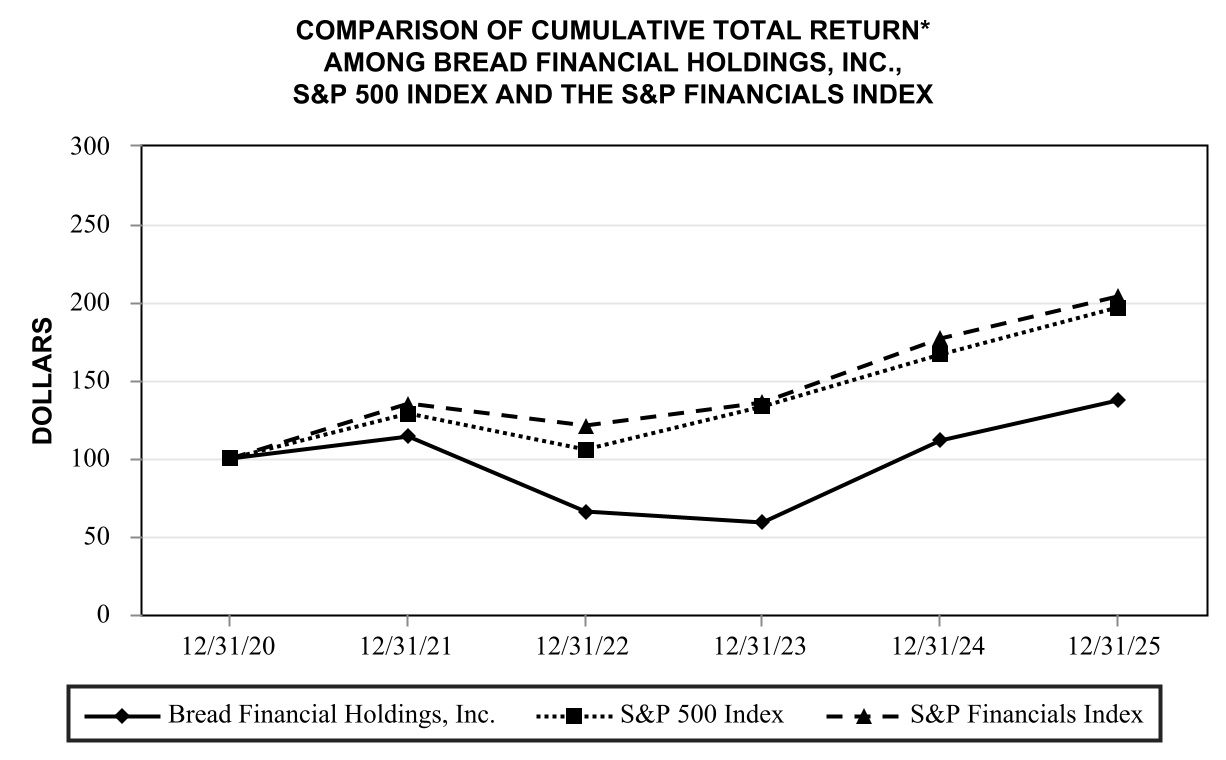
*$100 invested on December 31, 2020 in stock or index, including reinvestment of dividends.
Fiscal year end December 31.
Copyright© 2025 Standard & Poor’s, a division of S&P Global. All rights reserved.
| Bread Financial Holdings, Inc. | S&P 500 Index | S&P Financials Index | |||||||||||||||
| December 31, 2020 | $ | 100.00 | $ | 100.00 | $ | 100.00 | |||||||||||
| December 31, 2021 | 113.87 | 128.71 | 135.04 | ||||||||||||||
| December 31, 2022 | 65.53 | 105.40 | 120.81 | ||||||||||||||
| December 31, 2023 | 58.82 | 133.10 | 135.49 | ||||||||||||||
| December 31, 2024 | 111.09 | 166.40 | 176.89 | ||||||||||||||
| December 31, 2025 | 136.69 | 196.16 | 203.47 | ||||||||||||||
Our future filings with the SEC may “incorporate information by reference,” including this Annual Report on Form 10-K. Unless we specifically state otherwise, this Stock Performance Graph shall not be deemed to be incorporated by reference and shall not constitute soliciting material or otherwise be considered filed under the Securities Act of 1933, as amended, or the Securities Exchange Act of 1934, as amended.
Item 6. [Reserved]
55
Item 7. Management’s Discussion and Analysis of Financial Condition and Results of Operations (MD&A).
The following discussion and analysis of our results of operations and financial condition should be read in conjunction with our audited Consolidated Financial Statements and related Notes included elsewhere in this Annual Report on Form 10-K. Some of the information contained in this discussion and analysis constitutes forward-looking statements that involve risks and uncertainties. Actual results could differ materially from those discussed in these forward-looking statements. Factors that could cause or contribute to these differences include, but are not limited to, those discussed below and elsewhere in this Annual Report on Form 10-K, particularly under “Risk Factors” and “Cautionary Note Regarding Forward-Looking Statements.” Unless otherwise specified, references to Notes to our audited Consolidated Financial Statements are to the Notes to our audited Consolidated Financial Statements as of December 31, 2025 and 2024 and for years ended December 31, 2025, 2024 and 2023.
OVERVIEW
We are a tech-forward financial services company that provides simple, personalized payment, lending, and saving solutions to millions of U.S. consumers. Our payment solutions, including Bread Financial general purpose credit cards and savings products, empower our customers and their passions for a better life. Additionally, we deliver growth for some of the most recognized brands in travel and entertainment, health and beauty, jewelry and specialty apparel through our private label and co-brand credit cards and pay-over-time products providing choice and value to our shared customers.
We have continued to diversify our product mix with our brand partners through growth of our co-brand credit card programs, which, relative to our private label credit card programs, have higher credit sales per account and an improved credit risk mix that generally results in higher transactor balances, lower delinquencies and late fees, as well as lower losses. We also offer our proprietary credit cards along with the expansion of our Bread Pay products, which are our installment loans and “split-pay” offerings.
Our partner base consists of large consumer-based businesses, including well-known brands such as (alphabetically) AAA, Academy Sports + Outdoors, Caesars, Dell Technologies, Hard Rock International, the NFL, Raymour & Flanigan, Saks Fifth Avenue, Signet, Ulta and Victoria’s Secret, as well as small- and medium-sized businesses (SMBs). Our partner base is well diversified across a broad range of industries and retail verticals, including travel and entertainment, specialty apparel, health and beauty, jewelry, sporting goods, technology and electronics, as well as home and furniture. We believe our comprehensive suite of payment, lending and saving solutions, along with our related marketing and data and analytics, offers us a significant competitive advantage with products relevant across all customer segments (Gen Z, Millennial, Gen X and Baby Boomers). The breadth and quality of our product and service offerings, coupled with our customer-centric approach, have enabled us to establish and maintain long-standing partner relationships. We operate our business through a single reportable segment, with our primary source of revenue being from Interest and fees on loans from our various credit card and other loan products, and to a lesser extent from contractual relationships with our brand partners.
Throughout this report, unless stated or the context implies otherwise, the terms “Bread Financial,” “BFH,” the “Company,” “we,” “our” or “us” refer to Bread Financial Holdings, Inc. and its subsidiaries on a consolidated basis. References to “Parent Company” refer to Bread Financial Holdings, Inc. on a parent-only standalone basis. In addition, in this report we may refer to the retailers and other companies with whom we do business as our “partners,” “brand partners,” or “clients,” provided that the use of the term “partner,” “partnering” or any similar term does not mean or imply a formal legal partnership, and is not meant in any way to alter the terms of Bread Financial’s relationship with any third parties. We offer our credit products through our insured depository institution subsidiaries, Comenity Bank and Comenity Capital Bank, which together are referred to herein as the “Banks.”
NON-GAAP FINANCIAL MEASURES
We prepare our audited Consolidated Financial Statements in accordance with accounting principles generally accepted in the United States of America (GAAP). However, certain information included herein constitutes Non-GAAP Financial Measures. Our calculations of Non-GAAP Financial Measures may differ from the calculations of similarly titled measures by other companies. In particular:
•We have previously repurchased and may, from time to time, in the future continue to repurchase debt, including any outstanding senior unsecured notes, subordinated notes or convertible notes. In such transactions, we may pay a premium to induce these repurchases, or in certain cases repurchase at a discount, which, from a GAAP perspective, would result in an impact to Total non-interest expenses, with a corresponding impact also reflected
56
in Net income and consequently our Earnings per diluted share. For our prior debt repurchases, we show adjustments to these three financial statement line items, for total Company as well as for continuing operations, to exclude the impacts from our debt repurchases. We use Adjusted total non-interest expenses, Adjusted net income, and Adjusted earnings per diluted share to evaluate the ongoing operations of the Company excluding the volatility that can occur from the impacts of our debt repurchases.
•Pretax pre-provision earnings (PPNR) represents Income from continuing operations before income taxes and the Provision for credit losses. PPNR excluding any gain on portfolio sale and impacts from debt repurchases then excludes from PPNR the gain on any portfolio sale in the period, as well as the loss or gain on any debt repurchases in the period. We use PPNR and PPNR excluding any gain on portfolio sale and impacts from debt repurchases as metrics to evaluate our results of operations before income taxes, excluding the movements that can occur within Provision for credit losses and the one-time nature of a gain on the sale of a portfolio and/or the impacts from debt repurchases.
•Return on average tangible common equity (ROTCE) represents annualized Income from continuing operations less Dividends to preferred stockholders, divided by average Tangible common equity. Tangible common equity (TCE) represents Total stockholders’ equity reduced by Preferred stock and Goodwill and intangible assets, net. We use ROTCE as a metric to evaluate the Company’s performance.
•Tangible book value per common share represents TCE divided by common shares outstanding. We use Tangible book value per common share, a metric used across the industry, to assess capital and performance, in conjunction with ROTCE.
We believe the use of these Non-GAAP financial measures provide additional clarity in understanding our results of operations and trends. For a reconciliation of these Non-GAAP financial measures to the most directly comparable GAAP measures, please see Table 6: Reconciliation of GAAP to Non-GAAP Financial Measures that follows.
BUSINESS ENVIRONMENT
This Business Environment section provides an overview of our results of operations and financial position for the year ended December 31, 2025, as well as our related outlook for 2026 and certain of the uncertainties associated with achieving that outlook. This section should be read in conjunction with the other information appearing in this Annual Report on Form 10-K, including “Consolidated Results of Operations,” “Risk Factors,” and “Cautionary Note Regarding Forward-Looking Statements,” which provide further discussion of variances in our results of operations over the periods of comparison, along with other factors that could impact future results and the Company achieving its outlook.
Credit sales of $27.8 billion were up 3% when compared with 2024, reflecting new partner growth and higher general purpose cardholder spending. Average credit card and other loans of $17.9 billion decreased 1% while End-of-period credit card and other loans of $18.8 billion were flat; both being affected by an increasing payment rate and our disciplined credit management. Total interest income decreased 2% primarily as a result of lower billed late fees and a lower Average credit card and other loans balance, partially offset by lower reversals of finance charges and late fees, resulting from lower gross credit losses, and the ongoing implementation of pricing actions. Our lower delinquency volumes and the gradual shift in product mix to a lower proportion of private label accounts, which tend to have higher billed late fees, have resulted in lower overall billed late fees. Net interest margin was 18.4% in 2025 compared with 18.3% in 2024, primarily due to decreased funding costs which is reflective of our opportunistic debt actions and growth in our DTC deposits. Our net interest margin continues to be negatively impacted by lower billed late fees from lower delinquencies, as well as an elevated cash position and our gradual shift in product mix toward co-brand cards, offset by lower funding costs and the ongoing implementation of pricing actions. Non-interest income increased $13 million, due to the implementation of pricing actions, primarily paper statement fees, partially offset by an increase in costs associated with brand partner retailer share arrangements, along with a decrease in merchant discount fees from lower “big ticket” credit sales. Overall, Total net interest and non-interest income of $3.8 billion was flat versus 2024.
Provision for credit losses decreased relative to 2024 driven by a $135 million reserve release and net principal losses of $1.4 billion, compared with a $92 million reserve release and net principal losses of $1.5 billion in the prior year.
Our Allowance for credit losses decreased as of December 31, 2025 relative to December 31, 2024, due primarily to lower Credit card and other loans, as well as a decrease in the reserve rate over the period. Our reserve rate was 11.2% as of December 31, 2025 compared with 11.9% as of December 31, 2024, reflecting our improving credit metrics and higher-quality new account acquisitions. We continue to maintain appropriately prudent weightings on the economic scenarios in our credit reserve modeling to ensure the adequacy of our Allowance for credit losses given the wide range of potential macroeconomic outcomes, including ongoing uncertainty around inflation and unemployment. From an overall credit
57
quality perspective, our percentage of cardholders with Vantage scores greater than 660 remains above pre-pandemic levels due to prudent credit management and a more diversified product mix, with co-brand and proprietary cards representing a larger proportion of our portfolio.
Total non-interest expenses decreased 3% when compared with 2024, primarily as a result of the impacts from our debt repurchases of $74 million and $117 million for the years ended December 31, 2025 and 2024, respectively, as well as a decrease in Employee compensation and benefits due to prior year strategic adjustments in customer care staffing, partially offset by higher incentive compensation costs in the current year, along with a decrease in depreciation and amortization related to lower amortization from both capitalized software and premiums on historical credit card loan portfolios.
The efforts to strengthen and optimize our balance sheet continued in 2025. Throughout 2025 we engaged in a number of financing-related transactions, including the issuances of senior and subordinated notes, the completion of tender offers to repurchase certain outstanding senior and subordinated notes, the redemption of certain senior notes and the completion of the repurchases of 100% of our outstanding convertible senior notes. During the year we announced a total of $550 million in board-authorized common stock repurchase programs, repurchasing 5.7 million shares of common stock for a total of $310 million, and we issued 75,000 shares of preferred stock for gross proceeds of $75 million. Our Common equity tier 1 capital ratio (CET1) increased to 13.0%, from 12.4% as of December 31, 2024, driven by net earnings throughout the year, partially offset by the effects from both our repurchased shares and debt securities. Additionally, DTC deposits increased to $8.5 billion as of December 31, 2025, with average DTC deposits now representing 48% of our total funding sources, which is comprised of retail and wholesale deposits, and secured and unsecured borrowings, up from 43% a year ago.
Our 2026 financial outlook is based on continued consumer resilience, inflation remaining above the FRB’s target rate of 2%, and a generally stable labor market. Our outlook also anticipates interest rate decreases by the FRB, which we would expect to result in slight Net interest margin compression.
Based on our current economic outlook and visibility into our new business pipeline and partner growth, as well as both expected continued improvement in our Net principal loss rate and our ongoing expectations for strong cardholder payment rates, we expect growth in 2026 Average credit card and other loans to be up low-single digits on a percentage point basis from full year 2025. Growth in Total net interest and non-interest income is also anticipated to be up in the low-single digits on a percentage point basis from 2025, in line with growth in Average credit card and other loans. Our outlook for full year Net interest margin has a wide range of potential outcomes given it is impacted by many variables; however, our baseline expectation is that it will be flat to modestly higher than 2025 as a result of continued benefits from implemented pricing actions and an improving cost of funds, partially offset by interest rate decreases by the FRB, lower billed late fees from improving delinquency trends and continued shifts in risk and product mix.
We manage expense growth based on revenue generation and investment opportunities, and expect to deliver positive operating leverage in 2026, excluding the pretax impacts from our debt repurchases, a Non-GAAP financial measure. We continue to invest in AI capabilities, technology modernization, marketing, and product innovation to drive growth and efficiencies. However, the degree of positive operating leverage will be dependent upon macroeconomic factors, and related to improvement in the credit environment, growth in Average credit card and other loans, and the pace and timing of further interest rate decreases by the FRB.
Our 2026 financial outlook also assumes a Net principal loss rate ranging from 7.2% to 7.4% given a resilient consumer, our disciplined credit management, and continued shifts in risk and product mix.
In our 2026 financial outlook we also expect our full year normalized effective tax rate to be in the range of 25% to 27%, with quarter-over-quarter variability due to the timing of certain discrete items.
Our 2025 results reflect our prudent capital allocation, a disciplined credit management framework, and our focus on responsible growth. Supported by strong capital levels and cash flow generation, we are well positioned to execute on our capital and growth priorities while delivering sustainable, long-term value for our stockholders.
Note: We are unable to provide a quantitative reconciliation of the forward-looking 2026 financial outlook for the Non-GAAP financial measure above, to its most directly comparable forward-looking GAAP measure, as we cannot reliably predict all of the necessary components of such a forward-looking GAAP measure without unreasonable effort.
58
CONSOLIDATED RESULTS OF OPERATIONS
The following discussion provides commentary on the variances in our results of operations for the year ended December 31, 2025, compared with the year ended December 31, 2024, as presented in the accompanying tables. This discussion should be read in conjunction with the discussion under “Business Environment,” above. For a discussion of the financial condition and results of operations for 2024 compared with 2023, please refer to Part II, Item 7. “Management’s Discussion and Analysis of Financial Condition and Results of Operations (MD&A)” in our Annual Report on Form 10-K for the year ended December 31, 2024, filed with the SEC on February 14, 2025, which discussion is incorporated herein by reference from such prior report on Form 10-K.
Table 1: Summary of Our Financial Performance
| Years Ended December 31, | $ Change | % Change | |||||||||||||||||||||||||||||||||||||||
| 2025 | 2024 | 2023 | 2025 to 2024 | 2024 to 2023 | 2025 to 2024 | 2024 to 2023 | |||||||||||||||||||||||||||||||||||
| (Millions, except per share amounts and percentages) | |||||||||||||||||||||||||||||||||||||||||
| Total net interest and non-interest income | $ | 3,845 | $ | 3,838 | $ | 4,289 | $ | 7 | $ | (451) | — | (11) | |||||||||||||||||||||||||||||
| Provision for credit losses | 1,242 | 1,397 | 1,229 | (155) | 168 | (11) | 14 | ||||||||||||||||||||||||||||||||||
| Total non-interest expenses | 1,988 | 2,060 | 2,092 | (72) | (32) | (3) | (2) | ||||||||||||||||||||||||||||||||||
| Income from continuing operations before income taxes | 615 | 381 | 968 | 234 | (587) | 61 | (61) | ||||||||||||||||||||||||||||||||||
| Provision for income taxes | 94 | 102 | 231 | (8) | (129) | (9) | (56) | ||||||||||||||||||||||||||||||||||
| Income from continuing operations | 521 | 279 | 737 | 242 | (458) | 87 | (62) | ||||||||||||||||||||||||||||||||||
Loss from discontinued operations, net of income taxes (1) | (3) | (2) | (19) | (1) | 17 | 40 | (87) | ||||||||||||||||||||||||||||||||||
| Net income available to common stockholders | 518 | 277 | 718 | 241 | (441) | 87 | (61) | ||||||||||||||||||||||||||||||||||
Adjusted net income *(2) | $ | 575 | $ | 388 | $ | 719 | $ | 187 | $ | (331) | 48 | (46) | |||||||||||||||||||||||||||||
| Net income per diluted share | $ | 10.89 | $ | 5.49 | $ | 14.34 | $ | 5.40 | $ | (8.85) | 98 | (62) | |||||||||||||||||||||||||||||
Adjusted net income per diluted share *(2) | $ | 12.09 | $ | 7.69 | $ | 14.36 | $ | 4.40 | $ | (6.67) | 57 | (46) | |||||||||||||||||||||||||||||
| Income from continuing operations per diluted share | $ | 10.96 | $ | 5.54 | $ | 14.74 | $ | 5.42 | $ | (9.20) | 98 | (62) | |||||||||||||||||||||||||||||
Adjusted income from continuing operations per diluted share *(2) | $ | 12.16 | $ | 7.74 | $ | 14.76 | $ | 4.42 | $ | (7.02) | 57 | (48) | |||||||||||||||||||||||||||||
Net interest margin (3) | 18.4 | % | 18.3 | % | 19.5 | % | 0.1 | (1.2) | |||||||||||||||||||||||||||||||||
Return on average tangible common equity *(4) | 20.4 | % | 11.4 | % | 38.0 | % | 9.0 | (26.6) | |||||||||||||||||||||||||||||||||
| Effective income tax rate — continuing operations | 15.2 | % | 26.7 | % | 23.8 | % | (11.5) | 2.9 | |||||||||||||||||||||||||||||||||
______________________________
*Represents a Non-GAAP financial measure. See “Non-GAAP Financial Measures” and Table 6: Reconciliation of GAAP to Non-GAAP Financial Measures.
(1)Includes amounts that related to the previously disclosed discontinued operations associated with the spinoff of our former LoyaltyOne segment in 2021 and the sale of our former Epsilon segment in 2019. For additional information refer to Note 1, “Description of Business, Basis of Presentation and Significant Accounting Policies” to the audited Consolidated Financial Statements.
(2)Adjusts Net income, Net income per diluted share, and Income from continuing operations per diluted share for the impacts from our debt repurchases.
(3)Net interest margin represents annualized Net interest income divided by average Total interest-earning assets. See also Table 5: Net Interest Margin.
(4)Return on average tangible common equity (ROTCE) represents annualized Income from continuing operations, less Dividends to preferred stockholders, divided by average Tangible common equity. Tangible common equity (TCE) represents Total stockholders’ equity reduced by Preferred stock and Goodwill and intangible assets, net.
59
Table 2: Summary of Total Net Interest and Non-interest Income, After Provision for Credit Losses
| Years Ended December 31, | $ Change | % Change | |||||||||||||||||||||||||||||||||||||||
| 2025 | 2024 | 2023 | 2025 to 2024 | 2024 to 2023 | 2025 to 2024 | 2024 to 2023 | |||||||||||||||||||||||||||||||||||
| (Millions, except percentages) | |||||||||||||||||||||||||||||||||||||||||
| Interest income | |||||||||||||||||||||||||||||||||||||||||
| Interest and fees on loans | $ | 4,739 | $ | 4,820 | $ | 4,961 | $ | (81) | $ | (141) | (2) | (3) | |||||||||||||||||||||||||||||
| Interest on cash and investment securities | 173 | 204 | 184 | (31) | 20 | (16) | 11 | ||||||||||||||||||||||||||||||||||
| Total interest income | 4,912 | 5,024 | 5,145 | (112) | (121) | (2) | (2) | ||||||||||||||||||||||||||||||||||
| Interest expense | |||||||||||||||||||||||||||||||||||||||||
| Interest on deposits | 554 | 608 | 541 | (54) | 67 | (9) | 12 | ||||||||||||||||||||||||||||||||||
| Interest on borrowings | 300 | 352 | 338 | (52) | 14 | (15) | 4 | ||||||||||||||||||||||||||||||||||
| Total interest expense | 854 | 960 | 879 | (106) | 81 | (11) | 9 | ||||||||||||||||||||||||||||||||||
| Net interest income | 4,058 | 4,064 | 4,266 | (6) | (202) | — | (5) | ||||||||||||||||||||||||||||||||||
| Non-interest income | |||||||||||||||||||||||||||||||||||||||||
| Interchange revenue, net of retailer share arrangements | (416) | (381) | (335) | (35) | (46) | 9 | 14 | ||||||||||||||||||||||||||||||||||
| Gain on portfolio sale | 3 | 11 | 230 | (8) | (219) | (71) | (95) | ||||||||||||||||||||||||||||||||||
| Other | 200 | 144 | 128 | 56 | 16 | 38 | 12 | ||||||||||||||||||||||||||||||||||
| Total non-interest income | (213) | (226) | 23 | 13 | (249) | (6) | nm | ||||||||||||||||||||||||||||||||||
| Total net interest and non-interest income | 3,845 | 3,838 | 4,289 | 7 | (451) | — | (11) | ||||||||||||||||||||||||||||||||||
| Provision for credit losses | 1,242 | 1,397 | 1,229 | (155) | 168 | (11) | 14 | ||||||||||||||||||||||||||||||||||
| Total net interest and non-interest income, after provision for credit losses | $ | 2,603 | $ | 2,441 | $ | 3,060 | $ | 162 | $ | (619) | 7 | (20) | |||||||||||||||||||||||||||||
______________________________
(nm) Not meaningful, denoting a variance of 1,000 percent or more.
Total Net Interest and Non-interest Income, After Provision for Credit Losses
Interest income: Total interest income decreased for the year ended December 31, 2025, due to the following:
•Interest and fees on loans decreased due primarily to lower billed late fees and lower Average credit card and other loans balances, partially offset by lower reversals of finance charges and late fees, resulting from lower gross credit losses, and the ongoing implementation of pricing actions; collectively decreasing the yield on finance charges and late fees by approximately 10 basis points. Our lower delinquency volumes and the gradual shift in product mix to a lower proportion of private label accounts, which tend to have higher billed late fees, have resulted in lower overall billed late fees.
•Interest on cash and investment securities decreased due to lower average interest rates which decreased interest income by $37 million, partially offset by higher average balances, which increased interest income by $6 million.
Interest expense: Total interest expense decreased for the year ended December 31, 2025, due to the following:
•Interest on deposits decreased primarily due to lower average interest rates which decreased interest expense by $65 million, partially offset by higher average DTC deposit balances which increased funding costs by $11 million.
•Interest on borrowings decreased due to lower average borrowings which decreased funding costs by $30 million, and lower average interest rates which decreased funding costs by $22 million.
60
Non-interest income: Total non-interest income increased for the year ended December 31, 2025, due to the following:
•Interchange revenue, net of retailer share arrangements, typically a contra-revenue item for us, increased due to an increase in costs associated with brand partner retailer share arrangements, along with a decrease in merchant discount fees from lower “big ticket” credit sales.
•Other increased due to our implemented pricing actions, primarily paper statement fees, which we began assessing in the second quarter of 2024.
Provision for credit losses decreased for the year ended December 31, 2025, driven by a $135 million reserve release and net principal losses of $1.4 billion, compared with a $92 million reserve release and net principal losses of $1.5 billion in the prior year. Our reserve rate was 11.2% as of December 31, 2025, reflecting our improving credit metrics and higher-quality new account acquisitions. We continue to maintain appropriately prudent weightings on the economic scenarios in our credit reserve modeling to ensure the adequacy of our Allowance for credit losses given the wide range of potential macroeconomic outcomes, including ongoing uncertainty around inflation and unemployment.
Table 3: Summary of Total Non-interest Expenses
| Years Ended December 31, | $ Change | % Change | |||||||||||||||||||||||||||||||||||||||
| 2025 | 2024 | 2023 | 2025 to 2024 | 2024 to 2023 | 2025 to 2024 | 2024 to 2023 | |||||||||||||||||||||||||||||||||||
| (Millions, except percentages) | |||||||||||||||||||||||||||||||||||||||||
| Non-interest expenses | |||||||||||||||||||||||||||||||||||||||||
| Employee compensation and benefits | $ | 880 | $ | 897 | $ | 867 | $ | (17) | $ | 30 | (2) | 3 | |||||||||||||||||||||||||||||
| Card and processing expenses | 322 | 326 | 428 | (4) | (102) | (1) | (24) | ||||||||||||||||||||||||||||||||||
| Information processing and communication | 308 | 300 | 301 | 8 | (1) | 3 | — | ||||||||||||||||||||||||||||||||||
| Marketing expenses | 150 | 147 | 161 | 3 | (14) | 2 | (9) | ||||||||||||||||||||||||||||||||||
| Depreciation and amortization | 80 | 90 | 116 | (10) | (26) | (11) | (22) | ||||||||||||||||||||||||||||||||||
| Other | 248 | 300 | 219 | (52) | 81 | (17) | 36 | ||||||||||||||||||||||||||||||||||
| Total non-interest expenses | $ | 1,988 | $ | 2,060 | $ | 2,092 | $ | (72) | $ | (32) | (3) | (2) | |||||||||||||||||||||||||||||
Adjusted total non-interest expenses (1) | $ | 1,914 | $ | 1,943 | $ | 2,091 | $ | (29) | $ | (148) | (1) | (7) | |||||||||||||||||||||||||||||
__________________________________
(1)Adjusts Total non-interest expenses for the impacts from our debt repurchases, representing $74 million and $117 million and $1 million for the years ended December 31, 2025, 2024 and 2023, respectively, and therefore represent Non-GAAP financial measures. See “Non-GAAP Financial Measures” and Table 6: Reconciliation of GAAP to Non-GAAP Financial Measures.
Total Non-interest Expenses
Non-interest expenses: Total non-interest expenses decreased for the year ended December 31, 2025. Adjusted total non-interest expenses, which represents a Non-GAAP financial measure and has been adjusted for the impacts from our debt repurchases, also decreased over the periods of comparison.
•Employee compensation and benefits decreased due primarily to strategic adjustments in customer care staffing in the prior year, partially offset by higher incentive compensation in the current year.
•Depreciation and amortization decreased due to lower amortization related to both capitalized software and premiums on historical credit card loan portfolio acquisitions.
•Other decreased due primarily to higher year-over-year net impact from our debt repurchases.
Income Taxes
The Provision for income taxes decreased for the year ended December 31, 2025. The effective tax rate was 15.2% and 26.7% for the years ended December 31, 2025 and 2024, respectively. Both the decreases in the Provision for
income taxes and in the effective tax rates over the periods of comparison were primarily driven by a discrete tax benefit in the current year and larger non-deductible items in the prior year, partially offset by a $234 million increase in Income from continuing operations before income taxes in 2025.
61
On July 4, 2025, President Trump signed into law “The One Big Beautiful Bill Act” (the Bill). The Bill reinstates several provisions of the 2017 Tax Cuts and Jobs Act for businesses. The Bill did not have a significant impact on our financial position, results of operations or cash flows, nor do we expect it to have a significant impact in future periods. We also do not anticipate any significant changes to operational processes, controls or governance as a result of the Bill, either currently or in future periods.
Discontinued Operations
The Loss from discontinued operations, net of income taxes includes amounts that relate to the previously disclosed discontinued operations associated with the spinoff of our former LoyaltyOne segment in 2021 and the sale of our former Epsilon segment in 2019, and primarily relates to contractual indemnification and tax-related matters. For additional information refer to Note 22, “Discontinued Operations and Bank Holding Company Financial Presentation” to the audited Consolidated Financial Statements included in our Annual Report on Form 10-K for the year ended December 31, 2021.
Table 4: Summary Financial Highlights – Continuing Operations
| As of or for the Years Ended December 31, | % Change | ||||||||||||||||||||||||||||
| 2025 | 2024 | 2023 | 2025 to 2024 | 2024 to 2023 | |||||||||||||||||||||||||
| (Millions, except per share amounts and percentages) | |||||||||||||||||||||||||||||
| Credit sales | $ | 27,777 | $ | 26,962 | $ | 28,900 | 3 | (7) | |||||||||||||||||||||
PPNR *(1) | 1,857 | 1,778 | 2,197 | 4 | (19) | ||||||||||||||||||||||||
PPNR excluding gain on portfolio sale and impacts from debt repurchases *(1) | 1,928 | 1,884 | 1,968 | 2 | (4) | ||||||||||||||||||||||||
| Average credit card and other loans | 17,850 | 18,084 | 18,216 | (1) | (1) | ||||||||||||||||||||||||
| End-of-period credit card and other loans | 18,805 | 18,896 | 19,333 | — | (2) | ||||||||||||||||||||||||
| End-of-period direct-to-consumer (retail) deposits | 8,523 | 7,687 | 6,454 | 11 | 19 | ||||||||||||||||||||||||
Return on average assets (2) | 2.4 | % | 1.3 | % | 3.3 | % | 1.1 | (2.0) | |||||||||||||||||||||
Return on average equity (3) | 15.8 | % | 8.7 | % | 27.1 | % | 7.1 | (18.4) | |||||||||||||||||||||
Return on average tangible common equity *(4) | 20.4 | % | 11.4 | % | 38.0 | % | 9.0 | (26.6) | |||||||||||||||||||||
Net interest margin (5) | 18.4 | % | 18.3 | % | 19.5 | % | 0.1 | (1.2) | |||||||||||||||||||||
Loan yield (6) | 26.6 | % | 26.7 | % | 27.2 | % | (0.1) | (0.5) | |||||||||||||||||||||
Efficiency ratio (7) | 51.7 | % | 53.7 | % | 48.8 | % | (2.0) | 4.9 | |||||||||||||||||||||
Adjusted efficiency ratio (7) | 49.8 | % | 50.8 | % | 51.5 | % | (1.0) | (0.7) | |||||||||||||||||||||
Common equity tier 1 capital ratio (8) | 13.0 | % | 12.4 | % | 12.2 | % | 0.6 | 0.2 | |||||||||||||||||||||
Tangible book value per common share *(9) | $ | 57.57 | $ | 46.97 | $ | 43.70 | 23 | 7 | |||||||||||||||||||||
| Cash dividend per common share | $ | 0.86 | $ | 0.84 | $ | 0.84 | 2 | — | |||||||||||||||||||||
Payment rate (10) | 14.9 | % | 14.5 | % | 14.9 | % | 0.4 | (0.4) | |||||||||||||||||||||
Delinquency rate (11) | 5.8 | % | 5.9 | % | 6.5 | % | (0.1) | (0.6) | |||||||||||||||||||||
Net principal loss rate (12) | 7.7 | % | 8.2 | % | 7.5 | % | (0.5) | 0.7 | |||||||||||||||||||||
Reserve rate (13) | 11.2 | % | 11.9 | % | 12.0 | % | (0.7) | (0.1) | |||||||||||||||||||||
______________________________
Note: Beginning in 2024, we revised the calculation of average balances to more closely align with industry practice by incorporating an average daily balance. Prior to 2024, average balances represent the average balance at the beginning and end of each month, averaged over the periods indicated.
*Represents a Non-GAAP financial measure. See “Non-GAAP Financial Measures” and Table 6: Reconciliation of GAAP to Non-GAAP Financial Measures.
(1)PPNR represents Income from continuing operations before income taxes and the Provision for credit losses. PPNR excluding gain on portfolio sale and impacts from debt repurchases excludes from PPNR any gain on portfolio sale in the period, as well as the impacts from our debt repurchases in the period.
(2)Return on average assets represents annualized Income from continuing operations divided by average Total assets.
62
(3)Return on average equity represents annualized Income from continuing operations divided by average Total stockholders’ equity.
(4)Return on average tangible common equity (ROTCE) represents annualized Income from continuing operations, less Dividends to preferred stockholders, divided by average Tangible common equity. Tangible common equity (TCE) represents Total stockholders’ equity reduced by Preferred stock and Goodwill and intangible assets, net.
(5)Net interest margin represents annualized Net interest income divided by average Total interest-earning assets. See also Table 5: Net Interest Margin.
(6)Loan yield represents annualized Interest and fees on loans divided by Average credit card and other loans.
(7)Efficiency ratio represents Total non-interest expenses divided by Total net interest and non-interest income. Adjusted efficiency ratio excludes any gain on portfolio sale and impacts from debt repurchases.
(8)Common equity tier 1 capital ratio represents tier 1 capital reduced by Preferred stock divided by total risk-weighted assets. In the calculation of tier 1 capital, we follow the Basel III Standardized Approach and therefore Total stockholders’ equity has been reduced by Goodwill and intangible assets, net. For additional information, see “Legislative, Regulatory Matters and Capital Adequacy” included elsewhere in this report.
(9)Tangible book value per common share represents TCE divided by common shares outstanding.
(10)Payment rate represents consumer payments during the period, divided by the aggregate of the opening monthly Credit card and other loans balances during the period, including held for sale in applicable periods.
(11)Delinquency rate represents outstanding balances that are contractually delinquent (i.e., principal balances greater than 30 days past due) as of the end of the period, divided by the outstanding principal amount of Credit card and other loans as of the same period-end.
(12)Net principal loss rate, an annualized rate, represents net principal losses for the period divided by Average credit card and other loans for the same period, using an average daily balance calculation methodology. Net principal loss rate for the year ended December 31, 2023 was impacted by the transition of our credit card processing services in June 2022.
(13)Reserve rate represents the Allowance for credit losses divided by End-of-period credit card and other loans.
63
Table 5: Net Interest Margin
| Year Ended December 31, 2025 | |||||||||||||||||
| Average Balance | Interest Income / Expense | Average Yield / Rate | |||||||||||||||
| (Millions, except percentages) | |||||||||||||||||
| Cash and investment securities | $ | 4,232 | $ | 173 | 4.08 | % | |||||||||||
| Credit card and other loans | 17,850 | 4,739 | 26.55 | % | |||||||||||||
| Total interest-earning assets | 22,082 | 4,912 | 22.24 | % | |||||||||||||
| Direct-to-consumer (retail) deposits | 8,087 | 349 | 4.31 | % | |||||||||||||
| Wholesale deposits | 5,252 | 205 | 3.91 | % | |||||||||||||
| Interest-bearing deposits | 13,339 | 554 | 4.15 | % | |||||||||||||
| Secured borrowings | 3,306 | 192 | 5.79 | % | |||||||||||||
| Unsecured borrowings | 1,115 | 108 | 9.72 | % | |||||||||||||
| Interest-bearing borrowings | 4,421 | 300 | 6.78 | % | |||||||||||||
| Total interest-bearing liabilities | 17,760 | 854 | 4.81 | % | |||||||||||||
| Net interest income | $ | 4,058 | |||||||||||||||
Net interest margin (1) | 18.4 | % | |||||||||||||||
| Year Ended December 31, 2024 | |||||||||||||||||
| Average Balance | Interest Income / Expense | Average Yield / Rate | |||||||||||||||
| (Millions, except percentages) | |||||||||||||||||
| Cash and investment securities | $ | 4,116 | $ | 204 | 4.96 | % | |||||||||||
| Credit card and other loans | 18,084 | 4,820 | 26.65 | % | |||||||||||||
| Total interest-earning assets | 22,200 | 5,024 | 22.63 | % | |||||||||||||
| Direct-to-consumer (retail) deposits | 7,174 | 349 | 4.86 | % | |||||||||||||
| Wholesale deposits | 5,919 | 259 | 4.38 | % | |||||||||||||
| Interest-bearing deposits | 13,093 | 608 | 4.64 | % | |||||||||||||
| Secured borrowings | 3,576 | 236 | 6.58 | % | |||||||||||||
| Unsecured borrowings | 1,247 | 116 | 9.33 | % | |||||||||||||
| Interest-bearing borrowings | 4,823 | 352 | 7.29 | % | |||||||||||||
| Total interest-bearing liabilities | 17,916 | 960 | 5.36 | % | |||||||||||||
| Net interest income | $ | 4,064 | |||||||||||||||
Net interest margin (1) | 18.3 | % | |||||||||||||||
______________________________
(1)Net interest margin represents annualized Net interest income divided by average Total interest-earning assets.
64
Table 6: Reconciliation of GAAP to Non-GAAP Financial Measures
| Years Ended December 31, | % Change | ||||||||||||||||||||||||||||
| 2025 | 2024 | 2023 | 2025 to 2024 | 2024 to 2023 | |||||||||||||||||||||||||
| (Millions, except per share amounts and percentages) | |||||||||||||||||||||||||||||
| Adjusted net income available to common stockholders | |||||||||||||||||||||||||||||
| Net income available to common stockholders | $ | 518 | $ | 277 | $ | 718 | 87 | (61) | |||||||||||||||||||||
| Impacts from debt repurchases | 57 | 111 | 1 | (49) | nm | ||||||||||||||||||||||||
| Adjusted net income available to common stockholders | $ | 575 | $ | 388 | $ | 719 | 48 | (46) | |||||||||||||||||||||
| Adjusted net income available to common stockholders per diluted share | |||||||||||||||||||||||||||||
| Net income available to common stockholders per diluted share | $ | 10.89 | $ | 5.49 | $ | 14.34 | 98 | (62) | |||||||||||||||||||||
| Impacts from debt repurchases | $ | 1.20 | $ | 2.20 | $ | 0.02 | (46) | nm | |||||||||||||||||||||
| Adjusted net income available to common stockholders per diluted share | $ | 12.09 | $ | 7.69 | $ | 14.36 | 57 | (46) | |||||||||||||||||||||
| Adjusted income from continuing operations per diluted share | |||||||||||||||||||||||||||||
| Income from continuing operations per diluted share | $ | 10.96 | $ | 5.54 | $ | 14.74 | 98 | (62) | |||||||||||||||||||||
| Impacts from debt repurchases | $ | 1.20 | $ | 2.20 | $ | 0.02 | (46) | nm | |||||||||||||||||||||
| Adjusted income from continuing operations per diluted share | $ | 12.16 | $ | 7.74 | $ | 14.76 | 57 | (48) | |||||||||||||||||||||
| Adjusted total non-interest expenses | |||||||||||||||||||||||||||||
| Total non-interest expenses | $ | 1,988 | $ | 2,060 | $ | 2,092 | (3) | (2) | |||||||||||||||||||||
| Impacts from debt repurchases | 74 | 117 | 1 | (36) | nm | ||||||||||||||||||||||||
| Adjusted total non-interest expenses | 1,914 | 1,943 | 2,091 | (1) | (7) | ||||||||||||||||||||||||
| Pretax pre-provision earnings (PPNR) | |||||||||||||||||||||||||||||
| Income from continuing operations before income taxes | 615 | 381 | 968 | 61 | (61) | ||||||||||||||||||||||||
| Provision for credit losses | 1,242 | 1,397 | 1,229 | (11) | 14 | ||||||||||||||||||||||||
| Pretax pre-provision earnings (PPNR) | 1,857 | 1,778 | 2,197 | 4 | (19) | ||||||||||||||||||||||||
| Less: Gain on portfolio sale | (3) | (11) | (230) | (71) | (95) | ||||||||||||||||||||||||
| Add: Impacts from debt repurchases | 74 | 117 | 1 | (36) | nm | ||||||||||||||||||||||||
| PPNR excluding gain on portfolio sale and impacts from debt repurchases | 1,928 | 1,884 | 1,968 | 2 | (4) | ||||||||||||||||||||||||
| Average tangible common equity | |||||||||||||||||||||||||||||
| Average total stockholders’ equity | 3,293 | 3,214 | 2,722 | 2 | 18 | ||||||||||||||||||||||||
| Less: Average preferred stock | (7) | — | — | nm | — | ||||||||||||||||||||||||
| Less: Average goodwill and intangible assets, net | (733) | (753) | (780) | (3) | (4) | ||||||||||||||||||||||||
| Average tangible common equity | 2,553 | 2,461 | 1,942 | 4 | 27 | ||||||||||||||||||||||||
| Tangible common equity (TCE) | |||||||||||||||||||||||||||||
| Total stockholders’ equity | 3,327 | 3,051 | 2,918 | 9 | 5 | ||||||||||||||||||||||||
| Less: Preferred stock | (71) | — | — | nm | — | ||||||||||||||||||||||||
| Less: Goodwill and intangible assets, net | (716) | (746) | (762) | (4) | (2) | ||||||||||||||||||||||||
| Tangible common equity (TCE) | $ | 2,540 | $ | 2,305 | $ | 2,156 | 10 | 7 | |||||||||||||||||||||
(nm) Not meaningful, denoting a variance of 1,000 percent or more.
65
ASSET QUALITY
Given the nature of our business, the credit quality of our assets, in particular our Credit card and other loans, is a key determinant underlying our ongoing financial performance and overall financial condition. When it comes to our Credit card and other loans portfolio, we closely monitor Delinquency rates and Net principal loss rates, which reflect, among other factors, our underwriting, the inherent credit risk in our portfolio and the success of our collection and recovery efforts. These rates also reflect, more broadly, the general macroeconomic conditions, including the compounding effect of persistent inflation relative to wage growth, and higher interest rates. Our Delinquency and Net principal loss rates are also impacted by the size of our Credit card and other loans portfolio, which serves as the denominator in the calculation of these rates. Accordingly, changes in the size of our portfolio (whether due to credit tightening, acquisitions or dispositions of portfolios, or otherwise) may cause movements in our Delinquency and Net principal loss rates that are not necessarily indicative of the underlying credit quality of the overall portfolio.
Delinquencies: An account is contractually delinquent if we do not receive the minimum payment due by the specified due date. Our policy is to continue to accrue interest and fee income on all accounts, except in limited circumstances, until the balance and all related interest and fees are paid or charged-off. After an account becomes 30 days past due, a proprietary collection scoring algorithm automatically scores the risk of the account becoming further delinquent; based upon the level of risk indicated, a collection strategy is deployed, which may include tech-enabled, targeted collections strategies to engage with cardholders in the most efficient communication channel. If after exhausting all in-house collection efforts we are unable to collect on the account, we may engage collection agencies or outside attorneys to continue those efforts, or sell the charged-off balances.
The Delinquency rate is calculated by dividing outstanding principal balances that are contractually delinquent (i.e., principal balances greater than 30 days past due) as of the end of the period, by the outstanding principal amount of Credit card and other loans as of the same period-end.
The following table provides the delinquency trends on our Credit card and other loans portfolio based on the principal balances outstanding as of December 31:
Table 7: Delinquency Trends on Credit Card and Other Loans
| 2025 | % of Total | 2024 | % of Total | ||||||||||||||||||||
| (Millions, except percentages) | |||||||||||||||||||||||
| Credit card and other loans outstanding ─ principal | $ | 16,886 | 100.0 | % | $ | 17,418 | 100.0 | % | |||||||||||||||
| Outstanding balances contractually delinquent: | |||||||||||||||||||||||
| 31 to 60 days | 283 | 1.7 | % | 299 | 1.7 | % | |||||||||||||||||
| 61 to 90 days | 215 | 1.3 | % | 223 | 1.3 | % | |||||||||||||||||
| 91 or more days | 473 | 2.8 | % | 512 | 2.9 | % | |||||||||||||||||
| Total | $ | 971 | 5.8 | % | $ | 1,034 | 5.9 | % | |||||||||||||||
As part of our collections strategy, we may offer temporary and short term programs in order to improve the likelihood of collections and meet the needs of our customers. For example, as a result of hurricanes Helene and Milton in September and October of 2024, respectively, we froze delinquency progression for cardholders in FEMA identified impact zones for one billing cycle. Our modifications, for customers who have requested assistance and meet certain qualifying requirements, come in the form of reduced payment requirements, interest rate reductions and late fee waivers. We do not offer programs involving the forgiveness of principal. These temporary loan modifications may assist in cases where we believe the customer will recover from the short-term hardship and resume scheduled payments. Under these consumer relief programs, those accounts receiving relief may not advance to the next delinquency cycle, including charge-off, in the same time frame that would have occurred had the relief not been granted. We evaluate our consumer relief programs to determine if they represent a more than insignificant delay in payment granted to borrowers experiencing financial difficulty, in which case they would then be considered a Loan Modification. For additional information, see Note 2 “Credit Card and Other Loans – Modified Credit Card Loans” to our audited Consolidated Financial Statements.
Net Principal Losses: Our net principal losses include the principal amount of Credit card and other loans that are deemed uncollectible, less recoveries, and exclude charged-off interest, fees and third-party fraud losses (including synthetic fraud).
66
Charged-off interest and fees reduce Interest and fees on loans, while third-party fraud losses are recorded in Card and processing expenses. Our credit card loans, including unpaid interest and fees, are generally charged-off in the month during which an account becomes 180 days past due. Our pay-over-time products, which include installment loans and “split-pay” offerings, including unpaid interest, are generally charged-off when a loan becomes 120 days past due. However, in the case of a customer bankruptcy or death, Credit card and other loans, including unpaid interest and fees, as applicable, are charged-off 60 days after receipt of the notification of the bankruptcy or death, but in any case no later than 180 days past due for credit card loans and 120 days past due for installment loans and “split-pay” offerings.
The Net principal loss rate is calculated by dividing net principal losses for the period by the Average credit card and other loans for the same period. Beginning in January 2024, we revised the calculation of Average credit card and other loans to more closely align with industry practice by incorporating an average daily balance. Prior to 2024, Average credit card and other loans represent the average balance of the loans at the beginning and end of each month, averaged over the periods indicated. The following table provides our net principal losses for the periods presented:
Table 8: Net Principal Losses on Credit Card and Other Loans
| 2025 | 2024 | 2023 | |||||||||||||||
| (Millions, except percentages) | |||||||||||||||||
Average credit card and other loans | $ | 17,850 | $ | 18,084 | $ | 18,216 | |||||||||||
Net principal losses (1)(2) | 1,377 | 1,489 | 1,365 | ||||||||||||||
Net principal losses as a percentage of average credit card and other loans (1)(2) | 7.7 | % | 8.2 | % | 7.5 | % | |||||||||||
______________________________
(1)As a result of hurricanes Helene and Milton we froze delinquency progression for cardholders in FEMA identified impact zones for one billing cycle, which resulted in modestly lower Net principal losses and Net principal losses as a percentage of average credit card and other loans in the fourth quarter of 2024, and consequently these actions negatively impacted Net principal losses and Net principal losses as a percentage of average credit card and other loans in the second quarter of 2025.
(2)Net principal losses and Net principal losses as a percentage of average credit card and other loans for December 31, 2023 were impacted by the transition of our credit card processing services in June 2022.
CONSOLIDATED LIQUIDITY AND CAPITAL RESOURCES
Overview
We maintain a strong focus on liquidity and capital. Our funding, liquidity and capital policies are designed to ensure that our business has sufficient liquidity and capital resources necessary to support our daily operations, our business growth, and our credit ratings related to our Parent Company’s senior unsecured notes, subordinated notes, preferred stock and our public secured financings, and meet our regulatory and policy requirements, including capital and leverage ratio requirements applicable to Comenity Bank (CB) and Comenity Capital Bank (CCB) under FDIC regulations, in a cost effective and prudent manner through both expected and unexpected market environments.
Our primary sources of liquidity include cash generated from operating activities, our bank credit facility, issuances of senior unsecured, subordinated or convertible debt securities and preferred stock by our Parent Company, financings through our securitization programs, and deposits with the Banks. More broadly, we continuously evaluate opportunities to renew and expand our various sources of liquidity. We aim to satisfy our financing needs with a diverse set of funding sources, and we seek to maintain diversity of funding sources by type of instrument, by tenor and by investor base, among other factors, which we believe will mitigate the impact of disruptions in any one type of instrument, tenor or investor.
Our primary uses of liquidity are for underwriting Credit card and other loans, scheduled payments of principal and interest on our debt, operational expenses, capital expenditures, including digital and product innovation and technology enhancements, repurchases of equity and debt securities, and payments of dividends.
We have in the past, and may from time to time in the future, retire or repurchase our outstanding debt, including our senior unsecured notes or subordinated notes, through redemptions, cash purchases or exchanges for other securities, in open market purchases, tender offers, privately negotiated transactions or otherwise. Such repurchases or exchanges would depend on prevailing market conditions, our liquidity requirements, contractual restrictions and other factors, and may be funded through cash on hand, borrowings under our revolving credit facility, the issuance of new debt securities or other sources of liquidity. The amounts involved may be material.
67
We will also need additional financing in the future to repay or refinance our existing debt at or prior to maturity, and to fund our growth, which may include the issuance of additional debt or equity securities or engaging in other capital markets or financing transactions. In 2025, as part of our financing strategy and capital structure optimization, we issued our inaugural series of subordinated notes and publicly-traded preferred stock, and in the future we may continue to seek to further optimize our capital structure. Given the maturities of certain of our outstanding debt instruments and depending on the prevailing macroeconomic conditions, it is possible that we may be required to repay, extend or refinance some or all of our future debt maturities in volatile and/or unfavorable markets.
Because of the alternatives available to us, as discussed above, we believe our short-term and long-term sources of liquidity are adequate to fund not only our current operations, but also our near-term and long-term funding requirements including dividend payments, debt service obligations and repayment of debt maturities and other amounts that may ultimately be paid in connection with contingencies. However, the adequacy of our liquidity could be impacted by various factors, including pending or future legislation, regulation or litigation, macroeconomic conditions and volatility in the financial and capital markets, limiting our access to or increasing our cost of capital, which could make capital unavailable, or available but on terms that are unfavorable to us. These factors could significantly reduce our financial flexibility and cause us to contract or not grow our business, which could have a material adverse effect on our results of operations and financial condition.
We have a robust liquidity risk management framework in place which includes ongoing monitoring of our liquidity and funding positions against our risk appetite metrics and key risk indicators. During times where there may be potential risks from adverse developments in the banking industry and/or increased financial sector volatility, we may invoke our contingency funding plans to enhance daily monitoring of our liquidity and funding positions, determine potential mitigating actions, if necessary, and provide enhanced reporting to our Boards of Directors, at both the Bread Financial and Bank-levels, and regulators.
We maintain a significant majority of our liquidity portfolio on deposit within the Federal Reserve banking system, and we also have a small investment securities portfolio, classified as available-for-sale, which we hold in relation to the Community Reinvestment Act. We do not have any investment securities classified as held-to-maturity.
Credit Ratings
We obtain credit ratings for our Parent Company from the major credit rating agencies, Moody’s Investor Services (Moody’s), Standard & Poor’s (S&P) and Fitch Ratings (Fitch), in order to facilitate debt financings and broaden the investor base for our Parent Company debt securities.
Our management approach is designed, among other things, to maintain appropriate and stable credit ratings from the credit rating agencies which help support our access to cost-effective unsecured funding as a component of our overall liquidity and capital resources.
In October 2025 all three credit rating agencies issued their updated credit ratings and related outlooks. The table below provides a summary of the credit ratings for the outstanding senior unsecured debt, subordinated debt and preferred stock of Bread Financial Holdings, Inc. as of December 31, 2025:
| Bread Financial Holdings, Inc. | Moody’s | S&P | Fitch | ||||||||||||||
| Senior unsecured debt | Ba2 | BB- | BB | ||||||||||||||
| Subordinated debt | Ba2 | B | B+ | ||||||||||||||
| Preferred stock | B1 | — | B- | ||||||||||||||
| Outlook | Positive | Positive | Stable | ||||||||||||||
We also seek to maintain appropriate and stable credit ratings for our credit card securitizations issued through World Financial Network Credit Card Master Note Trust (WFNMNT) from the rating agencies (DBRS, S&P and Fitch). The table
68
below provides a summary of the structured finance credit ratings for certain of the asset-backed securities, specifically the outstanding Class A notes of WFNMNT as of December 31, 2025:
| WFNMNT | DBRS (1) | S&P | Fitch | ||||||||||||||
| Class A notes | AAA | AAA | AAA | ||||||||||||||
______________________________
(1)Does not include our Series 2024-B public asset-backed-notes.
Credit ratings are not a recommendation to buy or hold any securities and they may be revised or revoked at any time at the sole discretion of the rating agency. Downgrades in the ratings of our unsecured or secured debt could result in higher funding costs, as well as reductions in our borrowing capacity in the unsecured or secured debt markets. We believe our mix of funding, including the proportion of our DTC and wholesale deposits, to total funding, reduces the impact that a credit rating downgrade could have on our funding costs and capacity.
Funding Sources
As referenced above, our primary sources of liquidity include cash generated from operating activities, our bank credit facility, issuances of senior unsecured, subordinated or convertible debt securities and preferred stock by our Parent Company, financings through our securitization programs, and deposits with the Banks.
Throughout 2025 we engaged in a number of financing-related transactions, including the issuances of senior and subordinated notes, the completion of tender offers to repurchase certain outstanding senior and subordinated notes, the redemption of certain senior notes and the completion of the repurchases of 100% of our outstanding convertible senior notes, as well as the issuance of preferred stock. Each of these transactions, as well as other matters relating to our liquidity and capital resources during the year, are described in more detail below.
Certain of our long-term debt agreements include various restrictive financial and non-financial covenants. If we do not comply with certain of these covenants and an event of default occurs and remains uncured, the maturity of amounts outstanding may be accelerated and become payable, and, with respect to our credit agreement, the associated commitments may be terminated. As of December 31, 2025, we were in compliance with all such covenants.
Credit Agreement
In October 2024, we entered into our amended credit agreement with the Parent Company, as borrower, certain of our domestic subsidiaries, as guarantors, JPMorgan Chase Bank, N.A., as administrative agent and lender, and various other financial institutions, as lenders, which provides for a $700 million senior unsecured revolving credit facility (the Revolving Credit Facility), which matures in October 2028. As of December 31, 2025, our Revolving Credit Facility was undrawn and all $700 million remained available for future borrowings.
7.000% Senior Notes Due 2026 - Redemption
In January 2025, with cash on hand, we redeemed the remaining $100 million in aggregate principal amount of our 7.000% Senior Notes due 2026.
4.25% Convertible Senior Notes Due 2028 - Repurchases
In June 2023, we issued and sold $316 million aggregate principal amount of 4.25% Convertible Senior Notes due 2028 (the Convertible Notes). Before we repurchased 100% of our outstanding Convertible Notes, the Convertible Notes bore interest at an annual rate of 4.25%, payable semi-annually in arrears on June 15 and December 15 of each year. The Convertible Notes were scheduled to mature on June 15, 2028, unless earlier repurchased, redeemed or converted.
During 2025, through discrete, privately-negotiated repurchase transactions, we repurchased the remaining $10 million in aggregate principal amount of outstanding Convertible Notes. The aggregate purchase price, or settlement value, for the repurchases during 2025 was $16 million, which was funded with cash on hand. In connection with the repurchases, we recognized a $3 million inducement expense in Other non-interest expenses representing the total settlement value, inclusive of transaction fees, in excess of the total conversion value (calculated in accordance with the indenture governing the Convertible Notes), as well as a $4 million reduction in Additional paid-in capital (APIC) related to the total conversion
69
value paid in excess of the carrying value of the Convertible Notes repurchased and a deferred tax impact. As of December 31, 2025, all of the Convertible Notes had been extinguished and no Convertible Notes remained outstanding.
Prior to the repurchases of the Convertible Notes, the embedded conversion feature within the Convertible Notes was both considered indexed to the Company’s own equity and met the equity classification conditions; therefore, it did not require derivative accounting. Upon entering into the repurchase agreements that themselves required cash settlement of our conversion obligation in excess of the aggregate principal amount of the Convertible Notes, the embedded conversion feature no longer met the equity classification conditions; therefore, requiring bifurcation and derivative accounting.
In connection with the issuance of the Convertible Notes, we entered into privately negotiated capped call (Capped Call) transactions with certain financial institution counterparties. At that time, these transactions were expected generally to reduce potential dilution to our common stock upon any conversion of Convertible Notes and/or offset any cash payments we were required to make in excess of the principal amount of the Convertible Notes, with such reduction and/or offset subject to a cap, based on the cap price.
All of the Capped Call transactions continue to remain outstanding, notwithstanding that no Convertible Notes remain outstanding. Although we do not trade or speculate in derivatives, we may seek to opportunistically terminate the Capped Call transactions (in full or in part from time to time) or leave the Capped Call transactions outstanding, possibly until maturity, in any such case with the objective of optimizing the stockholder value we receive under these transactions. The value that we ultimately realize from the Capped Call transactions (either in the form of cash or shares of our common stock, at our election) is subject to a number of variables, most significantly our stock price at the time the Capped Call transactions are terminated, and is subject to other potential adjustments based on the amount of our quarterly dividend, the volume of our share repurchases and other factors.
For additional information on the June 2023 issuance of our Convertible Notes and the subsequent repurchases in 2024, as well as information on our Capped Call transactions, refer to Note 10, “Borrowings of Long-Term and Other Debt” to the audited Consolidated Financial Statements included in our Annual Report on Form 10-K for the year ended December 31, 2024.
9.750% Senior Notes Due 2029 - Tender Offers, Repurchase and Redemption
In June 2025, we completed a cash tender offer (the Tender Offer) pursuant to which we repurchased $150 million aggregate principal amount of our 9.750% Senior Notes due 2029 (Senior Notes due 2029). The consideration paid in the Tender Offer for each $1,000 principal amount of the Senior Notes due 2029 was $1,071, plus accrued and unpaid interest. In connection with the repurchase, we recognized a $13 million loss on extinguishment in Other non-interest expenses representing the total settlement value, inclusive of transaction fees, in excess of the carrying value of the Senior Notes due 2029.
In August 2025, we completed another cash tender offer (the Third Quarter Tender Offer) pursuant to which we repurchased $31 million in aggregate principal amount of our Senior Notes due 2029, as well as $0.1 million aggregate principal amount of 8.375% Subordinated Notes due 2035. The consideration paid in the Third Quarter Tender Offer for each $1,000 principal amount of the Senior Notes due 2029 was $1,070, plus accrued and unpaid interest. In connection with the repurchase, we recognized a $3 million loss on extinguishment in Other non-interest expenses representing the total settlement value, inclusive of transaction fees, in excess of the carrying value of the Senior Notes due 2029. See further discussion of our 8.375% Subordinated Notes due 2035, below.
In November 2025, we redeemed the remaining $719 million in aggregate principal amount of our Senior Notes due 2029 with the net proceeds from the issuance of the 6.750% Senior Notes due 2031 (as discussed below), together with cash on hand. The consideration paid in the redemption for each $1,000 principal amount of the Senior Notes due 2029 was $1,068, plus accrued and unpaid interest. In connection with the redemption, we recognized a $55 million loss on extinguishment in Other non-interest expenses representing the total settlement value, inclusive of transaction fees, in excess of the carrying value of the Senior Notes due 2029. There were no Senior Notes due 2029 outstanding as of December 31, 2025. For additional information on the issuance of our Senior Notes due 2029, refer to Note 10, “Borrowings of Long-Term and Other Debt” to the audited Consolidated Financial Statements included in our Annual Report on Form 10-K for the year ended December 31, 2024.
70
6.750% Senior Notes Due 2031 - Issuance
In November 2025, we issued $500 million aggregate principal amount of 6.750% Senior Notes due 2031 (Senior Notes due 2031). The Senior Notes due 2031 accrue interest on the outstanding principal amount at a rate of 6.750% per annum from November 6, 2025, payable semi-annually in arrears, on May 15 and November 15 of each year, beginning on May 15, 2026. The Senior Notes due 2031 will mature on May 15, 2031, unless subject to earlier repurchase or redemption. We used the net proceeds from the offering of the Senior Notes due 2031, together with cash on hand, to fund the redemption in full of our outstanding Senior Notes due 2029.
8.375% Subordinated Notes Due 2035 - Issuance, Tender Offer and Repurchase
In March 2025, we issued and sold $400 million in aggregate principal amount of 8.375% Fixed-Rate Reset Subordinated Notes due 2035 (the Subordinated Notes). The Subordinated Notes accrue interest on the outstanding principal amount (i) at a rate per annum equal to 8.375% from, and including, March 10, 2025, to, but excluding, June 15, 2030 (the Reset Date), and (ii) from, and including, the Reset Date to, but excluding, the maturity date at a rate per annum equal to the Five-Year U.S. Treasury Rate as of the date that is two business days prior to the Reset Date, plus 430 basis points. Interest on the Subordinated Notes is payable semiannually in arrears on June 15 and December 15 of each year. The Subordinated Notes will mature on June 15, 2035, unless subject to earlier repurchase or redemption. As noted above, as part of the Third Quarter Tender Offer, we repurchased $0.1 million aggregate principal amount of Subordinated Notes.
We used $250 million of the net proceeds from the Subordinated Notes offering to enter into a subordinated promissory note between Parent Company, as lender, and CCB, as borrower, on terms substantially the same as those of the Subordinated Notes. The subordinated promissory note is eliminated in consolidation.
Deposits
The Banks use a variety of deposit products to finance their operating activities, including funding for non-securitized credit card and other loans, and to fund their securitization enhancement requirements. The Banks offer DTC retail deposit products, including Individual Retirement Accounts, as well as deposits sourced through contractual arrangements with various financial counterparties (often referred to as wholesale deposits, and includes brokered deposits) and various non-maturity deposit products that are generally redeemable on demand by the customer, and as such have no scheduled maturity date. The Banks also issue certificates of deposit with scheduled maturity dates ranging between January 2026 and December 2030, in denominations of at least $1,000, on which interest is paid either monthly or at maturity.
71
The following table summarizes these retail and wholesale deposit products by type and associated attributes as of December 31:
Table 9: Interest-bearing Deposits
| 2025 | 2024 | ||||||||||
| (Millions, except percentages) | |||||||||||
| Deposits | |||||||||||
| Direct-to-consumer (retail) | $ | 8,522 | $ | 7,687 | |||||||
| Wholesale | 5,369 | 5,368 | |||||||||
| Total interest-bearing deposits | $ | 13,891 | $ | 13,055 | |||||||
| Non-maturity deposit products | |||||||||||
| Non-maturity deposits | $ | 7,700 | $ | 6,827 | |||||||
| Interest rate range | 0.70% - 4.05% | 0.70% - 4.75% | |||||||||
| Weighted-average interest rate | 3.74 | % | 4.16 | % | |||||||
| Certificates of deposit | |||||||||||
| Certificates of deposit | $ | 6,191 | $ | 6,228 | |||||||
| Interest rate range | 0.85% - 5.31% | 0.80% - 5.7% | |||||||||
| Weighted-average interest rate | 4.12 | % | 4.64 | % | |||||||
As of December 31, 2025 and 2024, retail deposits that exceeded applicable FDIC insurance limits, which are generally $250,000 per depositor, per insured bank, per ownership category, were estimated to be $638 million (5% of Total deposits) and $531 million (4% of Total deposits), respectively. The measurement of estimated uninsured deposits aligns with regulatory guidelines.
Securitization Programs Including Conduit Facilities
We sell the majority of the credit card loans originated by the Banks to certain of our master trusts (the Trusts). These securitization programs are a principal vehicle through which we finance the Banks’ credit card loans. For this purpose, we use a combination of public term asset-backed notes and private conduit facilities (the Conduit Facilities) with a consortium of lenders, including domestic money center, regional and international banks. Both our public term asset-backed notes and borrowings under the Conduit Facilities are included in Debt issued by consolidated variable interest entities (VIEs) in the Consolidated Balance Sheets.
72
The table below summarizes our conduit capacities, borrowings and maturities for the periods presented:
Table 10: Conduit Borrowing Capacity Rollforward and Maturities
| (Millions) | December 31, 2024 | Commitment | December 31, 2025 | |||||||||||||||||||||||||||||||||||
| Conduit Facilities | Capacity | Drawn (6) | Change | Capacity | Drawn | Maturity Date (7) | ||||||||||||||||||||||||||||||||
| Comenity Bank | ||||||||||||||||||||||||||||||||||||||
WFNMNT 2009-VFN (1) | $ | 2,650 | $ | 1,955 | $ | (900) | $ | 1,750 | $ | 1,363 | October 2026 | |||||||||||||||||||||||||||
WFNMT 2009-VFC1 (2) | — | 141 | — | — | — | — | ||||||||||||||||||||||||||||||||
| Comenity Capital Bank | ||||||||||||||||||||||||||||||||||||||
WFCMNT 2009-VFN (3) | 2,250 | 867 | (250) | 2,000 | 712 | February 2027 | ||||||||||||||||||||||||||||||||
CCAST 2023-VFN1 (4) | 250 | 250 | (250) | — | — | — | ||||||||||||||||||||||||||||||||
CCAST 2024-VFN1 (5) | 200 | — | (200) | — | — | — | ||||||||||||||||||||||||||||||||
| Total | $ | 5,350 | $ | 3,213 | $ | (1,600) | $ | 3,750 | $ | 2,075 | ||||||||||||||||||||||||||||
__________________________________
(1)2009-VFN Conduit issued under World Financial Network Credit Card Master Note Trust (WFNMNT). In October 2025, the 2009-VFN Conduit commitment was reduced by $900 million to $1.75 billion, and the Maturity Date was extended to October 2026.
(2)2009-VFC1 Conduit issued under World Financial Network Credit Card Master Trust III (WFNMT) was retired following controlled amortization, meaning the period in which principal collections are accumulated to pay down the outstanding principal amount of the notes issued under the Conduit Facility, in June 2025 pursuant to the termination, consent and waiver agreement.
(3)2009-VFN Conduit issued under World Financial Capital Master Note Trust (WFCMNT). In February 2025, the 2009-VFN Conduit commitment was reduced by $250 million to $2 billion, and the Maturity Date was extended to February 2026. Then in December 2025, the Maturity Date of the 2009-VFN Conduit was further extended to February 2027.
(4)2023-VFN1 Conduit issued under Comenity Capital Asset Securitization Trust (CCAST). The purchase commitment expired on September 29, 2025 and the 2023-VFN1 Conduit was retired on October 1, 2025 pursuant to the termination, consent and waiver agreement.
(5)2024-VFN1 Conduit issued under CCAST was retired in February 2025 pursuant to the termination, consent and waiver agreement.
(6)Amounts drawn do not include $1.1 billion of debt in the form of subordinated notes issued by WFNMNT and WFCMNT as of December 31, 2024, which were not sold, but were retained by us as credit enhancements and therefore have been eliminated from the Total. The credit enhancements represented by subordinated notes issued by WFCMNT and WFNMNT were replaced with excess collateral amounts in February 2025 and October 2025, respectively, as defined in the relevant indenture supplements.
(7)Maturity Date with respect to conduit borrowings means the date on which the revolving period for the applicable Conduit Facility expires. The revolving period may be extended or renewed (unless an early amortization event occurs prior to the Maturity Date). Absent the extension or renewal of the revolving period, the Conduit Facility shall enter controlled amortization on the Maturity Date and may no longer be drawn upon.
As of December 31, 2025, we had approximately $10.7 billion of securitized credit card loans. Securitizations require credit enhancements in the form of cash, spread deposits, additional loans and/or subordinated classes. The credit enhancement is principally based on the outstanding balances of the series issued by the Trusts and by the performance of the credit card loans in the Trusts.
Early amortization events as defined within each asset-backed securitization transaction are generally driven by asset performance. We do not believe it is reasonably likely that an early amortization event will occur due to asset performance. However, if an early amortization event were declared for a Trust, the trustee of the particular Trust would retain the interest in the loans along with the excess spread that would otherwise be paid to our Bank subsidiary until the investors were fully repaid. The occurrence of an early amortization event would significantly limit or negate our ability to securitize additional credit card loans.
We have secured and continue to secure the necessary commitments to fund our credit card and other loans. However, certain of these commitments are short-term in nature and subject to renewal. There is no guarantee that these funding sources, when they mature, will be renewed on similar terms, or at all, as they are dependent on the availability of the asset-backed securitization and deposit markets at the time.
Regulation RR (Credit Risk Retention) adopted by the FDIC, the SEC, the FRB and certain other federal regulators mandates a minimum five percent risk retention requirement for securitizations. Such risk retention requirements may limit our liquidity by restricting the amount of asset-backed securities we are able to issue or affecting the timing of future
73
issuances of asset-backed securities. We satisfy such risk retention requirements by maintaining a seller’s interest calculated in accordance with Regulation RR.
Equity
Preferred Stock
In November 2025, we authorized and issued 75,000 shares of preferred stock as depositary shares (the Depositary Shares) for gross proceeds of $75 million, with each Depositary Share representing a 1/40th interest in our Series A 8.625% Non-Cumulative Perpetual Preferred Stock, par value $0.01 per share (the Series A Preferred Stock). The Series A Preferred Stock has a liquidation preference of $25 per Depositary Share (equivalent to $1,000 per share of Series A Preferred Stock) and as of December 31, 2025, the aggregate liquidation value was $75 million. We used the net proceeds of the offering to enter into a preferred stock transaction with one of our subsidiary banks, CCB, pursuant to which CCB issued preferred stock to Parent Company on terms substantially the same as those of the Series A Preferred Stock. The CCB preferred stock is eliminated in consolidation.
We will pay dividends on the Series A Preferred Stock quarterly in arrears, when, as, and if declared by our Board of Directors, and to the extent that we have lawfully available funds to pay such dividends, on March 15, June 15, September 15, and December 15 of each year. We expect to pay dividends on our Series A Preferred Stock beginning on March 15, 2026, subject to the above referenced conditions. We may redeem the Series A Preferred Stock at our option, subject to any regulatory approval requirements as are in effect at such time, (i) in whole or in part, on any dividend payment date on or after December 15, 2030 or (ii) in whole but not in part, at any time within 90 days following a regulatory capital treatment event, in either case at a redemption price equal to $1,000 per share (equivalent to $25 per Depositary Share), plus any declared and unpaid dividends. In the event we liquidate, dissolve or wind-up our business and affairs, either voluntarily or involuntarily, as noted above holders of the Series A Preferred Stock are entitled to a liquidation preference of $25 per Depositary Share, plus any declared and unpaid dividends, before we make any distribution of assets to the holders of our common stock. Holders of the Depositary Shares are entitled to all proportional rights and preferences of the Series A Preferred Stock (including dividend, voting, redemption and liquidation rights).
Stock Repurchase Programs
Periodically, we enter into stock repurchase programs, as approved by our Board of Directors. The rationale for our repurchase programs, and the amounts thereof, is to execute against our previously disclosed capital priorities to grow responsibly, maintain balance sheet strength, and return value to stockholders.
The following table provides information about our common stock repurchases under our various Board of Directors approved share repurchase authorizations, for the periods presented:
Table 11: Authorized Share Repurchases
| (Millions) | Amount Authorized for Repurchase | Number of Shares Repurchased (1) | Approximate Dollar Value of Shares Repurchased (2) | Amount Remaining for Future Repurchases | ||||||||||||||||||||||
| For the three months ended: | ||||||||||||||||||||||||||
March 31, 2025 | $ | 150 | 2.1 | $ | 102 | $ | 48 | |||||||||||||||||||
June 30, 2025 | — | 1.1 | 48 | — | ||||||||||||||||||||||
September 30, 2025 | 200 | 0.6 | 40 | 160 | ||||||||||||||||||||||
December 31, 2025 | 200 | 1.9 | 120 | $ | 240 | |||||||||||||||||||||
| Total | $ | 550 | 5.7 | $ | 310 | |||||||||||||||||||||
______________________________
(1)Following their repurchase, these shares ceased to be outstanding shares of common stock and are now treated as authorized but unissued shares of common stock.
(2)Excludes excise taxes on stock repurchases.
74
Dividends
The table below summarizes the cash dividend activity we had on our common stock for the dates presented:
Table 12: Dividends
(Millions, except per share amounts) | ||||||||||||||||||||
| Dividend Declaration Date | Dividend Payment Date | Amount Per Common Share | Amount (1) | |||||||||||||||||
| January 30, 2025 | March 21, 2025 | $ | 0.21 | $ | 10 | |||||||||||||||
| April 24, 2025 | June 13, 2025 | $ | 0.21 | 10 | ||||||||||||||||
| July 24, 2025 | September 12, 2025 | $ | 0.21 | 10 | ||||||||||||||||
| October 23, 2025 | December 12, 2025 | $ | 0.23 | 10 | ||||||||||||||||
| $ | 40 | |||||||||||||||||||
______________________________
(1)Excludes dividend equivalent rights paid during the period.
No cash dividends were declared or paid on our preferred stock during 2025.
On January 29, 2026, our Board of Directors declared a quarterly cash dividend of $26.35 per share on our preferred stock and $0.23 per share on our common stock, payable on March 16, 2026, to stockholders of record at the close of business on February 27, 2026.
Contractual Obligations
In the normal course of business, we enter into various contractual obligations that may require future cash payments, the vast majority of which relate to deposits, debt issued by consolidated VIEs, long-term and other debt and operating contracts and leases.
We believe that we will have access to sufficient resources to meet these commitments.
Cash Flows
The table below summarizes our cash flow activity for the periods indicated, followed by a discussion of the variance drivers impacting our Operating, Investing and Financing activities:
Table 13: Cash Flows
| 2025 | 2024 | 2023 | |||||||||||||||
| (Millions) | |||||||||||||||||
| Total cash provided by (used in): | |||||||||||||||||
| Operating activities | $ | 2,092 | $ | 1,859 | $ | 1,987 | |||||||||||
| Investing activities | (1,371) | (1,169) | 788 | ||||||||||||||
| Financing activities | (807) | (592) | (3,086) | ||||||||||||||
| Net (decrease) increase in cash, cash equivalents and restricted cash | $ | (86) | $ | 98 | $ | (311) | |||||||||||
Cash Flows from Operating Activities primarily include Net income adjusted for (i) non-cash items included in Net income, such as Provision for credit losses, Depreciation and amortization, deferred taxes and other non-cash items, and (ii) changes in the balances of operating assets and liabilities, which can fluctuate in the normal course of business due to the amount and timing of payments. We generated Cash flows from operating activities of $2.1 billion and $1.9 billion for the years ended December 31, 2025 and 2024, respectively. The net cash provided by operating activities during these periods was primarily driven by cash generated from Net income, after adjusting for the Provision for credit losses and Loss on debt extinguishment.
Cash Flows from Investing Activities primarily include changes in Credit card and other loans. Cash used in investing activities was $1.4 billion and $1.2 billion for the years ended December 31, 2025 and 2024, respectively. For the years
75
ended December 31, 2025 and 2024, the net cash used in investing activities was primarily due to Net principal losses, and for the year ended December 31, 2024, the purchase of a credit card loan portfolio, partially offset by the paydown of Credit card and other loans and the sale of a credit card loan portfolio.
Cash Flows from Financing Activities primarily include changes in deposits and long-term debt. Cash used in financing activities was $807 million and $592 million for the years ended December 31, 2025 and 2024, respectively. For the year ended December 31, 2025, the net cash used in financing activities was primarily driven by net repayments of both debt issued by consolidated variable interest entities (i.e., securitizations) and of unsecured borrowings, as well as repurchases of common stock, partially offset by a net increase in deposits. For the year ended December 31, 2024, the net cash used in financing activities was primarily driven by net repayments of unsecured borrowings, including our repurchased Convertible Notes, and a net decrease in wholesale deposits, partially offset by the net borrowings of debt issued by consolidated variable interest entities.
INFLATION AND SEASONALITY
Although we cannot precisely determine the impact of inflation on our operations, we have generally sought to rely on operating efficiencies from scale, technology modernization and digital advancement along with other operational excellence initiatives, as well as expansion in lower cost jurisdictions to offset increased costs of employee compensation and other operating expenses impacted by inflation. We also recognize that a customer’s ability and willingness to repay us has been negatively impacted by factors such as recent inflation and higher interest rates, and any persistent effects therefrom, which may result in higher delinquencies and increased credit losses, as reflected in our elevated Reserve rate. If the efforts to control inflation in the U.S. and globally are not successful and inflationary pressures continue to persist, including due to changes to, or the imposition of, tariffs and/or trade barriers, they could further increase repayment pressure on consumers as well as the risk of a recessionary environment or stagflation which may adversely impact our business, results of operations and financial condition.
With respect to seasonality, our revenues, earnings and cash flows are affected by increased consumer spending patterns leading up to and including the holiday shopping season in the fourth quarter of each year and, to a lesser extent, during the first quarter of each year as Credit card and other loans are paid down. Net principal loss rates for our Credit card and other loans portfolio also have historically exhibited seasonal patterns and generally tend to be the highest in the first quarter of the year and lowest in the third quarter. While the effects of the seasonal trends discussed above remain evident, macroeconomic trends, such as those discussed within the Business Environment sections of our quarterly and annual reports on Forms 10-Q and Form 10-K generally have a more significant impact on our key financial metrics and can outweigh any seasonal impacts that we may experience.
LEGISLATIVE, REGULATORY MATTERS AND CAPITAL ADEQUACY
Our business is subject to extensive federal and state laws and regulations, as well as related regulation and supervision, including by the FDIC, CFPB and other federal and state authorities. Pending and future laws and regulations (federal and state) may adversely impact our business. Without limiting the foregoing, CB is subject to various regulatory capital requirements administered by the Delaware Office of the State Bank Commissioner and the FDIC. CCB is also subject to various regulatory capital requirements administered by the Utah Department of Financial Institutions and the FDIC. Failure to meet minimum capital requirements can trigger certain mandatory and possibly additional discretionary actions by our regulators. Under capital adequacy guidelines and the regulatory framework for prompt corrective action, both Banks must meet specific capital guidelines that involve quantitative measures of their assets and liabilities as calculated under regulatory accounting practices. The capital amounts and classification are also subject to qualitative judgments by these regulators about components, risk weightings and other factors. In addition, both Banks are limited in the amounts they can pay as dividends to the Parent Company. For additional information about legislative and regulatory matters impacting us, see “Business–Supervision and Regulation” under Part I of this Annual Report on Form 10-K, as well as “Management’s Discussion and Analysis of Financial Condition and Results of Operations (MD&A) — Business Environment” and “Risk Factors — Legal, Regulatory and Compliance Risks.”
Quantitative measures, established by regulations to ensure capital adequacy, require the Banks to maintain minimum amounts and ratios of Tier 1 capital to average assets, and Common equity tier 1, Tier 1 capital and Total capital, each to risk weighted assets. Failure to meet these minimum capital requirements can result in certain mandatory, and possibly additional discretionary actions by the Banks’ regulators that if undertaken, could have a direct material effect on CB’s and/or CCB’s operating activities, as well as our operating activities. Based on these regulations, as of December 31, 2025 and 2024, each Bank met all capital requirements to which it was subject, and maintained capital ratios in excess of the
76
minimums required to qualify as well capitalized. The Banks seek to maintain capital levels and ratios in excess of the minimum regulatory requirements inclusive of the 2.5% Capital Conservation Buffer. Although Bread Financial is not a bank holding company as defined under the Bank Holding Company Act, we seek to maintain capital levels and ratios in excess of the minimums required for bank holding companies.
The Banks adopted the option provided by the interim final rule issued by joint federal bank regulatory agencies, which largely delayed the effects of the CECL model on their regulatory capital for two years, until January 1, 2022, after which the effects were phased-in over a three-year period through December 31, 2024. Under the interim final rule, the amount of adjustments to regulatory capital deferred until the phase-in period included both the initial impact of our adoption of CECL as of January 1, 2020, and 25% of subsequent changes in our Allowance for credit losses during each quarter of the two-year period ended December 31, 2021. In accordance with the interim final rule, we began to ratably phase-in these effects on January 1, 2022, and as of January 1, 2025 had fully phased-in all such effects.
On December 17, 2025, we filed applications with the federal and respective state banking regulators for permission to merge CB with and into CCB, with CCB being the surviving entity. Pending regulatory approval and the expiration of any applicable waiting periods, the merger of CB and CCB is expected to occur in the second half of 2026. The merger is not expected to have a significant impact on our consolidated financial position, results of operations, or liquidity. For additional discussion, refer to “Part I, Item 1. Business — Supervision and Regulation — Planned Merger of CB with and into CCB.”
The following table provides the actual capital ratios and minimum ratios for the Company, as well as each Bank, as of December 31:
Table 14: Capital Ratios
| Ratio/Dollar Value | Minimum Ratio for Capital Adequacy Purposes * | Minimum Ratio to be Well Capitalized under Prompt Corrective Action Provisions | |||||||||||||||||||||
| (Millions, except percentages) | 2025 | 2024 | |||||||||||||||||||||
| Total Company | |||||||||||||||||||||||
Common equity tier 1 capital ratio (1) | 13.0 | % | 12.4 | % | 4.5 | % | N/A | ||||||||||||||||
Tier 1 capital ratio (2) | 13.4 | 12.4 | 6.0 | N/A | |||||||||||||||||||
Total risk-based capital ratio (3) | 16.8 | 13.8 | 8.0 | N/A | |||||||||||||||||||
Tier 1 leverage capital ratio (4) | 12.4 | 11.5 | 4.0 | N/A | |||||||||||||||||||
Total risk-weighted assets (5) | $ | 19,755 | $ | 19,928 | |||||||||||||||||||
| Comenity Bank | |||||||||||||||||||||||
Common equity tier 1 capital ratio (1) | 15.1 | % | 16.5 | % | 4.5 | % | 6.5 | % | |||||||||||||||
Tier 1 capital ratio (2) | 15.1 | 16.5 | 6.0 | 8.0 | |||||||||||||||||||
Total risk-based capital ratio (3) | 16.5 | 17.9 | 8.0 | 10.0 | |||||||||||||||||||
Tier 1 leverage capital ratio (4) | 14.1 | 15.3 | 4.0 | 5.0 | |||||||||||||||||||
| Comenity Capital Bank | |||||||||||||||||||||||
Common equity tier 1 capital ratio (1) | 13.5 | % | 15.4 | % | 4.5 | % | 6.5 | % | |||||||||||||||
Tier 1 capital ratio (2) | 14.1 | 15.4 | 6.0 | 8.0 | |||||||||||||||||||
Total risk-based capital ratio (3) | 17.5 | 16.7 | 8.0 | 10.0 | |||||||||||||||||||
Tier 1 leverage capital ratio (4) | 13.2 | 14.3 | 4.0 | 5.0 | |||||||||||||||||||
______________________________
*The listed capital adequacy ratios exclude the Capital Conservation Buffer.
(1)Common equity tier 1 capital ratio represents tier 1 capital reduced by Preferred stock divided by total risk-weighted assets. In the calculation of tier 1 capital, we follow the Basel III Standardized Approach and therefore Total
77
stockholders’ equity has been reduced by Goodwill and intangible assets, net. See below for a reconciliation of our Total stockholders’ equity under GAAP to tier 1 and tier 2 capital under the Basel III Standardized Approach.
(2)Tier 1 capital ratio represents tier 1 capital divided by total risk-weighted assets. In the calculation of tier 1 capital, we follow the Basel III Standardized Approach and therefore Total stockholders’ equity has been reduced, primarily by Goodwill and intangible assets, net. For us, tier 1 capital is primarily comprised of CET1 capital and Preferred stock. See below for a reconciliation of our Total stockholders’ equity under GAAP to tier 1 and tier 2 capital under the Basel III Standardized Approach.
(3)Total risk-based capital ratio represents total capital divided by total risk-weighted assets. In the calculation of total capital, we follow the Basel III Standardized Approach and therefore tier 1 capital has been increased by tier 2 capital, which for us is comprised of subordinated notes, as well as the allowable portion of the Allowance for credit losses. See below for a reconciliation of our Total stockholders’ equity under GAAP to tier 1 and tier 2 capital under the Basel III Standardized Approach.
(4)Tier 1 leverage capital ratio represents tier 1 capital divided by total average assets, after certain adjustments.
(5)Total risk-weighted assets are generally measured by allocating assets, and specified off-balance sheet exposures, to various risk categories as defined by the Basel III Standardized Approach.
The following table provides a reconciliation of our Total stockholders’ equity under GAAP to Basel III Standardized Approach Common equity tier 1 capital, Tier 1 capital, Tier 2 capital and Total capital, as of December 31:
Table 15: Capital Reconciliations
| 2025 | |||||
| (Millions) | |||||
| Total stockholders’ equity | $ | 3,327 | |||
| Less: | |||||
| Preferred stock | 71 | ||||
| Total common stockholders’ equity | 3,256 | ||||
| Less: | |||||
Goodwill (1) | 593 | ||||
| Other intangible assets | 82 | ||||
| Other | 12 | ||||
| Common equity tier 1 capital | 2,569 | ||||
| Add: | |||||
| Preferred stock | 71 | ||||
| Tier 1 capital | 2,640 | ||||
| Subordinated notes | 400 | ||||
Qualifying allowance for credit losses (2) | 270 | ||||
| Tier 2 capital | 670 | ||||
| Total capital | $ | 3,310 | |||
__________________________________
(1)Goodwill, net of the related $41 million deferred tax liability.
(2)Represents the allowable portion of the Allowance for credit losses, which is a maximum of 1.25% of RWA.
78
The following table provides the changes in our Basel III Standardized Approach Common equity tier 1 capital, Tier 1 capital and Tier 2 capital as of December 31:
Table 16: Capital Rollforwards
| 2025 | |||||
| (Millions) | |||||
| Common equity tier 1 capital beginning balance | $ | 2,474 | |||
| Net income available to common stockholders | 518 | ||||
| Dividends declared on common stock | (42) | ||||
| Repurchases of common stock | (313) | ||||
| CECL phase-in adjustment | (139) | ||||
| Changes in additional paid-in capital | 36 | ||||
| Changes in intangible assets | 30 | ||||
| Other | 5 | ||||
| Common equity tier 1 capital | 2,569 | ||||
| Additional Tier 1 capital beginning balance | — | ||||
| Change in preferred stock | 71 | ||||
| Tier 1 capital | 2,640 | ||||
| Tier 2 capital beginning balance | 271 | ||||
| Change in subordinated notes | 400 | ||||
| Change in qualifying allowance for credit losses | (1) | ||||
| Tier 2 capital | 670 | ||||
| Total capital | $ | 3,310 | |||
Further information about each Bank’s capital components and calculations can be found in each Bank’s Consolidated Reports of Condition and Income Form FFIEC 041 (Call Reports) as filed with the FDIC.
We are also involved, from time to time, in reviews, investigations, subpoenas, supervisory actions and other proceedings (both formal and informal) by governmental agencies regarding our business, which could subject us to significant fines, penalties, obligations to change our business practices, significant restrictions on our existing business or ability to develop new business, cease-and-desist orders, safety-and-soundness directives or other requirements resulting in increased expenses, diminished income and damage to our reputation.
In November 2023 following the consent of the Board of Managers of Comenity Servicing LLC (the Servicer), the FDIC issued a consent order to the Servicer. The Servicer is not one of our Bank subsidiaries, but is our wholly-owned subsidiary that services substantially all of our loans. The consent order arose out of the June 2022 transition of our credit card processing services to strategic outsourcing partners and addresses certain shortcomings in the Servicer’s information technology (IT) systems development, project management, business continuity management, cloud operations, and third-party oversight. The Servicer entered into the consent order for the purpose of resolving these matters without admitting or denying any violations of law or regulation set forth in the order. The consent order does not contain any monetary penalties or fines.
The Servicer continues to take significant steps to strengthen the organization’s IT governance and address the other issues identified in the consent order, working diligently to ensure that all requirements of the consent order are satisfied. Without limiting the generality of the foregoing, the Servicer has taken steps to address each provision within the consent order and continues to comply with each ongoing requirement. The Servicer is committed to complying with the longer-term requirements of the consent order, including the enhancement of its compliance management processes and related corporate governance, compliance with the applicable system conversion requirements, and enhanced risk management and reporting. The Servicer has submitted all required deliverables under the consent order to the FDIC for its review and consideration. The Board of Managers of the Servicer continues to oversee its compliance with the requirements of the
79
consent order and provide effective challenge to the Servicer’s management toward that end. The Board of Directors of each of the Banks also receives reporting about the Servicer and monitors the Servicer’s compliance with the provisions of the consent order.
CRITICAL ACCOUNTING POLICIES AND ESTIMATES
Our discussion and analysis of our results of operations and overall financial condition is based upon our audited Consolidated Financial Statements, which have been prepared in accordance with the accounting policies described in Note 1, “Description of Business, Basis of Presentation and Significant Accounting Policies” to our audited Consolidated Financial Statements included as part of this Annual Report on Form 10-K. The preparation of the audited Consolidated Financial Statements requires management to make estimates and judgments that affect the reported amounts of assets, liabilities, revenues and expenses, and related disclosure of contingent assets and liabilities. We continually evaluate our estimates and judgments in determination of our financial position and operating results. Estimates are based on information available as of the date of the audited Consolidated Financial Statements and, accordingly, actual results could differ from these estimates, sometimes materially. Critical accounting estimates are defined as those that are both most important to the portrayal of our financial position and operating results, and require management’s most subjective judgments, which for us is our Allowance for credit losses and Goodwill impairment.
Allowance for Credit Losses
The Allowance for credit losses represents our estimate of expected credit losses over the estimated life of our Credit card and other loans, incorporating future macroeconomic forecasts in addition to information about past events and current conditions. Our estimate under the CECL approach involves significant judgments from a modeling and forecasting perspective, and is significantly influenced by the composition, characteristics and quality of our Credit card and other loans portfolio, as well as the prevailing economic conditions and forecasts utilized.
In estimating our Allowance for credit losses, for each identified segment of loans sharing similar risk characteristics, management uses modeling and estimation techniques that leverage historical data and behavioral relationships, together with third-party projections of certain macroeconomic variables, to estimate expected credit losses based on historical correlation of realized losses to macroeconomic conditions. We consider the macroeconomic forecast used to be reasonable and supportable over the estimated life of the Credit card and other loans portfolio, with no reversion period. Since our implementation of the CECL guidance, we have maintained a consistent approach to modeling the life of loan losses in establishing our Allowance for credit losses.
In addition to the quantitative estimate of expected credit losses, we also incorporate qualitative adjustments to the modeled output in order to address risks not inherently captured by that modeled output, such as Company-specific risks, changes in current macroeconomic conditions, or other relevant factors to ensure the Allowance for credit losses reflects our best estimate of current expected credit losses.
If we used different assumptions in estimating our current expected credit losses, the impact on the Allowance for credit losses could have a material effect on our consolidated financial position and results of operations. For example, a 100 basis point increase in the Allowance for credit losses as a percentage of the amortized cost of our Credit card and other loans could have resulted in a change of approximately $184 million in the Allowance for credit losses as of December 31, 2025, with a corresponding change in the Provision for credit losses.
Goodwill Impairment
Goodwill is recognized for business acquisitions when the purchase price is higher than the fair value of acquired net assets. As required by GAAP, goodwill is not amortized but is tested for impairment at least annually or when events or circumstances arise that would more likely than not reduce the fair value of our single reporting unit below its carrying value.
We have the option to first assess qualitative factors to determine whether it is more likely than not that the fair value of our reporting unit is less than its carrying value. Alternatively, we can perform a more detailed quantitative assessment of goodwill impairment. Qualitative factors considered in evaluating goodwill impairment include macroeconomic conditions, industry and market considerations, our overall financial performance and other relevant entity-specific factors, and/or a sustained decrease in our share price. If, after assessing these qualitative factors we conclude that it is not more likely than not that the fair value of our reporting unit is less than its carrying amount, then the quantitative goodwill impairment test is
80
not necessary. However, if the qualitative factors indicate it is more likely than not that the fair value of our reporting unit is less than its carrying amount, or we elect to skip the qualitative assessment, we would perform a quantitative impairment test.
We apply significant judgment when testing goodwill for impairment, especially when performing the quantitative test where we perform a valuation of our reporting unit leveraging a combination of the income approach based on discounted cash flows and the market approach based on valuation multiples. The key assumptions used to determine the fair value are primarily unobservable inputs (i.e., Level 3 inputs as defined under GAAP) including internally developed forecasts to estimate future cash flows, growth rates and discount rates, as well as market valuation multiples (for the market approach). Estimated cash flows are based on internal forecasts grounded in historical performance and future expectations. To discount the estimated cash flows, we use the expected cost of equity taking into account a combination of industry and Company-specific factors we believe a third-party market participant would incorporate. We believe the discount rate applied appropriately reflects the risks and uncertainties in the financial markets generally and specifically in our internally developed forecasts. When using valuation multiples under the market approach, we apply comparable publicly traded companies’ multiples (e.g., price to tangible book value or return on tangible equity) to our reporting unit’s operating results.
Given the inherent uncertainty in the judgments involved, we could be exposed to goodwill impairment as a result of adverse impacts from various factors including regulatory or legislative changes, or if future macroeconomic conditions or future operating results differ significantly from our current assumptions.
In connection with our annual goodwill impairment evaluation for the year ended December 31, 2025, we performed a qualitative assessment and determined that it was not more likely than not that the fair value of our reporting unit was less than its carrying amount. See Note 6, “Goodwill and Intangible Assets, Net” to our audited Consolidated Financial Statements for additional information.
RECENTLY ADOPTED AND RECENTLY ISSUED ACCOUNTING STANDARDS
See “Recently Adopted and Recently Issued Accounting Standards” in Note 1, “Description of Business, Basis of Presentation and Significant Accounting Policies” to the audited Consolidated Financial Statements.
Item 7A. Quantitative and Qualitative Disclosures About Market Risk.
See “Risk Management” within Item 1A.
Item 8. Financial Statements and Supplementary Data.
Our audited Consolidated Financial Statements begin on page F-1 of this Annual Report on Form 10-K.
Item 9. Changes in and Disagreements with Accountants on Accounting and Financial Disclosure.
None.
Item 9A. Controls and Procedures.
Conclusion Regarding the Effectiveness of Disclosure Controls and Procedures
Our management, with the participation of our Chief Executive Officer and Chief Financial Officer, has evaluated the effectiveness of the design and operation of our disclosure controls and procedures (as defined in Rules 13a-15(e) and 15d-15(e) under the Securities Exchange Act of 1934, as amended (the Exchange Act)) as of the end of the period covered by this Report. Based upon that evaluation, our Chief Executive Officer and Chief Financial Officer have concluded that, as of the end of such period, our disclosure controls and procedures are effective and designed to ensure that the information required to be disclosed in our reports filed or submitted under the Exchange Act is recorded, processed, summarized and reported within the requisite time periods specified in the applicable rules and forms, and that it is accumulated and communicated to our management, including our Chief Executive Officer and Chief Financial Officer, as appropriate, to allow timely decisions regarding required disclosure.
81
There have not been any changes in our internal control over financial reporting (as such term is defined in Rules 13a-15(f) and 15d-15(f) under the Exchange Act) during the fourth quarter of 2025 that have materially affected, or are reasonably likely to materially affect, our internal control over financial reporting.
Management’s Report on Internal Control Over Financial Reporting
Our management is responsible for establishing and maintaining adequate internal control over financial reporting. Our internal control over financial reporting is a process designed to provide reasonable assurance regarding the reliability of financial reporting and the preparation of financial statements for external purposes in accordance with accounting principles generally accepted in the United States of America (GAAP), and includes those policies and procedures that:
•Pertain to the maintenance of records that, in reasonable detail, accurately and fairly reflect our transactions and dispositions of assets;
•Provide reasonable assurance that transactions are recorded as necessary to permit preparation of financial statements in accordance with GAAP, and that our receipts and expenditures are being made only in accordance with authorizations of our management and directors; and
•Provide reasonable assurance regarding prevention or timely detection of unauthorized acquisition, use or disposition of our assets that could have a material effect on the financial statements.
Because of its inherent limitations, internal control over financial reporting may not prevent or detect misstatements. Also, projections of any evaluation of effectiveness to future periods are subject to the risk that controls may become inadequate because of changes in conditions, or that the degree of compliance with the policies or procedures may deteriorate.
Our management, with the participation of our Chief Executive Officer and Chief Financial Officer, assessed the effectiveness of our internal control over financial reporting as of December 31, 2025. In making this assessment, our management used the criteria set forth by the Committee of Sponsoring Organizations of the Treadway Commission (COSO) in Internal Control—Integrated Framework (2013). Based on those criteria and management’s assessment, with the participation of our Chief Executive Officer and Chief Financial Officer, we conclude that, as of December 31, 2025, our internal control over financial reporting was effective.
The effectiveness of our internal control over financial reporting as of December 31, 2025, has been audited by Deloitte & Touche LLP, our independent registered public accounting firm who also audited our Consolidated Financial Statements; their attestation report on the effectiveness of our internal control over financial reporting appears on page F-4.
Item 9B. Other Information.
Item 9C. Disclosure Regarding Foreign Jurisdictions that Prevent Inspections.
Not applicable.
82
PART III
Item 10. Directors, Executive Officers and Corporate Governance.
Incorporated by reference to the Proxy Statement for the 2026 Annual Meeting of our stockholders, which will be filed with the SEC not later than 120 days after December 31, 2025.
Item 11. Executive Compensation.
Incorporated by reference to the Proxy Statement for the 2026 Annual Meeting of our stockholders, which will be filed with the SEC not later than 120 days after December 31, 2025.
Item 12. Security Ownership of Certain Beneficial Owners and Management and Related Stockholder Matters.
Incorporated by reference to the Proxy Statement for the 2026 Annual Meeting of our stockholders, which will be filed with the SEC not later than 120 days after December 31, 2025.
Item 13. Certain Relationships and Related Transactions, and Director Independence.
Incorporated by reference to the Proxy Statement for the 2026 Annual Meeting of our stockholders, which will be filed with the SEC not later than 120 days after December 31, 2025.
Item 14. Principal Accounting Fees and Services.
Incorporated by reference to the Proxy Statement for the 2026 Annual Meeting of our stockholders, which will be filed with the SEC not later than 120 days after December 31, 2025.
83
PART IV
Item 15. Exhibits and Financial Statement Schedules.
a)The following documents are filed as part of this Annual Report on Form 10-K:
(1)Financial Statements
(2)Financial Statement Schedules.
Separate financial statement schedules have been omitted either because they are not applicable or because the required information is included in the audited Consolidated Financial Statements.
(3)Exhibits.
The following exhibits are filed as part of this Annual Report on Form 10-K or, where indicated, were previously filed and are hereby incorporated by reference.
| Incorporated by Reference | |||||||||||||||||||||||||||||||||||
| Exhibit No. | Filer | Description | Form | Exhibit | Filing Date | ||||||||||||||||||||||||||||||
| 3.1 | (a) | 8-K | 3.2 | 6/10/16 | |||||||||||||||||||||||||||||||
| 3.2 | (a) | 8-K | 3.1 | 3/24/22 | |||||||||||||||||||||||||||||||
| 3.3 | (a) | 8-K | 3.1 | 11/25/25 | |||||||||||||||||||||||||||||||
| 3.4 | (a) | 8-K | 3.2 | 3/24/22 | |||||||||||||||||||||||||||||||
| 4.1 | (a) | 10-Q | 4.0 | 8/8/03 | |||||||||||||||||||||||||||||||
*4.2 | (a) | ||||||||||||||||||||||||||||||||||
| +10.1 | (a) | 8-K | 10.1 | 11/24/17 | |||||||||||||||||||||||||||||||
+10.2 | (a) | 10-K | 10.2 | 2/20/24 | |||||||||||||||||||||||||||||||
+10.3 | (a) | DEF 14A | A | 4/20/10 | |||||||||||||||||||||||||||||||
+10.4 | (a) | DEF 14A | B | 4/20/15 | |||||||||||||||||||||||||||||||
+10.5 | (a) | DEF 14A | A | 4/23/20 | |||||||||||||||||||||||||||||||
+10.6 | (a) | DEF 14A | A | 4/13/22 | |||||||||||||||||||||||||||||||
+10.7 | (a) | DEF 14A | B | 4/3/24 | |||||||||||||||||||||||||||||||
+10.8 | (a) | 8-K | 10.1 | 2/18/21 | |||||||||||||||||||||||||||||||
84
^+10.9 | (a) | 8-K | 10.2 | 2/18/21 | |||||||||||||||||||||||||||||||
+10.10 | (a) | 10-K | 10.9 | 2/20/24 | |||||||||||||||||||||||||||||||
^+10.11 | (a) | 10-K | 10.10 | 2/20/24 | |||||||||||||||||||||||||||||||
+10.12 | (a) | 10-Q | 10.11 | 8/1/24 | |||||||||||||||||||||||||||||||
+10.13 | (a) | 10-Q | 10.12 | 8/1/24 | |||||||||||||||||||||||||||||||
+10.14 | (a) | 10-K | 10.52 | 2/28/13 | |||||||||||||||||||||||||||||||
+10.15 | (a) | 10-Q | 10.6 | 8/7/17 | |||||||||||||||||||||||||||||||
+10.16 | (a) | 8-K | 10.1 | 6/15/21 | |||||||||||||||||||||||||||||||
+10.17 | (a) | 10-K | 10.14 | 2/20/24 | |||||||||||||||||||||||||||||||
+10.18 | (a) | 10-Q | 10.13 | 8/1/24 | |||||||||||||||||||||||||||||||
+10.19 | (a) | 8-K | 10.1 | 6/9/06 | |||||||||||||||||||||||||||||||
+10.20 | (a) | 10-K | 10.18 | 2/27/17 | |||||||||||||||||||||||||||||||
+10.21 | (a) | 8-K | 10.1 | 6/5/15 | |||||||||||||||||||||||||||||||
+10.22 | (a) | DEF 14A | C | 4/20/15 | |||||||||||||||||||||||||||||||
10.23 | (b) (c) | 8-K | 4.6 | 8/31/01 | |||||||||||||||||||||||||||||||
10.24 | (b) (c) (d) | 8-K | 4.1 | 8/4/04 | |||||||||||||||||||||||||||||||
85
10.25 | (b) (c) (d) | 8-K | 4.1 | 4/5/05 | |||||||||||||||||||||||||||||||
10.26 | (b) (d) | 8-K | 4.1 | 6/15/07 | |||||||||||||||||||||||||||||||
10.27 | (b) (c) (d) | 8-K | 4.1 | 10/31/07 | |||||||||||||||||||||||||||||||
10.28 | (b) (d) | 8-K | 4.1 | 5/29/08 | |||||||||||||||||||||||||||||||
10.29 | (b) (d) | 8-K | 4.2 | 6/30/10 | |||||||||||||||||||||||||||||||
10.30 | (b) (d) | 8-K | 4.1 | 8/12/10 | |||||||||||||||||||||||||||||||
10.31 | (b) (c) (d) | 8-K | 4.1 | 11/14/11 | |||||||||||||||||||||||||||||||
10.32 | (b) (c) (d) | 8-K | 4.1 | 12/2/16 | |||||||||||||||||||||||||||||||
10.33 | (b) (c) (d) | 8-K | 4.1 | 8/20/18 | |||||||||||||||||||||||||||||||
10.34 | (b) (c) (d) | 8-K | 4.2 | 6/16/20 | |||||||||||||||||||||||||||||||
10.35 | (b) (c) | 8-K | 4.1 | 10/30/20 | |||||||||||||||||||||||||||||||
10.36 | (b) (c) (d) | 8-K | 4.3 | 4/30/24 | |||||||||||||||||||||||||||||||
86
10.37 | (b) (c) | 8-K | 4.7 | 8/31/01 | |||||||||||||||||||||||||||||||
10.38 | (b) (c) | 8-K | 4.3 | 11/20/02 | |||||||||||||||||||||||||||||||
10.39 | (b) (c) (d) | 8-K | 4.1 | 7/8/16 | |||||||||||||||||||||||||||||||
10.40 | (b) (c) (d) | 8-K | 4.3 | 6/24/21 | |||||||||||||||||||||||||||||||
10.41 | (b) (c) | 8-K | 4.3 | 8/31/01 | |||||||||||||||||||||||||||||||
10.42 | (b) (c) | 8-K | 4.2 | 11/20/02 | |||||||||||||||||||||||||||||||
10.43 | (b) (c) (d) | 8-K | 4.2 | 8/4/04 | |||||||||||||||||||||||||||||||
10.44 | (b) (c) (d) | 8-K | 4.2 | 4/5/05 | |||||||||||||||||||||||||||||||
10.45 | (b) (d) | 8-K | 4.2 | 6/15/07 | |||||||||||||||||||||||||||||||
10.46 | (b) (c) (d) | 8-K | 4.2 | 10/31/07 | |||||||||||||||||||||||||||||||
10.47 | (b) (d) | 8-K | 4.4 | 6/30/10 | |||||||||||||||||||||||||||||||
87
10.48 | (b) (d) | 8-K | 4.3 | 8/12/10 | |||||||||||||||||||||||||||||||
10.49 | (b) (c) (d) | 8-K | 4.1 | 6/15/11 | |||||||||||||||||||||||||||||||
10.50 | (b) (c) (d) | 8-K | 4.3 | 11/14/11 | |||||||||||||||||||||||||||||||
10.51 | (b) (c) (d) | 8-K | 4.4 | 7/8/16 | |||||||||||||||||||||||||||||||
10.52 | (b) (c) (d) | 8-K | 4.5 | 4/30/24 | |||||||||||||||||||||||||||||||
10.53 | (b) (d) | 8-K | 4.8 | 8/31/01 | |||||||||||||||||||||||||||||||
10.54 | (b) (d) | 8-K | 4.3 | 6/30/10 | |||||||||||||||||||||||||||||||
10.55 | (b) (d) | 8-K | 4.2 | 8/12/10 | |||||||||||||||||||||||||||||||
10.56 | (b) (c) (d) | 8-K | 4.2 | 11/14/11 | |||||||||||||||||||||||||||||||
10.57 | (b) (c) (d) | 8-K | 4.2 | 7/8/16 | |||||||||||||||||||||||||||||||
10.58 | (b) (c) (d) | 8-K | 4.3 | 6/16/20 | |||||||||||||||||||||||||||||||
10.59 | (b) (c) (d) | 8-K | 4.4 | 4/30/24 | |||||||||||||||||||||||||||||||
10.60 | (b) (c) | 8-K | 4.1 | 8/31/01 | |||||||||||||||||||||||||||||||
88
10.61 | (b) (c) | 8-K | 4 | 4/22/03 | |||||||||||||||||||||||||||||||
10.62 | (b) (d) | 8-K | 4.2 | 8/28/03 | |||||||||||||||||||||||||||||||
10.63 | (b) (d) | 8-K | 4.3 | 6/15/07 | |||||||||||||||||||||||||||||||
10.64 | (b) (d) | 8-K | 4.2 | 5/29/08 | |||||||||||||||||||||||||||||||
10.65 | (b) (d) | 8-K | 4.1 | 6/30/10 | |||||||||||||||||||||||||||||||
10.66 | (b) (c) (d) | 8-K | 4.2 | 2/22/13 | |||||||||||||||||||||||||||||||
10.67 | (b) (c) (d) | 8-K | 4.3 | 7/8/16 | |||||||||||||||||||||||||||||||
10.68 | (b) (c) (d) | 8-K | 4.1 | 6/16/20 | |||||||||||||||||||||||||||||||
10.69 | (b) (c) (d) | 8-K | 4.1 | 4/30/24 | |||||||||||||||||||||||||||||||
10.70 | (b) (c) (d) | 8-K | 4.1 | 5/28/21 | |||||||||||||||||||||||||||||||
10.71 | (b) (c) (d) | 8-K | 4.1 | 6/24/21 | |||||||||||||||||||||||||||||||
10.72 | (b) (c) (d) | 8-K | 4.2 | 6/24/21 | |||||||||||||||||||||||||||||||
10.73 | (b) (c) (d) | 8-K | 4.1 | 5/19/23 | |||||||||||||||||||||||||||||||
89
10.74 | (b) (c) (d) | 8-K | 4.1 | 12/26/23 | |||||||||||||||||||||||||||||||
10.75 | (b) (c) (d) | 8-K | 4.2 | 4/30/24 | |||||||||||||||||||||||||||||||
10.76 | (b) (c) (d) | 8-K | 4.1 | 5/21/24 | |||||||||||||||||||||||||||||||
10.77 | (b) (c) (d) | 8-K | 4.1 | 8/14/24 | |||||||||||||||||||||||||||||||
10.78 | (b) (d) | 8-K | 4.4 | 8/31/01 | |||||||||||||||||||||||||||||||
10.79 | (b) (c) (d) | 8-K | 4.2 | 5/28/21 | |||||||||||||||||||||||||||||||
10.80 | (b) (d) | 8-K | 4.5 | 8/31/01 | |||||||||||||||||||||||||||||||
10.81 | (b) (d) | 8-K | 4.1 | 7/31/09 | |||||||||||||||||||||||||||||||
10.82 | (b) (c) (d) | 8-K | 99.1 | 1/2/25 | |||||||||||||||||||||||||||||||
10.83 | (b) (c) (d) | 8-K | 10.1 | 7/8/16 | |||||||||||||||||||||||||||||||
10.84 | (b) (c) (d) | 8-K | 99.1 | 4/3/25 | |||||||||||||||||||||||||||||||
10.85 | (b) (c) (d) | 8-K | 99.2 | 4/3/25 | |||||||||||||||||||||||||||||||
90
10.86 | (b) (c) (d) | 8-K | 99.3 | 4/3/25 | |||||||||||||||||||||||||||||||
10.87 | (b) (c) (d) | 8-K | 99.1 | 8/1/25 | |||||||||||||||||||||||||||||||
10.88 | (b) (c) (d) | 8-K | 99.1 | 10/1/25 | |||||||||||||||||||||||||||||||
10.89 | (a) | 10-Q | 10.3 | 11/7/08 | |||||||||||||||||||||||||||||||
10.90 | (a) | 10-Q | 10.11 | 8/9/10 | |||||||||||||||||||||||||||||||
10.91 | (a) | 10-K | 10.100 | 2/14/25 | |||||||||||||||||||||||||||||||
10.92 | (a) | 10-Q | 10.4 | 11/7/08 | |||||||||||||||||||||||||||||||
10.93 | (a) | 10-Q | 10.12 | 8/9/10 | |||||||||||||||||||||||||||||||
10.94 | (a) | 10-K | 10.103 | 2/14/25 | |||||||||||||||||||||||||||||||
10.95 | (a) | 10-K | 10.104 | 2/27/18 | |||||||||||||||||||||||||||||||
10.96 | (a) | 10-K | 10.105 | 2/14/25 | |||||||||||||||||||||||||||||||
10.97 | (a) | 10-K | 10.98 | 2/28/23 | |||||||||||||||||||||||||||||||
10.98 | (a) | 10-K | 10.107 | 2/14/25 | |||||||||||||||||||||||||||||||
10.99 | (a) | 10-K | 10.99 | 2/28/23 | |||||||||||||||||||||||||||||||
91
10.100 | (a) | 8-K | 10.109 | 2/14/25 | |||||||||||||||||||||||||||||||
10.101 | (a) | 10-K | 10.100 | 2/28/23 | |||||||||||||||||||||||||||||||
10.102 | (a) | 10-K | 10.101 | 2/28/23 | |||||||||||||||||||||||||||||||
10.103 | (a) | 10-K | 10.112 | 2/14/25 | |||||||||||||||||||||||||||||||
10.104 | (a) | 10-K | 10.129 | 2/27/15 | |||||||||||||||||||||||||||||||
10.105 | (a) | 10-Q | 10.8 | 8/7/17 | |||||||||||||||||||||||||||||||
10.106 | (a) | 10-K | 10.109 | 2/27/18 | |||||||||||||||||||||||||||||||
10.107 | (a) | 10-K | 10.110 | 2/26/19 | |||||||||||||||||||||||||||||||
10.108 | (a) | 10-K | 10.111 | 2/26/19 | |||||||||||||||||||||||||||||||
10.109 | (a) | 10-K | 10.112 | 2/26/19 | |||||||||||||||||||||||||||||||
10.110 | (a) | 10-K | 10.118 | 2/26/21 | |||||||||||||||||||||||||||||||
10.111 | (a) | 10-K | 10.119 | 2/26/21 | |||||||||||||||||||||||||||||||
92
10.112 | (a) | 10-K | 10.110 | 2/28/23 | |||||||||||||||||||||||||||||||
10.113 | (a) | 10-K | 10.127 | 2/20/24 | |||||||||||||||||||||||||||||||
10.114 | (a) | 10-K | 10.128 | 2/20/24 | |||||||||||||||||||||||||||||||
10.115 | (a) | 10-K | 10.124 | 2/14/25 | |||||||||||||||||||||||||||||||
*10.116 | (a) | ||||||||||||||||||||||||||||||||||
10.117 | (a) | 8-K | 10.2 | 6/13/23 | |||||||||||||||||||||||||||||||
^10.118 | (a) | 8-K | 10.1 | 10/21/24 | |||||||||||||||||||||||||||||||
10.119 | (a) | 8-K | 4.1 | 3/10/25 | |||||||||||||||||||||||||||||||
*10.120 | (a) | ||||||||||||||||||||||||||||||||||
*19 | (a) | ||||||||||||||||||||||||||||||||||
| *21 | (a) | ||||||||||||||||||||||||||||||||||
| *23.1 | (a) | ||||||||||||||||||||||||||||||||||
| *31.1 | (a) | ||||||||||||||||||||||||||||||||||
93
| *31.2 | (a) | ||||||||||||||||||||||||||||||||||
| **32.1 | (a) | ||||||||||||||||||||||||||||||||||
| **32.2 | (a) | ||||||||||||||||||||||||||||||||||
*97 | (a) | ||||||||||||||||||||||||||||||||||
| *101 | (a) | The following financial information from Bread Financial Holdings, Inc.’s Annual Report on Form 10-K for the fiscal year ended December 31, 2025, formatted in Inline XBRL: (i) Consolidated Statements of Income, (ii) Consolidated Statements of Comprehensive Income, (iii) Consolidated Balance Sheets, (iv) Consolidated Statements of Stockholders’ Equity, (v) Consolidated Statements of Cash Flows and (vi) Notes to the Audited Consolidated Financial Statements. | |||||||||||||||||||||||||||||||||
| *104 | (a) | Cover Page Interactive Data File (formatted as Inline XBRL and contained in Exhibit 101) | |||||||||||||||||||||||||||||||||
______________________________
*Filed herewith
** Furnished herewith
+ Management contract, compensatory plan or arrangement
∧ Certain exhibits have been omitted pursuant to Item 601(a)(5) of Regulation S-K. Bread Financial Holdings, Inc. hereby undertakes to furnish supplementally copies of any of the omitted exhibits upon request by the U.S. Securities and Exchange Commission.
# This exhibit has been re-filed with the Securities and Exchange Commission to correct an inadvertent error on the cover page of Exhibit 4.1, filed with the Company’s Current Report on Form 8-K (File 001-15749) on November 6, 2025, and hereby supersedes and replaces such Exhibit 4.1 in its entirety.
(a)Bread Financial Holdings, Inc.
(b)WFN Credit Company, LLC
(c)World Financial Network Credit Card Master Trust
(d)World Financial Network Credit Card Master Note Trust
Item 16. Form 10-K Summary.
None.
94
INDEX TO THE AUDITED CONSOLIDATED FINANCIAL STATEMENTS
BREAD FINANCIAL HOLDINGS, INC.
| Page | |||||
| Bread Financial Holdings, Inc. and Subsidiaries | |||||
Reports of Independent Registered Public Accounting Firm (PCAOB ID: | F-2 | ||||
F-5 | |||||
F-6 | |||||
F-7 | |||||
F-8 | |||||
F-9 | |||||
F-10 | |||||
F-1
REPORT OF INDEPENDENT REGISTERED PUBLIC ACCOUNTING FIRM
To the Stockholders and the Board of Directors of Bread Financial Holdings, Inc.
Opinion on the Financial Statements
We have audited the accompanying Consolidated Balance Sheets of Bread Financial Holdings, Inc. and subsidiaries (the “Company”) as of December 31, 2025 and 2024, the related Consolidated Statements of Income, Comprehensive Income, Stockholders’ Equity, and Cash Flows for each of the three years in the period ended December 31, 2025, and the related notes (collectively referred to as the “financial statements”). In our opinion, the financial statements present fairly, in all material respects, the financial position of the Company as of December 31, 2025 and 2024, and the results of its operations and its cash flows for each of the three years in the period ended December 31, 2025, in conformity with accounting principles generally accepted in the United States of America.
We have also audited, in accordance with the standards of the Public Company Accounting Oversight Board (United States) (PCAOB), the Company’s internal control over financial reporting as of December 31, 2025, based on criteria established in Internal Control — Integrated Framework (2013) issued by the Committee of Sponsoring Organizations of the Treadway Commission and our report dated February 13, 2026, expressed an unqualified opinion on the Company’s internal control over financial reporting.
Basis for Opinion
These financial statements are the responsibility of the Company’s management. Our responsibility is to express an opinion on the Company’s financial statements based on our audits. We are a public accounting firm registered with the PCAOB and are required to be independent with respect to the Company in accordance with the U.S. federal securities laws and the applicable rules and regulations of the Securities and Exchange Commission and the PCAOB.
We conducted our audits in accordance with the standards of the PCAOB. Those standards require that we plan and perform the audit to obtain reasonable assurance about whether the financial statements are free of material misstatement, whether due to error or fraud. Our audits included performing procedures to assess the risks of material misstatement of the financial statements, whether due to error or fraud, and performing procedures that respond to those risks. Such procedures included examining, on a test basis, evidence regarding the amounts and disclosures in the financial statements. Our audits also included evaluating the accounting principles used and significant estimates made by management, as well as evaluating the overall presentation of the financial statements. We believe that our audits provide a reasonable basis for our opinion.
Critical Audit Matter
The critical audit matter communicated below is a matter arising from the current-period audit of the financial statements that was communicated or required to be communicated to the audit committee and that (1) relates to accounts or disclosures that are material to the financial statements and (2) involved our especially challenging, subjective, or complex judgments. The communication of critical audit matters does not alter in any way our opinion on the financial statements, taken as a whole, and we are not, by communicating the critical audit matter below, providing a separate opinion on the critical audit matter or on the accounts or disclosures to which it relates.
Allowance for Credit Losses for credit card loans — Refer to Notes 1 and 3 to the financial statements
Critical Audit Matter Description
The Allowance for credit losses is an estimate of expected credit losses, measured over the estimated life of its credit card loans, that considers forecasts of future economic conditions in addition to information about past events and current conditions. The estimate under the credit reserving methodology referred to as the Current Expected Credit Loss (CECL) model is significantly influenced by the composition, characteristics and quality of the Company’s credit card portfolio, as well as the prevailing economic conditions and forecasts utilized. The estimate of the Allowance for credit losses for credit card loans includes an estimate for uncollectible principal as well as unpaid interest and fees. Principal losses, net of recoveries are deducted from the Allowance for credit losses. Losses for unpaid interest and fees, as well as any adjustments to the Allowance for credit losses associated with unpaid interest and fees are recorded as a reduction to
F-2
Interest and fees on loans. The Allowance for credit losses is maintained through an adjustment to the Provision for credit losses and is evaluated for appropriateness.
In estimating its Allowance for credit losses for credit card loans, management uses modeling and estimation techniques based on historical loss experience, current conditions, reasonable and supportable forecasts and other relevant factors. These models utilize historical data and applicable macroeconomic variables with statistical analysis and behavioral relationships, to determine expected credit performance. The Company’s quantitative estimate of expected credit losses under CECL is impacted by certain forecasted economic factors. The Company considers the forecast used to be reasonable and supportable over the estimated life of the credit card loans, with no reversion period. In addition to the quantitative estimate of expected credit losses, the Company also incorporates qualitative adjustments for certain factors such as Company-specific risks, changes in current economic conditions that may not be captured in the quantitatively derived results, or other relevant factors to ensure the Allowance for credit losses reflects the Company’s best estimate of current expected credit losses within the credit card loans balance.
Given the significant judgments made by management in estimating its Allowance for credit losses related to credit card loans, performing audit procedures to evaluate the reasonableness of the estimated Allowance for credit losses, including procedures to evaluate the qualitative adjustments, required a high degree of auditor judgment and an increased extent of effort, including the need to involve our credit modeling specialists.
How the Critical Audit Matter Was Addressed in the Audit
•We tested the design and operating effectiveness of management’s controls over the determination and review of model methodology, significant assumptions and qualitative adjustments.
•We evaluated whether the method (including the model), data, and significant assumptions are appropriate in the context of the applicable financial reporting framework.
•We tested the completeness and accuracy of the historical data used in management’s models.
•With assistance from credit modeling specialists, we evaluated whether the model is suitable for determining the estimate, which included understanding the model methodology and logic, whether the selected method for estimating credit losses is appropriate and whether the significant assumptions were reasonable.
•We evaluated the reasonableness of the selection of forecasted macroeconomic variables, considered alternative forecasted scenarios and evaluated any contradictory evidence.
•We evaluated whether judgments have been applied consistently to the model and that any qualitative adjustments to the output of the model are consistent with the measurement objective of the applicable financial reporting framework and are appropriate in the circumstances.
•We considered any contradictory evidence that arose while performing our procedures, and whether or not this evidence was indicative of management bias.
/s/ Deloitte & Touche LLP
Columbus, Ohio
February 13, 2026
We have served as the Company’s auditor since 1998.
F-3
REPORT OF INDEPENDENT REGISTERED PUBLIC ACCOUNTING FIRM
To the Stockholders and the Board of Directors of Bread Financial Holdings, Inc.
Opinion on Internal Control over Financial Reporting
We have audited the internal control over financial reporting of Bread Financial Holdings, Inc. and subsidiaries (the “Company”) as of December 31, 2025, based on criteria established in Internal Control — Integrated Framework (2013) issued by the Committee of Sponsoring Organizations of the Treadway Commission (COSO). In our opinion, the Company maintained, in all material respects, effective internal control over financial reporting as of December 31, 2025, based on criteria established in Internal Control — Integrated Framework (2013) issued by COSO.
We have also audited, in accordance with the standards of the Public Company Accounting Oversight Board (United States) (PCAOB), the Consolidated Financial Statements as of and for the year ended December 31, 2025, of the Company and our report dated February 13, 2026, expressed an unqualified opinion on those financial statements.
Basis for Opinion
The Company’s management is responsible for maintaining effective internal control over financial reporting and for its assessment of the effectiveness of internal control over financial reporting, included in the accompanying Management’s Report on Internal Control over Financial Reporting. Our responsibility is to express an opinion on the Company’s internal control over financial reporting based on our audit. We are a public accounting firm registered with the PCAOB and are required to be independent with respect to the Company in accordance with the U.S. federal securities laws and the applicable rules and regulations of the Securities and Exchange Commission and the PCAOB.
We conducted our audit in accordance with the standards of the PCAOB. Those standards require that we plan and perform the audit to obtain reasonable assurance about whether effective internal control over financial reporting was maintained in all material respects. Our audit included obtaining an understanding of internal control over financial reporting, assessing the risk that a material weakness exists, testing and evaluating the design and operating effectiveness of internal control based on the assessed risk, and performing such other procedures as we considered necessary in the circumstances. We believe that our audit provides a reasonable basis for our opinion.
Definition and Limitations of Internal Control over Financial Reporting
A company’s internal control over financial reporting is a process designed to provide reasonable assurance regarding the reliability of financial reporting and the preparation of financial statements for external purposes in accordance with generally accepted accounting principles. A company’s internal control over financial reporting includes those policies and procedures that (1) pertain to the maintenance of records that, in reasonable detail, accurately and fairly reflect the transactions and dispositions of the assets of the company; (2) provide reasonable assurance that transactions are recorded as necessary to permit preparation of financial statements in accordance with generally accepted accounting principles, and that receipts and expenditures of the company are being made only in accordance with authorizations of management and directors of the company; and (3) provide reasonable assurance regarding prevention or timely detection of unauthorized acquisition, use, or disposition of the company’s assets that could have a material effect on the financial statements. Because of its inherent limitations, internal control over financial reporting may not prevent or detect misstatements. Also, projections of any evaluation of effectiveness to future periods are subject to the risk that controls may become inadequate because of changes in conditions, or that the degree of compliance with the policies or procedures may deteriorate.
/s/ Deloitte & Touche LLP
February 13, 2026
F-4
| Years Ended December 31, | |||||||||||||||||
| 2025 | 2024 | 2023 | |||||||||||||||
| (Millions, except per share amounts) | |||||||||||||||||
| Interest income | |||||||||||||||||
| Interest and fees on loans | $ | $ | $ | ||||||||||||||
| Interest on cash and investment securities | |||||||||||||||||
| Total interest income | |||||||||||||||||
| Interest expense | |||||||||||||||||
| Interest on deposits | |||||||||||||||||
| Interest on borrowings | |||||||||||||||||
| Total interest expense | |||||||||||||||||
| Net interest income | |||||||||||||||||
| Non-interest income | |||||||||||||||||
| Interchange revenue, net of retailer share arrangements | ( | ( | ( | ||||||||||||||
| Gain on portfolio sale | |||||||||||||||||
| Other | |||||||||||||||||
| Total non-interest income | ( | ( | |||||||||||||||
| Total net interest and non-interest income | |||||||||||||||||
| Provision for credit losses | |||||||||||||||||
| Total net interest and non-interest income, after provision for credit losses | |||||||||||||||||
| Non-interest expenses | |||||||||||||||||
| Employee compensation and benefits | |||||||||||||||||
| Card and processing expenses | |||||||||||||||||
| Information processing and communication | |||||||||||||||||
| Marketing expenses | |||||||||||||||||
| Depreciation and amortization | |||||||||||||||||
| Other | |||||||||||||||||
| Total non-interest expenses | |||||||||||||||||
| Income from continuing operations before income taxes | |||||||||||||||||
| Provision for income taxes | |||||||||||||||||
| Income from continuing operations | |||||||||||||||||
Loss from discontinued operations, net of income taxes (1) | ( | ( | ( | ||||||||||||||
| Net income available to common stockholders | $ | $ | $ | ||||||||||||||
| Basic income per share (Note 18) | |||||||||||||||||
| Income from continuing operations | $ | $ | $ | ||||||||||||||
| Loss from discontinued operations | $ | ( | $ | ( | $ | ( | |||||||||||
| Net income per share | $ | $ | $ | ||||||||||||||
| Diluted income per share (Note 18) | |||||||||||||||||
| Income from continuing operations | $ | $ | $ | ||||||||||||||
| Loss from discontinued operations | $ | ( | $ | ( | $ | ( | |||||||||||
| Net income per share | $ | $ | $ | ||||||||||||||
| Weighted average common shares outstanding (Note 18) | |||||||||||||||||
| Basic | |||||||||||||||||
| Diluted | |||||||||||||||||
___________________________________________________________
(1) Includes amounts that related to the previously disclosed discontinued operations associated with the spinoff of our former LoyaltyOne segment in 2021 and the sale of our former Epsilon segment in 2019. For additional information refer to Note 1, “Description of Business, Basis of Presentation and Significant Accounting Policies” to the audited Consolidated Financial Statements.
See Notes to the audited Consolidated Financial Statements.
F-5
BREAD FINANCIAL HOLDINGS, INC.
CONSOLIDATED STATEMENTS OF COMPREHENSIVE INCOME
| Years Ended December 31, | |||||||||||||||||
| 2025 | 2024 | 2023 | |||||||||||||||
| (Millions) | |||||||||||||||||
| Net income | $ | $ | $ | ||||||||||||||
| Other comprehensive income (loss) | |||||||||||||||||
| Unrealized gain (loss) on available-for-sale debt securities | ( | ||||||||||||||||
| Tax (expense) benefit | ( | ||||||||||||||||
| Unrealized gain (loss) on available-for-sale debt securities, net of tax | ( | ||||||||||||||||
| Unrealized gain on cash flow hedges | |||||||||||||||||
| Tax expense | |||||||||||||||||
| Unrealized gain on cash flow hedges, net of tax | |||||||||||||||||
| Other comprehensive income (loss), net of tax | ( | ||||||||||||||||
| Total comprehensive income, net of tax | $ | $ | $ | ||||||||||||||
See Notes to the audited Consolidated Financial Statements.
F-6
BREAD FINANCIAL HOLDINGS, INC.
CONSOLIDATED BALANCE SHEETS
| December 31, | |||||||||||
| 2025 | 2024 | ||||||||||
| (Millions, except preferred shares and percentages) | |||||||||||
| ASSETS | |||||||||||
| Cash and cash equivalents | $ | $ | |||||||||
| Credit card and other loans | |||||||||||
Total credit card and other loans (includes loans available to settle obligations of consolidated variable interest entities: 2025, $ | |||||||||||
| Allowance for credit losses | ( | ( | |||||||||
| Credit card and other loans, net | |||||||||||
Investments (includes investment securities carried at fair value: 2025, $ | |||||||||||
| Property and equipment, net | |||||||||||
| Goodwill and intangible assets, net | |||||||||||
| Other assets | |||||||||||
| Total assets | $ | $ | |||||||||
| LIABILITIES AND STOCKHOLDERS’ EQUITY | |||||||||||
| Deposits | $ | $ | |||||||||
| Debt issued by consolidated variable interest entities | |||||||||||
| Long-term and other debt | |||||||||||
| Other liabilities | |||||||||||
| Total liabilities | |||||||||||
| Commitments and contingencies (Note 20) | |||||||||||
| Stockholders’ equity | |||||||||||
Preferred stock, $ | |||||||||||
Common stock, $ | |||||||||||
| Additional paid-in capital | |||||||||||
| Retained earnings | |||||||||||
| Accumulated other comprehensive loss | ( | ( | |||||||||
| Total stockholders’ equity | |||||||||||
| Total liabilities and stockholders’ equity | $ | $ | |||||||||
See Notes to the audited Consolidated Financial Statements.
F-7
BREAD FINANCIAL HOLDINGS, INC.
CONSOLIDATED STATEMENTS OF STOCKHOLDERS’ EQUITY
| Preferred Stock | Common Stock | Additional Paid-In Capital | Retained Earnings | Accumulated Other Comprehensive Loss | Total Stockholders’ Equity | ||||||||||||||||||||||||||||||||||||||||||
| Shares | Amount | Shares | Amount | ||||||||||||||||||||||||||||||||||||||||||||
| (Millions, except preferred shares in thousands and per shares amounts) | |||||||||||||||||||||||||||||||||||||||||||||||
| Balance as of December 31, 2022 | $ | $ | $ | $ | $ | ( | $ | ||||||||||||||||||||||||||||||||||||||||
| Net income | — | — | — | — | — | — | |||||||||||||||||||||||||||||||||||||||||
| Other comprehensive income | — | — | — | — | — | — | |||||||||||||||||||||||||||||||||||||||||
| Stock-based compensation | — | — | — | — | — | — | |||||||||||||||||||||||||||||||||||||||||
| Capped call transactions for convertible senior notes due 2028, net of tax | — | — | — | — | ( | — | — | ( | |||||||||||||||||||||||||||||||||||||||
| Repurchases of common stock | — | — | ( | — | ( | — | — | ( | |||||||||||||||||||||||||||||||||||||||
Dividends and dividend equivalent rights declared ($ | — | — | — | — | — | ( | — | ( | |||||||||||||||||||||||||||||||||||||||
| Issuances of shares to employees, net of shares withheld for employee taxes | — | — | — | ( | — | — | ( | ||||||||||||||||||||||||||||||||||||||||
| Balance as of December 31, 2023 | $ | $ | $ | $ | $ | ( | $ | ||||||||||||||||||||||||||||||||||||||||
Cumulative effect of change in accounting principle (1) | — | — | — | — | — | ( | — | ( | |||||||||||||||||||||||||||||||||||||||
| Net income | — | — | — | — | — | — | |||||||||||||||||||||||||||||||||||||||||
| Other comprehensive loss | — | — | — | — | — | — | ( | ( | |||||||||||||||||||||||||||||||||||||||
| Stock-based compensation | — | — | — | — | — | — | |||||||||||||||||||||||||||||||||||||||||
| Repurchases of common stock | — | — | ( | — | ( | — | — | ( | |||||||||||||||||||||||||||||||||||||||
| Repurchases of Convertible Notes | — | — | — | — | ( | — | — | ( | |||||||||||||||||||||||||||||||||||||||
Dividends and dividend equivalent rights declared ($ | — | — | — | — | — | ( | — | ( | |||||||||||||||||||||||||||||||||||||||
| Issuances of shares to employees, net of shares withheld for employee taxes | — | — | — | ( | — | — | ( | ||||||||||||||||||||||||||||||||||||||||
| Balance as of December 31, 2024 | $ | $ | $ | $ | $ | ( | $ | ||||||||||||||||||||||||||||||||||||||||
| Net income | — | — | — | — | — | — | |||||||||||||||||||||||||||||||||||||||||
| Other comprehensive income | — | — | — | — | — | — | |||||||||||||||||||||||||||||||||||||||||
| Stock-based compensation | — | — | — | — | — | — | |||||||||||||||||||||||||||||||||||||||||
| Issuance of preferred stock | — | — | — | — | — | ||||||||||||||||||||||||||||||||||||||||||
| Repurchases of common stock | — | — | ( | ( | ( | — | — | ( | |||||||||||||||||||||||||||||||||||||||
| Repurchases of Convertible Notes | — | — | — | — | ( | — | — | ( | |||||||||||||||||||||||||||||||||||||||
Dividends and dividend equivalent rights declared ($ | — | — | — | — | — | ( | — | ( | |||||||||||||||||||||||||||||||||||||||
| Issuances of shares to employees, net of shares withheld for employee taxes | — | — | — | ( | — | — | ( | ||||||||||||||||||||||||||||||||||||||||
| Balance as of December 31, 2025 | $ | $ | $ | $ | $ | ( | $ | ||||||||||||||||||||||||||||||||||||||||
__________________________________
(1)Represents the cumulative effect, net of tax, of adopting the proportional amortization method of accounting for our tax credit investment. For additional information refer to Note 1, “Description of Business, Basis of Presentation and Significant Accounting Policies” to the audited Consolidated Financial Statements.
See Notes to the audited Consolidated Financial Statements
F-8
| Years ended December 31, | |||||||||||||||||
| 2025 | 2024 | 2023 | |||||||||||||||
| (Millions) | |||||||||||||||||
| CASH FLOWS FROM OPERATING ACTIVITIES | |||||||||||||||||
| Net income | $ | $ | $ | ||||||||||||||
| Adjustments to reconcile net income to net cash provided by operating activities | |||||||||||||||||
| Provision for credit losses | |||||||||||||||||
| Depreciation and amortization | |||||||||||||||||
| Deferred income taxes | ( | ( | |||||||||||||||
| Non-cash stock-based compensation | |||||||||||||||||
| Amortization of deferred financing costs | |||||||||||||||||
| Amortization of deferred origination costs | |||||||||||||||||
| Gain on portfolio sale | ( | ( | ( | ||||||||||||||
| Loss on debt extinguishment | |||||||||||||||||
| Change in other operating assets and liabilities | |||||||||||||||||
| Change in other assets | |||||||||||||||||
| Change in other liabilities | ( | ( | |||||||||||||||
| Other | ( | ( | |||||||||||||||
| Net cash provided by operating activities | |||||||||||||||||
| CASH FLOWS FROM INVESTING ACTIVITIES | |||||||||||||||||
| Change in credit card and other loans | ( | ( | ( | ||||||||||||||
| Proceeds from sale of credit card loan portfolios | |||||||||||||||||
| Purchases of credit card loan portfolios | ( | ( | |||||||||||||||
| Purchases of investments | ( | ( | ( | ||||||||||||||
| Maturities of investments | |||||||||||||||||
| Other, including capital expenditures | ( | ( | ( | ||||||||||||||
| Net cash (used in) provided by investing activities | ( | ( | |||||||||||||||
| CASH FLOWS FROM FINANCING ACTIVITIES | |||||||||||||||||
| Unsecured borrowings under debt agreements | |||||||||||||||||
| Repayments/maturities of unsecured borrowings under debt agreements | ( | ( | ( | ||||||||||||||
| Debt issued by consolidated variable interest entities | |||||||||||||||||
| Repayments/maturities of debt issued by consolidated variable interest entities | ( | ( | ( | ||||||||||||||
| Net increase (decrease) in deposits | ( | ( | |||||||||||||||
| Payment of deferred financing costs | ( | ( | ( | ||||||||||||||
| Net proceeds from the issuance of preferred stock | |||||||||||||||||
| Repurchases of common stock | ( | ( | ( | ||||||||||||||
| Dividends and dividend equivalent rights paid | ( | ( | ( | ||||||||||||||
| Payment of Capped Call transactions | ( | ||||||||||||||||
| Other | ( | ( | ( | ||||||||||||||
| Net cash used in financing activities | ( | ( | ( | ||||||||||||||
| Change in cash, cash equivalents and restricted cash | ( | ( | |||||||||||||||
| Cash, cash equivalents and restricted cash at beginning of period | |||||||||||||||||
| Cash, cash equivalents and restricted cash at end of period | $ | $ | $ | ||||||||||||||
| SUPPLEMENTAL CASH FLOW INFORMATION | |||||||||||||||||
| Cash paid during the year for interest | $ | $ | $ | ||||||||||||||
| Cash paid during the year for income taxes, net | $ | $ | $ | ||||||||||||||
| Cash and cash equivalents reconciliation | |||||||||||||||||
| Cash and cash equivalents | $ | $ | $ | ||||||||||||||
| Restricted cash included within Other Assets | |||||||||||||||||
| Total cash, cash equivalents and restricted cash | $ | $ | $ | ||||||||||||||
The Consolidated Statements of Cash Flows are presented with the combined cash flows from continuing and discontinued operations.
See Notes to the audited Consolidated Financial Statements.
F-9
BREAD FINANCIAL HOLDINGS, INC.
NOTES TO THE AUDITED CONSOLIDATED FINANCIAL STATEMENTS
1. DESCRIPTION OF BUSINESS, BASIS OF PRESENTATION AND SIGNIFICANT ACCOUNTING POLICIES
DESCRIPTION OF BUSINESS
We are a tech-forward financial services company that provides simple, personalized payment, lending, and saving solutions to millions of U.S. consumers. Our payment solutions, including Bread Financial general purpose credit cards and savings products, empower our customers and their passions for a better life. Additionally, we deliver growth for some of the most recognized brands in travel and entertainment, health and beauty, jewelry and specialty apparel through our private label and co-brand credit cards and pay-over-time products providing choice and value to our shared customers.
We have continued to diversify our product mix with our brand partners through growth of our co-brand credit card programs, which, relative to our private label credit card programs, have higher credit sales per account and an improved credit risk mix that generally results in higher transactor balances, lower delinquencies and late fees, as well as lower losses. We also offer our proprietary credit cards along with the expansion of our Bread Pay products, which are our installment loans and “split-pay” offerings.
Our partner base consists of large consumer-based businesses, including well-known brands such as (alphabetically) AAA, Academy Sports + Outdoors, Caesars, Dell Technologies, Hard Rock International, the NFL, Raymour & Flanigan, Saks Fifth Avenue, Signet, Ulta and Victoria’s Secret, as well as small- and medium-sized businesses (SMBs). Our partner base is well diversified across a broad range of industries and retail verticals, including travel and entertainment, specialty apparel, health and beauty, jewelry, sporting goods, technology and electronics, as well as home and furniture. We believe our comprehensive suite of payment, lending and saving solutions, along with our related marketing and data and analytics, allows us to offer products relevant across all customer segments (Gen Z, Millennial, Gen X and Baby Boomers). The breadth and quality of our product and service offerings, coupled with our customer-centric approach, have enabled us to establish and maintain long-standing partner relationships. We operate our business through a single reportable segment, with our primary source of revenue being from Interest and fees on loans from our various credit card and other loan products, and to a lesser extent from contractual relationships with our brand partners.
Throughout this report, unless stated or the context implies otherwise, the terms “Bread Financial”, “BFH”, the “Company”, “we”, “our” or “us” refer to Bread Financial Holdings, Inc. and its subsidiaries on a consolidated basis. References to “Parent Company” refer to Bread Financial Holdings, Inc. on a parent-only standalone basis. In addition, in this report we may refer to the retailers and other companies with whom we do business as our “partners”, “brand partners”, or “clients”, provided that the use of the term “partner”, “partnering” or any similar term does not mean or imply a formal legal partnership, and is not meant in any way to alter the terms of Bread Financial’s relationship with any third parties. We offer our credit products through our insured depository institution subsidiaries, Comenity Bank and Comenity Capital Bank, which together are referred to herein as the “Banks.”
BASIS OF PRESENTATION
F-10
BREAD FINANCIAL HOLDINGS, INC.
NOTES TO THE AUDITED CONSOLIDATED FINANCIAL STATEMENTS – (CONTINUED)
SIGNIFICANT ACCOUNTING POLICIES
We present our accounting policies within the Notes to the audited Consolidated Financial Statements to which they relate; the table below lists such accounting policies and the related Notes. The remaining significant accounting policies applied are included following the table.
| Significant Accounting Policy | Note Number | Note Title | ||||||||||||
| Credit Card and Other Loans | Note 2 | Credit Card and Other Loans | ||||||||||||
| Allowance for Credit Losses | Note 3 | Allowance for Credit Losses | ||||||||||||
| Transfers of Financial Assets | Note 4 | Securitizations | ||||||||||||
| Investments | Note 5 | Investments | ||||||||||||
| Goodwill | Note 6 | Goodwill and Intangible Assets, Net | ||||||||||||
| Intangible Assets, Net | Note 6 | Goodwill and Intangible Assets, Net | ||||||||||||
| Stock-Based Compensation Expense | Note 14 | Stock-Based Compensation | ||||||||||||
| Income Taxes | Note 17 | Income Taxes | ||||||||||||
| Earnings Per Share | Note 18 | Earnings Per Share | ||||||||||||
Principles of Consolidation
The accompanying audited Consolidated Financial Statements include the accounts of BFH and all subsidiaries in which we have a controlling financial interest. For voting interest entities, a controlling financial interest is determined when we are able to exercise control over the operating and financial decisions of the investee. For variable interest entities (VIEs), which are themselves determined based on the amount and characteristics of the equity in the entity, we have a controlling financial interest when we are determined to be the primary beneficiary. The primary beneficiary is the party having both (i) the power to exercise control over the activities that most significantly impact the VIE’s financial performance, as well as (ii) the obligation to absorb the losses of, or the right to receive the benefits from, the VIE that could potentially be significant to that VIE. We are the primary beneficiary of our master securitization trusts and therefore consolidate these securitization trusts within our audited Consolidated Financial Statements.
In cases where we do not have a controlling financial interest, but we are able to exert significant influence over the operating and financial decisions of the investee, we account for such investments under the equity method.
All intercompany transactions have been eliminated.
Segment Reporting
We operate as a single reportable segment, where we manage our business and assess financial performance on a consolidated basis. Our single reportable segment’s primary source of revenue is from Interest and fees on loans from our various credit card and other loan products, and to a lesser extent from contractual relationships with our brand partners. Our primary expense is Provision for credit losses driven by Net principal losses from our various credit card and other loan products. Our key financial metrics include the growth in and yield on our Credit card and other loans, Net interest margin, operating leverage and Efficiency ratio, our various capital ratios, Return on average tangible common equity, and credit-related ratios such as our Delinquency rate, Net principal loss rate and Reserve rate. Our Chief Operating Decision Maker (CODM) regularly receives and reviews consolidated operating results and uses our key financial metrics to evaluate the performance of the Company, focusing primarily on Income from continuing operations before income taxes from the Consolidated Statements of Income, to make decisions regarding the allocation of resources and assessment of performance. The function of CODM is performed by our President and Chief Executive Officer.
Amounts Based on Estimates and Judgments
The preparation of financial statements in conformity with GAAP requires management to make estimates and judgments about future events that affect the reported amounts of assets and liabilities, and disclosure of contingent assets and liabilities as of the date of the audited Consolidated Financial Statements, as well as the reported amounts of income and
F-11
BREAD FINANCIAL HOLDINGS, INC.
NOTES TO THE AUDITED CONSOLIDATED FINANCIAL STATEMENTS – (CONTINUED)
expenses during the reporting periods. The most significant of those estimates and judgments relate to our Allowance for credit losses and Goodwill; actual results could differ.
Consolidated Statements of Income
Interest and fees on loans: Represents revenue earned on customer accounts owned by us, and is recognized in the period earned in accordance with the contractual provisions of the credit agreements. Interest and fees continue to accrue on all accounts, except in limited circumstances, until the account balance and all related interest and fees are paid or charged-off, which happens in the month during which an account becomes 180 days past due for credit card loans or 120 days past due for other loans, which consist primarily of our pay-over-time products, which include installment loans and “split-pay” offerings. Charge-offs of unpaid interest and fees are recorded as a reduction of Interest and fees on loans. Direct loan origination costs on Credit card and other loans are deferred and amortized on a straight-line basis over a one-year period for credit card loans, or for other loans, over the life of the loan, and are recorded as a reduction of Interest and fees on loans. As of December 31, 2025 and 2024, the remaining unamortized deferred direct loan origination costs were $42 million and $45 million, respectively, and included in Total credit card and other loans.
Interest on cash and investment securities: Represents revenue earned on cash and cash equivalents as well as investments in debt securities, and is recognized in the period earned.
Interchange revenue, net of retailer share arrangements: Represents revenue earned from merchants, including our brand partners, and cardholders from processing and servicing accounts, and is recognized as such services are performed. Such revenue primarily consists of merchant and interchange fees, which are transaction fees charged to the merchant for the processing of credit card transactions and are recognized at the time the cardholder transaction occurs. Our credit card program agreements may also provide for royalty payments, or retailer share arrangements, to our brand partners based on purchase volume or if certain contractual incentives are met (such as if the economic performance of the program exceeds a contractually defined threshold), or for new accounts acquired. These amounts are recorded as contra-revenue, i.e., as a reduction of revenue, in the period incurred. Also recorded as a contra-revenue, costs of cardholder reward arrangements are recognized when the rewards are earned by the cardholders and are generally classified as a reduction of revenue. Where we are responsible for reward redemption under the cardholder reward arrangements, we maintain a liability included in Other liabilities on the Consolidated Balance Sheets. Our liability is impacted by the terms and conditions of the specific reward arrangements, the costs of fulfillment, and anticipated redemption rates. Where our brand partners are responsible for reward redemption under the cardholder reward arrangements, our obligation to cover certain costs of rewards earned by the cardholders is satisfied as we make payments to the brand partners and, typically, no liability is recognized.
Other non-interest income: Represents ancillary revenues earned from cardholders, consisting primarily of monthly fees from the purchase of certain payment protection products, which are recognized based on the average cardholder account balance over time and can be cancelled at any point by the cardholder, as well as paper statement fees and losses from our equity method investment in Loyalty Ventures Inc. (LVI).
Contract costs: We recognize contract costs, such as up-front payments made pursuant to contractual agreements with brand partners, as assets. Such costs are deferred and recognized on a straight-line basis over the term of the related agreement. Depending on the nature of the contract costs, the amortization is recorded as either a contra-revenue through a reduction to Non-interest income, or as a charge to Non-interest expenses, in the Consolidated Statements of Income. Amortization of contract costs recorded as a reduction of Interchange revenue, net of retailer share arrangements, was $42 million, $51 59 million for the years ended December 31, 2025, 2024 and 2023, respectively; amortization of contract costs recorded across various Non-interest expense categories totaled $10 million for the year ended December 31, 2025 and $12 205 million and $228 million, respectively, and are included in Other assets on the Consolidated Balance Sheets.
F-12
BREAD FINANCIAL HOLDINGS, INC.
NOTES TO THE AUDITED CONSOLIDATED FINANCIAL STATEMENTS – (CONTINUED)
We perform an impairment assessment when events or changes in circumstances indicate that the carrying amount of our contract costs may not be recoverable. No 7 million impairment charge in Other non-interest expenses in our Consolidated Statements of Income for certain of our deferred contract costs.
Interest expense: Represents interest incurred primarily to fund Credit card and other loans, general corporate purposes and liquidity needs, and is recognized as incurred. Interest expense is divided between Interest on deposits, which relates to interest expense on Deposits taken from customers, and Interest on borrowings, which relates to interest expense on our Long-term and other debt.
Card and processing expenses: Primarily represents costs incurred in relation to customer service activities, including embossing, and postage and mailing, as well as fraud and credit bureau inquiries. These costs are expensed as incurred.
Information processing and communication expenses: Represents costs incurred in relation to data processing, and software license and maintenance charges. These costs are expensed as incurred.
Marketing expenses: Represents costs incurred in campaign development and initial placement of advertising, which are expensed in the period in which the advertising first takes place. Other marketing expenses are expensed as incurred.
Consolidated Balance Sheets
Leases: We have various operating leases for facilities and equipment which are recorded as lease-related assets (i.e., right-of-use assets) and liabilities for those leases with terms greater than 12 months. We do not have any finance leases. We determine if an arrangement is a lease or contains a lease at inception, and we do not separate lease and non-lease components. Right-of-use assets are recognized as of the lease commencement date at amounts equal to the respective lease liabilities, adjusted for any prepaid lease payments, initial direct costs and lease incentives, and are recorded in Other assets on the Consolidated Balance Sheets. Our lease liabilities are recognized as of the lease commencement date, or upon
F-13
BREAD FINANCIAL HOLDINGS, INC.
NOTES TO THE AUDITED CONSOLIDATED FINANCIAL STATEMENTS – (CONTINUED)
Derivatives: From time to time we may enter into derivative transactions to support our overall risk management activities. Our primary financial risks stem from the impact on our earnings and economic value of equity due to changes in interest rates, and to a lesser extent, changes in foreign exchange rates, and therefore we may use derivative financial instruments to manage our exposure to these financial risks. We do not trade or speculate in derivatives. Subject to the criteria set forth in GAAP, we will either designate our derivatives in qualifying hedging relationships, or as economic hedges should the criteria in GAAP not be met. All derivatives that we enter into are recognized at fair value in our Consolidated Balance Sheets, where our derivative receivables are included in Other assets and our derivative payables are included in Other liabilities. As permitted by GAAP, when a legally enforceable master netting agreement exists between us and the derivative counterparty, we present derivative receivables and derivative payables with the same counterparty on a net basis in the Consolidated Balance Sheets, including any related cash collateral receivables and payables. We have managed our interest rate sensitivity in part by changing the duration and re-pricing characteristics of a portion of our variable rate credit card loan portfolio by using interest rate swaps. We also use foreign currency forwards to limit our earnings and capital exposures to foreign exchange risk by hedging our limited exposures denominated in foreign currencies, in particular, Canadian dollars.
We have entered into receive-fixed, pay-floating interest rate swaps to modify the interest rate characteristics of designated credit card loans from a floating rate to a fixed rate in order to reduce the impact of changes in forecasted future cash flows due to fluctuations in market interest rates. We designate our interest rate swaps as qualifying accounting cash flow hedges. As of December 31, 2025 and 2024, we had outstanding interest rate swaps with a total notional amount of $500 million and $1.5 billion. The impacts of our cash flow hedges were insignificant to the Consolidated Financial Statements for the periods presented on both a gross basis and, where applicable, a net basis.
We have also entered into foreign currency forwards to limit our Canadian dollar exposure, which we account for as economic hedges (as the criteria under GAAP for designation have not been met). As of December 31, 2025 and 2024, we had outstanding foreign currency forwards with a total notional amount of $45 million and $73 million, respectively. The impacts of our economic hedges were insignificant to the Consolidated Financial Statements for the periods presented.
The notional amounts disclosed above are not exchanged on our derivatives. While these notional amounts provide an indication of the volume of our derivative activity, they significantly exceed, in our view, the possible losses that could arise from the associated transactions.
CONCENTRATIONS
We depend on a limited number of large partner relationships for a significant portion of our revenue. As of and for the year ended December 31, 2025, our five largest credit card programs (based on Total net interest and non-interest income) accounted for approximately 49 % of our Total net interest and non-interest income excluding the gain on sale and 44 % of our End-of-period credit card and other loans. In particular, our programs with (alphabetically) Signet Jewelers, Ulta Beauty and Victoria’s Secret & Co. and its retail affiliates, each accounted for 10% or more of our Total net interest and non-interest income for the year ended December 31, 2025. A decrease in business from, or the loss of, any of our significant partners for any reason, could have a material adverse effect on our business.
F-14
BREAD FINANCIAL HOLDINGS, INC.
NOTES TO THE AUDITED CONSOLIDATED FINANCIAL STATEMENTS – (CONTINUED)
RECENTLY ADOPTED AND RECENTLY ISSUED ACCOUNTING STANDARDS
Accounting Standards Recently Adopted during 2025 | ||||||||
| Standard | Guidance | Timing and Financial Statement Impact | ||||||
Income Taxes: Improvements to Income Tax Disclosures Issued December, 2023 | Requires greater disaggregation of rate reconciliation and income taxes paid information, as well as other changes intended to enhance the transparency and decision-usefulness of income tax disclosures. | Adopted effective with this report on a prospective basis. Adoption required enhancements to our income tax disclosures but did not have a significant impact on our financial reporting, or on our operational processes, controls and governance in support of the new guidance. | ||||||
Accounting Standards Recently Issued but Not Yet Adopted as of December 31, 2025 | ||||||||
| Standard | Guidance | Timing and Financial Statement Impact | ||||||
Debt – Debt with Conversion and Other Options: Induced Conversions of Convertible Debt Instruments Issued November, 2024 | Improves the relevance and consistency in application of the induced conversion guidance for (a) convertible debt instruments with cash conversion features and (b) debt instruments that are not currently convertible. | Adopted January 1, 2026. Adoption had no impact on our financial reporting and will not have any impact in the near term as all of our Convertible Notes had been extinguished and no Convertible Notes remained outstanding as of December 31, 2025. Additionally, adoption did not have a significant impact on our operational processes, controls and governance in support of the new guidance. | ||||||
Income Statement – Reporting Comprehensive Income – Expense Disaggregation Disclosures: Disaggregation of Income Statement Expenses Issued November, 2024 | Requires disaggregated disclosure of certain income statement expenses on the face of the Consolidated Statements of Income, and further disaggregation of certain expense captions into specified categories in disclosures within the notes to the Consolidated Financial Statements. | Effective beginning with our Annual Report on Form 10-K for the year ending December 31, 2027, and effective for interim reporting periods beginning in 2028. Early adoption is permitted, although we do not plan to early adopt. Adoption is not expected to have a significant impact on our financial reporting, or on our operational processes, controls and governance in support of the new guidance. | ||||||
Intangibles – Goodwill and Other – Internal-Use Software: Targeted Improvements to the Accounting for Internal-Use Software Issued September, 2025 | Amends certain aspects of the accounting for and disclosure of internal-use software costs, including removing all references to prescriptive and sequential software development stages to align better with current software development methods, e.g., agile. | Effective January 1, 2028. Early adoption is permitted, although we do not plan to early adopt. Adoption is not expected to have a significant impact on our financial reporting, or on our operational processes, controls and governance in support of the new guidance. | ||||||
Financial Instruments – Credit Losses: Purchased Loans Issued November, 2025 | Amends the accounting for acquired loans (excluding credit cards) that meet certain criteria at acquisition (referred to as purchased seasoned loans) by recognizing them at their purchase price plus an allowance for expected credit losses (i.e., the gross-up approach). | Effective January 1, 2027. Early adoption is permitted, although we do not plan to early adopt. Adoption is not expected to have a significant impact on our financial reporting, or on our operational processes, controls and governance in support of the new guidance. | ||||||
2. CREDIT CARD AND OTHER LOANS
Our payment and lending solutions result in the origination of Credit card and other loans, which are recorded at the time a borrower enters into a point-of-sale transaction with a merchant. Credit card loans represent revolving lines of credit and have a range of terms that include credit limits, interest rates and fees, which can be revised over time based on new
F-15
BREAD FINANCIAL HOLDINGS, INC.
NOTES TO THE AUDITED CONSOLIDATED FINANCIAL STATEMENTS – (CONTINUED)
information about the cardholder, in accordance with applicable regulations and the governing terms and conditions. Cardholders choosing to make a payment of less than the full balance due, instead of paying in full, are subject to finance charges and are required to make monthly payments based on pre-established amounts. Other loans, which consist primarily of our pay-over-time products, which include installment loans and “split-pay” offerings, have a range of fixed terms such as interest rates, fees and repayment periods, and borrowers are required to make pre-established monthly payments over the term of the loan in accordance with the applicable terms and conditions. Credit card and other loans include principal and any related accrued interest and fees and are presented on the Consolidated Balance Sheets net of the Allowance for credit losses. We continue to accrue interest and fee income on all accounts, except in limited circumstances, until the related balance and all related interest and fees are paid or charged-off.
We generally classify our Credit card and other loans as held for investment. We sell a majority of our credit card loans originated by Comenity Bank (CB) and by Comenity Capital Bank (CCB), to certain of our master securitization trusts (the Trusts), which are consolidated VIEs, and therefore these loans are restricted for securitization investors. All new originations of Credit card and other loans are determined to be held for investment at origination because we have the intent and ability to hold them for the foreseeable future. In determining what constitutes the foreseeable future, we consider the average life and homogenous nature of our Credit card and other loans. In assessing whether our Credit card and other loans continue to be held for investment, we also consider capital levels and scheduled maturities of funding instruments used. The assertion regarding the intent and ability to hold Credit card and other loans for the foreseeable future can be made with a high degree of certainty given the maturity distribution of our direct-to-consumer (DTC or retail) deposits and other funding instruments; the demonstrated ability to replace maturing time-based deposits and other borrowings with new deposits or borrowings; and historic payment activity on Credit card and other loans. Due to the homogenous nature of our credit card loans, amounts are classified as held for investment on a brand partner portfolio basis. From time to time certain credit card loans are classified as held for sale, as determined on a brand partner portfolio basis. We carry held for sale loans at the lower of aggregate cost or fair value and continue to recognize finance charges on an accrual basis. Cash flows associated with Credit card and other loans originated or purchased for investment are classified as Cash flows from investing activities, regardless of any subsequent change in intent and ability.
The following table provides Credit card and other loans, as of December 31:
| 2025 | 2024 | ||||||||||
| (Millions) | |||||||||||
| Credit card loans | $ | $ | |||||||||
| Other loans | |||||||||||
Total credit card and other loans (1)(2) | |||||||||||
| Less: Allowance for credit losses | ( | ( | |||||||||
| Credit card and other loans, net | $ | $ | |||||||||
(1)Includes $10.7 billion and $12.4 billion of Credit card and other loans available to settle obligations of consolidated VIEs as of December 31, 2025 and 2024, respectively.
(2)Includes $378
F-16
BREAD FINANCIAL HOLDINGS, INC.
NOTES TO THE AUDITED CONSOLIDATED FINANCIAL STATEMENTS – (CONTINUED)
Credit Card and Other Loans Aging
The following table provides the delinquency trends of our Credit card and other loans portfolio, based on the amortized cost, as of the dates presented:
Aging Analysis of Delinquent Amortized Cost Credit Card and Other Loans (1) | |||||||||||||||||||||||||||||||||||
| 31 to 60 Days Past Due | 61 to 90 Days Past Due | 91 or more Days Past Due | Total | Total Current | Total | ||||||||||||||||||||||||||||||
| (Millions) | |||||||||||||||||||||||||||||||||||
| December 31, 2025 | $ | $ | $ | $ | $ | $ | |||||||||||||||||||||||||||||
| December 31, 2024 | $ | $ | $ | $ | $ | $ | |||||||||||||||||||||||||||||
______________________________
(1)Other loans delinquencies have been included with credit card loan delinquencies in the table above, as amounts were insignificant as of each period presented. As permitted by GAAP, the primary difference between the amortized cost basis included in the table above and the carrying value of our Credit card and other loans relates to the exclusion of unbilled finance charges and fees from the amortized cost basis. For both December 31, 2025 and 2024, accrued interest and fees that have not yet been billed to cardholders were $378
From time to time we may re-age cardholders’ accounts, with the intent of assisting delinquent cardholders who have experienced financial difficulties but who demonstrate both an ability and willingness to repay the amounts due. This practice affects credit card loan delinquencies and principal losses. Accounts meeting specific defined criteria are re-aged when the cardholder makes one or more consecutive payments aggregating to a certain pre-defined amount of their account balance. Upon re-aging, the outstanding balance of a delinquent account is returned to current status. Our re-aged accounts as a percentage of Total credit card and other loans represented 3.0 %, 4.1 % and 2.6 %, for the years ended December 31, 2025, 2024, and 2023 respectively. Our re-aging practices comply with regulatory guidelines.
Credit Quality Indicators for Our Credit Card and Other Loans
Given the nature of our business, the credit quality of our assets, in particular our Credit card and other loans, is a key determinant underlying our ongoing financial performance and overall financial condition. When it comes to our Credit card and other loans portfolio, we closely monitor Delinquency rates and Net principal loss rates, which reflect, among other factors, our underwriting, the inherent credit risk in our portfolio and the success of our collection and recovery efforts. These rates also reflect, more broadly, the general macroeconomic conditions, including the compounding effect of persistent inflation relative to wage growth, and higher interest rates. Our Delinquency and Net principal loss rates are also impacted by the size of our Credit card and other loans portfolio, which serves as the denominator in the calculation of these rates. Accordingly, changes in the size of our portfolio (whether due to credit tightening, acquisitions or dispositions of portfolios, or otherwise) may cause movements in our Delinquency and Net principal loss rates that are not necessarily indicative of the underlying credit quality of the overall portfolio.
Delinquencies: An account is contractually delinquent if we do not receive the minimum payment due by the specified due date. Our policy is to continue to accrue interest and fee income on all accounts, except in limited circumstances, until the balance and all related interest and fees are paid or charged-off. After an account becomes 30 days past due, a proprietary collection scoring algorithm automatically scores the risk of the account becoming further delinquent; based upon the level of risk indicated, a collection strategy is deployed, which may include tech-enabled, targeted collections strategies to engage with cardholders in the most efficient communication channel. If after exhausting all in-house collection efforts we are unable to collect on the account, we may engage collection agencies or outside attorneys to continue those efforts, or sell the charged-off balances.
The Delinquency rate is calculated by dividing outstanding principal balances that are contractually delinquent (i.e., principal balances greater than 30 days past due) as of the end of the period, by the outstanding principal amount of Credit card and other loans as of the same period-end. As of December 31, 2025 and 2024, our Delinquency rates were 5.8 % and 5.9 %, respectively.
Net Principal Losses: Our net principal losses include the principal amount of Credit card and other loans that are deemed uncollectible, less recoveries, and exclude charged-off interest, fees and third-party fraud losses (including synthetic fraud).
F-17
BREAD FINANCIAL HOLDINGS, INC.
NOTES TO THE AUDITED CONSOLIDATED FINANCIAL STATEMENTS – (CONTINUED)
Charged-off interest and fees reduce Interest and fees on loans, while third-party fraud losses are recorded in Card and processing expenses. Our credit card loans, including unpaid interest and fees, are generally charged-off in the month during which an account becomes 180 days past due. Our pay-over-time products, which include installment loans and “split-pay” offerings, including unpaid interest, are generally charged-off when a loan becomes 120 days past due. However, in the case of a customer bankruptcy or death, Credit card and other loans, including unpaid interest and fees, as applicable, are charged-off 60 days after receipt of the notification of the bankruptcy or death, but in any case no later than 180 days past due for credit card loans and 120 days past due for installment loans and “split-pay” offerings. We record the actual losses for unpaid interest and fees as a reduction to Interest and fees on loans, which were $924 million, $1,027 million and $954 million for the years ended December 31, 2025, 2024 and 2023, respectively.
The Net principal loss rate is calculated by dividing net principal losses for the period by the Average credit card and other loans for the same period. Beginning in January 2024, we revised the calculation of Average credit card and other loans to more closely align with industry practice by incorporating an average daily balance. Prior to 2024, Average credit card and other loans represent the average balance of the loans at the beginning and end of each month, averaged over the periods indicated. For the years ended December 31, 2025, 2024 and 2023, our Net principal loss rates were 7.7 %, 8.2 %, and 7.5 %, respectively.
Overall Credit Quality: As part of our credit risk management activities for our credit card loans portfolio, we assess overall credit quality by reviewing information from credit bureaus and other sources relating to our cardholders’ broader credit performance. We utilize VantageScore (Vantage) credit scores to assist in our assessment of credit quality. Vantage credit scores are obtained at origination of the account and are refreshed monthly thereafter to assist in predicting customer behavior. We categorize these Vantage credit scores into the following three credit score categories: (i) 661 or higher, which are considered the strongest credits and therefore have the lowest credit risk; (ii) 601 to 660, considered to have moderate credit risk; and (iii) 600 or less, which are considered weaker credits and therefore have the highest credit risk. In certain limited circumstances there are customer accounts for which a Vantage score is not available and we use alternative sources to assess credit risk and predict behavior. The table below excludes less than 0.1 The following table reflects the distribution of credit card loans by Vantage score as of December 31:
| Vantage | |||||||||||||||||||||||||||||||||||
| 2025 | 2024 | ||||||||||||||||||||||||||||||||||
| 661 or Higher | 601 to 660 | 600 or Less | 661 or Higher | 601 to 660 | 600 or Less | ||||||||||||||||||||||||||||||
| Credit card loans | % | % | % | % | % | % | |||||||||||||||||||||||||||||
As part of our credit risk management activities for our Other loans portfolio, we also assess overall credit quality by reviewing information from credit bureaus. We have historically utilized Fair Isaac Corporation (FICO) credit scores to assist in our assessment of the credit quality for our Other loans portfolio, but in early 2024 we completed a transition to Vantage scoring. The scoring scale produced by both FICO and Vantage is similar in that scores of 600 or less are considered weaker scores and as per our categorization method would have the highest credit risk. The amortized cost basis of Other loans totaled $365 million and $298 million as of December 31, 2025 and 2024, respectively. As of December 31, 2025, approximately 88 % of these loans were originated with customers with scores of 661 or above, and correspondingly approximately 12 % of these loans were originated with customers with scores below 661. Similarly, as of December 31, 2024, approximately 84 % and 16 % of these loans were originated with customers with Vantage scores of 661 or above, and below 661, respectively.
Modified Credit Card Loans
Consumer Relief Programs
As part of our collections strategy, we may offer temporary and short term programs in order to improve the likelihood of collections and meet the needs of our customers. For example, as a result of hurricanes Helene and Milton in September and October of 2024, respectively, we froze delinquency progression for cardholders in Federal Emergency Management Agency identified impact zones for one billing cycle. Our modifications, for customers who have requested assistance and meet certain qualifying requirements, come in the form of reduced payment requirements, interest rate reductions and late fee waivers. We do not offer programs involving the forgiveness of principal. These temporary loan modifications may assist in cases where we believe the customer will recover from the short-term hardship and resume scheduled payments.
F-18
BREAD FINANCIAL HOLDINGS, INC.
NOTES TO THE AUDITED CONSOLIDATED FINANCIAL STATEMENTS – (CONTINUED)
Under these consumer relief programs, those accounts receiving relief may not advance to the next delinquency cycle, including charge-off, in the same time frame that would have occurred had the relief not been granted. We evaluate our consumer relief programs to determine if they represent a more than insignificant delay in payment granted to borrowers experiencing financial difficulty, in which case they would then be considered a Loan Modification. Loans in these short term programs that are determined to be Loan Modifications, will be included as such in the disclosure below.
Credit Card Loans – Modifications for Borrowers Experiencing Financial Difficulty (Loan Modifications)
In instances where cardholders are experiencing financial difficulty, we may modify our credit card loans with the intention of minimizing losses and improving collectability, while providing cardholders with financial relief; such credit card loans are classified as Loan Modifications, exclusive of the temporary, short-term consumer relief programs described above. Loan Modifications include concessions consisting primarily of a reduced minimum payment, late fee waiver, and/or an interest rate reduction. The majority of concessions remain in place for a period no longer than 12 months; however, for certain modifications the concessions remain in place through the payoff of the credit card loans if the cardholder complies with the terms of the program.
Loan Modification concessions do not include the forgiveness of unpaid principal, but may involve the reversal of certain unpaid interest or fee assessments, and the cardholder’s ability to make future purchases is either limited, or suspended until the cardholder successfully exits from the modification program. In accordance with the terms of our workout programs, the credit agreement reverts back to its original contractual terms (including the contractual interest rate) when the customer exits the program, which is either when all payments have been made in accordance with the program, or when the customer defaults out of the program.
Loan Modifications are collectively evaluated for impairment on a pooled basis in measuring the appropriate Allowance for credit losses. The following table provides information relating to credit card loans to borrowers experiencing financial difficulty that were granted a concession under a Loan Modification program during the years ended December 31:
| 2025 | 2024 | 2023 | |||||||||||||||
| (Millions, except percentages) | |||||||||||||||||
Account balance (1) | $ | $ | $ | ||||||||||||||
% of Total credit card loans | % | % | % | ||||||||||||||
Weighted average interest rate reduction (% points) | % | % | % | ||||||||||||||
__________________________________
(1)Represents the outstanding balances as of December 31, 2025, 2024 and 2023 of all Loan Modifications undertaken in the past twelve months, for credit card loans that remain in modification programs on December 31, 2025, 2024 and 2023, respectively. The outstanding balances include principal, accrued interest and fees.
Interest income on these impaired credit card loans is accounted for in the same manner as non-impaired credit card loans, and cash collections are allocated according to the same payment hierarchy methodology applied for credit card loans not in Loan Modification programs.
The following table provides the performance of our credit card loans that were modified within the 12 months prior to the dates presented and remain in a Loan Modification program as of the dates presented:
Aging Analysis of Delinquent Amortized Cost Loan Modifications – Credit Card Loans | |||||||||||||||||||||||||||||||||||
| 31 to 60 Days Past Due | 61 to 90 Days Past Due | 91 or more Days Past Due | Total | Total Current | Total | ||||||||||||||||||||||||||||||
| (Millions) | |||||||||||||||||||||||||||||||||||
| December 31, 2025 | $ | $ | $ | $ | $ | $ | |||||||||||||||||||||||||||||
| December 31, 2024 | $ | $ | $ | $ | $ | $ | |||||||||||||||||||||||||||||
F-19
BREAD FINANCIAL HOLDINGS, INC.
NOTES TO THE AUDITED CONSOLIDATED FINANCIAL STATEMENTS – (CONTINUED)
The following table provides additional information regarding credit card Loan Modifications that have subsequently defaulted within 12 months of their modification dates for the years ended December 31; the probability of default is factored into the Allowance for credit losses:
| 2025 | 2024 | 2023 | |||||||||||||||
| (Millions, except for Number of modifications) | |||||||||||||||||
Number of modifications | |||||||||||||||||
Outstanding balance | $ | $ | $ | ||||||||||||||
Unfunded Lending Commitments
We manage potential credit risk in unfunded lending commitments by reviewing each potential customer’s credit application and evaluating the applicant’s financial history and ability and perceived willingness to repay. Credit card loans are made primarily on an unsecured basis, and our Cardholders reside throughout the U.S. and are not significantly concentrated in any one geographic area.
We manage our potential risk in credit commitments by limiting the total amount of credit, both by individual customer and across our credit card loan portfolio, by monitoring the size and maturity of our loan portfolio and applying consistent risk-based underwriting standards reflective of current and anticipated macroeconomic conditions. We have the unilateral ability to cancel or reduce unused credit card lines at any time. Unused credit card lines available to cardholders totaled approximately $98 billion and $103 billion as of December 31, 2025 and 2024, respectively. While this amount represented the total available unused credit card lines, we have not experienced and do not anticipate that all cardholders will access their entire available line at any given point in time.
Portfolio Sales
As of December 31, 2025 and 2024, there were no
During the year ended December 31, 2025, we did not sell any credit card loan portfolios.
In late April 2024 we sold a credit card loan portfolio for cash consideration of $102 million. We recognized a gain on sale in April 2024 that was subsequently adjusted during the second half of 2024, and again one final time during the first half of 2025, to recognize an incremental amount due under the purchase and sale agreement.
We previously announced the non-renewal of our contract with BJ’s Wholesale Club (BJ’s) and the sale of the BJ’s portfolio, which closed in late February 2023, for a total purchase price of $2.5 billion on a loan portfolio of $2.3 billion, resulting in a $230 million Gain on portfolio sale.
Portfolio Acquisitions
During the year ended December 31, 2025, we did not acquire any credit card loan portfolios.
In August 2024, we acquired a credit card loan portfolio for cash consideration of approximately $378 million.
3. ALLOWANCE FOR CREDIT LOSSES
The Allowance for credit losses represents our estimate of expected credit losses over the estimated life of our Credit card and other loans, incorporating future macroeconomic forecasts in addition to information about past events and current conditions. Our estimate under the Current Expected Credit Loss (CECL) approach is significantly influenced by the composition, characteristics and quality of our portfolio of Credit card and other loans, as well as the prevailing economic conditions and forecasts utilized. The Allowance for credit losses includes an estimate for uncollectible principal as well as billed, unpaid interest and fees. Principal losses, net of recoveries are deducted from the Allowance for credit losses. Losses of unpaid interest and fees are recorded as a reduction to Interest and fees on loans upon charge-off. The Allowance for credit losses is maintained through an adjustment to the Provision for credit losses and is evaluated for appropriateness on a quarterly basis.
F-20
BREAD FINANCIAL HOLDINGS, INC.
NOTES TO THE AUDITED CONSOLIDATED FINANCIAL STATEMENTS – (CONTINUED)
In estimating our Allowance for credit losses, for each identified segment of loans sharing similar risk characteristics, management uses modeling and estimation techniques based on historical loss experience, current conditions, reasonable and supportable forecasts and other relevant factors. This modeling uses historical data and applicable macroeconomic variables with statistical analysis and behavioral relationships, to determine expected credit performance. Our quantitative estimate of expected credit losses under CECL is impacted by certain forecasted macroeconomic variables. We consider the macroeconomic forecast used to be reasonable and supportable over the estimated life of the Credit card and other loans portfolio, with no reversion period. In addition to the quantitative estimate of expected credit losses, we also incorporate qualitative adjustments for certain factors such as Company-specific risks, changes in current macroeconomic conditions that may not be captured in the quantitatively derived results, or other relevant factors to ensure the Allowance for credit losses reflects our best estimate of current expected credit losses.
Credit Card Loans
We use a “pooled” approach to estimate expected credit losses for financial assets with similar risk characteristics. We have evaluated multiple risk characteristics across our credit card loans portfolio, and determined delinquency status and overall credit quality to be the most significant characteristics for estimating expected credit losses. To estimate our Allowance for credit losses, we segment our credit card loans on the basis of delinquency status, credit quality risk score and product. These risk characteristics are evaluated on at least an annual basis, or more frequently as facts and circumstances warrant. In determining the estimated life of our credit card loans, payments were applied to the measurement date balance with no payments allocated to future purchase activity. We use a combination of First In First Out and the Credit Card Accountability, Responsibility, and Disclosure Act of 2009 (CARD Act) methodologies to model balance paydown.
Other Loans
We measure our Allowance for credit losses on Other loans, consisting primarily of our installment loans and “split-pay” offerings, using a statistical model to estimate projected losses over the remaining terms of the loans, inclusive of an assumption for prepayments. The model is based on the historical statistical relationship between loan loss performance and certain macroeconomic data pooled based on credit quality risk score, term of the underlying loans, vintage and geographic location. As of December 31, 2025 and 2024, the Allowance for credit losses on Other loans was $26 million and $30 million, respectively.
Allowance for Credit Losses Rollforward
The following table provides our Allowance for credit losses for our Credit card and other loans. The amount of the related Allowance for credit losses on other loans is insignificant and therefore has been included in the table below as of December 31:
| 2025 | 2024 | 2023 | |||||||||||||||
| (Millions) | |||||||||||||||||
| Beginning balance | $ | $ | $ | ||||||||||||||
Provision for credit losses (1) | |||||||||||||||||
| Change in the estimate for uncollectible unpaid interest and fees | |||||||||||||||||
Net principal losses (2) | ( | ( | ( | ||||||||||||||
| Ending balance | $ | $ | $ | ||||||||||||||
______________________________
(1)Provision for credit losses includes a build/release for the Allowance for credit losses, as well as replenishment of Net principal losses.
(2)Net principal losses are presented net of recoveries of $347 million, $367 million and $332 million for the years ended December 31, 2025, 2024 and 2023, respectively. Net principal losses for the year ended December 31, 2023 include an adjustment of $10 million related to the effects of the purchase of previously written-off accounts that were sold to a third-party debt collection agency; no such adjustment was made for the years ended December 31, 2025 and 2024.
For the year ended December 31, 2025, the factors that influenced the decrease in the Allowance for credit losses are lower Credit card and other loans, as well as a decrease in the reserve rate over the period. Our reserve rate was 11.2 % as of
F-21
BREAD FINANCIAL HOLDINGS, INC.
NOTES TO THE AUDITED CONSOLIDATED FINANCIAL STATEMENTS – (CONTINUED)
December 31, 2025, reflecting our improving credit metrics and higher-quality new account acquisitions. We continue to maintain appropriately prudent weightings on the economic scenarios in our credit reserve modeling to ensure the adequacy of our Allowance for credit losses given the wide range of potential macroeconomic outcomes, including ongoing uncertainty around inflation and unemployment.
4. SECURITIZATIONS
We account for transfers of financial assets as either sales or financings. Transfers of financial assets that are accounted for as a sale are removed from the Consolidated Balance Sheets with any realized gain or loss reflected in the Consolidated Statements of Income during the period in which the sale occurs. Transfers of financial assets that are not accounted for as a sale are treated as a financing.
We regularly securitize the majority of our credit card loans through the transfer of those loans to one of our Trusts. We perform the decision making for the Trusts, as well as servicing the cardholder accounts that generate the credit card loans held by the Trusts. In our capacity as a servicer, we administer the loans, collect payments and charge-off uncollectible balances. Servicing fees are earned by a subsidiary, which are eliminated in consolidation.
The Trusts are consolidated VIEs because they have insufficient equity at risk to finance their activities – the issuance of debt securities and notes, collateralized by the underlying credit card loans. Because we perform the decision making and servicing for the Trusts, we have the power to direct the activities that most significantly impact the Trusts’ economic performance (the collection of the underlying credit card loans). In addition, we hold all of the variable interests in the Trusts, with the exception of the liabilities held by third-parties. These variable interests provide us with the right to receive benefits and the obligation to absorb losses, which could be significant to the Trusts. As a result of these considerations, we are deemed to be the primary beneficiary of the Trusts and therefore consolidate the Trusts.
The Trusts issue debt securities and notes, which are non-recourse to us. The collections on the securitized credit card loans held by the Trusts are available only for payment of those debt securities and notes, or other obligations arising in the securitization transactions. For our securitized credit card loans, during the initial phase of a securitization reinvestment period, we generally retain principal collections in exchange for the transfer of additional credit card loans into the securitized pool of assets. During the amortization or accumulation period of a securitization, the investors’ share of principal collections (in certain cases, up to a maximum specified amount each month) is either distributed to the investors or held in an account until it accumulates to the total amount due, at which time it is paid to the investors in a lump sum.
Under the Indentures of each Trust and their Indenture Supplements, we are required to maintain minimum interests in our Trusts ranging from 4 % to 10 % of the securitized credit card loans. This requirement is met through a transferor’s interest and is supplemented through excess funding deposits which represent cash amounts deposited with the trustee of the securitizations. Cash collateral, restricted deposits are generally released proportionately as investors are repaid. Under the terms of the Trusts, the occurrence of certain triggering events associated with the performance of the securitized credit card loans in each Trust could result in certain required actions, including payment of Trust expenses, the establishment of reserve funds, or early amortization of the debt securities and/or notes, in a worst-case scenario. During the years ended December 31, 2025, 2024 and 2023, no such triggering events occurred.
The following tables provide the total securitized credit card loans, and related delinquencies, and net principal losses of securitized credit card loans for the periods presented:
| December 31, 2025 | December 31, 2024 | ||||||||||
| (Millions) | |||||||||||
| Total credit card loans – available to settle obligations of consolidated VIEs | $ | $ | |||||||||
| Of which: principal amount of credit card loans 91 days or more past due | $ | $ | |||||||||
| Year Ended December 31, 2025 | Year Ended December 31, 2024 | Year Ended December 31, 2023 | |||||||||||||||
| (Millions) | |||||||||||||||||
| Net principal losses of securitized credit card loans | $ | $ | $ | ||||||||||||||
F-22
BREAD FINANCIAL HOLDINGS, INC.
NOTES TO THE AUDITED CONSOLIDATED FINANCIAL STATEMENTS – (CONTINUED)
5. INVESTMENTS
Investments include investment securities and various other investments primarily held by the Banks for Community Reinvestment Act (CRA) purposes. Investment securities consist of available-for-sale (AFS) debt securities, which are mortgage-backed securities and municipal bonds, and equity securities, which are mutual funds. Investment securities are carried at fair value on the Consolidated Balance Sheets. We also have other investments, which primarily include a portfolio of investments in certain limited partnerships and limited liability companies accounted for under the equity method, and therefore are recorded at cost and adjusted each period for our share of the investee’s earnings or losses, less any impairment. Other investments also include an insignificant tax credit investment where we elected to apply the proportional amortization method of accounting, for which the impacts of both the amortization of the investment and income tax benefits are fully recognized in the Provision for income taxes. Refer to Note 12, “Fair Values of Financial Instruments” for a description of our methodology for determining the fair values of our investment securities.
The following table provides a summary of our Investments as of December 31:
| 2025 | 2024 | ||||||||||
| (Millions) | |||||||||||
| Investment securities | |||||||||||
| Available-for-sale debt securities | $ | $ | |||||||||
| Equity securities | |||||||||||
| Total investment securities | |||||||||||
| Equity method and other investments | |||||||||||
| Total Investments | $ | $ | |||||||||
For AFS debt securities in an unrealized loss position, any estimated credit losses are recognized in the Consolidated Statements of Income by establishing or adjusting an existing Allowance for credit losses for such losses. We typically invest in highly-rated securities with low probabilities of default; therefore, we did not
The table below provides unrealized gains and losses on AFS debt securities as of December 31:
| 2025 | 2024 | ||||||||||||||||||||||||||||||||||||||||||||||
| Amortized Cost | Unrealized Gains | Unrealized Losses | Fair Value | Amortized Cost | Unrealized Gains | Unrealized Losses | Fair Value | ||||||||||||||||||||||||||||||||||||||||
| (Millions) | |||||||||||||||||||||||||||||||||||||||||||||||
| Available-for-sale securities | $ | $ | $ | ( | $ | $ | $ | $ | ( | $ | |||||||||||||||||||||||||||||||||||||
| Total | $ | $ | $ | ( | $ | $ | $ | $ | ( | $ | |||||||||||||||||||||||||||||||||||||
F-23
BREAD FINANCIAL HOLDINGS, INC.
NOTES TO THE AUDITED CONSOLIDATED FINANCIAL STATEMENTS – (CONTINUED)
The following tables provide information about AFS debt securities in a gross unrealized loss position and the length of time that individual securities have been in a continuous unrealized loss position, as of December 31:
| 2025 | |||||||||||||||||||||||||||||||||||
| Less than 12 months | 12 Months or Greater | Total | |||||||||||||||||||||||||||||||||
| Fair Value | Unrealized Losses | Fair Value | Unrealized Losses | Fair Value | Unrealized Losses | ||||||||||||||||||||||||||||||
| (Millions) | |||||||||||||||||||||||||||||||||||
| Available-for-sale securities | $ | $ | $ | $ | ( | $ | $ | ( | |||||||||||||||||||||||||||
| Total | $ | $ | $ | $ | ( | $ | $ | ( | |||||||||||||||||||||||||||
| 2024 | |||||||||||||||||||||||||||||||||||
| Less than 12 months | 12 Months or Greater | Total | |||||||||||||||||||||||||||||||||
| Fair Value | Unrealized Losses | Fair Value | Unrealized Losses | Fair Value | Unrealized Losses | ||||||||||||||||||||||||||||||
| (Millions) | |||||||||||||||||||||||||||||||||||
| Available-for-sale securities | $ | $ | $ | $ | ( | $ | $ | ( | |||||||||||||||||||||||||||
| Total | $ | $ | $ | $ | ( | $ | $ | ( | |||||||||||||||||||||||||||
As of December 31, 2025, our AFS debt securities included mortgage-backed securities and municipal bonds. The mortgage-backed securities, which do not have a single maturity date, have an amortized cost and estimated fair value of $158 million and $143 million, respectively, with a weighted average yield of 3.21 %. The municipal bonds which all have a maturity date greater than ten years, have an amortized cost and estimated fair value of $31 million and $28 million, respectively, with a weighted average yield of 3.86 %. Weighted average yield is computed using the effective yield of each security owned at the end of the period, weighted based on the amortized cost of each security. The effective yield considers the contractual coupon, amortization of premiums and accretion of discounts. Accrued interest on our AFS debt securities is included in Other assets on the Consolidated Balance Sheets and was insignificant as of both December 31, 2025 and 2024.
There were no
6. GOODWILL AND INTANGIBLE ASSETS, NET
Goodwill
Goodwill is recognized for business acquisitions when the purchase price is higher than the fair value of acquired net assets. Goodwill is not amortized but is tested for impairment at least annually.
We evaluate goodwill for impairment annually as of July 1, or more frequently if events or circumstances arise that would more likely than not reduce the fair value of our single reporting unit below its carrying value. We have the option to first assess qualitative factors to determine whether it is more likely than not that the fair value of our reporting unit is less than its carrying value. Alternatively, we can perform a more detailed quantitative assessment of goodwill impairment.
Qualitative factors considered in evaluating goodwill impairment include macroeconomic conditions, industry and market considerations, our overall financial performance and other relevant entity-specific factors, and/or a sustained decrease in our share price. If, after assessing these qualitative factors we conclude that it is not more likely than not that the fair value of our reporting unit is less than its carrying amount, then the quantitative goodwill impairment test is not necessary. However, if the qualitative factors indicate it is more likely than not that the fair value of our reporting unit is less than its carrying amount, or we elect to skip the qualitative assessment, we would perform a quantitative impairment test.
The quantitative test compares the fair value of our reporting unit with its current carrying amount, including goodwill. When measuring the fair value we use widely accepted valuation techniques, leveraging a combination of the income approach based on discounted cash flows and the market approach based on valuation multiples. The key assumptions used to determine the fair value are primarily unobservable inputs (i.e., Level 3 inputs as defined under GAAP) including internally developed forecasts to estimate future cash flows, growth rates and discount rates, as well as market valuation
F-24
BREAD FINANCIAL HOLDINGS, INC.
NOTES TO THE AUDITED CONSOLIDATED FINANCIAL STATEMENTS – (CONTINUED)
multiples (for the market approach). Estimated cash flows are based on internal forecasts grounded in historical performance and future expectations. To discount the estimated cash flows, we use the expected cost of equity taking into account a combination of industry and Company-specific factors we believe a third-party market participant would incorporate. We believe the discount rate applied appropriately reflects the risks and uncertainties in the financial markets generally and specifically in our internally developed forecasts. When using valuation multiples under the market approach, we apply comparable publicly traded companies’ multiples (e.g., price to tangible book value or return on tangible equity) to our reporting unit’s operating results.
Goodwill was $634 No no accumulated goodwill impairment losses as of December 31, 2025.
Intangible Assets, net
Our identifiable intangible assets consist of both amortizable and non-amortizable intangible assets. Definite-lived intangible assets are subject to amortization and are amortized on a straight-line basis over their estimated useful lives; indefinite-lived intangible assets are not amortized. We review long-lived assets and asset groups, including intangible assets, for impairment whenever events and circumstances indicate their carrying amounts may not be recoverable; recognizing an impairment if the carrying amount is not recoverable and exceeds the fair value of the asset or asset group.
Intangible assets consisted of the following as of December 31:
| 2025 | |||||||||||||||||||||||
| Gross Assets | Accumulated Amortization | Net | Useful Life | ||||||||||||||||||||
| (Millions) | |||||||||||||||||||||||
| Definite-Lived Assets | |||||||||||||||||||||||
| Premium on purchased credit card loan portfolios | $ | $ | ( | $ | |||||||||||||||||||
| Non-compete agreements | ( | ||||||||||||||||||||||
| ( | |||||||||||||||||||||||
| Indefinite-Lived Assets | |||||||||||||||||||||||
| Tradename | — | Indefinite life | |||||||||||||||||||||
| Total intangible assets | $ | $ | ( | $ | |||||||||||||||||||
| 2024 | |||||||||||||||||||||||
| Gross Assets | Accumulated Amortization | Net | Useful Life | ||||||||||||||||||||
| (Millions) | |||||||||||||||||||||||
| Definite-Lived Assets | |||||||||||||||||||||||
| Premium on purchased credit card loan portfolios | $ | $ | ( | $ | |||||||||||||||||||
| Non-compete agreements | ( | ||||||||||||||||||||||
| $ | $ | ( | $ | ||||||||||||||||||||
| Indefinite-Lived Assets | |||||||||||||||||||||||
| Tradename | — | Indefinite life | |||||||||||||||||||||
| Total intangible assets | $ | $ | ( | $ | |||||||||||||||||||
Amortization expense related to intangible assets was approximately $30 million, $35 million and $37 million for the years ended December 31, 2025, 2024 and 2023, respectively.
F-25
BREAD FINANCIAL HOLDINGS, INC.
NOTES TO THE AUDITED CONSOLIDATED FINANCIAL STATEMENTS – (CONTINUED)
The estimated amortization expense related to intangible assets for the next five years and thereafter is as follows for the years ending December 31:
| (Millions) | |||||
| 2026 | $ | ||||
| 2027 | |||||
| 2028 | |||||
| 2029 | |||||
| 2030 | |||||
| Thereafter | |||||
| $ | |||||
7. OTHER ASSETS
The following provides a summary of Other assets as of December 31:
| 2025 | 2024 | ||||||||||
| (Millions) | |||||||||||
| Deferred tax asset, net | $ | $ | |||||||||
Deferred contract costs (1) | |||||||||||
Accounts receivable, net (2) | |||||||||||
Restricted cash (3) | |||||||||||
Other (4) | |||||||||||
| Total other assets | $ | $ | |||||||||
______________________________
(1)See Note 1, “Description of Business, Basis of Presentation and Significant Accounting Policies” for a discussion of impairment of certain deferred contract costs.
(2)Primarily related to federal, state and foreign income tax receivables (including a tax-related receivable in the amount of approximately $50 million, net, which we are entitled to receive through LVI), and amounts receivable from various brand partners.
(3)Restricted cash primarily includes cash restricted for principal and interest repayments of debt issued by our consolidated VIEs, as well as other restricted amounts including cash pledged to collateralize our derivative contracts.
(4)Primarily comprised of prepaid expenses and non-income-based tax receivables.
F-26
BREAD FINANCIAL HOLDINGS, INC.
NOTES TO THE AUDITED CONSOLIDATED FINANCIAL STATEMENTS – (CONTINUED)
8. DEPOSITS
Deposits were categorized as interest-bearing or non-interest-bearing as follows, as of December 31:
| 2025 | 2024 | ||||||||||
| (Millions) | |||||||||||
| Interest-bearing | $ | $ | |||||||||
| Non-interest-bearing (including cardholder credit balances) | |||||||||||
| Total deposits | $ | $ | |||||||||
Deposits by deposit type were as follows as of December 31:
| 2025 | 2024 | ||||||||||
| (Millions) | |||||||||||
| Savings accounts | |||||||||||
| Direct-to-consumer (retail) | $ | $ | |||||||||
| Wholesale | |||||||||||
| Certificates of deposit | |||||||||||
| Direct-to-consumer (retail) | |||||||||||
| Wholesale | |||||||||||
| Cardholder credit balances | |||||||||||
| Total deposits | $ | $ | |||||||||
The scheduled maturities of certificates of deposit were as follows as of December 31, 2025:
| (Millions) | |||||
2026 (1) | $ | ||||
| 2027 | |||||
| 2028 | |||||
| 2029 | |||||
| 2030 | |||||
| Thereafter | |||||
| Total certificates of deposit | $ | ||||
______________________________
As of December 31, 2025 and 2024, retail deposits that exceeded applicable Federal Deposit Insurance Corporation (FDIC) insurance limits, which are generally $250,000 per depositor, per insured bank, per ownership category, were estimated to be $638 million (5 % of Total deposits) and $531 million (4 % of Total deposits), respectively. The measurement of estimated uninsured deposits aligns with regulatory guidelines.
F-27
BREAD FINANCIAL HOLDINGS, INC.
NOTES TO THE AUDITED CONSOLIDATED FINANCIAL STATEMENTS – (CONTINUED)
9. BORROWINGS OF LONG-TERM AND OTHER DEBT
Long-term and other debt consisted of the following as of December 31:
| Description | 2025 | 2024 | Contractual Maturities | Interest Rates | ||||||||||||||||||||||
| (Millions, except percentages) | ||||||||||||||||||||||||||
| Long-term and other debt: | ||||||||||||||||||||||||||
| Revolving line of credit | $ | $ | October 2028 | (1) | ||||||||||||||||||||||
| Senior notes due 2026 | January 2026 | |||||||||||||||||||||||||
| Convertible senior notes due 2028 | June 2028 | |||||||||||||||||||||||||
| Senior notes due 2029 | March 2029 | |||||||||||||||||||||||||
| Senior notes due 2031 | May 2031 | |||||||||||||||||||||||||
| Subordinated notes due 2035 | June 2035 | |||||||||||||||||||||||||
| Subtotal | ||||||||||||||||||||||||||
| Less: Unamortized debt issuance costs | ||||||||||||||||||||||||||
| Total long-term and other debt | $ | $ | ||||||||||||||||||||||||
| Debt issued by consolidated VIEs: | ||||||||||||||||||||||||||
| Fixed rate asset-backed term note securities | $ | $ | Various – May 2026 to Jul. 2027 | |||||||||||||||||||||||
| Conduit asset-backed securities | Various – Oct. 2026 to Feb. 2027 | (2) | ||||||||||||||||||||||||
| Subtotal | ||||||||||||||||||||||||||
| Less: Unamortized debt issuance costs | ||||||||||||||||||||||||||
| Total debt issued by consolidated VIEs | $ | $ | ||||||||||||||||||||||||
| Total borrowings of long-term and other debt | $ | $ | ||||||||||||||||||||||||
______________________________
(1)The interest rate is based upon the Secured Overnight Financing Rate (SOFR) plus an applicable margin.
(2)The interest rate is based upon SOFR, or the asset-backed commercial paper costs of each individual conduit provider plus an applicable margin. As of December 31, 2025, the interest rates ranged from 4.77 % to 4.81 % with a weighted average rate of 4.78 %. As of December 31, 2024, the interest rates ranged from 5.48 % to 5.60 % with a weighted average rate of 5.54 %.
Certain of our long-term debt agreements include various restrictive financial and non-financial covenants. If we do not comply with certain of these covenants and an event of default occurs and remains uncured, the maturity of amounts outstanding may be accelerated and become payable, and, with respect to our credit agreement, the associated commitments may be terminated. As of December 31, 2025, we were in compliance with all such covenants.
Long-term and Other Debt
Throughout 2025 we engaged in a number of financing-related transactions, including the issuances of senior and subordinated notes, the completion of tender offers to repurchase certain outstanding senior and subordinated notes, the redemption of certain senior notes and the completion of the repurchases of 100% of our outstanding convertible senior notes. Each of these transactions, as well as other matters relating to our liquidity and capital resources during the year, are described in more detail below.
Credit Agreement
In October 2024, we entered into our amended credit agreement with the Parent Company, as borrower, certain of our domestic subsidiaries, as guarantors, JPMorgan Chase Bank, N.A., as administrative agent and lender, and various other financial institutions, as lenders, which provides for a $700 million senior unsecured revolving credit facility (the Revolving Credit Facility), which matures in October 2028. As of December 31, 2025, our Revolving Credit Facility was undrawn and all $700 million remained available for future borrowings.
Senior Notes Due 2026, 2028, 2029 and 2031
The Senior Notes set forth below are each governed by their respective indenture that includes usual and customary negative covenants and events of default. These Senior Notes are unsecured and are guaranteed on a senior unsecured basis
F-28
BREAD FINANCIAL HOLDINGS, INC.
NOTES TO THE AUDITED CONSOLIDATED FINANCIAL STATEMENTS – (CONTINUED)
by certain of our existing and future domestic restricted subsidiaries that incur or in any other manner become liable for any debt under our domestic credit facilities, including the Revolving Credit Facility.
In September 2020, we issued and sold $500 million aggregate principal amount of 7.000 % Senior Notes due January 15, 2026 (Senior Notes due 2026). In January 2024, we redeemed $400 million in aggregate principal amount of the Senior Notes due 2026, and in January 2025, with cash on hand, we redeemed the remaining $100 million in aggregate principal amount of our Senior Notes due 2026.
In June 2023, we issued and sold $316 million aggregate principal amount of 4.25 % Convertible Senior Notes due 2028 (the Convertible Notes). Before we repurchased 100 % of our outstanding Convertible Notes, the Convertible Notes bore interest at an annual rate of 4.25 %, payable semi-annually in arrears on June 15 and December 15 of each year. The Convertible Notes were scheduled to mature on June 15, 2028, unless earlier repurchased, redeemed or converted.
During 2025, through discrete, privately-negotiated repurchase transactions, we repurchased the remaining $10 million in aggregate principal amount of outstanding Convertible Notes. The aggregate purchase price, or settlement value, for the repurchases during 2025 was $16 million, which was funded with cash on hand. In connection with the repurchases, we recognized a $3 million inducement expense in Other non-interest expenses representing the total settlement value, inclusive of transaction fees, in excess of the total conversion value (calculated in accordance with the indenture governing the Convertible Notes), as well as a $4 million reduction in Additional paid-in capital (APIC) related to the total conversion value paid in excess of the carrying value of the Convertible Notes repurchased and a deferred tax impact. As of December 31, 2025, all of the Convertible Notes had been extinguished and no Convertible Notes remained outstanding.
Prior to the repurchases of the Convertible Notes, the embedded conversion feature within the Convertible Notes was both considered indexed to the Company’s own equity and met the equity classification conditions; therefore, it did not require derivative accounting. Upon entering into the repurchase agreements that themselves required cash settlement of our conversion obligation in excess of the aggregate principal amount of the Convertible Notes, the embedded conversion feature no longer met the equity classification conditions; therefore, requiring bifurcation and derivative accounting.
In connection with the issuance of the Convertible Notes, we entered into privately negotiated capped call (Capped Call) transactions with certain financial institution counterparties. At that time, these transactions were expected generally to reduce potential dilution to our common stock upon any conversion of Convertible Notes and/or offset any cash payments we were required to make in excess of the principal amount of the Convertible Notes, with such reduction and/or offset subject to a cap, based on the cap price.
All of the Capped Call transactions continue to remain outstanding, notwithstanding that no Convertible Notes remain outstanding. Although we do not trade or speculate in derivatives, we may seek to opportunistically terminate the Capped Call transactions (in full or in part from time to time) or leave the Capped Call transactions outstanding, possibly until maturity, in any such case with the objective of optimizing the stockholder value we receive under these transactions. The value that we ultimately realize from the Capped Call transactions (either in the form of cash or shares of our common stock, at our election) is subject to a number of variables, most significantly our stock price at the time the Capped Call transactions are terminated, and is subject to other potential adjustments based on the amount of our quarterly dividend, the volume of our share repurchases and other factors.
For additional information on the June 2023 issuance of our Convertible Notes and the subsequent repurchases in 2024, as well as information on our Capped Call transactions, refer to Note 10, “Borrowings of Long-Term and Other Debt” to the audited Consolidated Financial Statements included in our Annual Report on Form 10-K for the year ended December 31, 2024.
F-29
BREAD FINANCIAL HOLDINGS, INC.
NOTES TO THE AUDITED CONSOLIDATED FINANCIAL STATEMENTS – (CONTINUED)
In June 2025, we completed a cash tender offer (the Tender Offer) pursuant to which we repurchased $150 million aggregate principal amount of our 9.750 % Senior Notes due 2029 (Senior Notes due 2029). The consideration paid in the Tender Offer for each $1,000 1,071 , plus accrued and unpaid interest. In connection with the repurchase, we recognized a $13 million loss on extinguishment in Other non-interest expenses representing the total settlement value, inclusive of transaction fees, in excess of the carrying value of the Senior Notes due 2029.
In August 2025, we completed another cash tender offer (the Third Quarter Tender Offer) pursuant to which we repurchased $31 million in aggregate principal amount of our Senior Notes due 2029, as well as $0.1 million aggregate principal amount of 8.375 % Subordinated Notes due 2035. The consideration paid in the Third Quarter Tender Offer for each $1,000 principal amount of the Senior Notes due 2029 was $1,070 , plus accrued and unpaid interest. In connection with the repurchase, we recognized a $3 million loss on extinguishment in Other non-interest expenses representing the total settlement value, inclusive of transaction fees, in excess of the carrying value of the Senior Notes due 2029. See further discussion of our 8.375 % Subordinated Notes due 2035, below.
In November 2025, we redeemed the remaining $719 million in aggregate principal amount of our Senior Notes due 2029 with the net proceeds from the issuance of the 6.750 % Senior Notes due 2031 (as discussed below), together with cash on hand. The consideration paid in the redemption for each $1,000 principal amount of the Senior Notes due 2029 was $1,068 , plus accrued and unpaid interest. In connection with the redemption, we recognized a $55 million loss on extinguishment in Other non-interest expenses representing the total settlement value, inclusive of transaction fees, in excess of the carrying value of the Senior Notes due 2029. There were no Senior Notes due 2029 outstanding as of December 31, 2025. For additional information on the issuance of our Senior Notes due 2029, refer to Note 10, “Borrowings of Long-Term and Other Debt” to the audited Consolidated Financial Statements included in our Annual Report on Form 10-K for the year ended December 31, 2024.
In November 2025, we issued $500 million aggregate principal amount of 6.750 % Senior Notes due 2031 (Senior Notes due 2031). The Senior Notes due 2031 accrue interest on the outstanding principal amount at a rate of 6.750 % per annum from November 6, 2025, payable semi-annually in arrears, on May 15 and November 15 of each year, beginning on May 15, 2026. The Senior Notes due 2031 will mature on May 15, 2031, unless subject to earlier repurchase or redemption. We used the net proceeds from the offering of the Senior Notes due 2031, together with cash on hand, to fund the redemption in full of our outstanding Senior Notes due 2029.
In March 2025, we issued and sold $400 million in aggregate principal amount of 8.375 % Fixed-Rate Reset Subordinated Notes due 2035 (the Subordinated Notes). The Subordinated Notes accrue interest on the outstanding principal amount (i) at a rate per annum equal to 8.375 % from, and including, March 10, 2025, to, but excluding, June 15, 2030 (the Reset Date), and (ii) from, and including, the Reset Date to, but excluding, the maturity date at a rate per annum equal to the Five-Year U.S. Treasury Rate as of the date that is two business days prior to the Reset Date, plus 430 basis points. Interest on the Subordinated Notes is payable semiannually in arrears on June 15 and December 15 of each year. The Subordinated Notes will mature on June 15, 2035, unless subject to earlier repurchase or redemption. As noted above, as part of the Third Quarter Tender Offer, we repurchased $0.1 million aggregate principal amount of Subordinated Notes.
We used $250 million of the net proceeds from the Subordinated Notes offering to enter into a subordinated promissory note between Parent Company, as lender, and CCB, as borrower, on terms substantially the same as those of the Subordinated Notes. The subordinated promissory note is eliminated in consolidation.
Debt Issued by Consolidated VIEs
An asset-backed security is a security whose value and income payments are derived from and collateralized by a specified pool of underlying assets – in our case, our credit card loans. The sale of the pool of underlying assets to investors is accomplished through a securitization process. We regularly sell our credit card loans to our Trusts, which are
F-30
BREAD FINANCIAL HOLDINGS, INC.
NOTES TO THE AUDITED CONSOLIDATED FINANCIAL STATEMENTS – (CONTINUED)
consolidated. The liabilities of these consolidated VIEs include asset-backed securities for which creditors, or beneficial interest holders, do not have recourse to our general credit.
Conduit Facilities
We maintained committed syndicated bank Conduit Facilities to support the funding of our credit card loans for our Trusts. Borrowings outstanding under each private Conduit Facility bear interest at a margin above SOFR, or the asset-backed commercial paper costs of each individual conduit provider.
The table below summarizes our conduit capacities, borrowings and maturities for the periods presented:
| (Millions) | December 31, 2024 | Commitment | December 31, 2025 | |||||||||||||||||||||||||||||||||||
| Conduit Facilities | Capacity | Drawn (6) | Change | Capacity | Drawn | Maturity Date (7) | ||||||||||||||||||||||||||||||||
| Comenity Bank | ||||||||||||||||||||||||||||||||||||||
WFNMNT 2009-VFN (1) | $ | $ | $ | ( | $ | $ | October 2026 | |||||||||||||||||||||||||||||||
WFNMT 2009-VFC1 (2) | — | |||||||||||||||||||||||||||||||||||||
| Comenity Capital Bank | ||||||||||||||||||||||||||||||||||||||
WFCMNT 2009-VFN (3) | ( | February 2027 | ||||||||||||||||||||||||||||||||||||
CCAST 2023-VFN1 (4) | ( | — | ||||||||||||||||||||||||||||||||||||
CCAST 2024-VFN1 (5) | ( | — | ||||||||||||||||||||||||||||||||||||
| Total | $ | $ | $ | ( | $ | $ | ||||||||||||||||||||||||||||||||
______________________________
(1)2009-VFN Conduit issued under World Financial Network Credit Card Master Note Trust (WFNMNT). In October 2025, the 2009-VFN Conduit commitment was reduced by $900 million to $1.75 billion, and the Maturity Date was extended to October 2026.
(2)2009-VFC1 Conduit issued under World Financial Network Credit Card Master Trust III (WFNMT) was retired following controlled amortization, meaning the period in which principal collections are accumulated to pay down the outstanding principal amount of the notes issued under the Conduit Facility, in June 2025 pursuant to the termination, consent and waiver agreement.
(3)2009-VFN Conduit issued under World Financial Capital Master Note Trust (WFCMNT). In February 2025, the 2009-VFN Conduit commitment was reduced by $250 million to $2 billion, and the Maturity Date was extended to February 2026. Then in December 2025, the Maturity Date of the 2009-VFN Conduit was further extended to February 2027.
(4)2023-VFN1 Conduit issued under Comenity Capital Asset Securitization Trust (CCAST). The purchase commitment expired on September 29, 2025 and the 2023-VFN1 Conduit was retired on October 1, 2025 pursuant to the termination, consent and waiver agreement.
(5)2024-VFN1 Conduit issued under CCAST was retired in February 2025 pursuant to the termination, consent and waiver agreement.
(6)Amounts drawn do not include $1.1 billion of debt in the form of subordinated notes issued by WFNMNT and WFCMNT as of December 31, 2024, which were not sold, but were retained by us as credit enhancements and therefore have been eliminated from the Total. The credit enhancements represented by subordinated notes issued by WFCMNT and WFNMNT were replaced with excess collateral amounts in February 2025 and October 2025, respectively, as defined in the relevant indenture supplements.
(7)Maturity Date with respect to conduit borrowings means the date on which the revolving period for the applicable Conduit Facility expires. The revolving period may be extended or renewed (unless an early amortization event occurs prior to the Maturity Date). Absent the extension or renewal of the revolving period, the Conduit Facility shall enter controlled amortization on the Maturity Date and may no longer be drawn upon.
Fixed Rate Asset-Backed Term Notes
In May 2024, WFNMNT issued $570 million of Series 2024-A public term asset-backed notes, which mature in April 2027. The offering consisted of $500 million of Class A notes with a fixed interest rate of 5.47 % per year, $44 million of zero coupon Class M notes, and $26 million of zero coupon Class B notes. The Class M and B notes were retained by us and are eliminated in consolidation. In addition, in August 2024 WFNMNT issued $500 million of Series 2024-B public term asset-backed notes, which mature in July 2027. The offering consisted of $500 million of Class A notes with a fixed interest rate of 4.62 % per year. There were no asset-backed notes issued in 2025.
F-31
BREAD FINANCIAL HOLDINGS, INC.
NOTES TO THE AUDITED CONSOLIDATED FINANCIAL STATEMENTS – (CONTINUED)
Maturities
The future principal payments for our Long-term and other debt are as follows, as of December 31, 2025:
| Year | Long-Term and Other Debt | Debt Issued by Consolidated VIEs | Total | |||||||||||||||||
| (Millions) | ||||||||||||||||||||
| 2026 | $ | $ | $ | |||||||||||||||||
| 2027 | ||||||||||||||||||||
| 2028 | ||||||||||||||||||||
| 2029 | ||||||||||||||||||||
| 2030 | ||||||||||||||||||||
| Thereafter | ||||||||||||||||||||
| Total maturities | ||||||||||||||||||||
| Unamortized debt issuance costs | ( | ( | ( | |||||||||||||||||
| $ | $ | $ | ||||||||||||||||||
10. OTHER LIABILITIES
The following provides a summary of Other liabilities as of December 31:
| 2025 | 2024 | ||||||||||
| (Millions) | |||||||||||
| Accounts payable and other brand partner liabilities | $ | $ | |||||||||
Accrued liabilities (1) | |||||||||||
| Long-term tax reserves | |||||||||||
Other (2) | |||||||||||
| Total other liabilities | $ | $ | |||||||||
______________________________
(1)Primarily related to accrued payroll and benefits, professional services and regulatory fees, marketing and various other operating activities.
11. OTHER NON-INTEREST INCOME AND OTHER NON-INTEREST EXPENSES
The following table provides the components of Other non-interest income for the years ended December 31:
| 2025 | 2024 | 2023 | |||||||||||||||
| (Millions) | |||||||||||||||||
| Payment protection products | $ | $ | $ | ||||||||||||||
| Paper statement fees | |||||||||||||||||
| Loss from equity method investment | ( | ||||||||||||||||
| Other | |||||||||||||||||
| Total other non-interest income | $ | $ | $ | ||||||||||||||
F-32
BREAD FINANCIAL HOLDINGS, INC.
NOTES TO THE AUDITED CONSOLIDATED FINANCIAL STATEMENTS – (CONTINUED)
The following table provides the components of Other non-interest expenses for the years ended December 31:
| 2025 | 2024 | 2023 | |||||||||||||||
| (Millions) | |||||||||||||||||
| Professional services and regulatory fees | $ | $ | $ | ||||||||||||||
| Debt repurchases | |||||||||||||||||
| Occupancy expense | |||||||||||||||||
Other (1) | |||||||||||||||||
| Total other non-interest expenses | $ | $ | $ | ||||||||||||||
______________________________
12. FAIR VALUES OF FINANCIAL INSTRUMENTS
Fair value is defined under GAAP as the price that would be required to sell an asset or paid to transfer a liability in an orderly transaction between market participants at the measurement date; with such a transaction based on the principal market, or in the absence of a principal market the most advantageous market for the specific instrument. GAAP provides for a three-level fair value hierarchy that classifies the inputs to valuation techniques used to measure fair value, defined as follows:
Level 1: Inputs that are unadjusted quoted prices for identical assets or liabilities in active markets that the entity can access.
Level 2: Inputs, other than those included within Level 1, that are observable for the asset or liability, either directly or indirectly, for substantially the full term of the asset or liability, including quoted prices for similar assets or liabilities in active markets, quoted prices for identical or similar assets or liabilities in inactive markets, or inputs other than quoted prices that are observable for the asset or liability.
Level 3: Inputs that are unobservable (e.g., internally derived assumptions) and reflect an entity’s assumptions about estimates market participants would use in pricing the asset or liability based on the best information available under the circumstances. In particular, Level 3 inputs and valuation techniques involve judgment and as a result are not necessarily indicative of amounts we would realize in a current market exchange. The use of different assumptions or estimation techniques may have a material effect on the estimated fair value amounts.
We monitor the market conditions and evaluate the fair value hierarchy levels at least quarterly. For the years ended December 31, 2025 and 2024, there were no transfers into or out of Level 3, and no transfers between Levels 1 and 2.
The following table summarizes the carrying values and fair values of our financial assets and financial liabilities as of December 31:
| 2025 | 2024 | ||||||||||||||||||||||
| Carrying Amount | Fair Value | Carrying Amount | Fair Value | ||||||||||||||||||||
| (Millions) | |||||||||||||||||||||||
| Financial assets | |||||||||||||||||||||||
| Credit card and other loans, net | $ | $ | $ | $ | |||||||||||||||||||
| Investment securities | |||||||||||||||||||||||
| Financial liabilities | |||||||||||||||||||||||
| Deposits | |||||||||||||||||||||||
| Debt issued by consolidated VIEs | |||||||||||||||||||||||
| Long-term and other debt | |||||||||||||||||||||||
F-33
BREAD FINANCIAL HOLDINGS, INC.
NOTES TO THE AUDITED CONSOLIDATED FINANCIAL STATEMENTS – (CONTINUED)
Valuation Techniques Used in the Fair Value Measurement of Financial Assets and Financial Liabilities
Credit card and other loans, net: Our Credit card and other loans are recorded at amortized cost, less the Allowance for credit losses, on the Consolidated Balance Sheets. In estimating the fair values, we use a discounted cash flow model (i.e., Level 3 inputs), primarily because a comparable whole loan sales market for similar loans does not exist, and therefore there is a lack of observable pricing inputs. We use various internally derived inputs, including projected income, discount rates and forecasted charge-offs. Economic value attributable to future loans generated by the cardholder accounts is not included in the fair values.
Investment securities: Investment securities consist of AFS debt securities, including both mortgage-backed securities and municipal bonds, as well as equity securities, which are mutual funds, and are recorded at fair value on the Consolidated Balance Sheets. Quoted prices of identical or similar investment securities in active markets are used to estimate the fair values (i.e., Level 1 or Level 2 inputs).
Derivative assets and liabilities: We use derivatives to manage our interest rate and foreign currency risk exposures. When quoted market prices are available and used to value our derivatives, we classify them as Level 1. However, the majority of our derivatives do not have readily available quoted market prices. Therefore, we value most of our derivatives using vendor-based models. We primarily rely on market observable inputs for these models, including, for example, interest rate yield curves and currency rates. These inputs can vary depending on the type of derivatives and nature of the underlying rate, price or index upon which the value of the derivative is based. We typically classify derivatives as Level 2 as significant inputs can be observed in a liquid market and the underlying model itself does not require significant judgment. At least annually, we reaffirm our understanding of the valuation techniques applied in our vendor-based models and validate the valuation output on a quarterly basis. Our derivatives are included in Other assets or Other liabilities on the Consolidated Balance Sheets. The fair value impacts of our derivative assets and liabilities were insignificant to the Consolidated Financial Statements for the periods presented on both a gross basis and, where applicable, a net basis.
Deposits: Money market and other non-maturity deposits carrying values approximate their fair values because they are short-term in duration and have no defined maturity. GAAP requires that the fair values of deposit liabilities with no stated maturities equal their carrying values and does not permit recognition of the inherent funding value of the instruments. Certificates of deposit are recorded at their historical issuance cost on the Consolidated Balance Sheets, adjusted for unamortized fees, with the fair value being estimated based on the currently observable market rates available to us for similar deposits with similar remaining maturities (i.e., Level 2 inputs). Interest payable is included within Other liabilities on the Consolidated Balance Sheets.
Debt issued by consolidated VIEs: We record Debt issued by our consolidated VIEs at amortized cost (including unamortized fees, issuance costs, premiums and discounts, where applicable) on the Consolidated Balance Sheets. Fair value is estimated based on the currently observable market rates available to us for similar debt instruments with similar remaining maturities or quoted market prices for the same transaction (i.e., Level 2 inputs). Interest payable is included within Other liabilities on the Consolidated Balance Sheets.
Long-term and other debt: We record Long-term and other debt at amortized cost (including unamortized fees, issuance costs, premiums and discounts, where applicable) on the Consolidated Balance Sheets. Fair value is estimated based on the currently observable market rates available to us for similar debt instruments with similar remaining maturities, or quoted market prices for the same transaction (i.e., Level 2 inputs). Interest payable is included within Other liabilities on the Consolidated Balance Sheets.
Financial Instruments Measured at Fair Value on a Recurring Basis
The following tables summarize our financial instruments measured at fair value on a recurring basis, categorized by the fair value hierarchy described in the preceding paragraphs, as of December 31:
| 2025 | |||||||||||||||||||||||
| Total | Level 1 | Level 2 | Level 3 | ||||||||||||||||||||
| (Millions) | |||||||||||||||||||||||
| Investment securities | $ | $ | $ | $ | |||||||||||||||||||
| Total assets measured at fair value | $ | $ | $ | $ | |||||||||||||||||||
F-34
BREAD FINANCIAL HOLDINGS, INC.
NOTES TO THE AUDITED CONSOLIDATED FINANCIAL STATEMENTS – (CONTINUED)
| 2024 | |||||||||||||||||||||||
| Total | Level 1 | Level 2 | Level 3 | ||||||||||||||||||||
| (Millions) | |||||||||||||||||||||||
| Investment securities | $ | $ | $ | $ | |||||||||||||||||||
| Total assets measured at fair value | $ | $ | $ | $ | |||||||||||||||||||
Assets and Liabilities Measured at Fair Value on a Nonrecurring Basis
Certain assets and liabilities are recognized or disclosed at fair value on a nonrecurring basis, including equity method investments, property and equipment, right-of-use assets, deferred contract costs, goodwill and intangible assets. These assets are not measured at fair value on a recurring basis but are subject to fair value adjustments in certain circumstances, such as upon impairment. We did not 6 million of our equity method investment in LVI.
Financial Instruments Disclosed but Not Carried at Fair Value
The fair values of financial instruments that are measured at amortized cost are estimates, and require management’s judgment; therefore, these fair value estimates may not be indicative of future fair values, nor can our fair value be estimated by aggregating all of the amounts presented. The following tables summarize our financial assets and financial liabilities that are measured at amortized cost, and not required to be carried at fair value on a recurring basis, as of December 31:
| 2025 | |||||||||||||||||||||||
| Fair Value | Level 1 | Level 2 | Level 3 | ||||||||||||||||||||
| (Millions) | |||||||||||||||||||||||
| Financial assets | |||||||||||||||||||||||
| Credit card and other loans, net | $ | $ | $ | $ | |||||||||||||||||||
| Total | $ | $ | $ | $ | |||||||||||||||||||
| Financial liabilities | |||||||||||||||||||||||
| Deposits | $ | $ | $ | $ | |||||||||||||||||||
| Debt issued by consolidated VIEs | |||||||||||||||||||||||
| Long-term and other debt | |||||||||||||||||||||||
| Total | $ | $ | $ | $ | |||||||||||||||||||
| 2024 | |||||||||||||||||||||||
| Fair Value | Level 1 | Level 2 | Level 3 | ||||||||||||||||||||
| (Millions) | |||||||||||||||||||||||
| Financial assets | |||||||||||||||||||||||
| Credit card and other loans, net | $ | $ | $ | $ | |||||||||||||||||||
| Total | $ | $ | $ | $ | |||||||||||||||||||
| Financial liabilities | |||||||||||||||||||||||
| Deposits | $ | $ | $ | $ | |||||||||||||||||||
| Debt issued by consolidated VIEs | |||||||||||||||||||||||
| Long-term and other debt | |||||||||||||||||||||||
| Total | $ | $ | $ | $ | |||||||||||||||||||
F-35
BREAD FINANCIAL HOLDINGS, INC.
NOTES TO THE AUDITED CONSOLIDATED FINANCIAL STATEMENTS – (CONTINUED)
13. EMPLOYEE BENEFIT PLANS
Employee Stock Purchase Plan
In March 2015, our Board of Directors adopted the 2015 Employee Stock Purchase Plan (the 2015 ESPP), which was subsequently approved by our stockholders on June 3, 2015. The 2015 ESPP became effective July 1, 2015 with no definitive expiration date; however, our Board of Directors may at any time and for any reason terminate or amend the 2015 ESPP. No employee may purchase more than $25,000 worth of stock under the 2015 ESPP in any calendar year, and no employee may purchase stock under the 2015 ESPP if such purchase would cause the employee to own more than 5 % of the voting rights or value of our common stock. The 2015 ESPP provides for six-month offering periods, commencing on the first trading day of the first and third calendar quarter of each year and ending on the last trading day of each subsequent calendar quarter. The purchase price of the common stock upon exercise is 85 % of the fair market value of shares on the applicable purchase date as determined by averaging the high and low trading prices of the last trading day of each six-month period as defined above. An employee elects to participate and have contributions deducted through payroll deductions. The 2015 ESPP also provides for the issuance of any remaining shares available for issuance under our 2005 Employee Stock Purchase Plan, which were 441,327 shares as of June 30, 2015. The 2015 ESPP reserved an additional 1,000,000 shares of our common stock for issuance under the 2015 Plan, bringing the maximum number of shares reserved for issuance under the 2015 ESPP to 1,441,327 shares, subject to adjustment as provided in the 2015 ESPP.
During the year ended December 31, 2025, we issued 94,497 shares of common stock under the 2015 ESPP at a weighted-average issue price of $54.69 . Since the 2015 ESPP became effective on July 1, 2015, 1,015,496 shares of common stock have been issued, with 425,831 shares therefore available for issuance.
401(k) Retirement Savings Plan
The Bread Financial 401(k) Plan (the Plan), as amended, is a defined contribution plan that is qualified under Section 401(k) of the Internal Revenue Code of 1986. The Plan is an IRS-approved safe harbor plan design that eliminates the need for most discrimination testing. Eligible employees can participate in the Plan immediately upon joining BFH and begin receiving Company matching contributions and safe-harbor non-elective contributions. The Plan covers U.S. employees of BFH who are at least 18 years old, employees of one of our wholly-owned subsidiaries and any other subsidiary or affiliated organization that adopts the Plan; employees of BFH and all of its U.S. subsidiaries are currently covered.
The Plan permits eligible employees to make Roth elective deferrals, which are included in the employee’s taxable income at the time of contribution, but not when distributed. Regular, or Non-Roth elective deferrals made by employees, together with our contributions to the Plan, and income earned on these contributions, are not taxable until withdrawn from the Plan. In 2023, we expanded our contributions to the Plan with an automatic annual deposit for eligible employees. We now automatically deposit three percent of an employee’s eligible annual pay in their 401(k) account on an annual basis, regardless of their contributions. In addition, we match an employee’s contribution fifty cents-per-dollar, up to six percent of the employee’s eligible annual compensation. For the years ended December 31, 2025, 2024 and 2023, our employer contributions were $30 million, $29 million and $30 million, respectively.
Participants in the Plan can direct their contributions and our matching contribution to numerous investment options, including our common stock. On July 20, 2001, we registered 1,500,000 shares of our common stock for issuance in accordance with the Plan pursuant to a Registration Statement on Form S-8, File No. 333-65556. As of December 31, 2025, 107,291 of such shares remain available for issuance.
Executive Deferred Compensation Plan
We also maintain an Executive Deferred Compensation Plan (EDCP). The EDCP permits a defined group of management and highly compensated employees to defer, on a pre-tax basis, a portion of their base salary and incentive compensation (as defined in the EDCP) payable for services rendered. Deferrals under the EDCP are unfunded and subject to the claims of our creditors. Each participant in the EDCP is 100 % vested in their account, and account balances accrue interest at a rate established and adjusted periodically by the Compensation & Human Capital committee of our Board of Directors. As of December 31, 2025 and 2024, our outstanding liability related to the EDCP, which was included in Other liabilities on the Consolidated Balance Sheets, was $29 million and $25 million, respectively.
F-36
BREAD FINANCIAL HOLDINGS, INC.
NOTES TO THE AUDITED CONSOLIDATED FINANCIAL STATEMENTS – (CONTINUED)
14. STOCK-BASED COMPENSATION
We have adopted equity compensation plans to advance the interests of BFH by rewarding certain employees for their contributions to the financial success of BFH and thereby motivating them to continue to make such contributions in the future. Under the Omnibus Incentive Plans described further below, certain shares of common stock are reserved for grants of nonqualified stock options, incentive stock options, stock appreciation rights, restricted stock, restricted stock unit awards (RSUs), performance share awards, cash incentive awards, deferred stock units, and other stock-based and cash-based awards to selected officers, employees, non-employee directors and consultants performing services for us or our affiliates, with only employees being eligible to receive incentive stock options. As well, the maximum amount that may be awarded under any of our equity compensation plans to any independent member of our Board of Directors in any one calendar year may not exceed $1 million.
2020 Omnibus Incentive Plan
The 2020 Omnibus Incentive Plan (the 2020 Plan) became effective July 1, 2020 and reserved 2,400,000 shares of common stock for future grants. The 2020 Plan expires on June 30, 2030; provided that, pursuant to the terms of the 2022 Omnibus Incentive Plan (as defined below), no new grants are permitted to be made under the 2020 Plan.
2022 Omnibus Incentive Plan
The 2022 Omnibus Incentive Plan (the 2022 Plan) became effective July 1, 2022 and reserved 3,075,000 shares of common stock for future grants. The 2022 Plan expires on June 30, 2032, provided that pursuant to the terms of the 2024 Omnibus Incentive Plan (the 2024 Plan), no new grants are permitted to be made under the 2022 Plan, and all of the shares that remained available for grant under the 2022 Plan (203,687 shares) were rolled over into the 2024 Plan under the terms thereof, together with any shares that may be forfeited under the outstanding equity awards under the 2022 Plan, as discussed in more detail below.
2024 Omnibus Incentive Plan
In April 2024, our Board of Directors adopted the 2024 Plan, which was subsequently approved by our stockholders on May 14, 2024. The 2024 Plan became effective May 14, 2024 and expires on May 13, 2034. The 2024 Plan reserves 5,000,000 new shares of common stock for future grants. In addition, the 2024 Plan (i) permitted us to roll over the shares that remained available for grant under the 2022 Plan at the time the 2024 Plan was approved (203,687 shares as of May 14, 2024) and (ii) permits us to roll over and re-issue shares that are forfeited under outstanding equity awards under the 2022 Plan. As of December 31, 2025 61,300 shares had been forfeited and rolled over from the 2022 Plan to the 2024 Plan, and 1,574,387 shares remained subject to outstanding equity awards under the 2022 Plan.
On May 14, 2024 we registered up to an aggregate of 7,667,594 shares of our common stock authorized for issuance in accordance with the 2024 Plan pursuant to a Registration Statement on Form S-8, File No. 333-279495. Terms of all awards under the 2024 Plan are determined by the Board of Directors or the Compensation & Human Capital Committee of the Board of Directors or its designee at the time of award.
Stock-based Compensation Expense
Stock-based compensation expense is measured at the grant date of the award, based on the fair value of the award, and is recognized ratably over the requisite service period. Stock-based compensation expense recognized in Employee compensation and benefits expense in the Consolidated Statements of Income for the years ended December 31, 2025, 2024 and 2023 was $56 million, $54 million and $44 million, respectively, with corresponding income tax benefits of $10 million, $9 million and $8 million, respectively.
F-37
BREAD FINANCIAL HOLDINGS, INC.
NOTES TO THE AUDITED CONSOLIDATED FINANCIAL STATEMENTS – (CONTINUED)
As of December 31, 2025, there was approximately $63 million of unrecognized expense, adjusted for estimated forfeitures, related to non-vested, stock-based equity awards granted to employees, which is expected to be recognized over a weighted average remaining period of approximately 1.6 years.
Restricted Stock Unit Awards
The following table summarizes RSUs activity for our stock-based compensation plans:
Performance- Based(1) | Service- Based | Total | Weighted Average Fair Value | ||||||||||||||||||||
| Balance as of December 31, 2022 | $ | ||||||||||||||||||||||
| Shares granted | |||||||||||||||||||||||
| Shares vested | ( | ( | ( | ||||||||||||||||||||
| Shares forfeited | ( | ( | |||||||||||||||||||||
| Balance as of December 31, 2023 | $ | ||||||||||||||||||||||
| Shares granted | |||||||||||||||||||||||
| Shares vested | ( | ( | ( | ||||||||||||||||||||
| Shares forfeited | ( | ( | |||||||||||||||||||||
| Balance as of December 31, 2024 | $ | ||||||||||||||||||||||
| Shares granted | |||||||||||||||||||||||
| Shares vested | ( | ( | ( | ||||||||||||||||||||
| Shares forfeited | ( | ( | |||||||||||||||||||||
| Balance as of December 31, 2025 | $ | ||||||||||||||||||||||
| Outstanding and Expected to Vest | $ | ||||||||||||||||||||||
______________________________
(1) Shares granted reflect a 100
For Service-based and Performance-based awards, the fair value of the RSUs was estimated using our closing share price on the date of grant. Service-based RSUs typically vest ratably over a three-year period. Performance-based RSUs typically cliff vest at the end of three years , if specified performance measures tied to our financial performance are met, which are measured annually over the three-year period. Performance-based RSUs granted in 2025 include a market-based relative total stockholder return modifier which is measured over the three-year vesting period. For Performance-based awards granted in 2023 and 2024, the predefined vesting criteria permit a range from 0 % to 150 % to be earned. For Performance-based awards granted in 2025, the predefined vesting criteria permit a range from 0 % to 160 % to be earned, including the +/- 10% relative total stockholder return modifier, which is measured against a defined peer group. Accruals of compensation cost for an award with a performance condition are based on the probable outcome of that performance condition.
15. PREFERRED STOCK AND COMMON STOCK
Preferred Stock
In November 2025, we authorized and issued 75,000 75 million, with each Depositary Share representing a 1/40th interest in our Series A 8.625 % Non-Cumulative Perpetual Preferred Stock, par value $0.01 per share (the Series A Preferred Stock). The Series A Preferred Stock has a liquidation preference of $25 per Depositary Share (equivalent to $1,000 per share of Series A Preferred Stock) and as of December 31, 2025, the aggregate liquidation value was $75 million. We used the net proceeds of the offering to enter into a preferred stock transaction with one of our subsidiary banks, CCB, pursuant to which CCB issued preferred
F-38
BREAD FINANCIAL HOLDINGS, INC.
NOTES TO THE AUDITED CONSOLIDATED FINANCIAL STATEMENTS – (CONTINUED)
stock to Parent Company on terms substantially the same as those of the Series A Preferred Stock. The CCB preferred stock is eliminated in consolidation.
We will pay dividends on the Series A Preferred Stock quarterly in arrears, when, as, and if declared by our Board of Directors, and to the extent that we have lawfully available funds to pay such dividends, on March 15, June 15, September 15, and December 15 of each year. We expect to pay dividends on our Series A Preferred Stock beginning on March 15, 2026, subject to the above referenced conditions. We may redeem the Series A Preferred Stock at our option, subject to any regulatory approval requirements as are in effect at such time, (i) in whole or in part, on any dividend payment date on or after December 15, 2030 or (ii) in whole but not in part, at any time within 90 days following a regulatory capital treatment event, in either case at a redemption price equal to $1,000 per share (equivalent to $25 per Depositary Share), plus any declared and unpaid dividends. In the event we liquidate, dissolve or wind-up our business and affairs, either voluntarily or involuntarily, as noted above holders of the Series A Preferred Stock are entitled to a liquidation preference of $25 per Depositary Share, plus any declared and unpaid dividends, before we make any distribution of assets to the holders of our common stock. Holders of the Depositary Shares are entitled to all proportional rights and preferences of the Series A Preferred Stock (including dividend, voting, redemption and liquidation rights).
Stock Repurchase Programs
Periodically, we enter into stock repurchase programs, as approved by our Board of Directors. The rationale for our repurchase programs, and the amounts thereof, is to execute against our previously disclosed capital priorities to grow responsibly, maintain balance sheet strength, and return value to stockholders.
The following table provides information about our common stock repurchases under our various Board of Directors approved share repurchase authorizations, for the periods presented:
| (Millions) | Amount Authorized for Repurchase | Number of Shares Repurchased (1) | Approximate Dollar Value of Shares Repurchased (2) | Amount Remaining for Future Repurchases | ||||||||||||||||||||||
| For the three months ended: | ||||||||||||||||||||||||||
March 31, 2025 | $ | $ | $ | |||||||||||||||||||||||
June 30, 2025 | ||||||||||||||||||||||||||
September 30, 2025 | ||||||||||||||||||||||||||
December 31, 2025 | $ | |||||||||||||||||||||||||
| Total | $ | $ | ||||||||||||||||||||||||
______________________________
(1)Following their repurchase, these shares ceased to be outstanding shares of common stock and are now treated as authorized but unissued shares of common stock.
(2)Excludes excise taxes on stock repurchases.
Dividends
The table below summarizes the cash dividend activity we had on our common stock for the dates presented:
(Millions, except per share amounts) | ||||||||||||||||||||
| Dividend Declaration Date | Dividend Payment Date | Amount Per Common Share | Amount (1) | |||||||||||||||||
| January 30, 2025 | March 21, 2025 | $ | $ | |||||||||||||||||
| April 24, 2025 | June 13, 2025 | $ | ||||||||||||||||||
| July 24, 2025 | September 12, 2025 | $ | ||||||||||||||||||
| October 23, 2025 | December 12, 2025 | $ | ||||||||||||||||||
| $ | ||||||||||||||||||||
______________________________
(1)Excludes dividend equivalent rights paid during the period.
F-39
BREAD FINANCIAL HOLDINGS, INC.
NOTES TO THE AUDITED CONSOLIDATED FINANCIAL STATEMENTS – (CONTINUED)
No cash dividends were declared or paid on our preferred stock during 2025.
On January 29, 2026, our Board of Directors declared a quarterly cash dividend of $26.35 per share on our preferred stock and $0.23 per share on our common stock, payable on March 16, 2026, to stockholders of record at the close of business on February 27, 2026.
16. CHANGES IN ACCUMULATED OTHER COMPREHENSIVE LOSS
The changes in each component of Accumulated other comprehensive loss, net of tax effects, are as follows for the periods presented:
| Net Unrealized Losses on AFS Securities | Net Unrealized Gains on Cash Flow Hedges | Foreign Currency Translation Losses | Accumulated Other Comprehensive Loss | ||||||||||||||||||||
| (Millions) | |||||||||||||||||||||||
| Balance as of December 31, 2022 | $ | ( | $ | $ | ( | $ | ( | ||||||||||||||||
| Changes in other comprehensive income | |||||||||||||||||||||||
| Balance as of December 31, 2023 | $ | ( | $ | $ | ( | $ | ( | ||||||||||||||||
| Changes in other comprehensive loss | ( | ( | |||||||||||||||||||||
| Balance as of December 31, 2024 | $ | ( | $ | $ | ( | $ | ( | ||||||||||||||||
| Changes in other comprehensive income | |||||||||||||||||||||||
| Balance as of December 31, 2025 | $ | ( | $ | $ | ( | $ | ( | ||||||||||||||||
17. INCOME TAXES
We file income tax returns in U.S. federal, state, local and foreign jurisdictions, as applicable. Provisions for current income tax liabilities are calculated and accrued on income and expense amounts expected to be included in the income tax returns for the current year. Income taxes reported in earnings also include deferred income tax provisions and provisions for uncertain tax positions.
Differences between the audited Consolidated Financial Statements and tax bases of assets and liabilities give rise to deferred tax assets and liabilities, which measure the future tax effects of items recognized in the audited Consolidated Financial Statements. Changes in deferred income tax assets and liabilities associated with components of Stockholders’ equity are charged or credited directly to Stockholders’ equity. Otherwise, changes in deferred income tax assets and liabilities are included as a component of Provision for income taxes. The effect on deferred income tax assets and liabilities attributable to changes in enacted tax rates is charged or credited to Provision for income taxes in the period of enactment.
Deferred tax assets require certain estimates and judgments in order to determine whether it is more likely than not that all or a portion of the benefit of a deferred tax asset will not be realized. In evaluating our deferred tax assets on a quarterly basis as new facts and circumstances emerge, we analyze and estimate the impact of future taxable income, reversing temporary differences and available tax planning strategies. Uncertainties can lead to changes in the ultimate realization of deferred tax assets. A liability for unrecognized tax benefits, representing the difference between a tax position taken or expected to be taken in a tax return and the benefit recognized in the audited Consolidated Financial Statements, inherently requires estimates and judgments. A tax position is recognized only when it is more likely than not to be sustained, based purely on its technical merits after examination by the relevant taxing authority, and the amount recognized is the benefit we believe is more likely than not to be realized upon ultimate settlement. We evaluate our tax positions as new facts and circumstances become available, making adjustments to unrecognized tax benefits as appropriate. Uncertainties can mean the tax benefits ultimately realized differ from amounts previously recognized, with any differences recorded in Provision for income taxes, along with amounts for estimated interest and penalties.
F-40
BREAD FINANCIAL HOLDINGS, INC.
NOTES TO THE AUDITED CONSOLIDATED FINANCIAL STATEMENTS – (CONTINUED)
The components of our Income from continuing operations before income taxes and Provision for income taxes included in the Consolidated Statements of Income were as follows for the years ended December 31:
| 2025 | 2024 | 2023 | |||||||||||||||
| (Millions) | |||||||||||||||||
| Components of Income from continuing operations before income taxes | |||||||||||||||||
| Domestic | $ | $ | $ | ||||||||||||||
| Foreign | |||||||||||||||||
| Total Income from continuing operations before income taxes | $ | $ | $ | ||||||||||||||
| Components of Provision for income taxes | |||||||||||||||||
| Current | |||||||||||||||||
| Federal | $ | $ | $ | ||||||||||||||
| State and local | ( | ||||||||||||||||
| Foreign | |||||||||||||||||
| Total current income tax expense | |||||||||||||||||
| Deferred | |||||||||||||||||
| Federal | ( | ( | |||||||||||||||
| State and local | ( | ( | ( | ||||||||||||||
| Foreign | ( | ( | ( | ||||||||||||||
| Total deferred income tax expense (benefit) | ( | ( | |||||||||||||||
| Total Provision for income taxes | $ | $ | $ | ||||||||||||||
The following table presents Income taxes paid, net of refunds for the year ended December 31:
| 2025 | |||||
| (Millions) | |||||
| Federal | $ | ||||
| State and local | |||||
| Foreign | |||||
Total income taxes paid during the year, net of refunds (1) | $ | ||||
______________________________
(1) During the year ended December 31, 2025 Income taxes paid, net of refunds, for the State of California were $4 million, which exceeded 5% of our Total income taxes paid, net of refunds.
F-41
BREAD FINANCIAL HOLDINGS, INC.
NOTES TO THE AUDITED CONSOLIDATED FINANCIAL STATEMENTS – (CONTINUED)
In accordance with the applicable accounting guidance in effect for the year ended December 31, 2025, the following table reconciles the U.S. Federal statutory tax amount and rate to our actual effective income tax amount and rate for the year ended December 31:
| 2025 | ||||||||
| Amount | Percent | |||||||
| (Millions) | ||||||||
| Income from continuing operations, before income taxes | $ | |||||||
| U.S. Federal statutory tax | % | |||||||
State and local income taxes, net of federal income tax effect (1) | % | |||||||
| Tax credits | ( | ( | % | |||||
| Non-deductible expenses | % | |||||||
| Changes in unrecognized tax benefits | ( | ( | % | |||||
| Other adjustments | ( | ( | % | |||||
| Effective income tax | $ | % | ||||||
______________________________
(1) In 2025, state taxes in New York and Utah made up the majority (greater than 50 percent) of the tax effect in this category.
In accordance with the applicable accounting guidance in effect for the years ended December 31, 2024 and 2023, the following table reconciles the U.S. Federal statutory tax amount to our recorded Provision for income taxes for the years ended December 31:
| 2024 | 2023 | ||||||||||
| (Millions) | |||||||||||
| Expected expense at statutory rate | $ | $ | |||||||||
| Increase (decrease) in income taxes resulting from: | |||||||||||
| State and local income taxes, net of federal income tax effect | |||||||||||
| Non-deductible expenses | |||||||||||
| Valuation allowance | ( | ( | |||||||||
| Audit resolutions | ( | ||||||||||
| Other | ( | ( | |||||||||
| Total | $ | $ | |||||||||
For the tax year ended December 31, 2025, the decrease in the State and local income taxes, net of federal income tax effect is primarily related to a tax law change in the State of California.
For the year ended December 31, 2024, the increase in the non-deductible expenses from prior periods is primarily related to the non-deductible portion of our repurchased Convertible Notes transactions. We also utilized a portion of our capital loss, and therefore released the associated portion of valuation allowance against it. In addition, our tax expense decreased by approximately $20 million as a result of favorable audit resolutions.
For the year ended December 31, 2023, we utilized a portion of our capital loss, and therefore released the associated portion of the valuation allowance against it.
F-42
BREAD FINANCIAL HOLDINGS, INC.
NOTES TO THE AUDITED CONSOLIDATED FINANCIAL STATEMENTS – (CONTINUED)
The following table provides the significant components of Deferred tax assets and liabilities as of December 31:
| 2025 | 2024 | ||||||||||
| (Millions) | |||||||||||
| Deferred tax assets | |||||||||||
| Deferred revenue | $ | $ | |||||||||
| Allowance for credit losses | |||||||||||
| Net operating loss carryforwards and other carryforwards | |||||||||||
| Operating lease liabilities | |||||||||||
| Research & development expenses | |||||||||||
| Accrued expenses and other | |||||||||||
| Total deferred tax assets | |||||||||||
| Valuation allowance | ( | ( | |||||||||
| Deferred tax assets, net of valuation allowance | |||||||||||
| Deferred tax liabilities | |||||||||||
| Deferred income | $ | $ | |||||||||
| Depreciation | |||||||||||
| Right of use assets | |||||||||||
| Intangible assets | |||||||||||
| Total deferred tax liabilities | |||||||||||
| Net deferred tax assets | $ | $ | |||||||||
| Amounts recognized on the Consolidated Balance Sheets: | |||||||||||
| Other assets | $ | $ | |||||||||
As of December 31, 2025, included in our U.S. tax returns are approximately $107 million of U.S. federal net operating loss carryovers (NOLs) and federal capital losses of approximately $48 million to offset capital gains. With the exception of NOLs generated after December 31, 2017, these attributes expire at various times through the year 2034. As of December 31, 2025, we have state NOLs of approximately $237 million available to offset future state taxable income, as well as state capital losses of approximately $15 million to offset capital gains. With the exception of some state NOLs generated after December 31, 2017, these NOLs and capital losses will expire at various times through the year 2043. As of December 31, 2025, we have tax credits in foreign jurisdictions of approximately $4 million available to offset future tax liabilities. These credits expire at various times through the year 2041.
In 2024 we recorded a tax expense of approximately $7 million in Additional paid-in capital related to the tax impact of the repurchased Convertible Notes, specifically, the write-off of the associated deferred tax asset.
We use the portfolio approach relating to the release of stranded tax effects recorded in Accumulated other comprehensive loss.
F-43
BREAD FINANCIAL HOLDINGS, INC.
NOTES TO THE AUDITED CONSOLIDATED FINANCIAL STATEMENTS – (CONTINUED)
The following table presents changes in unrecognized tax benefits:
| (Millions) | |||||
| Balance as of December 31, 2022 | $ | ||||
| Increases related to prior years’ tax positions | |||||
| Decreases related to prior years’ tax positions | ( | ||||
| Increases related to current year tax positions | |||||
| Settlements during the period | ( | ||||
| Lapses of applicable statutes of limitations | ( | ||||
| Balance as of December 31, 2023 | $ | ||||
| Increases related to prior years’ tax positions | |||||
| Decreases related to prior years’ tax positions | ( | ||||
| Increases related to current year tax positions | |||||
| Settlements during the period | ( | ||||
| Lapses of applicable statutes of limitations | ( | ||||
| Balance as of December 31, 2024 | $ | ||||
| Increases related to prior years’ tax positions | |||||
| Decreases related to prior years’ tax positions | ( | ||||
| Increases related to current year tax positions | |||||
| Lapses of applicable statutes of limitations | ( | ||||
| Balance as of December 31, 2025 | $ | ||||
We recognize potential accrued interest and penalties related to unrecognized tax benefits in Provision for income taxes. We have potential cumulative interest and penalties with respect to unrecognized tax benefits of approximately $62 million, $86 million and $84 million as of December 31, 2025, 2024 and 2023, respectively. For those same years we recorded a benefit of approximately $19 million and expenses of $2 million and $9 million, respectively, in Provision for income taxes for potential interest and penalties for unrecognized tax benefits.
As of December 31, 2025, 2024 and 2023, we had unrecognized tax benefits of approximately $155 million, $200 million and $226 million, respectively, that, if recognized, would impact the effective tax rate.
With few exceptions, U.S. federal income tax returns are no longer subject to examination for years before 2022, and state and local income tax and foreign income tax returns are no longer subject to examination for years before 2021.
18. EARNINGS PER SHARE
F-44
BREAD FINANCIAL HOLDINGS, INC.
NOTES TO THE AUDITED CONSOLIDATED FINANCIAL STATEMENTS – (CONTINUED)
The following table sets forth the computation of basic and diluted EPS attributable to common stockholders for the years ended December 31:
| 2025 | 2024 | 2023 | |||||||||||||||
| (Millions, except per share amounts) | |||||||||||||||||
| Numerator | |||||||||||||||||
| Income from continuing operations | $ | $ | $ | ||||||||||||||
Loss from discontinued operations, net of income taxes (1) | ( | ( | ( | ||||||||||||||
| Net income available to common stockholders | $ | $ | $ | ||||||||||||||
| Denominator | |||||||||||||||||
| Weighted average common stock outstanding – basic | |||||||||||||||||
| Weighted average effect of dilutive securities | |||||||||||||||||
Add: net effect of dilutive unvested restricted stock awards (2) | |||||||||||||||||
Add: dilutive effect of Convertible Notes (3)(4) | |||||||||||||||||
| Weighted average common stock outstanding – diluted | |||||||||||||||||
| Basic EPS | |||||||||||||||||
| Income from continuing operations | $ | $ | $ | ||||||||||||||
| Loss from discontinued operations | $ | ( | $ | ( | $ | ( | |||||||||||
| Net income per share | $ | $ | $ | ||||||||||||||
| Diluted EPS | |||||||||||||||||
| Income from continuing operations | $ | $ | $ | ||||||||||||||
| Loss from discontinued operations | $ | ( | $ | ( | $ | ( | |||||||||||
| Net income per share | $ | $ | $ | ||||||||||||||
______________________________
(1)Includes amounts that related to the previously disclosed discontinued operations associated with the spinoff of our former LoyaltyOne segment in 2021 and the sale of our former Epsilon segment in 2019. For additional information refer to Note 1, “Description of Business, Basis of Presentation and Significant Accounting Policies” to the audited Consolidated Financial Statements.
(2)As the effect would have been anti-dilutive, for the years ended December 31, 2025, 2024 and 2023, approximately 0.4 million, 0.6 million, and 1.2 million, respectively, restricted stock awards were excluded from each calculation of weighted average dilutive common shares.
(3)The conversion feature of the Convertible Notes had a dilutive impact on EPS when the average market price of our common stock for the period exceeded the conversion price of $38.43 per share, and has been reflected in the table above. As of December 31, 2025, all of the Convertible Notes have been extinguished and no Convertible Notes remain outstanding.
(4)In connection with the issuance of the Convertible Notes, we entered into privately negotiated Capped Calls with certain financial institution counterparties. Diluted weighted average common stock does not include the impact of the Capped Calls we entered into concurrently with the issuance of the Convertible Notes, as the effect would have been anti-dilutive.
19. REGULATORY MATTERS AND CAPITAL ADEQUACY
Regulatory Matters
Our business is subject to extensive federal and state laws and regulations, as well as related regulation and supervision, including by the FDIC, CFPB and other federal and state authorities. Pending and future laws and regulations (federal and state) may adversely impact our business. Without limiting the foregoing, CB is subject to various regulatory capital requirements administered by the Delaware Office of the State Bank Commissioner and the FDIC. CCB is also subject to various regulatory capital requirements administered by the Utah Department of Financial Institutions and the FDIC. Failure to meet minimum capital requirements can trigger certain mandatory and possibly additional discretionary actions by our regulators. Under capital adequacy guidelines and the regulatory framework for prompt corrective action, both Banks must meet specific capital guidelines that involve quantitative measures of their assets and liabilities as calculated
F-45
BREAD FINANCIAL HOLDINGS, INC.
NOTES TO THE AUDITED CONSOLIDATED FINANCIAL STATEMENTS – (CONTINUED)
under regulatory accounting practices. The capital amounts and classification are also subject to qualitative judgments by these regulators about components, risk weightings and other factors. In addition, both Banks are limited in the amounts they can pay as dividends to the Parent Company.
Quantitative measures, established by regulations to ensure capital adequacy, require the Banks to maintain minimum amounts and ratios of Tier 1 capital to average assets, and Common equity tier 1, Tier 1 capital and Total capital, each to risk weighted assets. Failure to meet these minimum capital requirements can result in certain mandatory, and possibly additional discretionary actions by the Banks’ regulators that if undertaken, could have a direct material effect on CB’s and/or CCB’s operating activities, as well as our operating activities. Based on these regulations, as of December 31, 2025 and 2024, each Bank met all capital requirements to which it was subject, and maintained capital ratios in excess of the minimums required to qualify as well capitalized. The Banks seek to maintain capital levels and ratios in excess of the minimum regulatory requirements inclusive of the 2.5% Capital Conservation Buffer. Although Bread Financial is not a bank holding company as defined under the Bank Holding Company Act, we seek to maintain capital levels and ratios in excess of the minimums required for bank holding companies.
The following table provides the actual capital ratios and minimum ratios for the Company, as well as each Bank, as of December 31:
| Ratio/Dollar Value | Minimum Ratio for Capital Adequacy Purposes * | Minimum Ratio to be Well Capitalized under Prompt Corrective Action Provisions | |||||||||||||||||||||
| (Millions, except percentages) | 2025 | 2024 | |||||||||||||||||||||
| Total Company | |||||||||||||||||||||||
Common equity tier 1 capital ratio (1) | % | % | % | N/A | |||||||||||||||||||
Tier 1 capital ratio (2) | N/A | ||||||||||||||||||||||
Total risk-based capital ratio (3) | N/A | ||||||||||||||||||||||
Tier 1 leverage capital ratio (4) | N/A | ||||||||||||||||||||||
Total risk-weighted assets (5) | $ | $ | |||||||||||||||||||||
| Comenity Bank | |||||||||||||||||||||||
Common equity tier 1 capital ratio (1) | % | % | % | % | |||||||||||||||||||
Tier 1 capital ratio (2) | |||||||||||||||||||||||
Total risk-based capital ratio (3) | |||||||||||||||||||||||
Tier 1 leverage capital ratio (4) | |||||||||||||||||||||||
| Comenity Capital Bank | |||||||||||||||||||||||
Common equity tier 1 capital ratio (1) | % | % | % | % | |||||||||||||||||||
Tier 1 capital ratio (2) | |||||||||||||||||||||||
Total risk-based capital ratio (3) | |||||||||||||||||||||||
Tier 1 leverage capital ratio (4) | |||||||||||||||||||||||
__________________________________
*The listed capital adequacy ratios exclude the Capital Conservation Buffer.
(1)Common equity tier 1 capital ratio represents tier 1 capital reduced by Preferred stock divided by total risk-weighted assets. In the calculation of tier 1 capital, we follow the Basel III Standardized Approach and therefore Total stockholders’ equity has been reduced by Goodwill and intangible assets, net.
(2)Tier 1 capital ratio represents tier 1 capital divided by total risk-weighted assets. In the calculation of tier 1 capital, we follow the Basel III Standardized Approach and therefore Total stockholders’ equity has been reduced, primarily by Goodwill and intangible assets, net. For us, tier 1 capital is primarily comprised of CET1 capital and Preferred stock.
(3)Total risk-based capital ratio represents total capital divided by total risk-weighted assets. In the calculation of total capital, we follow the Basel III Standardized Approach and therefore tier 1 capital has been increased by tier 2 capital, which for us is
F-46
BREAD FINANCIAL HOLDINGS, INC.
NOTES TO THE AUDITED CONSOLIDATED FINANCIAL STATEMENTS – (CONTINUED)
comprised of subordinated notes, as well as the allowable portion of the Allowance for credit losses.
(4)Tier 1 leverage capital ratio represents tier 1 capital divided by total average assets, after certain adjustments.
(5)Total risk-weighted assets are generally measured by allocating assets, and specified off-balance sheet exposures, to various risk categories as defined by the Basel III Standardized Approach.
We are also involved, from time to time, in reviews, investigations, subpoenas, supervisory actions and other proceedings (both formal and informal) by governmental agencies regarding our business, which could subject us to significant fines, penalties, obligations to change our business practices, significant restrictions on our existing business or ability to develop new business, cease-and-desist orders, safety-and-soundness directives or other requirements resulting in increased expenses, diminished income and damage to our reputation.
In November 2023 following the consent of the Board of Managers of Comenity Servicing LLC (the Servicer), the FDIC issued a consent order to the Servicer. The Servicer is not one of our Bank subsidiaries, but is our wholly-owned subsidiary that services substantially all of our loans. The consent order arose out of the June 2022 transition of our credit card processing services to strategic outsourcing partners and addresses certain shortcomings in the Servicer’s information technology (IT) systems development, project management, business continuity management, cloud operations, and third-party oversight. The Servicer entered into the consent order for the purpose of resolving these matters without admitting or denying any violations of law or regulation set forth in the order. The consent order does not contain any monetary penalties or fines.
The Servicer continues to take significant steps to strengthen the organization’s IT governance and address the other issues identified in the consent order, working diligently to ensure that all requirements of the consent order are satisfied. Without limiting the generality of the foregoing, the Servicer has taken steps to address each provision within the consent order and continues to comply with each ongoing requirement. The Servicer is committed to complying with the longer-term requirements of the consent order, including the enhancement of its compliance management processes and related corporate governance, compliance with the applicable system conversion requirements, and enhanced risk management and reporting. The Servicer has submitted all required deliverables under the consent order to the FDIC for its review and consideration. The Board of Managers of the Servicer continues to oversee its compliance with the requirements of the consent order and provide effective challenge to the Servicer’s management toward that end. The Board of Directors of each of the Banks also receives reporting about the Servicer and monitors the Servicer’s compliance with the provisions of the consent order.
On December 17, 2025, we filed applications with the federal and respective state banking regulators for permission to merge CB with and into CCB, with CCB being the surviving entity. Pending regulatory approval and the expiration of any applicable waiting periods, the merger of CB and CCB is expected to occur in the second half of 2026. The merger is not expected to have a significant impact on our consolidated financial position, results of operations, or liquidity.
20. COMMITMENTS AND CONTINGENCIES
Legal Proceedings
From time to time we are subject to various lawsuits, claims, disputes, or potential claims or disputes, and other proceedings, arising in the ordinary course of business that we believe, based on our current knowledge, will not have a material adverse effect on our business, consolidated financial condition or liquidity, including claims and lawsuits alleging breaches of our contractual obligations, arbitrations, class actions and other litigation, arising in connection with our business activities. However, in light of the uncertainties involved in such matters, including the fact that some pending legal proceedings are at preliminary stages or seek an indeterminate amount of damages, penalties or fines, it is possible that the outcome of legal proceedings could have a material impact on our results of operations. Certain legal proceedings involving us or our subsidiaries are described further below.
On February 20, 2024, we and our general counsel were named as defendants in an adversary proceeding filed by the liquidating trustee in LVI’s Chapter 11 bankruptcy case in the United States Bankruptcy Court for the Southern District of Texas, captioned Pirinate Consulting Group, LLC v. Bread Financial Holdings, Inc., Case No. 24-03027 (Bankr. S.D. Tex.), alleging actual and constructive fraudulent transfers, among other claims, in connection with our spinoff of LVI. Also on February 20, 2024, the liquidating trustee filed an action in the United States District Court for the District of Delaware against us, each of the members of our Board of Directors at the time of the spinoff, and certain members of our management team, captioned Pirinate Consulting Group, LLC v. Bread Financial Holdings, Inc., Case No. 24-cv-00226-RGA (D. Del.), alleging certain breaches of fiduciary duties (and aiding and abetting breaches of fiduciary duties) in
F-47
BREAD FINANCIAL HOLDINGS, INC.
NOTES TO THE AUDITED CONSOLIDATED FINANCIAL STATEMENTS – (CONTINUED)
connection with the spinoff. Subsequently, the liquidating trustee voluntarily dismissed without prejudice the complaint in the District of Delaware and commenced on March 20, 2024 a substantially similar action in Delaware Chancery Court, captioned Pirinate Consulting Group, LLC v. Bread Financial Holdings, Inc., Case No. 2024-0277-MTZ (Del. Ch.), against the same parties and asserting the same claims. Among other things, in each of the Texas and Delaware actions, the liquidating trustee seeks damages in the amount of approximately $750 million plus interest, fees and expenses. In the Texas action, the United States Bankruptcy Court permitted certain of the claims to move past a motion to dismiss, and on January 22, 2026, the Court denied our motion for partial summary judgment on other claims; on February 5, 2026, we filed a motion for leave to appeal that decision to the United States District Court.
We and certain current and former members of our management team have also been named as defendants in other litigation matters relating to the LVI spinoff. LoyaltyOne, Co. (the LVI subsidiary that operated its Canadian AIR MILES business) filed suit against us and our general counsel in the Ontario Superior Court of Justice in Canada on October 18, 2023, in an action captioned LoyaltyOne, Co. v. Bread Financial Holdings, Inc. et al. The lawsuit asserts that our general counsel, in his capacity as a pre-spinoff director of LoyaltyOne, Co., breached various fiduciary duties owed to LoyaltyOne, Co. in connection with the LVI spinoff and certain other transactions, and that Bread Financial assisted in and benefited from those breaches. The lawsuit seeks damages in the amount of $775 million. LoyaltyOne, Co. is also contesting our entitlement to certain potential tax refunds under the tax matters agreement, in proceedings pursuant to the Canadian Companies’ Creditors Arrangement Act in the Commercial List of the Ontario Superior Court of Justice, captioned In re Matter of a Plan of Compromise or Arrangement of LoyaltyOne, Co., Case No. CV-23-00696017-00CL (the Tax Matters Dispute). In July 2024, the judge presiding over the Tax Matters Dispute issued an order in our favor, and LoyaltyOne, Co. filed a motion for leave to appeal that order, which motion was dismissed by the Court of Appeal for Ontario in March 2025. LoyaltyOne, Co. has indicated that it will continue to seek to contest our entitlement to these potential tax refunds. A hearing is scheduled before the Ontario Superior Court of Justice in March 2026 at which LoyaltyOne, Co. and certain creditors of LVI are seeking a temporary stay of these Canadian proceedings pending final resolution of the U.S. litigation filed by the liquidating trustee or, alternatively, an order that LoyaltyOne, Co. is entitled to breach the tax matters agreement and retain the tax refunds at issue. Finally, on April 27, 2023, we and certain current and former members of our management team were named as defendants in a putative federal securities class action filed in the United States District Court for the Southern District of Ohio, captioned Newtyn Partners, LP v. Alliance Data Systems n/k/a Bread Financial Holdings, Inc., Case No. 23-cv-1451-EAS (S.D. Ohio), concerning disclosures made about LVI’s business prior to the spinoff. The lead plaintiff in this matter filed an amended complaint on March 21, 2024. In March 2025, the United States District Court for the Southern District of Ohio granted our and the other defendants’ motions to dismiss in full and with prejudice; the court entered judgment in favor of all defendants and terminated the case. The plaintiffs appealed the District Court’s ruling in the Newtyn Partners matter, and the United States Court of Appeals for the Sixth Circuit affirmed the dismissal of the suit in January 2026.
In all these actions related to the spinoff, we believe the allegations contained in the complaints are without merit and intend to defend the cases. We cannot predict at this point the length of time that these actions will be ongoing or the liability, if any, which may arise therefrom.
Some matters pending against us specify the damages sought, others seek an unspecified amount of damages or are at very early stages of the legal process. In matters where the amount of damages claimed against us are stated, the claimed amount may be exaggerated and/or unsupported. While some matters have not yet progressed sufficiently through discovery or have had development of important factual information and legal issues to enable us to estimate an amount of loss or a range of possible loss, other matters may have progressed sufficiently to enable an estimate of an amount of loss, or a range of possible loss. We accrue for a loss contingency when it is both probable that a loss has occurred, and the amount of loss can be reasonably estimated; however, there may be instances in which an exposure to a loss contingency exceeds our accrual. On a quarterly basis we evaluate developments in the legal proceedings against us that could cause an increase or decrease in the amount of the accrual that has been previously recorded.
21. PARENT COMPANY FINANCIAL STATEMENTS
The following Parent Company financial statements are provided in accordance with the rules of the SEC, which require such disclosure when the restricted net assets of consolidated subsidiaries exceed 25 percent of consolidated net assets. Certain of our subsidiaries may be restricted in distributing cash or other assets to the Parent Company, which could be utilized to service our indebtedness. The stand-alone parent-only financial statements are presented below.
F-48
BREAD FINANCIAL HOLDINGS, INC.
NOTES TO THE AUDITED CONSOLIDATED FINANCIAL STATEMENTS – (CONTINUED)
Parent Company – Condensed Statements of Income and Comprehensive Income
| Years Ended December 31, | |||||||||||||||||
| 2025 | 2024 | 2023 | |||||||||||||||
| (Millions) | |||||||||||||||||
| Total interest income | $ | $ | $ | ||||||||||||||
| Total interest expense | |||||||||||||||||
| Net interest expense | ( | ( | ( | ||||||||||||||
| Dividends from subsidiaries | |||||||||||||||||
| Loss from equity method investment | ( | ||||||||||||||||
| Total net interest and non-interest income | |||||||||||||||||
| Total non-interest expenses | |||||||||||||||||
| Income before income taxes and equity in undistributed net income of subsidiaries | |||||||||||||||||
| Benefit for income taxes | |||||||||||||||||
| Income before equity in undistributed net income of subsidiaries | |||||||||||||||||
| Equity in undistributed net loss of subsidiaries | ( | ( | ( | ||||||||||||||
| Net income | $ | $ | $ | ||||||||||||||
| Total comprehensive income, net of tax | $ | $ | $ | ||||||||||||||
Parent Company – Condensed Balance Sheets
| December 31, | |||||||||||
| 2025 | 2024 | ||||||||||
| (Millions) | |||||||||||
| Assets | |||||||||||
Cash and cash equivalents (1) | $ | $ | |||||||||
| Investment in subsidiaries | |||||||||||
| Intercompany receivables, net | |||||||||||
| Other assets | |||||||||||
| Total assets | $ | $ | |||||||||
| Liabilities | |||||||||||
| Long-term and other debt | $ | $ | |||||||||
| Other liabilities | |||||||||||
| Total liabilities | |||||||||||
| Stockholders’ equity | |||||||||||
| Total liabilities and stockholders’ equity | $ | $ | |||||||||
______________________________
(1) Includes $210 million in deposits with CCB as of December 31, 2025. There were no deposits with either of our Banks as of December 31, 2024.
F-49
BREAD FINANCIAL HOLDINGS, INC.
NOTES TO THE AUDITED CONSOLIDATED FINANCIAL STATEMENTS – (CONTINUED)
Parent Company – Condensed Statements of Cash Flows
| Years Ended December 31, | |||||||||||||||||
| 2025 | 2024 | 2023 | |||||||||||||||
| (Millions) | |||||||||||||||||
| Net cash provided by (used in) operating activities | $ | $ | ( | $ | ( | ||||||||||||
| Cash flows from investing activities: | |||||||||||||||||
| Investment in subsidiaries | ( | ||||||||||||||||
| Net increase in amounts due from subsidiaries | ( | ||||||||||||||||
| Dividends received | |||||||||||||||||
| Net cash provided by investing activities | |||||||||||||||||
| Cash flows from financing activities: | |||||||||||||||||
| Borrowings under debt agreements | |||||||||||||||||
| Repayments of borrowings under debt agreements | ( | ( | ( | ||||||||||||||
| Payment of deferred financing costs | ( | ( | ( | ||||||||||||||
| Payment of capped call transactions | ( | ||||||||||||||||
| Dividends paid | ( | ( | ( | ||||||||||||||
| Repurchases of common stock | ( | ( | ( | ||||||||||||||
| Net proceeds from the issuance of preferred stock | |||||||||||||||||
| Other | ( | ( | ( | ||||||||||||||
| Net cash used in financing activities | ( | ( | ( | ||||||||||||||
| Change in cash, cash equivalents and restricted cash | ( | ||||||||||||||||
| Cash, cash equivalents and restricted cash at beginning of year | |||||||||||||||||
| Cash, cash equivalents and restricted cash at end of year | $ | $ | $ | ||||||||||||||
Non-cash financing activities related to the Parent Company – Condensed Statements of Cash Flows for the years ended December 31, 2025 and 2024 include the impact to Additional paid-in capital related to the debt issuance costs from the repurchased Convertible Notes.
Non-cash investing activities related to the Parent Company – Condensed Statements of Cash Flows for the year ended December 31, 2023 include a $318 million non-cash dividend in the form of an intercompany return of capital from Bread Financial Payments, Inc. to the Parent Company.
F-50
SIGNATURES
Pursuant to the requirements of Section 13 or 15(d) of the Securities Exchange Act of 1934, the Company has duly caused this Annual Report on Form 10-K to be signed on its behalf by the undersigned, thereunto duly authorized.
| Bread Financial Holdings, Inc. | ||||||||
| By: | /S/ RALPH J. ANDRETTA | |||||||
| Ralph J. Andretta | ||||||||
| President and Chief Executive Officer | ||||||||
DATE: February 13, 2026
Pursuant to the requirements of the Securities Exchange Act of 1934, this report has been signed below by the following persons on behalf of the Company and in the capacities and on the dates indicated.
| Name | Title | Date | ||||||||||||
| /S/ RALPH J. ANDRETTA | President, Chief Executive Officer and Director | February 13, 2026 | ||||||||||||
| Ralph J. Andretta | ||||||||||||||
| /S/ PERRY S. BEBERMAN | Executive Vice President and Chief Financial Officer | February 13, 2026 | ||||||||||||
| Perry S. Beberman | ||||||||||||||
| /S/ J. BRYAN CAMPBELL | Senior Vice President and Chief Accounting Officer | February 13, 2026 | ||||||||||||
| J. Bryan Campbell | ||||||||||||||
| /S/ ROGER H. BALLOU | Chairman of the Board, Director | February 13, 2026 | ||||||||||||
| Roger H. Ballou | ||||||||||||||
| /S/ JOHN J. FAWCETT | Director | February 13, 2026 | ||||||||||||
| John J. Fawcett | ||||||||||||||
| /S/ JOHN C. GERSPACH, JR. | Director | February 13, 2026 | ||||||||||||
| John C. Gerspach, Jr. | ||||||||||||||
| /S/ PRANITI LAKHWARA | Director | February 13, 2026 | ||||||||||||
| Praniti Lakhwara | ||||||||||||||
| /S/ RAJESH NATARAJAN | Director | February 13, 2026 | ||||||||||||
| Rajesh Natarajan | ||||||||||||||
| /S/ JOYCE ST. CLAIR | Director | February 13, 2026 | ||||||||||||
| Joyce St. Clair | ||||||||||||||
| /S/ TIMOTHY J. THERIAULT | Director | February 13, 2026 | ||||||||||||
| Timothy J. Theriault | ||||||||||||||
| /S/ LAURIE A. TUCKER | Director | February 13, 2026 | ||||||||||||
| Laurie A. Tucker | ||||||||||||||
| /S/ SHAREN J. TURNEY | Director | February 13, 2026 | ||||||||||||
| Sharen J. Turney | ||||||||||||||
EXHIBIT 4.2
DESCRIPTION OF CAPITAL STOCK
General
Bread Financial Holdings, Inc.’s (the “Company,” “us,” “we” or “our”) Third Amended and Restated Certificate of Incorporation, as amended (“charter”) is filed as Exhibits 3.1, 3.2 and 3.3 to this Annual Report on Form 10-K and incorporated herein by reference. Our Sixth Amended and Restated Bylaws (“bylaws”) is filed as Exhibit 3.4 to this Annual Report on Form 10-K and incorporated herein by reference. As of December 31, 2022, we had two classes of securities outstanding and registered under Section 12(b) of the Securities Exchange Act of 1934, as amended: (i) common stock, $0.01 par value per share (the “Common Stock”) and (ii) depositary shares (the “Depositary Shares”), each representing 1/40th interest in a share of 8.625% Non-Cumulative Perpetual Preferred Stock, Series A (the “Series A Preferred Stock”).
The Common Stock is traded on the New York Stock Exchange under the symbol “BFH” and the Depositary Shares are traded on the New York Stock Exchange under the symbol “BFH PrA.” The transfer agent and registrar for the Common Stock is Computershare Investor Services, and the depositary for the Depositary Shares is Computershare Inc. and Computershare Trust Services, acting jointly (the “Depositary”).
The following summary is not complete. You should refer to the applicable provisions of our charter and bylaws as well as to Delaware General Corporation Law (the “DGCL”) for a complete statement of the terms and rights of our common stock.
Authorized Capital Stock
Our charter currently authorizes issuance of 219,880,000 shares, including 200,000,000 shares of Common Stock, $0.01 par value per share and 19,880,000 shares of preferred stock, $0.01 par value per share, of which 75,000 have been designated as shares of Series A Preferred Stock.
Preferred Stock
The board of directors of the Company is authorized to determine the powers, designations, preferences and relative, participating, optional or other special rights, including voting rights, and the qualifications, limitations or restrictions thereof of each class of capital stock and of each series within such class.
Common Stock
The voting, dividend and liquidation rights of the holders of our Common Stock are subject to and qualified by the rights of the holders of the Series A Preferred Stock and any other series of preferred stock.
Dividends
Holders of Common Stock are entitled to receive dividends when, as and if declared by our board of directors out of funds legally available for their payment, subject to the rights of holders of the Series A Preferred Stock and any other series of preferred stock that may be issued and outstanding and to restrictions contained in agreements to which the Company is a party.
Voting Rights
Subject to the rights of holders of the Series A Preferred Stock and any other preferred stock that may be issued and outstanding, each share of Common Stock entitles the holder to one vote per share on all matters submitted to a vote of stockholders. In general, matters submitted for stockholder action shall be approved if the votes cast “for” the matter exceed the votes cast “against” a matter, unless a greater or different vote threshold is required by any applicable law, rule or regulation, the rights of any authorized class of stock, or our charter or bylaws. Other than in a contested election where directors are elected by a plurality vote, a director nominee shall be elected to the board if the votes cast “for” such nominee’s election exceed the votes cast “against” such nominee’s election. Holders of Common Stock may not cumulate their votes.
Consents in Lieu of Meetings
Any action required to be, or that may be taken, at any meeting of stockholders may be taken without a meeting, without prior notice and without a vote, if a consent in writing, setting forth the action so taken, shall be signed by the holders of outstanding stock having not less than the minimum number of votes that would be necessary to authorize or take such action at a meeting at which all shares entitled to vote thereon were present and voted. Prompt, written notice of the action taken by means of any such consent that is other than unanimous shall be given to those stockholders who have not consented in writing.
Rights upon Liquidation
In the event of the liquidation or dissolution of the Company, whether voluntary or involuntary, holders of the Common Stock will be entitled to receive all assets of the Company available for distribution to its stockholders, subject to the rights of the Series A Preferred Stock and any other then outstanding shares of preferred stock.
Other Rights
Holders of Common Stock are not entitled to preemptive, conversion or redemption rights and there are no sinking fund provisions applicable to shares of our Common Stock. All outstanding share of Common Stock are fully paid and non-assessable.
Special Meetings
Special meetings of the stockholders of the Company, for any purpose(s), may be called by (i) the chief executive officer or president; (2) the secretary of the Company upon a resolution adopted by a majority of the whole board; or (iii) the secretary of the Company upon the request of the stockholders of record of at least 25% of the Common Stock entitled to vote.
Proxy Access
Our bylaws permit a stockholder, or a group of up to 20 stockholders, owning at least three percent of our outstanding common stock continuously for at least three years to nominate and include in our annual meeting proxy materials director nominees constituting up to the greater of two directors or twenty percent of our board of directors, provided that the stockholders and nominees satisfy the requirements specified in our bylaws.
Removal of Directors; Vacancies
Any director may be removed at any annual or special stockholders’ meeting upon the affirmative vote of the holders of more than 50% of the outstanding shares of voting stock entitled to vote on the matter. Vacancies and newly-created directorships resulting from any increase in the authorized number of directors may be filled by a majority of the directors then in office, though less than a quorum, or by a sole remaining director
Other Provisions of Our Charter, Bylaws or the Delaware General Corporation Law That May Have Anti-Takeover Effects
Advance Notice Provisions for Stockholder Proposals and Director Nominations
Our bylaws provide that a stockholder must notify us in writing, within timeframes specified in the bylaws, of any stockholder nomination of a director and of any other business that the stockholder intends to bring at a meeting of stockholders. Our bylaws further provide requirements as to the timing, form and content of a stockholder’s notice.
Amendments to our Bylaws
Our charter and bylaws provide that our bylaws may be adopted, amended or repealed by the affirmative vote of the majority of the whole board or by the stockholders at any annual or special meeting providing notice of such action.
Delaware Business Combination Statute
We are subject to the provisions of Section 203 of the DGCL. In general, the statute prohibits a Delaware corporation that has either a class of stock listed on a national stock exchange or at least 2,000 stockholders of record from engaging in a business combination with an interested stockholder (generally, the beneficial owner of 15% or more of the corporation’s outstanding voting stock) for three years following the time the stockholder became an interested stockholder, unless, prior to that time: (1) the corporation’s board of directors approved either the business combination or the transaction that resulted in the stockholder becoming an interested stockholder, (2) at least two-thirds of the outstanding shares not owned by that interested stockholder approve the business combination, or (3) upon becoming an interested stockholder, that stockholder owned at least 85% of the outstanding shares, excluding those held by officers, directors and some employee stock plans. A “business combination” includes a merger, asset sale, or other transaction resulting in a financial benefit, other than proportionately as a stockholder, to the interested stockholder.
Description of Depositary Shares Each Representing a 1/40th Interest in a Share of Series A Preferred Stock
General
The Depositary Shares represent proportional fractional interests in our Series A Preferred Stock. Each Depositary Share represents a 1/40th interest in a share of the Series A Preferred Stock, and are evidenced by depositary receipts. We deposited the underlying shares of Series A Preferred Stock with the Depositary pursuant to a deposit agreement, dated November 25, 2025, among us, the Depositary and the holders from time to time of the depositary receipts described therein (the “Deposit Agreement”). Holders of the Depositary Shares are entitled to all proportional rights and preferences of the Series A Preferred Stock (including dividend, voting, redemption and liquidation rights). The Depositary’s principal executive office is located at 150 Royall Street, Canton, Massachusetts 02021.
Series A Preferred Stock
Shares of the Series A Preferred Stock: (i) rank senior to our Common Stock; (ii) rank junior to any of our existing and future indebtedness; and (iii) at least equally with each other series of preferred stock we may issue if provided for in the certificate of designations relating to such preferred stock or otherwise (except for any senior stock that may be issued with the requisite consent of the holders of the Series A Preferred Stock), with respect to the payments of dividends and distributions of assets upon liquidation, dissolution or winding up.
The Series A Preferred Stock is not convertible into, or exchangeable for, shares of any other class or series of stock or other securities of the Company. The Series A Preferred Stock has no stated maturity and is not be subject to any sinking fund or other obligation of the Company to redeem or repurchase the Series A Preferred Stock.
Shares of the Series A Preferred Stock are fully paid and nonassessable. The Depositary is the sole holder of shares of the Series A Preferred Stock. The holders of Depositary Shares are required to exercise their proportional rights in the Series A Preferred Stock through the Depositary, as described below.
Dividends and Other Distributions
Holders of Series A Preferred Stock are entitled to receive, when, as, and if declared by the board of directors of the Company or a duly authorized committee of the board of directors of the Company, non-cumulative cash dividends quarterly in arrears, on March 15, June 15, September 15 and December 15 of each year based on the liquidation preference of the Series A Preferred Stock at a fixed rate of 8.625% per annum.
Each dividend payable on a Depositary Share will be in an amount equal to 1/40th of the dividend declared and payable on the related share of the Series A Preferred Stock.
The Depositary will distribute any cash dividends or other cash distributions received in respect of the deposited Series A Preferred Stock to the record holders of Depositary Shares relating to the underlying Series A Preferred
Stock in proportion to the number of Depositary Shares held by the holders. If we make a distribution other than in cash, the Depositary will distribute any property received by it to the record holders of Depositary Shares entitled to those distributions, unless it determines that the distribution cannot be made proportionally among those holders or that it is not feasible to make a distribution. In that event, the Depositary may, with our approval, sell the property and distribute the net proceeds from the sale to the holders of the Depositary Shares.
Record dates for the payment of dividends and other matters relating to the Depositary Shares will be the same as the corresponding record dates for the Series A Preferred Stock.
The amounts distributed to holders of Depositary Shares will be reduced by the amounts required to be withheld by the Depositary or by us on account of taxes or other governmental charges. The Depositary may refuse to make any payment or distribution, or any transfer, exchange, or withdrawal of any Depositary Shares or the shares of the Series A Preferred Stock until such taxes or governmental charges are paid.
Redemption of Series A Preferred Stock and Depositary Shares
Series A Preferred Stock is not redeemable prior to December 15, 2030. On that date, and on any dividend payment date thereafter, Series A Preferred Stock will be redeemable at the option of the Company, in whole or in part, on any dividend payment date, at a redemption price equal to $1,000 per share, plus any declared and unpaid dividends. Holders of Series A Preferred Stock have no right to require the redemption or repurchase of Series A Preferred Stock.
If we redeem the Series A Preferred Stock represented by the Depositary Shares, the Depositary Shares will be redeemed from the proceeds received by the Depositary resulting from the redemption of the Series A Preferred Stock held by the Depositary. The redemption price per Depositary Share is expected to be equal to 1/40th of the redemption price per share payable with respect to the Series A Preferred Stock (or $25 per Depositary Share), plus any declared and unpaid dividends.
Whenever we redeem shares of Series A Preferred Stock held by the Depositary, the Depositary will redeem, as of the same redemption date, the number of Depositary Shares representing shares of the Series A Preferred Stock so redeemed. If fewer than all of the outstanding Depositary Shares are redeemed, the Depositary will select the Depositary Shares to be redeemed pro rata or by lot or in such other manner determined by us to be fair and equitable. The Depositary will send notice of redemption to record holders of the depositary receipts not less than 30 and not more than 60 days prior to the date fixed for redemption of the Series A Preferred Stock and the related Depositary Shares.
Voting the Series A Preferred Stock
The affirmative vote or consent of the holders of at least two-thirds of all the shares of Series A Preferred Stock at the time outstanding, voting separately as a class, is required to:
•authorize or increase the authorized amount of, or issue, shares of any class or series of stock ranking senior to the Series A Preferred Stock with respect to payment of dividends or the distribution of assets upon liquidation, dissolution or winding up of the Company, or issue any obligation or security convertible into or evidencing the right to purchase, any class or series of stock ranking senior to the Series A Preferred Stock with respect to payment of dividends or the distribution of assets upon liquidation, dissolution or winding up of the Company;
•amend the provisions of the charter so as to adversely affect the powers, preferences, privileges or rights of the Series A Preferred Stock, taken as a whole; provided, however, that any increase in the amount of the authorized or issued shares of the Series A Preferred Stock or authorized Common Stock or preferred stock or the creation and issuance, or an increase in the authorized or issued amount, of other series of preferred stock ranking equally with or junior to the Series A Preferred Stock with respect to the payment of dividends (whether such dividends are cumulative or non-cumulative) or the distribution of assets upon
liquidation, dissolution or winding up of the Company will not be deemed to adversely affect the powers, preferences, privileges or rights of the Series A Preferred Stock; and
•consummate a binding share-exchange or reclassification involving the Series A Preferred Stock or a merger or consolidation of the Company with or into another entity unless (i) the shares of the Series A Preferred Stock remain outstanding or are converted into or exchange for the preference securities of the new surviving entity and (ii) the shares of the remaining Series A Preferred Stock or new preferred securities have terms that are not materially less favorable than the Series A Preferred Stock.
If the Company fails to pay, or declare and set apart for payment, dividends on outstanding shares of the Series A Preferred Stock for six quarterly dividend periods, whether or not consecutive, the number of directors on the board of directors of the Company will be increased by two at the Company’s first annual meeting of the shareholders held thereafter, and at such meeting and at each subsequent annual meeting until continuous non-cumulative dividends for at least one year on all outstanding shares of the Series A Preferred Stock entitled thereto have been paid, in full, holders of shares of the Series A Preferred Stock will have the right, voting as a class, to elect such two additional members of the board of directors of the Company to hold office for a term of one year.
Because each Depositary Share represents a 1/40th interest in a share of the Series A Preferred Stock, holders of depositary receipts are entitled to 1/40th of a vote per Depositary Share under those limited circumstances in which holders of the Series A Preferred Stock are entitled to a vote.
When the Depositary receives notice of any meeting at which the holders of the Series A Preferred Stock are entitled to vote, the Depositary will send the information contained in the notice to the record holders of the Depositary Shares relating to the Series A Preferred Stock. Each record holder of the Depositary Shares on the record date, which will be the same date as the record date for the Series A Preferred Stock, may instruct the Depositary to vote the amount of the Series A Preferred Stock represented by the holder’s Depositary Shares. To the extent possible, the Depositary will vote the amount of the Series A Preferred Stock represented by Depositary Shares in accordance with the instructions it receives. We have agreed to take all reasonable actions that the Depositary determines are necessary to enable the Depositary to vote as instructed. If the Depositary does not receive specific instructions from the holders of any Depositary Shares representing the Series A Preferred Stock, it will not vote the amount of the Series A Preferred Stock represented by such Depositary Shares.
Restrictions upon the Right to Deposit or Withdraw the Series A Preferred Stock
The deposit of the Series A Preferred Stock may be refused, the delivery of receipts against Series A Preferred Stock may be suspended, the registration of transfer of receipts may be refused and the registration of transfer, surrender or exchange of outstanding receipts may be suspended (i) during any period when the register of stockholders of the Company is closed or (ii) if any such action is deemed necessary or advisable by the Depositary, any of the Depositary’s agents or the Company at any time or from time to time because of any requirement of law or of any government or governmental body or commission or under any provision of the Deposit Agreement.
Upon surrender of a receipt or receipts at the Depositary’s office or at such other offices as it may designate for the purpose of effecting a split-up or combination of such receipt or receipts, and subject to the terms and conditions of the Deposit Agreement, the Depositary shall execute a new receipt or receipts in the authorized denomination or denominations requested, evidencing the aggregate number of Depositary Shares evidenced by the receipt or receipts surrendered, and shall deliver such new receipt or receipts to or upon the order of the holder of the receipt or receipts so surrendered. If the depositary receipts delivered by the holder evidence a number of Depositary Shares in excess of the number of Depositary Shares representing the number of whole shares of the Series A Preferred Stock to be withdrawn, the Depositary will deliver to the holder at the same time a new depositary receipt evidencing such excess number of Depositary Shares.
In no event will fractional shares of the Series A Preferred Stock (or any cash payment in lieu thereof) be delivered by the Depositary. Delivery of the Series A Preferred Stock and money and other property, if any, being withdrawn may be made by the delivery of such certificates, documents of title and other instruments as the Depositary may deem appropriate.
Amendment and Termination of the Depositary Agreement
We and the Depositary at any time may amend the form of depositary receipt evidencing the Depositary Shares and any provision of the Deposit Agreement. However, any amendment which materially and adversely alters the rights of the holders of Depositary Shares will not be effective unless such amendment has been approved by the holders of at least a two-thirds majority of the Depositary Shares then outstanding. We or the Depositary may terminate the Deposit Agreement only if all outstanding Depositary Shares have been redeemed, there has been a final distribution in respect of the Series A Preferred Stock in connection with any liquidation, dissolution or winding up of the Company and such distribution has been distributed to the holders of depositary receipts, or upon the consent of the holders of receipts representing not less than two-thirds of the Depositary Shares outstanding.
Charges of the Depositary
We will pay all transfer and other taxes and governmental charges arising solely from the existence of the depositary arrangements. We will pay charges of the Depositary in connection with the initial deposit of the Series A Preferred Stock and any redemption of the Series A Preferred Stock. Holders of depositary receipts will pay other transfer and other taxes and governmental charges and such other charges as are expressly provided in the Deposit Agreement to be for their accounts.
Rights of Holders of Receipts to Inspect the Transfer Books of the Depositary
The Depositary will keep a receipt register at the Depositary’s office for the registration of depositary receipts and transfers of depositary receipts during business hours at the office of the Depositary’s agents for inspection by the holders.
Miscellaneous
The Depositary shall furnish to holders of receipts any reports and communications received from us which is received by the Depositary and which we are required to furnish to the holders of the Series A Preferred Stock.
Under the terms of the Deposit Agreement, the Depositary will treat the persons in whose names the Depositary Shares, including the depositary receipts, are registered as the owners of such securities for the purpose of receiving payments and for all other purposes. Consequently, neither we, nor any depositary, nor any agent of us or any such depositary will have any responsibility or liability for any aspect of the records relating to, or payments made on account of, beneficial ownership interests in the depositary receipts, for maintaining, supervising or reviewing any records relating to such beneficial ownership interests. Neither the Depositary nor any Depositary’s agent, nor any registrar, transfer agent, redemption agent or dividend disbursing agent nor the Company shall be liable for any action or any failure to act by it in reliance upon the written advice of legal counsel or accountants, or information from any person presenting the Series A Preferred Stock for deposit, any holder of a receipt or any other person believed by it in good faith to be competent to give such information. The Depositary, any Depositary’s agent, registrar, transfer agent, redemption agent or dividend disbursing agent and the Company may each rely and shall each be protected in acting upon or omitting to act upon any written notice, request, direction or other document believed by it to be genuine and to have been signed or presented by the proper party or parties.
EXECUTION VERSION
EXHIBIT 10.116
TWELFTH AMENDMENT TO FOURTH AMENDED AND RESTATED SERIES 2009-VFN
INDENTURE SUPPLEMENT
INDENTURE SUPPLEMENT
This TWELFTH AMENDMENT TO FOURTH AMENDED AND RESTATED SERIES 2009-VFN INDENTURE SUPPLEMENT, dated as of September 19, 2025 (this “Amendment”), is made between World Financial Network Credit Card Master Note Trust, as Issuer (the “Issuer”), and U.S. Bank National Association, as Indenture Trustee (in such capacity, the “Indenture Trustee”), under the Master Indenture, dated as of August 1, 2001 (as further amended from time to time prior to the date hereof, the “Master Indenture”), between the Issuer and the Indenture Trustee, to the Fourth Amended and Restated Series 2009-VFN Indenture Supplement, dated as of February 28, 2014 (as further amended from time to time prior to the date hereof, the “Indenture Supplement” and together with the Master Indenture, the “Indenture”), between the Issuer and the Indenture Trustee. Capitalized terms used and not otherwise defined in this Amendment are used as defined in the Indenture.
BACKGROUND
(A) The Issuer and the Indenture Trustee have previously entered into the Indenture Supplement to create and designate a Series of Notes.
(B) The Issuer and the Indenture Trustee wish to amend such Indenture Supplement, as set out in this Amendment.
(C) Pursuant to Section 10.2 of the Master Indenture, all of the Series 2009-VFN Noteholders have consented to this Amendment.
AGREEMENT
(a)Amendments to the Indenture Supplement. As of the Twelfth Amendment Effective Date (as defined below), the Indenture Supplement shall be amended to incorporate the changes reflected on Exhibit A hereto (it being understood that language which appears “struck out” has been deleted and language which appears as “double-underlined” has been added”).
(b)Termination of Subordinated Note Purchase Agreements. Comenity Bank and the Transferor, being all of the parties to the Class M Note Purchase Agreement, the Class B Note Purchase Agreement and the Class C Note Purchase Agreement, hereby agree that, as of the Twelfth Amendment Effective Date, each such agreement shall be terminated and shall no longer be of effect, and that all obligations under such agreements shall be deemed to have been satisfied other than those obligations (if any) that survive the termination of such agreements.
(c)Consent. By its execution hereof, the Transferor, as sole Class M Noteholder, Class B Noteholder and Class C Noteholder, hereby consents to this Amendment.
(d)Conditions to Effectiveness; Binding Effect; Ratification. (1) This Amendment shall become effective on October 1, 2025 (the “Twelfth Amendment Effective Date”) once
(i) counterparts hereof shall have been executed and delivered by the parties hereto and (ii) each of the conditions precedent described in Section 10.2, Section 10.3 and Section 12.1 of the Master Indenture has been satisfied, and thereafter shall be binding on the parties hereto and their respective successors and assigns.
(1)On and after the Twelfth Amendment Effective Date, the Indenture Supplement, as amended by this Amendment, shall be in all respects ratified and confirmed, and shall be read, taken and construed as one and the same instrument.
(e)Miscellaneous. (1) THIS AMENDMENT SHALL BE GOVERNED BY AND CONSTRUED AND INTERPRETED IN ACCORDANCE WITH THE INTERNAL LAWS OF THE STATE OF NEW YORK, WITHOUT REFERENCE TO ITS CONFLICT OF LAW PROVISIONS (OTHER THAN SECTION 5-1401 OF THE GENERAL OBLIGATIONS LAW), AND THE OBLIGATIONS, RIGHTS AND REMEDIES OF THE PARTIES HEREUNDER SHALL BE DETERMINED IN ACCORDANCE WITH SUCH LAWS. EACH OF THE PARTIES TO THIS AMENDMENT HEREBY AGREES TO THE JURISDICTION OF THE UNITED STATES DISTRICT COURT FOR THE SOUTHERN DISTRICT OF NEW YORK AND ANY APPELLATE COURT HAVING JURISDICTION TO REVIEW THE JUDGMENTS THEREOF. EACH OF THE PARTIES HEREBY WAIVES ANY OBJECTION BASED ON FORUM NON CONVENIENS AND ANY OBJECTION TO VENUE OF ANY ACTION INSTITUTED HEREUNDER IN ANY OF THE AFOREMENTIONED COURTS AND CONSENTS TO THE GRANTING OF SUCH LEGAL OR EQUITABLE RELIEF AS IS DEEMED APPROPRIATE BY SUCH COURT.
(1)Headings used herein are for convenience of reference only and shall not affect the meaning of this Amendment.
(2)This Amendment may be executed in two or more counterparts, and by different parties on separate counterparts (including by way of electronic transmission), each of which shall be deemed to be an original, but all of which shall constitute one and the same instrument. Each of the parties hereto agrees that the transaction consisting of this Amendment may be conducted by electronic means. Each party agrees, and acknowledges that it is such party’s intent, that if such party signs this Amendment using an electronic signature, it is signing, adopting, and accepting this Amendment and that signing this Amendment using an electronic signature is the legal equivalent of having placed its handwritten signature on this Amendment on paper. Each party acknowledges that it is being provided with an electronic or paper copy of this Amendment in a usable format.
(3)The Indenture Trustee shall not be responsible for the validity or sufficiency of this Amendment nor for the recitals herein.
(4)The Indenture Trustee and the Issuer acknowledge that, with reference to Section 10.2 of the Master Indenture, the Issuer will have provided or caused to be provided to the Noteholders executed copies of this Amendment on or prior to the date hereof.
(f)Limitation on Liability. It is expressly understood and agreed by the parties that (a) this document is executed and delivered by Citicorp Trust Delaware, National Association, not individually or personally, but solely as Owner Trustee, in the exercise of the powers and authority conferred and vested in it, pursuant to the Trust Agreement, (b) each of the representations, undertakings and agreements herein made on the part of the Issuer is made and intended not as personal representations, undertakings and agreements by Citicorp Trust Delaware, National Association but is made and intended for the purpose for binding only the Issuer, (c) nothing herein contained shall be construed as creating any liability on Citicorp Trust
2 Twelfth Amendment to the
Series 2009-VFN Indenture Supplement
Delaware, National Association, individually or personally, to perform any covenant either expressed or implied contained herein, all such liability, if any, being expressly waived by the parties hereto and by any person claiming by, through or under the parties hereto, (d) Citicorp Trust Delaware, National Association has made no investigation as to the accuracy or completeness of any representations and warranties made by the Issuer or any other party in this Amendment and (e) under no circumstances shall Citicorp Trust Delaware, National Association be personally liable for the payment of any indebtedness or expenses of the Issuer or be liable for the breach or failure of any obligation, representation, warranty or covenant made or undertaken by the Issuer under this Amendment or any other related documents.
(g)[Remainder of page left intentionally blank; signature page follows]
3 Twelfth Amendment to the
Series 2009-VFN Indenture Supplement
IN WITNESS WHEREOF, the parties have caused this Amendment to be executed by their respective officers thereunto duly authorized, as of the date first above written.
| WORLD FINANCIAL NETWORK CREDIT CARD MASTER NOTE TRUST, as Issuer | |||||
| By: Citicorp Trust Delaware, National Association, not in its individual capacity, but solely as Owner Trustee | |||||
By: /s/ Valerie Delgado | |||||
Name: Valerie Delgado | |||||
Title: Senior Trust Officer | |||||
| U.S. BANK NATIONAL ASSOCIATION, as Indenture Trustee | |||||
By: /s/ Mark Esposito | |||||
Name: Mark Esposito | |||||
Title: Vice President | |||||
Acknowledged and Accepted:
COMENITY BANK,
as Servicer
as Servicer
By: /s/ Tom McGuire
Name: Tom McGuire
Title: Chief Financial Officer
WFN CREDIT COMPANY, LLC
as Transferor, as sole Class M Noteholder,
Class B Noteholder and Class C Noteholder
By: /s/ Wai Chung
Name: Wai Chung
Title: Treasurer
S-1 Twelfth Amendment to the
Series 2009-VFN Indenture Supplement
Series 2009-VFN Indenture Supplement
EXHIBIT A
FOURTH AMENDED AND RESTATED SERIES 2009-VFN INDENTURE SUPPLEMENT
CONFORMED VERSION
Conformed through First Amendment, dated as of July 10, 2017
Conformed through Second Amendment, dated as of December 1, 2017
Conformed through Third Amendment, dated as of May 3, 2018
Conformed through Fourth Amendment, dated as of August 31, 2018
Conformed through Fifth Amendment, dated as of February 1, 2019
Conformed through Sixth Amendment, dated as of June 11, 2020
Conformed through Seventh Amendment, dated as of September 10, 2020
Conformed through Eighth Amendment, dated as of August 1, 2022
Conformed through Ninth Amendment, dated as of February 1, 2023
Conformed through Tenth Amendment, dated as of December 22, 2023
Conformed through Eleventh Amendment, dated as of April 26, 2024
Conformed through Twelfth Amendment, dated as of September 19, 2025
WORLD FINANCIAL NETWORK CREDIT CARD MASTER NOTE TRUST
Issuer
And
U.S. BANK NATIONAL ASSOCIATION1
Indenture Trustee
FOURTH AMENDED AND RESTATED
SERIES 2009-VFN INDENTURE SUPPLEMENT
SERIES 2009-VFN INDENTURE SUPPLEMENT
Dated as of February 28, 2014
1 [U.S. Bank National Association as successor to Union Bank, N.A. pursuant to the Succession Agreement, dated as of June 18, 2021, by and among Comenity Bank, World Financial Network Credit Card Master Note Trust, and U.S. Bank National Association.]
TABLE OF CONTENTS
ARTICLE I. CREATION OF THE SERIES 2009-VFN NOTES
Section 1.1 Designation 1
ARTICLE II. DEFINITIONS
Section 2.1 Definitions 2
ARTICLE III. NOTEHOLDER SERVICING FEE
Section 3.1 Servicing Compensation 19
Section 3.2 Representations and Warranties. 19
VARIABLE FUNDING MECHANICS
Section 4.1 Variable Funding Mechanics 19
Section 4.2 Class A Maximum Principal Balance 22
ARTICLE V. RIGHTS OF SERIES 2009-VFN NOTEHOLDERS AND ALLOCATION AND APPLICATION OF COLLECTIONS
Section 5.1 Collections and Allocations 23
Section 5.2 Determination of Monthly Interest 26
Section 5.3 Determination of Class A Monthly Principal 28
Section 5.4 Application of Available Finance Charge Collections and Available Principal Collections 30
Section 5.5 Investor Charge-Offs 34
Section 5.6 Reallocated Principal Collections 34
Section 5.7 Excess Finance Charge Collections 34
Section 5.8 Shared Principal Collections 34
Section 5.9 Certain Series Accounts 35
Section 5.10 [Reserved.] 36
Section 5.11 Investment Instructions 38
ARTICLE VI. DELIVERY OF SERIES 2009-VFN NOTES; DISTRIBUTIONS; REPORTS TO SERIES 2009-VFN NOTEHOLDERS
Section 6.1 Delivery and Payment for the Series 2009-VFN Notes 39
Section 6.2 Distributions 39
Section 6.3 Reports and Statements to Series 2009-VFN Noteholders 40
ARTICLE VII. SERIES 2009-VFN EARLY AMORTIZATION EVENTS
Section 7.1 Series 2009-VFN Early Amortization Events 41
ARTICLE VIII. REDEMPTION OF SERIES 2009-VFN NOTES; SERIES TERMINATION
Section 8.1Optional Redemption of Series 2009-VFN Notes; Final Distributions 43
Section 8.2 Series Termination 45
i
ARTICLE IX. MISCELLANEOUS PROVISIONS
Section 9.1 Ratification of Indenture; Amendments; Voting 45
Section 9.2 Form of Delivery of the Series 2009-VFN Notes 45
Section 9.3 Notices 45
Section 9.4 Counterparts 46
Section 9.5 GOVERNING LAW; Waiver of Jury Trial 46
Section 9.6 Limitation of Liability 46
Section 9.7 Rights of the Indenture Trustee 46
Section 9.8 Additional Provisions. 46
Section 9.9 No Petition 47
Section 9.10 Benchmark Determinations. 47
EXHIBITS
EXHIBIT A FORM OF CLASS A NOTE
EXHIBIT B FORM OF MONTHLY PAYMENT INSTRUCTIONS AND
NOTIFICATION TO INDENTURE TRUSTEE
EXHIBIT C FORM OF MONTHLY NOTEHOLDERS’ STATEMENT
EXHIBIT D FORM OF MONTHLY SERVICER’S CERTIFICATE
ii
FOURTH AMENDED AND RESTATED SERIES 2009-VFN INDENTURE SUPPLEMENT, dated as of February 28, 2014 (the “Indenture Supplement”), between WORLD FINANCIAL NETWORK CREDIT CARD MASTER NOTE TRUST, a trust organized and existing under the laws of the State of Delaware (herein, the “Issuer” or the “Trust”), and U.S. BANK NATIONAL ASSOCIATION (successor to Union Bank, N.A.), a national banking association, not in its individual capacity, but solely as indenture trustee (herein, together with its successors in the trusts thereunder as provided in the Master Indenture referred to below, the “Indenture Trustee”) under the Master Indenture, dated as of August 1, 2001 (as amended from time to time, the “Indenture”), between the Issuer and the Indenture Trustee (the Indenture, together with this Indenture Supplement, the “Agreement”).
WHEREAS, the parties hereto are party to the Third Amended and Restated Series 2009-VFN Indenture Supplement, dated as of June 13, 2012 (the “Existing Indenture Supplement”).
NOW THEREFORE, in consideration of the mutual agreements contained herein, the Existing Indenture Supplement is hereby amended and restated in its entirety as follows and each party agrees as follows for the benefit of the other party and the Series 2009-VFN Noteholders:
Pursuant to Section 2.11 of the Indenture, the Transferor may direct the Issuer to issue one or more Series of Notes. The Principal Terms of this Series are set forth in this Indenture Supplement to the Indenture.
ARTICLE I.
Creation of the Series 2009-VFN Notes
Creation of the Series 2009-VFN Notes
Section 1.1Designation.
(a)Pursuant to the Indenture and the Existing Indenture Supplement, a Series of Notes was issued known as “World Financial Network Credit Card Master Note Trust, Series 2009-VFN” or the “Series 2009-VFN Notes.” The Series 2009-VFN Notes were issued in four Classes, known as the “Class A Series 2009-VFN Floating Rate Asset Backed Notes,” the “Class M Series 2009-VFN Asset-Backed Notes,” the “Class B Series 2009-VFN Asset-Backed Notes,” and the “Class C Series 2009-VFN Asset-Backed Notes” (together with the Class M Series 2009-VFN Asset-Backed Notes and the Class B Series 2009-VFN Asset-Backed Notes, collectively, the “Subordinated Series 2009-VFN Asset-Backed Notes”). As of the Twelfth Amendment Effective Date, (x) the Subordinated Series 2009-VFN Asset-Backed Notes shall be cancelled in accordance with the terms of the Indenture and shall no longer be deemed outstanding in exchange for the increase in the Initial Excess Collateral Amount, and (y) the Class A Series 2009-VFN Floating Rate Asset-Backed Notes shall be the sole Class of Series 2009-VFN Notes.” The Series 2009-VFN Notes shall be Variable Interests.
(b)The Class A Notes may from time to time be divided into separate ownership tranches (each a “Class A Ownership Tranche”) which shall be identical in all respects, except for their respective Class A Maximum Principal Balances, Class A Principal Balances and certain matters relating to the rate and payment of interest. The initial allocation of Class A Notes among Class A Ownership Tranches shall be made, and reallocations among such Class A Ownership Tranches or new Class A Ownership Tranches may be made, as provided in Section 4.1 of this Indenture Supplement and the Class A Note Purchase Agreement.
(c)Series 2009-VFN shall be included in Group One and shall be a Principal Sharing Series. Series 2009-VFN shall be an Excess Allocation Series with respect to Group One only. Series 2009-VFN shall not be subordinated to any other Series.
ARTICLE II.
Definitions
Definitions
Section 2.1Definitions.
(a)Whenever used in this Indenture Supplement, the following words and phrases shall have the following meanings, and the definitions of such terms are applicable to the singular as well as the plural forms of such terms and the masculine as well as the feminine and neuter genders of such terms.
“Additional Enhancement Amount” is defined in Section 4.1(e).
“Additional Minimum Transferor Amount” means (a) as of any date of determination falling in November, December and January of each calendar year, the product of (i) 2% and (ii) the sum of (A) the Aggregate Principal Receivables and (B) if such date of determination occurs prior to the Certificate Trust Termination Date, the amount on deposit in the Excess Funding Account and (b) as of any date of determination falling in any other month, zero; provided that the amount specified in clause (a) shall be without duplication with the amount specified as the “Additional Minimum Transferor Amount” in any future supplement to the Pooling and Servicing Agreement that specifies such an amount and indicates that such amount is without duplication of the amount specified in clause (a) and in the Indenture Supplements relating to the Series outstanding on the Fourth Amendment and Restatement Date (or in any future Indenture Supplement that specifies such an amount and indicates that such amount is without duplication of the amount specified in clause (a)). The Additional Minimum Transferor Amount is specified pursuant to Section 9.7 of this Indenture Supplement as an additional amount to be considered part of the Minimum Transferor Amount.
“Administrative Agent” has the meaning specified in the Class A Note Purchase Agreement.
“Aggregate Investor Default Amount” means, as to any Monthly Period, the sum of the Investor Default Amounts in respect of such Monthly Period.
“Allocation Percentage” means, with respect to any Monthly Period, the percentage equivalent of a fraction:
(a)the numerator of which shall be equal to:
(i) for Principal Collections during the Revolving Period and for Finance Charge Collections at any time, the Collateral Amount at the end of the last day of the prior Monthly Period (or, in the case of the Monthly Period in which the Closing Date occurs, on the Closing Date), less any reductions to be made to the Collateral Amount on account of principal payments to be made on the Distribution Date falling in the Monthly Period for which the Allocation
2
Percentage is being calculated; provided, however, that with respect to any Monthly Period in which a Reset Date occurs as a result of a Class A Incremental Funding or the issuance of a new Series, the numerator determined pursuant to this clause (i) shall be (A) the Collateral Amount as of the close of business on the later of the last day of the prior Monthly Period or the preceding Reset Date, in each case less any reductions to be made to the Collateral Amount on account of principal payments to be made on the Distribution Date falling in the Monthly Period for which the Allocation Percentage is being calculated (to the extent not already subtracted in determining the Collateral Amount), for the period from and including the first day of the current Monthly Period or the preceding Reset Date, as applicable, to but excluding such Reset Date and (B) the Collateral Amount as of the close of business on such Reset Date, less any reductions to be made to the Collateral Amount on account of principal payments to be made on the Distribution Date falling in the Monthly Period for which the Allocation Percentage is being calculated (to the extent not already subtracted in determining the Collateral Amount), for the period from and including such Reset Date to the earlier of the last day of such Monthly Period (in which case such period shall include such day) or the next succeeding Reset Date (in which case such period shall not include such succeeding Reset Date); or
(ii) for Principal Collections during the Early Amortization Period and the Controlled Amortization Period, the Collateral Amount at the end of the last day of the Revolving Period, provided, however, that during the Controlled Amortization Period the Transferor may, by written notice to the Indenture Trustee, the Servicer and the Rating Agencies, reduce the numerator used for purposes of allocating Principal Collections to Series 2009-VFN at any time if (x) the Rating Agency Condition shall have been satisfied with respect to such reduction and (y) the Transferor shall have delivered to the Indenture Trustee an Officer’s Certificate to the effect, based on the facts known to such officer at that time, in the reasonable belief of the Transferor, such designation will not cause a Series 2009-VFN Early Amortization Event or an event that, after the giving of notice or the lapse of time, would cause a Series 2009-VFN Early Amortization Event to occur with respect to Series 2009-VFN; and
(b)the denominator of which shall be the greater of (x) the Aggregate Principal Receivables determined as of the close of business on the last day of the prior Monthly Period and (y) the sum of the numerators used to calculate the allocation percentages for allocations with respect to Finance Charge Collections, Principal Collections or Default Amounts, as applicable, for all outstanding Series and all outstanding Series under (and as defined in) the Pooling and Servicing Agreement (other than any Series represented by the Collateral Certificate) on such date of determination provided, that if one or more Reset Dates occur in a Monthly Period, the Allocation Percentage for the portion of the Monthly Period falling on and after such Reset Date and prior to any subsequent Reset Date will be recalculated for such period as of the close of business on the subject Reset Date.
“Available Finance Charge Collections” means, for any Monthly Period, an amount equal to the sum of (a) the Investor Finance Charge Collections for such Monthly Period, plus (b) the Excess Finance Charge Collections allocated to Series 2009-VFN for such Monthly Period.
“Available Principal Collections” means, for any Monthly Period, an amount equal to the sum of (a) the Investor Principal Collections for such Monthly Period, minus (b) the amount of Reallocated Principal Collections with respect to such Monthly Period which pursuant to
3
Section 5.6 are required to be applied on the related Distribution Date, plus (c) any Shared Principal Collections with respect to other Principal Sharing Series (including any amounts on deposit in the Excess Funding Account that are allocated to Series 2009-VFN for application as Shared Principal Collections), plus (d) the aggregate amount to be treated as Available Principal Collections pursuant to clauses 5.4(a)(v) and (vi) for the related Distribution Date.
“Bank” means Comenity Bank, and any successor (by merger or consolidation) or assign of Comenity Bank.
“Base Rate” means, as to any Monthly Period, the annualized percentage equivalent of a fraction, the numerator of which is equal to the sum of the Class A Monthly Interest, any Class A Non-Use Fees paid pursuant to clause 5.4(a)(ii) and any Class A Rated Additional Amounts for the related Distribution Period, and the Noteholder Servicing Fee with respect to such Monthly Period, and the denominator of which is the Weighted Average Collateral Amount during such Monthly Period.
“Change in Control” means the failure of Holding to own, directly or indirectly, 100% of the outstanding shares of common stock (excluding directors’ qualifying shares) of the Bank.
“Class A Additional Amounts” is defined in subsection 5.2(b).
“Class A Breakage Payment” is defined in subsection 5.2(c).
“Class A Fixed Period” is defined in subsection 5.2(a).
“Class A Funding Tranche” is defined in subsection 5.2(a).
“Class A Incremental Funding” means any increase in the Class A Principal Balance during the Revolving Period made pursuant to the Class A Note Purchase Agreement and subsection 4.1(a) hereof.
“Class A Incremental Principal Balance” means the amount of the increase in the Class A Principal Balance occurring as a result of any Class A Incremental Funding, which amount shall equal the aggregate amount of the purchase prices paid by the Class A Noteholders pursuant to the Class A Note Purchase Agreement with respect to such Class A Incremental Funding.
“Class A Maximum Principal Balance” means the “Maximum Class A Principal Balance” (as defined in the Class A Note Purchase Agreement), as such amount may be increased or decreased from time to time pursuant to the Class A Note Purchase Agreement. As applied to any particular Class A Note, the “Class A Maximum Principal Balance” means the portion of the overall Class A Maximum Principal Balance represented by that Class A Note.
“Class A Monthly Interest” is defined in subsection 5.2(a).
“Class A Monthly Principal” is defined in subsection 5.3(a).
“Class A Non-Use Fee” is defined in subsection 5.2(b).
4
“Class A Non-Use Fee Rate” means, with respect to any Class A Ownership Group, the rate specified as the Class A Non-Use Fee Rate in a fee letter between the Transferor and the Class A Noteholders in such Class A Ownership Group.
“Class A Note Purchase Agreement” means the Seventh Amended and Restated Note Purchase Agreement, dated as of June 1, 2021, among the Transferor, the Servicer and the Class A Noteholders party thereto, as supplemented by the various Fee Letters referred to (and defined) therein, and as the same may be amended, amended and restated or otherwise modified from time to time. The Class A Note Purchase Agreement is hereby designated a “Transaction Document” for all purposes of the Agreement and this Indenture Supplement.
“Class A Noteholder” means the Person in whose name a Class A Note is registered in the Note Register.
“Class A Notes” means any one of the Notes executed by the Issuer and authenticated by or on behalf of the Indenture Trustee, substantially in the form of Exhibit A.
“Class A Ownership Group” means an Ownership Group (as defined in the Class A Note Purchase Agreement).
“Class A Ownership Group Percentage” means the “Ownership Group Percentage” as defined in the Class A Note Purchase Agreement.
“Class A Ownership Tranche” is defined in subsection 1.1(b).
“Class A Principal Balance” means, on any Business Day, an amount equal to the result of (a) $0.00, plus (b) the aggregate amount of all Class A Incremental Principal Balances for all Class A Incremental Fundings occurring after the Fourth Amendment and Restatement Date and on or prior to that Business Day, minus (c) the aggregate amount of principal payments made to Class A Noteholders after the Fourth Amendment and Restatement Date and on or prior to such Business Day. As applied to any particular Class A Note, the “Class A Principal Balance” means the portion of the overall Class A Principal Balance represented by that Class A Note. The Class A Principal Balance shall be allocated among the Class A Ownership Tranches as provided in the Class A Note Purchase Agreement.
“Class A Rated Additional Amounts” is defined in subsection 5.2(b).
“Class A Required Amount” means, for any Distribution Date, an amount equal to the excess of the amounts described in clauses 5.4(a)(i), (ii) and (iii) over the Available Finance Charge Collections applied to pay such amount pursuant to subsection 5.4(a).
“Class A Scheduled Final Payment Date” means the Distribution Date falling in the twelfth month following the month in which the Controlled Amortization Period begins.
“Class A Tranche Rate” means, for any Distribution Period, the Note Rate (as defined in the Class A Note Purchase Agreement) for each Class A Ownership Tranche (or any related Class A Funding Tranche).
5
“Class A Unrated Additional Amounts” is defined in subsection 5.2(b).
“Closing Date” means September 29, 2009.
“Collateral Amount” means, as of any date of determination, an amount equal to the excess of (a) the sum of (i) the Class A Principal Balance as of such date of determination, (ii) the Initial Excess Collateral Amount, and (iii) the aggregate Additional Enhancement Amounts determined in accordance with Section 4.1(e) after the Twelfth Amendment Effective Date and on or prior to such date of determination, over (b) the sum of (i) the aggregate Enhancement Reduction Amounts determined in accordance with Section 4.1(e) after the Twelfth Amendment Effective Date and on or prior to such date of determination, (ii) the aggregate of all reductions in the Collateral Amount pursuant to Section 5.4(e), and (iii) the excess, if any, of the aggregate amount of Investor Charge-Offs and Reallocated Principal Collections over the reimbursement of such amounts pursuant to clause 5.4(a)(vi) prior to such date of determination.
“Controlled Amortization Amount” means for any Transfer Date with respect to the Controlled Amortization Period prior to the payment in full of the Class A Principal Balance, an amount equal to (a) the Class A Principal Balance as of the close of business on the last day of the Revolving Period divided by (b) twelve.
“Controlled Amortization Date” means the first day of the first Monthly Period that occurs on or after the “Purchase Expiration Date” (as such term is defined in the Class A Note Purchase Agreement).
“Controlled Amortization Period” means, unless a Series 2009-VFN Early Amortization Event or a Trust Early Amortization Event shall have occurred prior thereto, the period commencing at the close of business on the first Controlled Amortization Date to occur (without being extended as provided in the Class A Note Purchase Agreement) and ending on the earlier to occur of (a) the commencement of the Early Amortization Period, and (b) the Series Termination Date, provided that Transferor may, by written notice to the Indenture Trustee and the Lead Agent (and so long as the Early Amortization Period has not begun), cause the Controlled Amortization Period to begin on any date earlier than the one otherwise specified above.
“Controlled Amortization Shortfall” initially means zero and thereafter means, with respect to any Monthly Period during the Controlled Amortization Period, the excess, if any, of the Controlled Payment Amount for the previous Monthly Period over the sum of the amount distributed pursuant to subsection 6.2(a) with respect to the Class A Notes for the previous Monthly Period.
“Controlled Payment Amount” means, with respect to any Transfer Date, the sum of (a) the Controlled Amortization Amount for such Transfer Date and (b) any existing Controlled Amortization Shortfall.
“Day Count Fraction” means, as to any Class A Ownership Tranche (or Class A Funding Tranche) for any Distribution Period, a fraction (a) the numerator of which is the number of days
6
in that Distribution Period (or, if less, the number of days during that Distribution Period during which that Class A Ownership Tranche (or Class A Funding Tranche) was outstanding, including the first, but excluding the last, such day) and (b) the denominator of which is the actual number of days in the related calendar year (or, if so specified in the Class A Note Purchase Agreement, 360).
“DBRS” means DBRS, Inc.
“Default Amount” means, as to any Defaulted Account, the amount of Principal Receivables (other than Ineligible Receivables, unless there is an Insolvency Event with respect to the Bank or the Transferor) in such Defaulted Account on the day it became a Defaulted Account.
“Defaulted Account” means an Account in which there are Defaulted Receivables.
“Dilution” means any downward adjustment made by Servicer in the amount of any Receivable (a) because of a rebate, refund or billing error to an accountholder, (b) because such Receivable was created in respect of merchandise which was refused or returned by an accountholder or (c) for any other reason other than receiving Collections therefor or charging off such amount as uncollectible.
“Distribution Account” is defined in subsection 5.9(a).
“Distribution Date” means the 15th day of each calendar month thereafter, or if such 15th day is not a Business Day, the next succeeding Business Day.
“Distribution Period” means, for any Distribution Date, the period from and including the Distribution Date immediately preceding such Distribution Date (or, in the case of the first Distribution Date, from and including the Closing Date) to but excluding such Distribution Date.
“Early Amortization Period” means the period commencing on the date on which a Trust Early Amortization Event or a Series 2009-VFN Early Amortization Event is deemed to occur and ending on the Series Termination Date.
“Eligible Investments” is defined in Annex A to the Indenture; provided that in no event shall any Eligible Investment be an equity security or cause the Trust to have any voting rights in respect of such Eligible Investment.
“Enhancement Reduction Amount” is defined in Section 4.1(e).
“Excess Collateral Amount” means, for any date of determination, the excess of (a) the Collateral Amount as of such date of determination, over (b) the Class A Principal Balance as of such date of determination.
“Excess Spread Percentage” means, for any Monthly Period, a percentage equal to the Portfolio Yield for such Monthly Period minus the Base Rate for such Monthly Period.
7
“Finance Charge Account” is defined in Section 5.9(a).
“Finance Charge Collections” means Collections of Finance Charge Receivables.
“Finance Charge Shortfall” is defined in Section 5.7.
“Fitch” means Fitch Ratings, Inc. or any successor that is a nationally recognized statistical rating organization;
“Fourth Amendment and Restatement Date” means February 28, 2014.
“Group One” means, Series 2009-VFN, Series 2023-A, Series 2024-A, Series 2024-B, each Series under (and as defined in) the Pooling and Servicing Agreement (other than Series represented by the Collateral Certificate) hereafter specified in the related supplement to the Pooling and Servicing Agreement to be included in Group One and each other Series hereafter specified in the related Indenture Supplement to be included in Group One.
“Initial Excess Collateral Amount” means, on any date of determination following the Twelfth Amendment Effective Date, an amount equal to (a) the sum of the “Class M Note Principal Balance,” the “Class B Note Principal Balance,” and the “Class C Note Principal Balance” (in each case as defined in the Indenture Supplement prior to the Twelfth Amendment Effective Date) as of the close of business on the day prior to the Twelfth Amendment Effective Date, plus (b) the aggregate Additional Enhancement Amounts for all Class A Incremental Fundings occurring on or prior to such date of determination, minus (c) the aggregate Enhancement Reduction Amounts for all amortizations pursuant to Section 4.1(b) or Refinancing Dates occurring on or prior to such date of determination.
“Investor Charge-Offs” is defined in Section 5.5.
“Investor Default Allocation Percentage” means, with respect to any Monthly Period, the percentage equivalent of a fraction:
(a) the numerator of which shall be equal to the Weighted Average Collateral Amount for such Monthly Period; and
(b) the denominator of which shall be equal to the Weighted Average Allocation Percentage Denominator for such Monthly Period.
“Investor Default Amount” means, with respect to any Defaulted Account, an amount equal to the product of (a) the Default Amount and (b) the Investor Default Allocation Percentage for the Monthly Period in which such Account became a Defaulted Account.
“Investor Finance Charge Collections” means, for any Monthly Period, an amount equal to the aggregate amount of Finance Charge Collections (including Net Recoveries treated as Finance Charge Collections) retained or deposited in the Finance Charge Account for Series 2009-VFN pursuant to clause 5.1(b)(i) for such Monthly Period.
8
“Investor Interchange Allocation Percentage” means, with respect to any Monthly Period, the Allocation Percentage for such Monthly Period with respect to Finance Charge Receivables (or, if a Reset Date occurs during such Monthly Period, the average such Allocation Percentage for such Monthly Period determined as the quotient of the summation of the Allocation Percentages with respect to Finance Charge Receivables for all days during such Monthly Period, divided by the number of days in such Monthly Period).
“Investor Interchange Amount” means, with respect to any Monthly Period, an amount equal to the product of (a) the amount of Interchange attributed to the Accounts for such Monthly Period pursuant to Section 5.1(l) of the Receivables Purchase Agreement and (b) the Investor Interchange Allocation Percentage for such Monthly Period.
“Investor Merchant Fee Allocation Percentage” means, with respect to any Monthly Period, the Allocation Percentage for such Monthly Period with respect to Finance Charge Receivables (or, if a Reset Date occurs during such Monthly Period, the average such Allocation Percentage for such Monthly Period determined as the quotient of the summation of the Allocation Percentages with respect to Finance Charge Receivables for all days during such Monthly Period, divided by the number of days in such Monthly Period).
“Investor Merchant Fee Amount” means, with respect to any Monthly Period, an amount equal to the product of (a) the amount of Merchant Discount Fees attributed to the Accounts for such Monthly Period pursuant to Section 5.1(l) of the Receivables Purchase Agreement and (b) the Investor Merchant Fee Allocation Percentage for such Monthly Period.
“Investor Principal Collections” means, for any Monthly Period, an amount equal to the aggregate amount of Principal Collections retained or deposited in the Principal Account for Series 2009-VFN pursuant to clause 5.1(b)(ii) for such Monthly Period.
“Investor Uncovered Dilution Amount” means an amount equal to the product of (x) the Series Allocation Percentage for the related Monthly Period (determined on a weighted average basis, if one or more Reset Dates occur during that Monthly Period), times (y) the aggregate Dilutions occurring during that Monthly Period as to which any deposit is required to be made to the Excess Funding Account pursuant to subsection 3.9(a) of the Transfer and Servicing Agreement or subsection 3.9(a) of the Pooling and Servicing Agreement but has not been made, provided that, to the extent the Transferor Amount is greater than zero at the time the deposit referred to in clause (y) is required to be made, the Investor Uncovered Dilution Amount for such amount to be deposited shall be deemed to be zero.
“Lead Agent” has the meaning specified in the Class A Note Purchase Agreement.
“Majority Noteholders” means for purposes of Section 7.1, (a) at any time that the Class A Notes are Outstanding, Holders of the Class A Notes representing more than 50% of the Class A Principal Balance and (b) at any time when Class A Notes are no longer Outstanding, Holdings of Series 2009-VFN Notes representing more than 50% of the Class A Principal Balance.
9
“Mandatory Limited Amortization Amount” means, for any Transfer Date with respect to the Mandatory Limited Amortization Period (beginning with the Transfer Date in the Monthly Period following the Monthly Period in which the Mandatory Limited Amortization Period begins) and the Transfer Date in the Monthly Period in which the Controlled Amortization Period commences (unless the Non-Renewing Purchaser Class A Principal Balance shall have been reduced to zero prior to such date), the lesser of (a) the Non-Renewing Purchaser Class A Principal Balance as of the Mandatory Limited Amortization Date, divided by 12 (with the quotient rounded up to the nearest dollar) and (b) the excess of the Non-Renewing Purchaser Class A Principal Balance over the Mandatory Limited Amortization Target.
“Mandatory Limited Amortization Date” means, the Purchase Expiration Date (without giving effect to a requested extension) but only if all of the following have occurred: (x) the Transferor has requested an extension of such Purchase Expiration Date, (y) there are one or more Non-Renewing Ownership Groups and (z) the Issuer has not repaid the outstanding Non-Renewing Purchaser Class A Principal Balance on or prior to the related Purchase Expiration Date (without giving effect to the requested extension).
“Mandatory Limited Amortization Period” means the period commencing on the first day of the first Monthly Period that commences on or after the Mandatory Limited Amortization Date and ending the earliest to occur of (x) the payment in full of the Non-Renewing Purchaser Class A Principal Balance, (y) the commencement of the Controlled Amortization Period or the Early Amortization Period and (z) the Series Termination Date.
“Mandatory Limited Amortization Shortfall” means, with respect to any Payment Date, the excess, if any, of (a) the Mandatory Limited Payment Amount for the preceding Payment Date over (b) the amounts paid pursuant to Section 5.4(b) with respect to Class A Monthly Principal.
“Mandatory Limited Amortization Target” means, with respect to any Transfer Date, (a) the Non-Renewing Purchaser Class A Principal Balance as of the Mandatory Limited Amortization Date less (b) the product (rounded up to the nearest dollar) of (i) a fraction, the numerator of which is the number of full Monthly Periods that have elapsed during the Mandatory Limited Amortization Period as of such Transfer Date (which, for the avoidance of doubt, shall exclude the Monthly Period in which such Transfer Date falls), and the denominator of which is 12 and (ii) the Non-Renewing Purchaser Class A Principal Balance as of the Mandatory Limited Amortization Date.
“Mandatory Limited Payment Amount” means, with respect to any Transfer Date with respect to the Mandatory Limited Amortization Period, beginning with the Payment Date in the Monthly Period immediately following the Monthly Period in which the Mandatory Limited Amortization Period begins, and the Transfer Date in the Monthly Period in which the Controlled Amortization Period commences (unless the Non-Renewing Purchaser Class A Principal Balance shall have been reduced to zero prior to such date), the sum of (a) the Mandatory Limited Amortization Amount for such Payment Date, plus (b) any existing Mandatory Limited Amortization Shortfall.
10
“Minimum Transferor Amount” means (a) prior to the Certificate Trust Termination Date, the “Minimum Transferor Amount” under (and as defined in) the Pooling and Servicing Agreement and (b) on and after the Certificate Trust Termination Date, the “Minimum Transfer Amount” as defined in Annex A to the Indenture.
“Monthly Period” means the period from and including the first day of the calendar month preceding a related Distribution Date to and including the last day of such calendar month.
“Monthly Principal Reallocation Amount” means, for any Monthly Period, an amount equal to the lesser of (i) the sum of Class A Required Amount and the Servicing Fee Required Amount and (ii) (A) the Excess Collateral Amount minus the sum of (I) the amount of unreimbursed Investor Charge-Offs (after giving effect to Investor Charge-Offs for the related Monthly Period) and (II) unreimbursed Reallocated Principal Collections (as of the previous Distribution Date) and (B) zero.
“Non-Renewing Ownership Group” means, commencing on the related Mandatory Limited Amortization Date, any Class A Ownership Group that has not consented to the extension of the Purchase Expiration Date when requested as described in the Class A Note Purchase Agreement.
“Non-Renewing Purchaser Class A Principal Balance” means the outstanding principal balance of the Class A Notes allocated to Non-Renewing Ownership Groups.
“Non-Renewing Purchaser Scheduled Distribution Date” means the Distribution Date falling in the twelfth month following the month in which the Mandatory Limited Amortization Period begins.
“Noteholder Servicing Fee” is defined in Section 3.1.
“Optional Amortization Amount” is defined in subsection 4.1(b).
“Optional Amortization Date” is defined in subsection 4.1(b).
“Optional Amortization Notice” is defined in subsection 4.1(b).
“Percentage Allocation” is defined in paragraph 5.1(b)(ii)(y).
“Portfolio Yield” means, for any Monthly Period, the annualized percentage equivalent of a fraction, (a) the numerator of which is equal to (i) the Available Finance Charge Collections (excluding any Excess Finance Charge Collections), minus (ii) the Aggregate Investor Default Amount and the Investor Uncovered Dilution Amount for such Monthly Period and (b) the denominator of which is the Weighted Average Collateral Amount during such Monthly Period.
“Principal Account” is defined in subsection 5.9(a).
“Principal Collections” means Collections of Principal Receivables.
11
“Principal Shortfall” is defined in Section 5.8.
“Purchase Expiration Date” has the meaning specified in the Class A Note Purchase Agreement.
“Pro Rata Allocation” has the meaning specified in the Class A Note Purchase Agreement.
“Pro Rata Funding Event” has the meaning specified in the Class A Note Purchase Agreement.
“Quarterly Excess Spread Percentage” means, with respect to any Distribution Date, the percentage equivalent of a fraction, the numerator of which is the sum of the Excess Spread Percentages determined with respect to such Distribution Date and the immediately preceding two Distribution Dates and the denominator of which is three.
“Quarterly Payment Rate Percentage” means, with respect to any Distribution Date, the percentage equivalent of a fraction, the numerator of which is the sum of the Payment Rate Percentages determined with respect to such Distribution Date and the immediately preceding two Distribution Dates, and the denominator of which is three. For purposes of the foregoing calculation, the “Payment Rate Percentage” for any Distribution Date shall equal the percentage equivalent of a faction, the numerator which is the aggregate Collections received during the immediately preceding Monthly Period, and the denominator of which is the total Principal Receivables held by the Issuer as of the opening of business on the first day of such immediately preceding Monthly Period.
“Rating Agency” means each of Fitch and DBRS.
“Rating Agency Condition” means, notwithstanding anything to the contrary in the Indenture, at any time and with respect to Series 2009-VFN and any action subject to such condition, (i) with respect to any Class of Series 2009-VFN Notes that is then rated by DBRS, DBRS shall have notified the Issuer in writing that such action will not result in a reduction or withdrawal of its rating of such Class and (ii) with respect to any Class of Series 2009-VFN Notes that is then rated by one or more other Rating Agencies, ten (10) days’ prior written notice (or, if ten (10) days’ advance notice is impracticable, as much advance notice as is practicable) shall have been given to each such Rating Agency, electronically or otherwise, in the manner set forth in Section 9.3 and no such Rating Agency shall have issued written notice that such action will itself cause such Rating Agency to downgrade, qualify or withdraw its rating assigned to such Class of Notes.
“Reallocated Principal Collections” means, for any Transfer Date, Investor Principal Collections applied in accordance with Section 5.6 in an amount not to exceed the Monthly Principal Reallocation Amount for the related Monthly Period.
“Reassignment Amount” means, for any Transfer Date, after giving effect to any deposits and distributions otherwise to be made on the related Distribution Date, the sum of (i) the Class
12
A Principal Balance on the related Distribution Date, plus (ii) Class A Monthly Interest for the related Distribution Date and any Class A Monthly Interest previously due but not distributed to the Series 2009-VFN Noteholders, plus (iii) the amount of Class A Non-Use Fees, if any, for the related Distribution Date and any Class A Non-Use Fees previously due but not distributed to the Series 2009-VFN Noteholders on a prior Distribution Date, plus (iv) the amount of Class A Additional Amounts, if any, for the related Distribution Date and any Class A Additional Amounts previously due but not distributed to the Series 2009-VFN Noteholders on a prior Distribution Date.
“Record Date” means, for purposes of Series 2009-VFN with respect to any Distribution Date or Optional Amortization Date, the date falling five Business Days prior to such date.
“Refinancing Date” is defined in subsection 4.1(c).
“Regulation RR” means Regulation RR (Credit Risk Retention) promulgated by the Securities and Exchange Commission to implement the credit risk retention requirements of Section 15G of the Securities Exchange Act, as in effect as of the date hereof.
“Required Excess Collateral Amount” means, at any time, the product of (i) 28.00% times (ii) the quotient of (x) the Class A Principal Balance divided by (y) 72.00%; provided, that:
(a) except as provided in clause (c), the Required Excess Collateral Amount shall never be less than 28.00% of the Collateral Amount as of the last day of the Revolving Period;
(b) except as provided in clause (c), the Required Excess Collateral Amount shall not decrease during an Early Amortization Period; and
(c) the Required Excess Collateral Amount shall never be greater than the Class A Principal Balance.
“Required Retained Transferor Percentage” means, for purposes of Series 2009-VFN, 4%.
“Required Seller’s Interest” means, as of any date of determination, the product of (a) 5% and (b) the result of (i) the excess of the outstanding principal balance of all outstanding Classes of Notes other than Risk Retention Retained Notes minus (ii) the principal balance of all funds held in segregated principal accumulation accounts that meet the requirements of Rule 5(c)(2) of Regulation RR for the repayment of the principal amount of Notes other than Risk Retention Retained Notes.
“Reset Date” means:
(a)each Addition Date and each “Addition Date” (as such term is defined in the Pooling and Servicing Agreement), in each case relating to Supplemental Accounts;
13
(b)each Removal Date and each “Removal Date” (as such term is defined in the Pooling and Servicing Agreement) on which, if any Series of Notes or any Series under (and as defined in) the Pooling and Servicing Agreement has been paid in full, Principal Receivables equal to the initial Collateral Amount or initial Principal Balance for that Series are removed from the Receivables Trust;
(c)each date on which there is an increase in the outstanding balance of any Variable Interest or “Variable Interest” (as such term is defined in the Pooling and Servicing Agreement); and
(d)each date on which a new Series or Class of Notes is issued and each date on which a new “Series” or “Class” (each as defined in the Pooling and Servicing Agreement) of investor certificates is issued by the Certificate Trust.
“Revolving Period” means the period from and including the Closing Date to, but not including, the earlier of (a) the day the Controlled Amortization Period commences and (b) the day the Early Amortization Period commences. For the avoidance of doubt, the Revolving Period shall not terminate upon the commencement of a Mandatory Limited Amortization Period; provided that for purposes of Section 8.5 of the Master Indenture, the Mandatory Limited Amortization Period shall be deemed to be an Amortization Period.
“Risk Retention Retained Note” means any Note issued by the Issuer that is retained by the Bank, as “sponsor” (as defined under Regulation RR), or a Wholly-owned Affiliate thereof upon initial issuance thereof and at all times thereafter; provided that no Note issued after December 24, 2016 shall be treated as a Risk Retention Retained Note unless designated as a Risk Retention Retained Note pursuant to the related Indenture Supplement.
“RR Measurement Date” is defined in Section 9.8(f).
“Securities Exchange Act” means the provisions of the Securities Exchange Act of 1934 15 U.S.C. Sections 78a et seq., and any regulations promulgated thereunder.
“Seller’s Interest” means, as of any date of determination, the result of (a) the sum of the aggregate amount of Principal Receivables and the principal amount of any Participation Interests held by the Issuer as of such date of determination, plus (b) the aggregate amount of Principal Collections on deposit in the Collection Account as of such date of determination, minus (c) the aggregate of the principal balances of all outstanding Notes issued by the Issuer as of such date of determination.
“Series 2009-VFN” means the Series of Notes the terms of which are specified in this Indenture Supplement.
“Series 2009-VFN Early Amortization Event” is defined in Section 7.1.
“Series 2009-VFN Note” means a Class A Note.
“Series 2009-VFN Noteholder” means a Class A Noteholder.
14
“Series Account” means, (a) with respect to Series 2009-VFN, the Finance Charge Account, the Principal Account and the Distribution Account, and (b) with respect to any other Series, the “Series Accounts” for such Series as specified in the Indenture and the applicable Indenture Supplement for such Series.
“Series Allocation Percentage” means, with respect to any Monthly Period, the percentage equivalent of a fraction, the numerator of which is the Allocation Percentage for Finance Charge Collections for that Monthly Period and the denominator of which is the sum of the Allocation Percentage for Finance Charge Receivables for all outstanding Series on such date of determination; provided that if one or more Reset Dates occur in a Monthly Period, the Series Allocation Percentages for the portion of the Monthly Period falling on and after each such Reset Date and prior to any subsequent Reset Date will be determined using a denominator which is equal to the sum of the numerators used in determining the Allocation Percentage for Finance Charge Receivables for all outstanding Series as of the close of business on the subject Reset Date.
“Series Servicing Fee Percentage” means 2% per annum.
“Series Termination Date” means the earliest to occur of (a) the Distribution Date falling in the Controlled Amortization Period or an Early Amortization Period on which the Collateral Amount is paid in full, (b) the termination of the Trust pursuant to the Agreement, (c) the Distribution Date on or closest to the date falling 46 months after the commencement of the Early Amortization Period and (d) the Distribution Date on or closest to the date falling 58 months after the commencement of the Controlled Amortization Period.
“Servicing Fee Required Amount” means, for any Distribution Date, an amount equal to the excess of the amount described in clause 5.4(a)(iv) over the Available Finance Charge Collections applied to pay such amount pursuant to subsection 5.4(a).
“Specified Transferor Amount” means, as of any date of determination, the Minimum Transferor Amount (including the Additional Minimum Transferor Amount, if any) as of such date of determination.
“Surplus Collateral Amount” means, with respect to any Distribution Date, the excess, if any, of the Excess Collateral Amount over the Required Excess Collateral Amount, in each case calculated after giving effect to any payments of principal on such Distribution Date, but before giving effect to any reduction in the Collateral Amount on such Distribution Date pursuant to Section 5.4(e).
“Target Amount” is defined in clause 5.1(b)(i).
“Tranche Invested Amount” has the meaning specified in the Class A Note Purchase Agreement.
“Transfer” means any sale, transfer, assignment, exchange, participation, pledge, hypothecation, rehypothecation, or other grant of a security interest in or disposition of, a Note.
15
“Twelfth Amendment Effective Date” is October 1, 2025.
“Weighted Average Allocation Percentage Denominator” means, for any Monthly Period, the quotient of (a) the summation of the amount determined in accordance with paragraph (b) of the definition of “Allocation Percentage” set forth in this Section 2.1 (including the proviso thereto) as of each day in that Monthly Period, divided by (b) the number of days in that Monthly Period.
“Weighted Average Class A Principal Balance” means, as to any Class A Ownership Tranche (or Class A Funding Tranche) for any Distribution Period, the quotient of (a) the summation of the portion of the Class A Principal Balance allocated to that Class A Ownership Tranche (or Class A Funding Tranche) determined as of each day in that Distribution Period, divided by (b) the number of days in that Distribution Period (or, if less, the number of days during that Distribution Period during which that Class A Ownership Tranche or Class A Funding Tranche was outstanding).
“Weighted Average Collateral Amount” means, for any Monthly Period, the quotient of (a) the summation of the Collateral Amount determined as of each day in that Monthly Period, divided by (b) the number of days in that Monthly Period.
(b)Each capitalized term defined herein shall relate to the Series 2009-VFN Notes and no other Series of Notes issued by the Trust, unless the context otherwise requires. All capitalized terms used herein and not otherwise defined herein have the meanings ascribed to them in Annex A to the Master Indenture, or, if not defined therein, in the Class A Note Purchase Agreement.
(c)The interpretive rules specified in Section 1.2 of the Indenture also apply to this Indenture Supplement. If any term or provision contained herein shall conflict with or be inconsistent with any term or provision contained in the Indenture, the terms and provisions of this Indenture Supplement shall be controlling.
(d)“Wholly-owned Affiliate” has the meaning specified in Rule 2 of Regulation RR.
ARTICLE III.
Noteholder Servicing Fee
Noteholder Servicing Fee
Section 3.1Servicing Compensation. The share of the Servicing Fee allocable to Series 2009-VFN for any Transfer Date (the “Noteholder Servicing Fee”) shall be equal to one-twelfth of the product of (a) the Series Servicing Fee Percentage and (b) the Weighted Average Collateral Amount for the preceding Monthly Period; provided, however, that with respect to the first Transfer Date, the Noteholder Servicing Fee shall instead equal 32/360 of such product. The remainder of the Servicing Fee shall be paid by the holders of the Transferor Interest or the noteholders of other Series (as provided in the related Indenture Supplements) and in no event shall the Trust, the Indenture Trustee or the Series 2009-VFN Noteholders be liable for the share of the Servicing Fee to be paid by the holders of the Transferor Interest or the noteholders of any other Series.
16
Section 3.2Representations and Warranties. The parties hereto agree that the representations, warranties and covenants set forth in Schedule I shall be a part of this Indenture Supplement for all purposes.
ARTICLE IV.
Variable Funding Mechanics
Section 4.1Variable Funding Mechanics
(a)Class A Incremental Fundings. From time to time during the Revolving Period and prior to the Purchase Expiration Date, Transferor and Servicer may notify the Lead Agent and one or more Class A Noteholders that a Class A Incremental Funding will occur, subject to the conditions of the Class A Note Purchase Agreement, with respect to the related Class A Ownership Tranche(s) on the next or any subsequent Business Day by delivering a Notice of Class A Incremental Funding (as defined in the Class A Note Purchase Agreement) executed by Transferor and Servicer to the Lead Agent and the Administrative Agent for each such Class A Noteholder, specifying the amount of such Class A Incremental Funding and the Business Day upon which such Class A Incremental Funding is to occur, provided that a Class A Incremental Funding shall not be requested from an Administrative Agent for a Class A Noteholder that is a Non-Renewing Ownership Group if the Incremental Funding would occur on or after the Purchase Expiration Date (without giving effect to any requested extension of the Purchase Expiration to which the related Non-Renewing Ownership Group did not consent). The amount of Class A Incremental Funding allocated to each Class A Ownership Group shall be a minimum amount of $1,000,000 or a higher integral multiple thereof for each Class A Ownership Group, except that a Class A Incremental Funding may be requested in the entire remaining Class A Purchase Limit of the related Class A Ownership Group. At any time that a Pro Rata Funding Event has occurred and is continuing, the amount of each Class A Incremental Funding shall be allocated among the Class A Ownership Groups on a pro rata basis based on their respective Class A Ownership Group Percentages; provided that if a Pro Rata Funding Event has occurred and is continuing, the amount of the Class A Incremental Funding may be allocated among the Class A Ownership Groups on a non-pro rata basis if such allocation results in a Pro Rata Allocation among the Class A Ownership Groups after giving effect to the Class A Incremental Funding. Upon any Class A Incremental Funding, the Class A Principal Balance, the Collateral Amount and the Allocation Percentage shall increase as provided herein. For each Class A Incremental Funding, the Class A Principal Balance shall increase in an amount equal to the Class A Incremental Principal Balance. The increase in the Class A Principal Balance shall be allocated to the Class A Notes held by the Class A Noteholders from which purchase prices were received in connection with the Class A Incremental Funding in proportion to the amount of such purchase prices received.
(b)Optional Amortization. On any Business Day in the Revolving Period or the Controlled Amortization Period, Transferor may cause Servicer to provide notice to the Indenture Trustee, the Lead Agent and the affected Noteholders (an “Optional Amortization Notice”) at least two Business Days prior to any Business Day (the “Optional Amortization Date”) stating its intention to cause a full or partial amortization of the Class A Notes with Available Principal Collections on the Optional Amortization Date, in full, or in part in an amount (the “Optional Amortization Amount”), which shall be allocated to the Class A Notes. The portion of the Optional Amortization Amount allocated to any Class A Ownership Group shall be in an aggregate amount not less than $1,000,000 or a higher integral multiple thereof, except that the Optional Amortization Amount allocated to any Class A Ownership Group may equal the entire Principal Balance of the related Class A Note for such Class A Ownership Group. The Optional Amortization Notice shall state the Optional Amortization Date, the Optional Amortization Amount and the allocation of such Optional Amortization Amount among
17
the various Classes and Class A Ownership Groups; provided that at any time that a Pro Rata Funding Event has occurred and is continuing, the Optional Amortization Amount shall be allocated among the Class A Ownership Groups on a pro rata basis based on their respective Class A Ownership Group Percentages; provided further that if a Pro Rata Funding Event has occurred and is continuing, and a Pro Rata Allocation does not exist on the related Optional Amortization Date, then the Optional Amortization Amount shall instead be allocated among the Class A Ownership Groups on a non-pro rata basis such that a Pro Rata Allocation would exist after giving effect to application of the Optional Amortization Amount, or if the requested Optional Amortization Amount is not large enough to achieve a Pro Rata Allocation, allocated in a manner reasonably determined by the Transferor to most closely align the Tranche Invested Amounts of each Class A Ownership Group in proportion to the respective Class A Ownership Group Percentages.
(c)The Optional Amortization Amount shall be paid from Shared Principal Collections pursuant to Section 5.8. Allocation of the Optional Amortization Amount among the various outstanding Class A Funding Tranches shall be at the discretion of Transferor, and accrued interest and any Class A Additional Amounts on the affected Class A Funding Tranches shall be payable on the first Distribution Date on or after the related Optional Amortization Date. On the Business Day prior to each Optional Amortization Date, Servicer shall instruct the Indenture Trustee in writing (which writing shall be substantially in the form of Exhibit B) to withdraw from the Collection Account and deposit into the Distribution Account, to the extent of the available funds held therein as Shared Principal Collections pursuant to Section 5.8, an amount sufficient to pay the Optional Amortization Amount on that Optional Amortization Date, and the Indenture Trustee, acting in accordance with such instructions, shall on such Business Day make such withdrawal and deposit.
(d)Refinanced Optional Amortization. On any Business Day in the Revolving Period or the Controlled Amortization Period, Transferor may, with the consent of each affected Series 2009-VFN Noteholder, cause Servicer to provide notice to the Indenture Trustee, the Lead Agent and all of the Series 2009-VFN Noteholders at least five Business Days prior to any Business Day (the “Refinancing Date”) stating its intention to cause the Series 2009-VFN Notes to be prepaid in full or in part on the Refinancing Date by causing all or a portion of the Collateral Amount to be conveyed to one or more Persons (who may be the Noteholders of a new Series issued substantially contemporaneously with such prepayment) for a cash purchase price in an amount equal to the sum of (i) the Collateral Amount (or the portion thereof that is being conveyed), plus (ii) accrued and unpaid interest on the Collateral Amount (or the portion thereof that is being conveyed) through the Refinancing Date, plus (iii) any accrued and unpaid Class A Non-Use Fees and Class A Additional Amounts in respect of the Collateral Amount (or portion thereof that is being conveyed) through the Refinancing Date. In the case of any such conveyance, the purchase price shall be deposited in the Collection Account and shall be distributed to the Class A Noteholders in accordance with the terms of the Class A Note Purchase Agreement. At any time that a Pro Rata Funding Event has occurred and is continuing, the amount of any reduction in the Class A Principal Balance on a Refinancing Date shall be allocated among the Class A Ownership Groups on a pro rata basis based on their respective Class A Ownership Group Percentages; provided however that if a Pro Rata Funding Event has occurred and is continuing, and a reduction is requested at such time as a Pro Rata Allocation does not exist, then the amount of such reduction shall instead be allocated among the Class A Ownership Groups on a non-pro rata basis such that a Pro Rata Allocation would exist among the Class A Ownership Groups after giving effect to the payments made on the Refinancing Date, or if the requested refinancing amount is not large enough to achieve a Pro Rata Allocation, allocated in a manner reasonably determined by the Transferor to most closely align the Tranche Invested Amounts of each Class A Ownership Group in proportion to the respective Class A Ownership Group Percentages.
18
(e)Adjustment to Collateral Amount. Automatically upon the making of any Class A Incremental Funding, the Collateral Amount shall increase by the amount of the Class A Incremental Funding, plus such additional amount (an “Additional Enhancement Amount”) as may be necessary so that, after giving effect to such Class A Incremental Funding, the Excess Collateral Amount would not be less than the Required Excess Collateral Amount. Automatically upon the payment of any Optional Amortization Amount or the distribution of a purchase price pursuant to Section 4.1(d) on any Refinancing Date, the Collateral Amount shall decrease by an amount equal to the sum of (i) the related Optional Amortization Amount or purchase price, as applicable, distributed to the Class A Noteholders and (ii) an additional amount specified in the Optional Amortization Notice or notice delivered in connection with a Refinancing Date (an “Enhancement Reduction Amount”) so long as, after giving effect to such reduction, the Excess Collateral Amount would not be less than the Required Excess Collateral Amount.
Section 4.2Class A Maximum Principal Balance. The initial Class A Maximum Principal Balance is as set forth on the Class A Notes. The Class A Maximum Principal Balance may be reduced or increased from time to time as provided in the Class A Note Purchase Agreement. Any decrease in the Class A Maximum Principal Balance shall be permanent, unless a subsequent increase in the Class A Maximum Principal Balance is made in accordance with the Class A Note Purchase Agreement.
ARTICLE V.
Rights of Series 2009-VFN Noteholders and Allocation and Application of Collections
Rights of Series 2009-VFN Noteholders and Allocation and Application of Collections
Section 5.1Collections and Allocations
(a)Allocations. Finance Charge Collections, Principal Collections and Defaulted Receivables allocated to Series 2009-VFN pursuant to Article VIII of the Indenture shall be allocated and distributed as set forth in this Article.
(b)Allocations to the Series 2009-VFN Noteholders. The Servicer shall on the Date of Processing, allocate to the Series 2009-VFN Noteholders the following amounts as set forth below:
(i)Allocations of Finance Charge Collections. The Servicer shall allocate to the Series 2009-VFN Noteholders an amount equal to the product of (A) the Allocation Percentage and (B) the aggregate Finance Charge Collections processed on such Date of Processing and shall deposit such amount into the Finance Charge Account, provided that, with respect to each Monthly Period falling in the Revolving Period (and with respect to that portion of each Monthly Period in the Controlled Amortization Period falling on or after the day on which Collections of Principal Receivables equal to the related Controlled Amortization Amount have been allocated pursuant to clause 5.1(b)(ii)), Collections of Finance Charge Receivables shall be transferred into the Finance Charge Account only until such time as the aggregate amount so deposited equals the product of (x) 1.5 and (y) the sum (the “Target Amount”) of (A) the Class A Monthly Interest for the related Distribution Date, (B) the Class A Non-Use Fee and the Class A Rated Additional Amounts, if any, (C) if the Bank is not the Servicer, the Noteholder Servicing Fee (and if the Bank is the Servicer, then amounts that otherwise would have been transferred into the Finance Charge Account pursuant to this clause (C) shall instead by returned to the Bank as payment of the Noteholder Servicing Fee), and (D) the sum of the Investor Default Amounts for the prior Monthly Period and any Investor Uncovered Dilution Amount for the prior Monthly Period; provided further, that, notwithstanding the preceding proviso, if on any Business Day the Servicer determines
19
that the Target Amount for a Monthly Period exceeds the Target Amount for that Monthly Period as previously calculated by Servicer, then (x) Servicer shall (on the same Business Day) inform Transferor of such determination, and (y) within two Business Days of receiving such notice Transferor shall deposit into the Finance Charge Account funds in an amount equal to the amount of Collections of Finance Charge Receivables allocated to the Noteholders for that Monthly Period but not deposited into the Finance Charge Account due to the operation of the preceding proviso (but not in excess of the amount required so that the aggregate amount deposited for the subject Monthly Period equals the Target Amount); and provided, further, if on any Transfer Date the Transferor Amount is less than the Specified Transferor Amount or the aggregate amount of Principal Receivables plus amounts on deposit in the Excess Funding Account is less than the Required Principal Balance after giving effect to all transfers and deposits on that Transfer Date, Transferor shall, on that Transfer Date, deposit into the Principal Account funds in an amount equal to the amounts of Available Finance Charge Collections that are required to be treated as Available Principal Collections pursuant to clause 5.4(a)(v) and (vi) but are not available from funds in the Finance Charge Account as a result of the operation of second preceding proviso.
With respect to any Monthly Period when deposits of Collections of Finance Charge Receivables into the Finance Charge Account are limited to deposits up to 1.5 times the Target Amount in accordance with clause (i) above, notwithstanding such limitation and notwithstanding the provisions of Section 8.4(a) of the Indenture: (1) “Reallocated Principal Collections” for the related Transfer Date shall be calculated as if the full amount of Finance Charge Collections allocated to the Noteholders during that Monthly Period had been deposited in the Finance Charge Account and applied on such Transfer Date in accordance with subsection 5.4(a); and (2) Collections of Finance Charge Receivables released to Transferor pursuant to such Section 5.1(b)(i) shall be deemed, for purposes of all calculations under this Indenture Supplement, to have been retained in the Finance Charge Account and applied to the items specified in subsections 5.4(a) to which such amounts would have been applied (and in the priority in which they would have been applied) had such amounts been available in the Finance Charge Account on such Transfer Date. To avoid doubt, the calculations referred to in the preceding clause (2) include the calculations required by clause (b)(iii) of the definition of Collateral Amount and by the definition of Portfolio Yield.
(ii)Allocations of Principal Collections. The Servicer shall allocate to the Series 2009-VFN Noteholders the following amounts as set forth below:
(x) Allocations During the Revolving Period.
(1) During the Revolving Period an amount equal to the product of the Allocation Percentage and the aggregate amount of Principal Collections processed on such Date of Processing, shall be allocated to the Series 2009-VFN Noteholders and first, transferred to the Principal Account, to the extent necessary, to pay the Mandatory Limited Payment Amount on the related Distribution Date, second, if any other Principal Sharing Series is outstanding and in its accumulation period or amortization period, retained in the Collection Account for application, to the extent necessary, as Shared Principal Collections to other Principal Sharing Series on the related Distribution Date, third, if an Optional Amortization Notice has been given, transferred to the Principal Account
20
for application, to the extent necessary, as Optional Amortization Amounts on the related Optional Amortization Date, fourth, deposited in the Excess Funding Account to the extent necessary so that the Transferor Amount is not less than the Specified Transferor Amount and the aggregate amount of Principal Receivables plus amounts on deposit in the Excess Funding Account is not less than the Required Principal Balance and fifth, paid to the holders of the Transferor Interest.
(2) With respect to each Monthly Period falling in the Revolving Period, to the extent that Collections of Principal Receivables allocated to the Series 2009-VFN Noteholders pursuant to this clause 5.1(b)(ii) are paid to Transferor, Transferor shall make an amount equal to the Reallocated Principal Collections for the related Transfer Date available on that Transfer Date for application in accordance with Section 5.6.
(y) Allocations During the Controlled Amortization Period. During the Controlled Amortization Period an amount equal to the product of the Allocation Percentage and the aggregate amount of Principal Collections processed on such Date of Processing (the product for any such date is hereinafter referred to as a “Percentage Allocation”) shall be allocated to the Series 2009-VFN Noteholders and transferred to the Principal Account until applied as provided herein; provided, however, that if the sum of such Percentage Allocation and all preceding Percentage Allocations with respect to the same Monthly Period exceeds the Controlled Payment Amount during the Controlled Amortization Period for the related Distribution Date, then such excess shall not be treated as a Percentage Allocation and shall be first, if any other Principal Sharing Series is outstanding and in its accumulation period or amortization period, retained in the Collection Account for application, to the extent necessary, as Shared Principal Collections to other Principal Sharing Series on the related Distribution Date, second, transferred to the Principal Account to pay any Optional Amortization Amount on the related Optional Amortization Date, third, deposited in the Excess Funding Account to the extent necessary so that the Transferor Amount is not less than the Specified Transferor Amount and the aggregate amount of Principal Receivables plus amounts on deposit in the Excess Funding Account is not less than the Required Principal Balance and fourth, paid to the holders of the Transferor Interest.
(z) Allocations During the Early Amortization Period. During the Early Amortization Period, an amount equal to the Percentage Allocation shall be allocated to the Series 2009-VFN Noteholders and transferred to the Principal Account until applied as provided herein; provided, however, that after the date on which an amount of such Principal Collections equal to the Class A Principal Balance has been deposited into the Principal Account such amount shall be first, if any other Principal Sharing Series is outstanding and in its accumulation period or amortization period, retained in the Collection Account for application, to the extent necessary, as Shared Principal Collections to other Principal Sharing Series
21
on the related Distribution Date, second, deposited in the Excess Funding Account to the extent necessary so that the Transferor Amount is not less than the Specified Transferor Amount and the aggregate amount of Principal Receivables plus amounts on deposit in the Excess Funding Account is not less than the Required Principal Balance and third, paid to the holders of the Transferor Interest.
(c)During any period when Servicer is permitted by Section 4.3 of the Pooling and Servicing Agreement or Section 8.4 of the Indenture to make a single monthly deposit to the Collection Account, amounts allocated to the Noteholders pursuant to Sections 5.1(a) and (b) with respect to any Monthly Period need not be deposited into the Collection Account or any Series Account prior to the related Transfer Date, and, when so deposited, (x) may be deposited net of any amounts required to be distributed to Transferor and, if the Bank is Servicer, to Servicer, and (y) shall be deposited into the Finance Charge Account (in the case of Collections of Finance Charge Receivables) and the Principal Account (in the case of Collections of Principal Receivables (not including any Shared Principal Collections allocated to Series 2009-VFN pursuant to Section 4.15 of the Pooling and Servicing Agreement or Section 8.5 of the Indenture)).
(d)On any date, Servicer may withdraw from the Collection Account or any Series Account any amounts inadvertently deposited in such account that should have not been so deposited.
(e)Allocations of Interchange. Notwithstanding anything to the contrary in Section 5.1(b) of this Indenture Supplement or in the Indenture, Interchange for each Monthly Period equal to the Investor Interchange Amount shall be allocated to the Series 2009-VFN Noteholders and shall be deposited into the Finance Charge Account not later than 12:00 noon, New York City time, on the Transfer Date following the related Monthly Period.
(f)Allocations of Merchant Discount Fees. Notwithstanding anything to the contrary in Section 5.1(b) of this Indenture Supplement or in the Indenture, Merchant Discount Fees for each Monthly Period equal to the Investor Merchant Fee Amount shall be allocated to the Series 2009-VFN Noteholders, and shall be deposited into the Finance Charge Account not later 12:00 noon, New York City time, on the Transfer Date following the related Monthly Period.
Section 5.2Determination of Monthly Interest.
(a)Pursuant to the Class A Note Purchase Agreement, certain Class A Ownership Tranches may from time to time be divided into one or more subdivisions (each, as further specified in the Class A Note Purchase Agreement, a “Class A Funding Tranche”) which will accrue interest on different bases. For Class A Funding Tranches that accrue interest by reference to a commercial paper rate or the Benchmark (as defined in the Class A Note Purchase Agreement), a specified period (each, a “Class A Fixed Period”) will be designated in the Class A Note Purchase Agreement during which that Class A Funding Tranche may accrue interest at a fixed rate. The amount of monthly interest (“Class A Monthly Interest”) distributable from the Distribution Account with respect to the Class A Notes on any Distribution Date shall be an amount equal to the aggregate amount of interest that accrued over that Distribution Period on each Class A Funding Tranche (plus the aggregate amount of interest that accrued over any prior Distribution Period on any Class A Funding Tranche and has not yet been paid, plus additional interest (to the extent permitted by law) on such overdue amounts at the weighted average interest rate applicable to the related Class A Ownership Tranche during that Distribution Period, and minus any overpayment of interest on the prior Distribution Date as a
22
result of the estimation referred to below), all as determined by Servicer on the related Determination Date. For purposes of such determination, Servicer shall rely upon information provided by the various Administrative Agents pursuant to the Class A Note Purchase Agreement including estimates of the interest to accrue on any Class A Funding Tranche through the related Distribution Date. The interest accrued on any Class A Ownership Tranche (or related Class A Funding Tranche) for any Distribution Period shall be determined using the applicable Class A Tranche Rate and shall equal the product of (x) the Weighted Average Class A Principal Balance for that Class A Ownership Tranche (or Class A Funding Tranche), (y) the applicable Class A Tranche Rate and (z) the applicable Day Count Fraction.
(b)In addition to Class A Monthly Interest, each Class A Noteholder (i) shall receive a monthly commitment fee (a “Class A Non-Use Fee”) with respect to each Distribution Period (or portion thereof) falling in the Revolving Period accruing at the Class A Non-Use Fee Rate based on its portion of the excess of the average Class A Maximum Principal Balance over the average Class A Principal Balance for such period and (ii) shall be entitled to receive certain other amounts identified as Class A Additional Amounts (such amounts, including Class A Breakage Payments, being “Class A Additional Amounts”) in the Class A Note Purchase Agreement. The Class A Non-Use Fee shall accrue based upon the number of days in the related Distribution Period (or the portion thereof falling in the Revolving Period) and a year of 365 or 366 days, as applicable. Class A Additional Amounts payable on any Distribution Date shall, so long as they equal less than 0.50% of the Weighted Average Collateral Amount over the related Distribution Period, constitute “Class A Rated Additional Amounts.” Any Class A Additional Amounts payable on any Distribution Date in excess of the foregoing limitation shall constitute “Class A Unrated Additional Amounts.”
(c)If any distribution of principal is made with respect to any Class A Funding Tranche with a Fixed Period and a fixed interest rate other than on (i) the last day of that Fixed Period or (ii) a Distribution Date, or if the Class A Funded Amount of any Class A Ownership Tranche is reduced by an Optional Amortization Amount in an amount greater than the amount (if any) specified in the Class A Note Purchase Agreement with respect to that Class A Ownership Tranche without the applicable number (as specified in the Class A Note Purchase Agreement) of Business Days’ prior notice to the affected Series 2009-VFN Noteholder, and in either case (i) the interest paid by the Class A Noteholder holding that Class A Funding Tranche to providers of funds to it to fund that Class A Funding Tranche exceeds (ii) returns earned by that Class A Noteholder through the related Distribution Date (or, if earlier, the last day of that Fixed Period) by redeployment of such funds in highly rated short-term money market instruments, then, upon written notice (which notice shall be signed by an officer of that Class A Noteholder with knowledge of and responsibility for such matters and shall set forth in reasonable detail the basis for requesting the amounts) from such Class A Noteholder to Servicer, such Class A Noteholder shall be entitled to receive additional amounts in the amount of such excess (each, a “Class A Breakage Payment”) on the Distribution Date on or after the date such distribution of principal is made with respect to that Class A Funding Tranche, so long as such written notice is received not later than noon, New York City time, on the Transfer Date related to such Distribution Date. For purposes of calculations under this paragraph, any payment received by a Class A Noteholder later than noon, New York City time, on any day shall be deemed to have been received on the next day.
Section 5.3Determination of Class A Monthly Principal.
(a)The amount of monthly principal (the “Class A Monthly Principal”) to be transferred from the Principal Account with respect to the Class A Notes (i) on each Transfer Date, beginning with the Transfer Date in the Monthly Period following the Monthly Period in which the Controlled Amortization Period begins (unless an Early Amortization Period shall have commenced prior to the end of the Monthly Period immediately preceding such Transfer
23
Date), shall be equal to the least of (w) the Available Principal Collections on deposit in the Principal Account with respect to such Transfer Date, (x) the Controlled Payment Amount for such Transfer Date, (y) the Collateral Amount (after taking into account any adjustments to be made on such Transfer Date and the related Distribution Date pursuant to Sections 5.5 and 5.6), and (z) the Class A Principal Balance, (ii) on each Transfer Date, beginning with the Transfer Date in the Monthly Period following the Monthly Period in which the Early Amortization Period begins, shall be equal to the least of (x) the Available Principal Collections on deposit in the Principal Account with respect to such Transfer Date, (y) the Collateral Amount (after taking into account any adjustments to be made on such Transfer Date and the related Distribution Date pursuant to Sections 5.5 and 5.6), and (z) the Class A Principal Balance and (iii) on each Transfer Date, beginning with the Transfer Date in the Monthly Period following the Monthly Period in which the Mandatory Limited Amortization Period begins and ending on the Transfer Date in the Monthly Period in which the Controlled Amortization Period begins (unless an Early Amortization Period shall have commenced prior to the end of the Monthly Period immediately preceding such Transfer Date), shall be equal to the least of (x) the Class A Senior Percentage of the Available Principal Collections on deposit in the Principal Account with respect to such Transfer Date, (y) prior to the Non-Renewing Purchaser Scheduled Distribution Date, the Class A Senior Percentage of the Mandatory Limited Payment Amount for such Transfer Date, and (z) the Non-Renewing Purchaser Class A Principal Balance.
Section 5.4Application of Available Finance Charge Collections and Available Principal Collections. On or before each Transfer Date, the Servicer shall instruct the Indenture Trustee in writing (which writing shall be substantially in the form of Exhibit B) to withdraw and the Indenture Trustee, acting in accordance with such instructions, shall withdraw on such Transfer Date or related Distribution Date, as applicable, to the extent of available funds, the amount required to be withdrawn from the Finance Charge Account, the Principal Account, the Principal Funding Account and the Distribution Account as follows:
(a)On each Transfer Date, an amount equal to the Available Finance Charge Collections with respect to the related Distribution Date will be distributed or deposited in the following priority:
(i)an amount equal to the unpaid Class A Monthly Interest for such Distribution Date shall be deposited by Servicer or the Indenture Trustee into the Distribution Account for distribution to the Class A Noteholders in accordance with Section 6.2;
(ii)an amount equal to the unpaid Class A Non-Use Fee, if any, not paid by the Transferor pursuant to the Class A Note Purchase Agreement for the related Distribution Period plus any Class A Non-Use Fee due but not paid to the Class A Noteholders on any prior Distribution Date shall be deposited by Servicer or the Indenture Trustee into the Distribution Account for distribution to the Class A Noteholders in accordance with Section 6.2;
(iii)an amount equal to the Class A Rated Additional Amounts, if any, for the related Distribution Period plus any Class A Rated Additional Amounts due but not paid to the Class A Noteholders on any prior Distribution Date shall be deposited by Servicer or the Indenture Trustee into the Distribution Account for distribution to the Class A Noteholders in accordance with Section 6.2;
(iv)an amount equal to the Noteholder Servicing Fee for such Transfer Date, plus the amount of any Noteholder Servicing Fee previously due but not distributed to the Servicer on a prior Transfer Date, shall be distributed to the Servicer;
24
(v)an amount equal to the Aggregate Investor Default Amount and any Investor Uncovered Dilution Amount for such Distribution Date shall be treated as a portion of Available Principal Collections for such Distribution Date and, during the Controlled Amortization Period or the Early Amortization Period, deposited into the Principal Account on the related Transfer Date to the extent needed to pay Class A Monthly Principal on the related Distribution Date;
(vi)an amount equal to the sum of the aggregate amount of Investor Charge-Offs and the amount of Reallocated Principal Collections which have not been previously reimbursed pursuant to this clause (ix) shall be treated as a portion of Available Principal Collections for such Distribution Date and, during the Controlled Amortization Period or the Early Amortization Period, deposited into the Principal Account on the related Transfer Date to the extent needed to pay Class A Monthly Principal on the related Distribution Date;
(vii)an amount equal to the aggregate Class A Unrated Additional Amounts will be paid to the Class A Noteholders; and, in the event of any shortfall in the amount of Available Finance Charge Collections available for distribution in respect of Class A Unrated Additional Amounts, (x) the Available Finance Charge Collections shall be allocated ratably to each Class A Ownership Tranche in accordance with its Class A Principal Balance and (y) any Available Finance Charge Collections allocated pursuant to clause (x) to any Class A Ownership Tranche in excess of its Class A Unrated Additional Amounts shall be reallocated to each Class A Ownership Tranche that has a remaining shortfall in the Available Finance Charge Collections allocated to it pursuant to clause (xii) in order to cover its Class A Unrated Additional Amounts, which reallocation shall be made ratably in accordance with the portion of the Principal Balances of all remaining Class A Ownership Tranches represented by the Principal Balance of such remaining Class A Ownership Tranche; and
(viii)the balance, if any, will constitute a portion of Excess Finance Charge Collections for such Distribution Date.
(b)During the Revolving Period, an amount equal to the Available Principal Collections for the related Monthly Period will be treated as Shared Principal Collections and applied in accordance with Section 8.5 of the Indenture; provided, however, during any Mandatory Limited Amortization Period and on the Non-Renewing Purchaser Scheduled Distribution Date, an amount equal to the Available Principal Collections for the related Monthly Period shall be distributed or deposited in the following order of priority:
(i)an amount equal to the Class A Monthly Principal shall be deposited into the Distribution Account on such Transfer Date for payment to the Class A Noteholders in each Class A Ownership Group that is a Non-Renewing Ownership Group, on a pro rata basis, until the Non-Renewing Purchaser Class A Principal Balance has been reduced to zero; and
(ii)the balance shall be treated as Shared Principal Collections and applied in accordance with Section 8.5 of the Indenture.
(c)On each Transfer Date following any Monthly Period during the Controlled Amortization Period or the Early Amortization Period, an amount equal to the Available Principal Collections for the related Monthly Period shall be distributed or deposited in the following order of priority:
25
(i)an amount equal to the Class A Monthly Principal for such Transfer Date shall be deposited into the Distribution Account on such Transfer Date and on each subsequent Transfer Date for payment to the Class A Noteholders on the related Distribution Date until the Class A Principal Balance has been paid in full; and
(ii)the balance shall be treated as Shared Principal Collections and applied in accordance with Section 8.5 of the Indenture.
(d)On each Distribution Date, the Indenture Trustee shall pay in accordance with Section 6.2 to the Class A Noteholders from the Distribution Account, the amount deposited into the Distribution Account pursuant to clauses 5.4(a)(i) through (iii) and (vii) on the preceding Transfer Date.
(e)As of any Distribution Date during the Controlled Amortization Period or Early Amortization Period, the Collateral Amount shall be reduced by the Surplus Collateral Amount.
Section 5.5Investor Charge-Offs. On each Determination Date, the Servicer shall calculate the Aggregate Investor Default Amount and any Investor Uncovered Dilution Amount for the related Distribution Date. If, on any Distribution Date, the sum of the Aggregate Investor Default Amount and any Investor Uncovered Dilution Amount for such Distribution Date exceeds the sum of the amount of Available Finance Charge Collections with respect to such Distribution Date, the Collateral Amount will be reduced (but not below zero) by the amount of such excess (such reduction, an “Investor Charge-Off”).
Section 5.6Reallocated Principal Collections. On each Transfer Date, the Servicer shall apply, or shall instruct the Indenture Trustee in writing to apply, Reallocated Principal Collections with respect to that Transfer Date, to fund any deficiency pursuant to and in the priority set forth in clauses 5.4(a)(i) through (iv). On each Transfer Date, the Collateral Amount shall be reduced by the amount of Reallocated Principal Collections for such Transfer Date.
Section 5.7Excess Finance Charge Collections. Series 2009-VFN shall be an Excess Allocation Series with respect to Group One only. For this purpose, each outstanding series of certificates issued by World Financial Network Credit Card Master Trust (other than series represented by the Collateral Certificate) shall be deemed to be a Series in Group One. Subject to Section 8.6 of the Indenture, Excess Finance Charge Collections with respect to the Excess Allocation Series in Group One for any Transfer Date will be allocated to Series 2009-VFN in an amount equal to the product of (x) the aggregate amount of Excess Finance Charge Collections with respect to all the Excess Allocation Series in Group One for such Distribution Date and (y) a fraction, the numerator of which is the Finance Charge Shortfall for Series 2009-VFN for such Distribution Date and the denominator of which is the aggregate amount of Finance Charge Shortfalls for all the Excess Allocation Series in Group One for such Distribution Date. The “Finance Charge Shortfall” for Series 2009-VFN for any Distribution Date will be equal to the excess, if any, of (a) the full amount required to be paid, without duplication, pursuant to clauses 5.4(a)(i) through (vi) on such Distribution Date over (b) the Available Finance Charge Collections with respect to such Distribution Date (excluding any portion thereof attributable to Excess Finance Charge Collections).
Section 5.8Shared Principal Collections. Subject to Section 4.4 of the Pooling and Servicing Agreement and Section 8.5 of the Indenture, Shared Principal Collections allocable to Series 2009-VFN on any Transfer Date shall equal the product of (x) the aggregate amount of Shared Principal Collections with respect to all Principal Sharing Series for such Transfer Date and (y) a fraction, the numerator of which is the Principal Shortfall for Series 2009-VFN for such Transfer Date and the denominator of which is the aggregate amount of Principal Shortfalls for all the Series which are Principal Sharing Series for such Transfer Date. For this purpose, each
26
outstanding series of certificates issued by World Financial Network Credit Card Master Trust (other than series represented by the Collateral Certificate) shall be deemed to be a Principal Sharing Series. The “Principal Shortfall” for Series 2009-VFN for any Transfer Date shall equal, the excess, if any, of the sum, without duplication, of any Mandatory Limited Payment Amount, Optional Amortization Amounts and Class A Monthly Principal with respect to such Transfer Date over the amount of Available Principal Collections for such Transfer Date (excluding any portion thereof attributable to Shared Principal Collections).
Section 5.9Certain Series Accounts.
(a)The Indenture Trustee shall establish and maintain in the name of the Trust, on behalf of the Trust, for the benefit of the Noteholders, three Eligible Deposit Accounts (the “Finance Charge Account”, the “Principal Account” and the “Distribution Account”), bearing a designation clearly indicating that the funds deposited therein are held for the benefit of the Series 2009-VFN Noteholders. The Indenture Trustee shall possess all right, title and interest in all funds on deposit from time to time in the Finance Charge Account, the Principal Account and the Distribution Account and in all proceeds thereof. The Finance Charge Account, the Principal Account and the Distribution Account shall be under the sole dominion and control of the Indenture Trustee for the benefit of the Series 2009-VFN Noteholders. If at any time the Finance Charge Account, the Principal Account or the Distribution Account ceases to be an Eligible Deposit Account, the Transferor shall notify the Indenture Trustee in writing, and the Indenture Trustee upon being notified (or the Servicer on its behalf) shall, within ten (10) Business Days (or such longer period as to which the Rating Agency Condition is satisfied) establish a new Finance Charge Account, a new Principal Account or a new Distribution Account, as applicable, meeting the conditions specified above, and shall transfer any cash or any investments to such new Finance Charge Account, a new Principal Account or a new Distribution Account, as applicable. The Indenture Trustee, at the written direction of the Servicer, shall make withdrawals from the Finance Charge Account, the Principal Account and the Distribution Account from time to time, in the amounts and for the purposes set forth in this Indenture Supplement. Indenture Trustee at all times shall maintain accurate records reflecting each transaction in the Finance Charge Account, the Principal Account and the Distribution Account.
(b)Funds on deposit in the Finance Charge Account, the Principal Account and the Distribution Account, from time to time shall be invested and reinvested at the direction of the Servicer by the Indenture Trustee in Eligible Investments that will mature so that such funds will be available for withdrawal on or prior to the following Transfer Date.
The Indenture Trustee shall hold such of the Eligible Investments as consists of instruments, deposit accounts, negotiable documents, money, goods, letters of credit, and advices of credit in the State of New York and/or Illinois. The Indenture Trustee shall hold such of the Eligible Investments as constitutes investment property through a securities intermediary, which securities intermediary shall agree with the Indenture Trustee that (a) such investment property shall at all times be credited to a securities account of the Indenture Trustee, (b) such securities intermediary shall treat the Indenture Trustee as entitled to exercise the rights that comprise each financial asset credited to such securities account, (c) all property credited to such securities account shall be treated as a financial asset, (d) such securities intermediary shall comply with entitlement orders originated by the Indenture Trustee without the further consent of any other person or entity, (e) such securities intermediary will not agree with any person or entity other than the Indenture Trustee to comply with entitlement orders originated by such other person or entity, (f) such securities accounts and the property credited thereto shall not be subject to any lien, security interest or right of set-off in favor of such securities intermediary or anyone
27
claiming through it (other than the Indenture Trustee), and (g) such agreement shall be governed by the laws of the State of New York. Terms used in the preceding sentence that are defined in the New York UCC and not otherwise defined herein shall have the meaning set forth in the New York UCC.
Section 5.10[Reserved].
Section 5.11Investment Instructions. Any investment instructions required to be given to the Indenture Trustee pursuant to the terms hereof must be given to the Indenture Trustee no later than 11:00 a.m., New York City time, on the date such investment is to be made. In the event the Indenture Trustee receives such investment instruction later than such time, the Indenture Trustee may, but shall have no obligation to, make such investment. In the event the Indenture Trustee is unable to make an investment required in an investment instruction received by the Indenture Trustee after 11:00 a.m., New York City time, on such day, such investment shall be made by the Indenture Trustee on the next succeeding Business Day. In no event shall the Indenture Trustee be liable for any investment not made pursuant to investment instructions received after 11:00 a.m., New York City time, on the day such investment is requested to be made. If investment instructions are not given with respect to funds in any Accounts, such funds shall remain uninvested until instructions are delivered to the Indenture Trustee in accordance with the terms hereof.
ARTICLE VI.
Delivery of Series 2009-VFN Notes; Distributions; Reports to Series 2009-VFN Noteholders
Delivery of Series 2009-VFN Notes; Distributions; Reports to Series 2009-VFN Noteholders
Section 6.1Delivery and Payment for the Series 2009-VFN Notes. The Issuer shall execute and issue, and the Indenture Trustee shall authenticate, the Series 2009-VFN Notes in accordance with Section 2.3 of the Indenture. The Indenture Trustee shall deliver the Series 2009-VFN Notes to or upon the written order of the Trust when so authenticated.
Section 6.2Distributions.
(a)On each Distribution Date, the Indenture Trustee shall distribute to each Class A Noteholder of record on the related Record Date (other than as provided in Section 11.2 of the Indenture) such Class A Noteholder’s portion (determined in accordance with Section 4.2 and Article V) of the amounts on deposit in the Distribution Account that are allocated and available on such Distribution Date and as are payable to the Class A Noteholders pursuant to this Indenture Supplement.
(b)On each Distribution Date, if a shortfall in the amount of Available Finance Charge Collections available for distribution in accordance with any payment priority in clauses 5.4(a)(i), (ii), (iii) or (vii) exists, the Available Finance Charge Collections for such payment priority shall be allocated (a) ratably to each Class A Ownership Group based on the relative proportion of their respective Tranche Invested Amounts as a percentage of the Class A Principal Balance and (b) any Available Finance Charge Collections allocated pursuant to clause (a) to any Class A Ownership Group in excess of the amount owed to such Class A Ownership Group for the related payment priority shall be reallocated to each Class A Ownership Group that has a remaining shortfall in the Available Finance Charge Collections allocated to it pursuant to clause (a) in order to cover the amount owed to such Class A Ownership Group for the related payment priority, which reallocation shall be made ratably based on the relative proportion of the respective Tranche Invested Amounts of such remaining Class A Ownership Groups as a percentage of the Class A Principal Balance of the remaining Class A Ownership Groups. The amount of Available Principal Collections available for distribution pursuant to Section 5.4(c)
28
shall be allocated to each Class A Ownership Group based on a pro rata basis based on the relative proportion of their respective Tranche Invested Amounts as a percentage of the Class A Principal Balance.
(c)The distributions to be made pursuant to this Section 6.2 are subject to the provisions of Sections 2.6, 6.1 and 7.1 of the Transfer and Servicing Agreement, Section 11.2 of the Indenture and Section 7.1 of this Indenture Supplement.
(d)All payments set forth herein shall be made by wire transfer of immediately available funds, provided that the Paying Agent, not less than five Business Days prior to the Record Date relating to the first distribution to such Series 2009-VFN Noteholder, has been furnished with appropriate wiring instructions in writing.
Section 6.3Reports and Statements to Series 2009-VFN Noteholders.
(a)On each Distribution Date, the Indenture Trustee shall make available on the Indenture Trustee's website https://pivot.usbank.com a statement substantially in the form of Exhibit C prepared by the Servicer.
(b)Not later than the second Business Day preceding each Distribution Date, the Servicer shall deliver to the Owner Trustee, the Indenture Trustee and each Rating Agency (i) a statement substantially in the form of Exhibit B prepared by the Servicer and (ii) a certificate of an Authorized Officer substantially in the form of Exhibit D; provided that the Servicer may amend the form of Exhibit B from time to time, with the prior written consent of the Indenture Trustee.
(c)A copy of each statement or certificate provided pursuant to paragraph (a) or (b) may be obtained by any Series 2009-VFN Noteholder by a request in writing to the Servicer.
(d)On or before January 31 of each calendar year, beginning with January 31, 2010, the Indenture Trustee shall furnish or cause to be furnished to each Person who at any time during the preceding calendar year was a Series 2009-VFN Noteholder, a statement prepared by the Servicer containing the information which is required to be contained in the statement to Series 2009-VFN Noteholders, as set forth in paragraph (a) above, aggregated for such calendar year or the applicable portion thereof during which such Person was a Series 2009-VFN Noteholder, together with other information as is required to be provided by an issuer of indebtedness under the Code. Such obligation of the Indenture Trustee shall be deemed to have been satisfied to the extent that substantially comparable information shall be provided by the Servicer pursuant to any requirements of the Code as from time to time in effect.
ARTICLE VII.
Series 2009-VFN Early Amortization Events
Series 2009-VFN Early Amortization Events
Section 7.1Series 2009-VFN Early Amortization Events. If any one of the following events shall occur with respect to the Series 2009-VFN Notes:
(a)failure on the part of Transferor or the “Transferor” under the Pooling and Servicing Agreement (i) to make any payment or deposit required to be made by it by the terms of the Pooling and Servicing Agreement, the Collateral Series Supplement, the Transfer and Servicing Agreement, the Class A Note Purchase Agreement, the Indenture or this Indenture Supplement on or before the date occurring five (5) Business Days after the date such payment or deposit is required to be made therein or herein or (ii) duly to observe or perform in any material respect any other of its covenants or agreements set forth in the Transfer and Servicing
29
Agreement, the Class A Note Purchase Agreement, the Pooling and Servicing Agreement, the Indenture or this Indenture Supplement, which failure has a material adverse effect on the Series 2009-VFN Noteholders and which continues unremedied for a period of thirty (30) days after the date on which written notice of such failure, requiring the same to be remedied, shall have been given to the Transferor by the Indenture Trustee, or to the Transferor and the Indenture Trustee by any Holder of the Series 2009-VFN Notes;
(b)any representation or warranty made by Transferor or the “Transferor” under the Pooling and Servicing Agreement, in the Transfer and Servicing Agreement, the Class A Note Purchase Agreement or the Pooling and Servicing Agreement or any information contained in a computer file or microfiche list required to be delivered by it pursuant to Section 2.1 or subsection 2.6(c) of the Transfer and Servicing Agreement or Section 2.1 or subsection 2.6(c) of the Pooling and Servicing Agreement shall prove to have been incorrect in any material respect when made or when delivered, which continues to be incorrect in any material respect for a period of thirty (30) days after the date on which written notice of such failure, requiring the same to be remedied, shall have been given to the Transferor by the Indenture Trustee, or to the Transferor and the Indenture Trustee by any Holder of the Series 2009-VFN Notes and as a result of which the interests of the Series 2009-VFN Noteholders are materially and adversely affected for such period; provided, however, that a Series 2009-VFN Early Amortization Event pursuant to this subsection 6.1(b) shall not be deemed to have occurred hereunder if the Transferor has accepted reassignment of the related Receivable, or all of such Receivables, if applicable, during such period in accordance with the provisions of the Transfer and Servicing Agreement or the Pooling and Servicing Agreement;
(c)the Portfolio Yield averaged over three consecutive Monthly Periods is less than the Base Rate averaged over such period;
(d)a failure by Transferor or the “Transferor” under the Pooling and Servicing Agreement to convey Receivables in Additional Accounts or Participation Interests to the Receivables Trust within five (5) Business Days after the day on which it is required to convey such Receivables pursuant to subsection 2.6(b) of the Transfer and Servicing Agreement or subsection 2.8(b) of the Pooling and Servicing Agreement, respectively, provided that such failure shall not give rise to an Early Amortization Event if, prior to the date on which such conveyance was required to be completed, Transferor causes a reduction in the principal balance of any Variable Interest to occur, so that, after giving effect to that reduction (i) the Transferor Amount is not less than the Minimum Transferor Amount (including the Additional Minimum Transferor Amount, if any) and (ii) the sum of the aggregate amount of Principal Receivables plus amounts on deposit in the Excess Funding Account is not less than the Required Principal Balance;
(e)any Servicer Default or any “Servicer Default” under the Pooling and Servicing Agreement shall occur which would have a material adverse effect on the Series 2009-VFN Holders;
(f)the Class A Principal Balance shall not be paid in full on the Class A Scheduled Final Payment Date;
(g)a Change in Control has occurred;
(h)as of any Determination Date, the Quarterly Payment Rate Percentage is less than 10%;
(i)the Pension Benefit Guaranty Corporation shall file notice of a lien pursuant to Section 4068 of the Employee Retirement Income Security Act of 1974 with regard to any of the
30
assets of the Bank, which lien shall secure a liability in excess of $10,000,000 and shall not have been released within 40 days;
(j)a default shall have occurred and be continuing under any instrument or agreement evidencing or securing indebtedness for borrowed money of the Bank in excess of $10,000,000 which default (i) is a default in payment of any principal or interest on such indebtedness when due or within any applicable grace period or (ii) shall have resulted in acceleration of the maturity of such indebtedness; or
(k)without limiting the foregoing, the occurrence of an Event of Default with respect to Series 2009-VFN and acceleration of the maturity of the Series 2009-VFN Notes pursuant to Section 5.3 of the Indenture;
then, in the case of any event described in subsections 7.1(a), (b), (e), (i) or (j) of this Indenture Supplement, after the applicable grace period set forth in such Sections, either (i) Indenture Trustee or (ii) the Majority Noteholders by notice then given in writing to Transferor and Servicer (and to the Indenture Trustee if given by the Holders) may declare that an early amortization event (a “Early Amortization Event”) has occurred as of the date of such notice, and in the case of any event described in subsections 7.1(c), (d), (f), (g), (h) or (k) of this Indenture Supplement, an Early Amortization Event shall occur without any notice or other action on the part of Indenture Trustee or the Series 2009-VFN Noteholders immediately upon the occurrence of such event.
In addition to the other consequences of a Series 2009-VFN Early Amortization Event specified herein or a Trust Early Amortization Event, from and after the occurrence of any Series 2009-VFN Early Amortization Event or a Trust Early Amortization Event (until the same shall have been waived by all of the Series 2009-VFN Noteholders), with respect to any Account included in the Approved Portfolios, Transferor shall no longer permit or require Merchant Adjustment Payments or In-Store Payments to be netted against amounts owed to Transferor by the applicable Merchant but shall instead exercise its rights to require each Merchant to transfer to Servicer, not later than the third Business Day following receipt by such Merchant of any In-Store Payments or the occurrence of any event giving rise to Merchant Adjustment Payments, an amount equal to the sum of such In-Store Payments and Merchant Adjustment Payments. In addition, if any bankruptcy or other insolvency proceeding has been commenced against a Merchant, Servicer shall require that Merchant to (i) stop accepting In-Store Payments and (ii) inform Obligors who wish to make In-Store Payments that payment should instead be sent to Servicer, provided that Servicer shall not be required to take such action if (x) Servicer or Trustee has been provided a letter of credit, surety bond or other similar instrument covering collection risk with respect to In-Store Payments, (y) the Rating Agency Condition is satisfied with respect to such letter of credit, surety bond or other similar instrument and (z) each of the Series 2009-VFN Noteholders consents to such arrangement.
31
ARTICLE VIII.
Redemption of Series 2009-VFN Notes; Series Termination
Redemption of Series 2009-VFN Notes; Series Termination
Section 8.1Optional Redemption of Series 2009-VFN Notes; Final Distributions.
(a)On any Business Day occurring on or after the date on which the outstanding principal balance of the Series 2009-VFN Notes is reduced to 5% or less of the greatest ever Class A Principal Balance, the Servicer shall have the option to redeem the Series 2009-VFN Notes, at a purchase price equal to (i) if such day is a Distribution Date, the Reassignment Amount for such Distribution Date or (ii) if such day is not a Distribution Date, the Reassignment Amount for the Distribution Date following such day.
(b)Servicer shall give the Indenture Trustee at least thirty (30) days prior written notice of the date on which Servicer intends to exercise such optional redemption. Not later than 12:00 noon, New York City time, on such day Servicer shall deposit into the Collection Account in immediately available funds the excess of the Reassignment Amount over the amount, if any, on deposit in the Principal Account. Such redemption option is subject to payment in full of the Reassignment Amount. Following such deposit into the Collection Account in accordance with the foregoing, the Collateral Amount for Series 2009-VFN shall be reduced to zero and the Series 2009-VFN Noteholders shall have no further security interest in the Receivables. The Reassignment Amount shall be distributed as set forth in subsection 8.1(d).
(c)(i) The amount to be paid by the Transferor with respect to Series 2009-VFN in connection with a reassignment of Receivables to the Transferor pursuant to subsection 2.4(e) of the Transfer and Servicing Agreement shall equal the Reassignment Amount for the first Distribution Date following the Monthly Period in which the reassignment obligation arises under the Transfer and Servicing Agreement.
(i)The amount to be paid by the Transferor with respect to Series 2009-VFN in connection with a repurchase of the Notes pursuant to Section 7.1 of the Transfer and Servicing Agreement shall equal the Reassignment Amount for the Distribution Date of such repurchase.
(d)With respect to (a) the Reassignment Amount deposited into the Distribution Account pursuant to Section 8.1 or (b) the proceeds of any sale of Receivables pursuant to clause 5.5(a)(iii) of the Indenture with respect to Series 2009-VFN, the Indenture Trustee shall, in accordance with the written direction of the Servicer, not later than 12:00 noon, New York City time, on the related Distribution Date, make distributions of the following amounts (in the priority set forth below and, in each case, after giving effect to any deposits and distributions otherwise to be made on such date) in immediately available funds: (i) (x) the Class A Principal Balance on such Distribution Date will be distributed to the Class A Noteholders and (y) an amount equal to the sum of (A) Class A Monthly Interest for such Distribution Date, (B) any Class A Monthly Interest previously due but not distributed to the Class A Noteholders on any prior Distribution Date, (C) Class A Non-Use Fees, if any, due and payable on such Distribution Date or any prior Distribution Date and (D) Class A Additional Amounts, if any, due and payable on such Distribution Date or any prior Distribution Date will be distributed to the Class A Noteholders, and (ii) any excess shall be released to the Issuer.
Section 8.2Series Termination. The right of the Series 2009-VFN Noteholders to receive payments from the Trust will terminate on the first Business Day following the Series Termination Date.
32
ARTICLE IX.
Miscellaneous Provisions
Miscellaneous Provisions
Section 9.1Ratification of Indenture; Amendments; Voting.
(a)As supplemented by this Indenture Supplement, the Indenture is in all respects ratified and confirmed and the Indenture as so supplemented by this Indenture Supplement shall be read, taken and construed as one and the same instrument. This Indenture Supplement may be amended only by a Supplemental Indenture entered in accordance with the terms of Section 10.1 or 10.2 of the Indenture. For purposes of the application of Section 10.2 to any amendment of this Indenture Supplement, the Series 2009-VFN Noteholders shall be the only Noteholders whose vote shall be required. The Transferor shall provide notice of any amendment to this Indenture Supplement to S&P.
(b)In determining whether the Holders of Notes representing the requisite percentage of Class A Notes have given any consent or waiver hereunder or under any other Transaction Document, during the Revolving Period, Holders of Class A Notes representing the requisite percentage of both the Class A Principal Balance and the Class A Maximum Principal Balance shall be required to have given such consent or waiver.
Section 9.2Form of Delivery of the Series 2009-VFN Notes. The Class A Notes shall be Definitive Notes and initially shall be registered in the Note Register in the name of the initial purchasers of such Notes identified in the Class A Note Purchase Agreement.
Section 9.3Notices. Any required notice shall be made to the Rating Agencies and the Noteholders at the following:
(a)If to DBRS: DBRS, Inc., 140 Broadway, 35th Floor, New York, New York, 10005 and ABS_Surveillance@dbrs.com.
(b)If to Fitch: Fitch Ratings, Inc., 300 West 57th Street, New York, New York 10019 and notifications.abs@fitchratings.com.
(c)If to the Lead Agent, to the address specified in the Class A Note Purchase Agreement.
(d)If to the Series 2009-VFN Noteholders, to the address specified in the Class A Note Purchase Agreement.
Section 9.4Counterparts. This Indenture Supplement may be executed in two or more counterparts, and by different parties on separate counterparts, each of which shall be an original, but all of which shall constitute one and the same instrument.
Section 9.5GOVERNING LAW; Waiver of Jury Trial.
(a)THIS INDENTURE SUPPLEMENT SHALL BE GOVERNED BY AND CONSTRUED AND INTERPRETED IN ACCORDANCE WITH THE INTERNAL LAWS OF THE STATE OF NEW YORK, WITHOUT REFERENCE TO ITS CONFLICT OF LAW PROVISIONS (OTHER THAN SECTION 5-1401 OF THE GENERAL OBLIGATIONS LAW), AND THE OBLIGATIONS, RIGHTS AND REMEDIES OF THE PARTIES HEREUNDER SHALL BE DETERMINED IN ACCORDANCE WITH SUCH LAWS.
33
(b)Each of the parties hereto hereby irrevocably and unconditionally, to the extent permitted by applicable law, waives all right of trial by jury in any action, proceeding, or counterclaim based on, or arising out of, under or in connection with this Indenture Supplement, any other Transaction Document, or any matter arising hereunder or thereunder.
Section 9.6Limitation of Liability2. It is expressly understood and agreed by the parties that (a) this Agreement is executed and delivered by Citicorp Trust Delaware, National Association, not individually or personally, but solely as Owner Trustee, in the exercise of the powers and authority conferred and vested in it, pursuant to the Trust Agreement, (b) each of the representations, undertakings and agreements herein made on the part of the Issuer is made and intended not as personal representations, undertakings and agreements by Citicorp Trust Delaware, National Association but is made and intended for the purpose for binding only the Issuer, (c) nothing herein contained shall be construed as creating any liability on Citicorp Trust Delaware, National Association, individually or personally, to perform any covenant either expressed or implied contained herein, all such liability, if any, being expressly waived by the parties hereto and by any person claiming by, through or under the parties hereto, (d) Citicorp Trust Delaware, National Association has made no investigation as to the accuracy or completeness of any representations and warranties made by the Issuer or any other party in this Amendment and (e) under no circumstances shall Citicorp Trust Delaware, National Association be personally liable for the payment of any indebtedness or expenses of the Issuer or be liable for the breach or failure of any obligation, representation, warranty or covenant made or undertaken by the Issuer under this Agreement or any other related documents.
Section 9.7Rights of the Indenture Trustee. The Indenture Trustee shall have herein the same rights, protections, indemnities and immunities as specified in the Master Indenture.
Section 9.8Additional Provisions. Notwithstanding anything to the contrary in any Transaction Document, until the Series Termination Date:
(a)The Indenture Trustee shall not agree to any extension of the 60 day periods referred to in Section 2.4 or 3.3 of the Transfer and Servicing Agreement;
(b)Notwithstanding subsection 3.3(j) of the Transfer and Servicing Agreement, neither Transferor nor Servicer will take any action to cause any Receivable to be evidenced by, or to constitute, chattel paper, and each represents that none of the Receivables is evidenced by, or constitutes, chattel paper.
(c)Without the consent of each Class A Noteholder (which consent shall not be unreasonably withheld or delayed), Transferor shall not (i) engage in any transaction described in Section 4.2 of the Transfer and Servicing Agreement, (ii) designate additional or substitute Transferors or Credit Card Originators as permitted by Section 2.9 or 2.10 of the Transfer and Servicing Agreement, (iii) increase the percentage of Principal Receivables referred to in the proviso to clause (f) of the definition of “Eligible Account”, (iv) amend any Transaction Document in a manner that adversely affects the Class A Noteholders, (v) amend the Transfer and Servicing Agreement to permit the addition of receivables arising in VISA, MasterCard or any other type of open end revolving credit card account other than those in the Identified Portfolio or (vi) amend this Indenture Supplement.
2 [Citicorp Trust Delaware, National Association as successor to U.S. Bank Trust National Association.]
34
(d)The Additional Minimum Transferor Amount is hereby specified as an additional amount to be considered part of the Minimum Transferor Amount pursuant to clause (b) of the definition of Minimum Transferor Amount.
(e)The Transferor may designate additional Approved Portfolios if (a) the Rating Agency Condition is satisfied with respect to that designation and (b) the Transferor delivers to the Indenture Trustee an Opinion of Counsel that all UCC financing statements or amendments required to perfect the interest of the Trust and, if the date of determination is prior to the Certificate Trust Termination Date, the Trustee in Receivables arising in accounts included in each such Additional Portfolio have been made.
(f)So long as Regulation RR is in effect (x) to the extent that the sum of (i) the Seller’s Interest and (ii) amounts on deposit (excluding any investment earnings on deposit) in the Excess Funding Account (to the extent the Excess Funding Account meets the requirements of Rule 5(f) of Regulation RR) is less than the Required Seller’s Interest as of the last day of any Monthly Period (each, an “RR Measurement Date”), the Transferor shall cause the Seller’s Interest to be increased to an amount such that the sum of (i) the Seller’s Interest and (ii) amounts on deposit (excluding any investment earnings on deposit) in the Excess Funding Account (to the extent the Excess Funding Account meets the requirements of Rule 5(f) of Regulation RR) will be equal to or greater than the Required Seller’s Interest on or before the following RR Measurement Date; provided, that failure to satisfy the foregoing covenant shall not constitute a breach of this Indenture Supplement if at the time of such failure, the transaction contemplated by the Transaction Documents shall otherwise be in compliance with the requirements of Regulation RR and (y) other than as permitted by Regulation RR, the Transferor shall not sell, transfer or hedge any assets used to satisfy risk retention obligations under Regulation RR.
(g)For the avoidance of doubt, in no event shall either of the Indenture Trustee or the Owner Trustee have any responsibility to monitor compliance with or, subject to their obligations under the Transaction Documents, enforce compliance with, or be charged with knowledge of Regulation RR or any rules or regulations promulgated in connection therewith, nor shall it be liable to any investor or any other party whatsoever for any violation of Regulation RR or any rules or regulations promulgated in connection therewith or any similar provisions in effect or the breach of any related term of this Indenture Supplement, any Transaction Document or any other document made or delivered pursuant hereto or thereto.
(h)The Servicer will include the amount of the Seller’s Interest as of the most recent RR Measurement Date on each statement delivered pursuant to Section 6.3(a).
(i)Notwithstanding anything to the contrary set forth in this Indenture Supplement or in any other Transaction Document, if the Indenture Trustee is acting as successor Servicer pursuant to Section 5.5 of the Transfer and Servicing Agreement, it shall have no duty as successor Servicer or as Indenture Trustee to (i) monitor or determine whether a substitute index should or could be selected with respect to any Receivable, (ii) determine any substitute index with respect to any Receivable, or (iii) exercise any right related to the foregoing on behalf of the Trust, the Noteholders or any other Person.
Section 9.9No Petition. The Issuer and the Indenture Trustee, by entering into this Indenture Supplement, and each Series 2009-VFN Noteholder, by accepting a Series 2009-VFN Note, hereby covenant and agree that they will not at any time institute against the Issuer, or join in any institution against the Issuer of, any bankruptcy proceedings under any United States Federal or state bankruptcy or similar law in connection with any obligations relating to the Series 2009-VFN Noteholders, the Indenture or this Indenture Supplement; provided, however, that nothing herein shall prohibit the Indenture Trustee from filing proofs of claim or otherwise
35
participating in such proceedings instituted by any other person. The provisions of this Section 9.8 shall survive the termination of this Indenture Supplement.
Section 9.10Benchmark Determinations. The Indenture Trustee shall not be under any obligation (i) to monitor, determine or verify the unavailability or cessation of any Benchmark, or whether or when there has occurred, or to give notice to any other transaction party of the occurrence of, any Benchmark Transition Event or Benchmark Replacement Date (each as defined in the Class A Note Purchase Agreement), (ii) to select, determine or designate any Benchmark Replacement (as defined in the Class A Note Purchase Agreement), or other successor or replacement benchmark index, or whether any conditions to the designation of such a rate have been satisfied, (iii) to select, determine or designate any Benchmark Replacement Adjustment (as defined in the Class A Note Purchase Agreement) or other modifier to any replacement or successor index, or (iv) to determine whether or what conforming changes are necessary or advisable, if any, in connection with any of the foregoing. The Indenture Trustee shall not have any liability for any inability, failure or delay on its part to perform any of its duties set forth in this Indenture Supplement or any other Transaction Document as a result of the unavailability of any Benchmark and absence of a designated replacement Benchmark, including as a result of any inability, delay, error or inaccuracy on the part of any other transaction party in providing any direction, instruction, notice or information required or contemplated by the terms of this Indenture Supplement or any other Transaction Document and reasonably required for the performance of such duties
[SIGNATURE PAGE FOLLOWS]
36
IN WITNESS WHEREOF, the undersigned have caused this Indenture Supplement to be duly executed and delivered by their respective duly authorized officers on the day and year first above written.
WORLD FINANCIAL NETWORK CREDIT CARD MASTER NOTE TRUST, as Issuer
By: Citicorp Trust Delaware, National Association3, not in its individual capacity, but solely as Owner Trustee
By: ______________________________
Name:
Title:
Name:
Title:
U.S. BANK NATIONAL ASSOCIATION, as Indenture Trustee
By: ______________________________
Name:
Title:
Name:
Title:
3 [Citicorp Trust Delaware, National Association as successor to U.S. Bank Trust National Association.]
S-1 | Indenture Supplement | |||||||
Acknowledged and Accepted:
WFN CREDIT COMPANY, LLC
as Transferor
as Transferor
By: ________________________
Name:
Title:
Name:
Title:
S-2 | Indenture Supplement | |||||||
EXHIBIT A
FORM OF CLASS A SERIES 2009-VFN FLOATING RATE ASSET BACKED NOTE
THIS NOTE HAS NOT BEEN REGISTERED UNDER THE SECURITIES ACT OF 1933, AS AMENDED (THE “SECURITIES ACT”), IN RELIANCE UPON EXEMPTIONS PROVIDED BY THE SECURITIES ACT. NO RESALE OR OTHER TRANSFER OF THIS NOTE MAY BE MADE EXCEPT IN COMPLIANCE WITH THE REGISTRATION PROVISIONS OF THE SECURITIES ACT AND ANY APPLICABLE PROVISIONS UNDER STATE BLUE SKY OR SECURITIES LAWS OR PURSUANT TO AN AVAILABLE EXEMPTION FROM SUCH PROVISIONS. THE TRANSFER OF THIS NOTE IS SUBJECT TO CERTAIN CONDITIONS SET FORTH IN A NOTE PURCHASE AGREEMENT RELATING HERETO AND THE INDENTURE AND THE AMENDED AND RESTATED INDENTURE SUPPLEMENT REFERRED TO HEREIN.
THE HOLDER OF THIS NOTE BY ITS ACCEPTANCE HEREOF COVENANTS AND AGREES THAT IT WILL NOT AT ANY TIME INSTITUTE AGAINST WORLD FINANCIAL NETWORK CREDIT CARD MASTER TRUST, A COMMON LAW TRUST ORGANIZED UNDER THE LAWS OF NEW YORK (“WFNMT”), THE TRANSFEROR OR THE ISSUER, OR SOLICIT OR JOIN OR COOPERATE WITH OR ENCOURAGE ANY INSTITUTION IN INSTITUTING AGAINST WFNMT, THE TRANSFEROR OR THE ISSUER, ANY BANKRUPTCY, REORGANIZATION, ARRANGEMENT, INSOLVENCY OR LIQUIDATION PROCEEDINGS, OR OTHER PROCEEDINGS UNDER ANY UNITED STATES FEDERAL OR STATE BANKRUPTCY OR SIMILAR LAW IN CONNECTION WITH ANY OBLIGATION RELATING TO THE NOTES, THE INDENTURE OR ANY OF THE TRANSACTION DOCUMENTS.
EXCEPT IN THE CASE OF A CLASS A NOTE OWNED BY THE TRANSFEROR OR THE SERVICER OR BY A PERSON DISREGARDED FOR FEDERAL INCOME TAX PURPOSES AS A PERSON, SEPARATE FROM THE SERVICER OR THE TRANSFEROR, THE HOLDER OF THIS NOTE, BY ACCEPTANCE OF THIS NOTE, AND EACH HOLDER OF A BENEFICIAL INTEREST THEREIN, AGREE TO TREAT THE CLASS A NOTES AS INDEBTEDNESS OF THE ISSUER FOR APPLICABLE FEDERAL, STATE, AND LOCAL INCOME AND FRANCHISE TAX LAW AND FOR PURPOSES OF ANY OTHER TAX IMPOSED ON, OR MEASURED BY, INCOME.
THE HOLDER OF THIS NOTE SHALL BE DEEMED TO REPRESENT AND WARRANT THAT EITHER (I) IT IS NOT ACQUIRING THE NOTE WITH THE PLAN ASSETS OF AN “EMPLOYEE BENEFIT PLAN” AS DEFINED IN SECTION 3(3) OF THE EMPLOYEE RETIREMENT INCOME SECURITY ACT OF 1974, AS AMENDED (“ERISA”), WHICH IS SUBJECT TO TITLE I OF ERISA, A “PLAN” AS DEFINED IN AND SUBJECT TO SECTION 4975 OF THE INTERNAL REVENUE CODE OF 1986, AS AMENDED (THE “CODE”), AN ENTITY DEEMED TO HOLD THE PLAN ASSETS OF ANY OF THE FOREGOING BY REASON OF INVESTMENT BY AN EMPLOYEE
Exhibit A (Page 1) | |||||||||||
BENEFIT PLAN OR PLAN IN SUCH ENTITY, OR A GOVERNMENTAL PLAN, NON-U.S. PLAN OR CHURCH PLAN SUBJECT TO APPLICABLE LAW THAT IS SUBSTANTIALLY SIMILAR TO THE FIDUCIARY RESPONSIBILITY OR PROHIBITED TRANSACTION PROVISIONS OF ERISA OR SECTION 4975 OF THE CODE (EACH SUCH ENTITY A “BENEFIT PLAN”); OR (II) THE ACQUISITION AND HOLDING OF THE CLASS A NOTE WILL NOT GIVE RISE TO A NON-EXEMPT PROHIBITED TRANSACTION UNDER SECTION 406 OF ERISA OR SECTION 4975 OF THE CODE (OR, IN THE CASE OF A GOVERNMENTAL PLAN, NON-U.S. PLAN OR CHURCH PLAN, ANY SUBSTANTIALLY SIMILAR APPLICABLE LAW).
(Page 2) | ||||||||
REGISTERED Class A Maximum Principal Balance: $[_______]
No. R-[__]
No. R-[__]
WORLD FINANCIAL NETWORK CREDIT CARD MASTER NOTE TRUST
SERIES 2009-VFN
CLASS A SERIES 2009-VFN FLOATING RATE ASSET BACKED NOTE
CLASS A SERIES 2009-VFN FLOATING RATE ASSET BACKED NOTE
World Financial Network Credit Card Master Note Trust (herein referred to as the “Issuer” or the “Trust”), a Delaware statutory trust governed by an Amended and Restated Trust Agreement dated as of August 1, 2001, for value received, hereby promises to pay to [_______], or registered assigns, subject to the following provisions, the principal sum of [________] DOLLARS ($[________]), or such greater or lesser amount as determined in accordance with the Indenture, in the manner set forth in the Indenture. The Issuer will pay interest on the unpaid principal amount of this Note on each Distribution Date until the principal amount of this Note is paid in full. Interest on this Note will accrue for each Distribution Date from and including the most recent Distribution Date on which interest has been paid to but excluding such Distribution Date. Interest will be computed as described in the Amended and Restated Indenture Supplement referred to on the reverse hereof. Principal of this Note shall be paid in the manner specified in the Amended and Restated Indenture Supplement referred to on the reverse hereof.
The principal of and interest on this Note are payable in such coin or currency of the United States of America as at the time of payment is legal tender for payment of public and private debts.
Reference is made to the further provisions of this Note set forth on the reverse hereof, which shall have the same effect as though fully set forth on the face of this Note.
Unless the certificate of authentication hereon has been executed by or on behalf of the Indenture Trustee, by manual signature, this Note shall not be entitled to any benefit under the Indenture or the Amended and Restated Indenture Supplement referred to on the reverse hereof, or be valid for any purpose.
(Page 3) | ||||||||
IN WITNESS WHEREOF, the Issuer has caused this Class A Note to be duly executed.
WORLD FINANCIAL NETWORK CREDIT CARD MASTER NOTE TRUST,
as Issuer
as Issuer
By: Citicorp Trust Delaware, National Association4, not in its individual capacity but solely as Owner Trustee under the Trust Agreement
By:
Name:
Title:
Name:
Title:
Dated:
4 [Citicorp Trust Delaware, National Association as successor to U.S. Bank Trust National Association.]
(Page 4) | ||||||||
INDENTURE TRUSTEE’S CERTIFICATE OF AUTHENTICATION
This is one of the Class A Notes described in the within-mentioned Indenture.
U.S. BANK NATIONAL ASSOCIATION, as Indenture Trustee
By:
Authorized Signatory
Authorized Signatory
Dated:
(Page 5) | ||||||||
WORLD FINANCIAL NETWORK CREDIT CARD
MASTER NOTE TRUST SERIES 2009-VFN
CLASS A SERIES 2009-VFN FLOATING RATE ASSET BACKED NOTE
Summary of Terms and Conditions
MASTER NOTE TRUST SERIES 2009-VFN
CLASS A SERIES 2009-VFN FLOATING RATE ASSET BACKED NOTE
Summary of Terms and Conditions
This Class A Note is one of a duly authorized issue of Notes of the Issuer, designated as World Financial Network Credit Card Master Note Trust, Series 2009-VFN (the “SERIES 2009-VFN NOTES”), issued under a Master Indenture dated as of August 1, 2001 (as may be amended from time to time, the “MASTER INDENTURE”), between the Issuer and U.S. Bank National Association (as successor to Union Bank, N.A.), as indenture trustee (the “INDENTURE TRUSTEE”), as supplemented by the Fourth Amended and Restated Series 2009-VFN Indenture Supplement dated as of February 28, 2014 (as amended, the “AMENDED AND RESTATED INDENTURE SUPPLEMENT”), and representing the right to receive certain payments from the Issuer. The term “Indenture,” unless the context otherwise requires, refers to the Master Indenture as supplemented by the Amended and Restated Indenture Supplement. The Notes are subject to all of the terms of the Indenture. All terms used in this Note that are defined in the Indenture shall have the meanings assigned to them in or pursuant to the Indenture. In the event of any conflict or inconsistency between the Indenture and this Note, the Indenture shall control.
The Class A Noteholder, by its acceptance of this Note, agrees that it will look solely to the property of the Issuer allocated to the payment of this Note for payment hereunder and that neither the Owner Trustee nor the Indenture Trustee is liable to the Noteholders for any amount payable under the Notes or the Indenture or, except in the case of the Indenture Trustee as expressly provided in the Indenture, subject to any liability under the Indenture.
This Note does not purport to summarize the Indenture and reference is made to the Indenture for the interests, rights and limitations of rights, benefits, obligations and duties evidenced thereby, and the rights, duties and immunities of the Indenture Trustee.
THIS CLASS A NOTE DOES NOT REPRESENT AN OBLIGATION OF, OR AN INTEREST IN, COMENITY BANK, WFN CREDIT COMPANY, LLC, OR ANY OF THEIR AFFILIATES, AND IS NOT INSURED OR GUARANTEED BY THE FEDERAL DEPOSIT INSURANCE CORPORATION OR ANY OTHER GOVERNMENTAL AGENCY OR INSTRUMENTALITY. THIS CLASS A NOTE IS LIMITED IN RIGHT OF PAYMENT TO CERTAIN COLLECTIONS WITH RESPECT TO THE RECEIVABLES (AND CERTAIN OTHER COLLATERAL) ALLOCATED TO THE SERIES 2009-VFN NOTES, ALL AS MORE SPECIFICALLY SET FORTH HEREIN ABOVE AND IN THE INDENTURE AND THE INDENTURE SUPPLEMENT.
The Issuer, the Transferor, the Indenture Trustee and any agent of the Issuer, the Transferor or the Indenture Trustee shall treat the person in whose name this Class A Note is registered as the owner hereof for all purposes, and neither the Issuer, the Transferor, the Indenture Trustee nor any agent of the Issuer, the Transferor or the Indenture Trustee shall be affected by notice to the contrary.
(Page 6) | ||||||||
THIS CLASS A NOTE SHALL BE GOVERNED BY AND CONSTRUED AND INTERPRETED IN ACCORDANCE WITH THE INTERNAL LAWS OF THE STATE OF NEW YORK, WITHOUT REFERENCE TO ITS CONFLICT OF LAW PROVISIONS (OTHER THAN SECTION 5-1401 OF THE GENERAL OBLIGATIONS LAW), AND THE OBLIGATIONS, RIGHTS AND REMEDIES OF THE PARTIES HEREUNDER SHALL BE DETERMINED IN ACCORDANCE WITH SUCH LAWS.
(Page 7) | ||||||||
ASSIGNMENT
Social Security or other identifying number of assignee
FOR VALUE RECEIVED, the undersigned hereby sells, assigns and transfers unto (name and address of assignee) the within certificate and all rights thereunder, and hereby irrevocably constitutes and appoints attorney, to transfer said certificate on the books kept for registration thereof, with full power of substitution in the premises.
Dated: _________________________________*5
Signature Guaranteed:
Signature Guaranteed:
** The signature to this assignment must correspond with the name of the registered owner as it appears on the face of the within Note in every particular, without alteration, enlargement or any change whatsoever.
(Page 8) | ||||||||
EXHIBIT B
FORM OF MONTHLY PAYMENT INSTRUCTIONS AND
NOTIFICATION TO INDENTURE TRUSTEE
NOTIFICATION TO INDENTURE TRUSTEE
WORLD FINANCIAL NETWORK CREDIT CARD MASTER NOTE TRUST
SERIES 2009-VFN
SERIES 2009-VFN
| SUMMARY WIRE TRANSFER INSTRUCTIONS TO TRUSTEE- 2009-VFN | ||||||||||||||||||||
| THE TRUSTEE SHOULD COMPLETE THE FOLLOWING TRANSACTIONS ON THE TRANSFER DATE: | ||||||||||||||||||||
| Withdraw from Excess Funding Account #048172 and deposit into Finance Account #776066: | ||||||||||||||||||||
| Withdraw from the Finance Charge Account #776066: | ||||||||||||||||||||
| and deposit in the Distribution Account the total amount of: | ||||||||||||||||||||
| Holder of the Transferor Interest (WFN Credit) | ||||||||||||||||||||
| Transfer to the Servicer | ||||||||||||||||||||
| THE TRUSTEE SHOULD COMPLETE THE FOLLOWING TRANSACTIONS ON THE DISTRIBUTION DATE: | ||||||||||||||||||||
| Withdraw the balance from the Distribution Account | ||||||||||||||||||||
| and distribute amounts to the Class A Noteholders as applicable: | $ | 0.00 | ||||||||||||||||||
| (Invoice) | JPMorgan (Falcon) | |||||||||||||||||||
| (Invoice) | Wells Fargo | |||||||||||||||||||
| (Invoice) | RBC (Thunder Bay Funding) | |||||||||||||||||||
| (Invoice | Bank of America | |||||||||||||||||||
| (Invoice) | CIBC | |||||||||||||||||||
EXHIBIT C
COMENITY BANK
WORLD FINANCIAL NETWORK CREDIT CARD MASTER TRUST
SERIES 2009-VFN NOTE HOLDER'S STATEMENT
MONTHLY PERIOD ENDING
Days in Month: Interest days:
I. TOTAL RECEIVABLES
A. Beginning of the Month Principal Receivables (equal to preceding Monthly Period's End of Month):
B.Collection of Principal Receivables processed during the Monthly Period:
C.Collection of Finance Charge Receivables* processed on the Monthly Period:
D.Total Collections processed during the Monthly Period [B + C]:
E.Defaulted Receivables processed during the Monthly Period (principal charge-offs):
F.Dilution (Principal net of Debit Adjustments):
G.Sales (principal receivables generated):
H.Finance Charges Accrued (includes Late Fees, NG Check, etc.)
I.Net (Removal)/Addition of Principal Receivables:
A.Total Principal Receivables in the Trust at the end of the Monthly Period [A - B - E - F + G + I]:
B.Recoveries of previously Charged-off Receivables:
C.Interchange Fee:
D.Merchant Fee:
*(Finance Charge Receivables include Discount Option Receivables)
II. PORTFOLIO STATISTICS A. Portfolio Aging 1.Current (CA0) 2.1 -30 Days Delinquent (CA1) 3.31 - 60 Days Delinquent (CA2) 4.61 - 90 Days Delinquent (CA3) 5.91 - 120 Days Delinquent (CA4) 6.121 - 150 Days Delinquent (CA5) 7.151 + Days Delinquent (CA6) 8.Principal Receivables (equal to J in Section I) | |||||||||||
B. Other Portfolio Information
1.Aggregate Receivables greater than 60 days past due [CA3 and greater]
2.Aggregate Receivables greater than 60 days past due as % of Total Principal Receivables
3.Annualized Gross Charge-off Rate [(I.E / I.J) * 12]
4.Annualized Net Charge-off Rate [((I.E-I.K) / I.J)* 12]
5.Net Portfolio Yield (on assets)
6.Base Rate
7.Foreign Receivables Principal Balance
8.Maximum Foreign Receivables (2% of Principal A/R)
9.Deferred Receivables Principal Balance
Exhibit C | |||||||||||
C. Transferor's Interest
1.Total Principal Trust Receivables
2.Total Invested Amount
3.Transferor's Interest (excluding Excess Funding, Collections and/or Principal Accounts)
4.Excess Funding, Collections and/or Principal Accounts
5.Transferor's Interest (including Excess Funding, Collections and/or Principal Accounts)
6.Minimum Transferor's Interest
III. CUMULATIVE ALLOCATIONS (SUMMATION OF RELATED ITEMS FROM DAILY REPORTS RELATING TO DATES OF PROCESSING IN THE SUBJECT MONTHLY PERIOD)
A. Finance Charge Collections Including Recoveries
1.To Series 2023-A | ||||||||
2.To Series 2024-A | ||||||||
3.To Series 2024-B | ||||||||
4.To Series 2009-VFN | ||||||||
5.To WFN | ||||||||
B. Allocation of Default Amounts | ||||||||
1.To Series 2023-A | ||||||||
2.To Series 2024-A | ||||||||
3.To Series 2024-B | ||||||||
4.To Series 2009-VFN | ||||||||
5.To WFN | ||||||||
C. Allocation of Principal Receivable Collections | ||||||||
1.To Series 2023-A | ||||||||
2.To Series 2024-A | ||||||||
3.To Series 2024-B | ||||||||
4.To Series 2009-VFN | ||||||||
5.To WFN | ||||||||
COMENITY BANK
WORLD FINANCIAL NETWORK CREDIT CARD MASTER TRUST
SERIES 2009-VFN NOTE HOLDER'S STATEMENT
MONTHLY PERIOD ENDING
Days in Month: Interest days:
I. TRUST ACCOUNT BALANCES-SERIES 2009-VFN
A. Master Trust Accounts
1. Collection Account
2. Excess Funding Account
B. Series 2009-VFN Account Balances
1. Principal Account
2.Finance Charge Account
1.Distribution Account
C. Investment Earnings from Series Accounts
II. NOTE PRINCIPAL BALANCES- SERIES 2009-VFN
A.Class A Principal Balance
B.Total Note Principal Balances
C.Excess Collateral Amount
III. SERVICING FEE- SERIES 2009-VFN
A. Total Weighted Average Note Principal Balances
1. Class A Weighted Average Note Principal Balance
2. Total Note Principal Balances
3. Excess Collateral Amount
B. Servicing Fee Rate
C. Monthly Servicing Fee
IV. OTHER CALCULATIONS- SERIES 2009-VFN
A.Class A Monthly Interest (as of Transfer Date)
A.Class A Non-Use Fee (as of Transfer Date)
A.Charge-Offs
A.Class A Additional Rated Amounts
B.Class A Additional Unrated Amounts
A.Class A Monthly Principal
A.Class A Required Amount
A.Interim Interest Payments from Series Finance Charge Collections
B.Interim Class A Refinanced Optional Amortization per 4.1(d) of the Supplement
V. APPLICATIONS OF FUNDS- SERIES 2009-VFN
A. Application of Finance Charge Collections
1.Available Finance Charge Collections _________________________________
2.Class A Monthly Interest _________________________________
3.Class A Non-Use Fee _________________________________
4.Class A Rated Additional Amounts _________________________________
5.Noteholder Servicing Fee _________________________________
6.Investor Default Amount and Uncovered Dilution _________________________________
7.Unreimbursed Reallocated Principal Collections _________________________________
8.Class A Unrated Additional Amounts _________________________________
9.Amount to be treated as Excess Fin Charge Coll's _________________________________
B.Any Application of Principal Collections per 5.4 (b) or (c) of Supplement (specify if applicable)
C.Any Application of Reallocated Principal Collections per 5.6 of Supplement (specify if applicable)
D.Any Application of Excess Finance Charge Collections per 5.7 of Supplement
E.Any Application of Shared Principal Collections per 4.1 (c) of the Supplement
VI. PORTFOLIO PERFORMANCE- SERIES 2009-VFN
A. Net Portfolio Yield
Net Portfolio YieldA.Base Rate
Base RateVII. CALCULATION OF EARLY AMORTIZATION EVENTS- SERIES 2009-VFN | ||||||||
1. | 3-Month Payment Rate | ___________ (min = 10.0%) | ||||||
| a. Payment Rate | ___________ | |||||||
| b. Last Month’s Payment Rate | ___________ | |||||||
| c. Two Month’s Prior Payment Rate | ___________ | |||||||
VIII. SUMMARY WIRE TRANSFER INSTRUCTIONS TO TRUSTEE- SERIES 2009-VFN
COMENITY BANK
WORLD FINANCIAL NETWORK CREDIT CARD MASTER TRUST
TRANSFER INSTRUCTIONS TO THE TRUSTEE- SERIES 2009-VFN
WORLD FINANCIAL NETWORK CREDIT CARD MASTER TRUST
TRANSFER INSTRUCTIONS TO THE TRUSTEE- SERIES 2009-VFN
MONTHLY PERIOD ENDING:
THE TRUSTEE SHOULD COMPLETE THE FOLLOWING TRANSACTIONS ON THE TRANSFER DATE:
Withdraw from Master Collection Account and deposit into
2023-A Principal Accumulation Account#[_____]:
2023-A Principal Accumulation Account#[_____]:
Withdraw from Master Collection Account and deposit into Finance Charge Account#[_____]:
Withdraw from the Finance Charge Account #[_____]:
and deposit in the 20090VFB Distribution Account the total amount of:
Transfer to the Servicer:
THE TRUSTEE SHOULD COMPLETE THE FOLLOWING TRANSACTIONS ON THE DISTRIBUTION DATE:
 Withdraw the balance from the Distribution Account and
distribute amounts to the Class A Noteholders as applicable:
(Invoice) JPMorgan (Falcon) ______________
(Invoice) Wells Fargo (VFCC) ______________
(Invoice) CIBC (Bay Square Funding) ______________
(Invoice) RBC (Old Line Funding) ______________
(Invoice) Bank of America (BANA) ______________
(Invoice) Truist Bank ______________
EXHIBIT D
FORM OF MONTHLY SERVICER’S CERTIFICATE
COMENITY BANK
WORLD FINANCIAL NETWORK CREDIT CARD MASTER NOTE TRUST SERIES 2009-VFN
The undersigned, a duly authorized representative of Comenity Bank (“Comenity Bank”), as Servicer pursuant to the Transfer and Servicing Agreement, dated as of August 1, 2001 (as amended, the “Transfer and Servicing Agreement”), among WFN Credit Company, LLC, as Transferor, Comenity Bank, as Servicer and World Financial Network Credit Card Master Note Trust (the “Trust”), as Issuer, does hereby certify as follows:
1. Capitalized terms used in this Certificate have their respective meanings set forth in the Transfer and Servicing Agreement or the Master Indenture dated as of August 1, 2001 (as amended and supplemented, the “Master Indenture”), between the Trust and U.S. Bank National Association (successor to Union Bank, N.A.), as indenture trustee (the “Indenture Trustee”) as supplemented by the Amended and Restated Series 2009-VFN Indenture Supplement dated as of June 24, 2010, between the Trust and the Indenture Trustee (as amended and supplemented, the “Indenture Supplement” and together with the Master Indenture, the “Indenture”), as applicable.
2. Comenity Bank is, as of the date hereof, the Servicer under the Transfer and Servicing Agreement.
3. The undersigned is an Authorized Officer of the Servicer.
4. This Certificate relates to the Distribution Date occurring on ________ __, 200_.
5. As of the date hereof, to the best knowledge of the undersigned, the Servicer has performed in all material respects all of its obligations under the Transfer and Servicing Agreement and the Indenture through the Monthly Period preceding such Distribution Date [or, if there has been a default in the performance of any such obligation, set forth in detail the (i) nature of such default, (ii) the action taken by the Servicer, if any, to remedy such default and (iii) the current status of each such default]; if applicable, insert “None”.
6. As of the date hereof, to the best knowledge of the undersigned, no Early Amortization Event occurred on or prior to such Distribution Date.
Exhibit D (Page 1) | ||||||||
IN WITNESS WHEREOF, the undersigned has duly executed and delivered this Certificate this ___ day of _____________ __, 20__.
COMENITY BANK,
as Servicer
as Servicer
By:
Name:
Title:
Name:
Title:
Exhibit D-1(Page 2) | ||||||||
SCHEDULE I
PERFECTION COVENANTS
PERFECTION COVENANTS
Indenture Trustee covenants that it shall retain possession of the Collateral Certificate and that it shall not cause or allow possession of the Collateral Certificate to be transferred to any other entity, including any Affiliate of Indenture Trustee, unless (i) the Indenture Trustee provides written notice of its intent to transfer possession of the Collateral Certificate to the Owner Trustee, the Issuer and the Administrator at least sixty (60) days prior to such transfer, (ii) each of the Issuer and the Indenture Trustee receives an Opinion of Counsel of the Administrator stating that the Indenture Trustee will continue to have a perfected security interest in the Collateral Certificate free of any adverse claim and (iii) the Indenture Trustee receives a certificate of the Administrator, on behalf of the Issuer, signed by the Chairman of the Board, President, any Vice President or the Treasurer or any Assistant Treasurer, stating that the lien of the Indenture continues to constitute a valid first priority perfected security interest in the Collateral Certificate (other than with respect to a tax, mechanics or similar lien).
-1- | ||||||||
EXHIBIT 10.120
BREAD FINANCIAL HOLDINGS, INC., as Issuer
AND EACH OF THE GUARANTORS PARTY HERETO, as Guarantors
6.750% SENIOR NOTES DUE 2031
INDENTURE
Dated as of November 6, 2025
U.S. BANK TRUST COMPANY, NATIONAL ASSOCIATION,
as Trustee
TABLE OF CONTENTS
| Page | ||||||||
| Article 1 | ||||||||
| Definitions and Incorporation by Reference | 1 | |||||||
Section 1.01. | Definitions | 1 | ||||||
Section 1.02. | Rules of Construction | 41 | ||||||
Section 1.03. | Incorporation by Reference of Trust Indenture Act | 42 | ||||||
| Section 1.04. | Limited Condition Transactions | 42 | ||||||
| Article 2 | ||||||||
| The Notes | 44 | |||||||
Section 2.01. | Amount of Notes | 44 | ||||||
Section 2.02. | Form and Dating; Terms | 44 | ||||||
Section 2.03. | Execution and Authentication | 45 | ||||||
Section 2.04. | Registrar and Paying Agent | 46 | ||||||
Section 2.05. | Paying Agent To Hold Money in Trust | 46 | ||||||
Section 2.06. | Holder Lists | 47 | ||||||
Section 2.07. | Transfer and Exchange | 47 | ||||||
Section 2.08. | Replacement Notes | 59 | ||||||
Section 2.09. | Outstanding Notes | 60 | ||||||
Section 2.10. | Treasury Notes | 60 | ||||||
Section 2.11. | Temporary Notes | 61 | ||||||
Section 2.12. | Cancellation | 61 | ||||||
Section 2.13. | Defaulted Interest | 61 | ||||||
Section 2.14. | CUSIP Number | 61 | ||||||
Section 2.15. | Deposit of Moneys | 62 | ||||||
Section 2.16. | Computation of Interest | 62 | ||||||
| Article 3 | ||||||||
| Redemption and Prepayment | 62 | |||||||
Section 3.01. | Election To Redeem; Notices to Trustee | 62 | ||||||
Section 3.02. | Selection by Trustee of Notes To Be Redeemed | 63 | ||||||
Section 3.03. | Notice of Redemption | 63 | ||||||
i
Section 3.04. | Effect of Notice of Redemption | 64 | ||||||
Section 3.05. | Deposit of Redemption Price | 64 | ||||||
Section 3.06. | Notes Redeemed in Part | 65 | ||||||
Section 3.07. | Optional Redemption | 65 | ||||||
Section 3.08. | Mandatory Redemption | 66 | ||||||
| Article 4 | ||||||||
| Covenants | 66 | |||||||
Section 4.01. | Payment of Principal, Premium and Interest | 66 | ||||||
Section 4.02. | Maintenance of Office or Agency | 67 | ||||||
Section 4.03. | Provision of Financial Information | 67 | ||||||
Section 4.04. | Corporate Existence. | 70 | ||||||
Section 4.05. | Money for Notes Payments To Be Held in Trust | 70 | ||||||
Section 4.06. | [Reserved] | 71 | ||||||
Section 4.07. | Limitation on Restricted Payments | 71 | ||||||
Section 4.08. | Limitation on Dividend and Other Payment Restrictions Affecting Insured Subsidiaries | 76 | ||||||
| Section 4.09. | Limitation on Incurrence of Non-Funding Debt | 79 | ||||||
| Section 4.10. | Limitation on Asset Sales | 81 | ||||||
| Section 4.11. | Limitation on Transactions with Affiliates | 84 | ||||||
| Section 4.12. | Limitation on Liens | 86 | ||||||
| Section 4.13. | Purchase of Notes Upon a Change of Control | 87 | ||||||
| Section 4.14. | [Reserved] | 90 | ||||||
| Section 4.15. | Additional Note Guarantees | 90 | ||||||
| Section 4.16. | Limitation on Designation of Unrestricted Subsidiaries | 90 | ||||||
| Section 4.17. | Covenant Suspension Event | 91 | ||||||
| Section 4.18. | Compliance Certificate | 92 | ||||||
| Section 4.19. | Stay, Extension and Usury Laws | 93 | ||||||
| Article 5 | ||||||||
| Successors | 93 | |||||||
Section 5.01. | Consolidation, Merger, Conveyance, Transfer or Lease | 93 | ||||||
| Article 6 | ||||||||
| Defaults and Remedies | 94 | |||||||
Section 6.01. | Events of Default | 94 | ||||||
Section 6.02. | Acceleration of Maturity; Rescission | 97 | ||||||
ii
Section 6.03. | Other Remedies | 99 | ||||||
Section 6.04. | Waiver of Past Defaults and Events of Default | 99 | ||||||
Section 6.05. | Control by Majority | 100 | ||||||
Section 6.06. | Limitation on Suits | 100 | ||||||
Section 6.07. | Rights of Holders To Receive Payment | 100 | ||||||
Section 6.08. | Collection Suit by Trustee | 101 | ||||||
Section 6.09. | Trustee May File Proofs of Claim | 101 | ||||||
Section 6.10. | Priorities | 102 | ||||||
Section 6.11. | Undertaking for Costs | 102 | ||||||
Section 6.12. | Delay or Omission Not Waiver | 102 | ||||||
| Article 7 | ||||||||
| Trustee | 102 | |||||||
Section 7.01. | Duties of Trustee | 102 | ||||||
Section 7.02. | Rights of Trustee | 104 | ||||||
Section 7.03. | Individual Rights of Trustee | 106 | ||||||
Section 7.04. | Trustee’s Disclaimer | 106 | ||||||
Section 7.05. | Notice of Defaults | 106 | ||||||
Section 7.06. | Compensation and Indemnity | 106 | ||||||
Section 7.07. | Replacement of Trustee | 108 | ||||||
Section 7.08. | Successor Trustee by Consolidation, Merger, etc. | 109 | ||||||
Section 7.09. | Eligibility; Disqualification | 109 | ||||||
| Article 8 | ||||||||
| Amendment, Supplement and Waiver | 109 | |||||||
Section 8.01. | Without Consent of Holders | 109 | ||||||
Section 8.02. | With Consent of Holders | 110 | ||||||
Section 8.03. | Revocation and Effect of Consents | 112 | ||||||
Section 8.04. | Notation on or Exchange of Notes | 113 | ||||||
Section 8.05. | Trustee To Sign Amendments, etc. | 113 | ||||||
| Article 9 | ||||||||
| Satisfaction and Discharge of Indenture; Defeasance | 113 | |||||||
Section 9.01. | Satisfaction and Discharge of Indenture | 113 | ||||||
Section 9.02. | Conditions to Defeasance | 115 | ||||||
Section 9.03. | Deposited Money and U.S. Government Obligations To Be Held in Trust; Other Miscellaneous Provisions | 117 | ||||||
Section 9.04. | Reinstatement | 117 | ||||||
iii
Section 9.05. | Moneys Held by Paying Agent | 117 | ||||||
Section 9.06. | Moneys Held by Trustee | 117 | ||||||
| Article 10 | ||||||||
| Guarantees | 118 | |||||||
| Section 10.01. | Guarantee | 118 | ||||||
| Section 10.02. | Severability | 120 | ||||||
| Section 10.03. | Limitation of Liability | 120 | ||||||
| Section 10.04. | Contribution | 120 | ||||||
| Section 10.05. | Subrogation | 121 | ||||||
| Section 10.06. | Reinstatement | 121 | ||||||
| Section 10.07. | Release of a Guarantor | 121 | ||||||
| Section 10.08. | Benefits Acknowledged | 122 | ||||||
| Article 11 | ||||||||
| Miscellaneous | 122 | |||||||
Section 11.01. | Trust Indenture Act Controls | 122 | ||||||
Section 11.02. | Notices | 122 | ||||||
Section 11.03. | Certificate and Opinion as to Conditions Precedent | 124 | ||||||
Section 11.04. | Statements Required in Certificate and Opinion | 124 | ||||||
Section 11.05. | Rules by Trustee and Agents | 125 | ||||||
Section 11.06. | No Personal Liability of Directors, Officers, Employees and Stockholders | 125 | ||||||
Section 11.07. | Governing Law; Waiver of Jury Trial | 125 | ||||||
Section 11.08. | No Adverse Interpretation of Other Agreements | 125 | ||||||
Section 11.09. | Successors | 126 | ||||||
Section 11.10. | Separability | 126 | ||||||
Section 11.11. | Counterpart Originals. | 126 | ||||||
Section 11.12. | Table of Contents, Headings, etc. | 126 | ||||||
Section 11.13. | Status as Senior Debt | 126 | ||||||
Section 11.14. | USA PATRIOT Act | 127 | ||||||
EXHIBITS
EXHIBIT A FORM OF NOTE
EXHIBIT B FORM OF CERTIFICATE OF TRANSFER
EXHIBIT C FORM OF CERTIFICATE OF EXCHANGE
EXHIBIT D [RESERVED]
EXHIBIT E FORM OF SUPPLEMENTAL INDENTURE
iv
INDENTURE, dated as of November 6, 2025, among Bread Financial Holdings, Inc., a Delaware corporation, as issuer, the Subsidiaries of the Company listed on the signature page hereto and U.S. Bank Trust Company, National Association as trustee.
Each party agrees as follows for the benefit of the other parties and for the equal and ratable benefit of the Holders of the Notes.
ARTICLE 1
Definitions and Incorporation by Reference
Section 1.01. Definitions.
“144A Global Note” means a Global Note substantially in the form of Exhibit A hereto, bearing the Global Note Legend and the Private Placement Legend and deposited with or on behalf of, and registered in the name of, the Depositary or its nominee that will be issued in a denomination equal to the outstanding principal amount of the Notes sold in reliance on Rule 144A.
“Acceptable Commitment” has the meaning set forth in Section 4.10(b) hereof.
“Acquired Debt” means Debt (1) of a Person (including an Unrestricted Subsidiary) existing at the time such Person becomes a Restricted Subsidiary or (2) assumed in connection with the acquisition of assets from such Person. Acquired Debt shall be deemed to have been Incurred, with respect to clause (1) of the preceding sentence, on the date such Person becomes a Restricted Subsidiary and, with respect to clause (2) of the preceding sentence, on the date of consummation of such acquisition of assets; provided, however, that Debt of such acquired Person or assumed in connection with such acquisition of assets that is redeemed, defeased, retired or otherwise repaid substantially concurrently with the transactions by which (x) such Person merges with or into or becomes a Restricted Subsidiary of such Person or (y) such assets are acquired shall not be Acquired Debt.
“Affiliate” of any Person means any other Person directly or indirectly controlling or controlled by or under direct or indirect common control with such Person. For the purposes of this definition, “control” when used with respect to any Person means the power to direct the management and policies of such Person, directly or indirectly, whether through the ownership of voting securities, by contract or otherwise; and the terms “controlling” and “controlled” have meanings that correspond to the foregoing.
“Affiliate Transaction” has the meaning set forth in Section 4.11(a) hereof.
“Agent” means any Registrar, co-registrar or Paying Agent.
“amend” means amend, modify, supplement, restate or amend and restate, including successively; and “amending” and “amended” have correlative meanings.
1
“Applicable Premium” means, with respect to any Note on any applicable Redemption Date and as calculated by the Company, the greater of:
(1) 1% of the then outstanding principal amount of the Note; and
(2) the excess (to the extent positive) of:
(a) the present value at such Redemption Date of (i) the Redemption Price of the Note at May 15, 2028 (such Redemption Price being set forth in the table in Section 3.07(a) hereof) plus (ii) all required interest payments due on the Note through May 15, 2028 (excluding accrued but unpaid interest), computed using a discount rate equal to the Treasury Rate as of such Redemption Date plus 50 basis points; over
(b) the then outstanding principal amount of the Note.
Calculation of the Applicable Premium shall be made by the Company or on behalf of the Company by such Person as the Company shall designate and, in any event, such calculation shall not be a duty or obligation of the Trustee.
“Applicable Procedures” means, with respect to any transfer or exchange of or for beneficial interests in any Global Note, the rules and procedures of the Depositary that apply to such transfer or exchange.
“Asset Acquisition” means:
(1) an Investment by the Company or any Restricted Subsidiary in any other Person pursuant to which such Person shall become a Restricted Subsidiary, or shall be merged with or into the Company or any Restricted Subsidiary; or
(2) the acquisition by the Company or any Restricted Subsidiary of assets of any Person that constitute all or substantially all of the assets of such Person, any division or line of business of such Person or any other properties or assets of such Person other than in the ordinary course of business.
“Asset Sale” means:
(1) the sale, lease, conveyance, transfer or other disposition, whether in a single transaction or a series of related transactions, of property or assets (including by way of a Sale and Leaseback Transaction) of the Company or any of its Restricted Subsidiaries (each referred to in this definition as a “disposition”); or
(2) the issuance or sale of Capital Interests in any Restricted Subsidiary, whether in a single transaction or a series of related transactions (other than Preferred Interests in Restricted Subsidiaries issued in compliance with Section 4.09 hereof);
in each case, other than:
(a) any disposition of cash, Eligible Cash Equivalents or Investment Grade Securities or obsolete, damaged, surplus or worn out property in the ordinary course of
2
business or any disposition of inventory or goods (or other assets) no longer used in the ordinary course of business (including dispositions consisting of abandonment of intellectual property rights that, in the good faith judgment of the Company, are not material to the conduct of the business of the Company and its Restricted Subsidiaries, taken as a whole);
(b) the disposition of all or substantially all of the assets of the Company in a manner permitted pursuant to Section 5.01 hereof or any disposition that constitutes a Change of Control pursuant to this Indenture;
(c) the making of any Restricted Payment or Permitted Investment that is permitted to be made, and is made, under Section 4.07 hereof, or any payment or other transaction excluded from such definitions or their component definitions;
(d) any disposition of assets or issuance or sale of Capital Interests in any Restricted Subsidiary in any transaction or series of related transactions with an aggregate Fair Market Value of less than $75.0 million in any fiscal year (with unused amounts in any fiscal year being carried over to the next succeeding fiscal year);
(e) any disposition (including by liquidation, merger, consolidation or arrangement) of property or assets or issuance or sale of securities by a Restricted Subsidiary of the Company to the Company or by the Company or a Restricted Subsidiary of the Company to another Restricted Subsidiary of the Company;
(f) to the extent allowable under Section 1031 of the Code or any comparable or successor provision, any exchange of like property (excluding any boot thereon) for use in a Permitted Business;
(g) the lease, license, assignment or sublease of any real or personal property in the ordinary course of business;
(h) any termination of leases, subleases, licenses, sublicenses or cross-licenses (including of intellectual property or technology and any sale of improvements made to leased real property resulting from such sale), the termination of which is (i) made in the ordinary course of business, (ii) does not materially interfere with the business of the Company and the Restricted Subsidiaries, taken as a whole, or (iii) related to facilities that are temporarily not in use, held for sale or closed, or the discontinuation of any product line or line of business;
(i) any disposition of vehicles and information technology equipment purchased at the end of an operating lease and resold thereafter;
(j) any issuance, sale or other disposition of Capital Interests in, or Debt or other securities of, or disposition of assets or property received from, an Unrestricted Subsidiary;
3
(k) foreclosures, condemnation or any similar action on assets (or exercise of termination rights under any lease, license, assignment or sublease of any real or personal property) or the granting of Liens not prohibited by this Indenture;
(l) the sale or other disposition of Funding Assets, or participations or interests therein, or the issuance or sale of Capital Interests in a Funding Entity;
(m) the sale, discount or other disposition of inventory, accounts receivable or notes receivable in the ordinary course of business, or in connection with the collection or compromise thereof, or the conversion of accounts receivable to notes receivable or securities;
(n) any financing transaction with respect to property built or acquired by the Company or any Restricted Subsidiary after the Issue Date, including Sale and Leaseback Transactions and Funding Debt Transactions, not prohibited by this Indenture;
(o) any sale or lease of services or licensing of intellectual property in the ordinary course of business;
(p) any lapse or abandonment of intellectual property rights which in the reasonable good faith determination of the Company are not material to the conduct of the business of the Company and its Restricted Subsidiaries taken as a whole or are no longer used or useful or economically practicable or commercially reasonable to maintain;
(q) dispositions in the ordinary course of business, including dispositions in connection with any Settlement and dispositions of Settlement Assets;
(r) dispositions of Investments in Joint Ventures to the extent required by, or made pursuant to buy/sell arrangements between the joint venture parties set forth in, joint venture arrangements and similar binding arrangements;
(s) any issuance, sale or other disposition of Capital Interests in a Restricted Subsidiary to any Person (or an Affiliate thereof) for which a Restricted Subsidiary provides shared purchasing, billing, collection or similar services in the ordinary course of business;
(t) any disposition of assets to a governmental entity, authority or agency that continue in use by the Company or any Restricted Subsidiary, so long as the Company or any Restricted Subsidiary may obtain title to such assets upon reasonable notice by paying a nominal fee;
(u) settlements or terminations of Swap Contracts and Hedging Obligations;
(v) dispositions of real property and related assets in the ordinary course of business in connection with relocation activities for directors, officers, members of management, employees or consultants of the Company or any Restricted Subsidiary;
4
(w) dispositions of Permitted Investments of the types described in clause (10) of the definition thereof;
(x) dispositions that are necessary or advisable in order to comply with Regulatory Requirements;
(y) any disposition for Treasury Management Agreements and related activities in the ordinary course of business;
(z) issuances and sales of directors’ qualifying shares and other Capital Interests in Restricted Subsidiaries issued to foreign governments, foreign individuals or other third parties to the extent required by applicable law; and
(aa) any surrender or waiver of contract rights or the settlement, release, recovery on or surrender of contract, tort or other claims of any kind.
“Asset Sale Offer” has the meaning set forth in Section 4.10(c) hereof.
“Average Life” means, as of any date of determination, with respect to any Debt, the quotient obtained by dividing (i) the sum of the products of (x) the number of years from the date of determination to the dates of each successive scheduled principal payment (including any sinking fund or mandatory redemption payment requirements) of such Debt multiplied by (y) the amount of such principal payment by (ii) the sum of all such principal payments.
“Bankruptcy Law” means Title 11, United States Code, or any similar U.S. Federal or state law or law of any other jurisdiction relating to bankruptcy, insolvency, winding-up, liquidation, reorganization or relief of debtors.
“Board of Directors” means (i) with respect to a corporation, the board of directors of such corporation or any duly authorized committee thereof; and (ii) with respect to any other entity, the board of directors or similar body of the general partner or managers of such entity or any duly authorized committee thereof.
“Business Day” means any day, other than a Saturday or Sunday, that is neither a legal holiday nor a day on which commercial banks are authorized or required by law, regulation or executive order to close in The City of New York.
“Capital Interests” in any Person means any and all shares, interests (including Preferred Interests), participations or other equivalents in the equity interest (however designated) in such Person and any rights (other than Debt securities convertible into an equity interest), warrants or options to acquire an equity interest in such Person.
“Capital Lease Obligations” means any obligation under a lease that as of December 1, 2018 would have been required to have been capitalized for financial reporting purposes in accordance with GAAP; and the amount of Debt represented by such obligation shall be the capitalized amount of such obligations determined in accordance with GAAP as of such date; and the Stated Maturity thereof shall be the date
5
of the last payment of rent or any other amount due under such lease prior to the first date upon which such lease may be terminated by the lessee without payment of a penalty. For purposes of this definition, “GAAP” refers to GAAP applicable to public companies as of December 1, 2018.
“Certificated Notes” means certificated Notes registered in the name of the Holder thereof and issued in accordance with Section 2.07(c) hereof, substantially in the form set forth in Exhibit A hereto, except that such Note shall not bear the Global Note Legend and shall not have the “Schedule of Exchanges of Interests in the Global Note” attached thereto.
“Change of Control” means the occurrence of any of the following:
(1) the sale, lease, transfer, conveyance or other disposition, in one or a series of related transactions, of all or substantially all of the assets of the Company and its Subsidiaries, taken as a whole, to any Person (unless holders of a majority of the aggregate voting power of the Voting Interests of the Company, immediately prior to such transaction, hold securities of the surviving or transferee Person that represent, immediately after such transaction, at least a majority of the aggregate voting power of the Voting Interests of the surviving or transferee Person); or
(2) the Company becomes aware (by way of a report or any other filing pursuant to Section 13(d) of the Exchange Act, proxy, vote, written notice or otherwise) of the acquisition by any Person or group (within the meaning of Section 13(d)(3) or Section 14(d)(2) of the Exchange Act, or any successor provision), including any group acting for the purpose of acquiring, holding or disposing of securities (within the meaning of Rule 13d-5(b)(1) under the Exchange Act or any successor provision), in a single transaction or in a series of related transactions, by way of merger, consolidation or other business combination or purchase of beneficial ownership (within the meaning of Rule 13d-3 under the Exchange Act, or any successor provision) of more than 50% of the total voting power of the Voting Interests in the Company.
“Change of Control Expiration Date” has the meaning set forth in Section 4.13(b) hereof.
“Change of Control Offer” has the meaning set forth in Section 4.13(a) hereof.
“Change of Control Purchase Date” has the meaning set forth in Section 4.13(b) hereof.
“Change of Control Purchase Price” has the meaning set forth in Section 4.13(a) hereof.
“Change of Control Triggering Event” means the occurrence of both a Change of Control and a Rating Event.
“Code” means the Internal Revenue Code of 1986, as amended from time to time.
6
“Commission” means the Securities and Exchange Commission.
“Common Interests” of any Person means Capital Interests in such Person that do not rank prior, as to the payment of dividends or as to the distribution of assets upon any voluntary or involuntary liquidation, dissolution or winding up of such Person, to Capital Interests of any other class in such Person.
“Company” means Bread Financial Holdings, Inc. and any successor thereto.
“Company Order” means a written request or order signed in the name of the Company by its chief executive officer (or acting chief executive officer), its president, any corporate executive vice president or senior vice president, its chief financial officer, its treasurer or any assistant treasurer, and delivered to the Trustee.
“Consolidated Net Income” of any Person means, for any fiscal period, the net income of such Person and its Restricted Subsidiaries, determined on a consolidated basis for such period, exclusive of the effect of any extraordinary or other nonrecurring gain and loss and excluding (i) transaction costs and expenses associated with securities offerings, other financings and asset acquisitions and dispositions, (ii) any non-cash compensation charge arising from any grant of stock, stock options or other equity-based awards and (iii) any impairment charge or asset write-off pursuant to the Financial Accounting Standards Board’s Accounting Standards Codification No. 350 “Goodwill and Other Intangible Assets”; provided, that any cash payment made or received with respect to clause (ii) and (iii), such expense or gain shall be subtracted or added, as applicable, during the period in which such cash payment is made or received.
“Consolidated Non-Funding Debt” means, with respect to any Person as of any date of determination, an amount equal to the aggregate amount of all outstanding Non-Funding Debt of such Person and its Restricted Subsidiaries as of the date of the most recent annual or quarterly consolidated balance sheet determined on a consolidated basis in accordance with GAAP.
“Consolidated Non-Funding Debt to Tangible Net Worth Ratio” means, with respect to any Person on any date of determination, the ratio of (1) Consolidated Non-Funding Debt of such Person as of such date of determination to (2) the Tangible Net Worth of such Person as of such date of determination. In the event that the Company or any Restricted Subsidiary Incurs, assumes, guarantees, redeems, defeases, retires or extinguishes any Non-Funding Debt subsequent to the date of the most recent annual or quarterly consolidated balance sheet for which the Consolidated Non-Funding Debt to Tangible Net Worth Ratio is being calculated but prior to or simultaneously with the event for which the calculation of the Consolidated Non-Funding Debt to Tangible Net Worth Ratio is made, then the Consolidated Non-Funding Debt to Tangible Net Worth Ratio shall be calculated giving pro forma effect to such Incurrence, assumption, guarantee, redemption, defeasance, retirement or extinguishment of Debt as if the same had occurred prior to such date of determination. For purposes of this definition, whenever pro forma effect is to be given to a transaction, the pro forma calculations shall be made in good faith by a responsible financial or accounting officer of the Company. In addition to and without limitation of the foregoing, for purposes of this definition, this
7
ratio shall be calculated in a manner consistent with the adjustments and assumptions set forth in Section 4.09.
If such Person or any of its Restricted Subsidiaries Guarantees Debt of a third Person, the above clause shall give effect to the incurrence of such Guaranteed Debt as if such Person or such Subsidiary had directly incurred or otherwise assumed such Guaranteed Debt only if such Guarantee is secured by a Lien on assets or property of such Person or such Subsidiary.
“Consolidated Secured Non-Funding Debt” means, with respect to any Person as of any date of determination, all Consolidated Non-Funding Debt that is secured by a Lien on any assets, property or Capital Interests of such Person or any of its Restricted Subsidiaries.
“Consolidated Secured Non-Funding Debt to Tangible Net Worth Ratio” means, with respect to any Person on any date of determination, the ratio of (1) Consolidated Secured Non-Funding Debt of such Person as of such date of determination to (2) the Tangible Net Worth of such Person as of such date of determination. In the event that the Company or any Restricted Subsidiary Incurs, assumes, guarantees, redeems, defeases, retires or extinguishes any Secured Non-Funding Debt subsequent to the date of the most recent annual or quarterly consolidated balance sheet for which the Consolidated Secured Non-Funding Debt to Tangible Net Worth Ratio is being calculated but prior to or simultaneously with the event for which the calculation of the Consolidated Secured Non-Funding Debt to Tangible Net Worth Ratio is made, then the Consolidated Secured Non-Funding Debt to Tangible Net Worth Ratio shall be calculated giving pro forma effect to such Incurrence, assumption, guarantee, redemption, defeasance, retirement or extinguishment of Secured Debt as if the same had occurred prior to such date of determination. For purposes of this definition, whenever pro forma effect is to be given to a transaction, the pro forma calculations shall be made in good faith by a responsible financial or accounting officer of the Company. In addition to and without limitation of the foregoing, for purposes of this definition, this ratio shall be calculated in a manner consistent with the adjustments and assumptions set forth in Section 4.09.
If such Person or any of its Restricted Subsidiaries Guarantees Debt of a third Person, the above clause shall give effect to the incurrence of such Guaranteed Debt as if such Person or such Subsidiary had directly incurred or otherwise assumed such Guaranteed Debt only if such Guarantee is secured by a Lien on assets or property of such Person or such Subsidiary.
“Convertible Notes” means any unsubordinated Debt issued by the Company that by its terms may be converted into or exchanged for Capital Interests in the Company at the option of the Company or the holder of such Debt, including Debt with respect to which the performance due by the Company may be measured in whole or in part by reference to the value of a Capital Interest in the Company but may be satisfied in whole or in part in cash.
8
“Corporate Trust Office” means the office of the Trustee at which at any particular time this Indenture shall principally be administered, which office at the date hereof is located at U.S. Bank Trust Company, National Association, 1255 Corporate Drive, 6th Floor, Irving, Texas 75038, Attention: M. Herberger [Bread Financial Holdings, Inc.], or such other address as the Trustee may designate from time to time by notice to the Holders and the Company, or the principal corporate trust office of any successor Trustee (or such other address as such successor Trustee may designate from time to time by notice to the Holders and the Company).
“Covenant Defeasance” has the meaning set forth in Section 9.01(c) hereof.
“Covenant Suspension Event” has the meaning set forth in Section 4.17(a) hereof.
“Credit Agreement” means the Company’s Credit Agreement, dated as of June 7, 2023 as amended and restated on October 18, 2024 (and as may be further amended, restated, amended and restated, supplemented or otherwise modified through the date hereof), among the Company, as the borrower, certain of the Company’s domestic subsidiaries, as guarantors, JPMorgan Chase Bank, N.A., as administrative agent and lender, and the other lenders party thereto, together with all related notes, letters of credit, collateral documents, guarantees, and any other related agreements and instruments executed and delivered in connection therewith, whether before, on or after the Issue Date, in each case as amended, modified, supplemented, restated, refinanced, refunded or replaced in whole or in part from time to time including by or pursuant to any agreement or instrument that extends the maturity of any Debt thereunder, or increases the amount of available borrowings thereunder (provided that such increase in borrowings is permitted under clause (1) of the definition of the term “Permitted Debt”), or adds Subsidiaries of the Company as additional borrowers or guarantors thereunder, in each case with respect to such agreement or any successor or replacement agreement and whether by the same or any other agent, lender, group of lenders, purchasers or Debt holders.
“Credit Facilities” means one or more credit facilities (including the Credit Agreement) with banks or other lenders providing for revolving loans or term loans or the issuance of letters of credit or bankers’ acceptances or the like.
“Custodian” means any receiver, interim receiver, receiver and manager, trustee, assignee, liquidator, custodian or similar official under any Bankruptcy Law.
“Customary Recourse Exceptions” means with respect to any non-recourse Debt, exclusions from the exculpation provisions with respect to such non-recourse Debt for the voluntary bankruptcy of a Person, fraud, misapplication of cash, environmental claims, waste, willful destruction and other circumstances customarily excluded by lenders from exculpation provisions or included in separate indemnification agreements in non-recourse financings.
“Debt” of any Person means at any date, without duplication (i) all obligations of such Person for borrowed money, (ii) all obligations of such Person evidenced by bonds,
9
debentures, notes or other similar instruments, (iii) all obligations of such Person to pay the deferred purchase price of property, except trade accounts payable arising in the ordinary course of business, (iv) all Capital Lease Obligations, (v) all non-contingent obligations of such Person to reimburse any bank or other Person in respect of amounts paid under a letter of credit or similar instrument, in each case that have been drawn and not repaid within ten Business Days (but in each case excluding letters of credit and other instruments secured by cash or Eligible Cash Equivalents or issued in respect of trade payables), (vi) all Debt secured by a Lien on any asset of such Person, whether or not such Debt is otherwise an obligation of such Person (but if such Debt is not an obligation of such Person, the amount of Debt hereunder shall in no event be in excess of the orderly liquidation value of such asset), (vii) all Debt of others Guaranteed by such Person, to the extent of the maximum liability under such Guarantee, and (viii) Redeemable Capital Interests of the Company or any of its Subsidiaries, valued at the amount of all obligations with respect to the redemption or repurchase thereof or the applicable liquidation preference.
Notwithstanding the foregoing, the term “Debt” will exclude: (t) obligations arising under or in connection with Treasury Management Agreements; (u) obligations arising out of the endorsement of negotiable instruments for collection in the ordinary course of business; (v) customary indemnification obligations; (w) any obligations under a Funding Debt Transaction or any Standard Funding Undertakings; (x) any obligations of such Person in respect of Qualifying Deposits; (y) post-closing payment adjustments to which the seller may become entitled to the extent such payment is determined by a final closing balance sheet or such payment is otherwise contingent; provided, however, that, at the time of closing, the amount of any such payment is not determinable and, to the extent such payment thereafter becomes fixed and finally determined, the amount is paid within 60 days thereafter; and (z) any earn-out obligation.
The amount of Debt of any Person at any date shall be the outstanding balance at such date of all unconditional obligations as described above and the maximum liability, only upon the occurrence of the contingency giving rise to the obligations, of any contingent obligations at such date; provided, however, that in the case of Debt sold at a discount, the amount of such Debt at any time will be the accreted value thereof at such time.
“Debt Agreements” means one or more Credit Facilities (including the Credit Agreement), commercial paper facilities, notes, note purchase agreements or indentures, in each case with banks or other lenders, investors or a trustee providing for or evidencing revolving loans, term loans, the issuance of letters of credit or bankers’ acceptances, receivables financings or the issuance of debt securities.
“Default” means any event that is, or after notice or passage of time, or both, would be, an Event of Default.
“Derivative Instrument” with respect to a Person, means any contract, instrument or other right to receive payment or delivery of cash or other assets to which such Person or any Affiliate of such Person that is acting in concert with such Person in connection with such Person’s investment in the Notes (other than a Screened Affiliate) is
10
a party (whether or not requiring further performance by such Person), the value and/or cash flows of which (or any material portion thereof) are materially affected by the value and/or performance of the Notes and/or the creditworthiness of the Company and/or any one or more of the Guarantors (the “Performance References”).
“Depositary” means, with respect to the Notes issued in the form of one or more Global Notes, DTC or another Person designated as Depositary by the Company, which Person must be a clearing agency registered under the Exchange Act.
“Designated Non-cash Consideration” means non-cash consideration (or, if appropriate in the context, the Fair Market Value thereof) received by the Company or a Restricted Subsidiary in connection with an Asset Sale that is so designated as Designated Noncash Consideration pursuant to an Officers’ Certificate, setting forth the basis of such valuation, executed by the principal financial officer of the Company, less the amount of cash or Eligible Cash Equivalents received in connection with a subsequent sale or other disposition of or collection on such Designated Non-cash Consideration.
“Directing Holder” has the meaning set forth in Section 6.02(e) hereof.
“Discharge” has the meaning set forth in Section 9.01(a) hereof.
“Domestic Restricted Subsidiary” means a Domestic Subsidiary that is a Restricted Subsidiary.
“Domestic Subsidiary” means any Subsidiary that is formed or otherwise organized in the United States or a State thereof or the District of Columbia (other than a Restricted Subsidiary the parent or indirect parent of which is not formed or otherwise organized in the United States or a State thereof or the District of Columbia).
“DTC” means The Depository Trust Company.
“Eligible Bank” means a bank or trust company (i) that is organized and existing under the laws of the United States of America or Canada, or any state, territory, province or possession thereof or any member state of the European Union, (ii) that, as of the time of the making or acquisition of an Investment in such bank or trust company, has combined capital and surplus in excess of $500.0 million and (iii) the senior Debt of which is rated at least “A-2” by Moody’s or at least “A” by S&P.
“Eligible Cash Equivalents” means any of the following Investments: (i) securities issued or directly and fully guaranteed or insured by the United States, Canada or a member state of the European Union or any agency or instrumentality thereof (provided that the full faith and credit of the United States, Canada or such member state is pledged in support thereof) maturing not more than one year after the date of acquisition (or such other maturities if not prohibited by the Credit Agreement); (ii) time deposits in and certificates of deposit of any Eligible Bank (or in any other financial institution to the extent the amount of such deposit is within the limits insured by the Federal Deposit Insurance Corporation), provided that such Investments have a maturity date not more than two years after the date of acquisition and that the Average Life of all
11
such Investments is one year or less from the respective dates of acquisition (or such other maturities or Average Life if not prohibited by the Credit Agreement); (iii) repurchase obligations with a term of not more than 180 days for underlying securities of the types described in clause (i) above or clause (iv) below entered into with any Eligible Bank or securities dealers of recognized national standing; (iv) direct obligations issued by any state, province or territory of the United States or Canada or any political subdivision or public instrumentality thereof, provided that such Investments mature, or are subject to tender at the option of the holder thereof, within 365 days after the date of acquisition (or such other maturities if not prohibited by the Credit Agreement) and, at the time of acquisition, have a rating of at least A from S&P’s or A-2 or P-2 (or long term ratings of at least A3 or A-) from either S&P or Moody’s, or with respect to municipal bonds, a rating of at least MIG 2 or VMIG 2 from Moody’s (or equivalent ratings by any other nationally recognized rating agency); (v) commercial paper of any Person other than an Affiliate of the Company and other than structured investment vehicles, provided that such Investments have a rating permissible under clause (iv) above and mature within 270 days after the date of acquisition (or such other maturities if not prohibited by the Credit Agreement); (vi) overnight and demand deposits in and bankers’ acceptances of any Eligible Bank; (vii) demand deposits in any bank or trust company to the extent insured by the Federal Deposit Insurance Corporation; (viii) in the case of a Foreign Subsidiary or any other Restricted Subsidiary that conducts business outside of the United States, demand deposits and time deposits that (a) are denominated in the currency of a country that is a member of the Organisation for Economic Co-operation and Development (“OECD”) or the currency of the country in which such Restricted Subsidiary is organized or conducts business and (b) are consistent with the Company’s investment policy as in effect from time to time, provided that, in the case of time deposits, such Investments have a maturity date not more than two years after the date of acquisition and that the Average Life of all such time deposits is one year or less from the respective dates of acquisition; (ix) money market funds (and shares of investment companies that are registered under the Investment Company Act of 1940) substantially all of the assets of which comprise Investments of the types described in clauses (i) through (vii); (x) United States dollars, or money in other currencies received in the ordinary course of business; (xi) asset-backed securities and corporate securities that are eligible for inclusion in money market funds; (xii) fixed maturity securities that are rated BBB- and above by S&P or Baa3 and above by Moody’s; provided that the aggregate amount of Investments by any Person in fixed maturity securities that are rated BBB+, BBB or BBB- by S&P or Baa1, Baa2 or Baa3 by Moody’s shall not exceed 20% of the aggregate amount of Investments in fixed maturity securities by such Person; and (xiii) instruments generally equivalent or similar to those referred to in clauses (i) through (vii) above or funds generally equivalent or similar to those referred to in clause (ix) above and comparable in credit quality and tenor to those referred to in such clauses and commonly used by corporations for cash management purposes in jurisdictions outside the United States to the extent advisable in connection with any business conducted by the Company or by any Restricted Subsidiary, all as determined in good faith by the Company.
“European Union” means the European Union, including any country which is as of the Issue Date, or becomes after the Issue Date, a member of the European Union.
12
“Event of Default” has the meaning set forth in Section 6.01 hereof.
“Excess Proceeds” has the meaning set forth in Section 4.10(c) hereof.
“Exchange Act” means the Securities Exchange Act of 1934, as amended.
“Fair Market Value” means, with respect to the consideration received or paid in any transaction or series of transactions, the fair market value thereof as determined in good faith by the Company. In the case of a transaction between the Company or a Restricted Subsidiary, on the one hand, and a Funding Entity, on the other hand, if the Board of Directors of the Company determines in its sole discretion that such determination is appropriate, a determination as to Fair Market Value may be made at the commencement of the transaction and be applicable to all dealings between the Funding Entity and the Company or such Restricted Subsidiary during the course of such transaction.
“Fitch” means Fitch Ratings, Inc. or any of its successors or assigns that is a Nationally Recognized Statistical Ratings Organization.
“Foreign Subsidiary” means, with respect to any Person, any Restricted Subsidiary of such Person that is not organized or existing under the laws of the United States, any state thereof or the District of Columbia and any Restricted Subsidiary of such Foreign Subsidiary.
“Funding Advances” means advances made by any Person in its capacity as a Funding Entity.
“Funding Assets” means Funding Advances, credit card loans, other loans, installment contracts, real estate assets, credit card loan receivables, other loan receivables, Servicing Rights, letters of credit, bank guarantees, banker’s acceptances, bills, notes, certificates, bonds, derivatives (including swaps and total return swaps) and other debt and credit instruments, securities, assets and products (including all debt and credit instruments, securities, assets and products and other related instruments, securities, assets and products (including warrants, convertible debt instruments and other debt-equity hybrids) and other incidental, ancillary or connected instruments, securities, assets and products or other similar or related assets (including investment rights with respect to Capital Interests)), installment contracts, accounts receivable, receivable assets, payment intangibles, general intangibles, rents, fees, royalties, credit risk transfer securities, securitization risk retention interests, and any other assets and property to the extent capable of being financed (and proceeds of such assets or property), Capital Interests of Funding Entities and of subsidiaries of Funding Entities and all rights under shareholders, limited liability company, partnership, trust, formation and other organizational agreements relating thereto, and deposit, securities, custodial and other accounts, books, records, files, electronic data, intellectual property, contract rights, Liens and collateral and all other tangible and intangible real or personal property related to the foregoing, and any other assets capable of being securitized.
13
“Funding Debt” means, with respect to any Person, any Debt of such Person or its Restricted Subsidiaries that finances or leverages, or is otherwise Incurred in connection with the Securitization of, any Funding Assets, whether at the time such Funding Assets are created, originated or acquired or thereafter, or that refinances any such Debt incurred for such purpose, and any Guarantee of such Debt.
“Funding Debt Transaction” means the financing, leveraging or sale, including Securitization, of Funding Assets, and any transaction related thereto, contemplated thereby or in connection therewith.
“Funding Entity” means any Person (whether or not a Restricted Subsidiary of the Company) established or operated for the purpose of entering into Funding Debt, including any special purpose Subsidiary established or operated for the purpose of selling, depositing or contributing assets into such a Person or holding securities, Capital Interests or Debt of any Funding Entity.
“GAAP” means generally accepted accounting principles in the United States, consistently applied, as set forth in the Financial Accounting Standards Board (“FASB”) Accounting Standards Codification and the rules and interpretations of the Commission under the authority of the federal securities laws, or in such other statements by such other entity as may be approved by a significant segment of the accounting profession of the United States, as in effect as of the Issue Date (unless otherwise specified herein) irrespective of any subsequent change in such Accounting Standards Codification or other statements or any subsequent adoption of International Financial Reporting Standards.
“Global Note Legend” means the legend set forth in Section 2.07(f)(2) hereof, which is required to be placed on all Global Notes issued under this Indenture.
“Global Notes” means, individually and collectively, each of the Restricted Global Notes and the Unrestricted Global Notes, substantially in the form of Exhibit A hereto, that bears the Global Note Legend and that has the “Schedule of Exchanges of Interests in the Global Note” attached thereto, issued in accordance with Section 2.02, 2.07(b), 2.07(d) or 2.07(g) hereof.
“Guarantee” means, as applied to any Debt of another Person, (i) a guarantee (other than by endorsement of negotiable instruments for collection in the normal course of business), direct or indirect, in any manner, of any part or all of such Debt, (ii) any direct or indirect obligation, contingent or otherwise, of a Person guaranteeing or having the effect of guaranteeing the Debt of any other Person in any manner and (iii) an agreement of a Person, direct or indirect, contingent or otherwise, the practical effect of which is to assure in any way the payment (or payment of damages in the event of non-payment) of all or any part of such Debt of another Person (and “Guaranteed” and “Guaranteeing” shall have meanings that correspond to the foregoing).
“Guarantor” means each Restricted Subsidiary of the Company that executes and delivers this Indenture on the Issue Date as a guarantor and each other Restricted Subsidiary of the Company that thereafter Guarantees the Notes pursuant to the terms of
14
this Indenture, and their respective successors and assigns, in each case unless and until such Restricted Subsidiary is released from its obligations under its Note Guarantee pursuant to this Indenture.
“Hedging Obligations” of any Person means the obligations of such Person pursuant to any interest rate agreement, currency agreement or commodity agreement.
“Holder” means a Person in whose name a Note is registered in the security register. In connection with Global Notes, DTC shall be treated for all purposes as the only registered holder of such Notes.
“Incur” means, with respect to any Debt or other obligation of any Person, to create, issue, incur (by conversion, exchange or otherwise), assume, Guarantee or otherwise become liable in respect of such Debt or other obligation Debt otherwise Incurred by a Person before it becomes a Restricted Subsidiary shall be deemed to be Incurred at the time at which such Person becomes a Subsidiary of the Company. “Incurrence,” “Incurred,” “Incurrable” and “Incurring” shall have meanings that correspond to the foregoing. A Guarantee by the Company or a Restricted Subsidiary of Debt Incurred by the Company or a Restricted Subsidiary, as applicable, shall not be a separate Incurrence of Debt. For the avoidance of doubt, Debt of a Restricted Subsidiary that is assumed by the Company or a Restricted Subsidiary shall not be deemed to be a separate Incurrence of Debt.
“Indenture” means this Indenture, as amended or supplemented from time to time in accordance with its terms.
“Indirect Participant” means a Person who holds a beneficial interest in a Global Note through a Participant.
“Initial Notes” means the $500,000,000 aggregate principal amount of the 6.750% Senior Notes due 2031 of the Company issued pursuant to this Indenture on the Issue Date.
“Initial Purchasers” means Wells Fargo Securities, LLC, BMO Capital Markets Corp., J.P. Morgan Securities LLC, CIBC World Markets Corp., KeyBanc Capital Markets Inc., RBC Capital Markets, LLC, Scotia Capital (USA) Inc., Truist Securities, Inc., Fifth Third Securities, Inc., U.S. Bancorp Investments, Inc. and, as applicable, such other initial purchasers party to any purchase agreement entered into in connection with the offer and sale of any Additional Notes.
“Insured Subsidiary” means a Subsidiary of the Company that is an “insured depository institution” under and as defined in the U.S. Federal Deposit Insurance Act (12 U.S.C. 1813(c)(2)) or any successor statute or that has an analogous status under the laws of Canada or any other country that is a member of the OECD or any political subdivision of any such country.
“Interest Payment Date” means May 15 and November 15 of each year, as applicable, commencing on May 15, 2026.
15
“Investment” by any Person means any direct or indirect loan, advance (or other extension of credit) or capital contribution to (by means of any transfer of cash or other property or assets to another Person or any other payments for property or services for the account or use of another Person) another Person, including the following: (i) the purchase or acquisition of any Capital Interest or other evidence of beneficial ownership in another Person; (ii) the purchase, acquisition or Guarantee of the Debt of another Person; and (iii) the purchase or acquisition of the business or assets of another Person substantially as an entirety but shall exclude: (a) accounts receivable and other extensions of trade credit in accordance with the Company’s customary practices; (b) the acquisition of property and assets from suppliers and other vendors in the normal course of business; (c) prepaid expenses and workers’ compensation, utility, lease and other pledges and deposits permitted under the definition of “Permitted Liens”; and (d) endorsements of negotiable instruments and documents in the ordinary course of business. The value of an Investment shall be deemed to be the value at the time made as determined in good faith by the senior management or Board of Directors of the Company and without giving effect to subsequent changes in value.
“Investment Grade Rating” means a rating equal to or higher than Baa3 (or the equivalent) by Moody’s, BBB- (or the equivalent) by S&P, or BBB- (or the equivalent) by Fitch, or an equivalent rating by any other Nationally Recognized Statistical Rating Organization.
“Investment Grade Securities” means:
(1) securities issued or directly and fully guaranteed or insured by the United States government or any agency or instrumentality thereof (other than Eligible Cash Equivalents);
(2) debt securities or debt instruments with an Investment Grade Rating, but excluding any debt securities or instruments constituting loans or advances among the Company and its Subsidiaries;
(3) investments in any fund that invests exclusively in investments of the type described in clauses (1) and (2), other than immaterial amounts of cash pending investment or distribution; and
(4) corresponding instruments in countries other than the United States customarily utilized for high quality investments.
“Investment Grade Status” has the meaning set forth in Section 4.17(a) hereof.
“Issue Date” means November 6, 2025.
“Joint Venture” means any joint venture entity, whether a company, unincorporated firm, association, partnership or any other entity which, in each case, is not a Subsidiary of the Company or any of its Restricted Subsidiaries, but in which the Company or a Restricted Subsidiary has a direct or indirect equity or similar interest.
16
“Legal Defeasance” has the meaning set forth in Section 9.01(b) hereof.
“Lien” means, with respect to any property or other asset, any mortgage, deed of trust, deed to secure Debt, pledge, hypothecation, assignment, deposit arrangement, security interest, lien (statutory or otherwise), charge, easement, encumbrance, preference, priority or other security agreement or preferential arrangement of any kind or nature whatsoever on or with respect to such property or other asset (including any conditional sale or other title retention agreement having substantially the same economic effect as any of the foregoing).
“Limited Condition Transaction” means (1) any Investment or acquisition (whether by merger, amalgamation, consolidation or other business combination or the acquisition of Capital Interests or otherwise and which may include, for the avoidance of doubt, a transaction that may constitute a Change of Control), whose consummation is not conditioned on the availability of, or on obtaining, third party financing, (2) any redemption, repurchase, defeasance, satisfaction and discharge or repayment of Debt requiring irrevocable notice in advance of such redemption, repurchase, defeasance, satisfaction and discharge or repayment, (3) any Restricted Payment requiring irrevocable notice in advance thereof and (4) any Asset Sale or a disposition excluded from the definition of “Asset Sale.”
“Maturity Date” when used with respect to any Note, means the date on which the principal amount of such Note becomes due and payable as therein or herein provided.
“Long Derivative Instrument” means a Derivative Instrument (i) the value of which generally increases, and/or the payment or delivery obligations under which generally decrease, with positive changes to the Performance References and/or (ii) the value of which generally decreases, and/or the payment or delivery obligations under which generally increase, with negative changes to the Performance References.
“Moody’s” means Moody’s Investors Service, Inc. or any of its successors or assigns that is a Nationally Recognized Statistical Rating Organization.
“Nationally Recognized Statistical Rating Organization” means a nationally recognized statistical rating organization as defined under Section 3(a)(62) under the Exchange Act.
“Net Proceeds” means the aggregate cash proceeds received by the Company or any of its Restricted Subsidiaries in respect of any Asset Sale, including any cash received upon the sale or other disposition of any Designated Non-cash Consideration received in any Asset Sale, net of (i) the costs relating to such Asset Sale and the sale or disposition of such Designated Non-cash Consideration, including legal, accounting and investment banking fees, and brokerage and sales commissions, survey costs, title insurance premiums, and related search and recording charges, transfer taxes, deed or mortgage recording taxes, other customary expenses and consultant and other customary fees, and any relocation expenses incurred as a result thereof, (ii) taxes paid or payable as a result thereof (including, in respect of any proceeds received in connection with any
17
Asset Sale of or by any Foreign Subsidiary or of any asset or property located or deemed located outside of the United States, deductions in respect of withholding taxes and similar taxes, fees, charges and penalties payable in connection with repatriation of such funds to the United States), in each case after taking into account any available tax credits or deductions and any tax sharing arrangements, (iii) all distributions and other payments required to be made to holders of minority interests, royalty interests, stock appreciation rights or similar rights or interests in Restricted Subsidiaries or the assets or properties thereof as a result of such Asset Sale, (iv) amounts required to be applied to the repayment of principal, premium, if any, and interest on senior Debt required (other than required by Section 4.10(b)(1) hereof) to be paid as a result of such transaction, and (v) deduction of appropriate amounts to be provided by the Company or any of its Restricted Subsidiaries as a reserve in accordance with GAAP against any liabilities associated with the asset disposed of in such transaction and retained by the Company or any of its Restricted Subsidiaries after such sale or other disposition thereof, including pension and other post-employment benefit liabilities, liabilities related to environmental matters, indemnification obligations associated with such transaction and purchase price adjustments.
Notwithstanding the foregoing, to the extent that any or all of the Net Proceeds from an Asset Sale of or by any Foreign Subsidiary or of any asset or property located or deemed located outside of the United States is prohibited or delayed from being repatriated to the United States pursuant to applicable local law (or to the extent that the Board of Directors of the Company determines, in good faith, that repatriation of such Net Proceeds would have a material adverse tax consequence to the Company) despite reasonable effort by the Company or such Restricted Subsidiary to exclude or release those funds from such restrictions or to avoid such tax, the portion of such Net Proceeds so affected shall be deemed excluded from Net Proceeds for so long as such restrictions or material adverse tax consequences exist.
“Net Short” means, with respect to a Holder or beneficial owner, as of a date of determination, either (i) the value of its Short Derivative Instruments exceeds the sum of the (x) the value of its Notes plus (y) the value of its Long Derivative Instruments as of such date of determination or (ii) it is reasonably expected that such would have been the case were a Failure to Pay or Bankruptcy Credit Event (each as defined in the 2014 ISDA Credit Derivatives Definitions) to have occurred with respect to the Company or any Guarantor immediately prior to such date of determination.
“Non-Funding Debt” means any Debt for borrowed money other than Funding Debt.
“Non-U.S. Person” means a Person who is not a U.S. person, as defined in Regulation S.
“Note Guarantee” means the Guarantee by any Guarantor of the Company’s obligations under this Indenture.
“Noteholder Direction” has the meaning set forth in Section 6.02(e) hereof.
18
“Notes” means the 6.750% Senior Notes due 2031 of the Company.
“obligations” means any principal, premium, interest (including any interest accruing subsequent to the filing of a petition in bankruptcy, reorganization or similar proceeding at the rate provided for in the documentation with respect thereto, whether or not such interest is an allowed claim under applicable state, federal or foreign law), penalties, fees, indemnifications, reimbursements (including reimbursement obligations with respect to letters of credit and bankers’ acceptances), damages and other liabilities, and guarantees of payment of such principal, interest, penalties, fees, indemnifications, reimbursements, damages and other liabilities, payable under the documentation governing any Debt.
“OECD” has the meaning set forth in the definition of “Eligible Cash Equivalents.”
“Offering Memorandum” means the offering memorandum of the Company, dated October 28, 2025, related to the offering of the Initial Notes and related Note Guarantees.
“Officers’ Certificate” means a certificate signed by two officers of the Company or a Guarantor, as applicable, one of whom must be the principal executive officer, the principal financial officer, the principal accounting officer or the treasurer of the Company or such Guarantor, as applicable.
“Opinion of Counsel” means a written opinion from legal counsel who is reasonably acceptable to the Trustee and delivered to the Trustee. The counsel may be an employee of or counsel to the Company or the Trustee.
“Participant” means, with respect to the Depositary, a Person who has an account with the Depositary.
“Paying Agent” has the meaning set forth in Section 2.04 hereof.
“Performance References” has the meaning set forth in the definition of “Derivative Instrument.”
“Permitted Asset Swap” means the purchase and sale, exchange or other disposition (within a 180-day period) of Related Business Assets or a combination of Related Business Assets and cash or Eligible Cash Equivalents between the Company or any of its Restricted Subsidiaries and another Person; provided that any cash or Eligible Cash Equivalents received must be applied in accordance with Section 4.10 hereof.
“Permitted Business” means any business conducted or proposed to be conducted by the Company and its Restricted Subsidiaries on the Issue Date or any business that is similar, reasonably related, incidental, complementary or ancillary thereto, or expansions or developments thereof, and any other business approved from time to time by the Board of Directors of the Company.
19
“Permitted Debt” means:
(1) Debt Incurred pursuant to the Credit Agreement and other Debt Agreements in an aggregate principal amount at any one time outstanding not to exceed the greater of (a) $1.0 billion and (b) the aggregate principal amount of Debt that at the time of Incurrence would not cause the Consolidated Secured Non-Funding Debt to Tangible Net Worth Ratio of the Company and its Restricted Subsidiaries to exceed 0.75 to 1.00, and Refinancing Debt incurred in respect of Debt permitted under this clause (1); provided that for purposes of determining the amount of Debt that may be Incurred pursuant to clause (1)(b), all Debt Incurred under this clause (1) shall be treated as Secured Debt;
(2) Debt under the Notes issued on the Issue Date;
(3) Note Guarantees;
(4) Debt of the Company or any Restricted Subsidiary outstanding on the Issue Date (other than pursuant to clauses (1), (2) or (3) above);
(5) Guarantees Incurred by the Company of Debt of a Restricted Subsidiary otherwise permitted to be incurred under this Indenture;
(6) Debt consisting of (i) obligations in respect of or pursuant to brand partner, incentive, supplier finance, supply, license or similar agreements, or take and pay obligations or contracts, (ii) obligations to reacquire assets or inventory in connection with customer financing arrangements, and/or (iii) customer deposits and advance payments, in each case in the ordinary course of business;
(7) Guarantees Incurred by any Restricted Subsidiary of Debt of the Company or any Restricted Subsidiary, including Guarantees by any Restricted Subsidiary of Debt under the Credit Agreement, provided that (a) such Debt is Permitted Debt or is otherwise Incurred in accordance with Section 4.09 hereof and (b) if such Debt is subordinated in right of payment to the Notes, such Guarantees are subordinated in right of payment to the Note Guarantees to the same or a greater extent;
(8) Debt incurred in respect of workers’ compensation claims, health, disability or other employee benefits, property, casualty or liability insurance, and self-insurance obligations, and, for the avoidance of doubt, indemnity, bid, performance, warranty, stay, release, appeal, surety, customs and similar bonds, letters of credit and bank guarantees for trade payables or other operating purposes and completion guarantees provided or incurred (including Guarantees thereof) by the Company or a Restricted Subsidiary in the ordinary course of business;
(9) Funding Debt;
(10) Debt Incurred by the Company or any Restricted Subsidiary to finance an acquisition or the Incurrence of Acquired Debt by the Company or any Restricted Subsidiary that was outstanding on the date that such Restricted Subsidiary was acquired,
20
directly or indirectly, by the Company; provided that the Consolidated Non-Funding Debt to Tangible Net Worth Ratio of the Company and its Restricted Subsidiaries immediately following such acquisition and Incurrence would not be greater than (i) 1.25 to 1.00 or (ii) the Consolidated Non-Funding Debt to Tangible Net Worth Ratio of the Company and its Restricted Subsidiaries immediately prior to such acquisition and/or Incurrence;
(11) Debt of the Company or any of its Restricted Subsidiaries supported by any letter of credit, letter of guarantee, bank guarantee, bankers’ acceptance, performance bond, surety bond or other similar instrument issued pursuant to any Credit Facilities or otherwise permitted in a principal amount not in excess of the stated amount of such letter of credit, letter of guarantee, bank guarantee, bankers’ acceptance, performance bond, surety bond or other similar instrument;
(12) Debt owed by the Company or a Restricted Subsidiary to the Company or any Restricted Subsidiary, provided that if for any reason such Debt ceases to be held by the Company or a Restricted Subsidiary, as applicable, such Debt shall cease to be Permitted Debt under this clause (12) and shall be deemed Incurred as Debt of the Company or a Restricted Subsidiary as appropriate for purposes of this Indenture;
(13) Debt of the Company or any Restricted Subsidiary pursuant to Capital Lease Obligations and Purchase Money Debt, and Refinancing Debt incurred in respect of Debt permitted under this clause (13); provided that the aggregate principal amount of such Debt outstanding at any time under this clause (13) may not exceed, in the aggregate, the greater of (i) 1.0% of Total Assets of the Company (as of the end of the last fiscal quarter for which financial information in respect thereof is available immediately preceding the date of the incurrence of such obligation) and (ii) $200.0 million (except for any increase contemplated by the definition of “Refinancing Debt”);
(14) Debt arising from agreements of the Company or a Restricted Subsidiary providing for indemnification, contribution, earnout, adjustment of purchase price, deferred compensation or similar obligations, in each case, incurred or assumed in connection with the acquisition or disposition of any business, assets or Capital Interests of a Restricted Subsidiary otherwise permitted under this Indenture;
(15) the issuance by any of the Company’s Restricted Subsidiaries to the Company or to any of its Restricted Subsidiaries of shares of Preferred Interests; provided, however, that:
(a) any subsequent issuance or transfer of Capital Interests that results in any such Preferred Interests being held by a Person other than the Company or a Restricted Subsidiary; and
(b) any sale or other transfer of any such Preferred Interests to a Person that is not either the Company or a Restricted Subsidiary;
shall be deemed, in each case, to constitute an issuance of such Preferred Interests by such Restricted Subsidiary that was not permitted by this clause (15);
21
(16) Debt arising from the honoring by a bank or other financial institution of a check, draft or similar instrument drawn against insufficient funds in the ordinary course of business; provided, however, that such Debt is extinguished within five Business Days of Incurrence;
(17) Debt of the Company or any of the Restricted Subsidiaries issued to former, current or future directors, officers, members of management, employees or consultants of the Company or any of its Subsidiaries or their respective estates, heirs, family members, spouses, former spouses or beneficiaries under their estates to finance the purchase or redemption of Capital Interests of the Company or any Restricted Subsidiary permitted by this Indenture;
(18) Debt of the Company or any Restricted Subsidiary, and Refinancing Debt incurred in respect of Debt permitted under this clause (18); provided that the aggregate principal amount of such Debt outstanding at any time under this clause (18) may not exceed the greater of (i) 2.50% of Total Assets of the Company and (ii) $550.0 million (except for any increase contemplated by the definition of “Refinancing Debt”);
(19) Debt consisting of (i) the financing of insurance premiums or (ii) take-or-pay obligations of the Company or any Restricted Subsidiary contained in supply arrangements, in each case, in the ordinary course of business;
(20) issuances by Insured Subsidiaries of deposits and other items;
(21) Debt Incurred by the Company or any Restricted Subsidiary representing deferred compensation to employees of the Company or any Subsidiary incurred in the ordinary course of business (including those Incurred in connection with any acquisition);
(22) Debt Incurred on behalf of, or representing Guarantees of Debt of, Joint Ventures, and Refinancing Debt incurred in respect of Debt permitted under this clause (22); provided that the aggregate principal amount of such Debt outstanding at any time under this clause (22) may not exceed the greater of (i) 1.0% of Total Assets of the Company and (ii) $200.0 million (except for any increase contemplated by the definition of “Refinancing Debt”);
(23) Debt Incurred by the Company or any Restricted Subsidiary to an Unrestricted Subsidiary for money borrowed, excluding any amounts that are funded, directly or indirectly, by Debt Incurred by such Unrestricted Subsidiary;
(24) Hedging Obligations (excluding Hedging Obligations entered into for speculative purposes); and
(25) Refinancing Debt Incurred in respect of Debt incurred pursuant to Section 4.09(a) and clauses (2), (3), (4) and (5) of this definition of “Permitted Debt.”
“Permitted Investments” means:
(1) Investments in existence on the Issue Date;
22
(2) Investments required pursuant to any agreement or obligation of the Company or a Restricted Subsidiary, in effect on the Issue Date, to make such Investments;
(3) Investments in cash and Eligible Cash Equivalents;
(4) Investments in property and other assets, owned or used by the Company or any Restricted Subsidiary in the normal course of business;
(5) Investments by the Company or any of its Restricted Subsidiaries in the Company or any Restricted Subsidiary;
(6) (i) Investments by the Company or any Restricted Subsidiary in a Person, if as a result of such Investment (A) such Person becomes a Restricted Subsidiary or (B) such Person is merged, consolidated or amalgamated with or into, or transfers or conveys substantially all of its assets to, or is liquidated or wound-up into, the Company or a Restricted Subsidiary and (ii) Investments owned by such Person at the time of such acquisition, merger or other transaction;
(7) Swap Contracts and Hedging Obligations;
(8) receivables owing to the Company or any of its Restricted Subsidiaries and advances to customers and suppliers, in each case if created, acquired or made in the ordinary course of business and payable or dischargeable in accordance with customary trade terms or such other terms as the Company or such Restricted Subsidiary deems reasonable under the circumstances;
(9) Investments (i) consisting of deposits, prepayments, rebates, extension of credit in the nature of accounts receivable and/or other credits to suppliers or other trade counterparties, (ii) made in connection with obtaining, maintaining or renewing client and customer contracts, including commitments of funds for marketing, promotion or support for growth in connection with new client or customer contracts and/or renewals of existing client or customer contracts, and/or (iii) in the form of advances made to distributors, suppliers, licensors and licensees, in each case, in the ordinary course of business, or in the case of clause (iii), to the extent necessary to maintain the ordinary course of supplies to the Company or any Restricted Subsidiary;
(10) any Investments received in compromise or resolution of (A) other Investments or obligations of trade creditors, suppliers or customers that were incurred in the ordinary course of business of the Company or any of its Restricted Subsidiaries, including pursuant to any plan of reorganization or similar arrangement upon the bankruptcy or insolvency of any trade creditor, supplier or customer, (B) a foreclosure or other security enforcement by the Company or any of its Restricted Subsidiaries with respect to any secured Investment or other transfer of title with respect to any secured Investment in default, or (C) litigations, arbitration or other disputes with Persons who are not Affiliates;
23
(11) Investments by the Company or any Restricted Subsidiary in an aggregate amount not to exceed the greater of (i) 1.50% of Total Assets of the Company and (ii) $325.0 million at any one time outstanding (provided, however, that if any Investment made pursuant to this clause is made in any Person that is not a Restricted Subsidiary and such Person thereafter becomes a Restricted Subsidiary, such Investment shall thereafter be deemed to have been made pursuant to clause (5) above and not this clause for so long as such Person continues to be a Restricted Subsidiary);
(12) loans and advances (including for travel and relocation) to directors, officers, members of management, employees and consultants (or Guarantees issued to support the obligations of such Persons) made in the ordinary course of business;
(13) contributions in connection with compensation arrangements or to a “rabbi” trust for the benefit of any future, current or former employees, directors, officers, managers, members, partners, independent contractors or consultants or other service providers of the Company or any Restricted Subsidiary or to any other grantor trust subject to claims of creditors in the case of a bankruptcy or other insolvency proceeding of the Company or any Restricted Subsidiary;
(14) Investments the payment for which consists solely of Capital Interests of the Company;
(15) the conversion to Capital Interests of the Company of any Debt owed by the Company or any Restricted Subsidiary and permitted by Section 4.09 hereof;
(16) Investments consisting of promissory notes issued by the Company or any Guarantor to future, present or former employees, directors, officers, managers, members, partners, independent contractors or consultants of the Company or any of its Subsidiaries or their respective estates, spouses or former spouses to finance the purchase or redemption of Capital Interests of the Company, to the extent the applicable Restricted Payment is permitted by Section 4.09 hereof;
(17) payroll, travel and similar advances to cover matters that are expected at the time of such advances ultimately to be treated as expenses for accounting purposes and that are made in the ordinary course of business;
(18) Investments made from casualty insurance proceeds in connection with the replacement, substitution, restoration or repair of assets on account of an event that gives rise to the receipt by the Company or any Restricted Subsidiary of any insurance proceeds or condemnation awards in respect of any equipment, fixed assets or real property (including any improvements thereon) to replay or repair such equipment, fixed assets or real property;
(19) earnest money deposits required in connection with any acquisition permitted under this Indenture (or similar Investments);
(20) Guarantees permitted by Section 4.09 hereof;
24
(21) Investments consisting of (i) inventory, supplies, material or equipment or (ii) the leasing, subleasing, licensing, sublicensing or contribution of intellectual property in the ordinary course of business, consistent with past practice, consistent with industry practice or pursuant to join marketing arrangements or non-exclusive licenses or sublicenses with other Persons;
(22) Investments in Joint Ventures not to exceed the greater of (i) 1.0% of Total Assets of the Company and (ii) $200.0 million at any one time outstanding;
(23) Investments in Unrestricted Subsidiaries not to exceed the greater of (i) 0.5% of Total Assets of the Company and (ii) $100.0 million at any one time outstanding;
(24) Investments in securities or other assets not constituting cash or Eligible Cash Equivalents and received in connection with an Asset Sale made pursuant to Section 4.10 hereof or any disposition of assets not constituting an Asset Sale;
(25) repurchases of the Notes and related Note Guarantees;
(26) Investments arising in the ordinary course of business as a result of any Settlement, including Investments in and of Settlement Assets;
(27) Investments consisting of credit card or other loans made by Restricted Subsidiaries pursuant to the terms of any applicable credit card accounts or other applicable governing agreements of such loans owned by Restricted Subsidiaries in the ordinary course of business;
(28) Investments by Insured Subsidiaries that are necessary or advisable to comply with Regulatory Requirements, including any Investment made pursuant to, or as contemplated by, the Community Reinvestment Act;
(29) Investments in Funding Assets and Funding Entities (including, but not limited to, Standard Funding Undertakings) and other Investments made pursuant to, arising as a result of, or otherwise in connection with, any Funding Debt Transactions;
(30) any Investment in connection with Treasury Management Arrangements or other related activities in the ordinary course of business or consistent with past practice;
(31) any transaction to the extent it constitutes an Investment that is permitted by and made in accordance with the provisions of Section 4.11(b) hereof (except transactions described in clauses (3), (6), (11), (17), (18), (19) and (20) of Section 4.11(b) hereof);
(32) Guarantees by the Company or any Restricted Subsidiary of leases (other than Capital Lease Obligations) and other obligations not constituting Debt, in each case entered into in the ordinary course of business;
(33) any pledges or deposits permitted under the definition of “Permitted Liens”; and
25
(34) any Investment that replaces, refinances or refunds any other Investment permitted under this Indenture; provided, that the new Investment is in an amount that does not exceed the amount replaced, refinanced or refunded, and is made in the same Person as the Investment replaced, refinanced or refunded.
“Permitted Liens” means:
(1) Liens existing on the Issue Date;
(2) Liens in favor of the Company or a Restricted Subsidiary;
(3) Liens that secure Debt if, at the time of each such Incurrence, such Debt is in an aggregate maximum principal amount not to exceed the maximum principal amount of Debt that is permitted to be Incurred pursuant to clause (1) of the definition of “Permitted Debt” (and, in each case, that secure any related Treasury Management Agreements, Hedging Obligations and Swap Contracts permitted under the agreement related thereto); provided that in each case the Company may elect pursuant to an Officers’ Certificate delivered to the Trustee to treat all or any portion of the commitment under any Credit Facility as being Incurred at such time, in which case any subsequent Incurrence of Debt under such commitment shall be deemed, for purposes of this clause (3), not to be an Incurrence at such subsequent time;
(4) any Lien for taxes, assessments or other governmental charges or levies not overdue for more than 30 days (or which, if due and payable, are being contested in good faith and for which adequate reserves are being maintained, to the extent required by GAAP) or the nonpayment of which in the aggregate would not reasonably be expected to have a material adverse effect on the Company and its Restricted Subsidiaries taken as a whole;
(5) any warehousemen’s, materialmen’s, landlord’s or other similar Liens arising by law or ordinary course of business contracts for sums not overdue for more than 60 days (or which, if due and payable, are being contested in good faith and with respect to which adequate reserves are being maintained, to the extent required by GAAP) or the nonpayment of which in the aggregate would not reasonably be expected to have a material adverse effect on the Company and its Restricted Subsidiaries taken as a whole;
(6) survey exceptions, encumbrances, easements or reservations of, or rights of others for, licenses, rights-of- way, sewers, electric lines, telephone lines and other similar purposes, or zoning or other similar restrictions as to the use of real properties or Liens incidental to the conduct of the business of such Person or to the ownership of its properties that do not in the aggregate materially adversely affect the value of the Company and its Restricted Subsidiaries (taken as a whole) or materially impair the operation of the business of the Company and its Restricted Subsidiaries (taken as a whole);
26
(7) Liens incurred or deposits or pledges (i) in connection with workers’ compensation, unemployment insurance and other types of statutory obligations or the requirements of any official body, (ii) to secure the payment or performance of tenders, statutory or regulatory obligations, self-insurance obligations, bids, leases, contracts (including contracts to provide customer care services, billing services, transaction processing services and other services), banker’s acceptances, performance, surety, stay, customs, appeals and return of money bonds and other similar obligations, including letters of credit and bank guarantees required or requested by the United States, any State thereof or any foreign government or any subdivision, department, agency, organization or instrumentality of any of the foregoing in connection with any contract or statute (exclusive of obligations for the payment of borrowed money), (iii) to cover anticipated costs of future redemptions of awards under loyalty marketing programs, or (iv) required or requested by any Regulatory Authority;
(8) Liens in favor of issuers of performance, surety, big, indemnity, warranty, release, appeal or similar bonds or with respect to other Regulatory Requirements or letters of credit or bankers’ acceptances issue, and completion guarantees provided for, in each case, issued pursuant to the request of and for the account of such Person in the ordinary course of its business or consistent with past practice;
(9) Liens (including Liens securing Acquired Debt) on property or assets of a Person existing at the time such property or asset is acquired by, or such Person is acquired or merged with or into or consolidated with, the Company or a Restricted Subsidiary, or becomes a Restricted Subsidiary (and not created or Incurred in anticipation of such transaction), provided that such Liens are not extended to the property and assets of the Company and its Restricted Subsidiaries other than the property or assets acquired;
(10) Liens on vehicles or equipment of the Company or any of its Restricted Subsidiaries granted in the ordinary course of business or consistent with past practice;
(11) Liens arising out of conditional sale, title retention, consignment or similar arrangements for the sale or purchase of goods entered into by the Company or any Restricted Subsidiary in the ordinary course of business or consistent with past practice;
(12) Liens to secure any permitted extension, renewal, refinancing, replacement or refunding (or successive extensions, renewals, refinancings, replacements or refundings), in whole or in part, of any Debt secured by Permitted Liens; provided that such Liens do not extend to any other property or assets;
(13) Liens in favor of customs or revenue authorities arising as a matter of law to secure payment of custom duties in connection with the importation of goods incurred in the ordinary course of business;
(14) licenses of intellectual property granted in the ordinary course of business;
(15) Liens granted pursuant to security agreements between the Company or any Restricted Subsidiary and a licensee of intellectual property to secure the damages, if
27
any, incurred by such licensee resulting from the rejection of the license of such licensee in a bankruptcy, reorganization or similar proceeding with respect to the Company or such Restricted Subsidiary;
(16) Liens to secure Capital Lease Obligations, Purchase Money Debt and Refinancing Debt permitted to be incurred pursuant to clause (13) of the definition of “Permitted Debt”; provided that such Liens do not extend to or cover any assets other than such assets acquired or constructed after the Issue Date with the proceeds of such Capital Lease Obligations or Purchase Money Debt;
(17) Liens upon specific items of inventory or other goods and proceeds of any Person securing such Person’s obligation in respect of banker’s acceptances issued or created in the ordinary course of business for the account of such Person to facilitate the purchase, shipment, or storage of such inventory or other goods;
(18) Liens securing (i) Debt Incurred to finance the construction, purchase or lease of, or repairs, improvements or additions to, property, plant or equipment of such Person; provided, however, that the Lien may not extend to any other property owned by such Person or any of its Restricted Subsidiaries at the time the Lien is Incurred, and the Debt secured by the Lien may not be Incurred more than 270 days after the later of the acquisition, completion of construction, repair, improvement, addition or commencement of full operation of the property subject to the Lien and (ii) Refinancing Debt Incurred in respect of Debt Incurred pursuant to this clause (18);
(19) Liens on property of, shares of Capital Interests in, securities and Debt of, or other obligations of, another Person at the time such other Person becomes a Subsidiary of such Person (including Liens that secure Debt of such Subsidiary); provided, however, that (i) the Liens may not extend to any other property owned by such Person or any of its Restricted Subsidiaries and (ii) such Liens are not created or incurred in connection with, or in contemplation of, such other Person becoming such a Restricted Subsidiary;
(20) Liens (i) that are contractual rights of set-off, (ii) relating to the establishment of depository relations with banks not given in connection with the issuance of Debt, (iii) relating to pooled deposit or sweep accounts of the Company or any of its Restricted Subsidiaries to permit satisfaction of overdraft or similar obligations and other cash management activities incurred in the ordinary course of business of the Company and or any of its Restricted Subsidiaries, (iv) relating to purchase orders and other agreements entered into with customers of the Company or any of its Restricted Subsidiaries in the ordinary course of business, (v) of a collection bank on items in the course of collection, (vi) encumbering reasonable customary initial deposits and margin deposits and attaching to commodity trading accounts or other brokerage accounts incurred in the ordinary course of business, or (vii) in favor of banking institutions arising as a matter of law or pursuant to customary account agreements encumbering deposits (including the right of set-off) and which are within the general parameters customary in the banking industry;
28
(21) any attachment or Liens securing judgments not constituting an Event of Default under Section 6.01(7) hereof;
(22) leases, subleases, licenses or sublicenses granted to others in the ordinary course of business that do not materially interfere with the ordinary conduct of the business of the Company and its Restricted Subsidiaries taken as a whole;
(23) ground leases or subleases in respect of real property on which facilities owned or leased by the Company or any Restricted Subsidiary are located and any zoning, building or similar law or right reserved to or vested in any Regulatory Authority to control or regulate the use of any real property or any structure thereon (including Liens in connection with any condemnation or eminent domain proceeding or compulsory purchase order) that does not materially interfere with the business of the Company or the Restricted Subsidiaries, taken as a whole;
(24) deposits of cash with the owner or lessor of premises leased and operated by the Company or any of its Restricted Subsidiaries in the ordinary course of business of the Company or its Restricted Subsidiary or consistent with past practice to secure the performance of the Company’s or such Restricted Subsidiary’s obligations under the terms of the lease for such premises;
(25) any interest or title of an owner of equipment or inventory on loan or consignment to the Company or any of its Restricted Subsidiaries and Liens arising from Uniform Commercial Code financing statement filings regarding operating leases entered into by the Company or any Restricted Subsidiary in the ordinary course of business;
(26) Liens in the ordinary course of business to secure liability to insurance carriers;
(27) Liens securing the Notes and the Note Guarantees;
(28) Liens securing Hedging Obligations and Swap Contracts so long as any related Debt is permitted to be Incurred under this Indenture;
(29) options, put and call arrangements, rights of first refusal and similar rights relating to Investments in Joint Ventures, partnerships and the like permitted to be made under this Indenture;
(30) Liens pursuant to the terms and conditions of any contracts between the Company or any Restricted Subsidiary and the government of the United States, any State thereof, or any foreign country or any subdivision, department, agency, organization or instrumentality of any of the foregoing;
(31) Liens on Funding Assets and other Liens securing Funding Debt and Standard Funding Undertakings and Liens arising in connection with Funding Debt Transactions;
(32) Settlement Liens;
29
(33) any pledge of the Capital Interests of, securities and Debt of, or other obligations of, an Unrestricted Subsidiary;
(34) Liens on assets deemed to arise in connection with and solely as a result of the execution, delivery or performance of contracts to sell such assets if such sale is otherwise permitted under this Indenture;
(35) Liens (i) on advances of cash or Eligible Cash Equivalents in favor of the seller of any property to be acquired by the Company or any Restricted Subsidiary under clause (6) of the definition of “Permitted Investments” to be applied against the purchase price for such Investment, (ii) consisting of an agreement to dispose of any property in a disposition permitted under this Indenture or (iii) on cash earnest money deposits made by the Company or any Restricted Subsidiary in connection with any letter of intent or purchase agreement permitted under this Indenture;
(36) Liens securing Debt permitted by clause (14) of the definition of “Permitted Debt”;
(37) Liens arising under this Indenture in favor of the Trustee for its own benefit and similar Liens in favor of other trustees, agents and representatives arising under instruments governing Debt permitted to be incurred or outstanding under this Indenture, provided that such Liens are solely for the benefit of the trustees, agents and representatives in their capacities as such and not for the benefit of the holders of such Debt;
(38) Liens arising from the deposit of funds or securities in trust for the purpose of decreasing or defeasing Debt so long as such deposit of funds or securities and such decreasing or defeasing of Debt are permitted under Section 4.07 hereof;
(39) Liens on securities that are the subject of repurchase agreements constituting Eligible Cash Equivalents;
(40) Liens created by, or granted pursuant to, Regulatory Requirements;
(41) Liens given to a utility or municipality when requested or required by such utility or municipality in the ordinary course of business of the Company or any Restricted Subsidiary and obligations in respect of letters of credit posted to support any of the foregoing;
(42) Liens not securing Debt for borrowed money that are customary in the operation of the business of the Company and/or any Restricted Subsidiary (as determined by the Company in good faith); and
(43) Liens not otherwise permitted under this Indenture, including any Liens that extend, renew, refinance, replace or refund prior Liens in respect of Liens incurred pursuant to this clause (43), securing obligations in an aggregate amount at the time of
30
incurrence not to exceed the greater of (i) 2.50% of Total Assets of the Company and (ii) $550.0 million.
In the event that a Permitted Lien meets the criteria of more than one of the types of Permitted Liens (at the time of incurrence or at a later date), the Company in its sole discretion may divide, classify or from time to time reclassify all or any portion of such Permitted Lien in any manner that complies with this Indenture and such Permitted Lien shall be treated as having been made pursuant only to the clause or clauses of the definition of Permitted Lien to which such Permitted Lien has been classified or reclassified.
In each case set forth above, notwithstanding any stated limitation on the assets or property that may be subject to such Lien, a Permitted Lien on a specified asset or property or group or type of assets or property may include Liens on all improvements, additions and accessions thereto, assets and property affixed or appurtenant thereto, and all products and proceeds thereof, including dividends, distributions, interest and increases in respect thereof.
“Person” means any individual, corporation, limited liability company, partnership, Joint Venture, trust, unincorporated organization or government or any agency or political subdivision thereof.
“Place of Payment,” when used with respect to the Notes, means the place or places where the principal of (and premium, if any) and interest on the Notes are payable as specified as contemplated by Section 4.02 hereof.
“Position Representation” has the meaning set forth in Section 6.02(e) hereof.
“Preferred Interests,” as applied to the Capital Interests in any Person, means Capital Interests in such Person of any class or classes (however designated) that rank prior, as to the payment of dividends or as to the distribution of assets upon any voluntary or involuntary liquidation, dissolution or winding up of such Person, to shares of Common Interests in such Person.
“Private Placement Legend” means the legend set forth in Section 2.07(f)(1) hereof to be placed on all Notes issued under this Indenture, except where otherwise permitted by the provisions of this Indenture.
“Purchase Money Debt” means Debt:
(1) Incurred to finance the purchase, lease or construction (including additions and improvements thereto) of any assets (other than Capital Interests) of such Person or any Restricted Subsidiary; and
(2) that is secured by a Lien on such assets where the lender’s sole security is to the assets so purchased, leased or constructed (and additions and accessions thereto and proceeds thereof);
31
and in either case that does not exceed 100% of the cost.
“Qualified Capital Interests” in any Person means a class of Capital Interests other than Redeemable Capital Interests.
“Qualified Equity Offering” means a public or private offering of Qualified Capital Interests of the Company other than (x) any such offering to a Subsidiary of the Company and (y) any public offerings registered on Form S-8.
“Qualified Institutional Buyer” or “QIB” shall have the meaning specified in Rule 144A.
“Qualifying Deposits” means any and all deposits that are received at an Insured Subsidiary, including those held in checking and savings accounts, as time deposits, evidenced by certificates of deposit or otherwise.
“Rating Agency” means (1) any of Moody’s, S&P and Fitch and (2) if Moody’s, S&P or Fitch ceases to rate the Notes for reasons outside of the Company’s control, a Nationally Recognized Statistical Rating Organization selected by the Company as a replacement agency for Moody’s, S&P or Fitch, as the case may be.
“Rating Event” means:
(1)if the Notes are not rated Investment Grade by at least two of the Rating Agencies on the first day of the Trigger Period, the Notes are downgraded by at least one rating category (e.g., from BB+ to BB or Ba1 to Ba2) from the applicable rating of the Notes on the first day of the Trigger Period by at least two of such Rating Agencies on any date during the Trigger Period;
(2)if the Notes are rated Investment Grade by at least two of the Rating Agencies on the first day of the Trigger Period, the Notes are downgraded to below Investment Grade (i.e. below BBB- or Baa3) by at least two of such Rating Agencies on any date during the Trigger Period; or
(3)if the Notes are rated by only two Rating Agencies on the first day of the Trigger Period, one of which has rated the Notes Investment Grade (“Rating Agency 1”) and one of which has rated the Notes below Investment Grade (“Rating Agency 2”), the Notes are downgraded to below Investment Grade (i.e., below BBB- or Baa3) by Rating Agency 1 on any date during the Trigger Period and the Notes are downgraded by at least one rating category (e.g, from BB+ to BB or Ba1 to Ba2) from the applicable rating of the Notes on the first day of the Trigger Period by Rating Agency 2 on any date during the Trigger Period,
provided that a Rating Event otherwise arising by virtue of a particular downgrade in rating shall not be deemed to have occurred in respect of a particular Change of Control (and thus shall not be deemed a Rating Event for purposes of the definition of Change of Control Triggering Event hereunder) if the Rating Agency making the reduction in rating to which this definition would otherwise apply does not announce or
32
publicly confirm or inform the Company that the reduction was the result, in whole or in part, of any event or circumstance comprised of or arising as a result of, or in respect of, the applicable Change of Control (whether or not the applicable Change of Control shall have occurred at the time of the Rating Event). For the avoidance of doubt, no Change of Control Triggering Event will be deemed to have occurred in connection with any particular Change of Control unless and until such Change of Control has actually been consummated.
“Redeemable Capital Interests” in any Person means any equity security of such Person that by its terms (or by terms of any security into which it is convertible or for which it is exchangeable), or otherwise (including the passage of time or the happening of an event), is required to be redeemed, is redeemable at the option of the holder thereof in whole or in part (including by operation of a sinking fund), or is convertible or exchangeable for Debt of such Person at the option of the holder thereof, in whole or in part, at any time prior to the Stated Maturity of the Notes; provided that only the portion of such equity security that is required to be redeemed, is so convertible or exchangeable or is so redeemable at the option of the holder thereof before such date will be deemed to be Redeemable Capital Interests. Notwithstanding the preceding sentence, any equity security that would constitute Redeemable Capital Interests solely because the holders of the equity security have the right to require the Company to repurchase such equity security upon the occurrence of a change of control or an asset sale will not constitute Redeemable Capital Interests if the terms of such equity security provide that the Company may not repurchase or redeem any such equity security pursuant to such provisions unless such repurchase or redemption complies with Section 4.07 hereof. The amount of Redeemable Capital Interests deemed to be outstanding at any time for purposes of this Indenture will be the maximum amount that the Company and its Restricted Subsidiaries may become obligated to pay upon the maturity of, or pursuant to any mandatory redemption provisions of, such Redeemable Capital Interests or portion thereof, exclusive of accrued dividends.
“Redemption Date,” when used with respect to any Note to be redeemed pursuant to Article 3 of this Indenture, means the date fixed for such redemption pursuant to the terms of such Article 3.
“Redemption Price,” when used with respect to any Note to be redeemed, means the price at which it is to be redeemed pursuant to this Indenture.
“Refinancing Debt” means Debt that refunds, refinances, renews, replaces, extends or defeases any Debt permitted to be Incurred by the Company or any Restricted Subsidiary pursuant to the terms of this Indenture, whether involving the same or any other lender or creditor or group of lenders or creditors, but only to the extent that:
(1) such Refinancing Debt is subordinated in right of payment to the Notes or any Note Guarantee to at least the same extent as the Debt being refunded, refinanced, renewed, replaced, extended or defeased, if such Debt was subordinated in right of payment to the Notes or any Note Guarantee;
33
(2) the Refinancing Debt is scheduled to mature either (a) no earlier than the Debt being refunded, refinanced, renewed, replaced, or extended or defeased or (b) at least 91 days after the maturity date of the Notes;
(3) the Refinancing Debt has an Average Life at the time such Refinancing Debt is Incurred that is equal to or greater than the Average Life of the Debt being refunded, refinanced, renewed, replaced, extended or defeased;
(4) such Refinancing Debt is in an aggregate principal amount that is less than or equal to the sum of (a) the aggregate principal or accreted amount (in the case of any Debt issued with original issue discount, as such) then outstanding (plus the amount of any unexpired unfunded commitments) under the Debt being refunded, refinanced, renewed, replaced, extended or defeased, (b) the amount of accrued and unpaid interest, if any, and premiums owed, if any, not in excess of preexisting prepayment provisions on such Debt being refunded, refinanced, renewed, replaced, extended or defeased and (c) the amount of reasonable and customary fees, expenses and costs related to the Incurrence of such Refinancing Debt; and
(5) such Refinancing Debt is Incurred by the same Person (or its successor) that initially Incurred the Debt being refunded, refinanced, renewed, replaced, extended or defeased, except that the Company or a Guarantor may Incur Refinancing Debt to refund, refinance, renew, replace, extend or defease Debt of the Company or any Restricted Subsidiary of the Company.
“Registrar” has the meaning set forth in Section 2.04 hereof.
“Regulation S” means Regulation S promulgated under the Securities Act.
“Regulation S Global Note” means a Global Note substantially in the form of Exhibit A hereto, bearing the Global Note Legend and the Private Placement Legend and deposited with or on behalf of, and registered in the name of, the Depositary or its nominee that will be issued in a denomination equal to the outstanding principal amount of the Notes sold in reliance on Rule 903.
“Regulatory Authority” means any federal, state, local, foreign or other government or any political subdivision thereof, and any agency, authority, corporation, instrumentality, regulatory body, court, central bank or other entity exercising executive, legislative, judicial, taxing, regulatory or administrative powers or functions of or pertaining to government and having direct or indirect jurisdiction over an Insured Subsidiary or any business thereof, a Funding Entity, or any direct or indirect parent company of an Insured Subsidiary or Funding Entity.
“Regulatory Requirements” means all applicable laws, rules, regulations, orders, requirements, guidelines, interpretations, directives and requests (whether or not having the force of law) from and of, and plans, memoranda and agreements with, any Regulatory Authority.
34
“Related Business Assets” means assets (other than cash or Eligible Cash Equivalents) used or useful in a Permitted Business; provided that any assets received by the Company or a Restricted Subsidiary in exchange for assets transferred by the Company or a Restricted Subsidiary will not be deemed to be Related Business Assets if they consist of securities of a Person, unless upon receipt of the securities of such Person, such Person would become a Restricted Subsidiary or a Joint Venture.
“Responsible Officer” means, when used with respect to the Trustee, any officer of the Trustee within the Corporate Trust Department of the Trustee located at the Corporate Trust Office who has direct responsibility for the administration of this Indenture and, for the purposes of Section 7.01(c)(2) hereof and the second sentence of Section 7.05 hereof shall also mean any other officer of the Trustee to whom any corporate trust matter relating to this Indenture is referred because of such officer’s knowledge of and familiarity with the particular subject.
“Restricted Certificated Note” means a Certificated Note bearing the Private Placement Legend.
“Restricted Global Note” means a Global Note bearing the Private Placement Legend.
“Restricted Payment” means any of the following:
(1) any dividend or other distribution declared and paid on the Capital Interests in the Company or on the Capital Interests in any Restricted Subsidiary of the Company to any Person other than the Company or a Restricted Subsidiary of the Company, other than:
(A) dividends or distributions made solely in Qualified Capital Interests in the Company, and
(B) dividends or distributions payable to the Company or a Restricted Subsidiary of the Company or to other holders of Capital Interests of a Restricted Subsidiary on a pro rata basis;
(2) any payment made by the Company or any of its Restricted Subsidiaries to purchase, redeem, defease or otherwise acquire or retire for value any Capital Interests in the Company (including the conversion into, or exchange for, Debt) other than (A) any such Capital Interests owned by the Company or any Restricted Subsidiary and (B) any payment made solely in Qualified Capital Interests in the Company;
(3) any payment made by the Company or any of its Restricted Subsidiaries (other than a payment made solely in Qualified Capital Interests in the Company) to redeem, repurchase, defease (including in substance or legal defeasance) or otherwise acquire or retire for value (including pursuant to mandatory repurchase covenants), prior to any scheduled maturity, scheduled sinking fund or mandatory redemption payment, Debt of the Company or any Guarantor (excluding any Debt owed to the Company or any Restricted Subsidiary and any Funding Debt) that is subordinate in right of payment to
35
the Notes or Note Guarantees, other than payments in anticipation of satisfying a sinking fund obligation, principal installment or final maturity, in each case, within one year of the due date thereof;
(4) any Investment by the Company or a Restricted Subsidiary in any Person, other than a Permitted Investment; and
(5) any designation of a Restricted Subsidiary as an Unrestricted Subsidiary.
“Restricted Period,” with respect to any Notes, means the period of 40 consecutive days beginning on and including the later of (a) the day on which such Notes are first offered to persons other than distributors (as defined in Regulation S) in reliance on Regulation S, notice of which day shall be promptly given by the Company to the Trustee, and (b) the Issue Date.
“Restricted Subsidiary” means any Subsidiary (including any Foreign Subsidiary) that has not been designated as an “Unrestricted Subsidiary” in accordance with this Indenture.
“Rule 144” means Rule 144 promulgated under the Securities Act.
“Rule 144A” means Rule 144A promulgated under the Securities Act.
“Rule 903” means Rule 903 promulgated under the Securities Act.
“Rule 904” means Rule 904 promulgated under the Securities Act.
“S&P” means Standard & Poor’s Financial Services LLC, a division of S&P Global, and any successor to its rating agency business.
“Sale and Leaseback Transaction” means any direct or indirect arrangement pursuant to which property is sold or transferred by the Company or a Restricted Subsidiary and is thereafter leased back as a capital lease by the Company or a Restricted Subsidiary.
“Screened Affiliate” means any Affiliate of a Holder (a) that makes investment decisions independently from such Holder and any other Affiliate of such Holder that is not a Screened Affiliate, (b) that has in place customary information screens between it and such Holder and any other Affiliate of such Holder that is not a Screened Affiliate and such screens prohibit the sharing of information with respect to the Company or its Subsidiaries, (c) whose investment policies are not directed by such Holder or any other Affiliate of such Holder that is acting in concert with such Holder in connection with its investment in the Notes and (d) whose investment decisions are not influenced by the investment decisions of such Holder or any other Affiliate of such Holder that is acting in concert with such Holders in connection with its investment in the Notes.
“Secured Debt” of a Person means any Debt of such Person secured by a Lien on assets or property of such Person permitted to be Incurred under this Indenture.
36
“Securities Act” means the Securities Act of 1933, as amended.
“Securitization” means a public or private transfer, sale or financing of Funding Assets by which the Company or any of its Restricted Subsidiaries directly or indirectly securitizes a pool of specified Funding Assets including any such transaction involving the sale of specified Funding Advances or loans to a Funding Entity.
“Servicing Rights” means credit card or other loan, or associated receivable, servicing rights entitling the holder to service the loans, including, for the avoidance of doubt, the right of such person to receive cash flows in its capacity as servicer of any receivable or pool of receivables, and any interests in such right, together with any assets related thereto that are of the type transferred in connection with securitization transactions involving assets such as, or similar to, servicing rights, and any collections or proceeds thereof, including all contracts and contract rights, security interests, financing statements or other documentation in respect of such servicing rights, all general intangibles under or arising out of or relating to such servicing rights, and any guarantees, indemnities, warranties or other obligations in respect of such servicing rights.
“Settlement” means the transfer of cash or other property with respect to any credit, charge or debit card charge, check or other instrument, electronic funds transfer, or other type of paper-based or electronic payment, transfer, or charge transaction for which a Person acts as a processor, remitter, funds recipient or funds transmitter in the ordinary course of its business.
“Settlement Asset” means any cash, receivable or other property, including a Settlement Receivable, due or conveyed to a Person in consideration for a Settlement made or arranged, or to be made or arranged, by such Person or an Affiliate of such Person.
“Settlement Debt” means any payment or reimbursement obligation in respect of a Settlement Payment.
“Settlement Liens” means any Lien relating to any Settlement or Settlement Debt (and may include, for the avoidance of doubt, the grant of a Lien in or other assignment of a Settlement Asset in consideration of a Settlement Payment, Liens securing intraday and overnight overdraft and automated clearing house exposure, and similar Liens).
“Settlement Payment” means the transfer, or contractual undertaking (including by automated clearing house transaction) to effect a transfer, of cash or other property to effect a Settlement.
“Settlement Receivable” means any general intangible, payment intangible, or instrument representing or reflecting an obligation to make payments to or for the benefit of a Person in consideration for and in the amount of a Settlement made or arranged, or to be made or arranged, by such Person.
37
“Short Derivative Position” means a Derivative Instrument (i) the value of which generally decreases, and/or the payment or delivery obligations under which generally increase, with positive changes to the Performance References and/or (ii) the value of which generally increases, and/or the payment or delivery obligations under which generally decrease, with negative changes to the Performance References.
“Significant Subsidiary” has the meaning set forth in Rule 1-02 of Regulation S-X promulgated under the Securities Act, but shall not include any Unrestricted Subsidiary.
“Standard Funding Undertakings” means representations, warranties, covenants and indemnities entered into by the Company or any Subsidiary of the Company which the Company has determined in good faith to be customary in connection with any Funding Debt, including, without limitation, those relating to the investment management, servicing or other administration of the assets of a Funding Entity (so long as, in the case of any such arrangements relating to a Funding Entity that is not a Restricted Subsidiary, such arrangements comply with Section 4.11(b) hereof).
“Stated Maturity,” when used with respect to (i) any Note or any installment of interest thereon, means the date specified in such Note as the fixed date on which the principal amount of such Note or such installment of interest is due and payable and (ii) any other Debt or any installment of interest thereon, means the date specified in the instrument governing such Debt as the fixed date on which the principal of such Debt or such installment of interest is due and payable.
“Subsidiary” means, with respect to any Person, any corporation, limited or general partnership, trust, association or other business entity of which an aggregate of at least a majority of the Voting Interests therein is, at the time, directly or indirectly, owned by such Person and/or one or more Subsidiaries of such Person. Unless otherwise specified or the context shall otherwise require, “Subsidiary” refers to a Subsidiary of the Company.
“Supplemental Indenture” means, for purposes of Section 4.15 hereof, a supplemental indenture substantially in the form attached as Exhibit E hereto.
“Surviving Entity” has the meaning set forth in Section 5.01(a) hereof.
“Swap Contract” means (a) any and all rate swap transactions, basis swaps, credit derivative transactions, forward rate transactions, commodity swaps, commodity options, forward contracts, future contracts, equity or equity index swaps or options, bond or bond price or bond index swaps or options or forward bond or forward bond price or forward bond index transactions, interest rate options, forward foreign exchange transactions, cap transactions, floor transactions, collar transactions, currency swap transactions, cross-currency rate swap transactions, currency options, spot contracts, repurchase agreements, reverse repurchase agreements, sell buy backs and buy sell back agreements, and securities lending and borrowing agreements, or any other similar transactions or any combination of any of the foregoing (including any option to enter into any of the foregoing), whether or not any such transaction is governed by or subject to any master agreement, and (b) any and all transactions of any kind, and the related
38
confirmations, which are subject to the terms and conditions of, or governed by, any form of master agreement published by the International Swaps and Derivatives Association, Inc., any International Foreign Exchange Master Agreement, or any other master agreement (any such master agreement, together with any related schedules, a “Master Agreement”), including any such obligations or liabilities under any Master Agreement.
“Tangible Net Worth” means, with respect to any Person as of any date of determination, total stockholders’ equity of such Person and its Restricted Subsidiaries minus the sum of goodwill and intangible assets (net), in each case as those items appear on the most recent annual or quarterly consolidated balance sheet of such Person and its Restricted Subsidiaries on such date, all as determined in accordance with GAAP.
“Total Assets” means, with respect to any Person, as of any date of determination, the total assets of such Person and its Restricted Subsidiaries determined on a consolidated basis in accordance with GAAP as of the end of the most recent fiscal quarter for which an internal consolidated balance sheet of such Person and its Restricted Subsidiaries is available.
“Treasury Management Agreements” means any agreement or other arrangement governing the provision of treasury or cash management services, including deposit accounts, overdraft, funds transfer, automated clearinghouse, zero balance accounts, cash pooling (including notional cash pooling), returned check, concentration, controlled disbursement, lockbox, account reconciliation and reporting, trade finance services, commercial credit cards, merchant card services, purchase or debit cards (including noncard e-payables services), and any other deposit or operating account relationships or other treasury, cash management or similar services, and in each case including any associated lines or extensions of credit and related customary guarantees, collateral and security arrangements and other credit support.
“Treasury Rate” means, with respect to the Notes, as of the applicable Redemption Date, the yield to maturity as of such Redemption Date of United States Treasury securities with a constant maturity (as compiled and published in the most recent Federal Reserve Statistical Release H.15 (519) that has become publicly available at least two Business Days prior to such Redemption Date (or, if such Statistical Release is no longer published, any publicly available source of similar market data)) most nearly equal to the period from such Redemption Date to May 15, 2028; provided, however, that if the period from such Redemption Date to such date is less than one year, the weekly average yield on actually traded United States Treasury securities adjusted to a constant maturity of one year will be used.
“Trigger Period” means the period commencing on the first public announcement by the Company of an arrangement that could result in a Change of Control until the end of the 60-day period following the public notice of the consummation of the Change of Control; provided, that if the rating of the Notes is under publicly announced consideration for possible downgrade by any of the Rating Agencies, such 60-day period shall be extended until the first to occur of (x) the date that such Rating Agency announces the results of its review and (y) the date that is 180 days after consummation of the Change of Control.
39
“Trust Indenture Act” means the Trust Indenture Act of 1939 (15 U.S. Code §§ 77aaa-77bbbb), as amended.
“Trustee” means U.S. Bank Trust Company, National Association, as trustee under this Indenture until a successor replaces it in accordance with the applicable provisions of this Indenture and thereafter means the successor serving hereunder.
“Unrestricted Certificated Note” means one or more Certificated Notes that do not bear and are not required to bear the Private Placement Legend.
“Unrestricted Global Note” means a permanent Global Note, substantially in the form of Exhibit A attached hereto, that bears the Global Note Legend and that has the “Schedule of Exchanges of Interests in the Global Note” attached thereto, and that is deposited with or on behalf of and registered in the name of the Depositary, representing Notes that do not bear and are not required to bear the Private Placement Legend.
“Unrestricted Subsidiary” means:
(1) any Subsidiary designated as such by an Officers’ Certificate where neither the Company nor any of its Restricted Subsidiaries (i) provides credit support for, or Guarantee of, any Debt of such Subsidiary or any Subsidiary of such Subsidiary (including any undertaking, agreement or instrument evidencing such Debt, but excluding, in each case, Customary Recourse Exceptions, the grant of Liens described in clause (33) of the definition of the term “Permitted Liens” and, in the case of a Funding Entity, any Funding Debt) or (ii) is directly or indirectly liable for any Debt of such Subsidiary or any Subsidiary of such Subsidiary (except, in each case, Customary Recourse Exceptions, the grant of Liens described in clause (33) of the definition of the term “Permitted Liens” and, in the case of a Funding Entity, any Funding Debt); and
(2) any Subsidiary of an Unrestricted Subsidiary.
“U.S. Government Obligations” means securities that are (1) direct obligations of the United States of America for the timely payment of which its full faith and credit is pledged or (2) obligations of a Person controlled or supervised by and acting as an agency or instrumentality of the United States of America the timely payment of which is unconditionally Guaranteed as a full faith and credit obligation of the United States of America, which, in either case, are not callable or redeemable at the option of the issuers thereof, and shall also include a depositary receipt issued by a bank (as defined in Section 3(a)(2) of the Securities Act), as custodian with respect to any such U.S. Government Obligations or a specific payment of principal of or interest on any such U.S. Government Obligations held by such custodian for the account of the holder of such depositary receipt, provided that (except as required by law) such custodian is not authorized to make any deduction from the amount payable to the holder of such depositary receipt from any amount received by the custodian in respect of the U.S. Government Obligations or the specific payment of principal of or interest on the U.S. Government Obligations evidenced by such depositary receipt.
40
“U.S. Person” means a U.S. person as defined in Rule 902(k) promulgated under the Securities Act.
“Verification Covenant” has the meaning set forth in Section 6.02(e) hereof.
“Voting Interests” means, with respect to any Person, securities of any class or classes of Capital Interests in such Person, taking into account the voting power of such securities, entitling the holders thereof generally to vote on the election of members of the Board of Directors or comparable body of such Person (other than securities or interests having such power only by reason of the happening of a contingency).
Section 1.02 Rules of Construction
Unless the context otherwise requires:
(1) a term has the meaning assigned to it herein, whether defined expressly or by reference;
(2) unless otherwise specified herein, all accounting terms used herein shall be interpreted, all accounting determinations hereunder shall be made, and all financial statements required to be delivered hereunder shall be prepared, in accordance with GAAP;
(3) “or” is not exclusive;
(4) words in the singular include the plural, and in the plural include the singular;
(5) “will” shall be interpreted to express a command;
(6) words used herein implying any gender shall apply to both genders;
(7)“herein,” “hereof,” “hereunder” and other words of similar import refer to this Indenture as a whole and not to any particular Article, Section or other subsection;
(8) “$,” “U.S. Dollars” and “United States Dollars” each refer to United States dollars, or such other money of the United States that at the time of payment is legal tender for payment of public and private debts;
(9) references to sections of or rules under the Securities Act will be deemed to include substitute, replacement of successor sections or rules adopted by the Commission from time to time;
(10) references to Sections, Articles or Exhibits are references to Sections, Articles or Exhibits of or to this Indenture unless context otherwise requires; and
41
(11) the words “including,” “includes” and similar words shall be deemed to be followed by “without limitation.”
Section 1.03 Incorporation by Reference of Trust Indenture Act
Whenever this Indenture expressly refers to a provision of the Trust Indenture Act, the provision is incorporated by reference in and made a part of this Indenture. Unless and until this Indenture has been qualified under the Trust Indenture Act, provisions of the Trust Indenture Act not expressly incorporated by reference in this Indenture will not be applicable and will not be a part of this Indenture.
If and to the extent relevant, the following Trust Indenture Act terms used in this Indenture have the following meanings:
“indenture securities” means the Notes;
“indenture security Holder” means a Holder of a Note;
“indenture to be qualified” means this Indenture;
“indenture trustee” or “institutional trustee” means the Trustee; and
“obligor” on the Notes and the Guarantees means the Company and the Guarantors, respectively, and any successor obligor upon the Notes and the Guarantees, respectively.
All other terms used in this Indenture that are defined by the Trust Indenture Act, defined by Trust Indenture Act reference to another statute or defined by Commission rule under the Trust Indenture Act have the meanings so assigned to them.
Section 1.04 Limited Condition Transactions
When calculating the availability under any basket or ratio under this Indenture or compliance with any provision of this Indenture in connection with any Limited Condition Transaction and any actions or transactions related thereto (including acquisitions, Investments, the Incurrence or issuance of Debt and the use of proceeds thereof, the incurrence of Liens, repayments, Restricted Payments and Asset Sales), in each case, at the option of the Company (the Company’s election to exercise such option, an “LCT Election”), the date of determination for availability under any such basket or ratio and whether any such action or transaction is permitted (or any requirement or condition therefor is complied with or satisfied (including as to the absence of any continuing Default or Event of Default)) under this Indenture shall be deemed to be the date (the “LCT Test Date”) the definitive agreements for such Limited Condition Transaction are entered into (or, if applicable, the date of delivery of an irrevocable notice, declaration of a Restricted Payment or similar event) and, if, after giving pro forma effect to the Limited Condition Transaction and any actions or transactions related thereto (including acquisitions, Investments, the Incurrence or issuance of Debt and the
42
use of proceeds thereof, the incurrence of Liens, repayments, Restricted Payments and Asset Sales) and any related pro forma adjustments, the Company or any of its Restricted Subsidiaries would have been permitted to take such actions or consummate such transactions on the relevant LCT Test Date in compliance with such ratio, test or basket (and any related requirements and conditions), such ratio, test or basket (and any related requirements and conditions) shall be deemed to have been complied with (or satisfied) for all purposes (in the case of Debt, for example, whether such Debt is committed, issued or Incurred at the LCT Test Date or at any time thereafter); provided, that (a) if financial statements for one or more subsequent fiscal quarters shall have become available, the Company may elect, in its sole discretion, to re-determine all such ratios, tests or baskets on the basis of such financial statements, in which case, such date of redetermination shall thereafter be deemed to be the applicable LCT Test Date for purposes of such ratios, tests or baskets and (b) except as contemplated in the foregoing clause (a), compliance with such ratios, tests or baskets (and any related requirements and conditions) shall not be determined or tested at any time after the applicable LCT Test Date for such Limited Condition Transaction and any actions or transactions related thereto (including acquisitions, Investments, the Incurrence or issuance of Debt and the use of proceeds thereof, the incurrence of Liens, repayments, Restricted Payments and Asset Sales).
For the avoidance of doubt, if the Company has made an LCT Election: (1) if any of the ratios, tests or baskets for which compliance was determined or tested as of the LCT Test Date would at any time after the LCT Test Date have been exceeded or otherwise failed to have been complied with (or satisfied) as a result of fluctuations in any such ratio, test or basket, including due to fluctuations in Consolidated Tangible Net Worth or Total Assets of the Company or the Person subject to such Limited Condition Transaction, such baskets, tests or ratios will be deemed not to have been exceeded or failed to have been complied (or satisfied) with as a result of such fluctuations; (2) if any related requirements and conditions (including as to the absence of any continuing Default or Event of Default) for which compliance or satisfaction was determined or tested as of the LCT Test Date would at any time after the LCT Test Date not have been complied with or satisfied (including due to the occurrence or continuation of a Default or Event of Default), such requirements and conditions will be deemed not to have been failed to be complied with or satisfied (and such Default or Event of Default shall be deemed not to have occurred or be continuing); and (3) in calculating the availability under any ratio, test or basket in connection with any action or transaction unrelated to such Limited Condition Transaction following the relevant LCT Test Date and prior to the earlier of the date on which such Limited Condition Transaction is consummated or the date that the definitive agreement or date for redemption, purchase or repayment specified in an irrevocable notice for such Limited Condition Transaction is terminated, expires or passes, as applicable, without consummation of such Limited Condition Transaction, any such ratio, test or basket shall be determined or tested giving pro forma effect to such Limited Condition Transaction.
43
ARTICLE 2
The Notes
Section 2.01. Amount of Notes.
The Trustee shall initially authenticate and deliver the Initial Notes for original issue on the Issue Date in an aggregate principal amount of $500,000,000 of the Notes upon a written order of the Company in the form of a Company Order. In addition, at any time and from time to time, the Trustee shall upon a written order of the Company in the form of a Company Order authenticate and deliver any additional Notes (“Additional Notes”) in unlimited aggregate principal amount (so long as permitted by the terms of this Indenture, including, without limitation, Section 4.09 hereof). Each such written order shall specify the amount of Notes to be authenticated and the date on which the Notes are to be authenticated. All the Notes issued under this Indenture shall be consolidated with and form a single class with the Initial Notes and shall have the same terms as to status, waivers, amendments, offers to purchase, redemptions or otherwise as the Initial Notes. If any Additional Notes are not fungible with any other Notes for United States federal income tax purposes or if the Company otherwise determines that any Additional Notes should be differentiated from any other Notes, such Additional Notes will have a separate CUSIP number, provided that, for the avoidance of doubt, such Additional Notes will still constitute a single series with all other Notes issued hereunder for all purposes.
Notwithstanding anything else in this Indenture to the contrary, at the Company’s option, Additional Notes may be issued, subject to the preceding paragraph, with the same CUSIP number as the Initial Notes and without the Private Placement Legend, provided that the Company has furnished an Opinion of Counsel to the Trustee confirming that such issuance would not conflict with federal and state securities laws and the rules and regulations of the Commission.
Section 2.02. Form and Dating; Terms.
(a) The Notes and the Trustee’s certificate of authentication shall be substantially in the form of Exhibit A hereto. The Notes may have notations, legends or endorsements required by law, stock exchange rules or usage. Each Note shall be dated the date of its authentication. The Notes shall be in minimum denominations of $2,000 and integral multiples of $1,000 in excess thereof.
(b) Global Notes shall be substantially in the form of Exhibit A hereto (including the Global Note Legend thereon and the “Schedule of Exchanges of Interests in the Global Note” attached thereto). Certificated Notes shall be substantially in the form of Exhibit A attached hereto (but without the Global Note Legend thereon and without the “Schedule of Exchanges of Interests in the Global Note” attached thereto). Each
44
Global Note shall represent such of the outstanding Notes as shall be specified in the “Schedule of Exchanges of Interests in the Global Note” attached thereto and each shall provide that it shall represent up to the aggregate principal amount of Notes from time to time endorsed thereon and that the aggregate principal amount of outstanding Notes represented thereby may from time to time be reduced or increased, as applicable, to reflect exchanges and redemptions and transfers of interests. Any endorsement of a Global Note to reflect the amount of any increase or decrease in the aggregate principal amount of outstanding Notes represented thereby shall be made by the Trustee or the Custodian, at the direction of the Trustee, in accordance with instructions given by the Holder thereof as required by Section 2.07 hereof.
(c) The aggregate principal amount of Notes that may be authenticated and delivered under this Indenture is unlimited.
The terms and provisions contained in the Notes shall constitute, and are hereby expressly made, a part of this Indenture and the Company, the Guarantors and the Trustee, by their execution and delivery of this Indenture, expressly agree to such terms and provisions and to be bound thereby. However, to the extent any provision of any Note conflicts with the express provisions of this Indenture, the provisions of this Indenture shall govern and be controlling.
Section 2.03. Execution and Authentication.
The Notes shall be executed on behalf of the Company by its Chairman of the Board, Chief Executive Officer (or acting Chief Executive Officer), Chief Financial Officer, President, any Executive Vice President, any Senior Vice President, any Vice President or Treasurer. The signature of any of these officers on the Notes may be manual, facsimile or in electronic form.
If an officer whose signature is on a Note was an officer at the time of such execution but no longer holds that office at the time the Trustee authenticates the Note, the Note shall be valid nevertheless.
No Note shall be entitled to any benefit under this Indenture or be valid or obligatory for any purpose unless there appears on such Note a certificate of authentication substantially in the form provided for herein executed by the Trustee by manual signature, and such certificate upon any Note shall be conclusive evidence, and the only evidence, that such Note has been duly authenticated and delivered hereunder. Notwithstanding the foregoing, if any Note shall have been authenticated and delivered hereunder but never issued and sold by the Company, and the Company shall deliver such Note to the Trustee for cancellation as provided in Section 2.12 hereof, for all purposes of this Indenture such Note shall be deemed never to have been authenticated and delivered hereunder and shall never be entitled to the benefits of this Indenture.
At any time and from time to time after execution and delivery of this Indenture, subject to the terms of this Indenture, the Trustee shall, upon written order of the Company in the form of a Company Order, authenticate and deliver Notes. Each such
45
written order shall specify the amount of Notes to be authenticated and the date on which the Notes are to be authenticated.
Section 2.04. Registrar and Paying Agent.
The Company shall maintain an office or agency where Notes may be presented for registration of transfer or for exchange (the “Registrar”), and an office or agency where Notes may be presented for payment (the “Paying Agent”) and an office or agency where notices and demands to or upon the Company, if any, in respect of the Notes and this Indenture may be served. The Registrar shall keep a register of the Notes and of their transfer and exchange. The Company may have one or more additional Paying Agents. The term “Paying Agent” includes any additional Paying Agent, and the term “Registrar” includes any co-registrar.
The Company shall enter into an appropriate agency agreement with any Agent that is not a party to this Indenture. The agreement shall implement the provisions of this Indenture that relate to such Agent. The Company shall notify the Trustee in writing of the name and address of any such Agent. If the Company fails to maintain a Registrar or Paying Agent, or fails to give the foregoing notice, the Trustee shall act as such and shall be entitled to appropriate compensation in accordance with Section 7.06 hereof.
The Company initially appoints DTC to act as Depositary with respect to the Global Notes.
The Company initially appoints the Trustee as Registrar, Paying Agent and Agent for service of notices and demands in connection with the Notes and this Indenture, and the Corporate Trust Office of the Trustee as the office or agency of the Company for such purposes; provided, that the Corporate Trust Office of the Trustee shall not be a place of service of legal process on the Company. The Company may change any Paying Agent or Registrar without prior notice to the Holders. The Company or any of its Subsidiaries may act as Paying Agent or Registrar.
Section 2.05. Paying Agent To Hold Money in Trust.
Each Paying Agent shall hold in trust for the benefit of the Holders or the Trustee all money held by the Paying Agent for the payment of principal of, premium, if any, or interest on the Notes (whether such money has been paid to it by the Company or any other obligor on the Notes), and the Company and the Paying Agent shall notify the Trustee in writing of any default by the Company (or any other obligor on the Notes) in making any such payment. Money held in trust by any Paying Agent need not be segregated except as required by law and in no event shall any Paying Agent be liable for any interest on any money received by it hereunder; provided that if the Company or an Affiliate thereof acts as Paying Agent, it shall segregate the money held by it as Paying Agent and hold such money in a separate trust fund. The Company at any time may require a Paying Agent to pay all money held by it to the Trustee and account for any funds disbursed, and the Trustee may at any time during the continuance of any Event of Default specified in Section 6.01(1) or (2) hereof or upon any bankruptcy or insolvent reorganization proceeding relating to the Company, upon written request to a Paying
46
Agent, require such Paying Agent to pay forthwith all money so held by it to the Trustee and to account for any funds disbursed. Upon making such payment, the Paying Agent shall have no further liability for the money delivered to the Trustee.
Section 2.06. Holder Lists.
The Trustee shall preserve in as current a form as is reasonably practicable the most recent list available to it of the names and addresses of the Holders and shall otherwise comply with Trust Indenture Act Section 312(a). If the Trustee is not the Registrar, the Company shall furnish to the Trustee at least five Business Days before each Interest Payment Date, and at such other times as the Trustee may request in writing, a list in such form and as of such date as the Trustee may reasonably require of the names and addresses of the Holders as of the May 1 or November 1, as applicable, immediately preceding such Interest Payment Date or such other date as the Trustee requests and the Company shall otherwise comply with Trust Indenture Act Section 312(a); provided that, if and as long as the Trustee is the Registrar, no such list need be furnished.
Section 2.07. Transfer and Exchange.
(a) Transfer and Exchange of Global Notes. Except as otherwise set forth in this Section 2.07, a Global Note may be transferred, in whole and not in part, only by the Depositary to a nominee of the Depositary, by a nominee of the Depositary to the Depositary or to another nominee of the Depositary, or by the Depositary or any such nominee to a successor Depositary or a nominee of such successor Depositary. A beneficial interest in a Global Note may not be exchanged for a Certificated Note unless (i) the Depositary (x) notifies the Company that it is unwilling or unable to continue as Depositary for such Global Note or (y) has ceased to be a clearing agency registered under the Exchange Act and, in either case, a successor Depositary is not appointed by the Company within 90 days, (ii) there shall have occurred and be continuing an Event of Default with respect to the Notes under this Indenture and the Depositary shall have requested the issuance of Certificated Notes or (iii) subject to the procedures of the Depositary, the Company, at its option, notifies the Trustee in writing that the Company elects to cause the issuance of the Certificated Notes. Upon the occurrence of any of the preceding events in (i), (ii) or (iii) above, Certificated Notes delivered in exchange for any Global Note or beneficial interests therein will be registered in the names, and issued in any approved denominations, requested by or on behalf of the Depositary (in accordance with its customary procedures). Global Notes also may be exchanged or replaced, in whole or in part, as provided in Sections Section 2.08 and 2.11 hereof. Every Note authenticated and delivered in exchange for, or in lieu of, a Global Note or any portion thereof, pursuant to this Section 2.07 or Section 2.08 or 2.11 hereof, shall be authenticated and delivered in the form of, and shall be, a Global Note, except for Certificated Notes issued subsequent to any of the preceding events in (i), (ii) or (iii) above and pursuant to Section 2.07(c) hereof. A Global Note may not be exchanged for another Note other than as provided in this Section 2.07(a); provided, however, beneficial interests in a Global Note may be transferred and exchanged as provided in Section 2.07(b), (c) or (h) hereof.
47
(b) Transfer and Exchange of Beneficial Interests in the Global Notes. The transfer and exchange of beneficial interests in the Global Notes shall be effected through the Depositary, in accordance with the provisions of this Indenture and the Applicable Procedures. Beneficial interests in the Restricted Global Notes shall be subject to restrictions on transfer comparable to those set forth herein to the extent required by the Securities Act. Transfers of beneficial interests in the Global Notes also shall require compliance with either subparagraph (1) or (2) below, as applicable, as well as one or more of the other following subparagraphs, as applicable:
(1) Transfer of Beneficial Interests in the Same Global Note. Beneficial interests in any Restricted Global Note may be transferred to Persons who take delivery thereof in the form of a beneficial interest in the same Restricted Global Note in accordance with the transfer restrictions set forth in the Private Placement Legend; provided, however, that prior to the expiration of the Restricted Period, transfers of beneficial interests in the Regulation S Global Note may not be made to a U.S. Person or for the account or benefit of a U.S. Person (other than an Initial Purchaser). The Restricted Period shall be terminated upon the receipt by the Trustee of an Officers’ Certificate certifying that the Restricted Period may be terminated in accordance with Regulation S. Beneficial interests in any Unrestricted Global Note may be transferred to Persons who take delivery thereof in the form of a beneficial interest in an Unrestricted Global Note. No written orders or instructions shall be required to be delivered to the Registrar to effect the transfers described in this Section 2.07(b)(1).
(2) All Other Transfers and Exchanges of Beneficial Interests in Global Notes. In connection with all transfers and exchanges of beneficial interests that are not subject to Section 2.07(b)(1) hereof, the transferor of such beneficial interest must deliver or cause to be delivered to the Registrar either (A) (1) a written order from a Participant or an Indirect Participant given to the Depositary in accordance with the Applicable Procedures directing the Depositary to credit or cause to be credited a beneficial interest in another Global Note in an amount equal to the beneficial interest to be transferred or exchanged and (2) instructions given in accordance with the Applicable Procedures containing information regarding the Participant account to be credited with such increase or (B) (1) a written order from a Participant or an Indirect Participant given to the Depositary in accordance with the Applicable Procedures directing the Depositary to cause to be issued a Certificated Note in an amount equal to the beneficial interest to be transferred or exchanged and (2) instructions given by the Depositary to the Registrar containing information regarding the Person in whose name such Certificated Note shall be registered to effect the transfer or exchange referred to in (1) above; provided that in no event shall Certificated Notes be issued upon the transfer or exchange of beneficial interests in the Regulation S Global Note prior to the expiration of the Restricted Period. The Restricted Period shall be terminated upon the receipt by the Trustee of an Officers’ Certificate certifying that the Restricted Period may be terminated in accordance with Regulation S. Upon satisfaction of all of the requirements for transfer or exchange of beneficial interests in Global Notes contained in this Indenture and the Notes or otherwise applicable under the Securities Act, the Trustee shall adjust the
48
principal amount of the relevant Global Note(s) pursuant to Section 2.07(g) hereof.
(3) Transfer of Beneficial Interests to Another Restricted Global Note. A beneficial interest in any Restricted Global Note may be transferred to a Person who takes delivery thereof in the form of a beneficial interest in another Restricted Global Note if the transfer complies with the requirements of Section 2.07(b)(2) hereof and the Registrar receives the following:
(A) if the transferee will take delivery in the form of a beneficial interest in the 144A Global Note, then the transferor must deliver a certificate in the form of Exhibit B hereto, including the certifications in item (1) thereof; or
(B) if the transferee will take delivery in the form of a beneficial interest in the Regulation S Global Note, then the transferor must deliver a certificate in the form of Exhibit B hereto, including the certifications in item (2) thereof.
(4) Transfer and Exchange of Beneficial Interests in a Restricted Global Note for Beneficial Interests in an Unrestricted Global Note. A beneficial interest in any Restricted Global Note may be exchanged by any holder thereof for a beneficial interest in an Unrestricted Global Note or transferred to a Person who takes delivery thereof in the form of a beneficial interest in an Unrestricted Global Note if the exchange or transfer complies with the requirements of Section 2.07(b)(2) hereof and the Registrar receives the following:
(i) if the holder of such beneficial interest in a Restricted Global Note proposes to exchange such beneficial interest for a beneficial interest in an Unrestricted Global Note, a certificate from such Holder substantially in the form of Exhibit C hereto, including the certifications in item (1)(a) thereof; or
(ii) if the holder of such beneficial interest in a Restricted Global Note proposes to transfer such beneficial interest to a Person who shall take delivery thereof in the form of a beneficial interest in an Unrestricted Global Note, a certificate from such holder in the form of Exhibit B hereto, including the certifications in item (4) thereof;if the holder of such beneficial interest in a Restricted Global Note proposes to transfer such beneficial interest to a Person who shall take delivery thereof in the form of a beneficial interest in an Unrestricted Global Note, a certificate from such holder in the form of Exhibit B hereto, including the certifications in item (4) thereof;
if th
49
and, in each such case set forth in this paragraph, if the Registrar so requests or if the Applicable Procedures so require, an Opinion of Counsel in form reasonably acceptable to the Registrar and the Company to the effect that such exchange or transfer is in compliance with the Securities Act and that the restrictions on transfer contained herein and in the Private Placement Legend are no longer required in order to maintain compliance with the Securities Act.
If any such transfer is effected pursuant to this paragraph at a time when an Unrestricted Global Note has not yet been issued, the Company shall issue and, upon receipt of a Company Order, the Trustee shall, in accordance with Section 2.03 hereof, authenticate one or more Unrestricted Global Notes in an aggregate principal amount equal to the aggregate principal amount of beneficial interests transferred pursuant to the paragraph above.
Beneficial interests in an Unrestricted Global Note cannot be exchanged for, or transferred to Persons who take delivery thereof in the form of, a beneficial interest in a Restricted Global Note.
(c) Transfer or Exchange of Beneficial Interests for Certificated Notes.
(1) Beneficial Interests in Restricted Global Notes to Restricted Certificated Notes. If any holder of a beneficial interest in a Restricted Global Note proposes to exchange such beneficial interest for a Restricted Certificated Note or to transfer such beneficial interest to a Person who takes delivery thereof in the form of a Restricted Certificated Note, then, upon the occurrence of any of the events in paragraph (i), (ii) or (iii) of Section 2.07(a) hereof and receipt by the Registrar of the following documentation:
(A) if the holder of such beneficial interest in a Restricted Global Note proposes to exchange such beneficial interest for a Restricted Certificated Note, a certificate from such holder substantially in the form of Exhibit C hereto, including the certifications in item (2)(a) thereof;
(B) if such beneficial interest is being transferred to a QIB in accordance with Rule 144A, a certificate substantially in the form of Exhibit B hereto, including the certifications in item (1) thereof;
(C) if such beneficial interest is being transferred to a Non-U.S. Person in an offshore transaction in accordance with Rule 903 or Rule 904, a certificate substantially in the form of Exhibit B hereto, including the certifications in item (2) thereof;
(D) if such beneficial interest is being transferred pursuant to an exemption from the registration requirements of the Securities Act in accordance with Rule 144, a certificate substantially in the form of Exhibit B hereto, including the certifications in item (3)(a) thereof;
(E) if such beneficial interest is being transferred to the Company or any of its Restricted Subsidiaries, a certificate substantially in
50
the form of Exhibit B hereto, including the certifications in item (3)(b) thereof; or
(F) if such beneficial interest is being transferred pursuant to an effective registration statement under the Securities Act, a certificate substantially in the form of Exhibit B hereto, including the certifications in item (3)(c) thereof,
the Trustee shall cause the aggregate principal amount of the applicable Global Note to be reduced accordingly pursuant to Section 2.07(g) hereof, and the Company shall execute and the Trustee, upon receipt of a Company Order, shall authenticate and deliver to the Person designated in the instructions a Certificated Note in the applicable principal amount. Any Certificated Note issued in exchange for a beneficial interest in a Restricted Global Note pursuant to this Section 2.07(c) shall be registered in such name or names and in such authorized denomination or denominations as the holder of such beneficial interest shall instruct the Registrar through instructions from the Depositary and the Participant or Indirect Participant. The Trustee shall deliver such Certificated Notes to the Persons in whose names such Notes are so registered. Any Certificated Note issued in exchange for a beneficial interest in a Restricted Global Note pursuant to this Section 2.07(c)(1) shall bear the Private Placement Legend and shall be subject to all restrictions on transfer contained therein.
(2) Beneficial Interests in Restricted Global Notes to Unrestricted Certificated Notes. A holder of a beneficial interest in a Restricted Global Note may exchange such beneficial interest for an Unrestricted Certificated Note or may transfer such beneficial interest to a Person who takes delivery thereof in the form of an Unrestricted Certificated Note only upon the occurrence of any of the events in subsection (i), (ii) or (iii) of Section 2.07(a) hereof and the Registrar receives the following:
(i) if the holder of such beneficial interest in a Restricted Global Note proposes to exchange such beneficial interest for an Unrestricted Certificated Note, a certificate from such holder substantially in the form of Exhibit C hereto, including the certifications in item (1)(b) thereof; or
(ii) if the holder of such beneficial interest in a Restricted Global Note proposes to transfer such beneficial
if the
interest to a Person who shall take delivery thereof in the form of an Unrestricted Certificated Note, a certificate from such holder substantially in the form of Exhibit B hereto, including the certifications in item (4) thereof;
and, in each such case set forth in this paragraph, if the Registrar so requests or if the Applicable Procedures so require, an Opinion of Counsel in form reasonably acceptable to the Registrar and the Company to the effect that such exchange or transfer is in
51
compliance with the Securities Act and that the restrictions on transfer contained herein and in the Private Placement Legend are no longer required in order to maintain compliance with the Securities Act.
(3) Beneficial Interests in Unrestricted Global Notes to Unrestricted Certificated Notes. If any holder of a beneficial interest in an Unrestricted Global Note proposes to exchange such beneficial interest for an Unrestricted Certificated Note or to transfer such beneficial interest to a Person who takes delivery thereof in the form of a Unrestricted Certificated Note, then, upon the occurrence of any of the events in subsection (i), (ii) or (iii) of Section 2.07(a) hereof and satisfaction of the conditions set forth in Section 2.07(b)(2) hereof, the Trustee shall cause the aggregate principal amount of the applicable Global Note to be reduced accordingly pursuant to Section 2.07(g) hereof, and the Company shall execute and the Trustee, upon receipt of a Company Order, shall authenticate and deliver to the Person designated in the instructions a Unrestricted Certificated Note in the applicable principal amount. Any Unrestricted Certificated Note issued in exchange for a beneficial interest pursuant to this Section 2.07(c)(3) shall be registered in such name or names and in such authorized denomination or denominations as the holder of such beneficial interest shall instruct the Registrar through instructions from or through the Depositary and the Participant or Indirect Participant. The Trustee shall deliver such Unrestricted Certificated Notes to the Persons in whose names such Notes are so registered. Any Unrestricted Certificated Note issued in exchange for a beneficial interest pursuant to this Section 2.07(c)(3) shall not bear the Private Placement Legend.
(d) Transfer and Exchange of Certificated Notes for Beneficial Interests.
(1) Restricted Certificated Notes to Beneficial Interests in Restricted Global Notes. If any Holder of a Restricted Certificated Note proposes to exchange such Note for a beneficial interest in a Restricted Global Note or to transfer such Restricted Certificated Note to a Person who takes delivery thereof in the form of a beneficial interest in a Restricted Global Note, then, upon receipt by the Registrar of the following documentation:
(A) if the Holder of such Restricted Certificated Note proposes to exchange such Note for a beneficial interest in a Restricted Global Note, a certificate from such Holder substantially in the form of Exhibit C hereto, including the certifications in item (2)(b) thereof;
(B) if such Restricted Certificated Note is being transferred to a QIB in accordance with Rule 144A, a certificate substantially in the form of Exhibit B hereto, including the certifications in item (1) thereof;
(C) if such Restricted Certificated Note is being transferred to a Non-U.S. Person in an offshore transaction
52
in accordance with Rule 903 or Rule 904, a certificate substantially in the form of Exhibit B hereto, including the certifications in item (2) thereof;
(D) if such Restricted Certificated Note is being transferred pursuant to an exemption from the registration requirements of the Securities Act in accordance with Rule 144, a certificate substantially in the form of Exhibit B hereto, including the certifications in item (3)(a) thereof;
(E) if such Restricted Certificated Note is being transferred to the Company or any of its Restricted Subsidiaries, a certificate substantially in the form of Exhibit B hereto, including the certifications in item (3)(b) thereof; or
(F) if such Restricted Certificated Note is being transferred pursuant to an effective registration statement under the Securities Act, a certificate substantially in the form of Exhibit B hereto, including the certifications in item (3)(c) thereof,
the Trustee shall cancel the Restricted Certificated Note, increase or cause to be increased the aggregate principal amount of, in the case of clause (A) above, the applicable Restricted Global Note, in the case of clause (B) above, the applicable 144A Global Note, and in the case of clause (C) above, the applicable Regulation S Global Note.
(2) Restricted Certificated Notes to Beneficial Interests in Unrestricted Global Notes. A Holder of a Restricted Certificated Note may exchange such Note for a beneficial interest in an Unrestricted Global Note or transfer such Restricted Certificated Note to a Person who takes delivery thereof in the form of a beneficial interest in an Unrestricted Global Note and the Registrar receives the following:
(i) if the Holder of such Certificated Notes proposes to exchange such Notes for a beneficial interest in the
if the
Unrestricted Global Note, a certificate from such Holder substantially in the form of Exhibit C hereto, including the certifications in item (1)(c) thereof; or
(ii) if the Holder of such Certificated Notes proposes to transfer such Notes to a Person who shall take delivery thereof in the form of a beneficial interest in the Unrestricted Global Note, a certificate from such Holder substantially in the form of Exhibit B hereto, including the certifications in item (4) thereof;
if the
and, in each such case set forth in this paragraph, if the Registrar or the Company so requests or if the Applicable Procedures so require, an Opinion of Counsel in form reasonably acceptable to the Registrar and the Company to the effect that such exchange or transfer is in compliance with the Securities Act and that the restrictions on transfer
53
contained herein and in the Private Placement Legend are no longer required in order to maintain compliance with the Securities Act.
Upon satisfaction of the conditions of any of the subparagraphs in this Section 2.07(d)(2), the Trustee shall cancel the Certificated Notes and increase or cause to be increased the aggregate principal amount of the Unrestricted Global Note.
(3) Unrestricted Certificated Notes to Beneficial Interests in Unrestricted Global Notes. A Holder of an Unrestricted Certificated Note may exchange such Note for a beneficial interest in an Unrestricted Global Note or transfer such Certificated Notes to a Person who takes delivery thereof in the form of a beneficial interest in an Unrestricted Global Note at any time. Upon receipt of a request for such an exchange or transfer, the Trustee shall cancel the applicable Unrestricted Certificated Note and increase or cause to be increased the aggregate principal amount of one of the Unrestricted Global Notes.
If any such exchange or transfer from a Unrestricted Certificated Note to a beneficial interest is effected pursuant to subparagraph (2) or (3) above at a time when an Unrestricted Global Note has not yet been issued, the Company shall issue and, upon receipt of a Company Order, the Trustee shall, in accordance with Section 2.03 hereof, authenticate one or more Unrestricted Global Notes in an aggregate principal amount equal to the principal amount of Unrestricted Certificated Notes so transferred.
(e) Transfer and Exchange of Certificated Notes for Certificated Notes. Upon request by a Holder of Certificated Notes and such Holder’s compliance with the provisions of this Section 2.07(e), the Registrar shall register the transfer or exchange of Certificated Notes. Prior to such registration of transfer or exchange, the requesting Holder shall present or surrender to the Registrar the Certificated Notes duly endorsed or accompanied by a written instruction of transfer substantially in the form of Exhibit B attached hereto, duly executed by such Holder or by its attorney, duly authorized in writing. In addition, the requesting Holder shall provide any additional certifications, documents and information, as applicable, required pursuant to the following provisions of this Section 2.07(e):
(1) Restricted Certificated Notes to Restricted Certificated Notes. Any Restricted Certificated Note may be transferred to and registered in the name of Persons who take delivery thereof in the form of a Restricted Certificated Note if the Registrar receives the following:
(A) if the transfer will be made pursuant to a QIB in accordance with Rule 144A, then the transferor must deliver a certificate substantially in the form of Exhibit B hereto, including the certifications in item (1) thereof;
(B) if the transfer will be made pursuant to Rule 903 or Rule 904 then the transferor must deliver a certificate substantially in the form of Exhibit B hereto, including the certifications in item (2) thereof; or
(C) if the transfer will be made pursuant to any other exemption from the registration requirements of the Securities Act, then the transferor
54
must deliver a certificate substantially in the form of Exhibit B hereto, including the certifications, certificates and Opinions of Counsel required by item (3) thereof, if applicable.
(2) Restricted Certificated Notes to Unrestricted Certificated Notes. Any Restricted Certificated Note may be exchanged by the Holder thereof for an Unrestricted Certificated Note or transferred to a Person or Persons who take delivery thereof in the form of an Unrestricted Certificated Note and the Registrar receives the following:
(i) if the Holder of such Restricted Certificated Notes proposes to exchange such Notes for an Unrestricted Certificated Note, a certificate from such Holder substantially in the form of Exhibit C hereto, including the certifications in item (1)(d) thereof; or
(ii) if the Holder of such Restricted Certificated Notes proposes to transfer such Notes to a Person who shall take delivery thereof in the form of an Unrestricted Certificated Note, a certificate from such Holder substantially in the form of Exhibit B hereto, including the certifications in item (4) thereof;
if the
and, in each such case set forth in this paragraph, if the Registrar or the Company so requests, an Opinion of Counsel in form reasonably acceptable to the Registrar and the Company to the effect that such exchange or transfer is in compliance with the Securities Act and that the restrictions on transfer contained herein and in the Private Placement Legend are no longer required in order to maintain compliance with the Securities Act.
(3) Unrestricted Certificated Notes to Unrestricted Certificated Notes. A Holder of Unrestricted Certificated Notes may transfer such Notes to a Person who takes delivery thereof in the form of an Unrestricted Certificated Note. Upon receipt of a request to register such a transfer, the Registrar shall register the Unrestricted Certificated Notes pursuant to the instructions from the Holder thereof.
(f) Legends. The following legends shall appear on the face of all Global Notes and Certificated Notes issued under this Indenture unless specifically stated otherwise in the applicable provisions of this Indenture:
(1) Private Placement Legend.
(A) Except as permitted by subparagraph (B) below, each Global Note and each Certificated Note (and all Notes issued in exchange therefor or substitution therefor) shall bear the legend in substantially the following form:
THE SECURITY (OR ITS PREDECESSOR) EVIDENCED HEREBY WAS ORIGINALLY ISSUED IN A TRANSACTION EXEMPT FROM REGISTRATION UNDER SECTION 5 OF THE
55
UNITED STATES SECURITIES ACT OF 1933, AS AMENDED (THE “SECURITIES ACT”), AND THE SECURITY EVIDENCED HEREBY MAY NOT BE OFFERED, SOLD, PLEDGED, ASSIGNED, ENCUMBERED OR OTHERWISE TRANSFERRED IN THE ABSENCE OF SUCH REGISTRATION OR AN APPLICABLE EXEMPTION THEREFROM. EACH PURCHASER OF THE SECURITY EVIDENCED HEREBY IS HEREBY NOTIFIED THAT THE SELLER MAY BE RELYING ON THE EXEMPTION FROM THE PROVISIONS OF SECTION 5 OF THE SECURITIES ACT PROVIDED BY RULE 144A THEREUNDER. THE HOLDER OF THE SECURITY EVIDENCED HEREBY AGREES FOR THE BENEFIT OF THE COMPANY THAT (A) SUCH SECURITY MAY BE RESOLD, PLEDGED OR OTHERWISE TRANSFERRED, ONLY (1)(a) INSIDE THE UNITED STATES TO A PERSON WHO THE SELLER REASONABLY BELIEVES IS A QUALIFIED INSTITUTIONAL BUYER (AS DEFINED IN RULE 144A UNDER THE SECURITIES ACT) PURCHASING FOR ITS OWN ACCOUNT OR FOR THE ACCOUNT OF A QUALIFIED INSTITUTIONAL BUYER IN A TRANSACTION MEETING THE REQUIREMENTS OF RULE 144A UNDER THE SECURITIES ACT, (b) OUTSIDE THE UNITED STATES TO A FOREIGN PERSON IN A TRANSACTION MEETING THE REQUIREMENTS OF RULE 903 OR RULE 904 OF REGULATION S UNDER THE SECURITIES ACT, (c) PURSUANT TO AN EXEMPTION FROM REGISTRATION UNDER THE SECURITIES ACT PROVIDED BY RULE 144 THEREUNDER (IF APPLICABLE) OR (d) IN ACCORDANCE WITH ANOTHER EXEMPTION FROM THE REGISTRATION REQUIREMENTS OF THE SECURITIES ACT (AND BASED UPON AN OPINION OF COUNSEL ACCEPTABLE TO THE COMPANY IF THE COMPANY SO REQUESTS), (2) TO THE COMPANY OR (3) PURSUANT TO AN EFFECTIVE REGISTRATION STATEMENT AND, IN EACH CASE, IN ACCORDANCE WITH ANY APPLICABLE SECURITIES LAWS OF ANY STATE OF THE UNITED STATES OR ANY OTHER APPLICABLE JURISDICTION AND (B) THE HOLDER WILL, AND EACH SUBSEQUENT HOLDER IS REQUIRED TO, NOTIFY ANY PURCHASER OF THE SECURITY EVIDENCED HEREBY OF THE RESALE RESTRICTIONS SET FORTH IN CLAUSE (A) ABOVE. NO REPRESENTATION CAN BE MADE AS TO THE AVAILABILITY OF THE EXEMPTION PROVIDED BY RULE 144 FOR RESALE OF THE SECURITY EVIDENCED HEREBY.
(B) Notwithstanding the foregoing, any Global Note or Certificated Note issued pursuant to subparagraph (b)(4), (c)(2), (c)(3), (d)(2), (d)(3), (e)(2) or (e)(3) of this Section 2.07 (and all Notes issued in exchange therefor or substitution thereof) shall not bear the Private Placement Legend.
56
(2) Global Note Legend. Each Global Note shall bear a legend in substantially the following form:
THIS NOTE IS A GLOBAL NOTE WITHIN THE MEANING OF THE INDENTURE HEREINAFTER REFERRED TO AND IS REGISTERED IN THE NAME OF A DEPOSITARY OR A NOMINEE OF A DEPOSITARY. THIS NOTE IS NOT EXCHANGEABLE FOR NOTES REGISTERED IN THE NAME OF A PERSON OTHER THAN THE DEPOSITARY OR ITS NOMINEE EXCEPT IN THE LIMITED CIRCUMSTANCES DESCRIBED IN THE INDENTURE, AND NO TRANSFER OF THIS NOTE (OTHER THAN A TRANSFER OF THIS NOTE AS A WHOLE BY THE DEPOSITARY TO A NOMINEE OF THE DEPOSITARY OR BY A NOMINEE OF THE DEPOSITARY TO THE DEPOSITARY OR ANOTHER NOMINEE OF THE DEPOSITARY) MAY BE REGISTERED EXCEPT IN THE LIMITED CIRCUMSTANCES DESCRIBED IN THE INDENTURE. UNLESS THIS CERTIFICATE IS PRESENTED BY AN AUTHORIZED REPRESENTATIVE OF THE DEPOSITORY TRUST COMPANY (A NEW YORK CORPORATION) (“DTC”) TO THE ISSUER OR ITS AGENT FOR REGISTRATION OF TRANSFER, EXCHANGE, OR PAYMENT, AND ANY CERTIFICATE ISSUED IS REGISTERED IN THE NAME OF CEDE & CO. OR IN SUCH OTHER NAME AS IS REQUESTED BY AN AUTHORIZED REPRESENTATIVE OF DTC (AND ANY PAYMENT IS MADE TO CEDE & CO. OR SUCH OTHER ENTITY AS IS REQUESTED BY AN AUTHORIZED REPRESENTATIVE OF DTC), ANY TRANSFER, PLEDGE OR OTHER USE HEREOF FOR VALUE OR OTHERWISE BY OR TO ANY PERSON IS WRONGFUL INASMUCH AS THE REGISTERED OWNER HEREOF, CEDE & CO., HAS AN INTEREST HEREIN.
(g) Cancellation and/or Adjustment of Global Notes. At such time as all beneficial interests in a particular Global Note have been exchanged for Certificated Notes or for beneficial interests in another Global Note, or a particular Global Note has been redeemed, repurchased or canceled in whole and not in part, each such Global Note shall be returned to or retained and canceled by the Trustee in accordance with Section 2.12 hereof. At any time prior to such cancellation, if any beneficial interest in a Global Note is exchanged for or transferred to a Person who will take delivery thereof in the form of a beneficial interest in another Global Note or for Certificated Notes, the principal amount of Notes represented by such Global Note shall be reduced accordingly and an endorsement shall be made on such Global Note by the Trustee or by the Depositary at the direction of the Trustee to reflect such reduction; and if the beneficial interest is being exchanged for or transferred to a Person who will take delivery thereof in the form of a beneficial interest in another Global Note, such other Global Note shall be increased accordingly and an endorsement shall be made on such Global Note by the Trustee or by the Depositary at the direction of the Trustee to reflect such increase.
(h) General Provisions Relating to Transfers and Exchanges.
57
(1) To permit registrations of transfers and exchanges, the Company shall execute and the Trustee shall authenticate Global Notes and Certificated Notes upon receipt of a Company Order in accordance with Section 2.03 hereof or at the Registrar’s request.
(2) No service charge shall be made to a holder of a beneficial interest in a Global Note or to a Holder of a Certificated Note for any registration of transfer or exchange, but the Company may require payment of a sum sufficient to cover any transfer tax or similar governmental charge payable in connection therewith (other than any such transfer taxes or similar governmental charge payable upon exchange or transfer pursuant to Sections 2.08, 2.11, 3.06, 4.10, 4.13 and 8.04 hereof).
(3) Neither the Registrar nor the Company shall be required to register the transfer of or exchange any Note selected for redemption in whole or in part, except the unredeemed portion of any Note being redeemed in part.
(4) All Global Notes and Certificated Notes issued upon any registration of transfer or exchange of Global Notes or Certificated Notes shall be the valid obligations of the Company, evidencing the same debt, and entitled to the same benefits under this Indenture, as the Global Notes or Certificated Notes surrendered upon such registration of transfer or exchange.
(5) The Company shall not be required (A) to issue, to register the transfer of or to exchange any Notes during a period beginning at the opening of business 30 days before the day of any selection of Notes for redemption under Section 3.02 hereof and ending at the close of business on the day of selection, (B) to register the transfer of or to exchange any Note so selected for redemption in whole or in part, except the unredeemed portion of any Note being redeemed in part or (C) to register the transfer of or to exchange a Note between a regular record date and the next succeeding Interest Payment Date.
(6) Prior to due presentment for the registration of a transfer of any Note, the Trustee, any Agent and the Company may deem and treat the Person in whose name any Note is registered as the absolute owner of such Note for the purpose of receiving payment of principal of (and premium, if any) and interest on such Notes and for all other purposes, and none of the Trustee, any Agent or the Company shall be affected by notice to the contrary.
(7) Upon surrender for registration of transfer of any Note at the office or agency of the Company designated pursuant to Section 4.02 hereof, the Company shall execute, and the Trustee shall authenticate and deliver, in the name of the designated transferee or transferees, one or more replacement Notes of any authorized denomination or denominations of a like aggregate principal amount.
(8) At the option of the Holder, Notes may be exchanged for other Notes of any authorized denomination or denominations of a like aggregate
58
principal amount upon surrender of the Notes to be exchanged at such office or agency; provided that such exchange is made in accordance with this Section 2.07. Whenever any Global Notes or Certificated Notes are so surrendered for exchange, the Company shall execute, and the Trustee shall authenticate and deliver, the replacement Global Notes and Certificated Notes which the Holder making the exchange is entitled to in accordance with the provisions of this Section 2.07.
(9) All certifications, certificates and Opinions of Counsel required to be submitted to the Registrar pursuant to this Section 2.07 to effect a registration of transfer or exchange may be submitted by facsimile.
(10) None of the Trustee, Registrar or any Agent shall have an obligation or duty to monitor, determine or inquire as to compliance with any restrictions on transfer that may be imposed under this Indenture with respect to the Notes pursuant to the terms hereof or under applicable law, other than to require delivery of such certificates, documentation or other evidence as are expressly required by, and to do so if and when expressly required by, this Indenture or the terms of the Notes. The Company, the Trustee and the Agents shall be entitled to rely and shall be fully protected in relying upon information furnished by the Depositary with respect to its members, participants and any beneficial owners. The Company, the Trustee and the Agents shall be entitled to deal with the Depositary, and any nominee thereof, that is the registered holder of any Global Note for all purposes of this Indenture relating to such Global Note (including the payment of principal, premium, if any, and interest and additional amounts, if any, and the giving of instructions or directions by or to the owner or holder of a beneficial ownership interest in such Global Note) as the sole holder of such Global Note and shall have no obligations to the beneficial owners thereof. None of the Company, Trustee or Agents shall have any responsibility or liability for any acts or omissions of the Depositary with respect to such Global Note, for the records of any such depositary, including records in respect of beneficial ownership interests in respect of any such Global Note, for any transactions between the Depositary and any Participant or between or among the Depositary, any such Participant and/or any holder or owner of a beneficial interest in such Global Note, or for any transfers of beneficial interests in any such Global Note. Notwithstanding the foregoing, with respect to any Global Note, nothing herein shall prevent the Company, the Trustee, or any agent of the Company or the Trustee from giving effect to any written certification, proxy or other authorization furnished by any Depositary (or its nominee), as a Holder, with respect to such Global Note or shall impair, as between such Depositary and owners of beneficial interests in such Global Note, the operation of customary practices governing the exercise of the rights of such Depositary (or its nominee) as Holder of such Global Note.
Section 2.08. Replacement Notes.
If a mutilated Note is surrendered to the Registrar or the Trustee, or if the Holder of a Note claims that the Note has been lost, destroyed or wrongfully taken, the Company
59
shall issue and the Trustee, upon receipt of a Company Order, shall authenticate a replacement Note if the Holder of such Note furnishes to the Company and the Trustee evidence reasonably acceptable to them of the ownership and the destruction, loss or theft of such Note and if the requirements of Section 8-405 of the New York Uniform Commercial Code as in effect on the date of this Indenture are met. If required by the Trustee or the Company, an indemnity bond shall be posted, sufficient in the judgment of all to protect the Company, the Trustee, the Registrar or any Paying Agent from any loss that any of them may suffer if such Note is replaced. The Company may charge such Holder for the Company’s reasonable out-of-pocket expenses in replacing such Note and the Trustee may charge the Company for the Trustee’s expenses (including, without limitation, attorneys’ fees and disbursements) in replacing such Note. Every replacement Note shall constitute a contractual obligation of the Company.
Section 2.09. Outstanding Notes.
The Notes outstanding at any time are all Notes that have been authenticated by the Trustee except for (a) those canceled by it, (b) those delivered to it for cancellation, (c) to the extent set forth in Sections 9.01 and 9.02 hereof, on or after the date on which the conditions set forth in Section 9.01 or 9.02 hereof have been satisfied, those Notes theretofore authenticated and delivered by the Trustee hereunder and (d) those described in this Section 2.09 as not outstanding. Subject to Section 2.10 hereof, a Note does not cease to be outstanding because the Company or one of its Affiliates holds the Note.
If a Note is replaced pursuant to Section 2.08 hereof, it ceases to be outstanding unless the Trustee receives proof satisfactory to it that the replaced Note is held by a bona fide purchaser in whose hands such Note is a legal, valid and binding obligation of the Company.
If the Paying Agent holds, in its capacity as such, on any Maturity Date, money sufficient to pay all accrued interest and principal with respect to the Notes payable on that date and is not prohibited from paying such money to the Holders thereof pursuant to the terms of this Indenture, then on and after that date such Notes cease to be outstanding and interest on them ceases to accrue.
Section 2.10. Treasury Notes.
In determining whether the Holders of the required principal amount of Notes have concurred in any declaration of acceleration or notice of default or direction, waiver or consent or any amendment, modification or other change to this Indenture, Notes owned by the Company or any other Affiliate of the Company shall be disregarded as though they were not outstanding, except that for the purposes of determining whether the Trustee shall be protected in relying on any such direction, waiver or consent or any amendment, modification or other change to this Indenture, only Notes as to which a Responsible Officer of the Trustee has actually received an Officers’ Certificate stating that such Notes are so owned shall be so disregarded. Notes so owned which have been pledged in good faith shall not be disregarded if the pledgee established to the satisfaction of the Trustee the pledgee’s right so to act with respect to the Notes and that the pledgee is not the Company or any other obligor on the Notes or any of their respective Affiliates.
60
Section 2.11. Temporary Notes.
Until definitive Notes are prepared and ready for delivery, the Company may prepare and the Trustee shall, upon receipt of a Company Order, authenticate temporary Notes. Temporary Notes shall be substantially in the form of definitive Notes but may have variations that the Company considers appropriate for temporary Notes. Without unreasonable delay, the Company shall prepare and the Trustee shall authenticate definitive Notes in exchange for temporary Notes. Until such exchange, temporary Notes shall be entitled to the same rights, benefits and privileges as definitive Notes.
Section 2.12. Cancellation.
The Company at any time may deliver Notes to the Trustee for cancellation. The Registrar and the Paying Agent shall forward to the Trustee any Notes surrendered to them for registration of transfer, exchange or payment. The Trustee shall cancel all Notes surrendered for registration of transfer, exchange, payment, replacement or cancellation and such surrendered Notes shall be destroyed (subject to the record retention requirements of the Exchange Act and the Trustee). The Trustee shall deliver a certificate to the Company with respect to canceled certificates upon written request. The Company may not reissue or resell, or issue new Notes to replace Notes that the Company has redeemed or paid, or that have been delivered to the Trustee for cancellation (other than in accordance with this Indenture).
Section 2.13. Defaulted Interest.
If the Company defaults on a payment of interest on the Notes, it shall pay the defaulted interest, plus (to the extent permitted by law) any interest payable on the defaulted interest, in accordance with the terms hereof, to the Persons who are Holders on a subsequent special record date, which date shall be at least five Business Days prior to the payment date. The Company shall fix such special record date and payment date in a manner satisfactory to the Trustee and the Paying Agent. At least 10 days before such special record date, the Company shall mail (or send electronically to DTC, in the case of Global Notes) to each Holder a notice that states the special record date, the payment date and the amount of defaulted interest, and interest payable on defaulted interest, if any, to be paid. The Company may make payment of any defaulted interest in any other lawful manner not inconsistent with the requirements (if applicable) of any securities exchange on which the Notes may be listed and, upon such notice as may be required by such exchange, if, after written notice given by the Company to the Trustee of the proposed payment pursuant to this sentence, such manner of payment shall be deemed practicable by the Trustee.
Section 2.14. CUSIP Number.
The Company in issuing the Notes may use a “CUSIP,” “ISIN” or other similar number, and if so, such CUSIP, ISIN or other similar number shall be included in notices of redemption or exchange as a convenience to Holders; provided that any such notice may state that no representation is made as to the correctness or accuracy of the CUSIP,
61
ISIN or other similar number printed in the notice or on the Notes, and that reliance may be placed only on the other identification numbers printed on the Notes. The Company shall promptly notify the Trustee in writing of any such CUSIP, ISIN or other similar number used by the Company in connection with the issuance of the Notes and of any change in the CUSIP, ISIN or other similar number.
Section 2.15. Deposit of Moneys.
Prior to 11:00 a.m., New York City time, on each Interest Payment Date and Maturity Date, the Company shall have deposited with the Paying Agent in immediately available funds money sufficient to make cash payments, if any, due on such Interest Payment Date or Maturity Date, as the case may be. The principal and interest on a Global Note shall be payable by the Trustee to the Depositary of such Global Note or its nominee, as the case may be, as the sole registered owner and the sole Holder of the Notes represented thereby. If the due date for any payment in respect of the Notes is not a Business Day at the location of the applicable Paying Agent, payment of the amount due will be made on the next succeeding Business Day and no interest shall accrue for the period from such due date to such succeeding Business Day. The principal and interest on Certificated Notes shall be payable, either in person or by mail, at the office of the Paying Agent.
Section 2.16. Computation of Interest.
Interest on the Notes shall be computed on the basis of a 360-day year comprised of twelve 30-day months.
ARTICLE 3
Redemption and Prepayment
Section 3.01. Election To Redeem; Notices to Trustee.
If the Company elects to redeem Notes pursuant to this Article 3, at least three Business Days prior to the date on which the notice of a redemption shall be sent to the Holders (unless a shorter notice period shall be satisfactory to the Trustee), the Company shall notify the Trustee in writing of the Redemption Date and the principal amount of such Notes to be redeemed and the Redemption Price, and deliver to the Trustee, no later than two Business Days prior to the Redemption Date, an Officers’ Certificate stating that such redemption will comply with the conditions contained this Article 3. Notice given to the Trustee pursuant to this Section 3.01 may, at the Company’s discretion, be subject to the satisfaction of one or more conditions precedent. The Trustee may waive either or both of the time periods set forth in this Section 3.01 or agree to shorter time periods. Other than an optional redemption made by an affirmative election of the Company pursuant to this Section 3.01, no payment, purchase, redemption, repurchase, defeasance, exchange or other acquisition, retirement for value or satisfaction of Notes (including any payment made or deemed made after acceleration of the Notes) shall constitute an optional redemption of the Notes for purposes of Section 3.07 hereof and paragraphs 5 and 7 of the Notes.
62
Section 3.02. Selection by Trustee of Notes To Be Redeemed.
If less than all of the Notes are to be redeemed, the Trustee will select the Notes or portions thereof in authorized denominations to be redeemed, pro rata, by lot or by any other method customarily authorized by the clearing systems (subject to DTC procedures). No Notes of $2,000 or less shall be redeemed in part and no redemption shall result in a Holder holding a Note of less than $2,000.
The Trustee (or the Registrar, as appropriate) shall promptly notify the Company of the Notes selected for redemption and, in the case of any partial redemption, the principal amount thereof to be redeemed. For all purposes of this Indenture unless the context otherwise requires, provisions of this Indenture that apply to Notes called for redemption also apply to portions of Notes called for redemption.
The Trustee shall not be responsible for any actions taken or not taken by DTC pursuant to the Applicable Procedures.
Section 3.03. Notice of Redemption.
Notices of redemption shall be sent electronically to DTC, in the case of Global Notes, or shall be mailed by first-class mail, in the case of Certificated Notes, not less than 10 nor more than 60 days before the Redemption Date to each Holder of Notes to be redeemed at its registered address (with a copy to the Trustee). Notice of redemption may be sent more than 60 days before the Redemption Date in connection with the satisfaction and discharge of this Indenture pursuant to Section 9.01(a) hereof.
The notice shall identify the Notes to be redeemed (including the CUSIP numbers thereof) and shall state:
(1) the Redemption Date;
(2) the Redemption Price;
(3) if any Note is to be redeemed in part only, the portion of the principal amount of such Note to be redeemed and that, after the Redemption Date and upon surrender of such Note, a new Note or Notes in principal amount equal to the unredeemed portion will be issued;
(4) the name and address of the Paying Agent;
(5) that Notes called for redemption must be surrendered to the Paying Agent to collect the Redemption Price;
(6) that unless the Company defaults in making the redemption payment, interest on Notes called for redemption ceases to accrue on and after the Redemption Date;
63
(7) if such notice is conditioned upon the occurrence of one or more conditions precedent, the nature of such conditions precedent;
(8) the aggregate principal amount of Notes that are being redeemed;
(9) the paragraph of the Notes and/or Section of this Indenture pursuant to which the Notes called for redemption are being redeemed;
(10) that no representation is made as to the correctness or accuracy of the CUSIP number, ISIN number or other similar number, if any, listed in such notice or printed on the Notes; and
(11) the conditions, if any, to the redemption.
At the Company’s written request made at least five Business Days prior to the date on which notice is to be given (unless a shorter notice shall be agreed to by the Trustee), the Trustee shall give the notice of redemption in the Company’s name and at the Company’s sole expense.
Section 3.04. Effect of Notice of Redemption.
Once the notice of redemption described in Section 3.03 hereof is mailed or given electronically in the manner provided in Section 3.03 hereof, Notes called for redemption become irrevocably due and payable on the Redemption Date unless, in the case of a conditional redemption, the notice is rescinded if any or all of the conditions have not been satisfied and at the Redemption Price plus interest accrued to the Redemption Date. Upon surrender to the Paying Agent, such Notes shall be paid at the Redemption Price plus interest accrued to the Redemption Date; provided that (a) if the Redemption Date is after a regular record date and on or prior to the Interest Payment Date, the accrued interest shall be payable to the Holder of the redeemed Notes registered on the relevant record date; and (b) if a Redemption Date is on a day other than a Business Day, payment shall be made on the next succeeding Business Day and no interest shall accrue for the period from such Redemption Date to such succeeding Business Day. Such notice, if mailed or given electronically in the manner provided in Section 3.03 hereof, shall be conclusively presumed to have been given whether or not the Holder receives such notice.
Section 3.05. Deposit of Redemption Price.
On or prior to 11:00 A.M., New York City time, on each Redemption Date, the Company shall deposit with the Trustee or the Paying Agent in immediately available funds money, U.S. Government Obligations, which through the scheduled payment in principal and interest in respect thereof in accordance with their terms will provide, not later than the due date of any payment, money, or a combination thereof sufficient to pay the Redemption Price of, and accrued interest on, all Notes to be redeemed on that date other than Notes or portions thereof called for redemption on that date which have been delivered by the Company to the Trustee for cancellation.
64
On and after any Redemption Date, if money or U.S. Government Obligations sufficient to pay the Redemption Price of, and accrued interest on, Notes called for redemption shall have been made available in accordance with the immediately preceding paragraph, the Notes called for redemption will cease to accrue interest and the only right of the Holders of such Notes will be to receive payment of the Redemption Price of, and, subject to Section Section 3.04(a) hereof, accrued and unpaid interest on, such Notes to the Redemption Date. If any Note surrendered for redemption shall not be so paid, interest will be paid, from the Redemption Date until such redemption payment is made, on the unpaid principal of the Note and any interest not paid on such unpaid principal, in each case at the rate and in the manner provided in the Notes.
Section 3.06. Notes Redeemed in Part.
In the case of Certificated Notes redeemed in part, a new Note in principal amount equal to the unredeemed portion of the original Note will be issued in the name of the Holder thereof upon surrender for cancellation of the original Note. In the case of Global Notes redeemed in part, the outstanding balance of any such Global Note shall be adjusted by the Trustee to reflect such redemption. On and after the Redemption Date, subject to Section 3.05 hereof, interest ceases to accrue on Notes or portions of them called for redemption.
Section 3.07. Optional Redemption.
(a) The Notes may be redeemed, in whole or in part, at any time on or after May 15, 2028 at the option of the Company upon not less than 10 nor more than 60 days’ prior notice at the following Redemption Prices (expressed as percentages of the principal amount to be redeemed) set forth below, plus accrued and unpaid interest, if any, to, but not including, the Redemption Date (subject to the right of Holders of record on the relevant regular record date to receive interest due on the relevant Interest Payment Date), if redeemed during the 12-month period beginning on May 15 of the years indicated:
| Year | Redemption Price | ||||
| 2028 | 103.375% | ||||
| 2029 | 101.688% | ||||
| 2030 and thereafter | 100.000% | ||||
(b) In addition, prior to May 15, 2028, the Notes may be redeemed, in whole or in part, at any time, at the option of the Company upon not less than 10 nor more than 60 days’ prior notice mailed by first-class mail to each Holder’s registered address or sent electronically in accordance with the procedures of DTC for Global Notes (with a copy to the Trustee), at a Redemption Price equal to 100% of the principal amount of the Notes to be redeemed plus the Applicable Premium as of, and accrued and unpaid interest, if any, to, but not including, the applicable Redemption Date (subject to the right of Holders of record on the relevant regular record date to receive interest due on the relevant Interest Payment Date).
65
(c) In addition to the optional redemption provisions of the Notes described in clauses (a) and (b) of this Section 3.07, prior to May 15, 2028, the Company may, with an amount equal to the net cash proceeds of one or more Qualified Equity Offerings, redeem up to 40% of the aggregate principal amount of the outstanding Notes (including Additional Notes) at a Redemption Price equal to 106.750% of the principal amount thereof, plus accrued and unpaid interest thereon, if any, to, but not including, the Redemption Date (subject to the right of Holders of record on the relevant regular record date to receive interest due on the relevant Interest Payment Date); provided that at least 50% of the aggregate principal amount of Notes originally issued under this Indenture (including Additional Notes) remains outstanding immediately after the occurrence of any such redemption (excluding Notes held by the Company or its Subsidiaries) and that any such redemption occurs within 180 days following the closing of any such Qualified Equity Offering.
(d) The Notes may also be redeemed in certain circumstances as described in Section 4.13(h) hereof.
(e) Any redemption pursuant to this Section 3.07 or Section 4.13(h) hereof shall be made pursuant to the provisions of Sections 3.01 through 3.06 hereof.
(f) Notice of any redemption, whether in connection with a Qualified Equity Offering, other transaction or otherwise, may be given prior to the completion thereof, and any such redemption or notice may, at the Company’s discretion, be subject to one or more conditions precedent, including, but not limited to, completion of the related Qualified Equity Offering or other transaction. In addition, if such redemption is subject to satisfaction of one or more conditions precedent, such notice shall state that, in the Company’s discretion, the Redemption Date may be delayed until such time as any or all such conditions shall be satisfied, or such redemption may not occur and such notice may be rescinded in the event that any or all such conditions shall not have been satisfied by the Redemption Date, or by the Redemption Date so delayed. In addition, the Company may provide in such notice that payment of the Redemption Price and performance of the Company’s obligations with respect to such redemption may be performed by another Person.
Section 3.08. Mandatory Redemption.
The Company is not required to make mandatory redemption or sinking fund payments with respect to the Notes.
ARTICLE 4
Covenants
Section 4.01. Payment of Principal, Premium and Interest.
The Company covenants and agrees that it will duly and punctually pay the principal of (and premium, if any) and interest on the Notes in accordance with the terms of the Notes and this Indenture.
66
Section 4.02 Maintenance of Office or Agency.
The Company will maintain in each Place of Payment for Notes an office or agency where Notes may be presented or surrendered for payment, where Notes may be surrendered for registration of transfer or exchange and where notices and demands to or upon the Company in respect of the Notes and this Indenture may be served. The Company will give prompt written notice to the Trustee of the location, and any change in the location, of such office or agency. If at any time the Company shall fail to maintain any such required office or agency or shall fail to furnish the Trustee with the address thereof, such presentations, surrenders, notices and demands may be made or served at the Corporate Trust Office of the Trustee, and the Company hereby appoints the Trustee as its agent to receive all such presentations, surrenders, notices and demands; provided, the at the Corporate Trust Office of the Trustee shall not be a place for service of legal process on the Company.
The Company may also from time to time designate one or more other offices or agencies where the Notes may be presented or surrendered for any or all such purposes and may from time to time rescind such designations; provided, however, that no such designation or rescission shall in any manner relieve the Company of its obligation to maintain an office or agency in each Place of Payment for Notes for such purposes. The Company will give prompt written notice to the Trustee of any such designation or rescission and of any change in the location of any such other office or agency.
Section 4.03. Provision of Financial Information.
(a) Whether or not required by the Commission, from and after the Issue Date for so long as any Notes are outstanding, the Company will furnish to the Trustee:
(1) within 120 days after the end of each fiscal year ending after the Issue Date (or if such day is not a Business Day, on the next succeeding Business Day), all financial statements that would be required to be contained in an annual report with the Commission on Form 10-K, or any successor or comparable form, and a “Management’s Discussion and Analysis of Financial Condition and Results of Operations” and, with respect to the annual information only, a report on the annual financial statements by the Company’s certified independent accountants;
(2) within 60 days after the end of each of the first three fiscal quarters of each fiscal year ending after the Issue Date (or if such day is not a Business Day, on the next succeeding Business Day), all financial statements that would be required to be contained in a an annual report with the Commission on Form 10-Q, or any successor or comparable form, and a “Management’s Discussion and Analysis of Financial Condition and Results of Operations”; and
(3) promptly after the occurrence of any of the following events, all current reports that would be required to be filed with the Commission on Form 8-K as in effect on the Issue Date (if the Company had been a reporting company under Section 15(d) of the Exchange Act); provided, however, that the foregoing
67
shall not obligate the Company to make available (i) any information regarding the occurrence of any of the following events if the Company determines in its reasonable determination that such event would otherwise be required to be disclosed is not material to the Holders or the business, assets, operations, financial positions or prospects of the Company and its Restricted Subsidiaries taken as a whole, (ii) an exhibit or summary of the terms of any employment or compensatory agreement, agreement, plan or understanding between the Company or any of its Subsidiaries and any director, officer or manager of the Company or any of its Subsidiaries, (iii) copies of any agreements, financial statements or other items that would be required to be filed as exhibits to a current report on Form 8-K or (iv) any trade secrets, privileged or confidential information obtained from another Person and competitively sensitive information:
(A) the entry into or termination of material agreements;
(B) significant acquisitions or dispositions (which shall only be with respect to acquisitions or dispositions that are significant pursuant to the definition of “Significant Subsidiary”);
(C) bankruptcy;
(D) cross-default under direct material financial obligations;
(E) a change in the Company’s certifying independent auditor;
(F) the appointment or departure of directors or executive officers (with respect to the principal executive officer, president, principal financial officer, principal accounting officer and principal operating officer only);
(G) non-reliance on previously issued financial statements; and
(H) change of control transactions,
In the case of each of clauses (a)(1), (a)(2) and (a)(3) above, in a manner that complies in all material respects with the requirements specified in such form, except as described above or below and subject to exceptions consistent with the presentation of information in the Offering Memorandum; provided, however, that the Company shall not be required to provide (i) segment reporting and disclosure (including any required by FASB Accounting Standards Codification Topic 280), (ii) separate financial statements or other information contemplated by Rules 3-05, 3-09, 3-10, 3-16 or 4-08 of Regulation S-X (or any successor provisions) or any schedules required by Regulation S-X, (iii) information required by Regulation G under the Exchange Act or Item 10, Item 302, Item 402 or Item 601 of Regulation S-K (or any successor provision), (iv) XBRL exhibits, (v) earnings per share information, (vi) information regarding executive compensation and related party disclosure related to SEC Release Nos. 33-8732A, 34-54302A and IC-27444A, and (vii) other information customarily excluded from an offering
68
memorandum, including any information that is not otherwise of the type and form currently included in the Offering Memorandum. In addition, notwithstanding the foregoing, the Company will not be required to (i) comply with Sections 302, 906 and 404 of the Sarbanes-Oxley Act of 2002, as amended, or (ii) otherwise furnish any information, certificates or reports required by Items 307 or 308 of Regulation S-K (or any successor provision). To the extent any such information is not so filed or furnished, as applicable, within the time periods specified above and such information is subsequently filed or furnished, as applicable, the Company will be deemed to have satisfied its obligations with respect thereto at such time and any Default with respect thereto shall be deemed to have been cured; provided that such cure shall not otherwise affect the rights of the Holders pursuant to Section 6.01 hereof if Holders of at least 30% in aggregate principal amount of the then outstanding Notes have declared the principal, premium, if any, interest and any other monetary obligations on all the outstanding Notes to be due and payable immediately and such declaration shall not have been rescinded or cancelled prior to such cure. In addition, to the extent not satisfied by the foregoing, the Company shall agree that, for so long as any Notes are outstanding, it shall furnish to Holders and to securities analysts and prospective investors, upon their request, the information required to be delivered pursuant to Rule 144A(d)(4) under the Securities Act.
(b) Substantially concurrently with the furnishing of such information to the Trustee pursuant to clauses (a)(1), (a)(2) and (a)(3) of this Section 4.03, the Company shall also post copies of such information on a website (which may be nonpublic, require a confidentiality acknowledgement and may be maintained by the Company or a third party) to which access will be given to Holders, bona fide prospective investors in the Notes (which prospective investors shall be limited to “qualified institutional buyers” within the meaning of Rule 144A of the Securities Act or non-U.S. persons (as defined in Regulation S under the Securities Act) that certify their status as such to the reasonable satisfaction of the Company), and securities analysts (to the extent providing analysis of an investment in the Notes) and market making financial institutions that are reasonably satisfactory to the Company who agree to treat such information and reports as confidential; provided that the Company may deny access to any competitively sensitive information and reports otherwise to be provided pursuant to this paragraph to any Holder, bona fide prospective investors, security analyst or market maker that is a competitor of the Company and its Subsidiaries to the extent that the Company determines in good faith that the provision of such information and reports to such Person would be competitively harmful to the Company and its Subsidiaries. The Company may condition the delivery of any such reports to such Holders, prospective investors in the Notes and securities analysts and market making financial institutions on the agreement of such Persons to (i) treat all such reports (and the information contained therein) and information as confidential, (ii) not use such reports (and the information contained therein) and information for any purpose other than their investment or potential investment in the Notes and (iii) not publicly disclose any such reports (and the information contained therein) and information.
Notwithstanding anything to the contrary set forth in this Section 4.03, if the Company has furnished to the Holders of Notes or filed with the Commission the reports
69
described in this Section 4.03 with respect to the Company, the Company shall be deemed to be in compliance with the provisions of this section.
Delivery of reports, information and documents to the Trustee is for informational purposes only, and receipt of such reports and documents will not constitute actual or constructive notice of any information contained therein or determinable from information contained therein, including the Company’s compliance with any of its covenants under this Indenture or the Notes (as to which the Trustee is entitled to rely exclusively on an Officers’ Certificate). The Trustee shall have no duty to monitor or confirm, on a continuing basis or otherwise, the Company’s or any other Person’s compliance with any of the covenants hereunder to determine whether any such reports, information or documents are available on the Commission’s EDGAR system or otherwise, to examine such reports, information, documents and other reports to ensure compliance with the provisions herein, to ascertain the correctness or otherwise of the information or the statements contained therein or to participate in any conference calls. Notwithstanding anything to the contrary herein, the Trustee shall have no duty to search for or obtain any electronic or other filings that the Company makes with the Commission, regardless of whether such filings are periodic, supplemental or otherwise.
Section 4.04. Corporate Existence.
Subject to Article 5 hereof, the Company will do or cause to be done all things necessary to preserve and keep in full force and effect its existence as a corporation.
Section 4.05. Money for Notes Payments To Be Held in Trust.
(a) If the Company shall at any time act as its own Paying Agent with respect to the Notes, it will, on or before each Maturity Date or Interest Payment Date on any of the Notes, segregate and hold in trust for the benefit of the Persons entitled thereto a sum sufficient to pay the principal (and premium, if any) or interest so becoming due until such sums shall be paid to such Persons or otherwise disposed of as herein provided and will promptly notify the Trustee in writing of its action or failure so to act.
(b) Whenever the Company shall have a Paying Agent for the Notes, it will, prior to 11:00 a.m., New York City time, on the Maturity Date or each Interest Payment Date on the Notes, deposit with the Paying Agent in immediately available funds a sum sufficient to pay the principal (and premium, if any) or interest so becoming due, such sum to be held in trust for the benefit of the Persons entitled to such principal, premium, if any, or interest, and (unless such Paying Agent is the Trustee) the Company will promptly notify the Trustee in writing of its action or failure so to act.
(c) The Company will cause the Paying Agent, other than the Trustee, to execute and deliver to the Trustee an instrument in which the Paying Agent shall agree with the Trustee, subject to the provisions of this Section 4.05, that the Paying Agent will:
(1) hold all sums held by it for the payment of the principal of (and premium, if any) or interest on the Notes in trust for the benefit of the Persons entitled
70
thereto until such sums shall be paid to such Persons or otherwise disposed of as herein provided;
(2) give the Trustee notice of any default by the Company (or any other obligor upon the Notes) in the making of any payment of principal (and premium, if any) or interest on the Notes; and
(3) at any time during the continuance of any such default, upon the written request of the Trustee, forthwith pay to the Trustee all sums so held in trust by the Paying Agent.
(d) The Company may at any time, for the purpose of obtaining the satisfaction and discharge of this Indenture or for any other purpose, pay, or by Company Order direct the Paying Agent to pay, to the Trustee all sums held in trust by the Company or the Paying Agent, such sums to be held by the Trustee upon the same trusts as those upon which such sums were held by the Company or the Paying Agent; and, upon such payment by the Paying Agent to the Trustee, the Paying Agent shall be released from all further liability with respect to such money or U.S. Government Obligations.
(e) Subject to applicable abandoned property law, any money or U.S. Government Obligations deposited with the Trustee or the Paying Agent, or then held by the Company, in trust for the payment of the principal of (and premium, if any) or interest on the Notes and remaining unclaimed for two years after such principal (and premium, if any) or interest has become due and payable shall be paid to the Company on Company Order, or (if then held by the Company) shall be discharged from such trust; and the Holder of such Note shall thereafter, as an unsecured general creditor, look only to the Company for payment thereof, and all liability of the Trustee or the Paying Agent with respect to such trust money or U.S. Government Obligations, and all liability of the Company as trustee thereof, shall thereupon cease.
Section 4.06. [Resvered].
Section 4.07. Money for Notes Payments To Be Held in Trust.
(a) The Company will not, and will not permit any of its Restricted Subsidiaries to, directly or indirectly, make any Restricted Payment unless, at the time of and after giving effect to the proposed Restricted Payment:
(1) no Default or Event of Default shall have occurred and be continuing or will occur as a consequence thereof; and
(2) after giving effect to such Restricted Payment on a pro forma basis, the aggregate amount expended or declared for all Restricted Payments made on or after the Issue Date (excluding Restricted Payments permitted by clauses (2), (3), (4), (5), (6), (7), (8), (9), (10), (11), (14), (15), (16), (17), (18), (19) and (21) of Section 4.07(b) hereof) shall not exceed the sum (without duplication) of (all such calculations being made as if this Section 4.07 had been in effect as of the Issue Date and at all times thereafter):
71
(A) $100 million, plus
(B) 50% of the Consolidated Net Income of the Company accrued on a cumulative basis during the period (taken as one accounting period) from January 1, 2024 and ending on the last day of the fiscal quarter immediately preceding the date of such proposed Restricted Payment (or, if Consolidated Net Income shall be a deficit, zero shall be used), plus
(C) 100% of the aggregate net proceeds (including the Fair Market Value of property other than cash) received by the Company subsequent to the Issue Date either (i) as a contribution to its common equity capital or (ii) from the issuance and sale (other than to a Restricted Subsidiary) of its Qualified Capital Interests, including Qualified Capital Interests issued upon the conversion of Debt or Redeemable Capital Interests of the Company, and from the exercise of options, warrants or other rights to purchase such Qualified Capital Interests (other than the exercise by a Restricted Subsidiary), plus
(D) 100% of the net reduction in Investments (other than Permitted Investments), subsequent to the Issue Date, in any Person, resulting from payments of interest on Debt, dividends, repayments of loans or advances, or any sale or disposition of such Investments, repurchases or redemptions of Investments, releases of guarantees and reclassifications of Investments as Permitted Investments (but only to the extent such items are not included in the calculation of Consolidated Net Income), in each case to the Company or any Subsidiary from any Person, plus
(E) to the extent that any Unrestricted Subsidiary of the Company designated as such after the Issue Date is redesignated as a Restricted Subsidiary, an amount equal to the sum of (i) the return, after the Issue Date, on Investments in such Unrestricted Subsidiary made after the Issue Date as a result of dividends, distributions, cancellation of indebtedness for borrowed money owed by the Company or any Restricted Subsidiary to an Unrestricted Subsidiary, interest payments, return of capital, repayments of Investments or other transfers of assets to the Company or any Restricted Subsidiary from such Unrestricted Subsidiary, any sale for cash, repayment, redemption, liquidating distribution or other cash and (ii) the portion (proportionate to the Company’s equity interest in such Subsidiary) of the Fair Market Value of the assets less liabilities of such Unrestricted Subsidiary at the time such Unrestricted Subsidiary is designated a Restricted Subsidiary, not to exceed, in the case of any Unrestricted Subsidiary, the amount of Investments made after the Issue Date by the Company and its Restricted Subsidiaries in such Unrestricted Subsidiary.
(b) Notwithstanding Section 4.07(a) hereof, the Company and its Restricted Subsidiaries may take the following actions, provided that, in the case of clause (21) of this Section 4.07(b), immediately after giving effect to such action, no Default or Event of Default has occurred and is continuing:
72
(1) the payment of any dividend or other distribution on Capital Interests in the Company or a Restricted Subsidiary or the consummation of any irrevocable redemption within 65 days after the declaration of such dividend or other distribution or the giving of the redemption notice, as the case may be, if at the date of such declaration or notice, such payment would have been permitted by this Section 4.07;
(2) the purchase, repurchase, redemption, defeasance or other acquisition or retirement of any Qualified Capital Interests of the Company by conversion into, or by or in exchange for, Qualified Capital Interests, or out of net cash proceeds of the substantially concurrent sale (other than to a Restricted Subsidiary of the Company) of other Qualified Capital Interests of the Company;
(3) the purchase, repurchase, redemption, defeasance or acquisition or retirement for value of any Debt of the Company or a Guarantor that is subordinate in right of payment to the Notes or the applicable Note Guarantee by conversion into, or by or in exchange for, or out of the net cash proceeds of a substantially concurrent issue and sale (other than to a Subsidiary of the Company) of, (x) new subordinated Debt of the Company or a Guarantor Incurred in accordance with this Indenture or (y) Qualified Capital Interests of the Company;
(4) the purchase, redemption, defeasance, retirement or other acquisition for value of Capital Interests in the Company or any Subsidiary held by former, current or future directors, officers, employees or consultants of the Company or any Restricted Subsidiary (or their respective estates, heirs, family members, spouses, former spouses or beneficiaries under their estates or other permitted transferees) upon death, disability, retirement or termination of employment or alteration of employment status or pursuant to the terms of any agreement under which such Capital Interests were issued, including any purchase or deemed purchase resulting from any forfeiture of Capital Interests in the Company or any Subsidiary; provided that the aggregate cash consideration paid for such purchase, redemption, defeasance, retirement or other acquisition of such Capital Interests does not exceed $25.0 million in any fiscal year (with unused amounts in any fiscal year being carried over to succeeding fiscal years); provided, however, that such amount in any calendar year may be increased by an amount not to exceed (A) the cash proceeds received by the Company or any of its Restricted Subsidiaries from the sale of Qualified Capital Interests of the Company to directors, officers and employees of the Company and its Restricted Subsidiaries and such other persons that occurs after the Issue Date; provided, however, that the amount of such cash proceeds utilized for any such repurchase, retirement, other acquisition or dividend will not increase the amount available for Restricted Payments under Section 4.07(a)(2) hereof; plus (B) the cash proceeds of key man life insurance policies received by the Company and its Restricted Subsidiaries after the Issue Date (provided, however, that the Company may elect to apply all or any portion of the aggregate increase contemplated by the proviso of this clause (4) in any calendar year and, to the extent any payment described under this clause (4) is made by delivery of Debt and not in cash, such payment
73
shall be deemed to occur only when, and to the extent, the obligor on such Debt makes payments with respect to such Debt);
(5) the purchase, repurchase, redemption, defeasance or other acquisition or retirement of Capital Interests deemed to occur upon (A) the exercise of stock options, warrants or other convertible or exchangeable securities or (B) the withholding of a portion of such Capital Interests to pay for the taxes payable by such Person on account of such grant or award;
(6) the extension of credit that constitutes intercompany Debt, the Incurrence of which was permitted pursuant to Section 4.09 hereof;
(7) payments arising out of the exercise of warrants, options or other securities convertible into or exchangeable for the Capital Interests of the Company or a Restricted Subsidiary, including upon conversion of Convertible Notes, or in connection with any merger, consolidation, amalgamation or other combination involving the Company, and all other payments arising out of the purchase, repurchase, redemption, defeasance or other acquisition or retirement for value of, or the conversion or exercise of, or otherwise with respect to, the Convertible Notes and all warrants, options and other securities issued, sold or purchased in connection with the issuance of the Convertible Notes or upon conversion or exercise of any of the foregoing, including, in each case, any payments in connection with the termination of any Hedging Obligation or Swap Contract entered into at any time in connection with any Convertible Notes;
(8) the purchase, repurchase, redemption, defeasance or other acquisition or retirement for value of any subordinated Debt in accordance with provisions substantially similar to those in Sections 4.10 and 4.13 hereof; provided that all Notes tendered by Holders in connection with a Change of Control Offer or Asset Sale Offer, as applicable, have been repurchased, redeemed or acquired for value;
(9) the declaration and payment of dividends to holders of any class or series of Redeemable Capital Interests of the Company or any Restricted Subsidiary issued or Incurred in compliance with Section 4.09 hereof;
(10) any Restricted Payment used to fund amounts owed to Affiliates, in each case to the extent permitted by Section 4.11 hereof;
(11) any Investment made in exchange for, or out of the net cash proceeds of, a substantially concurrent offering of Qualified Capital Interests of the Company;
(12) repurchases by the Company or any Restricted Subsidiary of Capital Interests that were not theretofore owned by the Company or a Subsidiary of the Company in any Restricted Subsidiary;
(13) cash payments, in lieu of issuance of fractional shares, in connection with the conversion, exercise or exchange of warrants, options, Convertible Notes or
74
other securities convertible into, or exercisable or exchangeable for, Capital Interests in the Company or a Restricted Subsidiary;
(14) the repurchase, redemption or other acquisition of Capital Interests of the Company or any Restricted Subsidiary deemed to occur in connection with paying cash in lieu of fractional shares of such Capital Interests in connection with the declaration and payment of any dividend or distribution consisting of Capital Interests in the Company or Restricted Subsidiary, as applicable;
(15) the declaration and payment of any dividend or distribution consisting of Capital Interests in, Debt or other securities of, or assets or property received from, an Unrestricted Subsidiary;
(16) payments to dissenting stockholders pursuant to applicable law or in connection with the settlement or other satisfaction of legal claims made pursuant to or in connection with a consolidation, merger, amalgamation, arrangement or disposition of assets in a transaction not prohibited by this Indenture;
(17) payments of fees, including by means of discounts with respect to interests issued or sold, in connection with Funding Debt Transactions;
(18) the making of any Restricted Payments if, at the time of the making of such payments, and after giving effect thereto (including the Incurrence of any Debt to finance such payment), the Consolidated Non-Funding Debt to Tangible Net Worth Ratio of the Company and its Restricted Subsidiaries would not exceed 0.75 to 1.0;
(19) the making of any other Restricted Payments in an aggregate amount not to exceed the greater of (i) 2.50% of Total Assets of the Company (as of the end of the last fiscal quarter for which financial information in respect thereof is available immediately preceding the date of the making of such Restricted Payment) and (ii) $550.0 million;
(20) [reserved];
(21) and (A) the declaration after the Issue Date of dividends to holders of Common Interests of the Company and (B) the purchase of Common Interests of the Company, in an aggregate amount during any fiscal year pursuant to this clause (21) of up to the greater of (i) $275.0 million and (ii) 1.25% of Total Assets of the Company (as of the end of the last fiscal year for which financial information in respect thereof is available immediately preceding the date of such declaration or purchase, as applicable).
For purposes of determining compliance with this Section 4.07, in the event that a Restricted Payment (or a portion thereof) meets the criteria of more than one of the types of Restricted Payments described above and/or one or more of the clauses contained in the definition of “Permitted Investments” or is entitled to be made pursuant to Section 4.07(a) hereof, the Company, in its sole discretion, may classify, and from time to time
75
may reclassify, all or any portion of such Restricted Payment in any manner such that Restricted Payment would be permitted to be made at the time of such classification or reclassification, as applicable.
(c) If the Company makes a Restricted Payment which, at the time of the making of such Restricted Payment, in the good faith determination of the Company, would be permitted under the requirements of this Indenture, such Restricted Payment shall be deemed to have been made in compliance with this Indenture notwithstanding any subsequent adjustment made in good faith to the Company’s financial statements.
(d) If any Person in which an Investment is made, which Investment constitutes a Restricted Payment when made, thereafter becomes a Restricted Subsidiary in accordance with this Indenture, all such Investments previously made in such Person shall no longer be counted as Restricted Payments for purposes of calculating the aggregate amount of Restricted Payments pursuant to Section 4.07(a)(2) hereof, in each case to the extent such Investments would otherwise be so counted.
(e) For purposes of this Section 4.07, if a particular Restricted Payment involves a non-cash payment, including a distribution of assets, then such Restricted Payment shall be deemed to be an amount equal to the cash portion of such Restricted Payment, if any, plus an amount equal to the Fair Market Value of the non-cash portion of such Restricted Payment.
Section 4.08. Limitation on Dividend and Other Payment Restrictions Affecting Insured Subsidiaries.
(a) The Company will not, and will not permit any of its Restricted Subsidiaries to, directly or indirectly, cause or suffer to exist or become effective or enter into any consensual encumbrance or restriction (other than pursuant to Regulatory Requirements) on the ability of any Insured Subsidiary to (i) pay dividends or make any other distributions on its Capital Interests owned by the Company or any Restricted Subsidiary or pay any Debt or other obligation owed to the Company or any Restricted Subsidiary, (ii) make loans or advances to the Company or any Restricted Subsidiary or (iii) sell, lease or transfer any of its property or assets to the Company or any of its Restricted Subsidiaries.
(b) Section 4.08(a) hereof shall not apply to the following encumbrances or restrictions:
(1) encumbrances and restrictions in existence on the Issue Date, including those required by the Credit Agreement;
(2) encumbrances and restrictions under this Indenture, the Notes and the Note Guarantees;
(3) customary supermajority voting provisions and other customary provisions with respect to the disposition or distribution of assets, each contained in corporate charters, bylaws, stockholders’ agreements, limited liability company
76
agreements, partnership agreements, Joint Venture agreements and other similar agreements;
(4) encumbrances and restrictions required by any Regulatory Requirement or any Regulatory Authority;
(5) customary restrictions in agreements governing Liens permitted to be incurred under this Indenture, including Section 4.12 hereof; provided that such restrictions relate solely to the property subject to such Lien;
(6) encumbrances and restrictions contained in any merger agreement or any agreement for the sale or other disposition of an asset, including the Capital Interests or other securities or obligations of a Subsidiary, provided that such disposition is made in compliance with this Indenture, including Sections 4.10 and 5.01 hereof;
(7) restrictions on Eligible Cash Equivalents or other deposits imposed by suppliers, customers or landlords under contracts entered into in the ordinary course or consistent with past practice or arising in connection with any Permitted Liens;
(8) provisions in leases, subleases, licenses, or sublicenses or similar agreements, including with respect to intellectual property and other agreements, in each case, entered into in the ordinary course of business or consistent with industry practices or that in the judgment of the Company would not materially impair the Company’s ability to make payments on the Notes when due;
(9) restrictions or conditions contained in any trading, netting, operating, construction, service, purchase, sale or other agreement to which the Company or any of its Restricted Subsidiaries is a party entered into in the ordinary course or consistent with past practice; provided that such agreement prohibits the encumbrance of solely the property or assets of the Company or such Restricted Subsidiary that are subject to the agreement, the payment rights thereunder or the proceeds thereof and does not extend to any other asset or property of the Company or such Restricted Subsidiary or the assets or property of another Restricted Subsidiary;
(10) encumbrances and restrictions contained in contracts (other than relating to Debt) entered into in the ordinary course of business that do not, in the aggregate, detract from the value of the property or assets of the Company or any Restricted Subsidiary in any material manner (including non-assignment provisions or restrictions on subletting and sublicensing in leases and licenses);
(11) encumbrances and restrictions contained in agreements governing Debt permitted to be Incurred under this Indenture, including Section 4.09 hereof;
(12) in the case of the redesignation of an Unrestricted Subsidiary into the Company or a Restricted Subsidiary or the transfer of all or substantially all of
77
the assets of an Unrestricted Subsidiary to the Company or a Restricted Subsidiary, any agreement or other instrument of such Unrestricted Subsidiary (but, in each such case, not created in contemplation thereof);
(13) any encumbrance or restriction contained in any agreement, instrument or Capital Interest of a Person, or with respect to any property or asset, acquired after the Issue Date (including by merger or consolidation) as in effect at the time of such acquisition (except to the extent such agreement, instrument or Capital Interest was incurred in connection with or in contemplation of such acquisition), which encumbrance or restriction is not applicable to any Person, or any property or assets, as applicable, other than the Person or the property or assets so acquired;
(14) any encumbrance or restriction created in connection with any Funding Debt, or with respect to any Funding Assets, or applicable to any Funding Entity formed in connection therewith (including encumbrances and restrictions on Restricted Subsidiaries other than the Funding Entities related to such Funding Debt);
(15) encumbrances and restrictions contained in customary lock-up agreements entered into in connection with a proposed sale or issuance of Capital Interests;
(16) customary encumbrances and restrictions contained in Swap Contracts, Hedging Obligations and Treasury Management Agreements;
(17) encumbrances and restrictions arising out of Preferred Interests relating to the payment of dividends and distributions with respect to other Capital Interests; and
(18) encumbrances and restrictions contained in any agreement or instrument or Capital Interest that amends, modifies, restates, renews, increases, supplements, refunds, replaces, extends or refinances any agreement, instrument or Capital Interest described in clauses (1) through (18) of this Section 4.08(b), from time to time, in whole or in part, provided that the encumbrances or restrictions set forth therein are not materially more restrictive, taken as a whole, than those contained in the predecessor agreement, instrument or Capital Interest.
In each case set forth above, notwithstanding any stated limitation on the assets or property that may be subject to such encumbrance or restriction, an encumbrance or restriction on a specified asset or property or group or type of assets or property may also apply to all improvements, additions and accessions thereto, assets and property affixed or appurtenant thereto, and all products and proceeds thereof, including dividends, distributions, interest and increases in respect thereof.
(c) Nothing contained in this Section 4.08 shall prevent the Company or any Restricted Subsidiary from (i) creating, incurring, assuming or suffering to exist any Liens otherwise permitted by Section 4.12 hereof or (ii) restricting the sale or other
78
disposition of property or assets of the Company or any of its Restricted Subsidiaries that secure Debt of the Company or any of its Restricted Subsidiaries Incurred in accordance with Sections 4.09 and 4.12 hereof.
Section 4.09. Limitation on Incurrence of Non-Funding Debt.
(a) The Company will not, and will not permit any of its Restricted Subsidiaries to, Incur any Non-Funding Debt (including Acquired Debt that is Non-Funding Debt); provided, however, that the Company and any Restricted Subsidiary may Incur Non-Funding Debt (including Acquired Debt that is Non-Funding Debt) if, immediately after giving effect (on a pro forma basis, as if the transaction had occurred on the last day of the most recent fiscal quarter for which financial information in respect thereof is available) to the Incurrence of such Non-Funding Debt and the receipt and application of the proceeds therefrom, (i) the Consolidated Non-Funding Debt to Tangible Net Worth Ratio of the Company and its Restricted Subsidiaries would not be greater than 1.0 to 1.0 and (ii) no Default or Event of Default shall have occurred and be continuing at the time or as a consequence of the Incurrence of such Non-Funding Debt.
(b) If the Debt that is the subject of a determination under this provision is Acquired Debt, Debt Incurred in connection with the acquisition of any Person, business, property or assets, or Debt of an Unrestricted Subsidiary being designated as a Restricted Subsidiary, then such ratio shall be determined by giving effect (on a pro forma basis, as if the transaction had occurred on the last day of the most recent fiscal quarter for which financial information in respect thereof is available) to the Incurrence of such Acquired Debt or such other Debt by the Company or any of its Restricted Subsidiaries.
(c) Notwithstanding the provisions of Section 4.09(a) hereof, the Company and its Restricted Subsidiaries may Incur Permitted Debt.
(d) For purposes of determining any particular amount of Debt under this Section 4.09, (x) Debt outstanding under the Credit Agreement on the Issue Date shall at all times be treated as Incurred pursuant to clause (1) of the definition of “Permitted Debt” and (y) Guarantees or obligations with respect to letters of credit supporting Debt otherwise included in the determination of such particular amount shall not be included. For purposes of determining compliance with this Section 4.09, in the event that an item of Debt meets the criteria of more than one of the types of Debt described above, including categories of Permitted Debt and under Section 4.09(a) hereof, the Company, in its sole discretion, may classify, and from time to time may reclassify, all or any portion of such item of Debt in any manner such that the item of Debt would be permitted to be incurred at the time of such classification or reclassification, as applicable.
(e) The accrual of interest or dividends, the accretion of principal, accreted value or liquidation preference, the amortization of original issue discount or debt discount, the payment of interest on Debt in the form of additional Debt, the payment of dividends on Capital Interests in the form of additional shares of Capital Interests with the same terms, the obligation to pay a premium in respect of Debt or a Capital Interest arising in connection with the issuance of a notice of redemption or the making of a
79
mandatory change of control offer or asset sale offer for such Debt or Capital Interest, increases in the amount of Debt outstanding solely as a result of fluctuations in market value, exchange rates or currency values, and unrealized losses or charges in respect of Hedging Obligations or Swap Contracts, in each case will be deemed not to be an Incurrence of Debt or an issuance of Capital Interests for purposes of this Section 4.09.
(f) For purposes of determining compliance with any U.S. dollar-denominated restriction on the Incurrence of Debt or any other covenant, limitation or ratio in this Indenture, the U.S. dollar-equivalent principal amount of Debt denominated in a foreign currency shall be utilized, calculated based on the relevant currency exchange rate in effect on the date such Debt was Incurred. Notwithstanding any other provision of this Indenture, the maximum amount of Debt that the Company or any Restricted Subsidiary may Incur pursuant to this Section 4.09 shall not be deemed to be exceeded, nor shall any other covenant, limitation or ratio in this Indenture be deemed to be breached or exceeded, solely as a result of fluctuations in market value, exchange rates or currency values.
(g) Debt will not be considered subordinate in right of payment to any other Debt solely by virtue of being unsecured, secured with a subset of the collateral securing such other Debt or with different collateral, secured to a greater or lesser extent or secured with greater or lower priority, by virtue of structural subordination, by virtue of maturity date, order of payment or order of application of funds, or by virtue of not being guaranteed by all guarantors of such other Debt, and any subordination in right of payment must be pursuant to a written agreement or instrument.
(h) Debt permitted by this Section 4.09 (including pursuant to the definition of “Permitted Debt”) need not be permitted solely by reference to one provision (or clause of “Permitted Debt”) permitting such Debt but may be permitted in part by one such provision (or clause of “Permitted Debt”) and in part by one or more other provisions of this covenant (or any clause of “Permitted Debt”) permitting such Debt.
(i) For all purposes under this Indenture, including for purposes of calculating the Consolidated Non-Funding Debt to Tangible Net Worth Ratio, in connection with the incurrence, issuance or assumption of any Debt or the incurrence or creation of any Lien pursuant to the definition of “Permitted Liens,” the Company may elect, at its option, to treat all or any portion of the committed amount of any Debt (and the issuance and creation of letters of credit and bankers’ acceptances thereunder) which is to be incurred (or any commitment in respect thereof) or secured by such Lien, as the case may be (any such committed amount elected until revoked as described in this Section 4.09(i), the “Reserved Debt Amount”), as being incurred as of such election date, and, if such Consolidated Non-Funding Debt to Tangible Net Worth Ratio or other provision of this Indenture, as applicable, is complied with (or satisfied) with respect thereto on such election date, any subsequent borrowing or reborrowing thereunder (and the issuance and creation of letters of credit and bankers’ acceptances thereunder) will be deemed to be permitted under this Section 4.09 or the definition of “Permitted Liens,” as applicable, whether or not the Consolidated Non-Funding Debt to Tangible Net Worth or other provision of this Indenture, as applicable, at the actual time of any subsequent borrowing or reborrowing (or issuance or creation of letters of credit or bankers’ acceptances
80
thereunder) is complied with (or satisfied) for all purposes (including as to the absence of any continuing Default or Event of Default); provided, that for purposes of subsequent calculations of the Consolidated Non-Funding Debt to Tangible Net Worth or other provision of this Indenture, as applicable, the Reserved Debt Amount shall be deemed to be outstanding, whether or not such amount is actually outstanding, for so long as such commitments are outstanding or until the Company revokes an election of a Reserved Debt Amount.
Section 4.10. Limitation on Asset Sales.
(a) The Company will not, and will not permit any of its Restricted Subsidiaries to, consummate an Asset Sale, unless:
(i) the Company or such Restricted Subsidiary, as the case may be, receives consideration from such Asset Sale at least equal to the Fair Market Value of the assets sold or otherwise disposed of or Capital Interests issued or sold (in each case, such Fair Market Value to be determined by the Company on the date of contractually agreeing to such Asset Sale); and
(ii) except in the case of a Permitted Asset Swap, at least 75% of the consideration therefor, together with all other Asset Sales since the Issue Date (on a cumulative basis), received by the Company or such Restricted Subsidiary, as the case may be, is in the form of cash or Eligible Cash Equivalents; provided that the following shall be deemed to be cash for purposes of this Section 4.10(a)(2) and for no other purpose:
(A) any liabilities (as reflected in the Company’s or such Restricted Subsidiary’s most recent balance sheet or in the footnotes thereto, or if Incurred or accrued subsequent to the date of such balance sheet, such liabilities that would have been shown on the Company’s or such Restricted Subsidiary’s balance sheet or in the footnotes thereto if such Incurrence or accrual had taken place on the date of such balance sheet, as determined by the Company) of the Company or such Restricted Subsidiary, other than liabilities that are by their terms subordinated to the Notes, (i) for which the Company and all of its Restricted Subsidiaries have been validly released by all creditors in writing or (ii) in respect of which neither the Company nor any Restricted Subsidiary following such Asset Sale has any obligation,
(B) any securities, notes or other obligations or assets received by the Company or such Restricted Subsidiary from such transferee that are converted by the Company or such Restricted Subsidiary into cash (to the extent of the cash received) within 365 days following the closing of such Asset Sale, and
(C) any Designated Non-cash Consideration received by the Company or such Restricted Subsidiary in such Asset Sale having an aggregate Fair Market Value, taken together with all other Designated Non-cash Consideration received pursuant to this clause (C) that is at that
81
time outstanding, not to exceed the greater of (i) 1.0% of Total Assets of the Company and its Subsidiaries at the time of the receipt of such Designated Non-cash Consideration and (ii) $200.0 million, with the Fair Market Value of each item of Designated Non-cash Consideration being measured at the time received and without giving effect to subsequent changes in value.
(b) Within 450 days after the receipt of any Net Proceeds of any Asset Sale, the Company or such Restricted Subsidiary, at its option, may apply the Net Proceeds from such Asset Sale, or other funds,
(1) to permanently reduce:
(A) obligations under Credit Facilities or under any Debt of the Company or the Guarantors that is not subordinated in right of payment to the Notes (and, to the extent the obligations being reduced constitute revolving credit obligations, to correspondingly reduce commitments with respect thereto); or
(B) Debt of a Restricted Subsidiary that is not a Guarantor, other than Debt owed to the Company or another Restricted Subsidiary;
provided, however, that to the extent the Company redeems, repays or repurchases any unsecured Debt pursuant to clause (1)(A), the Company shall equally and ratably reduce obligations under the Notes as provided by Section 3.07 hereof or through open-market purchases or privately negotiated transactions at market prices (which may be below par);
(2) to make an Asset Sale Offer; or
(3) to make any combination of (A) an Investment in all or substantially all of the assets (including Funding Assets) of one or more businesses, (B) an Investment in the Capital Interests of one or more businesses, provided that such business is a Restricted Subsidiary or such Investment results in such business becoming a Restricted Subsidiary, (C) capital expenditures or (D) acquisitions of other assets (including Funding Assets), in each of (A) through (D), that are used or useful in a Permitted Business or replace the businesses, properties and/or assets that are the subject of such Asset Sale; provided that, in the case of this clause (3) of this Section 4.10(b), a binding commitment (which may be subject to customary conditions) shall be treated as a permitted application of funds from the date of such commitment so long as the Company or such other Restricted Subsidiary enters into such commitment with the good faith expectation that such funds will be applied to satisfy such commitment within 180 days after the end of the 450-day period described above (an “Acceptable Commitment”); provided, further, that if any Acceptable Commitment is later cancelled or terminated for any reason before such funds are so applied, then, to the extent the 450-day period referred to in the first sentence of this paragraph has lapsed, such unapplied amount shall constitute Excess Proceeds.
82
(c) If the amount of Net Proceeds from Asset Sales exceeds the amount invested, expended or applied as provided and within the time periods set forth in clause (b) of this Section 4.10, such excess amount will be deemed to constitute “Excess Proceeds.”
When the aggregate amount of Excess Proceeds exceeds $150.0 million, the Company shall make an offer to all Holders of the Notes, and, if required (or at the Company’s election, if permitted) by the terms of any other Debt that ranks pari passu in right of payment with the Notes (“Pari Passu Debt”), to the holders of any such Pari Passu Debt (an “Asset Sale Offer”), to purchase the maximum aggregate principal amount of the Notes and such Pari Passu Debt that is a minimum of $2,000 or an integral multiple of $1,000 in excess thereof that may be purchased out of the Excess Proceeds at an offer price in cash in an amount equal to 100% of the principal amount thereof, plus accrued and unpaid interest to, but not including, the date fixed for the closing of such offer, in accordance with the procedures set forth in this Indenture and, in the case of Pari Passu Debt, at the offer price required by the terms thereof, in accordance with the agreements governing such Pari Passu Debt. The Company will commence an Asset Sale Offer with respect to Excess Proceeds within 10 Business Days after the date that Excess Proceeds exceed $150.0 million by sending the notice required pursuant to the terms of this Indenture, with a copy to the Trustee.
(d) To the extent that the aggregate amount of Notes and Pari Passu Debt tendered pursuant to an Asset Sale Offer is less than the Excess Proceeds, the Company may use any remaining Excess Proceeds for general corporate purposes, subject to other covenants contained in this Indenture. If the aggregate principal amount of Notes and Pari Passu Debt tendered by such holders thereof exceeds the amount of Excess Proceeds, the Trustee shall select the Notes and the agent for such Pari Passu Debt, as applicable, shall select such Pari Passu Debt to be purchased by lot, pro rata or by any other method customarily authorized by clearing systems (so long as an authorized denomination results therefrom) based on the accreted value or principal amount of the Notes or such Pari Passu Debt tendered. Additionally, the Company may, at its option, make an Asset Sale Offer using funds in an amount equal to the amount of Net Proceeds from any Asset Sale at any time after consummation of such Asset Sale; provided that such Asset Sale Offer shall be in an aggregate amount of not less than $10.0 million. Upon completion of any Asset Sale Offer, the amount of Excess Proceeds shall be reset at zero.
(e) Pending the final application of any Net Proceeds pursuant to this Section 4.10, the holder of such Net Proceeds may apply such Net Proceeds temporarily to reduce Debt outstanding under a revolving credit facility or otherwise invest such Net Proceeds in any manner not prohibited by this Indenture.
(f) Notwithstanding anything to the contrary in this Section 4.10, all references herein to “Net Proceeds” and “Excess Proceeds” shall be deemed to mean cash in an amount equal to the amount of Net Proceeds or Excess Proceeds, as applicable, but not necessarily the actual cash received from the relevant Asset Sale. The Company and its Subsidiaries shall have no obligation to segregate, trace or otherwise identify Net Proceeds or Excess Proceeds (other than the amounts thereof), it being agreed that cash is fungible and that the Company’s obligations under this Section 4.10 may be satisfied by the application of funds from other sources.
83
(g) The Company will comply with the requirements of Rule 14e-1 under the Exchange Act and any other securities laws and regulations thereunder and all Regulatory Requirements, in each case to the extent such laws, regulations or Regulatory Requirements are applicable in connection with the repurchase of the Notes pursuant to an Asset Sale Offer. To the extent that the provisions of any securities laws or regulations or Regulatory Requirements conflict with the provisions of this Indenture, the Company will comply with the applicable securities laws and regulations and Regulatory Requirements and shall be deemed not to have breached its obligations described in this Indenture by virtue thereof.
Section 4.11. Limitation on Transactions with Affiliates.
(a) The Company will not, and will not permit any of its Restricted Subsidiaries to, make any payment to, or sell, lease, transfer or otherwise dispose of any of its properties or assets to, or purchase any property or assets from, or enter into or make or amend any transaction, contract, agreement, understanding, loan, advance or guarantee with (which term, for purposes of this Section 4.11, shall include “for the benefit of” where appropriate in the context) any Affiliate of the Company (each, an “Affiliate Transaction”) involving aggregate payments or consideration in excess of $50.0 million, unless the Affiliate Transaction is on terms that are not materially less favorable to the Company or the relevant Restricted Subsidiary, taken as a whole, than those that would have been obtained in a comparable transaction by the Company or such Restricted Subsidiary with an unrelated Person.
(b) The following items will be deemed not to be Affiliate Transactions and, therefore, will not be subject to the provisions of clause (a) of this Section 4.11:
(1) any employment, consulting or other compensation arrangement or agreement, employee or compensation benefit plan, officer or director compensation or indemnification agreement or any similar arrangement entered into by the Company or any of its Restricted Subsidiaries in the ordinary course of business and payments pursuant thereto;
(2) transactions between or among the Company and/or its Restricted Subsidiaries;
(3) transactions with a Person that is an Affiliate of the Company solely because the Company owns, directly or
through a Restricted Subsidiary, a Capital Interest in, or controls, such Person;
(4) [reserved];
(5) any issuance or sale of Qualified Capital Interests of the Company and the granting of registration and other customary rights in connection therewith;
84
(6) Restricted Payments that do not violate the provisions of Section 4.07 hereof, Permitted Investments, and payments described in, but excluded from, the definitions of “Restricted Payment” and “Permitted Investments” and their component definitions;
(7) the grant of stock options, restricted stock, stock appreciation rights, phantom stock awards or similar rights or Capital Interests to directors, officers, employees and consultants that are approved by the Board of Directors of the Company or any of its Restricted Subsidiaries in the ordinary course of business;
(8) Investments by Affiliates in Qualifying Deposits, securities or loans or other Debt of the Company or any of its Restricted Subsidiaries (and payment of out-of-pocket expenses incurred by such Affiliates in connection therewith) so long as the investment is being offered by the Company or such Restricted Subsidiary generally to other investors on the same or more favorable terms and (ii) payments to Affiliates in respect of Qualifying Deposits, securities or loans or Debt of the Company or any of its Restricted Subsidiaries contemplated in the foregoing subclause (i) or that were acquired from Persons other than the Company and its Restricted Subsidiaries, in each case, in accordance with the terms of such Qualifying Deposits, securities or loans or other Debt;
(9) the existence of, or the performance by the Company or any of its Restricted Subsidiaries under the terms of, any agreement or instrument as in effect on the Issue Date or any amendment thereto (so long as any such agreement or instrument together with all amendments thereto, taken as a whole, is not more disadvantageous to the Holders of the Notes in any material respect than the original agreement or instrument as in effect on the Issue Date) or any transaction contemplated thereby;
(10) transactions that are necessary or advisable in order to comply with Regulatory Requirements;
(11) transactions in which the Company or any of its Restricted Subsidiaries, as the case may be, delivers to the Trustee a letter from an independent financial advisor stating that such transaction is fair to the Company or such Restricted Subsidiary from a financial point of view or stating that the terms are not materially less favorable to the Company or its relevant Restricted Subsidiary than those that would have been obtained in a comparable transaction by the Company or such Restricted Subsidiary with an unrelated Person;
(12) transactions with customers, clients, suppliers, or purchasers or sellers of goods or services, in each case in the ordinary course of business that are fair to the Company and its Restricted Subsidiaries in the good faith judgment of the Company, or are on terms at least as favorable as might reasonably have been obtained at such time from an unaffiliated party;
85
(13) intellectual property licenses and research and development agreements in the ordinary course of business;
(14) any transaction with a Funding Entity that is not prohibited under this Indenture;
(15) payments of reasonable fees, expenses and indemnity to, and loans (or cancellation of loans) to, former, current and future employees, officers, directors, management personnel or consultants of the Company or any of its Subsidiaries and employment agreements, collective bargaining agreements, stock option plans, benefit plans, other similar arrangements and related trust arrangements with such Persons which, in each case, are approved by the Company in good faith;
(16) payments to and from, and transactions with, any Joint Venture in the ordinary course of business;
(17) transactions with Persons solely in their capacity as holders of a minority of any class of Debt or Capital Interests of the Company or any of its Restricted Subsidiaries, where such Persons are treated no more favorably than holders of such class of Debt or Capital Interests of the Company or such Restricted Subsidiary generally;
(18) any transaction with any Person who is not an Affiliate of the Company immediately before the consummation of such transaction that becomes an Affiliate as a result of such transaction;
(19) transactions permitted by, and complying with, Section 5.01 hereof;
(20) transactions between the Company or any of its Restricted Subsidiaries and any Person, a director of which is also a director of the Company or any of its Subsidiaries, if such director abstains from voting as a director of the Company or such Subsidiary, as the case may be, on any matter involving such other Person;
(21) and pledges of Capital Interests in, or Debt of, Unrestricted Subsidiaries.
Section 4.12. Limitation on Liens.
The Company will not, and will not permit any of the Guarantors to, enter into, create, Incur, assume or suffer to exist any Liens of any kind securing Debt (other than Permitted Liens) on or with respect to any of its property or assets now owned or hereafter acquired or any interest therein or any income or profits therefrom, without securing the Notes and all other amounts due under this Indenture equally and ratably with (or, at the Company’s election, prior to) the Debt secured by such Lien until such time as such Debt is no longer secured by such Lien; provided that if the Debt so secured
86
is subordinated by its terms to the Notes or a Note Guarantee, the Lien securing such Debt will also be so subordinated by its terms to the Lien securing the Notes and the Note Guarantees at least to the same extent.
Unless otherwise specified in the relevant security agreement, any Lien securing the Notes or a Note Guarantee granted in satisfaction of the preceding paragraph shall be automatically and unconditionally released and discharged in all respects upon (i) the release and discharge of the Lien securing such other Debt or (ii) in the case of any Lien securing a Note Guarantee, upon the termination and discharge of such Note Guarantee in accordance with the terms of this Indenture.
With respect to any Lien securing Debt that was permitted to secure such Debt at the time of the incurrence of such Debt, such Lien shall also be permitted to secure any Increased Amount of such Debt. The “Increased Amount” of any Debt shall mean any increase in the amount of such Debt in connection with any accrual of interest, the accretion of accreted value, the amortization of original issue discount, the payment of interest in the form of additional Debt with the same terms, accretion of original issue discount or liquidation preference and increases in the amount of Debt outstanding solely as a result of fluctuations in the exchange rate of currencies or increases in the value of property securing Debt.
Section 4.13. Purchase of Notes Upon a Change of Control Triggering Event.
(a) If a Change of Control Triggering Event occurs, unless the Company has previously or concurrently sent a redemption notice with respect to all the outstanding Notes pursuant to Section 3.07 hereof, the Company will make a written offer to purchase all of the Notes pursuant to the offer described below (the “Change of Control Offer”) at a price in cash (the “Change of Control Purchase Price”) equal to 101% of the aggregate principal amount thereof plus accrued and unpaid interest, if any, to, but not including, the date of purchase.
(b) The Change of Control Offer will be sent by the Company, (i) in the case of Global Notes, through the facilities of DTC and (ii) in the case of Certificated Notes, by first class mail, postage prepaid, to each Holder at his address appearing in the security register on the date of the Change of Control Offer, in the case of each of clauses (i) and (ii), offering to purchase all of the Notes at the purchase price set forth in such Change of Control Offer (as determined pursuant to this Indenture). Unless otherwise required by applicable law, the Change of Control Offer shall specify an expiration date (the “Change of Control Expiration Date”) which shall be, subject to any contrary requirements of applicable law, not less than 10 days or more than 60 days after the date of delivery of such Change of Control Offer and a settlement date (the “Change of Control Purchase Date”) for purchase of Notes within five Business Days after the Change of Control Expiration Date. The Company shall notify the Trustee at least 10 days (or such shorter period as is acceptable to the Trustee), in the case of Global Notes, through the facilities of DTC, and, in the case of Certificated Notes, prior to the delivery of the Change of Control Offer of the Company’s obligation to make a Change of Control Offer, and the Change of Control Offer shall be sent by the Company or, at the Company’s written request (given at least five Business Days before such notice is to be
87
sent (or such shorter period as shall be acceptable to the Trustee)), by the Trustee in the name and at the expense of the Company; provided, that the Company shall prepare the form of such notice. The Change of Control Offer shall contain all instructions and materials necessary to enable such Holders to tender Notes pursuant to the Change of Control Offer. The Change of Control Offer shall also state:
(2) the Section of this Indenture pursuant to which the Change of Control Offer is being made;
(3) the Change of Control Expiration Date and the Change of Control Purchase Date;
(4) the aggregate principal amount of the outstanding Notes offered to be purchased pursuant to the Change of Control Offer;
(5) the Change of Control Purchase Price to be paid by the Company for each $1,000 principal amount of Notes accepted for payment (as specified pursuant to this Indenture);
(6) that the Holder may tender all or any portion of the Notes registered in the name of such Holder and that any portion of a Note tendered must be tendered in a minimum principal amount of $2,000 (and integral multiples of $1,000 in excess thereof);
(7) the place or places where Notes are to be surrendered for tender pursuant to the Change of Control Offer, if applicable;
(8) that, unless the Company defaults in making such purchase, any Note accepted for purchase pursuant to the Change of Control Offer will cease to accrue interest on and after the Change of Control Purchase Date, but that any Note not tendered or tendered but not purchased by the Company pursuant to the Change of Control Offer will continue to accrue interest at the same rate;
(9) that, on the Change of Control Purchase Date, the Change of Control Purchase Price will become due and payable upon each Note accepted for payment pursuant to the Change of Control Offer;
(10) that each Holder electing to tender a Note pursuant to the Change of Control Offer will be required to surrender such Note or cause such Note to be surrendered at the place or places set forth in the Change of Control Offer prior to the close of business on the Change of Control Expiration Date (such Note being, if the Company or the Trustee so requires, duly endorsed by, or accompanied by a written instrument of transfer in form satisfactory to the Company and the Trustee duly executed by, the Holder thereof or his attorney duly authorized in writing);
(11) that Holders will be entitled to withdraw all or any portion of Notes tendered if the Company (or its paying agent) receives, not later than the close of business on the Change of Control Expiration Date, a facsimile
88
transmission or letter setting forth the name of the Holder, the aggregate principal amount of the Notes the Holder tendered, the certificate numbers of the Notes the Holder tendered and a statement that such Holder is withdrawing all or a portion of his tender;
(12) that, if Notes are duly tendered and not withdrawn pursuant to the Change of Control Offer, the Company shall purchase all such Notes; and
(13) if applicable, that, in the case of any Holder whose Note is purchased only in part, the Company shall execute, and the Trustee shall authenticate and deliver to the Holder of such Note without service charge, a new Note or Notes, of any authorized denomination as requested by such Holder, in the aggregate principal amount equal to and in exchange for the unpurchased portion of the aggregate principal amount of the Notes so tendered.
(c) A Change of Control Offer shall be deemed to have been made by the Company with respect to the Notes if (i) within 60 days following the date of the consummation of a transaction or series of transactions that constitutes a Change of Control Triggering Event, the Company commences a Change of Control Offer for all outstanding Notes at the Change of Control Purchase Price (provided that the running of such 60-day period shall be suspended, for up to a maximum of 30 days, during any period when the commencement of such Change of Control Offer is delayed or suspended by reason of any court’s or governmental authority’s review of or ruling on any materials being employed by the Company to effect such Change of Control Offer, so long as the Company has used and continues to use its commercially reasonable efforts to make and conclude such Change of Control Offer promptly) and (ii) all Notes properly tendered pursuant to the Change of Control Offer are purchased on the terms of such Change of Control Offer.
(d) The Company will comply with the requirements of Rule 14e-1 under the Exchange Act and any other securities laws and regulations thereunder and all Regulatory Requirements, in each case to the extent such laws, regulations or Regulatory Requirements are applicable in connection with the repurchase of the Notes pursuant to a Change of Control Offer. To the extent that the provisions of any securities laws, regulations or Regulatory Requirements conflict with the provisions of this Indenture, the Company will comply with the applicable securities laws and regulations and Regulatory Requirements and shall be deemed not to have breached its obligations described in this Indenture by virtue thereof.
(e) The Company will not be required to make a Change of Control Offer with respect to the Notes upon a Change of Control Triggering Event if (i) a third party makes such Change of Control Offer contemporaneously with or upon a Change of Control Triggering Event in the manner, at the times and otherwise in compliance with the requirements of this Indenture and purchases all Notes validly tendered and not withdrawn under such Change of Control Offer or (ii) a notice of redemption has been given pursuant to Section 3.07 hereof.
89
(f) A Change of Control Offer may be made in advance of a Change of Control Triggering Event, conditional upon such Change of Control Triggering Event, if a definitive agreement is in place for the Change of Control at the time of launching the Change of Control Offer.
(g) On the Change of Control Purchase Date, the Company will, to the extent permitted by law:
(1) accept for payment all Notes issued by it or portions thereof properly tendered pursuant to the Change of Control Offer;
(2) deposit with the Paying Agent an amount equal to the aggregate Change of Control Purchase Price in respect of all Notes or portions thereof so tendered;
(3) and deliver, or cause to be delivered, to the Trustee for cancellation of the Notes so accepted together with an Officers’ Certificate to the Trustee stating that such Notes or portions thereof have been tendered to and purchased by the Company.
(h) If Holders of not less than 90% in aggregate principal amount of the outstanding Notes validly tender and do not withdraw such Notes in a Change of Control Offer and the Company, or any third party making a Change of Control Offer in lieu of the Company as described above, purchases all of the Notes validly tendered and not withdrawn by such Holders, the Company or such third party will have the right, upon not less than 10 days nor more than 60 days’ prior written notice, provided that such notice is given not more than 30 days following such purchase pursuant to the Change of Control Offer described above, to redeem (and the Holders of the remaining Notes shall be deemed to have agreed to surrender) all Notes that remain outstanding following such purchase on a date (the “Second Change of Control Payment Date”) at the Change of Control Purchase Price in respect of the Second Change of Control Payment Date.
Section 4.14. [Reserved].
Section 4.15. Additional Note Guarantees.
The Company will cause each of its Domestic Restricted Subsidiaries that Incurs or in any other manner becomes liable for any Non-Funding Debt in an amount of not less than $50.0 million under the Credit Agreement or other Debt Agreement of the Company or a Domestic Restricted Subsidiary, within 30 days thereafter, to execute and deliver to the Trustee a Supplemental Indenture pursuant to which such Domestic Subsidiary will guarantee the Company’s obligations under the Notes and this Indenture.
Section 4.16. Limitation on Designation of Unrestricted Subsidiaries.
(a) The Company may designate any Subsidiary of the Company to be an “Unrestricted Subsidiary” as provided below, in which event such Subsidiary and each
90
other Person that is then or thereafter becomes a Subsidiary of such Subsidiary will be deemed to be an Unrestricted Subsidiary.
(b) The Company may designate any Subsidiary to be an Unrestricted Subsidiary if either:
(1) the Subsidiary to be so designated has Total Assets of $1,000 or less; or
(2) the Company could make a Restricted Payment at the time of designation in an amount equal to the greater of the Fair Market Value or book value of such Subsidiary pursuant to Section 4.07 hereof (other than pursuant to Section 4.07(b)(18) hereof) and such amount is thereafter treated as a Restricted Payment for the purpose of calculating the amount available for Restricted Payments thereunder.
(c) An Unrestricted Subsidiary may be designated as a Restricted Subsidiary if (i) all the Debt of such Unrestricted Subsidiary could be Incurred under Section 4.09 hereof and (ii) all the Liens on the property and assets of such Unrestricted Subsidiary could be incurred pursuant to Section 4.12 hereof.
Section 4.17. Covenant Suspension Event.
(a) If on any date following the Issue Date (i) the Notes have an Investment Grade Rating from any two Rating Agencies (“Investment Grade Status”), and (ii) no Default has occurred and is continuing under this Indenture, then, beginning on that date (the “Covenant Suspension Date”) and continuing until the Reversion Date (as defined below), the Company and its Subsidiaries will not be subject to the provisions of Sections 4.07, 4.08, 4.09, 4.10, 4.11 and 4.15 of this Indenture (collectively, the “Suspended Covenants”).
If at any time the Notes cease to have such Investment Grade Status, then the Suspended Covenants will thereafter be reinstated on such date (the “Reversion Date”) as if such covenants had never been suspended and be applicable pursuant to the terms of this Indenture (including in connection with performing any calculation or assessment to determine compliance with the terms of this Indenture), unless and until the Notes subsequently attain Investment Grade Status (in which event the Suspended Covenants shall no longer be in effect for such time that the Notes maintain Investment Grade Status); provided, however, that no Default, Event of Default or breach of any kind shall be deemed to exist under this Indenture, the Notes or the Note Guarantees with respect to the Suspended Covenants based on, and none of the Company or any of its Subsidiaries shall bear any liability for, any actions taken or events occurring during the Suspension Period (as defined below), or any actions taken at any time pursuant to any contractual obligation arising prior to the Reversion Date, regardless of whether such actions or events would have been permitted if the applicable Suspended Covenants remained in effect during such period. Additionally, upon the achievement of Investment Grade Status, the Excess Proceeds from any Asset Sales shall be reset to zero. The period of time between the date of suspension of the covenants and the Reversion Date is referred
91
to as the “Suspension Period.” During the Suspension Period, no Restricted Subsidiary may be designated as an Unrestricted Subsidiary.
On the Reversion Date, all Debt Incurred during the Suspension Period will be deemed to have been outstanding on the Issue Date, so that it is classified as Permitted Debt under clause (4) of the definition thereof. On and after the Reversion Date, all Liens created during the Suspension Period will be considered Permitted Liens permitted under clause (1) of the definition thereof. For purposes of calculations made after the Reversion Date of the amount available to be made as Restricted Payments under Section 4.07 hereof. Restricted Payments made during the Suspension Period will not reduce the amount available to be made as Restricted Payments under Section 4.07(a) hereof. For purposes of determining compliance with the covenant described under Section 4.10 hereof, on the Reversion Date, the amount of Excess Proceeds and any other proceeds from all Asset Sales not applied in accordance with such covenant shall be deemed to be reset to zero. Further, any Affiliate Transaction after the Reversion Date pursuant to an agreement entered into during any Suspension Period shall be deemed to be permitted pursuant to clause (9) of Section 4.11(b) hereof. Additionally, any encumbrance or restriction on the ability of any Restricted Subsidiary to take any action described in clauses (i) through (iii) of Section 4.08(a) hereof that becomes effective during any Suspension Period shall be deemed to be permitted pursuant to clause (1) of Section 4.08(b) hereof.
(b) In addition, during the Suspension Period any future obligation to grant further Note Guarantees shall be released. All such further obligation to grant Note Guarantees shall be reinstated upon the Reversion Date.
(c) The Company will provide the Trustee with written notice of such Covenant Suspension Date or a Reversion Date. In the absence of such notice, the Trustee shall assume that no such Covenant Suspension Date or Reversion Date (as applicable) has occurred.
Section 4.18. Compliance Certificate.
(a) The Company and each Guarantor shall deliver to the Trustee, within 120 days after the end of each fiscal year, a certificate of the principal executive officer, principal financial officer or principal accounting officer stating that a review of the activities of the Company and its Subsidiaries during the preceding fiscal year has been made under the supervision of the signing officer with a view to determining whether the Company has complied in all material respects with all conditions and covenants under this Indenture (such compliance to be determined without regard to any period of grace or requirement of notice provided under this Indenture).
(b) So long as any of the Notes are outstanding, the Company will deliver to the Trustee, reasonably promptly after the principal executive officer, the principal financial officer, the principal accounting officer, any corporate executive vice president or the treasurer of the Company becomes aware that a Default or Event of Default has occurred and is continuing, an Officers’ Certificate specifying such Default or Event of Default and what action the Company is taking or proposes to take with respect thereto.
92
Section 4.19. Stay, Extension and Usury Laws.
Each of the Company and each of the Guarantors covenants (to the extent that it may lawfully do so) that it will not at any time insist upon, plead, or in any manner whatsoever claim or take the benefit or advantage of, any stay, extension or usury law wherever enacted, now or at any time hereafter in force, that may affect the covenants or the performance of this Indenture; and each of the Company and each of the Guarantors (to the extent that it may lawfully do so) hereby expressly waives all benefit or advantage of any such law, and covenants that it will not, by resort to any such law, hinder, delay or impede the execution of any power herein granted to the Trustee, but will suffer and permit the execution of every such power as though no such law has been enacted.
ARTICLE 5
Successors
Section 5.01. Consolidation, Merger, Conveyance, Transfer or Lease.
(a) The Company will not, in any transaction or series of transactions, consolidate with or merge into any other Person (other than a merger of a Subsidiary into the Company in which the Company is the continuing Person), or sell, assign, convey, transfer, lease or otherwise dispose of all or substantially all of the assets of the Company and its Restricted Subsidiaries, taken as a whole, to any other Person, unless:
(1) either:
(A) the Company shall be the continuing Person;
(B) or the Person (if other than the Company) formed by such consolidation or into which the Company is merged, or the Person that acquires, by sale, assignment, conveyance, transfer, lease or other disposition, all or substantially all of the assets of the Company and its Restricted Subsidiaries, taken as a whole (such Person, the “Surviving Entity”), (i) shall be a corporation, partnership, limited liability company or similar entity organized and validly existing under the laws of the United States, any political subdivision thereof or any state thereof or the District of Columbia and (ii) shall expressly assume, by a supplemental indenture, the due and punctual payment of all amounts due in respect of the principal of (and premium, if any) and interest on all the Notes and the performance of the covenants and obligations of the Company under this Indenture;
(2) immediately after giving effect to such transaction or series of transactions on a pro forma basis (including any Debt Incurred or anticipated to be Incurred in connection with or in respect of such transaction or series of transactions), no Default or Event of Default shall have occurred and be continuing or would result therefrom; and
93
(3) the Company delivers, or causes to be delivered, to the Trustee an Officers’ Certificate and an Opinion of Counsel, each stating that such consolidation, merger, sale, conveyance, assignment, transfer, lease or other disposition complies with the requirements of this Indenture and that such supplemental indenture constitutes the legal, valid and binding obligation of the Surviving Entity subject to customary exceptions.
(b) Notwithstanding the foregoing, failure to satisfy the requirements of clause (2) of Section 5.01(a) hereof will not prohibit:
(1) a merger between the Company and a Restricted Subsidiary that is a wholly owned Subsidiary of the Company or a sale, assignment, conveyance, transfer, lease or other disposition of all or substantially all of the assets of the Company and its Restricted Subsidiaries, taken as a whole, to a Restricted Subsidiary that is a wholly owned Subsidiary of the Company; or
(2) a merger between the Company and an Affiliate incorporated solely for the purpose of converting the Company into a corporation organized under the laws of the United States or any political subdivision or state thereof, so long as the amount of Non-Funding Debt of the Company and its Restricted Subsidiaries is not increased thereby.
(c) For all purposes of this Indenture and the Notes, Subsidiaries of any Surviving Entity will, upon such transaction or series of transactions, become Restricted Subsidiaries or Unrestricted Subsidiaries as provided pursuant to this Indenture and all Debt, and all Liens on property or assets, of the Surviving Entity and its Restricted Subsidiaries that was not Debt, or were not Liens on property or assets, of the Company and its Restricted Subsidiaries immediately prior to such transaction or series of transactions shall be deemed to have been Incurred upon such transaction or series of transactions.
(d) Upon any transaction or series of transactions that are of the type described in, and are effected in accordance with, conditions described in clauses (a), (b) and (c) of this Section 5.01, the Surviving Entity shall succeed to, and be substituted for, and may exercise every right and power of, the Company, under this Indenture with the same effect as if such Surviving Entity had been named as the Company therein; and when a Surviving Entity duly assumes all of the obligations and covenants of the Company pursuant to this Indenture and the Notes, except in the case of a lease, the predecessor Person shall be relieved of all such obligations.
ARTICLE 6
Defaults and Remedies
Section 6.01. Events of Default.
Each of the following is an “Event of Default” under this Indenture:
94
(1) default in the payment in respect of the principal of (or premium, if any, on) any Note when due and payable (whether at Stated Maturity or upon repurchase, acceleration, optional redemption or otherwise);
(2) default in the payment of any interest upon any Note when it becomes due and payable, and continuance of such default for a period of 30 days;
(3) except as permitted by this Indenture, any Note Guarantee of any Significant Subsidiary (or any group of Restricted Subsidiaries that, taken together, would constitute a Significant Subsidiary) shall for any reason cease to be, or it shall be asserted in writing by any Guarantor or the Company not to be, in full force and effect and enforceable in accordance with its terms (and, in the case of any such assertion, such default continues for a period of 10 days);
(4) failure by the Company or any of its Restricted Subsidiaries to comply with Section 5.01 hereof;
(5) default in the performance, or breach, of any other covenant or agreement of the Company or any Guarantor in this Indenture (other than a covenant or agreement a default in whose performance or whose breach is specifically dealt with in clause (1), (2), (3) or (4) of this Section 6.01), and continuance of such default or breach for a period of 60 days after written notice thereof (or 270 days in the case of such a default or breach under Section 4.03 hereof) has been given to the Company by the Trustee or to the Company and the Trustee by the Holders of at least 30% in aggregate principal amount of the outstanding Notes;
(6) a default or defaults under any bonds, debentures or notes evidencing Debt, or other evidences of Debt (other than the Notes) by the Company or any Restricted Subsidiary that is a Significant Subsidiary having, individually or in the aggregate, a principal amount outstanding of at least $300.0 million, whether such Debt now exists or shall hereafter be created, which default or defaults shall have resulted in the acceleration of the maturity of such Debt prior to its express maturity or shall constitute a failure to pay at least $300.0 million of such Debt when due and payable after the expiration of any applicable grace period with respect thereto;
(7) the entry against the Company or any Restricted Subsidiary that is a Significant Subsidiary of a final judgment or final judgments for the payment of money in an aggregate amount in excess of $300.0 million (in excess of amounts covered by independent third-party insurance as to which the insurer has been notified of such judgment and does not deny coverage) by a court or courts of competent jurisdiction, which judgments remain undischarged, unwaived, unstayed, unbonded or unsatisfied for a period of 60 consecutive days;
95
(8) the Company or any Significant Subsidiary (or any group of Restricted Subsidiaries that, taken together, would constitute a Significant Subsidiary):
(A) commences a voluntary insolvency proceeding;
(B) consents to the entry of an order for relief against it in an involuntary insolvency proceeding or consents to its dissolution or winding-up;
(C) consents to the appointment of a Custodian of it or for any substantial part of its property;
(D) makes a general assignment for the benefit of its creditors;
(E) generally is not paying its debts as they become due;
(F) or takes any comparable action under any foreign laws relating to insolvency;
provided, however, for the avoidance of doubt, that the dissolution or liquidation of any Restricted Subsidiary into the Company or into another Restricted Subsidiary, other than as part of a credit reorganization, shall not constitute an Event of Default under this Section 6.01(8); and
(9) a court of competent jurisdiction enters an order or decree under any Bankruptcy Law that:
(A) is for relief against the Company or any Significant Subsidiary (or any group of Restricted Subsidiaries that, taken together, would constitute a Significant Subsidiary) in an involuntary insolvency proceeding;
(B) appoints a Custodian of the Company or any Significant Subsidiary (or any group of Restricted Subsidiaries that, taken together, would constitute a Significant Subsidiary) or for any substantial part of their property;
(C) orders the winding-up, liquidation or dissolution of the Company or any Significant Subsidiary (or any group of Restricted Subsidiaries that, taken together, would constitute a Significant Subsidiary);
(D) orders the presentation of any plan or arrangement, compromise or reorganization of the Company or any Significant Subsidiary (or any group of Restricted Subsidiaries that, taken together, would constitute a Significant Subsidiary); or
96
(E) grants any similar relief under any foreign laws;
and in each such case the order or decree remains undischarged, unstayed and in effect for 60 days.
The foregoing will constitute Events of Default whatever the reason for any such Event of Default and whether it is voluntary or involuntary or is effected by operation of law or pursuant to any judgment, decree or order of any court or any order, rule or regulation of any administrative or governmental body.
Section 6.02. Acceleration of Maturity; Rescission.
(a) If an Event of Default (other than an Event of Default specified in clause (8) or (9) of Section 6.01 hereof with respect to the Company) occurs and is continuing, then and in every such case the Trustee or the Holders of not less than 30% in aggregate principal amount of the outstanding Notes may declare the principal of the Notes and any accrued interest on the Notes to be due and payable immediately by a notice in writing to the Company (and to the Trustee if given by Holders); provided, however, that after such acceleration, the Holders of a majority in aggregate principal amount of the outstanding Notes may rescind and annul such acceleration if (i) the rescission would not conflict with any judgment or decree and (ii) all Events of Default, other than the nonpayment of accelerated principal amount of or interest on the Notes, have been cured or waived as provided in this Indenture. No such rescission shall affect any subsequent Default or impair any right consequent thereto.
(b) In the event of a declaration of acceleration of the Notes solely because an Event of Default described in clause (6) of Section 6.01 hereof has occurred and is continuing, the declaration of acceleration of the Notes shall be automatically rescinded and annulled if the event of default or payment default triggering such Event of Default pursuant to clause (6) of Section 6.01 hereof shall be remedied or cured by the Company or a Restricted Subsidiary of the Company or waived by the holders of the relevant Debt within 20 Business Days after the declaration of acceleration with respect thereto and if the rescission and annulment of the acceleration of the Notes would not conflict with any judgment or decree of a court of competent jurisdiction obtained by the Trustee for the payment of amounts due on the Notes.
(c) If an Event of Default specified in clause (8) or (9) of Section 6.01 hereof occurs with respect to the Company, the principal of and any accrued interest on the Notes then outstanding shall ipso facto become immediately due and payable without any declaration or other act on the part of the Trustee or any Holder. Notwithstanding the foregoing, a notice of Default, notice of acceleration or instruction to the Trustee to provide a notice of Default or notice of acceleration may not be given by the Trustee or Holders of the Notes (or any other action taken on the assertion of any Default) with respect to any action taken, and reported publicly or to Holders of the Notes, more than two years prior to such notice of Default, notice of acceleration or instruction to the Trustee to provide a notice of default or notice of acceleration (or other action). Any notice of Default, notice of acceleration or instruction to the Trustee to provide a notice of Default, notice of acceleration or take any other action (a “Noteholder Direction”)
97
provided by any one or more Holders (each a “Directing Holder”) must be accompanied by a written representation from each such Holder to the Company and the Trustee that such Holder is not (or, in the case such Holder is DTC or its nominee, that such Holder is being instructed solely by beneficial owners that have represented to such Holder that they are not) Net Short (a “Position Representation”), which representation, in the case of a Noteholder Direction relating to a notice of Default, shall be deemed repeated at all times until the resulting Event of Default is cured or otherwise ceases to exist or the Notes are accelerated. In addition, each Directing Holder is deemed at the time of providing a Noteholder Direction, to covenant to provide the Company with such other information as the Company may reasonably request from time to time in order to verify the accuracy of such Holder’s Position Representation within five Business Days of request therefor (a “Verification Covenant”). In any case in which the Holder is DTC or its nominee, any Position Representation or Verification Covenant required hereunder shall be provided by the beneficial owner of the Notes in lieu of DTC or its nominee and DTC shall be entitled to conclusively rely on such Position Representation and Verification Covenant in delivering its direction to the Trustee.
If, following the delivery of a Noteholder Direction, but prior to acceleration of the Notes, the Company determines in good faith that there is a reasonable basis to believe a Directing Holder was, at any relevant time, in breach of its Position Representation and provides to the Trustee an Officers’ Certificate that the Company has instituted litigation with a court of competent jurisdiction seeking a determination that such Directing Holder was, at such time, in breach of its Position Representation, and seeking to invalidate any Event of Default that resulted from the applicable Noteholder Direction, the cure period with respect to such Default shall be automatically stayed and the cure period with respect to such Event of Default shall be automatically reinstituted and any remedy stayed pending a final and non appealable determination of a court of competent jurisdiction on such matter. If, following the delivery of a Noteholder Direction, but prior to acceleration of the Notes, the Company provides to the Trustee an Officers’ Certificate stating that a Directing Holder failed to satisfy its Verification Covenant, the cure period with respect to such Default shall be automatically stayed and the cure period with respect to any Default or Event of Default that resulted from the applicable Noteholder Direction shall be automatically reinstituted and any remedy stayed until such time as the Company provides the Trustee with an Officers’ Certificate that the Verification Covenant has been satisfied; provided that the Company shall promptly deliver such Officers’ Certificate to the Trustee upon becoming aware that the Verification Covenant has been satisfied. Any breach of the Position Representation (as evidenced by an Officers’ Certificate delivered to the Trustee) shall result in such Holder’s participation in such Noteholder Direction being disregarded; and if, without the participation of such Holder, the percentage of Notes held by the remaining Holders that provided such Noteholder Direction would have been insufficient to validly provide such Noteholder Direction, such Noteholder Direction shall be void ab initio, with the effect that such Event of Default shall be deemed never to have occurred, acceleration voided and the Trustee shall be deemed not to have received such Noteholder Direction or any notice of such Default or Event of Default; provided, however, this shall not invalidate any indemnity or security provided by the Directing Holders to the Trustee which obligations shall continue to survive.
98
Notwithstanding anything in this clause (e) to the contrary, any Noteholder Direction delivered to the Trustee during the pendency of an Event of Default as the result of bankruptcy or similar proceedings shall not require compliance with this clause (e).
For the avoidance of doubt, the Trustee shall be entitled to conclusively rely on any Noteholder Direction delivered to it in accordance with this Indenture and shall have no duty to inquire as to or investigate the accuracy of any Position Representation, enforce compliance with any Verification Covenant, verify any statements in any Officers’ Certificate delivered to it, or otherwise make calculations, investigations or determinations with respect to Derivative Instruments, Net Shorts, Long Derivative Instruments, Short Derivative Instruments or otherwise. The Trustee shall have no liability to the Company, any Holder or any other Person in acting in good faith on a Noteholder Direction.
Section 6.03. Other Remedies.
(a) If an Event of Default occurs and is continuing, the Trustee is authorized to pursue any available remedy by proceeding at law or in equity to collect the payment of principal of, or premium, if any, and interest on the Notes, as the case may be, or to enforce the performance of any provision of the Notes or this Indenture and may take any necessary action requested of it as Trustee to settle, compromise, adjust or otherwise conclude any proceedings to which it is a party. The Trustee is authorized to maintain a proceeding even if it does not possess any of the Notes or does not produce any of them in the proceeding. Any such proceeding instituted by the Trustee may be brought in its own name and as trustee of an express trust, and any recovery of judgment shall, after provision for the payment of the compensation, expenses, disbursements of the Trustee and its counsel, be for the ratable benefit of the Holders of the Notes in respect of which such judgment has been recovered. A delay or omission by the Trustee or any Holder in exercising any right or remedy accruing upon an Event of Default shall not impair the right or remedy or constitute a waiver of or acquiescence in the Event of Default. No remedy is exclusive of any other remedy. All available remedies are cumulative, to the extent permitted by law. Any costs, including attorneys’ fees and expenses, associated with actions taken by the Trustee under this Section 6.03 shall be reimbursed to the Trustee by the Company.
Section 6.04. Waiver of Past Defaults and Events of Default.
The Holders of not less than a majority in aggregate principal amount of the outstanding Notes may on behalf of the Holders of all the Notes waive any past Default under this Indenture and its consequences, except a Default:
(1) in any payment in respect of the principal of (or premium, if any) or interest on any Notes (including any Note which is required to have been purchased pursuant to a Change of Control Offer or Asset Sale Offer which has been made by the Company);
99
(2) or in respect of a covenant or provision of this Indenture which under this Indenture cannot be modified or amended without the consent of the Holder of each outstanding Note affected thereby.
Section 6.05. Control by Majority.
The Holders of a majority in principal amount of the outstanding Notes will have the right to direct the time, method and place of conducting any proceeding for any remedy available to the Trustee or exercising any trust or power conferred on the Trustee, subject to receipt by the Trustee of security and indemnity satisfactory to the Trustee.
However, the Trustee may refuse to follow any direction that conflicts with law or this Indenture or that the Trustee determines may be unduly prejudicial to the rights of other Holders of Notes or that may involve the Trustee in personal liability (it being understood that the Trustee has no duty to determine whether any action is prejudicial to any Holder). Prior to taking any action under this Indenture, the Trustee will be entitled to indemnification or security satisfactory to it against all fees, losses, liabilities and expenses caused by taking or not taking any action.
Section 6.06. Limitation on Suits.
No Holder of any Note will have any right to institute any proceeding with respect to this Indenture or for any remedy hereunder unless such Holder shall have previously given to the Trustee written notice of a continuing Event of Default and unless also the Holders of at least 30% in aggregate principal amount of the outstanding Notes shall have made written request to the Trustee, and provided security and indemnity satisfactory to the Trustee, to institute such proceeding as Trustee, and the Trustee shall not have received from the Holders of a majority in aggregate principal amount of the outstanding Notes a direction inconsistent with such request and shall have failed to institute such proceeding within 60 days. Such limitations do not apply, however, to a suit instituted by a Holder of a Note directly (as opposed to through the Trustee) for enforcement of payment of the principal of (and premium, if any) or interest on such Note on or after the respective due dates expressed in such Note.
Section 6.07. Rights of Holders To Receive Payment.
Notwithstanding any other provision of this Indenture, the legal right of any Holder of a Note to receive payment of the principal of (and premium, if any) or interest on such Note (including in connection with an offer to purchase) or to bring suit for the enforcement of any such payment, on or after the due date expressed in the Notes shall not be impaired or affected without the consent of such Holder, but (i) the foregoing provisions of this Section 6.07 shall not apply to any action or omission that impairs or affects merely the practical (but not the legal) right of any Holder of a Note to receive any such payment, and (ii) no action or omission that impairs or affects merely the practical (but not the legal) right of any Holder of a Note to receive any such payment shall be prohibited by this Section 6.07 or constitute a breach of this Section 6.07.
100
Section 6.08. Collection Suit by Trustee.
If an Event of Default specified in clause (1) or (2) of Section 6.01 hereof occurs and is continuing, the Trustee is authorized to recover judgment in its own name and as trustee of an express trust against the Company (or any other obligor on the Notes) for the whole amount of unpaid principal (and premium, if any) and accrued interest remaining unpaid.
Section 6.09. Trustee May File Proofs of Claim.
The Trustee is authorized to file such proofs of claim and other papers or documents as may be necessary or advisable in order to have the claims of the Trustee (including any claim for the compensation, expenses, disbursements and advances of the Trustee, its agents and counsel, and any other amounts due the Trustee under Section 7.06 hereof) and the Holders allowed in any judicial proceedings relative to the Company (or any other obligor upon the Notes), its creditors or its property and, unless prohibited by law, shall be entitled and empowered to collect and receive any monies or other property payable or deliverable on any such claims and to distribute the same after deduction of its charges and expenses to the extent that any such charges and expenses are not paid out of the estate in any such proceedings and any custodian in any such judicial proceeding is hereby authorized by each Holder to make such payments to the Trustee, and in the event that the Trustee shall consent to the making of such payments directly to the Holders, to pay to the Trustee any amount due to it for the compensation, expenses, disbursements and advances of the Trustee, its agents and counsel, and any other amounts due the Trustee under Section 7.06 hereof. To the extent that the payment of any such compensation, expenses, disbursements and advances of the Trustee, and any other amounts due the Trustee under Section 7.06 hereof out of the estate in any such proceeding, shall be denied for any reason, payment of the same shall be secured by a Lien on, and shall be paid out of, any and all distributions, dividends, money, securities and other properties that the Holders may be entitled to receive in such proceeding whether in liquidation or under any plan of reorganization or arrangement or otherwise.
Nothing herein contained shall be deemed to authorize the Trustee to authorize or consent to or accept or adopt on behalf of any Holder any plan of reorganization, arrangement, adjustment or composition affecting the Notes or the rights of any Holder thereof, or to authorize the Trustee to vote in respect of the claim of any Holder in any such proceedings. All rights of action and claims under this Indenture or the Notes may be prosecuted and enforced by the Trustee without the possession of any of the Notes thereof in any proceeding relating thereto, and any such proceeding instituted by the Trustee shall be brought in its own name as trustee of an express trust, and any recovery of judgment shall, after provision for the payment of the compensation, expenses, disbursements and advances of the Trustee, its agents and counsel, be for the ratable benefit of the Holders in respect of which such judgment has been recovered.
101
Section 6.10. Priorities.
Any money or property collected by the Trustee pursuant to this Article 6, and any money or other property distributable in respect of the Company’s obligations under this Indenture after an Event of Default shall be applied in the following order:
FIRST: to the Trustee (including any predecessor Trustee) for amounts due under Section 7.06 hereof;
SECOND: to Holders for amounts due and unpaid on the affected Notes for principal, premium, if any, and interest as to each, ratably, without preference or priority of any kind, according to the amounts due and payable on the affected Notes; and
THIRD: to the Company. The Trustee may fix a record date and payment date for any payment to Holders pursuant to this Section 6.10.
Section 6.11. Undertaking for Costs.
In any suit for the enforcement of any right or remedy under this Indenture or in any suit against the Trustee for any action taken or omitted by it as Trustee, a court in its discretion may require the filing by any party litigant in the suit of an undertaking to pay the costs of the suit, and the court in its discretion may assess reasonable costs, including reasonable attorneys’ fees and expenses, against any party litigant in the suit, having due regard to the merits and good faith of the claims or defenses made by the party litigant. This Section 6.11 does not apply to a suit by the Trustee, a suit by a Holder pursuant to Section 6.07 hereof or a suit by Holders of more than 10% in principal amount of the Notes then outstanding.
Section 6.12. Delay or Omission Not Waiver.
No delay or omission of the Trustee or of any Holder of any Notes to exercise any right or remedy occurring upon an Event of Default shall impair any such right or remedy or constitute a waiver of any such Event of Default or an acquiescence therein. Every right and remedy given by this Article 6 or by law to the Trustee or to the Holders may be exercised from time to time, and as often as may be deemed expedient, by the Trustee or by the Holders, as the case may be.
ARTICLE 7
Trustee
Section 7.01. Duties of Trustee.
(a) If an Event of Default actually known to a Responsible Officer of the Trustee has occurred and is continuing, the Trustee will exercise such of the rights and powers vested in it under this Indenture, and use the same degree of care and skill in their exercise, as a prudent person would exercise or use under the circumstances in the conduct of its own affairs.
102
(b) Except during the continuance of an Event of Default:
(1) the Trustee undertakes to perform such duties and only such duties as are specifically set forth in this Indenture, and no implied covenants or obligations shall be read into this Indenture against the Trustee;
(2) and in the absence of gross negligence or willful misconduct on its part, the Trustee may conclusively rely, as to the truth of the statements and the correctness of the opinions expressed therein, upon certificates or opinions furnished to the Trustee and conforming to the requirements of this Indenture but, in the case of any such certificates or opinions which by any provision hereof are specifically required to be furnished to the Trustee, the Trustee shall examine the same to determine whether or not they conform to the requirements of this Indenture (but need not confirm or investigate the accuracy of mathematical calculations or other facts, statements, opinions or conclusions stated therein).
(c) No provision of this Indenture shall be construed to relieve the Trustee from liability for its own negligent action, its own negligent failure to act, or its own willful misconduct, except that:
(1) this paragraph does not limit the effect of clause (b) or (d) of this Section 7.01;
(2) the Trustee shall not be liable for any error of judgment made in good faith by a Responsible Officer or Responsible Officers of the Trustee, unless it is proved in a court of competent jurisdiction that the Trustee was negligent in ascertaining the pertinent facts;
(3) and the Trustee shall not be liable with respect to any action it takes or omits to take in good faith in accordance with a direction of the Holders of a majority in aggregate principal amount of the outstanding Notes, determined as provided herein, relating to the time, method and place of conducting any proceeding for any remedy available to the Trustee, or exercising any trust or power conferred upon the Trustee, under this Indenture with respect to the Notes.
(d) No provision of this Indenture shall require the Trustee to expend or risk its own funds or otherwise incur any liability. The Trustee will be under no obligation to exercise any of its rights and powers under this Indenture at the request of any Holders, unless such Holders have offered, and, if requested, provided to the Trustee security and indemnity satisfactory to it against any cost, loss, liability or expense.
(e) Whether or not therein expressly so provided, every provision of this Indenture relating to the conduct of, affecting the liability of, or affording protection to, the Trustee shall be subject to the provisions of this Section 7.01.
(f) The Trustee shall not be liable for interest or earnings on any money received by it except as the Trustee may agree in writing with the Company. Money held
103
in trust by the Trustee need not be segregated from other funds except to the extent required by the law. The Trustee shall not be responsible for the application of any money by any Paying Agent other than the Trustee.
Section 7.02. Rights of Trustee.
Subject to Section 7.01 hereof:
(a) The Trustee may conclusively rely and shall be fully protected in acting or refraining from acting upon any resolution, certificate, statement, instrument, opinion, report, notice, request, direction, consent, order, bond, debenture, note, other evidence of indebtedness or other paper or document (whether in its original or facsimile form) believed in good faith by it to be genuine and to have been signed or presented by the proper person. The Trustee need not investigate any fact or matter stated in the document.
(b) Any request or direction of the Company mentioned herein shall be sufficiently evidenced by a Company Order and any resolution of the Board of Directors may be sufficiently evidenced by a board resolution.
(c) Whenever in the administration of this Indenture the Trustee shall deem it desirable that a matter be proved or established prior to taking, suffering or omitting any action hereunder, the Trustee (unless other evidence be herein specifically prescribed) may, in the absence of bad faith on its part, conclusively rely upon an Officers’ Certificate or an Opinion of Counsel or both.
(d) The Trustee may execute any of the trusts or powers hereunder or perform any duties hereunder either directly or by or through attorneys or agents and the Trustee shall not be responsible for any misconduct or negligence on the part of any agent appointed with due care by it hereunder.
(e) The Trustee shall not be liable for any action taken, suffered, or omitted to be taken in good faith and believed by it to be authorized or within the discretion or rights or powers conferred upon it by this Indenture.
(f) The Trustee may consult with counsel of its selection, and the advice of such counsel or any Opinion of Counsel shall be full and complete authorization and protection from liability in respect of any action taken, omitted or suffered by it hereunder in good faith and in reliance thereon.
(g) The Trustee shall be under no obligation to exercise any of the rights or powers vested in it by this Indenture at the request or direction of any of the Holders pursuant to this Indenture, unless such Holders shall have provided to the Trustee security and indemnity satisfactory to the Trustee against the costs, losses, expenses and liabilities which might be incurred by it in compliance with such request or direction and then only to the extent required by the terms of this Indenture.
(h) The rights, privileges, protections, immunities and benefits given to the Trustee, including, without limitation, its right to be indemnified, are extended to, and
104
shall be enforceable by, the Trustee in each of its capacities hereunder, and each agent, custodian and other Person employed to act hereunder.
(i) The Trustee shall not be bound to make any investigation into the facts or matters stated in any resolution, certificate, statement, instrument, opinion, report, notice, request, direction, consent, order, bond, debenture, note, other evidence of indebtedness or other paper or document, but the Trustee may, but shall not be obligated to, make such further inquiry or investigation into such facts or matters as it may see fit, and, if the Trustee shall determine to make such further inquiry or investigation, it shall be entitled to examine the books, records, and premises of the Company, personally or by agent or attorney at the sole cost of the Company and shall incur no liability or additional liability of any kind by reason of such inquiry or investigation.
(j) The Trustee shall not be deemed to have notice or be charged with knowledge of any Default or Event of Default unless a Responsible Officer of the Trustee has actual knowledge thereof or unless written notice of such Default or Event of Default from the Company or any Holder is received by the Trustee at the Corporate Trust Office of the Trustee, and such notice references the Notes and this Indenture.
(k) The Trustee may request that the Company deliver an Officers’ Certificate setting forth the names of individuals and/or titles of officers authorized at such time to take specified actions pursuant to this Indenture, which Officers’ Certificate may be signed by any person authorized to sign an Officers’ Certificate, including any person specified as so authorized in any such certificate previously delivered and not superseded.
(l) Anything in this Indenture notwithstanding, in no event shall the Trustee be liable for special, indirect, punitive or consequential loss or damage of any kind whatsoever (including, but not limited to, loss of profit), even if the Trustee has been advised as to the likelihood of such loss or damage and regardless of the form of action.
(m) The Trustee shall not be responsible or liable for any failure or delay in the performance of its obligations under this Indenture arising out of or caused, directly or indirectly, by circumstances beyond its control, including, without limitation, any provision of any law or regulation or any act of any governmental authority; natural catastrophes or other acts of God; earthquakes; fire; flood; terrorism; wars and other military disturbances; sabotage; epidemics; riots; interruptions; loss or malfunctions of utilities, computer (hardware or software) or communication services; accidents; labor disputes; acts of civil or military authority and governmental action.
(n) The permissive right of the Trustee to take or refrain from taking action hereunder shall not be construed as a duty.
(o) Before the Trustee acts or refrains from acting, it may require an Officers’ Certificate or an Opinion of Counsel or both. The Trustee shall not be liable for any action it takes or omits to take in good faith in reliance on such Officers’ Certificate or Opinion of Counsel.
105
(p) The Trustee shall not be required to give any bond or surety in respect of the performance of its powers and duties hereunder.
Section 7.03. Individual Rights of Trustee.
The Trustee in its individual or any other capacity may become the owner or pledgee of Notes and may make loans to, accept deposits from, perform services for or otherwise deal with the Company or any Affiliate thereof with the same rights it would have if it were not Trustee. However, in the event that the Trustee acquires any conflicting interest within the meaning of Section 310(b)(1) of the Trust Indenture Act, it must eliminate such conflict within 90 days, apply to the Commission for permission to continue as Trustee (if this Indenture has been qualified under the Trust Indenture Act) or resign.
Any Agent may do the same with like rights. The Trustee is also subject to Section 7.09 hereof.
Section 7.04. Trustee’s Disclaimer.
The recitals contained herein and in the Notes, except the Trustee’s certificates of authentication, shall be taken as the statements of the Company, and the Trustee assumes no responsibility for their correctness. The Trustee shall not be responsible for and makes no representations as to the validity, sufficiency or adequacy of this Indenture or of the Notes. The Trustee shall not be accountable for the use or application by the Company of Notes or the proceeds thereof. The Trustee shall not be responsible to make any calculation with respect to any matter under this Indenture. The Trustee shall have no duty to monitor or investigate the Company’s compliance with or the breach of, or cause to be performed or observed, any representation, warranty or covenant made in this Indenture.
Section 7.05. Notice of Defaults.
Within 90 days after the occurrence thereof, and if actually known to a Responsible Officer of the Trustee, the Trustee shall give to the Holders of the Notes a notice of each Default or Event of Default with respect to the Notes known to the Trustee, by transmitting such notice to Holders at their addresses as the same shall then appear on the register of the Notes kept by the Registrar, unless such Default shall have been cured or waived before the giving of such notice and a Responsible Officer of the Trustee has actual knowledge of such cure or waiver. Except in the case of a Default or Event of Default in payment of the principal of (and premium, if any) or interest on any of the Notes when and as the same shall become payable, or to make any payments pursuant to a redemption or repurchase of the Notes pursuant to the provisions of this Indenture, the Trustee shall be protected in withholding such notice if and so long as the Trustee in good faith determines that withholding the notice is in the interests of Holders.
Section 7.06. Compensation and Indemnity.
106
(a) The Company shall pay to the Trustee and Agents from time to time such compensation for their services hereunder (which compensation shall not be limited by any provision of law in regard to the compensation of a trustee of an express trust) as shall be agreed upon in writing. The Company shall reimburse the Trustee and Agents upon request for all disbursements, expenses and advances incurred or made by them in connection with the Trustee’s duties under this Indenture, including the compensation, disbursements and expenses of the Trustee’s agents and external counsel, except any such expense, disbursement or advance incurred or made by the Trustee or its agents through the Trustee’s or such agents’ own willful misconduct or gross negligence, as determined by an order of a court of competent jurisdiction.
(b) The Company and the Guarantors, jointly and severally, shall fully indemnify each of the Trustee and their officers, agents and employees and any predecessor Trustee for, and hold each of them harmless against, any and all loss, damage, claim, liability or expense, including, without limitation, attorneys’ fees and expenses incurred by each of them in connection with the acceptance or performance of its duties under this Indenture including the costs and expenses of defending itself against any claim (whether asserted by the Company, the Guarantors or any Holder or any other Person) or liability in connection with the exercise or performance of any of its powers or duties hereunder (including, without limitation, settlement costs). The Trustee or Agent shall notify the Company in writing promptly of any claim of which a Responsible Officer of the Trustee has actual knowledge asserted against the Trustee or Agent for which it may seek indemnity; provided that the failure by the Trustee or Agent to so notify the Company shall not relieve the Company or the Guarantors of their obligations hereunder. The Trustee may have separate counsel with respect to the defense of any such claim and the Company and the Guarantors, jointly and severally, shall pay the reasonable fees and expenses of such counsel; provided, however, that the Company and the Guarantors shall not be required to pay such fees and expenses if they assume the Trustee’s defense and, in the Trustee’s reasonable judgment, there is no conflict of interest between (i) the Company and the Guarantors, as applicable, and (ii) the Trustee in connection with such defense or potential harm to the Trustee’s business.
(c) Notwithstanding the foregoing, the Company need not reimburse the Trustee for any expense or indemnify it against any loss or liability to have been incurred by the Trustee through its own willful misconduct or gross negligence, as determined by an order of a court of competent jurisdiction.
(d) To secure the payment obligations of the Company in this Section 7.06, the Trustee shall have a Lien prior to the Notes on all money or property held or collected by the Trustee and such money or property held in trust to pay principal of and interest on particular Notes. Such Lien will survive the satisfaction and discharge of this Indenture.
(e) The obligations of the Company under this Section 7.06 to compensate and indemnify the Trustee, Agents and each predecessor Trustee and to pay or reimburse the Trustee, Agents and each predecessor Trustee for expenses, disbursements and advances shall be the liability of the Company and the Lien provided for under this Section 7.06 and shall survive the resignation or removal of the Trustee and the
107
satisfaction, discharge or other termination of this Indenture for any reason, including any termination or rejection hereof under any Bankruptcy Law.
(f) In addition to, but without prejudice to its other rights under this Indenture, when the Trustee incurs expenses or renders services after an Event of Default specified in clause (8) or (9) of Section 6.01 hereof occurs, the expenses (including the reasonable charges and expenses of its agents and counsel) and the compensation for the services are intended to constitute expenses of administration under any Bankruptcy Law.
(g) For purposes of this Section 7.06, the term “Trustee” shall include any predecessor Trustee; provided, however, that the negligence, willful misconduct or bad faith of any Trustee hereunder shall not affect the rights of any other Trustee hereunder.
Section 7.07. Replacement of Trustee.
(a) A resignation or removal of the Trustee and appointment of a successor Trustee will become effective only upon the successor Trustee’s acceptance of appointment as provided in this Section 7.07.
(b) The Trustee may resign, and be discharged from the trust hereby created, at any time by so notifying the Company in writing no later than 15 Business Days prior to the date of the proposed resignation. The Holders of a majority in principal amount of the outstanding Notes may remove the Trustee by notifying the Company and the removed Trustee in writing and may appoint a successor Trustee with the Company’s written consent, which consent shall not be unreasonably withheld. The Company may remove the Trustee at its election if:
(1) the Trustee fails to comply with Section 7.09 hereof;
(2) the Trustee is adjudged bankrupt or insolvent or an order for relief is entered with respect to the Trustee under Bankruptcy Law;
(3) a receiver or other public officer takes charge of the Trustee or its property;
(4) the Trustee otherwise becomes incapable of acting;
(5) or other than with respect to a successor Trustee appointed by the Holders pursuant to the second sentence of this Section 7.07(b), the Company desires in its sole and absolute discretion to appoint a successor Trustee and no Default or Event of Default is then continuing.
(c) If the Trustee resigns or is removed or if a vacancy exists in the office of Trustee for any reason, the Company shall promptly appoint a successor Trustee.
(d) If a successor Trustee does not take office within 30 days after the retiring Trustee resigns or is removed, the retiring Trustee, the Company or the Holders of at least
108
10% in principal amount of the outstanding Notes may petition at the expense of the Company any court of competent jurisdiction for the appointment of a successor Trustee.
(e) If the Trustee fails to comply with Section 7.09 hereof, any Holder may petition any court of competent jurisdiction for the removal of the Trustee and the appointment of a successor Trustee.
(f) A successor Trustee shall deliver a written acceptance of its appointment to the retiring Trustee and to the Company. Immediately following such delivery, the retiring Trustee shall, subject to the Lien and its rights under Section 7.06 hereof, transfer all property held by it as Trustee to the successor Trustee, the resignation or removal of the retiring Trustee shall become effective, and the successor Trustee shall have all the rights, powers and duties of the Trustee under this Indenture. A successor Trustee shall mail (or send electronically to DTC in the case of Global Notes) notice of its succession to each Holder. Notwithstanding replacement of the Trustee pursuant to this Section 7.07, the Lien and Company’s obligations under Section 7.06 hereof shall continue for the benefit of the retiring Trustee.
Section 7.08. Successor Trustee by Consolidation, Merger, etc.
Any Person into which the Trustee or any successor to it in the trusts created by this Indenture shall be merged or converted, or any Person with which it or any successor to it shall be consolidated, or any Person resulting from any merger, conversion or consolidation to which the Trustee or any such successor to it shall be a party, or any Person to which the Trustee or any successor to it shall sell or otherwise transfer all or substantially all of the corporate trust business of the Trustee, shall be the successor Trustee under this Indenture without the execution or filing of any paper or any further act on the part of any of the parties hereto; provided that such Person shall be otherwise qualified and eligible under this Article 7. In case at the time such successor to the Trustee shall succeed to the trusts created by this Indenture with respect to the Notes, any of such Notes shall have been authenticated but not delivered by the Trustee then in office, any successor to such Trustee may adopt the certificate of authentication of any predecessor Trustee, and deliver such Notes so authenticated; and in case at that time any of the Notes shall not have been authenticated, any successor to the Trustee may authenticate such Notes either in the name of any predecessor hereunder or in the name of the successor Trustee; provided, however, that the right to adopt the certificate of authentication of any predecessor Trustee or authenticate Notes in the name of any predecessor Trustee shall apply only to its successor or successors by merger, conversion or consolidation.
Section 7.09. Eligibility; Disqualification.
There will at all times be a Trustee hereunder that is a Person (i) organized and doing business under the laws of the United States of America or of any state thereof, (ii) authorized under such laws to exercise corporate trustee power, and (iii) subject to supervision or examination by federal or state authorities. The Trustee (together with its corporate parent) shall have a combined capital and surplus of at least $100.0 million as set forth in the most recent applicable published annual report of condition.
109
ARTICLE 8
Amendment, Supplement and Waiver
Section 8.01. Without Consent of Holders.
Without the consent of any Holders, at any time and from time to time, the Company, the Guarantors and the Trustee may enter into one or more indentures supplemental to this Indenture and the Note Guarantees for any of the following purposes:
(1) (i) to evidence the succession of another Person to the Company and the assumption by any such successor of the covenants of the Company in this Indenture and the Note Guarantees and in the Notes or (ii) to comply with Section 5.01 herein;
(2) to secure the Notes, to add to the covenants of the Company for the benefit of the Holders, or to surrender any right or power conferred upon the Company in this Indenture;
(3) to add additional Events of Default;
(4) to provide for uncertificated Notes in addition to or in place of the Certificated Notes, provided that such uncertificated Notes are in registered form within the meaning of Section 163(f) of the Code;
(5) to evidence and provide for the acceptance of appointment under this Indenture by a successor Trustee;
(6) to provide for or confirm the issuance of Additional Notes in accordance with the terms of this Indenture;
(7) to add a Guarantor or to release a Guarantor in accordance with the terms of this Indenture;
(8) to cure or reform any ambiguity, defect, omission, mistake, manifest error or inconsistency or to conform this Indenture or the Notes to any provision of the “Description of Notes” set forth in the Offering Memorandum to the extent that the provision in the “Description of Notes” was intended to be a verbatim recitation of this Indenture or the Notes, which intent shall be established by an Officers’ Certificate;
(9) to comply with any requirements of the Commission with respect to the qualification of this Indenture under the Trust Indenture Act;
(10) or to provide additional rights or benefits to the Holders or to make any change that does not adversely affect the rights of any Holder in any material manner.
110
Upon the written request of the Company and upon receipt by the Trustee of the documents described in Section 8.05 hereof, the Trustee shall join with the Company in the execution of such supplemental indenture unless such supplemental indenture affects the Trustee’s own rights, duties or immunities under this Indenture, in which case the Trustee may, but shall not be obligated to, enter into such supplemental indenture.
Section 8.02. With Consent of Holders.
(a) With the consent of the Holders of not less than a majority in aggregate principal amount of the outstanding Notes, the Company, the Guarantors and the Trustee may enter into an indenture or indentures supplemental to this Indenture for the purpose of adding any provisions to or changing in any manner or eliminating any of the provisions of this Indenture or the Notes or of modifying in any manner the rights of the Holders of the Notes under this Indenture, including the definitions therein; provided, however, that no such supplemental indenture shall, without the consent of the Holder of each outstanding Note affected thereby:
(1) change the Stated Maturity of any Note or of any installment of interest on any Note, or reduce the amount payable in respect of the principal thereof or the rate of interest thereon or any premium payable thereon, or reduce the amount that would be due and payable on acceleration of the maturity thereof, or change the Place of Payment where, or the coin or currency in which, any Note or any premium or interest thereon is payable, or impair the right to institute suit for the enforcement of any such payment on or after the Stated Maturity thereof, or change the date on which any Notes may be subject to redemption or reduce the Redemption Price therefor;
(2) reduce the percentage in aggregate principal amount of the outstanding Notes, the consent of whose Holders is required for any such supplemental indenture, or the consent of whose Holders is required for any waiver (of compliance with certain provisions of this Indenture or of certain defaults hereunder and their consequences) provided for in this Indenture;
(3) modify or change any provision of this Indenture affecting the ranking of the Notes or any Note Guarantee in a manner adverse to the Holders of the Notes;
(4) modify any of the provisions of this Indenture described in this Section 8.02(a) or provisions relating to waiver of defaults or certain covenants, except to increase any such percentage required for such actions or to provide that certain other provisions of this Indenture cannot be modified or waived without the consent of the Holder of each outstanding Note affected thereby; or
(5) release any Note Guarantees required to be maintained under this Indenture (other than in accordance with the terms of this Indenture).
111
(b) The Holders of not less than a majority in aggregate principal amount of the outstanding Notes may, on behalf of the Holders of all the Notes, waive any past Default under this Indenture and its consequences, except a Default:
(1) in any payment in respect of the principal of (or premium, if any) or interest on any Notes (including any Note that is required to have been purchased pursuant to a Change of Control Offer or Asset Sale Offer that has been made by the Company); or
(2) in respect of a covenant or provision of this Indenture that under this Indenture cannot be modified or amended without the consent of the Holder of each outstanding Note affected.
(c) It is not necessary for the consent of the Holders under this Section 8.02 to approve the particular form of any proposed amendment, supplement or waiver, but it is sufficient if such consent approves the substance thereof.
(d) After an amendment that requires the consent of the Holders becomes effective, the Company shall mail (or send electronically to DTC in the case of Global Notes) to each registered Holder at such Holder’s address appearing in the security register (with a copy to the Trustee) a notice briefly describing such amendment. However, the failure to give such notice to all Holders, or any defect therein, shall not impair or affect the validity of the amendment.
(e) Upon the written request of the Company accompanied by a board resolution of the Board of Directors of the Company authorizing the execution of any such supplemental indenture, and upon the receipt by the Trustee of evidence reasonably satisfactory to the Trustee of the consent of the Holders as aforesaid and upon receipt by the Trustee of the documents described in Section 8.05 hereof, the Trustee shall join with the Company in the execution of such supplemental indenture unless such supplemental indenture affects the Trustee’s own rights, duties or immunities under this Indenture, in which case the Trustee may, but shall not be obligated to, enter into such supplemental indenture.
Section 8.03. Revocation and Effect of Consents.
(a) After an amendment, supplement, waiver or other action becomes effective, a consent to it by a Holder of a Note is a continuing consent conclusive and binding upon such Holder and every subsequent Holder of the same Note or portion thereof, and of any Note issued upon the transfer thereof or in exchange therefor or in place thereof, even if notation of the consent is not made on any such Note. However, any such Holder of a Note or subsequent Holder of a Note may revoke the consent as to its Note if the Trustee receives written notice of revocation before the date the amendment, supplement or waiver becomes effective. An amendment, supplement or waiver becomes effective with respect to the Notes in accordance with its terms and thereafter binds every Holder of Notes.
112
(b) The Company may, but shall not be obligated to, fix a record date for the purpose of determining the Holders entitled to consent to any amendment, supplement, or waiver. If a record date is fixed, then, notwithstanding clause (a) of this Section 8.03, those Persons who were Holders at such record date (or their duly designated proxies), and only such Persons, shall be entitled to consent to such amendment, supplement, or waiver or to revoke any consent previously given, whether or not such Persons continue to be Holders after such record date. No such consent shall be valid or effective for more than 180 days after such record date unless the consent of the requisite number of Holders has been obtained.
Section 8.04. Section Notation on or Exchange of Notes.
If an amendment, supplement or waiver changes the terms of a Note, the Company may require the Holder of the Note to deliver it to the Trustee. The Trustee may place an appropriate notation on the Note regarding the changed terms and return it to the Holder.
Alternatively, if the Company or the Trustee so determines, the Company in exchange for the Note shall issue and the Trustee shall authenticate a new Note that reflects the changed terms. Failure to make the appropriate notation or issue a new Note shall not affect the validity and effect of such amendment, supplement or waiver.
Section 8.05. Trustee To Sign Amendments, etc.
The Trustee shall sign any amendment, supplement or waiver authorized pursuant to this Article 8 if the amendment, supplement or waiver does not affect the rights, duties, liabilities or immunities of the Trustee. If it does affect the rights, duties, liabilities or immunities of the Trustee, the Trustee may, but need not, sign such amendment, supplement or waiver. In signing or refusing to sign such amendment, supplement or waiver the Trustee shall be entitled to receive and, subject to Section 7.01 hereof, shall be fully protected in relying upon an Officers’ Certificate and an Opinion of Counsel stating, in addition to the matters required by Section 11.03 hereof, that such amendment, supplement or waiver is authorized or permitted by this Indenture.
ARTICLE 9
Satisfaction and Discharge of Indenture; Defeasance
Section 9.01. Satisfaction and Discharge of Indenture; Defeasance.
(a) The Company may terminate its obligations and the obligations of the Guarantors with respect to the Notes and the Note Guarantees under this Indenture, except for those which expressly survive by the terms of this Indenture, when:
(1) either:
(A) all Notes theretofore authenticated and delivered have been delivered to the Trustee for cancellation, or
113
(B) all such Notes not theretofore delivered to the Trustee for cancellation (i) have become due and payable or (ii) will become due and payable within one year or are to be called for redemption within one year (a “Discharge”) under irrevocable arrangements satisfactory to the Trustee for the giving of notice of redemption by the Trustee in the name, and at the expense, of the Company, and the Company has irrevocably deposited or caused to be deposited with the Trustee money, U.S. Government Obligations, which through the scheduled payment of principal and interest in respect thereof in accordance with their terms will provide, not later than the due date of any payment, money, or a combination thereof, in an amount sufficient to pay and discharge the entire indebtedness on the Notes not theretofore delivered to the Trustee for cancellation, for principal of, premium, if any, and interest to the Stated Maturity or Redemption Date;
(2) the Company has paid or caused to be paid all other sums then due and payable under this Indenture by the Company;
(3) with respect to clause (1)(B) of this Section 9.01(a), the Company has delivered irrevocable instructions to the Trustee under this Indenture to apply the deposited money or U.S. Government Obligations toward the payment of the Notes at maturity or on the Redemption Date, as the case may be; and
(4) the Company has delivered to the Trustee an Officers’ Certificate and an Opinion of Counsel in form reasonably acceptable to the Trustee, each stating that all conditions precedent under this Indenture relating to the Discharge have been complied with.
(b) The Company may elect, at its option, to have its obligations and the obligations of the Guarantors discharged with respect to the outstanding Notes and the Note Guarantees (“Legal Defeasance”). Legal Defeasance means that the Company shall be deemed to have paid and discharged the entire indebtedness represented by the outstanding Notes, except for:
(1) the rights of Holders of such Notes to receive payments in respect of the principal of and any premium and interest on such Notes when payments are due;
(2) the Company’s obligations with respect to such Notes concerning issuing temporary Notes under Section 2.11 hereof, registration of Notes under Section 2.04 hereof, mutilated, destroyed, lost or stolen Notes under Section 2.08 hereof, and the maintenance of an office or agency for payment under Section 4.02 hereof and money for security payments held in trust under Section 2.05 hereof;
(3) the rights, powers, trusts, duties, and immunities of the Trustee; and
114
(4) clauses (b) and (c) of this Section 9.01.
(c) In addition, the Company may elect, at its option, to have its obligations and the obligations of the Guarantors released with respect to Sections 4.03, 4.07 through 4.16, 4.18 and 5.01 hereof (“Covenant Defeasance”). In the event Covenant Defeasance occurs, Sections 6.01(3), (4), (5), (6) and (7) hereof will no longer constitute Defaults or Events of Default with respect to the Notes.
(d) If the Company exercises its Legal Defeasance option, payment of the Notes may not be accelerated because of an Event of Default with respect thereto.
(e) Upon satisfaction of the conditions set forth herein and upon request of the Company, the Trustee shall acknowledge in writing the discharge of those obligations that the Company terminates.
(f) Notwithstanding clauses (a) and (b) of this Section 9.01, the Company’s obligations in Sections 2.04, 2.06,2.07, 2.08, 7.06, 9.03, 9.05 and 9.06 hereof and the rights and immunities of the Trustee under this Indenture shall survive until such time as the Notes have been paid in full. Thereafter, the Company’s obligations in Sections 7.06, 9.03, 9.05 and 9.06 hereof and the rights and immunities of the Trustee under this Indenture shall survive.
Section 9.02. Conditions to Defeasance.
In order to exercise either Legal Defeasance or Covenant Defeasance with respect to the outstanding Notes:
(a) the Company must irrevocably have deposited or caused to be deposited with the Trustee as trust funds in trust for the purpose of making the following payments, specifically pledged as security for, and dedicated solely to the benefit of, the Holders of the Notes: (1) money in cash in U.S. Dollars in an amount, (2) U.S. Government Obligations, which through the scheduled payment of principal and interest in respect thereof in accordance with their terms will provide, not later than the due date of any payment, money in an amount or (3) a combination thereof, in each case sufficient without reinvestment, in the opinion of a nationally recognized firm of independent public accountants in the case of U.S. Government Obligations (or, if two or more nationally recognized firms of independent public accountants decline to issue such opinion after the Company has made reasonable efforts to obtain such an opinion, in the opinion of the Company’s chief financial officer) expressed in a written certification thereof delivered to the Trustee, to pay and discharge, and which shall be applied by the Trustee to pay and discharge, the entire indebtedness in respect of the principal of and premium, if any, and interest on the Notes on the Stated Maturity thereof or (if the Company has made irrevocable arrangements satisfactory to the Trustee for the giving of notice of redemption by the Trustee in the name and at the expense of the Company) the Redemption Date thereof, as the case may be, in accordance with the terms of this Indenture and the Notes;
115
(b) in the case of Legal Defeasance, the Company shall have delivered to the Trustee an Opinion of Counsel from counsel satisfactory to the Trustee stating that (1) the Company has received from, or there has been published by, the Internal Revenue Service a ruling or (2) since the date of this Indenture, there has been a change in the applicable United States federal income tax law, in either case (1) or (2) to the effect that, and based thereon such opinion shall confirm that, the beneficial owners of the Notes will not recognize gain or loss for United States federal income tax purposes as a result of the deposit and Legal Defeasance to be effected with respect to such Notes and will be subject to United States federal income tax on the same amount, in the same manner and at the same times as would be the case if such deposit and Legal Defeasance were not to occur;
(c) in the case of Covenant Defeasance, the Company shall have delivered to the Trustee an Opinion of Counsel to the effect that the beneficial owners of such outstanding Notes will not recognize gain or loss for United States federal income tax purposes as a result of the deposit and Covenant Defeasance to be effected with respect to such Notes and will be subject to United States federal income tax on the same amount, in the same manner and at the same times as would be the case if such deposit and Covenant Defeasance were not to occur;
(d) no Default or Event of Default with respect to the outstanding Notes shall have occurred and be continuing at the time of such deposit after giving effect thereto (other than a Default or Event of Default resulting from the borrowing of funds to be applied to such deposit (and any similar concurrent deposit relating to other Debt) and the granting of any Lien to secure such borrowing);
(e) such Legal Defeasance or Covenant Defeasance shall not cause the Trustee to have a conflicting interest within the meaning of the Trust Indenture Act (assuming all Notes are in default within the meaning of the Trust Indenture Act);
(f) such Legal Defeasance or Covenant Defeasance shall not result in a breach or violation of, or constitute a default under, any material agreement or material instrument (other than this Indenture) to which the Company is a party or by which the Company is bound (other than a default or event of default under any such other instrument resulting from borrowing funds to be applied to make the deposit under this Indenture in connection with the legal defeasance or covenant defeasance (and any similar concurrent deposit relating to other Debt) and the granting of Liens in connection therewith);
(g) and the Company shall have delivered to the Trustee an Officers’ Certificate and an Opinion of Counsel, each stating that all conditions precedent with respect to such Legal Defeasance or Covenant Defeasance have been complied with.
Notwithstanding the foregoing, the Opinion of Counsel required by clause (b) of this Section 9.02 with respect to a Legal Defeasance need not to be delivered if all Notes not previously delivered to the Trustee for cancellation (x) have become due and payable, or (y) will become due and payable within one year at Stated Maturity or are to be called for redemption within one year under arrangements satisfactory to the Trustee for the
116
giving of notice of redemption by the Trustee in the name, and at the expense, of the Company.
Section 9.03. Deposited Money and U.S. Government Obligations To Be Held in Trust; Other Miscellaneous Provisions.
(a) All money and U.S. Government Obligations (including the proceeds thereof) deposited with the Trustee pursuant to clause (a) of Section 9.02 hereof in respect of the outstanding Notes shall be held in trust and applied by the Trustee, in accordance with the provisions of such Notes and this Indenture, to the payment, either directly or through any Paying Agent, to the Holders of such Notes, of all sums due and to become due thereon in respect of principal, premium, if any, and accrued interest, but such money need not be segregated from other funds except to the extent required by law.
(b) The Company shall pay and indemnify the Trustee against any tax, fee or other charge imposed on or assessed against the U.S. Government Obligations deposited pursuant to clause (a) of Section 9.02 hereof or the principal, premium, if any, and interest received in respect thereof other than any such tax, fee or other charge which by law is for the account of the Holders of the outstanding Notes; it being understood that the Trustee shall bear no responsibility for any such tax, fee or other charge which by law is payable by or on behalf of the Holders.
(c) Anything in this Article 9 to the contrary notwithstanding, the Trustee shall deliver or pay to the Company from time to time upon a request of the Company any money or U.S. Government Obligations held by it as provided in clause (a) of Section 9.02 hereof which, in the opinion of a nationally recognized firm of independent public accountants expressed in a written certification thereof delivered to the Trustee, are in excess of the amount thereof which would then be required to be deposited to effect an equivalent Legal Defeasance or Covenant Defeasance.
Section 9.04. Reinstatement.
If the Trustee or Paying Agent is unable to apply any money or U.S. Government Obligations in accordance with Section 9.01 hereof by reason of any legal proceeding or by reason of any order or judgment of any court or governmental authority enjoining, restraining or otherwise prohibiting such application, the Company’s obligations under this Indenture and the Notes shall be revived and reinstated as though no deposit had occurred pursuant to this Article 9 until such time as the Trustee or Paying Agent is permitted to apply all such money or U.S. Government Obligations in accordance with Section 9.01 hereof; provided that if the Company has made any payment of principal of, premium, if any, or accrued interest on any Notes because of the reinstatement of its obligations, the Company shall be subrogated to the rights of the Holders of such Notes to receive such payment from the money or U.S. Government Obligations held by the Trustee or Paying Agent.
117
Section 9.05. Moneys Held by Paying Agent.
In connection with the satisfaction and discharge of this Indenture, all moneys then held by any Paying Agent under the provisions of this Indenture shall, upon written demand of the Company, be paid to the Trustee, or if sufficient moneys have been deposited pursuant to clause (a) of Section 9.02 hereof, to the Company upon a request of the Company, and thereupon the Paying Agent shall be released from all further liability with respect to such moneys.
Section 9.06. Moneys Held by Trustee.
Subject to applicable abandoned property laws, any moneys deposited with the Trustee or any Paying Agent or then held by the Company in trust for the payment of the principal of, or premium, if any, or interest on any Note that are not applied but remain unclaimed by the Holder of such Note for two years after the date upon which the principal of, or premium, if any, or interest on such Note shall have respectively become due and payable shall be repaid to the Company upon a request of the Company, or if such moneys are then held by the Company in trust, such moneys shall be released from such trust; and the Holder of such Note entitled to receive such payment shall thereafter, as an unsecured general creditor, look only to the Company for the payment thereof, and all liability of the Trustee or the Paying Agent with respect to such trust money shall thereupon cease; provided that the Trustee or the Paying Agent, before being required to make any such repayment, shall, at the written request of the Company and at the expense of the Company either mail (or send electronically to DTC in the case of Global Notes) to each Holder affected, at the address shown in the register of the Notes maintained by the Registrar pursuant to Section 2.04 hereof, or cause to be published once a week for two successive weeks, in a newspaper published in the English language, customarily published each Business Day and of general circulation in The City of New York, New York, a notice that such money remains unclaimed and that, after a date specified therein, which shall not be less than 30 days from the date of such notice or the date of the publication, any unclaimed balance of such moneys then remaining will be repaid to the Company. After payment to the Company or the release of any money held in trust by the Company, Holders entitled to the money must look only to the Company for payment as general creditors unless applicable abandoned property law designates another Person.
ARTICLE 10
GUARANTEES
Section 10.01. Guarantee.
(a) Subject to this Article 10, each Guarantor, hereby jointly and severally, absolutely, unconditionally and irrevocably guarantees the Notes and obligations of the Company hereunder and thereunder, and guarantees to each Holder of a Note authenticated and delivered by the Trustee, and to the Trustee on behalf of such Holder, that (i) the principal of (and premium, if any) and interest on the Notes will be paid in full when due, whether at Stated Maturity, by acceleration or otherwise (including, without limitation, the amount that would become due but for the operation of any automatic stay provision of any Bankruptcy Law), together with interest on the overdue principal, if any,
118
and interest on any overdue interest, to the extent lawful, and all other obligations of the Company to the Holders or the Trustee hereunder or thereunder will be paid in full or performed, all in accordance with the terms hereof and thereof; and (ii) in case of any extension of time of payment or renewal of any Notes or of any such other obligations, the same will be paid in full when due or performed in accordance with the terms of the extension or renewal, whether at Stated Maturity, by acceleration or otherwise, subject, however, in the case of clauses (i) and (ii) above, to the limitations set forth in Section 10.03 hereof.
Subject to this Article 10, each Guarantor hereby agrees that its obligations hereunder shall be unconditional, irrespective of the validity, regularity or enforceability of the Notes or this Indenture, the absence of any action to enforce the same, any waiver or consent by any Holder of Notes with respect to any provisions hereof or thereof, any release of any other Guarantor, the recovery of any judgment against the Company, any action to enforce the same or any other circumstance which might otherwise constitute a legal or equitable discharge or defense of a Guarantor.
(b) Each Guarantor hereby waives (to the extent permitted by law) the benefits of diligence, presentment, demand for payment, filing of claims with a court in the event of insolvency or bankruptcy of the Company, any right to require a proceeding first against the Company or any other Person, protest, notice and all demands whatsoever and covenants that the Note Guarantee of such Guarantor shall not be discharged as to the Notes, except by complete performance of the obligations contained in the Notes, this Indenture and such Note Guarantee. Each Guarantor acknowledges that the Note Guarantee is a guarantee of payment and not of collection. Each of the Guarantors hereby agrees that, in the event of a default in payment of principal (or premium, if any) or interest on any Note, whether at its Stated Maturity, by acceleration, purchase or otherwise, legal proceedings may be instituted by the Trustee on behalf of, or by, the Holder of such Note, subject to the terms and conditions set forth in this Indenture, directly against each of the Guarantors to enforce such Guarantor’s Note Guarantee without first proceeding against the Company or any other Guarantor. Each Guarantor agrees that if, after the occurrence and during the continuance of an Event of Default, the Trustee or any of the Holders are prevented by applicable law from exercising their respective rights to accelerate the maturity of the Notes, to collect interest on the Notes, or to enforce or exercise any other right or remedy with respect to the Notes, such Guarantor will pay to the Trustee for the account of the Holders, upon demand therefor, the amount that would otherwise have been due and payable had such rights and remedies been permitted to be exercised by the Trustee or any of the Holders.
(c) If any Holder or the Trustee is required by any court or otherwise to return to the Company or any Guarantor, or any custodian, trustee, liquidator or other similar official acting in relation to either the Company or any Guarantor, any amount paid by any of them to the Trustee or such Holder, the Note Guarantee of each of the Guarantors, to the extent theretofore discharged, shall be reinstated in full force and effect. Each Guarantor further agrees that, as between each Guarantor, on the one hand, and the Holders and the Trustee, on the other hand, (x) subject to this Article 10, the maturity of the obligations guaranteed hereby may be accelerated as provided in Article 6 hereof for the purposes of the Note Guarantee of such Guarantor, notwithstanding any stay,
119
injunction or other prohibition preventing such acceleration in respect of the obligations guaranteed hereby, and (y) in the event of any acceleration of such obligations as provided in Article 6 hereof, such obligations (whether or not due and payable) shall forthwith become due and payable by each Guarantor for the purpose of the Note Guarantee of such Guarantor.
(d) Each Note Guarantee shall remain in full force and effect and continue to be effective should any petition be filed by or against the Company for liquidation or reorganization, should the Company become insolvent or make an assignment for the benefit of creditors or should a receiver or trustee be appointed for all or any significant part of the Company’s assets, and shall, to the fullest extent permitted by law, continue to be effective or be reinstated, as the case may be, if at any time payment and performance of the Notes are, pursuant to applicable law, rescinded or reduced in amount, or must otherwise be restored or returned by any obligee on the Notes, whether as a “voidable preference”, “fraudulent transfer” or otherwise, all as though such payment or performance had not been made. In the event that any payment, or any part thereof, is rescinded, reduced, restored or returned, the Notes shall, to the fullest extent permitted by law, be reinstated and deemed reduced only by such amount paid and not so rescinded, reduced, restored or returned.
Section 10.02. Severability.
In case any provision of any Note Guarantee shall be invalid, illegal or unenforceable, the validity, legality, and enforceability of the remaining provisions shall not in any way be affected or impaired thereby.
Section 10.03. Limitation of Liability.
Each Guarantor and by its acceptance hereof each Holder confirms that it is the intention of all such parties that the guarantee by each such Guarantor pursuant to its Note Guarantee not constitute a fraudulent transfer or conveyance for purposes of the Bankruptcy Law, the Uniform Fraudulent Conveyance Act, the Uniform Fraudulent Transfer Act or any similar federal or state law or the provisions of its local law relating to fraudulent transfer or conveyance. To effectuate the foregoing intention, the Holders and each such Guarantor hereby irrevocably agree that the obligations of such Guarantor under its Note Guarantee shall be limited to the maximum amount that will not, after giving effect to all other contingent and fixed liabilities of such Guarantor and after giving effect to any collections from or payments made by or on behalf of any other Guarantor in respect of the obligations of such other Guarantor under its Note Guarantee or pursuant to this Article 10, result in the obligations of such Guarantor under its Note Guarantee constituting such fraudulent transfer or conveyance.
Section 10.04. Contribution.
In order to provide for just and equitable contribution among the Guarantors, the Guarantors agree, inter se, that in the event any payment or distribution is made by any Guarantor under a Note Guarantee, such Guarantor will be entitled to a contribution from
120
any other Guarantor in a pro rata amount based on the net assets of each Guarantor determined in accordance with GAAP.
Section 10.05. Subrogation.
Each Guarantor shall be subrogated to all rights of Holders against the Company in respect of any amounts paid by any Guarantor pursuant to the provisions of Section 10.01 hereof; provided, however, that if an Event of Default has occurred and is continuing, no Guarantor shall be entitled to enforce or receive any payments arising out of, or based upon, such right of subrogation until all amounts then due and payable by the Company under this Indenture or the Notes shall have been paid in full.
Section 10.06. Reinstatement.
Each Guarantor hereby agrees (and each Person who becomes a Guarantor shall agree) that the Note Guarantee provided for in Section 10.01 hereof shall continue to be effective or be reinstated, as the case may be, if at any time, payment, or any part thereof, of any obligations or interest thereon is rescinded or must otherwise be restored by a Holder to the Company upon the bankruptcy or insolvency of the Company or any Guarantor.
Section 10.07. Release of a Guarantor.
In the event of a sale or other transfer or disposition of all of the Capital Interests in any Guarantor (or its holding company) to any Person that is not an Affiliate of the Company in compliance with the terms of this Indenture, or in the event all or substantially all the assets or Capital Interests of a Guarantor are sold or otherwise transferred, by way of merger, consolidation or otherwise, to a Person that is not an Affiliate of the Company in compliance with the terms of this Indenture, then such Guarantor (or the Person concurrently acquiring such assets of such Guarantor) shall be deemed automatically and unconditionally released and discharged of any obligations under its Note Guarantee without any further action on the part of the Trustee or any Holder.
In addition, a Guarantor shall be deemed automatically and unconditionally released and discharged of any obligations under its Note Guarantee without any further action on the part of the Trustee or any Holder:
(1) if the Company designates any Restricted Subsidiary that is a Guarantor as an Unrestricted Subsidiary in accordance with the applicable provisions of this Indenture;
(2) or upon the discharge of the Notes in accordance with this Indenture or upon Covenant Defeasance or Legal Defeasance of the Notes pursuant to this Indenture;
(3) upon the achievement of Investment Grade Status by the Notes, provided that such Note Guarantee shall be reinstated upon any Reversion Date;
121
(4) in the case of a Note Guarantee provided by a Guarantor as a result of its guarantee of Non-Funding Debt of the Company or a Guarantor, upon the release, termination or satisfaction of all Debt of such Guarantor giving rise to the obligation of the Company to cause such Guarantor to guarantee the Notes pursuant to Section 4.15 hereof;
(5) upon such Guarantor being (or being substantially concurrently) released or discharged from all of its Guarantees of payment, or otherwise not providing any Guarantee of payment, by the Company of any Non-Funding Debt of the Company under all loan facilities and debt securities of the Company.
At the written request of the Company, any such release and discharge or any other release of a Note Guarantee shall be evidenced by a supplemental indenture executed by the Company and the Trustee.
Section 10.08. Benefits Acknowledged.
Each Guarantor acknowledges that it will receive direct and indirect benefits from the financing arrangements contemplated by this Indenture and that its respective Note Guarantee and waiver pursuant to its respective Note Guarantee is knowingly made in contemplation of such benefits.
ARTICLE 11
Miscellaneous
Section 11.01. Trust Indenture Act Controls.
Subject to Section 1.03 hereof, if this Indenture has been qualified under the Trust Indenture Act and if any provision of this Indenture limits, qualifies or conflicts with the duties imposed by the Trust Indenture Act, the imposed duties shall control.
Section 11.02. Notices.
Except for notice or communications to Holders, any notice or communication shall be given in writing and is duly given when received if delivered in person, when receipt is acknowledged if sent by facsimile or email, on the next Business Day if timely delivered by a nationally recognized courier service that guarantees overnight delivery or two Business Days after deposit if mailed by first-class mail, postage prepaid, addressed as follows:
If to the Company and/or any Guarantor:
Bread Financial Holdings, Inc.
3095 Loyalty Circle
Columbus, Ohio 43219
Attention: General Counsel
122
with a copy to (which shall not constitute notice):
Davis Polk & Wardwell LLP
450 Lexington Avenue
New York, NY 10017
Attention: John B. Meade
If to the Trustee:
U.S. Bank Trust Company, National Association 1255 Corporate Drive, 6th Floor Irving, Texas 75038 Attention: M. Herberger [Bread Financial Holdings, Inc.]
Such notices or communications shall be effective when actually received and shall be sufficiently given if so given within the time prescribed in this Indenture.
The Company, any Guarantor or the Trustee by written notice to the others may designate additional or different addresses for subsequent notices or communications.
The Trustee shall have the right, but shall not be required, to rely upon and comply with instructions and directions sent by email, facsimile and other similar unsecured electronic methods by Persons believed by the Trustee to be authorized to give instructions and directions on behalf of the Company. The Trustee shall have no duty or obligation to verify or confirm that the Person who sent such instructions or directions is, in fact, a Person authorized to give instructions on behalf of the Company; and the Trustee shall have no liability for any losses, liabilities, costs or expenses incurred or sustained by the Company as a result of such reliance upon or compliance with such instructions or directions, provided that such reliance was in good faith. The Company agrees to assume all risks arising out of the use of such electronic methods to submit instructions and directions to the Trustee, including without limitation the risk of the Trustee acting on unauthorized instructions, and all the risk of interception and misuse by third parties.
Unless otherwise expressly provided in this Indenture, any notice or communication mailed to a Holder shall be mailed to him by first-class mail, postage prepaid, at his address shown on the register kept by the Registrar.
Failure to mail a notice or communication to a Holder or any defect in it shall not affect its sufficiency with respect to other Holders. If a notice or communication to a Holder is mailed in the manner provided above, it shall be deemed duly given, whether or not the addressee receives it.
If the Company mails a notice or communication to Holders, it will mail a copy to the Trustee and each Agent at the same time.
In case by reason of the suspension of regular mail service, or by reason of any other cause, it shall be impossible to mail any notice as required by this Indenture, then such method of notification as shall be made with the approval of the Trustee shall constitute a sufficient mailing of such notice.
123
Section 11.03. Certificate and Opinion as to Conditions Precedent.
Upon any request or application by the Company to the Trustee to take any action under this Indenture (other than the authentication and delivery of the Initial Notes), if so requested by the Trustee, the Company shall furnish to the Trustee:
(1) an Officers’ Certificate in form reasonably satisfactory to the Trustee (which must include the statements set forth in Section 11.04 hereof) stating that, in the opinion of the signers, all conditions precedent, if any, provided for in this Indenture relating to the proposed action have been complied with; and
(2) an Opinion of Counsel in form reasonably satisfactory to the Trustee (which must include the statements set forth in Section 11.04 hereof) stating that, in the opinion of such counsel, all such conditions precedent have been complied with.
In any case where several matters are required to be certified by, or covered by an opinion of, any specified Person, it is not necessary that all such matters be certified by, or covered by the opinion of, only one such Person, or that they be so certified or covered by only one document, but one such Person may certify or give an opinion with respect to some matters and one or more other such eligible and qualified Persons as to other matters, and any such Person may certify or give an opinion as to such matters in one or several documents.
Any certificate or opinion of an Officer of the Company may be based, insofar as it relates to legal matters, upon a certificate or opinion of, or representations by, counsel, unless such Officer knows, or in the exercise of reasonable care should know, that the certificate or opinion or representations with respect to the matters upon which his certificate or opinion is based are erroneous. Any certificate or opinion of counsel may be based, insofar as it relates to factual matters, upon a certificate or opinion of, or representations by, an officer or officers of the Company stating the information on which counsel is relying unless such counsel knows, or in the exercise of reasonable care should know, that the certificate or opinion or representations with respect to such matters are erroneous.
Where any Person is required to make, give or execute two or more applications, requests, consents, certificates, statements, opinions or other instruments under this Indenture, they may, but need not, be consolidated and form one instrument.
Section 11.04. Statements Required in Certificate and Opinion.
Each certificate or opinion with respect to compliance with a condition or covenant provided for in this Indenture must include:
(1) a statement that the Person making such certificate or opinion has read such covenant or condition;
124
(2) a brief statement as to the nature and scope of the examination or investigation upon which the statements or opinions contained in such certificate or opinion are based;
(3) a statement that, in the opinion of such Person, he or she has made such examination or investigation as is necessary to enable him or her to express an informed opinion as to whether or not such covenant or condition has been complied with;
(4) and a statement as to whether or not, in the opinion of such Person, such condition or covenant has been complied with.
Section 11.05. Rules by Trustee and Agents.
The Trustee may make reasonable rules for action by or at a meeting of Holders. The Registrar or Paying Agent may make reasonable rules and set reasonable requirements for its functions.
Section 11.06. No Personal Liability of Directors, Officers, Employees and Stockholders.
No director, manager, officer, employee, stockholder, member, general or limited partner or incorporator, past, present or future, of the Company or any of its Subsidiaries, as such or in such capacity, shall have any personal liability for any obligations of the Company under the Notes, any Note Guarantee or this Indenture by reason of his, her or its status as such director, manager, officer, employee, stockholder, member, general or limited partner or incorporator. Each Holder of Notes by accepting a Note waives and releases all such liability. The waiver and release are part of the consideration for the issuance of the Notes and Note Guarantees.
Section 11.07. Governing Law; Waiver of Jury Trial.
THE INTERNAL LAW OF THE STATE OF NEW YORK WILL GOVERN AND BE USED TO CONSTRUE THIS INDENTURE, THE NOTES AND THE NOTE GUARANTEES WITHOUT GIVING EFFECT TO APPLICABLE PRINCIPLES OF CONFLICTS OF LAW TO THE EXTENT THAT THE APPLICATION OF THE LAWS OF ANOTHER JURISDICTION WOULD BE REQUIRED THEREBY.
EACH PARTY HEREBY WAIVES, TO THE FULLEST EXTENT PERMITTED BY APPLICABLE LAW, ANY RIGHT IT MAY HAVE TO A TRIAL BY JURY IN RESPECT OF ANY LITIGATION DIRECTLY OR INDIRECTLY ARISING OUT OF, OR IN CONNECTION WITH THIS INDENTURE.
Section 11.08. No Adverse Interpretation of Other Agreements.
125
This Indenture may not be used to interpret any other indenture, loan or debt agreement of the Company or its Subsidiaries or of any other Person. Any such indenture, loan or debt agreement may not be used to interpret this Indenture.
Section 11.09. Successors.
All agreements of the Company in this Indenture and the Notes will bind its successors. All agreements of the Trustee in this Indenture will bind its successors. All agreements of each Guarantor in this Indenture will bind its successors, except as otherwise provided in Section 10.07 hereof.
Section 11.10. Separability.
In case any provision in this Indenture or in the Notes is invalid, illegal or unenforceable, the validity, legality and enforceability of the remaining provisions will not in any way be affected or impaired thereby.
Section 11.11. Counterpart Originals.
The parties may sign any number of copies of this Indenture. Each signed copy will be an original, but all of them together represent the same agreement. The words “execution,” signed,” “signature,” and words of like import in this Indenture or in any other certificate, agreement or document related to this Indenture shall include images of manually executed signatures transmitted by facsimile or other electronic format (including, without limitation, “pdf”, “tif” or “jpg”) and other electronic signatures (including, without limitation, DocuSign and AdobeSign). The use of electronic signatures and electronic records (including, without limitation, any contract or other record created, generated, sent, communicated, received, or stored by electronic means) shall be of the same legal effect, validity and enforceability as a manually executed signature or use of a paper-based record-keeping system to the fullest extent permitted by applicable law, including the Federal Electronic Signatures in Global and National Commerce Act, the New York State Electronic Signatures and Records Act, and any other applicable law, including, without limitation, any state law based on the Uniform Electronic Transactions Act or the Uniform Commercial Code.
Section 11.12. Table of Contents, Headings, etc.
The Table of Contents, Cross-Reference Table and Headings of the Articles and Sections of this Indenture have been inserted for convenience of reference only, are not to be considered a part of this Indenture and will in no way modify or restrict any of the terms or provisions hereof.
Section 11.13. Status as Senior Debt.
With respect to rights upon liquidation, winding up and dissolution, the Notes shall rank senior in right of payment to the Company’s existing and future indebtedness that is expressly subordinated to the Notes.
126
Section 11.14. USA PATRIOT Act.
The parties hereto acknowledge that in accordance with Section 326 of the USA PATRIOT Act, the Trustee, like all financial institutions and in order to help fight the funding of terrorism and money laundering, is required to obtain, verify, and record information that identifies each person or legal entity that establishes a relationship or opens an account. The Company agrees that it will provide the Trustee with information about the Company as the Trustee may reasonably request in order for the Trustee to satisfy the requirements of the USA PATRIOT Act.
[Signatures on following page]
127
IN WITNESS WHEREOF, the parties have caused this Indenture to be duly executed as of the date first written above.
COMPANY: BREAD FINANCIAL HOLDINGS, INC., as Issuer | |||||
| By: | /s/ Perry S. Beberman | ||||
| Name: Perry S. Beberman | |||||
Title: Executive Vice President, Chief Financial Officer | |||||
GUARANTORS: BREAD FINANCIAL PAYMENTS, INC. | |||||
| By: | /s/ Perry S. Beberman | ||||
| Name: Perry S. Beberman | |||||
Title: Executive Vice President, Chief Financial Officer | |||||
COMENITY SERVICING LLC | |||||
| By: | /s/ Rob Corron | ||||
| Name: Rob Corron | |||||
Title: Senior Vice President, Finance | |||||
[Signature Page to Indenture]
TRUSTEE: U.S. BANK TRUST COMPANY, NATIONAL ASSOCIATION, as Trustee | |||||
| By: | /s/ Michael K. Herberger | ||||
| Name: Michael K. Herberger | |||||
Title: Vice President | |||||
[Signature Page to Indenture]
EXHIBIT A
[Face of Note]
[Insert the Global Note Legend, if applicable pursuant to the provisions of the Indenture]
[Insert the Private Placement Legend, if applicable pursuant to the provisions of the Indenture]
A-1 | ||
CUSIP No. 144A/ Reg S: 018581 AR9 / U01797 AN6
ISIN No. 144A/Reg S: US018581AR99 / USU01797AN68
[RULE 144A] [REGULATION S] [GLOBAL] NOTE
6.750% SENIOR NOTE DUE 2031
No. | $[(or such revised amount as may be indicated on the attached Schedule of Exchanges of Interests in the Global Note)]1 | ||||
BREAD FINANCIAL HOLDINGS, INC.,
a Delaware corporation (the “Company”)
promises to pay to [CEDE & CO. or registered assigns]2 [_______]3, the principal sum [set forth on the Schedule of Exchanges of Interests in the Global Note attached hereto]1 [of _______ United States Dollars]2 on May 15, 2031.
Interest Payment Dates: May 15 and November 15
Record Dates: May 1 and November 1
Reference is made to the further provisions of this Note contained herein, which will for all purposes have the same effect as if set forth at this place.
1 If the Note is issued in global form.
2 If the Note is issued in global form.
3 If the Note is issued in certificated form.
A-2 | ||
IN WITNESS WHEREOF, the Company has caused this Note to be signed manually or by facsimile by one of its duly authorized officers.
| BREAD FINANCIAL HOLDINGS, INC. | |||||
| By: | |||||
| Name: | |||||
Title: | |||||
A-3 | ||
Certificate of Authentication
This is one of the 6.750% Senior Notes due 2031 referred to in the within-mentioned Indenture.
U.S. BANK TRUST COMPANY, NATIONAL ASSOCIATION as Trustee | |||||
| By: | |||||
| Authorized Signatory | |||||
Dated:
A-4 | ||
[FORM OF REVERSE OF NOTE]
BREAD FINANCIAL HOLDINGS, INC.
6.750% SENIOR NOTE DUE 2031
1. Interest. BREAD FINANCIAL HOLDINGS, INC., a Delaware corporation, as issuer (the “Company”), promises to pay, until the principal hereof is paid or made available for payment, interest on the principal amount set forth on the face hereof at a rate of 6.750 % per annum. Interest shall be payable in arrears on each May 15 and November 15 (each an “Interest Payment Date”). Interest on the 6.750% Senior Notes due 2031 (the “Notes”) will accrue from and including the most recent date to which interest has been paid or, if no interest has been paid, from and including November 6, 20254 to but excluding the date on which interest is paid; provided that the first Interest Payment Date shall be May 15, 20265. Interest will be computed on the basis of a 360-day year comprised of twelve 30-day months. The Company shall pay interest on overdue principal and on overdue interest (to the full extent permitted by law) at the rate borne by the Notes.
2. Method of Payment. The Company will pay interest to those persons who were holders of record on the May 1 and November 1, as the case may be, immediately preceding each Interest Payment Date. Principal of and premium, if any, and interest on the Notes will be payable, and the Notes will be exchangeable and transferable, at the office or agency of the Company maintained for such purposes, which, initially, will be an office of the Trustee located in the contiguous United States; provided, however, that payment of interest with respect to the Notes may be made at the option of the Company by check mailed to the Person entitled thereto as shown on the security register or in accordance with the procedures of DTC for global book-entry Notes.
3. Paying Agent and Registrar. Initially, U.S. Bank Trust Company, National Association, as trustee under the Indenture (the “Trustee”), will act as a Paying Agent and Registrar. The Company may change any Paying Agent or Registrar without notice to the Holders. The Company or any of its Subsidiaries may act as Paying Agent.
4. Indenture. The Company issued the Notes under an Indenture dated as of November 6, 2025 (as such may be amended or supplemented from time to time in accordance with its terms, the “Indenture”) among the Company, the Guarantors and the Trustee. The terms of the Notes include those stated in the Indenture and those made part of the Indenture by reference to the Trust Indenture Act. The Notes are subject to all such terms, and Holders are referred to the Indenture and the Trust Indenture Act for a statement of such terms. To the extent any provision of this Note conflicts with the express provisions of the Indenture, the provisions of the Indenture shall govern and be controlling. Capitalized and certain other terms used and not otherwise defined herein have the meanings set forth in the Indenture.
4 With respect to the Initial Notes.
5 With respect to the Initial Notes.
A-5 | ||
5. Redemption of Notes. The Notes may be redeemed, in whole or in part, at any time on or after May 15, 2028, at the option of the Company upon not less than 10 nor more than 60 days’ prior notice at the following Redemption Prices (expressed as percentages of the principal amount to be redeemed) set forth below, plus accrued and unpaid interest, if any, to, but not including, the Redemption Date (subject to the right of Holders of record on the relevant regular record date to receive interest due on the relevant Interest Payment Date), if redeemed during the 12-month period beginning on May 15 of the years indicated:
| Year | Redemption Price | ||||
| 2028 | 103.375% | ||||
| 2029 | 101.688% | ||||
| 2030 and thereafter | 100.000% | ||||
In addition, prior to May 15, 2028, the Notes may be redeemed, in whole or in part, at any time, at the option of the Company upon not less than 10 nor more than 60 days’ prior notice mailed by first-class mail to each Holder’s registered address or sent electronically in accordance with the procedures of DTC for Global Notes (with a copy to the Trustee), at a Redemption Price equal to 100% of the principal amount of the Notes to be redeemed plus the Applicable Premium as of, and accrued and unpaid interest, if any, to, but not including, the applicable Redemption Date (subject to the right of Holders of record on the relevant regular record date to receive interest due on the relevant Interest Payment Date).
“Applicable Premium” means, with respect to any Note on any applicable Redemption Date and as calculated by the Company, the greater of:
(1) 1% of the then outstanding principal amount of the Note; and
(2) the excess (to the extent positive):
(A) the present value at such Redemption Date of (i) the Redemption Price of the Note at May 15, 2028 (such Redemption Price being set forth in the table above) plus (ii) all required interest payments due on the Note through May 15, 2028 (excluding accrued but unpaid interest), computed using a discount rate equal to the Treasury Rate as of such Redemption Date plus 50 basis points; over
(B) the then outstanding principal amount of the Note.
The Trustee shall have no obligation to calculate or verify the calculation of the Applicable Premium.
“Treasury Rate” means, as of the applicable Redemption Date, the yield to maturity as of such Redemption Date of United States Treasury securities with a constant maturity (as compiled and published in the most recent Federal Reserve Statistical Release H.15 (519) that has become publicly available at least two Business Days prior to such Redemption Date (or, if such Statistical Release is no longer published, any publicly available source of similar market
A-6 | ||
data)) most nearly equal to the period from such Redemption Date to May 15, 2028; provided, however, that if the period from such Redemption Date to such date is less than one year, the weekly average yield on actually traded United States Treasury securities adjusted to a constant maturity of one year will be used.
6. [Reserved].
7. Redemption of Notes with Net Proceeds of Qualified Equity Offerings. Prior to May 15, 2028, the Company may, with an amount equal to the net cash proceeds of one or more Qualified Equity Offerings, redeem up to 40% of the aggregate principal amount of the outstanding Notes (including Additional Notes) at a Redemption Price equal to 106.750% of the principal amount thereof, plus accrued and unpaid interest thereon, if any, to, but not including, the Redemption Date (subject to the right of Holders of record on the relevant regular record date to receive interest due on the relevant Interest Payment Date); provided that at least 50% of the aggregate principal amount of Notes originally issued under the Indenture (including Additional Notes) remains outstanding immediately after the occurrence of any such redemption (excluding Notes held by the Company or its Subsidiaries) and that any such redemption occurs within 180 days following the closing of any such Qualified Equity Offering.
“Qualified Equity Offering” means a public or private offering of Qualified Capital Interests of the Company other than (x) any such offering to a Subsidiary of the Company and (y) any public offerings registered on Form S-8.
8. Redemption Procedures. If less than all of the Notes are to be redeemed, the Trustee will select the Notes or portions thereof in authorized denominations to be redeemed, pro rata or by lot or by any other method customarily authorized by the clearing systems (subject to DTC procedures). No Notes of $2,000 or less shall be redeemed in part and no redemption shall result in a Holder holding a Note of less than $2,000. For all purposes of the Indenture unless the context otherwise requires, provisions of the Indenture that apply to Notes called for redemption also apply to portions of Notes called for redemption.
9. Notice of Redemption. Notices of redemption shall be sent electronically to DTC, in the case of Global Notes, or shall be mailed by first-class mail, in the case of Certificated Notes, not less than 10 nor more than 60 days before the Redemption Date to each Holder of Notes to be redeemed at its registered address. If any Note is to be redeemed in part only, the notice of redemption that relates to that Note shall state the portion of the principal amount thereof to be redeemed.
10. Denominations, Transfer, Exchange. The Notes shall be issuable only in fully registered form without coupons in minimum denominations of $2,000 and integral multiples of $1,000 in excess thereof.
11. Persons Deemed Owners. The Depositary may be treated by the Company, the Trustee and any agent of the Company or the Trustee as the absolute owner of a Global Note for all purposes whatsoever.
12. Unclaimed Money. If money for the payment of principal or interest remains unclaimed for two years, the Trustee or Paying Agent will pay the money back to the Company
A-7 | ||
at its request or, if such money is then held by the Company in trust, such money shall be released from such trust. After that, Holders entitled to the money must look only to the Company for payment as general creditors unless applicable abandoned property law designates another Person.
13. Amendment, Supplement, Waiver, Etc. Without the consent of any Holders, at any time and from time to time, the Company, the Guarantors and the Trustee may enter into one or more Indentures supplemental to the Indenture and the Note Guarantees to, among other things, cure or reform any ambiguity, defect, omission, mistake, manifest error or inconsistency or to conform the Indenture or the Notes to any provision of the “Description of Notes” contained in the Offering Memorandum to the extent that the provision in the “Description of Notes” was intended to be a verbatim recitation of the Indenture or the Notes, which intent shall be established by an Officers’ Certificate, and to provide additional rights or benefits to the Holders or to make any change that does not adversely affect the rights of any Holder in any material manner. With the consent of the Holders of not less than a majority in aggregate principal amount of the outstanding Notes, the Company, the Guarantors and the Trustee may enter into an indenture or indentures supplemental to the Indenture to make other amendments or modifications, subject to certain exceptions requiring the consent of the Holder of each outstanding Note affected thereby.
14. Purchase of Notes Upon a Change of Control Triggering Event. If a Change of Control occurs, unless the Company has previously or concurrently sent a redemption notice with respect to all the outstanding Notes pursuant to Section 3.07 of the Indenture, the Company will make a written offer to purchase all of the Notes pursuant to a Change of Control Offer at a Change of Control Purchase Price in cash equal to 101% of the aggregate principal amount thereof plus accrued and unpaid interest, if any, to, but not including, the date of purchase. The Company will not be required to make a Change of Control Offer with respect to the Notes upon a Change of Control if a third party makes such Change of Control Offer contemporaneously with or upon a Change of Control Triggering Event in the manner, at the times and otherwise in compliance with the requirements of the Indenture and purchases all Notes validly tendered and not withdrawn under such Change of Control Offer.
15. Successor Entity. When a successor entity duly assumes all of the obligations and covenants of the Company pursuant to the Indenture and the Notes, except in the case of a lease, the predecessor entity shall be relieved of all such obligations.
16. Defaults and Remedies. Events of Default are set forth in the Indenture. Subject to certain limitations in the Indenture, if an Event of Default with respect to the Notes (other than an Event of Default described in clause (8) or (9) of Section 6.01 of the Indenture with respect to the Company) occurs and is continuing, then and in every such case the Trustee or the Holders of not less than 30% in aggregate principal amount of the outstanding Notes may declare the principal of the Notes and any accrued interest on the Notes to be due and payable immediately. If an Event of Default described in clause (8) or (9) of Section 6.01 of the Indenture occurs with respect to the Company, the principal amount of and any accrued interest on the Notes then outstanding shall ipso facto become immediately due and payable without any declaration or other act on the part of the Trustee or any Holder. The Trustee shall be under no obligation to exercise any of its rights or powers under the Indenture at the request or direction of any of the Holders, unless such Holders have offered, and, if requested, provided, to the Trustee security
A-8 | ||
and indemnity satisfactory to the Trustee. Except in the case of a Default or Event of Default in payment of the principal of, premium, if any, or interest on any Note (including payments pursuant to a redemption or repurchase of the Notes pursuant to the provisions of the Indenture), the Trustee may withhold the notice if and so long as Trustee in good faith determines that withholding the notice is in the interests of Holders.
17. Trustee Dealings with Company. The Trustee or its Affiliates in its individual or any other capacity may become the owner or pledgee of Notes and may make loans to, accept deposits from, perform services for or otherwise deal with the Company or any Affiliate thereof with the same rights it would have if it were not Trustee.
18. No Recourse Against Others. No director, manager, officer, employee, stockholder, member, general or limited partner or incorporator, past, present or future, of the Company or any of its Subsidiaries, as such or in such capacity, shall have any personal liability for any obligations of the Company under the Notes, any Note Guarantee or the Indenture by reason of his, her or its status as such director, manager, officer, employee, stockholder, member, general or limited partner or incorporator. Each Holder of Notes by accepting a Note waives and releases all such liability. The waiver and release are part of the consideration for the issuance of the Notes and Note Guarantees.
19. Discharge. The Company’s obligations pursuant to the Indenture will be discharged, except for obligations pursuant to certain sections thereof, subject to the terms of the Indenture, upon the payment or cancellation of all the Notes or upon the irrevocable deposit with the Trustee of funds in an amount sufficient to pay and discharge the entire indebtedness on the Notes not theretofore delivered to the Trustee for cancellation for principal, premium, if any, and interest to the Stated Maturity or Redemption Date.
20. Guarantees. The Company’s obligations under the Notes are jointly and severally, fully and unconditionally guaranteed, to the extent set forth in the Indenture, by each of the Guarantors.
21. Covenant Suspension Event. In the event of the occurrence of a Covenant Suspension Event, as defined in the Indenture, and continuing until the Reversion Date, as defined in the Indenture, the Company and its Subsidiaries will not be subject to the provisions of Sections 4.07, 4.08, 4.09, 4.10, 4.11 and 4.15 of the Indenture with respect to the Notes.
22. Authentication. This Note shall not be valid until the Trustee signs the certificate of authentication on this Note by manual signature.
23. Governing Law. THE INTERNAL LAW OF THE STATE OF NEW YORK WILL GOVERN AND BE USED TO CONSTRUE THIS NOTE WITHOUT GIVING EFFECT TO APPLICABLE PRINCIPLES OF CONFLICTS OF LAW TO THE EXTENT THAT THE APPLICATION OF THE LAWS OF ANOTHER JURISDICTION WOULD BE REQUIRED THEREBY.
24. Abbreviations. Customary abbreviations may be used in the name of a Holder or an assignee, such as: TEN COM (= tenants in common), TENANT (= tenants by the entireties),
A-9 | ||
JT TEN (= joint tenants with right of survivorship and not as tenants in common), CUST (= Custodian), and U/G/M/A (= Uniform Gifts to Minors Act).
The Company will furnish to any Holder upon written request and without charge a copy of the Indenture. Requests may be made to:
Bread Financial Holdings, Inc. 3095 Loyalty Circle
Columbus, Ohio 43219 Attention: General Counsel
With a copy (which shall not constitute notice) to:
Davis Polk & Wardwell LLP
450 Lexington Avenue
New York, NY 10017 Attention: John B. Meade
25. Status as Senior Debt. With respect to rights upon liquidation, winding up and dissolution, the Notes shall rank senior in right of payment to the Company’s existing and future indebtedness that is expressly subordinated to the Notes.
A-10 | ||
ASSIGNMENT
I or we assign and transfer this Note to:
(Insert assignee’s social security or tax I.D. number)
(Print or type name, address and zip code of assignee)
and irrevocably appoint:
as Agent to transfer this Note on the books of the Company. The Agent may substitute another to act for him.
| Date: | Your Signature: | |||||||||||||
| (Sign exactly as your name appears on the face of this Note) | ||||||||||||||
| Signature Guarantee: | |||||
SIGNATURE GUARANTEE
Signatures must be guaranteed by an “eligible guarantor institution” meeting the requirements of the Registrar, which requirements include membership or participation in the Security Transfer Agent Medallion Program (“STAMP”) or such other “signature guarantee program” as may be determined by the Registrar in addition to, or in substitution for, STAMP, all in accordance with the Securities Exchange Act of 1934, as amended.
A-11 | ||
OPTION OF HOLDER TO ELECT PURCHASE
If you want to elect to have this Note purchased by the Company pursuant to Section 4.10 (Asset Sale) or Section 4.13 (Change of Control) of the Indenture, check the appropriate box below:
☐ | ☐ | ||||
| Asset Sale | Change of Control | ||||
If you want to elect to have only part of this Note purchased by the Company pursuant to Section 4.10 or Section 4.13 of the Indenture, state the principal amount (in denominations of $2,000 and integral multiples of $1,000):
| $ | |||||||||||||||||
| Date: | Your Signature: | _________________________________________ | |||||||||||||||
(Sign exactly as your name appears on the face of this Note)
| Signature Guarantee*: | ____________________________ | ||||
* Signature must be guaranteed by a participant in a recognized Signature Guaranty Medallion Program or other signature guarantor acceptable to the Trustee
A-12 | ||
[TO BE ATTACHED TO GLOBAL NOTES]
SCHEDULE OF EXCHANGES OF INTERESTS IN THE GLOBAL NOTE
The initial outstanding principal amount of this Global Note is $_______. The following exchanges of a part of this Global Note for interest in another Global Note or for a Certificated Note, or exchanges of a part of another Global or Certificated Note for an interest in this Global Note, have been made:
| Date of Exchange | Amount of decrease in Principal Amount of this Global Note | Amount of increase in Principal Amount of this Global Note | Principal Amount of this Global Note following Such decrease or increase | Signature of authorized signatory of Trustee or Notes Custodian | ||||||||||||||||||||||
A-13 | ||
EXHIBIT B
FORM OF CERTIFICATE OF TRANSFER
Bread Financial Holdings, Inc.
3095 Loyalty Circle
Columbus, Ohio 43219
Attention: General Counsel
U.S. Bank Trust Company, National Association
1255 Corporate Drive, 6th Floor
Irving, Texas 75038
Attention: M. Herberger [Bread Financial Holdings, Inc.]
Re: 6.750% Senior Notes due 2031
Reference is hereby made to the Indenture, dated as of November 6, 2025 (the “Indenture”), among Bread Financial Holdings, Inc., the Guarantors named therein and the Trustee. Capitalized terms used but not defined herein shall have the meanings given to them in the Indenture.
____________ (the “Transferor”) owns and proposes to transfer the Note[s] or interest in such Note[s] specified in Annex A hereto, in the principal amount of $_________ in such Note[s] or interests (the “Transfer”), to __________________ (the “Transferee”), as further specified in Annex A hereto. In connection with the Transfer, the Transferor hereby certifies that:
[CHECK ALL THAT APPLY]
ARTICLE 12 CHECK IF TRANSFEREE WILL TAKE DELIVERY OF A BENEFICIAL INTEREST IN THE 144A GLOBAL NOTE OR A PHYSICAL NOTE PURSUANT TO RULE 144A. The Transfer is being effected pursuant to and in accordance with Rule 144A under the United States Securities Act of 1933, as amended (the “Securities Act”), and, accordingly, the Transferor hereby further certifies that the beneficial interest or Certificated Note is being transferred to a Person that the Transferor reasonably believes is purchasing the beneficial interest or Certificated Note for its own account, or for one or more accounts with respect to which such Person exercises sole investment discretion, and such Person and each such account is a “qualified institutional buyer” within the meaning of Rule 144A in a transaction meeting the requirements of Rule 144A and such Transfer is in compliance with any applicable blue sky securities laws of any state of the United States.
o CHECK IF TRANSFEREE WILL TAKE DELIVERY OF A BENEFICIAL INTEREST IN THE REGULATION S GLOBAL NOTE OR A PHYSICAL NOTE PURSUANT TO REGULATION S. The Transfer is being effected pursuant to and in accordance with Rule 903 or Rule 904 under the Securities Act and, accordingly, the Transferor hereby further certifies that (i) the Transfer is not being made to a person in the United States and (x) at the time the buy order was originated, the Transferee was outside the United States or such Transferor and any Person acting on its behalf reasonably believed and believes that the Transferee was outside the United States or (y) the transaction was executed in, on or through the facilities of a designated offshore securities market and neither such Transferor nor any Person acting on its behalf knows that the transaction was prearranged with a buyer in the United States, (ii) no directed selling efforts have been made in contravention of the requirements of Rule 903(b) or Rule 904(b) of Regulation S under the Securities Act, (iii) the transaction is not part of a plan or scheme
B-1 | ||
to evade the registration requirements of the Securities Act and (iv) if the proposed transfer is being made prior to the expiration of the Restricted Period, the transfer is not being made to a U.S. Person or for the account or benefit of a U.S. Person (other than an Initial Purchaser). The Restricted Period shall be terminated upon the receipt by the Trustee of an Officers’ Certificate certifying that the Restricted Period may be terminated in accordance with Regulation S. Upon consummation of the proposed transfer in accordance with the terms of the Indenture, the transferred beneficial interest or Certificated Note will be subject to the restrictions on Transfer enumerated in the Indenture and the Securities Act.
ARTICLE 13o CHECK AND COMPLETE IF TRANSFEREE WILL TAKE DELIVERY OF A BENEFICIAL INTEREST IN THE RESTRICTED PHYSICAL NOTE PURSUANT TO ANY PROVISION OF THE SECURITIES ACT OTHER THAN RULE 144A OR REGULATION S. The Transfer is being effected in compliance with the transfer restrictions applicable to beneficial interests in Restricted Global Notes and Restricted Certificated Notes and pursuant to and in accordance with the Securities Act and any applicable blue sky securities laws of any state of the United States, and accordingly the Transferor hereby further certifies that (check one):
Section 13.01. such Transfer is being effected pursuant to and in accordance with Rule 144 under the Securities Act; | |||||
or
Section 13.02. such Transfer is being effected to the Company or a subsidiary thereof; | |||||
or
Section 13.03. such Transfer is being effected pursuant to an effective registration statement under the Securities Act and in compliance with the prospectus delivery requirements of the Securities Act; | |||||
or
Section 13.04. such Transfer is being effected to an Institutional Accredited Investor and pursuant to an exemption from the registration requirements of the Securities Act other than Rule 144A, Rule 144 or Rule 904, and the Transferor hereby further certifies that it has not engaged in any general solicitation within the meaning of Regulation D under the Securities Act and the Transfer complies with the transfer restrictions applicable to beneficial interests in a Restricted Global Note or Restricted Certificated Notes and the requirements of the exemption claimed, which certification is supported by (1) a certificate executed by the Transferee and (2) an Opinion of Counsel provided by the Transferor or the Transferee (a copy of which the Transferor has attached to this certification), to the effect that such Transfer is in compliance with the Securities Act. Upon consummation of the proposed transfer in accordance with the terms of the Indenture, the transferred beneficial interest or Certificated Note will be subject to the restrictions on transfer enumerated in the Private Placement Legend printed on the Restricted Global Note and/or the Certificated Notes and in the Indenture and the Securities Act. | |||||
B-2 | ||
ARTICLE 14o CHECK IF TRANSFEREE WILL TAKE DELIVERY OF A BENEFICIAL INTEREST IN AN UNRESTRICTED GLOBAL NOTE OR OF AN UNRESTRICTED PHYSICAL NOTE.
Section 14.01. CHECK IF TRANSFER IS PURSUANT TO RULE 144. (i) The Transfer is being effected pursuant to and in accordance with Rule 144 under the Securities Act and in compliance with the transfer restrictions contained in the Indenture and any applicable blue sky securities laws of any state of the United States and (ii) the restrictions on transfer contained in the Indenture and the Private Placement Legend are not required in order to maintain compliance with the Securities Act. Upon consummation of the proposed Transfer in accordance with the terms of the Indenture, the transferred beneficial interest or Certificated Note will no longer be subject to the restrictions on transfer enumerated in the Private Placement Legend printed on the Restricted Global Notes, on Restricted Certificated Notes and in the Indenture. | |||||
Section 14.02. CHECK IF TRANSFER IS PURSUANT TO REGULATION S. (i) The Transfer is being effected pursuant to and in accordance with Rule 903 or Rule 904 under the Securities Act and in compliance with the transfer restrictions contained in the Indenture and any applicable blue sky securities laws of any state of the United States and (ii) the restrictions on transfer contained in the Indenture and the Private Placement Legend are not required in order to maintain compliance with the Securities Act. Upon consummation of the proposed Transfer in accordance with the terms of the Indenture, the transferred beneficial interest or Certificated Note will no longer be subject to the restrictions on transfer enumerated in the Private Placement Legend printed on the Restricted Global Notes, on Restricted Certificated Notes and in the Indenture. | |||||
Section 14.03. CHECK IF TRANSFER IS PURSUANT TO OTHER EXEMPTION. (i) The Transfer is being effected pursuant to and in compliance with an exemption from the registration requirements of the Securities Act other than Rule 144, Rule 903 or Rule 904 and in compliance with the transfer restrictions contained in the Indenture and any applicable blue sky securities laws of any State of the United States and (ii) the restrictions on transfer contained in the Indenture and the Private Placement Legend are not required in order to maintain compliance with the Securities Act. Upon consummation of the proposed Transfer in accordance with the terms of the Indenture, the transferred beneficial interest or Certificated Note will not be subject to the restrictions on transfer enumerated in the Private Placement Legend printed on the Restricted Global Notes or Restricted Certificated Notes and in the Indenture. | |||||
B-3 | ||
This certificate and the statements contained herein are made for your benefit and the benefit of the Company.
[Insert Name of Transferor]
By: ________________________________
Name:
Title:
Dated: ______________
B-4 | ||
TO BE COMPLETED BY TRANSFEROR IF (1) ABOVE IS CHECKED
The transfer is being effected pursuant to and in accordance with Rule 144A under the Securities Act of 1933, as amended, and, accordingly, the transferor hereby further certifies that the beneficial interest or Certificated Note is being transferred to a Person that the transferor reasonably believed and believes is purchasing the beneficial interest or Certificated Note for its own account, or for one or more accounts with respect to which such Person exercises sole investment discretion, and such Person and each such account is a “qualified institutional buyer” within the meaning of Rule 144A in a transaction meeting the requirements of Rule 144A and such transfer is in compliance with any applicable securities laws of any state of the United States. Upon consummation of the proposed transfer in accordance with the terms of the Indenture, the transferred beneficial interest or Certificated Note will be subject to the restrictions on transfer enumerated on the Rule 144A Notes and/or the Certificated Note and in the Indenture and the Securities Act.
| Dated: ___________________ | ___________________________________________ | |||||||
| NOTICE: To be executed by an executive officer | ||||||||
B-5 | ||
ANNEX A TO CERTIFICATE OF TRANSFER
1. The Transferor owns and proposes to transfer the following:
[CHECK ONE OF (a) OR (b)]
Section 14.04. a beneficial interest in the:
144A Global Note (CUSIP 018581 AR9), or
Regulation S Global Note (CUSIP U01797 AN6), or
(b) a Restricted Certificated Note.
ARTICLE 15 After the Transfer the Transferee will hold:
[CHECK ONE]
Section 15.01. a beneficial interest in the:
(i) 144A Global Note (CUSIP 018581 AR9), or
(ii) Regulation S Global Note (CUSIP U01797 AN6), or
(iii) Unrestricted Global Note (CUSIP ); or
(b) a Restricted Definitive Note; or
(c) an Unrestricted Definitive Note, in accordance with the terms of the Indenture.
B-6 | ||
EXHIBIT C
FORM OF CERTIFICATE OF EXCHANGE
Bread Financial Holdings, Inc.
3095 Loyalty Circle
Columbus, Ohio 43219
Attention: General Counsel
U.S. Bank Trust Company, National Association
1255 Corporate Drive, 6th Floor
Irving, Texas 75038
Attention: M. Herberger [Bread Financial Holdings, Inc.]
Re: 6.750% Senior Notes due 2031
Reference is hereby made to the Indenture, dated as of November 6, 2025 (the “Indenture”), among Bread Financial Holdings, Inc., the Guarantors named therein and the Trustee. Capitalized terms used but not defined herein shall have the meanings given to them in the Indenture.
_________________ (the “Owner”) owns and proposes to exchange the Note[s] or interest in such Note[s] specified herein, in the principal amount of $________ in such Note[s] or interests (the “Exchange”). In connection with the Exchange, the Owner hereby certifies that:
1.EXCHANGE OF RESTRICTED PHYSICAL NOTES OR BENEFICIAL INTERESTS IN A RESTRICTED GLOBAL NOTE FOR UNRESTRICTED PHYSICAL NOTES OR BENEFICIAL INTERESTS IN AN UNRESTRICTED GLOBAL NOTE
Section 15.02. o CHECK IF EXCHANGE IS FROM BENEFICIAL INTEREST IN A RESTRICTED GLOBAL NOTE TO BENEFICIAL INTEREST IN AN UNRESTRICTED GLOBAL NOTE. In connection with the Exchange of the Owner’s beneficial interest in a Restricted Global Note for a beneficial interest in an Unrestricted Global Note in an equal principal amount, the Owner hereby certifies (i) the beneficial interest is being acquired for the Owner’s own account without transfer, (ii) such Exchange has been effected in compliance with the transfer restrictions applicable to the Global Notes and pursuant to and in accordance with the United States Securities Act of 1933, as amended (the “Securities Act”), (iii) the restrictions on transfer contained in the Indenture and the Private Placement Legend are not required in order to maintain compliance with the Securities Act and (iv) the beneficial interest in an Unrestricted Global Note is being acquired in compliance with any applicable blue sky securities laws of any state of the United States.
o CHECK IF EXCHANGE IS FROM BENEFICIAL INTEREST IN A RESTRICTED GLOBAL NOTE TO UNRESTRICTED PHYSICAL NOTE. In connection with the Exchange of the Owner’s beneficial interest in a Restricted Global Note for an Unrestricted Certificated Note, the Owner hereby certifies (i) the Certificated Note is being acquired for the Owner’s own account without transfer, (ii) such Exchange has been effected in compliance with the transfer restrictions applicable to the Restricted Global Notes and pursuant to and in accordance with the Securities Act, (iii) the restrictions on transfer contained in the Indenture and the Private Placement Legend are not required in order to maintain compliance with the Securities Act and (iv) the Certificated Note is being acquired in compliance with any applicable blue sky securities laws of any state of the United States.
C-1 | ||
Section 15.03. o CHECK IF EXCHANGE IS FROM RESTRICTED PHYSICAL NOTE TO BENEFICIAL INTEREST IN AN UNRESTRICTED GLOBAL NOTE. In connection with the Owner’s Exchange of a Restricted Certificated Note for a beneficial interest in an Unrestricted Global Note, the Owner hereby certifies (i) the beneficial interest is being acquired for the Owner’s own account without transfer, (ii) such Exchange has been effected in compliance with the transfer restrictions applicable to Restricted Certificated Notes and pursuant to and in accordance with the Securities Act, (iii) the restrictions on transfer contained in the Indenture and the Private Placement Legend are not required in order to maintain compliance with the Securities Act and (iv) the beneficial interest is being acquired in compliance with any applicable blue sky securities laws of any state of the United States.
o CHECK IF EXCHANGE IS FROM RESTRICTED PHYSICAL NOTE TO UNRESTRICTED PHYSICAL NOTE. In connection with the Owner’s Exchange of a Restricted Certificated Note for an Unrestricted Certificated Note, the Owner hereby certifies (i) the Unrestricted Certificated Note is being acquired for the Owner’s own account without transfer, (ii) such Exchange has been effected in compliance with the transfer restrictions applicable to Restricted Certificated Notes and pursuant to and in accordance with the Securities Act, (iii) the restrictions on transfer contained in the Indenture and the Private Placement Legend are not required in order to maintain compliance with the Securities Act and (iv) the Unrestricted Certificated Note is being acquired in compliance with any applicable blue sky securities laws of any state of the United States.
ARTICLE 16 EXCHANGE OF RESTRICTED PHYSICAL NOTES OR BENEFICIAL INTERESTS IN RESTRICTED GLOBAL NOTES FOR RESTRICTED PHYSICAL NOTES OR BENEFICIAL INTERESTS IN RESTRICTED GLOBAL NOTES
Section 16.01. o CHECK IF EXCHANGE IS FROM BENEFICIAL INTEREST IN A RESTRICTED GLOBAL NOTE TO RESTRICTED PHYSICAL NOTE. In connection with the Exchange of the Owner’s beneficial interest in a Restricted Global Note for a Restricted Certificated Note with an equal principal amount, the Owner hereby certifies that the Restricted Certificated Note is being acquired for the Owner’s own account without transfer. Upon consummation of the proposed Exchange in accordance with the terms of the Indenture, the Restricted Certificated Note issued will continue to be subject to the restrictions on transfer enumerated in the Private Placement Legend printed on the Restricted Certificated Note and in the Indenture and the Securities Act.
o CHECK IF EXCHANGE IS FROM RESTRICTED PHYSICAL NOTE TO BENEFICIAL INTEREST IN A RESTRICTED GLOBAL NOTE. In connection with the Exchange of the Owner’s Restricted Certificated Note for a beneficial interest in the [CHECK ONE] o 144A Global Note o Regulation S Global Note, with an equal principal amount, the Owner hereby certifies (i) the beneficial interest is being acquired for the Owner’s own account without transfer and (ii) such Exchange has been effected in compliance with the transfer restrictions applicable to the Restricted Global Notes and pursuant to and in accordance with the Securities Act, and in compliance with any applicable blue sky securities laws of any state of the United States.
2. Upon consummation of the proposed Exchange in accordance with the terms of the Indenture, the beneficial interest issued will be subject to the restrictions on transfer enumerated in the Private Placement Legend printed on the relevant Restricted Global Note and in the Indenture and the Securities Act.
C-2 | ||
This certificate and the statements contained herein are made for your benefit and the benefit of the Company and are dated _________.
[Insert Name of Transferor]
By: ___________________________________
Name:
Title:
Dated: _______________________
C-3 | ||
TO BE COMPLETED BY TRANSFEROR IF (1) ABOVE IS CHECKED
The transfer is being effected pursuant to and in accordance with Rule 903 or Rule 904 under the Securities Act of 1933, as amended, and, accordingly, the transferor hereby further certifies that (i) the transfer is not being made to a Person in the United States and (x) at the time the buy order was originated, the transferee was outside the United States or such transferor and any Person acting on its behalf reasonably believed and believes that the transferee was outside the United States or (y) the transaction was executed in, on or through the facilities of a designated offshore securities market and neither such transferor nor any Person acting on its behalf knows that the transaction was prearranged with a buyer in the United States, (ii) no directed selling efforts have been made in contravention of the requirements of Rule 903(b) or Rule 904(b) of Regulation S under the Securities Act, (iii) the transaction is not part of a plan or scheme to evade the registration requirements of the Securities Act and (iv) if the proposed transfer is being made prior to the expiration of the restricted period under Regulation S, the transfer is not being made to a U.S. Person or for the account or benefit of a U.S. Person (other than an initial purchaser). Upon consummation of the proposed transfer in accordance with the terms of the Indenture, the transferred beneficial interest or Certificated Note will be subject to the restrictions on transfer enumerated on the Regulation S Notes and/or the Certificated Note and in the Indenture and the Securities Act.
| Dated: ___________________ | ___________________________________________ | |||||||
| NOTICE: To be executed by an executive officer | ||||||||
C-4 | ||
EXHIBIT D
[RESERVED]
E-1
EXHIBIT E
[FORM OF SUPPLEMENTAL INDENTURE TO BE DELIVERED BY SUBSEQUENT GUARANTORS]
SUPPLEMENTAL INDENTURE (this “Supplemental Indenture”), dated as of ______________, among ________________________ (the “Guaranteeing Subsidiary”), a subsidiary of Bread Financial Holdings, Inc., a Delaware corporation (or its permitted successor) (the “Company”), the Company and U.S. Bank Trust Company, National Association, as trustee under the Indenture referred to below (the “Trustee”).
W I T N E S S E T H
WHEREAS, the Company has heretofore executed and delivered to the Trustee an indenture (as such may be amended or supplemented, the “Indenture”), dated as of November 6, 2025, providing for the issuance of 6.750% Senior Notes due 2031 (the “Notes”);
WHEREAS, the Indenture provides that under certain circumstances the Guaranteeing Subsidiary shall execute and deliver to the Trustee a supplemental indenture pursuant to which the Guaranteeing Subsidiary shall agree to guarantee the Notes on the terms and conditions set forth herein (the “Note Guarantee”); and
WHEREAS, pursuant to Section 8.01 of the Indenture, the parties hereto are authorized to execute and deliver this Supplemental Indenture without the consent of any Holders.
NOW, THEREFORE, in consideration of the foregoing and for other good and valuable consideration, the receipt of which is hereby acknowledged, the parties hereto mutually covenant and agree for the equal and ratable benefit of the Holders of the Notes as follows:
1.CAPITALIZED TERMS. Capitalized terms used herein without definition shall have the meanings assigned to them in the Indenture.
2. AGREEMENT TO GUARANTEE. The Guaranteeing Subsidiary hereby agrees to provide an unconditional Guarantee on the terms and subject to the conditions set forth in the Note Guarantee and in the Indenture including but not limited to Article 10 thereof.
3. NO RECOURSE AGAINST OTHERS. No director, manager, officer, employee, stockholder, member, general or limited partner or incorporator, past, present or future, of the Guarantors, as such or in such capacity, shall have any personal liability for any obligations of the Guarantors under the Note Guarantees by reason of his, her or its status as such director, manager, officer, employee, stockholder, member, general or limited partner or incorporator. Each Holder of Notes by accepting a Note waives and releases all such liability. The waiver and release are part of the consideration for the issuance of the Note Guarantees.
4. NEW YORK LAW TO GOVERN. THE INTERNAL LAW OF THE STATE OF NEW YORK WILL GOVERN AND BE USED TO CONSTRUE THIS SUPPLEMENTAL INDENTURE WITHOUT GIVING EFFECT TO APPLICABLE PRINCIPLES OF CONFLICTS OF LAW TO THE EXTENT THAT THE APPLICATION OF THE LAWS OF ANOTHER JURISDICTION WOULD BE REQUIRED THEREBY.
E-1
5. COUNTERPARTS. The parties may sign any number of copies of this Supplemental Indenture. Each signed copy shall be an original, but all of them together represent the same agreement.
6. EFFECT OF HEADINGS. The Section headings herein are for convenience only and shall not affect the construction hereof.
7.THE TRUSTEE. The Trustee shall not be responsible in any manner whatsoever for or in respect of the validity or sufficiency of this Supplemental Indenture or for or in respect of the recitals contained herein, all of which recitals are made solely by the Guaranteeing Subsidiary and the Company.
E-2
IN WITNESS WHEREOF, the parties hereto have caused this Supplemental Indenture to be duly executed and attested, all as of the date first above written.
Dated:
[GUARANTEEING SUBSIDIARY]
By:
Name:
Title:
BREAD FINANCIAL HOLDINGS, INC.
By:
Name:
Title:
U.S. BANK TRUST COMPANY, NATIONAL
ASSOCIATION, as Trustee
By:
Name:
Title:
E-3
Exhibit 19

Insider Trading Policy
Table of Contents
1.0 Policy Overview 3
1.1 Purpose 3
1.2 Scope 3
1.3 Objectives 3
2.0 Key Terms and Definitions 3
3.0 Policy Elements 4
3.1 Restrictions Applicable to all Insiders 4
3.2 Additional Restrictions Applicable to Covered Persons 5
3.3 Restrictions Applicable to the Company 7
3.4 Transactions Covered by This Policy 7
3.5 Unauthorized Disclosure of Material Non-Public Information 7
3.6 Consequences of Violating Insider Trading Laws or This Policy 7
3.7 Transactions Under Company Plans and Rule 10b5-1 Trading Plans 8
3.8 Post-Termination Transactions 9
4.0 Policy Maintenance 9
4.1 Policy Owner 9
4.2 Policy Approver 9
4.3 Accountability/Sign-Off 9
4.4 Administration of this Policy 9
5.0 Related Documents 9
6.0 Appendix A – Rule 10b5-1 Trading Plan Guidelines 10
7.0 Appendix B – Executive Leadership Team - Preclearance 13
2
1.0 Policy Overview
1.1 Purpose
This Insider Trading Policy (the “Policy”) sets forth the standards of Bread Financial Holdings, Inc. (“Bread Financial”) and its subsidiaries, including Comenity Bank and Comenity Capital Bank (Bread Financial and its subsidiaries collectively referred to herein as the “Company”) with respect to transactions in Bread Financial securities or securities of certain other publicly traded companies while in possession of material non-public information.
1.2 Scope
This Policy applies to (i) associates and officers of the Company, (ii) directors of Bread Financial, Comenity Bank and Comenity Capital Bank, (iii) other persons, including contractors or consultants, who have access to material non-public information about the Company, and (iv) Family Members and Controlled Entities (each as defined below) of the persons identified above (collectively, “Insiders”).
1.3 Objectives
Federal and state securities laws generally prohibit any person who is aware of material non-public information about a company from trading in securities of that company or disclosing such information to other persons who may trade on the basis of that information. Bread Financial’s Board of Directors has adopted this Policy to promote compliance with these laws and to protect the Company and its Insiders from serious liabilities and penalties that can result from violations of these laws.
2.0 Key Terms and Definitions
● “Controlled Entities.” Controlled Entities include entities that you directly or indirectly control, including any corporations, limited liability companies, partnerships, and trusts.
● “Covered Persons.” Covered Persons (as referenced in Section 3.2) include (i) each director of Bread Financial, Comenity Bank and Comenity Capital Bank, (ii) each officer of Bread Financial who has been designated by Bread Financial’s Board of Directors as an “executive officer” for purposes of Section 16 of the Securities Exchange Act of 1934, as amended (the “Exchange Act”) and (iii) any additional persons that the Company may from time to time designate as a Covered Person based on their position or relationship with the Company and access to material non-public information in the normal performance of their duties.
● “Family Members.” Family Members include family members who reside with you, anyone else who lives with you, any family members whose transactions in Bread Financial securities are directed by you or subject to your influence or control (e.g., parents or children who consult with you before they trade).
● “material information.” Information is material if there is a substantial likelihood that a reasonable stockholder or investor would consider it important in making a decision to buy, sell or hold securities, or if the disclosure of the information would be expected to significantly alter the total mix of information in the marketplace about the company.
In simple terms, material information is any type of information that could reasonably be expected to affect the market price of a company’s securities. Both positive and negative information may be material. There is no bright-line standard for assessing materiality; rather, materiality is based on an assessment of all of the facts and circumstances, and is often evaluated by enforcement authorities with the benefit of hindsight. Although it is not possible to list all types of material information, the
3
following are examples of the types of information that are particularly sensitive and should be treated as material:
● earnings estimates (including changes to previously announced estimates)
● financial performance, especially quarterly and year-end earnings or significant changes in financial performance or liquidity
● a significant change in operations, projections, prospects or strategic plans
● a significant write-down in assets or increases in reserves
● an actual or suspected cybersecurity event, including a data breach
● a potential merger or acquisition
● a potential sale of significant assets or subsidiaries
● the gain or loss of a major contract, customer or supplier
● the development or release of, or a significant change in, a product or service
● a significant pricing change in products or services
● declaration of a stock split, stock or bond repurchase program, a public or private securities offering or a change in dividend or repurchase policies or amounts
● a change in senior management
● developments regarding significant litigation or government agency investigations
● a significant action by regulatory bodies with respect to a company
● “non-public information.” Information is “non-public” if it has not been disclosed generally to the investing public in a manner that complies with applicable securities laws (e.g., by a press release or in a report filed with the U.S. Securities and Exchange Commission (“SEC”)). If you are aware of material non-public information, you may not trade until the information has been widely disclosed to the public and the market has had sufficient time to absorb the information. For purposes of this Policy, information will generally be considered public after one full trading day following the Company’s public release of the information. For example, if we publicly disclose the information before the market opens on Monday, you may trade in Bread Financial securities when the market opens on Tuesday, because one full trading day would have elapsed. If the announcement is made on Monday after the market opens, you may not trade in Bread Financial securities until the market opens on Wednesday.
When in doubt about whether particular information is material or non-public, exercise caution and consult Bread Financial’s Office of the Chief Legal Officer before disclosing the information or trading in securities to which the information relates.
3.0 Policy Elements
3.1 Restrictions Applicable to all Insiders
a. General Prohibition on Insider Trading.
i. If an Insider has material non-public information regarding the Company, they must not trade in Bread Financial securities until that information has been publicly disclosed or is no longer material.
ii. If an Insider has material non-public information regarding any other company that they obtained as a result of their employment or relationship with the Company, they must not trade in the securities of that other company until that information has been publicly disclosed or is no longer material.
4
b. Prohibition on Tipping Information to Others. Insiders must not disclose any material non-public information concerning the Company or any other company to friends, family members or any other person or entity not authorized to receive such information, including where such person or entity may benefit by trading on the basis of such information. In addition, Insiders must not make recommendations or express opinions on the basis of material non-public information as to trading in the securities of companies to which such information relates. This prohibition applies whether or not the Insider receives any benefit from the use of that information by the other person or entity.
c. Transactions by Family Members. As set forth above, this Policy applies to Family Members and Controlled Entities. You are responsible for transactions of your Family Members and Controlled Entities, and therefore should treat such transactions by Family Members and Controlled Entities as if the transactions were for your own account..
d. Other Prohibited Transactions. The Company considers it inappropriate for Insiders to engage in speculative transactions in Bread Financial securities or in certain other transactions in Bread Financial securities that may lead to inadvertent violations of insider trading laws or that create a conflict of interest with the Insider. Therefore, Insiders may not engage in the following transactions with respect to Bread Financial securities:
i. Hedging transactions. Hedging transactions are often accomplished through the use of financial instruments, including prepaid variable forward contracts, equity swaps, collars and exchange funds. These transactions are designed to hedge or offset any decrease in market value of a person’s stock holdings and may permit you to own Bread Financial securities without the full risk and reward of stock ownership and therefore your objectives may not be in alignment with other Bread Financial stockholders.
ii. Trading in puts or calls or engaging in short sales. Trading in “puts” or “calls” (e.g., publicly traded options to sell or buy securities) and engaging in short sales (e.g., selling a security you do not own, often because of an expectation that the securities will decline in value), are often perceived as involving insider trading and may focus your attention on the Company’s short-term performance rather than its long-term objectives. In addition, Section 16(c) of the Exchange Act prohibits officers and directors from engaging in short sales.
iii. Holding Bread Financial securities in a margin account. Because a broker is permitted to sell securities in a margin account if the customer fails to meet a margin call, the securities may be sold at a time when the customer is aware of material non-public information about the Company.
iv. Pledging Bread Financial securities as collateral for a loan. Securities pledged as collateral for a loan may be sold in foreclosure if the borrower defaults on the loan, which may occur at a time when the borrower is aware of material non-public information about the Company.
3.2 Additional Restrictions Applicable to Covered Persons
a. Trading Windows
i. Covered Persons may only trade in Bread Financial securities during an open trading window (a “Trading Window”) or pursuant to a Rule 10b5-1 Trading Plan that complies with the guidelines set forth on Appendix A. For purposes of this Policy, Trading Windows will generally commence after one full trading day following Bread Financial’s public release of quarterly or annual financial results and will extend through market close on the last business day of the second month of each fiscal quarter.
5
ii. Special blackout period. From time to time, a development may occur that is material to the Company and has not yet been disclosed to the public. In such instances, the Company may impose a special blackout period during which certain Covered Persons are prohibited from trading in Bread Financial securities, even during a trading window. In addition, our financial results may be sufficiently material in a particular fiscal quarter that certain Covered Persons may be asked to refrain from trading in Bread Financial securities. If the Company imposes a special blackout period, it will notify the relevant Covered Persons. The existence of a special blackout period is confidential and if you are made aware of a special blackout period, you must not disclose to any other person that a special blackout period has been designated.
b. Mandatory Preclearance of Transactions by Covered Persons.
i. Covered Persons must receive preclearance/approval prior to executing any transactions in Bread Financial securities (including gifts) from both (1) the appropriate member of the Company’s executive leadership team (as designated on Appendix B) or their successor or designee as determined by Bread Financial’s Chief Legal Officer and (2) a representative of Bread Financial’s Office of the Chief Legal Officer, and, certify in writing that they are not in possession of material non-public information concerning the Company. Covered Persons must not engage in the transaction unless and until they receive the required approvals in writing.
ii. The Office of the Chief Legal Officer shall record the date and time each request is approved or disapproved. Unless revoked, an approval will generally remain valid until the close of trading on the third business day for which permission was granted.
iii. The existence of these preclearance procedures does not in any way guarantee approval of any proposed transaction. Further, if the requestor becomes aware of material non-public information concerning the Company before the trade is executed, the preclearance/approval shall be void and the trade must not be completed.
c. Pension Plan Blackout Period. Executive officers and directors of Bread Financial may not trade or transfer during any pension fund blackout period any Bread Financial securities (including derivative securities) that they acquired in connection with their service as an executive officer or director, except to the extent such trade or transfer is permitted by SEC rules. The Company will notify plan participants, directors, executive officers and the SEC in advance of any pension plan blackout period.
3.3 Restrictions Applicable to the Company
The Company will not engage in transactions in Bread Financial securities in violation of applicable securities laws.
3.4 Transactions Covered by This Policy
This Policy applies to all trading or other transactions, including gifts, involving any securities issued by or related to Bread Financial, including common stock, options to purchase common stock or any other type of securities that Bread Financial may issue, such as preferred stock, convertible notes and warrants, as well as derivative securities that are not issued by Bread Financial, such as exchange-traded put or call options or swaps relating to Bread Financial securities (collectively, “Bread Financial securities”).
6
This Policy also applies to trading or other transactions involving securities of other companies with respect to which an Insider has material non-public information that they obtained as a result of their employment or relationship with the Company.
Notwithstanding this general rule, this Policy contains exceptions for certain transactions under Company plans (i.e., stock option exercises, restricted stock awards, routine purchases under the Company’s 401(k) plan and employee stock purchase plan) and Rule 10b5-1 Plans, which are discussed in more detail below in Section 3.7.
3.5 Unauthorized Disclosure of Material Non-Public Information
Insiders are required to maintain the confidentiality of material non-public information about the Company until such information has been broadly disseminated to the public or until the information is no longer material. Such Insiders are also responsible for ensuring their Family Members and Controlled Entities do not trade on the basis of such information.
The Company is subject to laws that govern the timing of its disclosures of material information to the public and others. Bread Financial’s Disclosure Policy provides that only certain designated associates (i.e., Company Spokespersons) may communicate on behalf of the Company with the news media, securities analysts and investors. All inquiries from security holders, institutional investors, broker/dealers, securities analysts, other members of the investment community and media must be referred to the appropriate authorized Company Spokesperson as set forth in the Disclosure Policy.
3.6 Consequences of Violating Insider Trading Laws or This Policy
The consequences of violating the securities laws or this Policy can be severe and include the following:
Civil and criminal penalties. If you violate insider trading or tipping laws, you may be required to:
● pay civil penalties up to three times the profit made or loss avoided
● pay a criminal penalty of up to $5 million
● serve a jail term of up to 20 years.
In addition, the Company and/or the supervisors of a person who violates these laws may be subject to civil or criminal penalties if they did not take appropriate steps to prevent illegal trading.
Company Discipline. If you violate this Policy or insider trading or tipping laws, you may be subject to corrective action by the Company, up to and including termination. A violation of this Policy is not necessarily the same as a violation of law and we may determine that specific conduct violates the Policy, whether or not the conduct also violates the law. We are not required to await the filing or conclusion of a civil or criminal action against an alleged violator before taking disciplinary action.
Reporting Of Violations. Any person who violates this Policy or any federal or state laws governing insider trading or tipping, or knows of any such violation by any other associate, officer, director or others, must report the violation immediately to Bread Financial’s Chief Legal Officer, the Ethics Office or the Ethics Helpline (online: www.breadfinancial.ethicspoint.com or phone: 877-217-6218 (United States) or 000 800 9191 189 (India)).
3.7 Transactions Under Company Plans and Rule 10b5-1 Trading Plans
This Policy does not apply in the case of the following transactions, except as specifically noted:
7
Stock Option Exercises. This Policy does not apply to the exercise of an employee stock option acquired pursuant to a Company plan, or to the exercise of a tax withholding right pursuant to which you elect to have Bread Financial withhold shares subject to an option to satisfy tax withholding requirements. This Policy does, however, apply to any broker-assisted cashless exercise of an option or any other market sale for the purpose of generating cash needed to pay the exercise price of an option or satisfy tax withholding obligations, as well as any market sales of shares received upon exercise of an option.
Restricted Stock Awards. This Policy does not apply to the vesting of restricted stock units, or the exercise of a tax withholding right pursuant to which you elect to have Bread Financial withhold shares of its stock to satisfy tax withholding obligations upon the vesting of any restricted stock units. This Policy does, however, apply to any market sale of shares received upon vesting.
401(k) Plan. This Policy does not apply to purchases of Bread Financial stock in our 401(k) Plan resulting from your periodic contribution of money to the plan through a payroll deduction election. This Policy does, however, apply to certain elections you may make under our 401(k) plan, including (a) an initial election to participate in the Bread Financial stock fund, (b) an election to increase or decrease the percentage of your periodic contributions that will be allocated to the Bread Financial stock fund, (c) an election to make an intra-plan transfer of an existing account balance into or out of the Bread Financial stock fund, (d) an election to borrow money against your 401(k) plan account if the loan will result in a liquidation of some or all of your Bread Financial stock fund balance, and (e) your election to prepay a plan loan if the prepayment will result in allocation of loan proceeds to the Bread Financial stock fund.
Employee Stock Purchase Plan. This Policy does not apply to purchases of Bread Financial stock in our employee stock purchase plan pursuant to the election you made at the time of your enrollment in the plan. The Policy does, however, apply to (a) your election to participate in the plan for any enrollment period, (b) any changes to such election and (c) the sale of Bread Financial stock purchased pursuant to the plan.
Rule 10b5-1 Trading Plans. This Policy does not apply to trading in Bread Financial securities if the trades occur pursuant to a prearranged trading plan that complies with Rule 10b5-1 under the Securities Exchange Act of 1934, as amended, and the Rule 10b5-1 Trading Plan Guidelines set forth on Appendix A. Rule 10b5-1 provides an affirmative defense from insider trading liability for trades that occur pursuant to a prearranged trading plan that meets certain specified conditions.
3.8 Post-Termination Transactions
This Policy will continue to apply to Insiders after their employment or service has terminated with the Company until such time as any material non-public information possessed when such employment or service terminated has become public or is no longer material.
4.0 Policy Maintenance
4.1 Policy Owner
Bread Financial’s Chief Legal Officer owns and maintains this Policy.
4.2 Policy Approver
This Policy will be reviewed and approved by the Policy & Governance Committee and Bread Financial’s Board of Directors on an annual basis, or more frequently as necessary.
8
4.3 Accountability/Sign-Off
Certain associates (based on job function) are required to complete training on insider trading and acknowledge and certify that they have read, understand and agree to comply with this Policy and any applicable procedures.
4.4 Administration of this Policy
Bread Financial’s Office of the Chief Legal Officer is the administrator of this Policy. If you have a question about this Policy or whether it applies to a particular transaction, contact the Office of the Chief Legal Officer for additional guidance. Remember, however, Insiders are ultimately responsible for compliance with the securities laws and this Policy and avoiding improper transactions.
Specific exceptions to Section 3.2 of this Policy may be made when the person requesting approval does not possess material non-public information, the particular circumstances warrant the exception and the exception would not otherwise contravene the law or the purposes of this Policy. Any request for an exception should be directed to the Office of the Chief Legal Officer.
5.0 Related Documents
Please refer to the following documents for additional information related to this Policy:
● Code of Ethics
● Disclosure Policy
9
6.0 Appendix A – Rule 10b5-1 Trading Plan Guidelines
The Company’s Insider Trading Policy provides an exception for trades that occur pursuant to a prearranged trading plan that complies with Rule 10b5-1 under the Securities Exchange Act of 1934, as amended, and the Rule 10b5-1 trading plan guidelines set forth below. Rule 10b5-1 allows Insiders to establish plans to sell or purchase Bread Financial securities without restrictions imposed by “trading windows” - even when in possession of material non-public information concerning the Company. Rule 10b5-1 provides an “affirmative defense” from insider trading liability for trades that occur pursuant to a prearranged trading plan that meets the conditions specified in Rule 10b5-1.
Note: Due to concerns that insiders were abusing Rule 10b5-1 Trading Plans, the Securities and Exchange Commission has imposed additional restrictions and requirements on Rule 10b5-1 Trading Plans, which are addressed in the requirements below.
Bread Financial’s Chief Legal Officer may update these guidelines from time to time as appropriate to ensure compliance with SEC guidance and best practices
Updated Effective: February 27, 2023
REQUIREMENTS FOR RULE 10b5-1 TRADING PLANS
Minimum Plan Requirements. Your Rule 10b5-1 Trading Plan must:
1. Be entered into in good faith and during an open “trading window” (as defined in the Policy) at a time when you do not possess material non-public information concerning the Company. Such a plan must not be entered into as part of a plan or scheme to otherwise trade on the basis of material non-public information concerning the Company.
For the Board of Directors and Section 16 executive officers of Bread Financial Holdings, Inc. (“Directors and Officers”), the Rule 10b5-1 Trading Plan must include representations certifying that (1) they are not aware of material non-public information concerning the Company or its securities; and (2) they are adopting the Rule 10b5-1 Trading Plan in good faith and not as part of a plan or scheme to evade the prohibitions of Rule 10b-5.
2. Be in writing and preapproved by Bread Financial’s Office of the Chief Legal Officer and the Compensation Department. Any action on the part of the Company, the Office of the Chief Legal Officer or the Compensation Department pursuant to these guidelines does not in any way constitute legal advice or insulate you from liability under applicable securities laws. Compliance with Rule 10b5-1 and applicable securities laws is solely your responsibility. .
3. Include appropriate trading instructions. You may either specify the price, number of shares and date of trades ahead of time or provide a formula or other instructions by which your broker can determine the price, amount and date of trades. You may also authorize your broker to make purchase and sale decisions on your behalf without any control or influence by you.
10
4. Prohibit you from exercising, after entering into the plan, any subsequent influence over the amount of securities to be traded, the price at which securities are to be traded or the date of the trade. You may delegate discretionary authority to your broker, but you are not allowed to exercise any subsequent influence or discretion over the trades.
5. Include the required cooling off period between the date you adopt your Rule 10b5-1 Trading Plan and when the first trade occurs under the plan. A cooling off period helps minimize the risk that a claim will be made that you were aware of material non-public information when you entered into the plan. Rule 10b5-1 requires the following cooling off periods:
● For Directors and Officers, the cooling off period is the later of (1) 90 days after adopting or modifying the Rule 10b5-1 Trading Plan or (2) two business days following the filing of the Form 10-Q or Form 10-K for the fiscal quarter in which the plan was adopted or modified. In any event, the required cooling off period is not to exceed 120 days after adopting the plan.
● For all other persons, the cooling off period is 30 days after adopting the Rule 10b5-1 Trading Plan.
Note that any modification to the amount, price or timing of the purchase or sale of securities in the Rule 10b5-1 Trading Plan is considered a termination of such plan and the adoption of a new plan. Therefore, the new ‘modified’ plan would also be subject to the cooling off periods above.
6. Include an expiration date that is at least six months but not more than 24 months from the effective date of your Rule 10b5-1 Trading Plan. Shorter trading plans may be viewed as an attempt to take advantage of short-term trades, and longer trading plans are more likely to be amended or terminated, which actions are discouraged and scrutinized.
Good Faith Requirement. In addition to entering into the plan in good faith (as discussed above), you must also act in good faith with respect to the Rule 10b5-1 Plan, and not take actions after adopting the plan to benefit from material non-public information that you may acquire after entering into the plan (e.g., influencing the timing of Company disclosures so the trades under a plan are more profitable).
Disclosures Regarding Rule 10b5-1 Trading Plans. Bread Financial is required to provide quarterly disclosure in its Forms 10-Q and 10-K regarding the adoption, modification or termination of Rule 10b5-1 Trading Plans by Directors and Officers. Such disclosure includes the name and title of the Director or Officer, the date of the Rule 10b5-1 Trading Plan, the plan’s duration and the total number of securities to be purchased or sold under the plan.
In addition, Forms 4 and 5 include a checkbox for Directors and Officers to identify transactions made pursuant to a Rule 10b5-1 Plan.
Multiple Overlapping Rule 10b5-1 Trading Plans Are Not Allowed. Except in limited circumstances, you are not allowed to have multiple Rule 10b5-1 Trading Plans that overlap during the same time period.
11
Only One Single-Trade Plan is Allowed During any 12-Month Period. Except in limited circumstances, you are limited to only one “single-trade” Rule 10b5-1 Trading Plan in any 12-month period. A single-trade plan is a plan designed to effect the purchase or sale of the total amount of securities subject to the plan in one single trade.
Modifications and Terminations of Rule 10b5-1 Trading Plans. Any modification to the amount, price or timing of the purchase or sale of securities in a Rule 10b5-1 Trading Plan is considered a termination of the plan and the adoption of a new Rule 10b5-1 Trading Plan, which will be subject to the cooling off periods set forth above.
Any modifications or terminations of Rule 10b5-1 Trading Plans must be made during a “trading window” when you do not possess material non-public information concerning Bread Financial and must be preapproved by the Office of the Chief Legal Officer, which will inquire into the change in circumstances that has occurred since the inception of the plan. The Company has the right at any time to impose additional and/or different requirements in connection with the modification or termination of a Rule 10b5-1 Trading Plan in order to protect you and the Company from potential liability.
Trading Outside Your Rule 10b5-1 Trading Plan. Any purchase or sale of Bread Financial securities outside of your Rule 10b5-1 Trading Plan must be in accordance with the Company’s Insider Trading Policy. In addition, you may not purchase or sell Bread Financial securities in an effort to use a hedging strategy to offset your plan trades while a plan is in effect. Any trading outside of your Rule 10b5-1 Trading Plan will be subject to heightened scrutiny for potential hedging strategies and/or good faith concerns. Depending on the circumstances, it may be advisable not to engage in any trading outside the plan.
12
7.0 Appendix B – Executive Leadership Team - Preclearance
The following list sets forth the executive leadership team for purposes of Section 3.2(b) of the Policy, which requires Covered Persons to receive approval from both (1) the appropriate member of the Company’s executive leadership team (as set forth below) and (2) a representative of Bread Financial’s Office of the Chief Legal Officer.
Bread Financial’s Chief Legal Officer may update this Appendix from time to time as appropriate.
Last Updated: November 2025
•CEO & President
◦All direct reports of the CEO
•EVP & CFO
◦All Covered Persons within the CFO organization
•EVP, Chief Credit Risk and Operations Officer
◦All Covered Persons within the Credit Risk & Operations organization
•EVP, Chief Commercial Officer
◦All Covered Persons within the Chief Commercial Officer’s organization
•EVP, Chief Technology Officer
◦All Covered Persons within the Chief Technology Officer’s organization
•EVP, CAO, Chief Legal Officer and Secretary
◦CEO; All members of the Bread Financial, Comenity Bank and Comenity Capital Bank boards of directors; all Covered Persons within the Chief Legal Officer and Chief Administrative Officer’s organization; and any Covered Persons not otherwise captured under any of the other executive leaders listed above
13
Exhibit 21
Subsidiaries of
Bread Financial Holdings, Inc.
A Delaware Corporation
(as of December 31, 2025)
Subsidiary | Jurisdiction of Organization | Other Business Names | ||||||
ADS Card Services Foreign Holdings B.V. | Netherlands | None | ||||||
Bread Financial Canada Co. | Nova Scotia, Canada | None | ||||||
| Bread Financial Global Solutions India LLP | India | None | ||||||
Bread Financial Payments, Inc. | Delaware | None | ||||||
Bread Reinsurance Ltd. | Bermuda | None | ||||||
Comenity Bank | Delaware | None | ||||||
Comenity Canada L.P. | Ontario, Canada | Comenity Canada | ||||||
Comenity Capital Bank | Utah | None | ||||||
Bread Financial Funding, LLC | Delaware | None | ||||||
Comenity Servicing LLC | Texas | None | ||||||
WFC Card Services Holdings Inc. | Ontario, Canada | None | ||||||
WFN Credit Company, LLC | Delaware | None | ||||||
World Financial Capital Credit Company, LLC | Delaware | None | ||||||
Exhibit 23.1
CONSENT OF INDEPENDENT REGISTERED PUBLIC ACCOUNTING FIRM
We consent to the incorporation by reference in Registration Statement Nos. 333-291573 and 333-251165 on Form S-3 and Registration Statement Nos. 333-279495, 333-204759, 333-204758, 333-167525, 333-6556, 333-239040, and 333-265771 on Form S-8 of our reports dated February 13, 2026, relating to the financial statements of Bread Financial Holdings, Inc. and subsidiaries and the effectiveness of Bread Financial Holdings, Inc. and subsidiaries’ internal control over financial reporting appearing in this Annual Report on Form 10-K for the year ended December 31, 2025.
/s/ Deloitte & Touche LLP
Columbus, Ohio
February 13, 2026
Exhibit 31.1
CERTIFICATION OF THE
CHIEF EXECUTIVE OFFICER
OF
BREAD FINANCIAL HOLDINGS, INC.
I, Ralph J. Andretta, certify that:
1.I have reviewed this annual report on Form 10-K of Bread Financial Holdings, Inc.;
2.Based on my knowledge, this report does not contain any untrue statement of a material fact or omit to state a material fact necessary to make the statements made, in light of the circumstances under which such statements were made, not misleading with respect to the period covered by this report;
3.Based on my knowledge, the financial statements, and other financial information included in this report, fairly present in all material respects the financial condition, results of operations and cash flows of the registrant as of, and for, the periods presented in this report;
4.The registrant’s other certifying officer(s) and I are responsible for establishing and maintaining disclosure controls and procedures (as defined in Exchange Act Rules 13a-15(e) and 15d-15(e)) and internal control over financial reporting (as defined in Exchange Act Rules 13a-15(f) and 15d-15(f)) for the registrant and have:
(a)Designed such disclosure controls and procedures, or caused such disclosure controls and procedures to be designed under our supervision, to ensure that material information relating to the registrant, including its consolidated subsidiaries, is made known to us by others within those entities, particularly during the period in which this report is being prepared;
(b)Designed such internal control over financial reporting, or caused such internal control over financial reporting to be designed under our supervision, to provide reasonable assurance regarding the reliability of financial reporting and the preparation of financial statements for external purposes in accordance with generally accepted accounting principles;
(c)Evaluated the effectiveness of the registrant’s disclosure controls and procedures and presented in this report our conclusions about the effectiveness of the disclosure controls and procedures, as of the end of the period covered by this report based on such evaluation; and
(d)Disclosed in this report any change in the registrant’s internal control over financial reporting that occurred during the registrant’s most recent fiscal quarter (the registrant’s fourth fiscal quarter in the case of an annual report) that has materially affected, or is reasonably likely to materially affect, the registrant’s internal control over financial reporting; and
5.The registrant’s other certifying officer(s) and I have disclosed, based on our most recent evaluation of internal control over financial reporting, to the registrant’s auditors and the audit committee of the registrant’s board of directors (or persons performing the equivalent functions):
(a)All significant deficiencies and material weaknesses in the design or operation of internal control over financial reporting which are reasonably likely to adversely affect the registrant’s ability to record, process, summarize and report financial information; and
(b)Any fraud, whether or not material, that involves management or other employees who have a significant role in the registrant’s internal control over financial reporting.
Date: February 13, 2026
/S/ RALPH J. ANDRETTA | |||||
| Ralph J. Andretta | |||||
| Chief Executive Officer | |||||
Exhibit 31.2
CERTIFICATION OF THE
CHIEF FINANCIAL OFFICER
OF
BREAD FINANCIAL HOLDINGS, INC.
I, Perry S. Beberman, certify that:
1.I have reviewed this annual report on Form 10-K of Bread Financial Holdings, Inc.;
2.Based on my knowledge, this report does not contain any untrue statement of a material fact or omit to state a material fact necessary to make the statements made, in light of the circumstances under which such statements were made, not misleading with respect to the period covered by this report;
3.Based on my knowledge, the financial statements, and other financial information included in this report, fairly present in all material respects the financial condition, results of operations and cash flows of the registrant as of, and for, the periods presented in this report;
4.The registrant’s other certifying officer(s) and I are responsible for establishing and maintaining disclosure controls and procedures (as defined in Exchange Act Rules 13a-15(e) and 15d-15(e)) and internal control over financial reporting (as defined in Exchange Act Rules 13a-15(f) and 15d-15(f)) for the registrant and have:
(a)Designed such disclosure controls and procedures, or caused such disclosure controls and procedures to be designed under our supervision, to ensure that material information relating to the registrant, including its consolidated subsidiaries, is made known to us by others within those entities, particularly during the period in which this report is being prepared;
(b)Designed such internal control over financial reporting, or caused such internal control over financial reporting to be designed under our supervision, to provide reasonable assurance regarding the reliability of financial reporting and the preparation of financial statements for external purposes in accordance with generally accepted accounting principles;
(c) Evaluated the effectiveness of the registrant’s disclosure controls and procedures and presented in this report our conclusions about the effectiveness of the disclosure controls and procedures, as of the end of the period covered by this report based on such evaluation; and
(d)Disclosed in this report any change in the registrant’s internal control over financial reporting that occurred during the registrant’s most recent fiscal quarter (the registrant’s fourth fiscal quarter in the case of an annual report) that has materially affected, or is reasonably likely to materially affect, the registrant’s internal control over financial reporting; and
5.The registrant’s other certifying officer(s) and I have disclosed, based on our most recent evaluation of internal control over financial reporting, to the registrant’s auditors and the audit committee of the registrant’s board of directors (or persons performing the equivalent functions):
(a)All significant deficiencies and material weaknesses in the design or operation of internal control over financial reporting which are reasonably likely to adversely affect the registrant’s ability to record, process, summarize and report financial information; and
(b)Any fraud, whether or not material, that involves management or other employees who have a significant role in the registrant’s internal control over financial reporting.
Date: February 13, 2026
/S/ PERRY S. BEBERMAN | |||||
| Perry S. Beberman | |||||
| Chief Financial Officer | |||||
Exhibit 32.1
CERTIFICATION PURSUANT TO
18 U.S.C. SECTION 1350,
AS ADOPTED PURSUANT TO
SECTION 906 OF THE SARBANES-OXLEY ACT OF 2002
In connection with the Annual Report on Form 10-K of Bread Financial Holdings, Inc. (the Company) for the annual period ended December 31, 2025, as filed with the Securities and Exchange Commission on the date hereof (the Report), Ralph J. Andretta, as Chief Executive Officer of the Company, hereby certifies pursuant to 18 U.S.C. Section 1350, as adopted pursuant to Section 906 of the Sarbanes-Oxley Act of 2002 that:
(i)the Report fully complies with the requirements of Section 13(a) or 15(d) of the Securities Exchange Act of 1934; and
(ii)the information contained in the Report fairly presents, in all material respects, the financial condition and results of operations of the Company.
Date: February 13, 2026
/s/ RALPH J. ANDRETTA | |||||
| Ralph J. Andretta | |||||
| Chief Executive Officer | |||||
A signed original of this written statement required by Section 906 has been provided to the Company and will be retained by the Company and furnished to the Securities and Exchange Commission or its staff upon request.
Exhibit 32.2
CERTIFICATION PURSUANT TO
18 U.S.C. SECTION 1350,
AS ADOPTED PURSUANT TO
SECTION 906 OF THE SARBANES-OXLEY ACT OF 2002
In connection with the Annual Report on Form 10-K of Bread Financial Holdings, Inc. (the Company) for the annual period ended December 31, 2025, as filed with the Securities and Exchange Commission on the date hereof (the Report), Perry S. Beberman, as Chief Financial Officer of the Company, hereby certifies pursuant to 18 U.S.C. Section 1350, as adopted pursuant to Section 906 of the Sarbanes-Oxley Act of 2002 that:
(i)the Report fully complies with the requirements of Section 13(a) or 15(d) of the Securities Exchange Act of 1934; and
(ii)the information contained in the Report fairly presents, in all material respects, the financial condition and results of operations of the Company.
Date: February 13, 2026
/s/ PERRY S. BEBERMAN | |||||
| Perry S. Beberman | |||||
| Chief Financial Officer | |||||
A signed original of this written statement required by Section 906 has been provided to the Company and will be retained by the Company and furnished to the Securities and Exchange Commission or its staff upon request.
Exhibit 97

Compensation Recoupment Policy
Compensation Recoupment Policy
Table of Contents
1.0 Policy Overview 3
1.1 Purpose 3
1.2 Scope 3
2.0 Policy Elements 3
2.1 Definitions 3
2.2 Recoupment of Erroneously Awarded Compensation 5
2.3 Administration 6
2.4 Amendment/Termination 6
2.5 Interpretation 7
2.6 Other Compensation Clawback/Recoupment Rights 7
2.7 Exempt Compensation 7
2.8 Miscellaneous 7
3.0 Policy Maintenance 8
3.1 Policy Owner 8
3.2 Policy Approver 8
2
1.0 Policy Overview
1.1 Purpose
This Bread Financial Holdings, Inc. Compensation Recoupment Policy (the “Policy”) has been adopted by the Board of Directors (the “Board”) of Bread Financial Holdings, Inc. (the “Company”) to provide for the recoupment of certain executive compensation in the event of an accounting restatement resulting from material noncompliance with financial reporting requirements under U.S. federal securities laws in accordance with the terms and conditions set forth herein. This Policy is intended to comply with the requirements of Section 10D of the Exchange Act (as defined below) and Section 303A.14 of the NYSE Listed Company Manual (the “Listing Rule”).
1.2 Scope
This Policy applies to Covered Executives (as defined below) of the Company.
2.0 Policy Elements
2.1 Definitions
For the purposes of this Policy, the following terms shall have the meanings set forth below.
● “Committee” means the Compensation & Human Capital Committee of the Board or any successor committee thereof. If there is no Compensation & Human Capital Committee of the Board, references herein to the Committee shall refer to the Company’s committee of independent directors that is responsible for executive compensation decisions, or in the absence of such committee, the independent members of the Board.
● “Covered Compensation” means any Incentive-based Compensation “received” by a Covered Executive during the applicable Recoupment Period; provided that:
(i) such Incentive-based Compensation was received by such Covered Executive (A) on or after the Effective Date, (B) after they commenced service as an Executive Officer and (C) while the Company had a class of securities publicly listed on a United States national securities exchange; and
(ii) such Covered Executive served as an Executive Officer at any time during the performance period applicable to such Incentive-based Compensation.
For purposes of this Policy, Incentive-based Compensation is “received” by a Covered Executive during the fiscal period in which the Financial Reporting Measure applicable to such Incentive-based Compensation (or portion thereof) is attained, even if the payment or grant of such Incentive-based Compensation is made thereafter.
● “Covered Executive” means any current or former Executive Officer.
● “Effective Date” means the date on which the Listing Rule became effective (i.e., October 2, 2023).
● “Exchange Act” means the U.S. Securities Exchange Act of 1934, as amended.
● “Executive Officer” means, with respect to the Company, (i) its president, (ii) its principal financial officer, (iii) its principal accounting officer (or if there is no such accounting officer, its controller), (iv)
3
any vice-president in charge of a principal business unit, division or function (such as sales, administration or finance), (v) any other officer who performs a policy-making function for the Company (including any officer of the Company’s parent(s) or subsidiaries if they perform policy-making functions for the Company) and (vi) any other person who performs similar policy-making functions for the Company. Policy-making function is not intended to include policy-making functions that are not significant. The determination as to an individual’s status as an Executive Officer shall be made by the Board and such determination shall be final, conclusive and binding on such individual and all other interested persons.
● “Financial Reporting Measure” means any (i) measure that is determined and presented in accordance with the accounting principles used in preparing the Company’s financial statements, (ii) stock price measure or (iii) total shareholder return measure (and any measures that are derived wholly or in part from any measure referenced in clause (i), (ii) or (iii) above). For the avoidance of doubt, any such measure does not need to be presented within the Company’s financial statements or included in a filing with the U.S. Securities and Exchange Commission to constitute a Financial Reporting Measure.
● “Financial Restatement” means a restatement of the Company’s financial statements due to the Company’s material noncompliance with any financial reporting requirement under U.S. federal securities laws that is required in order to correct:
(i) an error in previously issued financial statements that is material to the previously issued financial statements; or
(ii) an error that would result in a material misstatement if the error was (A) corrected in the current period or (B) left uncorrected in the current period.
For purposes of this Policy, a Financial Restatement shall not be deemed to occur in the event of a revision of the Company’s financial statements due to an out-of-period adjustment (i.e., when the error is immaterial to the previously issued financial statements and the correction of the error is also immaterial to the current period) or a retrospective (1) application of a change in accounting principles; (2) revision to reportable segment information due to a change in the structure of the Company’s internal organization; (3) reclassification due to a discontinued operation; (4) application of a change in reporting entity, such as from a reorganization of entities under common control; or (5) revision for stock splits, reverse stock splits, stock dividends or other changes in capital structure.
● “Incentive-based Compensation” means any compensation (including, for the avoidance of doubt, any cash or equity or equity-based compensation, whether deferred or current) that is granted, earned and/or vested based wholly or in part upon the achievement of a Financial Reporting Measure. For purposes of this Policy, “Incentive-based Compensation” shall also be deemed to include any amounts that were determined based on (or were otherwise calculated by reference to) Incentive-based Compensation (including, without limitation, any amounts under any long-term disability, life insurance or supplemental retirement or severance plan or agreement or any notional account that is based on Incentive-based Compensation, as well as any earnings accrued thereon).
● “NYSE” means the New York Stock Exchange, or any successor thereof.
4
● “Recoupment Period” means the three fiscal years completed immediately preceding the date of any applicable Recoupment Trigger Date. Notwithstanding the foregoing, the Recoupment Period additionally includes any transition period (that results from a change in the Company’s fiscal year) within or immediately following those three completed fiscal years, provided that a transition period between the last day of the Company’s previous fiscal year end and the first day of its new fiscal year that comprises a period of nine (9) to twelve (12) months would be deemed a completed fiscal year.
● “Recoupment Trigger Date” means the earlier of (i) the date that the Board (or a committee thereof or the officer(s) of the Company authorized to take such action if Board action is not required) concludes, or reasonably should have concluded, that the Company is required to prepare a Financial Restatement, and (ii) the date on which a court, regulator or other legally authorized body directs the Company to prepare a Financial Restatement.
2.2 Recoupment of Erroneously Awarded Compensation
(a) In the event of a Financial Restatement, if the amount of any Covered Compensation received by a Covered Executive (the “Awarded Compensation”) exceeds the amount of such Covered Compensation that would have otherwise been received by such Covered Executive if calculated based on the Financial Restatement (the “Adjusted Compensation”), the Company shall reasonably promptly recover from such Covered Executive an amount equal to the excess of the Awarded Compensation over the Adjusted Compensation, each calculated on a pre-tax basis (such excess amount, the “Erroneously Awarded Compensation”).
(b) If (i) the Financial Reporting Measure applicable to the relevant Covered Compensation is stock price or total shareholder return (or any measure derived wholly or in part from either of such measures) and (ii) the amount of Erroneously Awarded Compensation is not subject to mathematical recalculation directly from the information in the Financial Restatement, then the amount of Erroneously Awarded Compensation shall be determined (on a pre-tax basis) based on the Company’s reasonable estimate of the effect of the Financial Restatement on the Company’s stock price or total shareholder return (or the derivative measure thereof) upon which such Covered Compensation was received.
(c) For the avoidance of doubt, the Company’s obligation to recover Erroneously Awarded Compensation is not dependent on (i) if or when the restated financial statements are filed or (ii) any fault of any Covered Executive for the accounting errors or other actions leading to a Financial Restatement.
(d) Notwithstanding anything to the contrary in Sections 2(a) through (c) hereof, the Company shall not be required to recover any Erroneously Awarded Compensation if both (x) the conditions set forth in either of the following clauses (i) or (ii) are satisfied and (y) the Committee (or a majority of the independent directors serving on the Board) has determined that recovery of the Erroneously Awarded Compensation would be impracticable:
(i) the direct expense paid to a third party to assist in enforcing the recovery of the Erroneously Awarded Compensation under this Policy would exceed the amount of such Erroneously Awarded Compensation to be recovered; provided that, before concluding that it would be impracticable to recover any amount of Erroneously Awarded Compensation pursuant to this Section 2(d), the Company shall have first made a reasonable attempt to recover such
5
Erroneously Awarded Compensation, document such reasonable attempt(s) to make such recovery and provide that documentation to the NYSE; or
(ii) recovery of the Erroneously Awarded Compensation would likely cause an otherwise tax-qualified retirement plan, under which benefits are broadly available to employees of the Company, to fail to meet the requirements of Sections 401(a)(13) or 411(a) of the U.S. Internal Revenue Code of 1986, as amended (the “Code”).
(e) The Company shall not indemnify any Covered Executive, directly or indirectly, for any losses that such Covered Executive may incur in connection with the recovery of Erroneously Awarded Compensation pursuant to this Policy, including through the payment of insurance premiums or gross-up payments.
(f) The Committee shall determine, in its sole discretion, the manner and timing in which any Erroneously Awarded Compensation shall be recovered from a Covered Executive in accordance with applicable law, including, without limitation, by (i) requiring reimbursement of Covered Compensation previously paid in cash; (ii) seeking recovery of any gain realized on the vesting, exercise, settlement, sale, transfer or other disposition of any equity or equity-based awards; (iii) offsetting the Erroneously Awarded Compensation amount from any compensation otherwise owed by the Company or any of its affiliates to the Covered Executive; (iv) cancelling outstanding vested or unvested equity or equity-based awards; and/or (v) taking any other remedial and recovery action permitted by applicable law. For the avoidance of doubt, except as set forth in Section 2(d), in no event may the Company accept an amount that is less than the amount of Erroneously Awarded Compensation; provided that, to the extent necessary to avoid any adverse tax consequences to the Covered Executive pursuant to Section 409A of the Code, any offsets against amounts under any nonqualified deferred compensation plans (as defined under Section 409A of the Code) shall be made in compliance with Section 409A of the Code.
2.3 Administration
This Policy shall be administered by the Committee. All decisions of the Committee shall be final, conclusive and binding upon the Company and the Covered Executives, their beneficiaries, executors, administrators and any other legal representative. The Committee shall have full power and authority to (i) administer and interpret this Policy; (ii) correct any defect, supply any omission and reconcile any inconsistency in this Policy; and (iii) make any other determination and take any other action that the Committee deems necessary or desirable for the administration of this Policy and to comply with applicable law (including Section 10D of the Exchange Act) and applicable stock market or exchange rules and regulations. Notwithstanding anything to the contrary contained herein, to the extent permitted by Section 10D of the Exchange Act and the Listing Rule, the Board may, in its sole discretion, at any time and from time to time, administer this Policy in the same manner as the Committee.
2.4 Amendment/Termination
Subject to Section 10D of the Exchange Act and the Listing Rule, this Policy may be amended or terminated by the Board at any time. To the extent that any applicable law, or stock market or exchange rules or regulations require recovery of Erroneously Awarded Compensation in circumstances in addition to those specified herein, nothing in this Policy shall be deemed to limit or restrict the right or obligation of the Company to recover Erroneously Awarded Compensation to the fullest extent required by such applicable law, stock market or exchange rules and regulations. Unless otherwise required by applicable law, this Policy shall no longer be effective from and after the date that the Company no longer has a class of securities publicly listed on a United States national securities exchange.
6
2.5 Interpretation
Notwithstanding anything to the contrary herein, this Policy is intended to comply with the requirements of Section 10D of the Exchange Act and the Listing Rule (and any applicable regulations, administrative interpretations or stock market or exchange rules and regulations adopted in connection therewith). The provisions of this Policy shall be interpreted in a manner that satisfies such requirements and this Policy shall be operated accordingly. If any provision of this Policy would otherwise frustrate or conflict with this intent, the provision shall be interpreted and deemed amended so as to avoid such conflict.
2.6 Other Compensation Clawback/Recoupment Rights
Any right of recoupment under this Policy is in addition to, and not in lieu of, any other remedies, rights or requirements with respect to the clawback or recoupment of any compensation that may be available to the Company pursuant to the terms of any other recoupment or clawback policy of the Company (or any of its affiliates) that may be in effect from time to time, any provisions in any employment agreement, offer letter, equity plan, equity award agreement or similar plan or agreement, and any other legal remedies available to the Company, as well as applicable law, stock market or exchange rules, listing standards or regulations; provided, however, that any amounts recouped or clawed back under any other policy that would be recoupable under this Policy shall count toward any required clawback or recoupment under this Policy and vice versa.
2.7 Exempt Compensation
Notwithstanding anything to the contrary herein, the Company has no obligation under this Policy to seek recoupment of amounts paid to a Covered Executive that are granted, vested or earned based solely upon the occurrence or non-occurrence of nonfinancial events. Such exempt compensation includes, without limitation, base salary, time-vesting awards, compensation awarded on the basis of the achievement of metrics that are not Financial Reporting Measures or compensation awarded solely at the discretion of the Committee or the Board, provided that such amounts are in no way contingent on, and were not in any way granted on the basis of, the achievement of any Financial Reporting Measure performance goal.
2.8 Miscellaneous
(a) Any applicable award agreement or other document setting forth the terms and conditions of any compensation covered by this Policy shall be deemed to include the restrictions imposed herein and incorporate this Policy by reference and, in the event of any inconsistency, the terms of this Policy will govern. For the avoidance of doubt, this Policy applies to all compensation that is received on or after the Effective Date, regardless of the date on which the award agreement or other document setting forth the terms and conditions of the Covered Executive’s compensation became effective, including, without limitation, compensation received under the 2022 Omnibus Incentive Plan, the 2020 Omnibus Incentive Plan, and any successor plan to each of the foregoing.
(b) This Policy shall be binding and enforceable against all Covered Executives and their beneficiaries, heirs, executors, administrators or other legal representatives.
(c) This Policy shall be construed and interpreted in accordance with the laws of the State of Delaware without regard to its conflict of law principles. For purposes of litigating any dispute that arises under this Policy, jurisdiction shall be the State of Texas and such litigation shall be conducted in the
7
courts of Collin County, Texas, or the federal courts for the United States for the Eastern District of Texas.
(d) If any provision of this Policy is determined to be unenforceable or invalid under any applicable law, such provision will be applied to the maximum extent permitted by applicable law and shall automatically be deemed amended in a manner consistent with its objectives to the extent necessary to conform to any limitations required under applicable law.
3.0 Policy Maintenance
3.1 Policy Owner
Bread Financial’s Chief Legal Officer owns and maintains this Policy and is responsible for managing the Policy review process and identifying and implementing changes.
3.2 Policy Approver
This Policy will be reviewed and approved by the Policy & Governance Committee and submitted to the Compensation & Human Capital Committee to review and recommend to Bread Financial’s Board of Directors for approval on an annual basis, or more frequently as necessary.
8